
Beam dynamics simulation with 3 D Field map
Beam dynamics simulation with 3 D Field map for FCC RF gun A. Barnyakov, D. Nikiforov, A. Levichev BINP A. E. Levichev@inp. nsk. su
Outline • RF Gun overview • FCC RF Gun requirements • Possible FCC Gun Design • Beam dynamic simulation with 3 D fields • SUPERKEKB experience • The secondary emission enhanced photoinjector • Conclusion
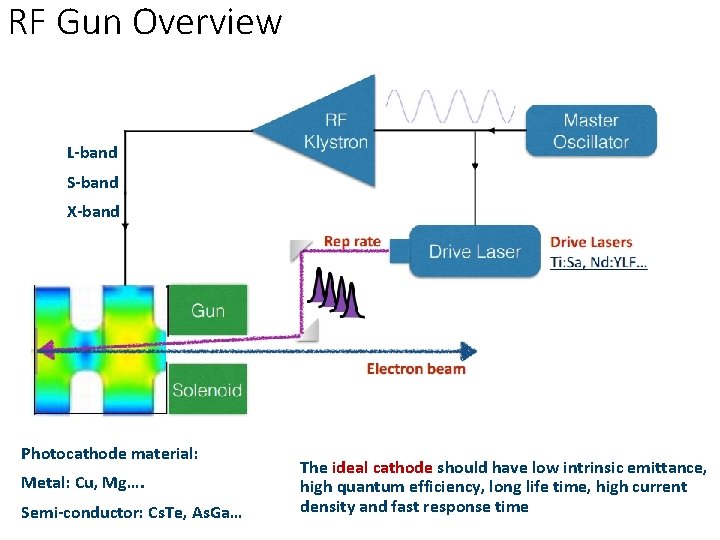
RF Gun Overview L-band S-band X-band Photocathode material: Metal: Cu, Mg…. Semi-conductor: Cs. Te, As. Ga… The ideal cathode should have low intrinsic emittance, high quantum efficiency, long life time, high current density and fast response time
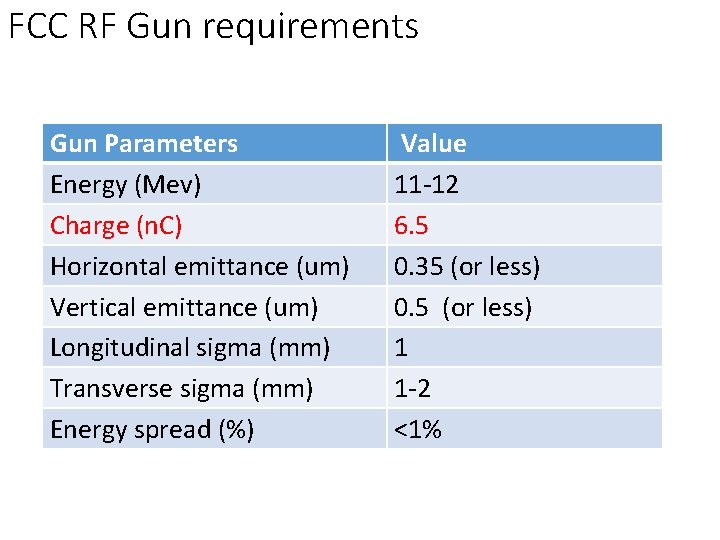
FCC RF Gun requirements Gun Parameters Energy (Mev) Charge (n. C) Horizontal emittance (um) Vertical emittance (um) Longitudinal sigma (mm) Transverse sigma (mm) Energy spread (%) Value 11 -12 6. 5 0. 35 (or less) 0. 5 (or less) 1 1 -2 <1%
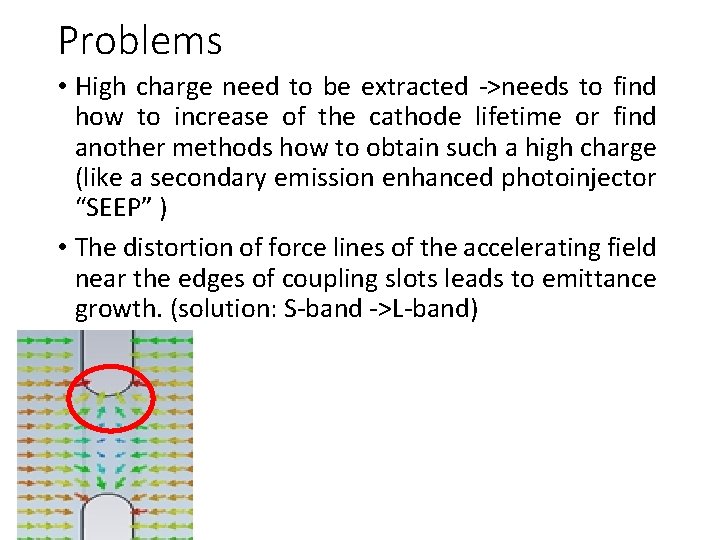
Problems • High charge need to be extracted ->needs to find how to increase of the cathode lifetime or find another methods how to obtain such a high charge (like a secondary emission enhanced photoinjector “SEEP” ) • The distortion of force lines of the accelerating field near the edges of coupling slots leads to emittance growth. (solution: S-band ->L-band)
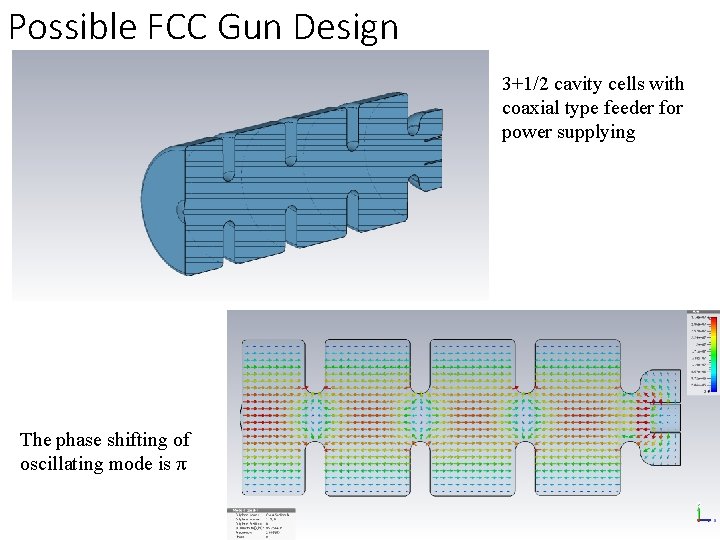
Possible FCC Gun Design 3+1/2 cavity cells with coaxial type feeder for power supplying The phase shifting of oscillating mode is π
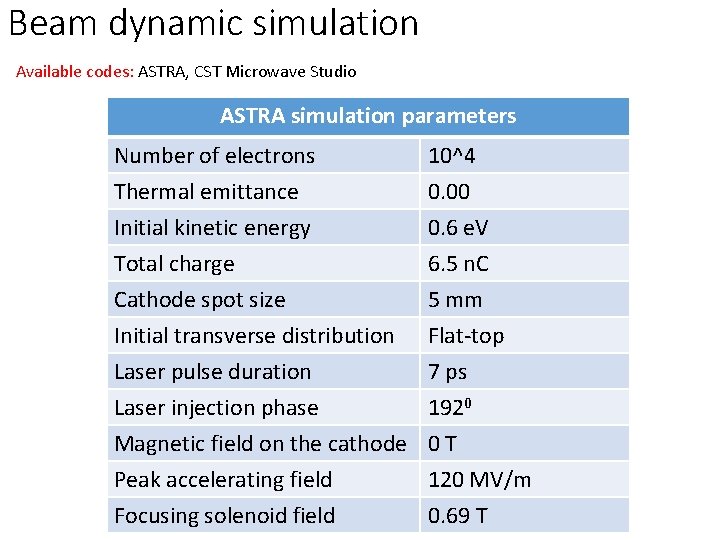
Beam dynamic simulation Available codes: ASTRA, CST Microwave Studio ASTRA simulation parameters Number of electrons Thermal emittance Initial kinetic energy 10^4 0. 00 0. 6 e. V Total charge Cathode spot size Initial transverse distribution Laser pulse duration Laser injection phase Magnetic field on the cathode Peak accelerating field Focusing solenoid field 6. 5 n. C 5 mm Flat-top 7 ps 1920 0 T 120 MV/m 0. 69 T
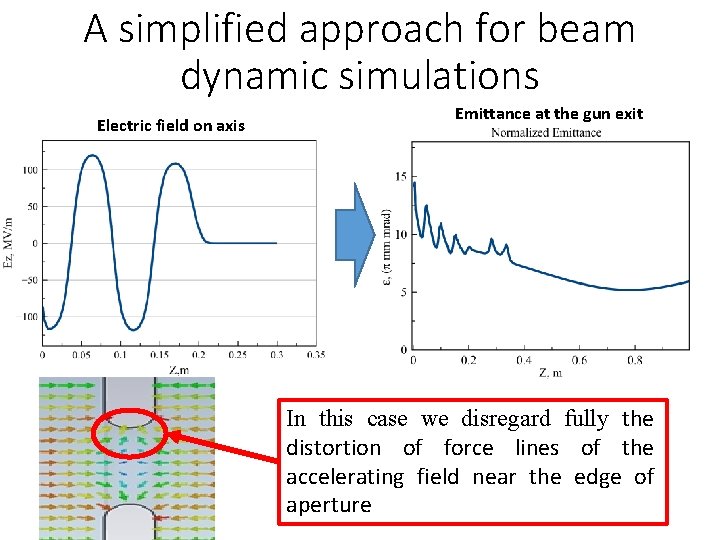
A simplified approach for beam dynamic simulations Electric field on axis Emittance at the gun exit In this case we disregard fully the distortion of force lines of the f accelerating field near the edge of aperture
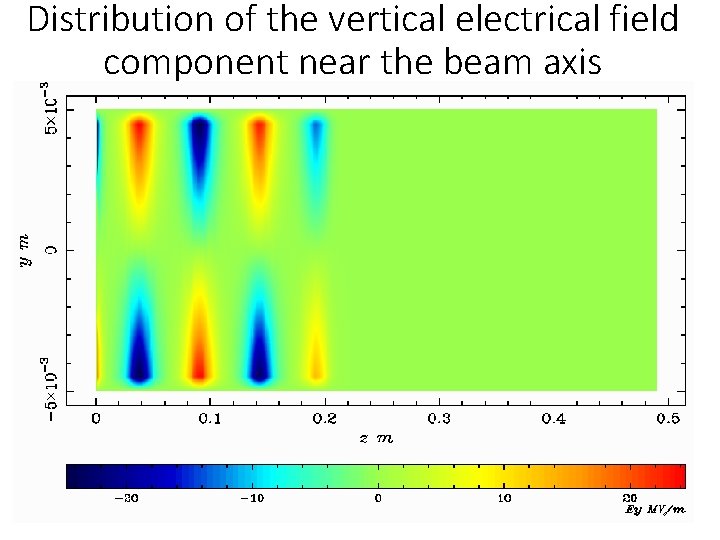
Distribution of the vertical electrical field component near the beam axis
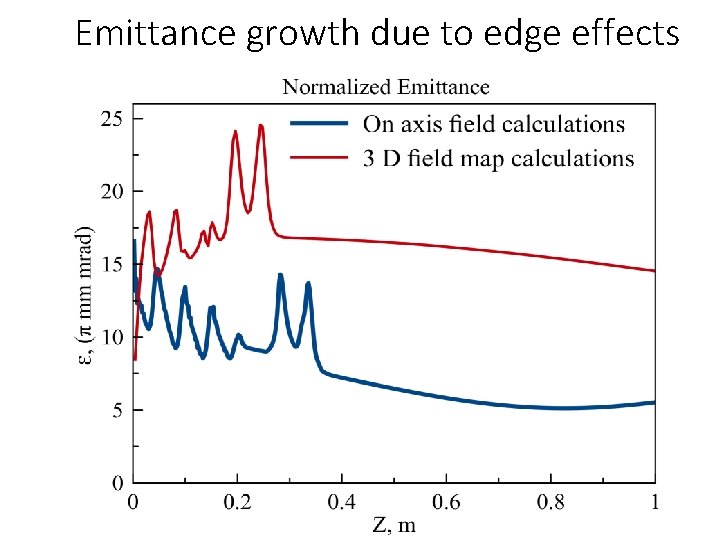
Emittance growth due to edge effects
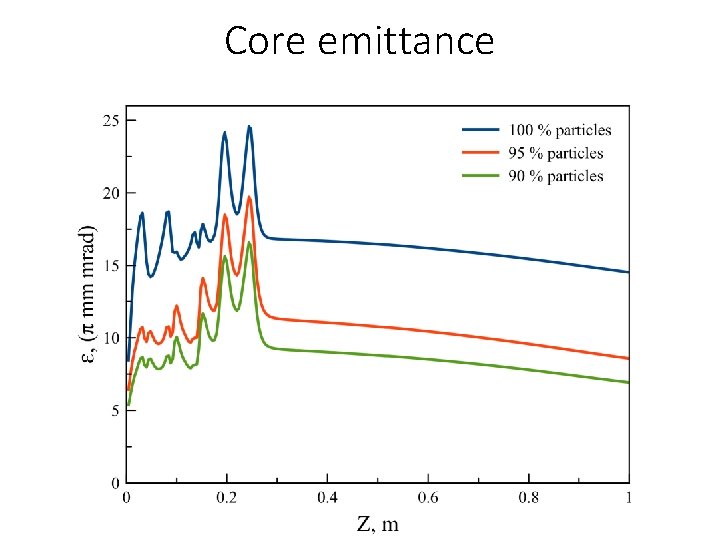
Core emittance

Circular collimator Collimated beam parameters Charge 5. 6 n. C Average energy 13. 0 Me. V Energy spread 1. 2% Normalized transverse emittance 9. 2 π mm mrad (0. 34 um) RMS beam length 1. 1 mm Beam radius 2 mm
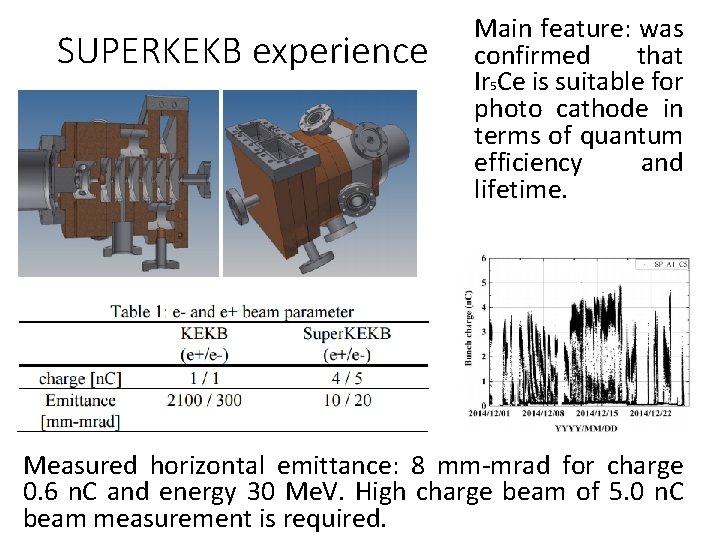
SUPERKEKB experience Main feature: was confirmed that Ir 5 Ce is suitable for photo cathode in terms of quantum efficiency and lifetime. Measured horizontal emittance: 8 mm-mrad for charge 0. 6 n. C and energy 30 Me. V. High charge beam of 5. 0 n. C beam measurement is required.
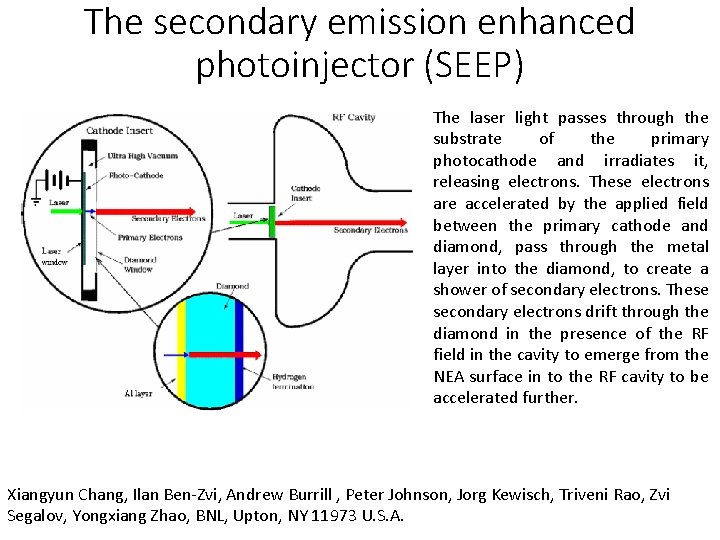
The secondary emission enhanced photoinjector (SEEP) The laser light passes through the substrate of the primary photocathode and irradiates it, releasing electrons. These electrons are accelerated by the applied field between the primary cathode and diamond, pass through the metal layer into the diamond, to create a shower of secondary electrons. These secondary electrons drift through the diamond in the presence of the RF field in the cavity to emerge from the NEA surface in to the RF cavity to be accelerated further. Xiangyun Chang, Ilan Ben-Zvi, Andrew Burrill , Peter Johnson, Jorg Kewisch, Triveni Rao, Zvi Segalov, Yongxiang Zhao, BNL, Upton, NY 11973 U. S. A.
The advantages of the SEEP • Significant reduction in the number of primary electrons required to meet the current /charge requirement, resulting in a corresponding reduction in the laser power/energy requirement • Increase in the life time of the primary photocathode due to reduction in current/charge delivered • Isolation of the cathode from the cavity vacuum, increasing the life time of the primary cathode • The Secondary Electron Yield (SEY) can be much larger than 100 Question Emittance growth due to beam interaction with diamond and metal layer on a diamond window
Conclusion Conditions for low emittance: 1. Flat top profile of the laser 2. Symmetrical coaxial type feeder for RF power supplying 3. Beam energy 4. Initial transverse beam size and length Choice of photocathode and laser system: 1. To produce 6. 5 n. C the cathode material has to be researched 2. Parameters of the laser has to be chosen 3. The cathode life time has to be researched (high power laser will destroy the cathode) 4. Input cathode system, allowing the gun training, has to be developed A further investigations 1. Development of L-band RF gun and beam dynamic simulation in this gun. 2. Investigation of SEEP methods for FCC gun, investigation of the minimum achievable emittance.
- Slides: 16