
Beam Dynamics in Electron Storage Ring Why electron
Beam Dynamics in Electron Storage Ring

Why electron storage ring is different? SYNCHROTRON RADIATION • Origin: Energy emitted to infinity or other boundary condition. – Form: Electromagnetic wave – Source: the charged particles – Direction: Along the tangent of the beam trajectory curve.
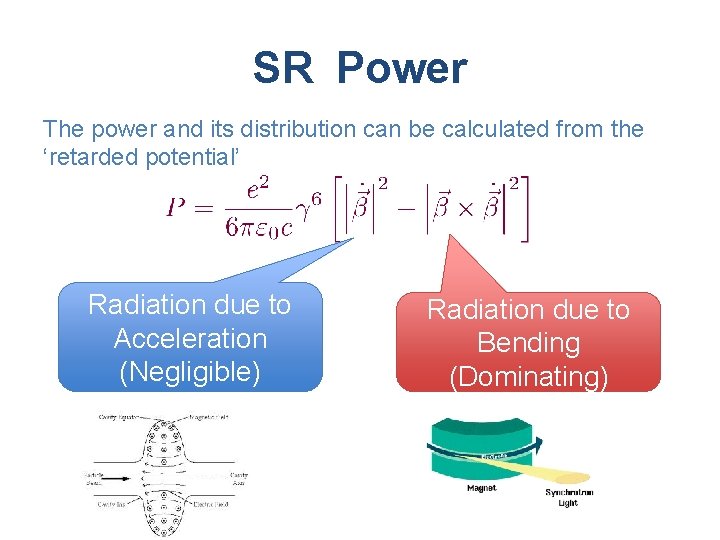
SR Power The power and its distribution can be calculated from the ‘retarded potential’ Radiation due to Acceleration (Negligible) Radiation due to Bending (Dominating)
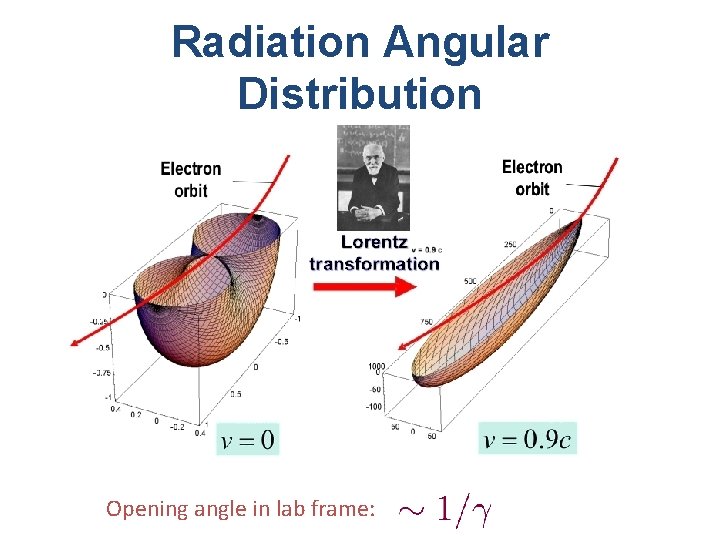
Radiation Angular Distribution Opening angle in lab frame:
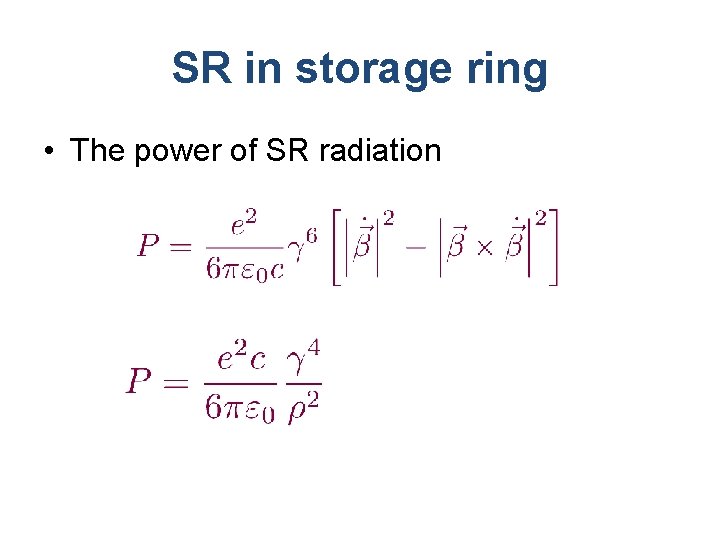
SR in storage ring • The power of SR radiation
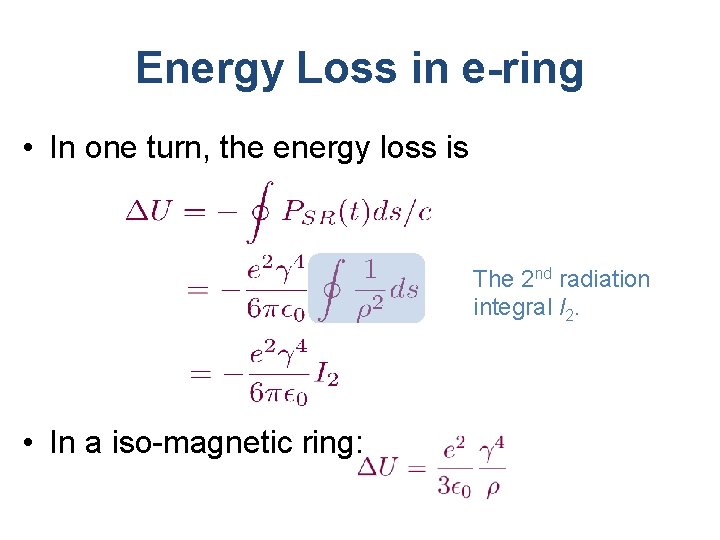
Energy Loss in e-ring • In one turn, the energy loss is The 2 nd radiation integral I 2. • In a iso-magnetic ring:
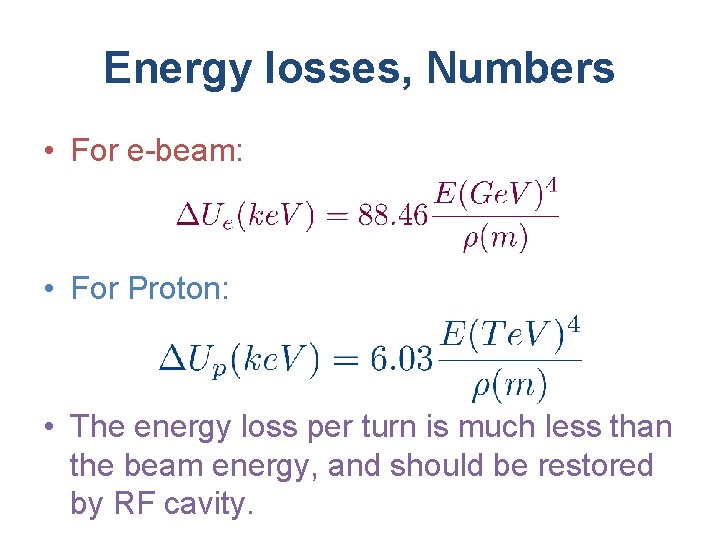
Energy losses, Numbers • For e-beam: • For Proton: • The energy loss per turn is much less than the beam energy, and should be restored by RF cavity.
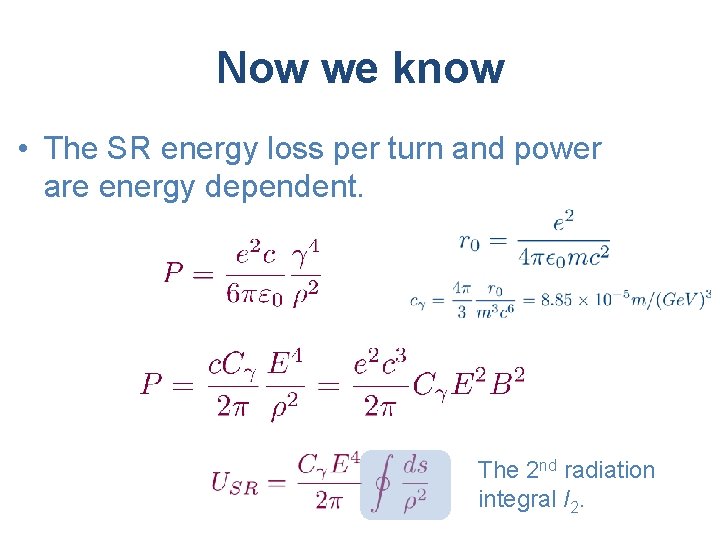
Now we know • The SR energy loss per turn and power are energy dependent. The 2 nd radiation integral I 2.
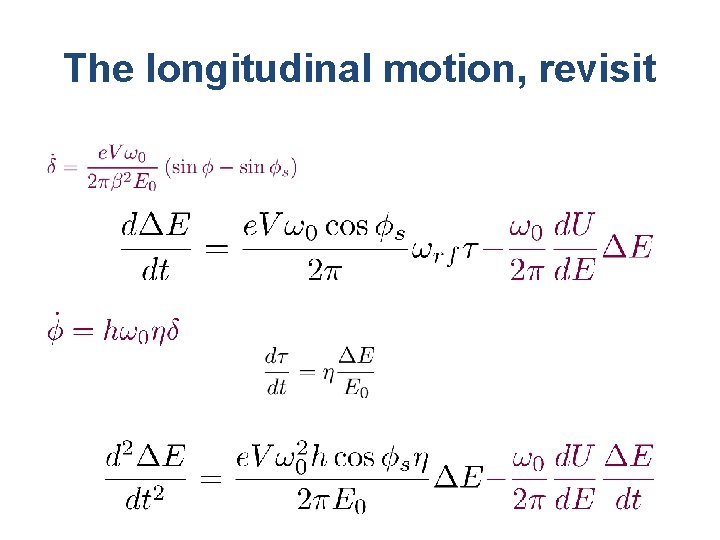
The longitudinal motion, revisit
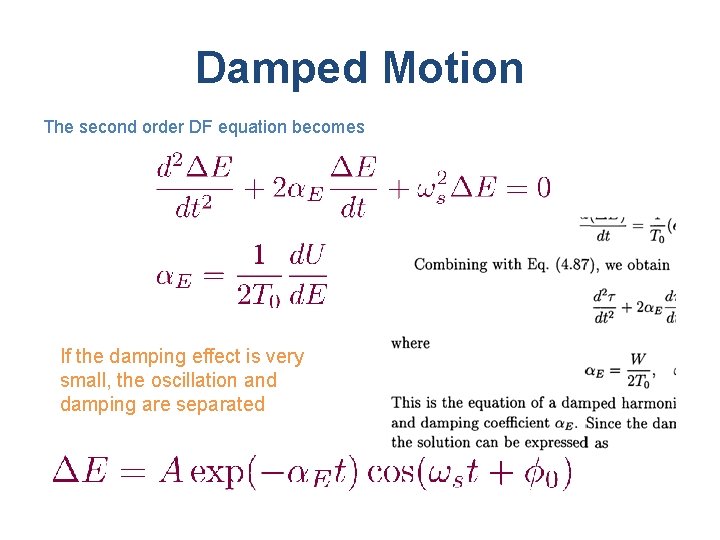
Damped Motion The second order DF equation becomes If the damping effect is very small, the oscillation and damping are separated
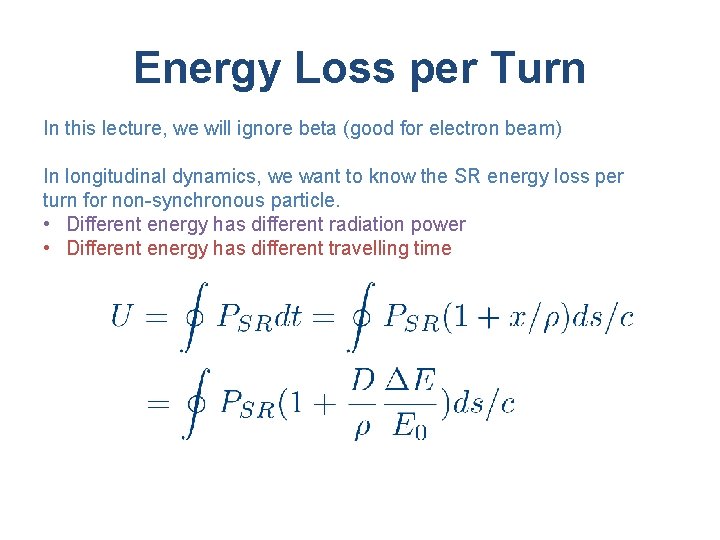
Energy Loss per Turn In this lecture, we will ignore beta (good for electron beam) In longitudinal dynamics, we want to know the SR energy loss per turn for non-synchronous particle. • Different energy has different radiation power • Different energy has different travelling time
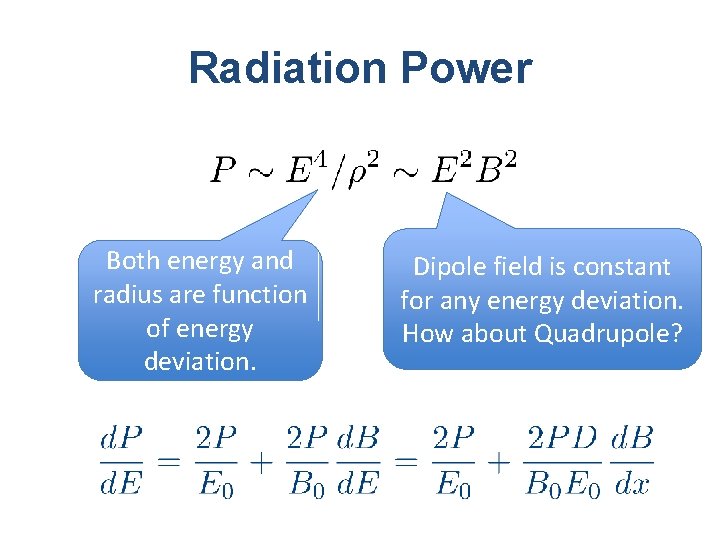
Radiation Power Both energy and radius are function of energy deviation. Dipole field is constant for any energy deviation. How about Quadrupole?
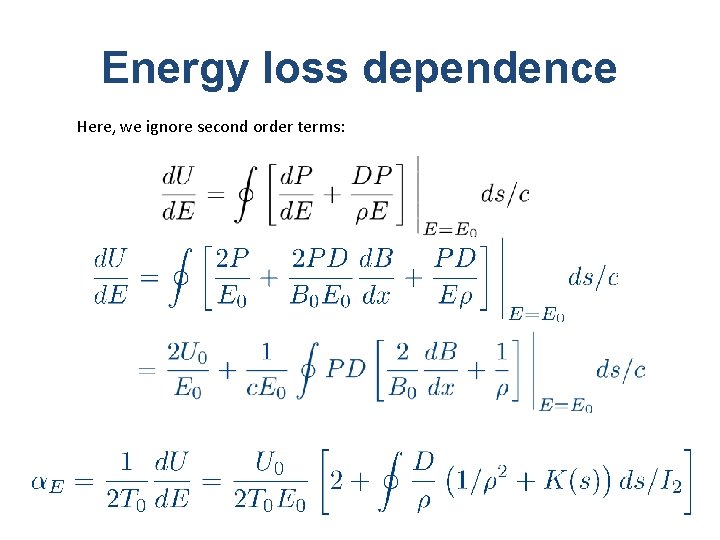
Energy loss dependence Here, we ignore second order terms:
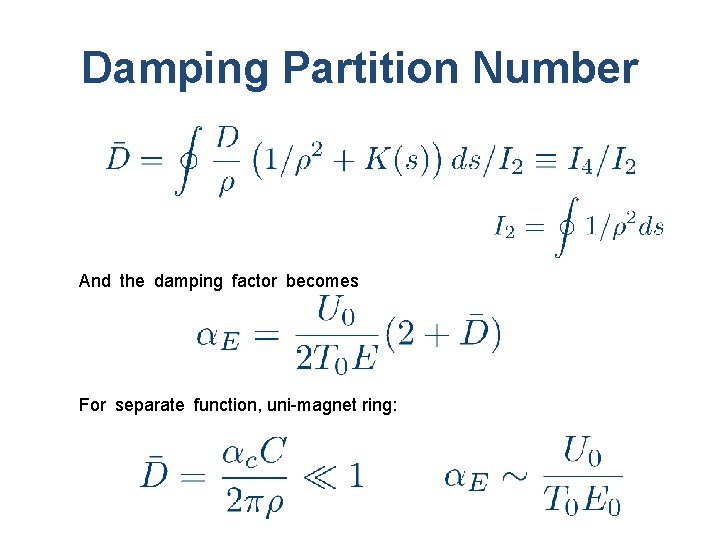
Damping Partition Number And the damping factor becomes For separate function, uni-magnet ring:
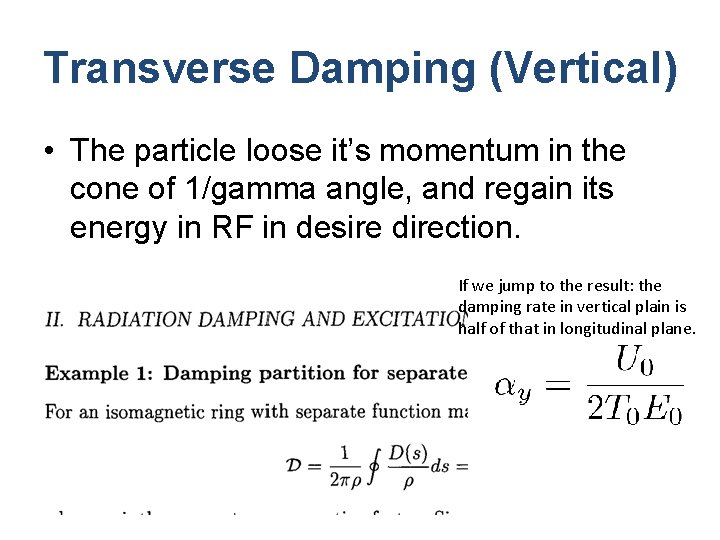
Transverse Damping (Vertical) • The particle loose it’s momentum in the cone of 1/gamma angle, and regain its energy in RF in desire direction. If we jump to the result: the damping rate in vertical plain is half of that in longitudinal plane.
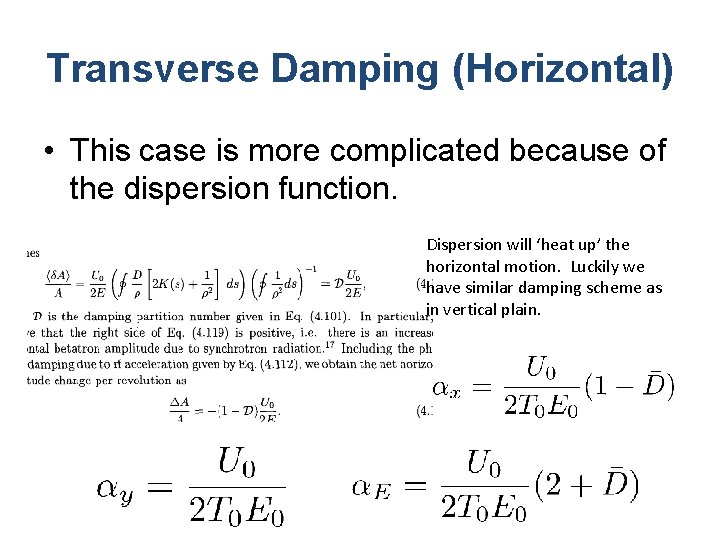
Transverse Damping (Horizontal) • This case is more complicated because of the dispersion function. Dispersion will ‘heat up’ the horizontal motion. Luckily we have similar damping scheme as in vertical plain.
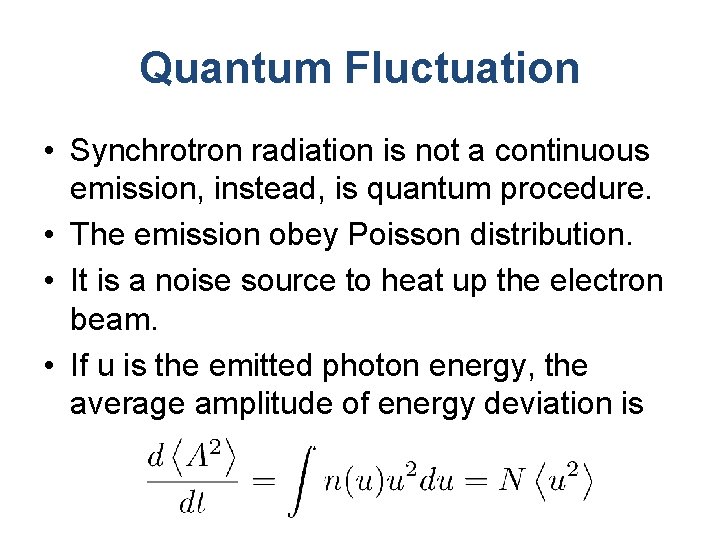
Quantum Fluctuation • Synchrotron radiation is not a continuous emission, instead, is quantum procedure. • The emission obey Poisson distribution. • It is a noise source to heat up the electron beam. • If u is the emitted photon energy, the average amplitude of energy deviation is
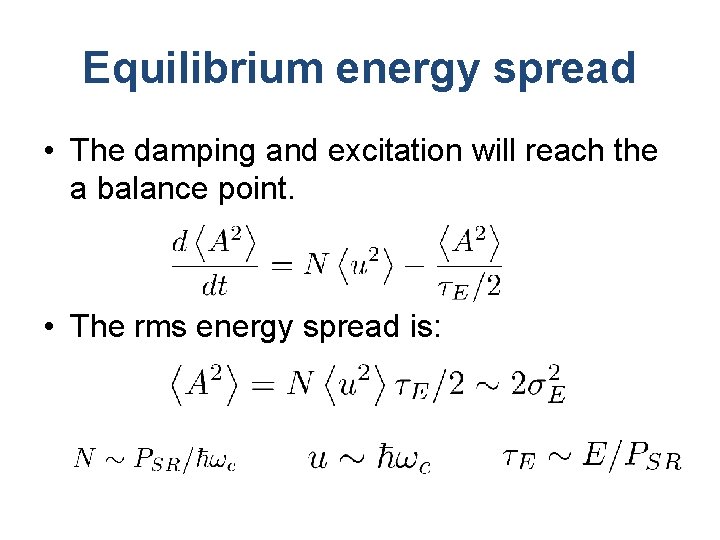
Equilibrium energy spread • The damping and excitation will reach the a balance point. • The rms energy spread is:
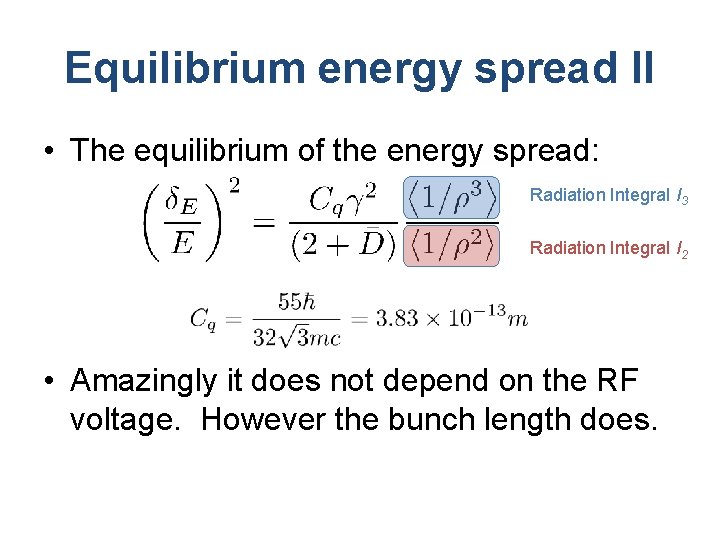
Equilibrium energy spread II • The equilibrium of the energy spread: Radiation Integral I 3 Radiation Integral I 2 • Amazingly it does not depend on the RF voltage. However the bunch length does.
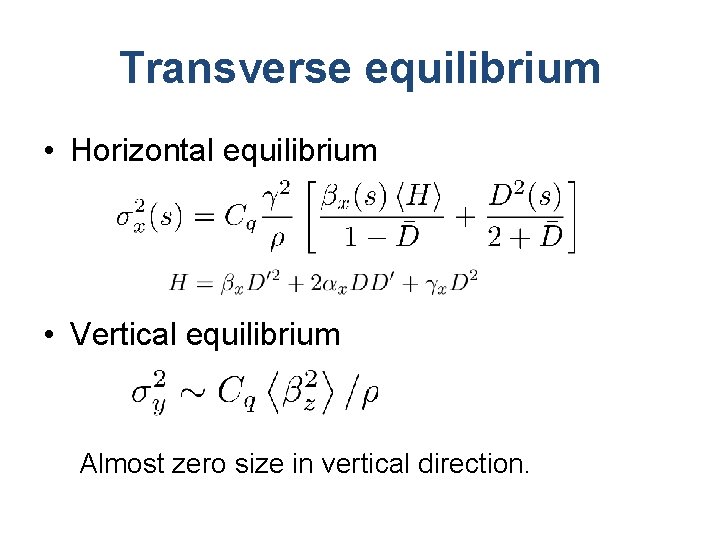
Transverse equilibrium • Horizontal equilibrium • Vertical equilibrium Almost zero size in vertical direction.
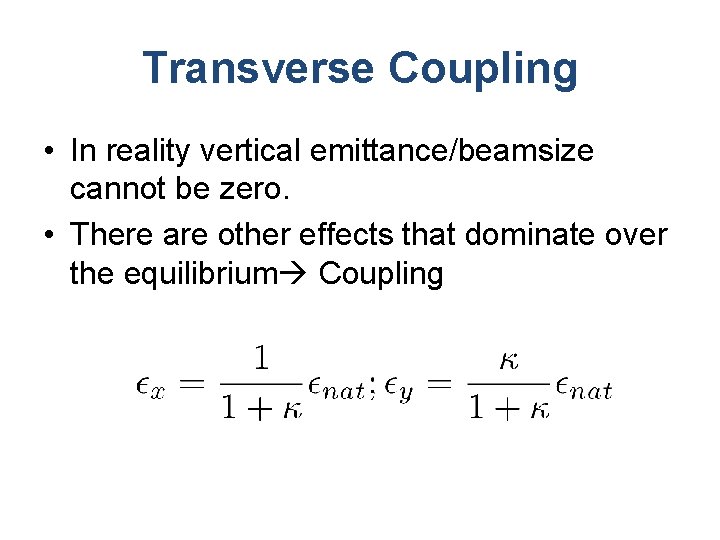
Transverse Coupling • In reality vertical emittance/beamsize cannot be zero. • There are other effects that dominate over the equilibrium Coupling
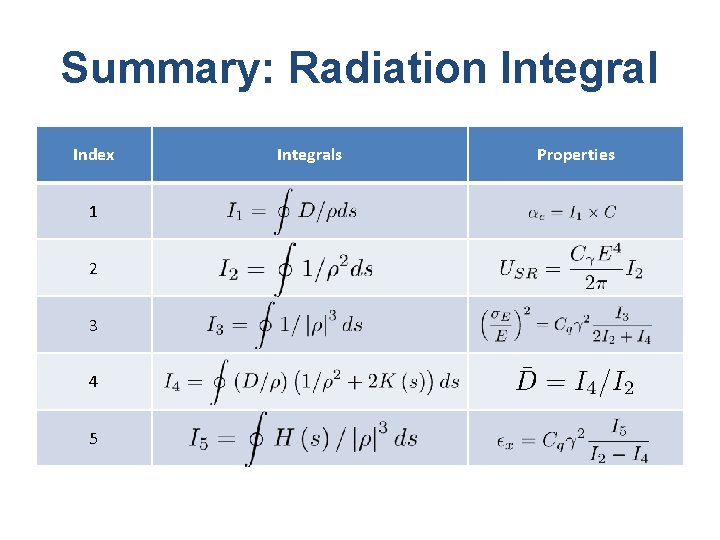
Summary: Radiation Integral Index 1 2 3 4 5 Integrals Properties
Beam life-time • Quantum lifetime – Although the equilibrium emittance is small, there is chance that, for one single electron, continuous random emission drive the electron out of aperture – Longitudinal or Transverse. • Touschek lifetime – Coulomb scattering in the bunch may transfer transverse momentum to longitudinal plane and cause beam loss.
Typical numbers • Revolution time: ~ micro second • Longitudinal oscillation: sub millisecond • Damping time: few thousand turns – Several millisecond • Energy spread ~1 e-3 • Rms transverse emittance sub nm-rad • Rms vertical emittance several pm-rad

- Slides: 25