
Beam Delivery Simulation Development BDS MDI Applications L
Beam Delivery Simulation Development & BDS / MDI Applications L. Nevay, S. Boogert, H. Garcia-Morales, S. Gibson, J. Snuverink, L. Deacon Royal Holloway, University of London 13 th May 2014 http: //twiki. ph. rhul. ac. uk/twiki/bin/view/PP/JAI/Bd. Sim laurie. nevay@rhul. ac. uk

Outline BDSIM structure & overview Previous studies using BDSIM Prospects for Linear Collider Studies High Luminosity LHC studies Current developments On going simulations 2

Beam Delivery SIMulation • Beam Delivery Simulation is a Geant 4 based tool for tracking and energy deposition studies in linear colliders • Started by G. Blair at Royal Holloway • Geant 4 simulation with fast in-vacuum tracking routines L. Deacon TUPC 005 EPAC 08 3
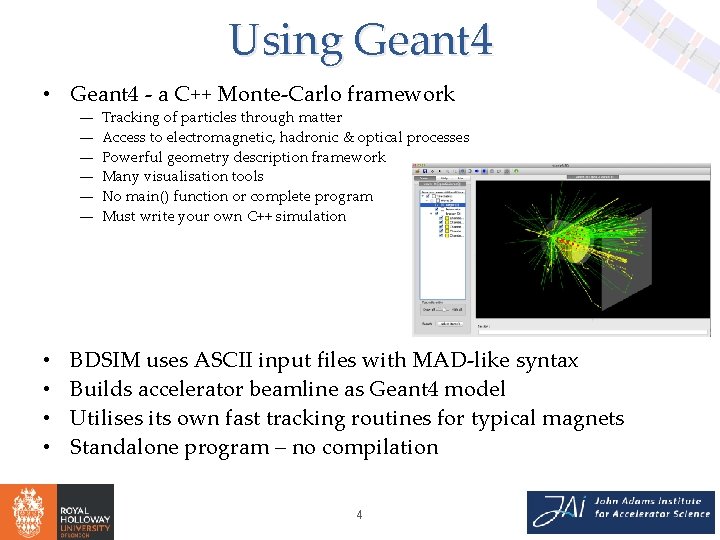
Using Geant 4 • Geant 4 - a C++ Monte-Carlo framework ― ― ― • • Tracking of particles through matter Access to electromagnetic, hadronic & optical processes Powerful geometry description framework Many visualisation tools No main() function or complete program Must write your own C++ simulation BDSIM uses ASCII input files with MAD-like syntax Builds accelerator beamline as Geant 4 model Utilises its own fast tracking routines for typical magnets Standalone program – no compilation 4

CLIC Beam Delivery System • BDSIM used to accurately simulate beam losses for CLIC • Losses due to secondaries and showers are important Phys. Rev. S. T. Accel. & Beams 12 081001 2009 5

BDSIM for Linear Colliders • Current developments are towards circular colliders… however… • BDSIM is already suitable for linear colliders! • Current developments improving efficiency and usability • • Significantly increased efficiency ~40 x faster Input from MADX and MAD 8 improved Can convert MAD scripts or use twiss output in TFS file Support for GDML added and being improved 6
Input Sources • Machines are typically designed in some other software ― MADX, MAD 8 etc • Geometry descriptions in other formats ― GDML, LCDD, Mokka • Improvements on easily importing input sources • Can convert MAD scripts directly to GMAD (bdsim) syntax • Or use new python suite to convert input formats ― pybdsim – included with BDSIM ― TFS files for both MAD 8 and MADX accepted • Can programmatically vary input files using python ― adjust collimator settings for different runs ― adjust magnet strengths 7
LHC and Hi. Lumi LHC • BDSIM being developed for rings • CERN uses Six. Track for tracking studies ― applies aperture definition after tracking complete ― digital loss maps ― custom physics routines for collimator scattering • Use FLUKA for energy deposition near IPs • Aim to use BDSIM for accurate loss maps around ring • Detailed energy deposition due to primaries and secondaries 8
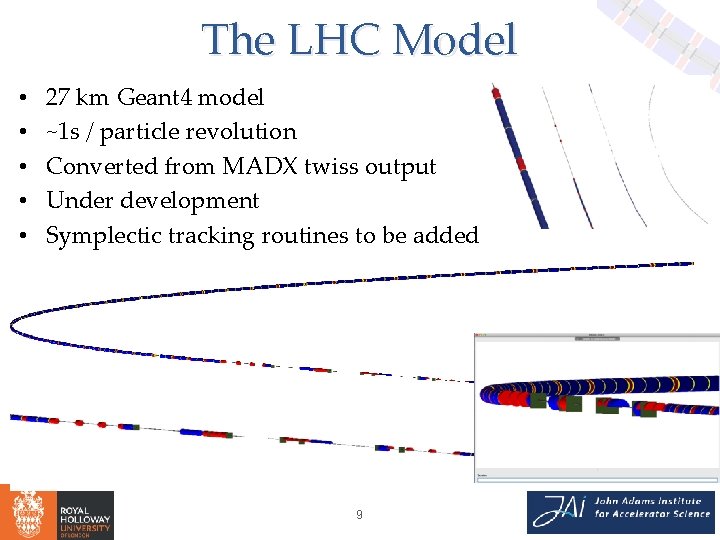
The LHC Model • • • 27 km Geant 4 model ~1 s / particle revolution Converted from MADX twiss output Under development Symplectic tracking routines to be added 9
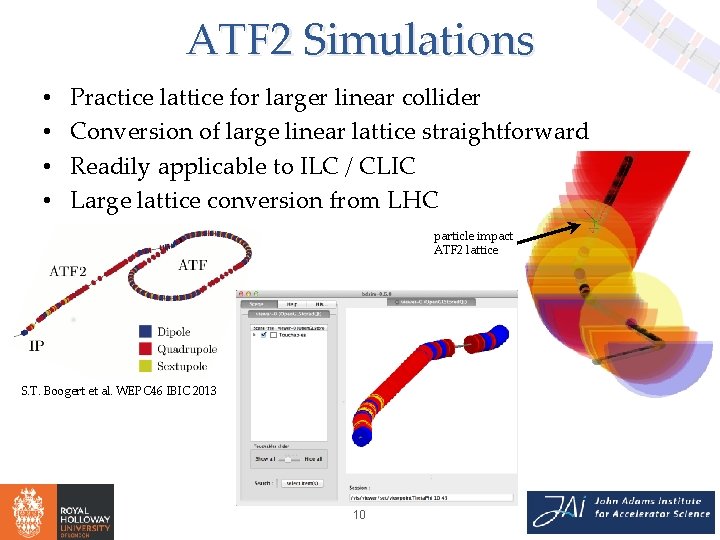
ATF 2 Simulations • • Practice lattice for larger linear collider Conversion of large linear lattice straightforward Readily applicable to ILC / CLIC Large lattice conversion from LHC particle impact ATF 2 lattice S. T. Boogert et al. WEPC 46 IBIC 2013 10
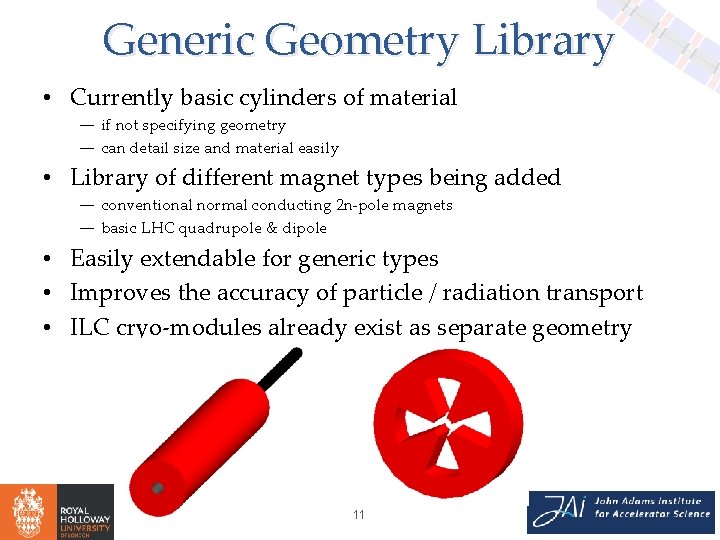
Generic Geometry Library • Currently basic cylinders of material ― if not specifying geometry ― can detail size and material easily • Library of different magnet types being added ― conventional normal conducting 2 n-pole magnets ― basic LHC quadrupole & dipole • Easily extendable for generic types • Improves the accuracy of particle / radiation transport • ILC cryo-modules already exist as separate geometry 11
The Beam Delivery System • The BDS has many features that require simulation • Diagnostics • Compton systems (laserwires / polarimeters) ― laserwires as main emittance measurement during operation • • • Betatron and energy collimation IPBSM / tune up station Dumps Possible SC magnets Dosimetry • All require accurate beam loss predictions 12
Laserwire Simulations • Royal Holloway have extensive experience with laserwires ― laser used to scan across electron / positron beam for emittance measurement ― Compton-scattered photon flux measured • Compton cross-section is low – requires high power laser ― GW peak powers • Low number of scattered photons (~1 – 1000) • Requires high precision for accurate emittance measurement ― Agapov et al. Phys. Rev. ST Accel. Beams 10, 112801 (2007) • Not a problem at few Hz bunch train frequency • Much better to perform intra-train scanning • Fibre lasers suitable for this and being developed ― Up to several MW peak powers demonstrated for intra-train scanning • Laser requirements depend on background levels and location 13
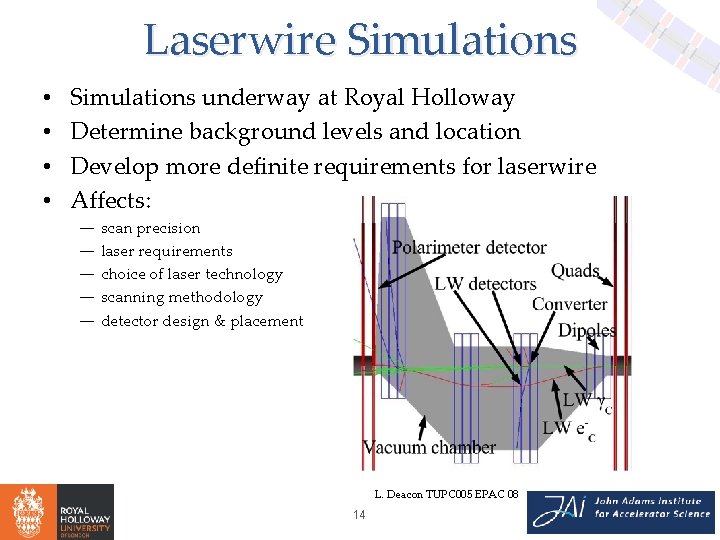
Laserwire Simulations • • Simulations underway at Royal Holloway Determine background levels and location Develop more definite requirements for laserwire Affects: ― ― ― scan precision laser requirements choice of laser technology scanning methodology detector design & placement L. Deacon TUPC 005 EPAC 08 14
Current Development • BDSIM is under active development • 5 active developers • Open source! • Contributions and collaborators welcome • Git repository https: //bitbucket. org/stewartboogert/bdsim • Can not only ‘checkout’ latest version but also ‘fork’ and develop yourself • Can then merge into BDSIM 15
Conclusions • BDSIM is a mature beam line simulation tool • Under active development • Being developed for circular colliders • Open source and easily extendable! • Readily useable for linear collider studies 16
Thank you http: //twiki. ph. rhul. ac. uk/twiki/bin/view/PP/JAI/Bd. Sim laurie. nevay@rhul. ac. uk 17
- Slides: 17