
Beam Condition Monitor for the CMS BCM Group
Beam Condition Monitor for the CMS BCM Group Luis Fernández Hernando (EST/LEA), Christoph Ilgner (EST/LEA), Alick Macpherson (CMS/CMM), Alexander Oh (CMS/CMD), Terry Pritchard (CMS/CMM), Bob Stone (CMS/CMT)
Beam Condition Monitor for CMS Purpose – The Beam Condition Monitor (BCM) has to provide online radiation monitoring within the CMS – BCM forms part of the radiation monitoring system for equipment safety and radiation level/beam monitoring – The BCM should be in addition to the LHC machine protection system and Beam Loss Monitors BCM Issues – Allows protection of equipment during instabilities/accidents – Provides fast feedback to the machine for optimization of beam conditions – Provides fast feedback to the machine for detection of adverse beam conditions – Monitors the instantaneous dose during operation – Provides input into LHC beam abort system (1 input/ experiment)
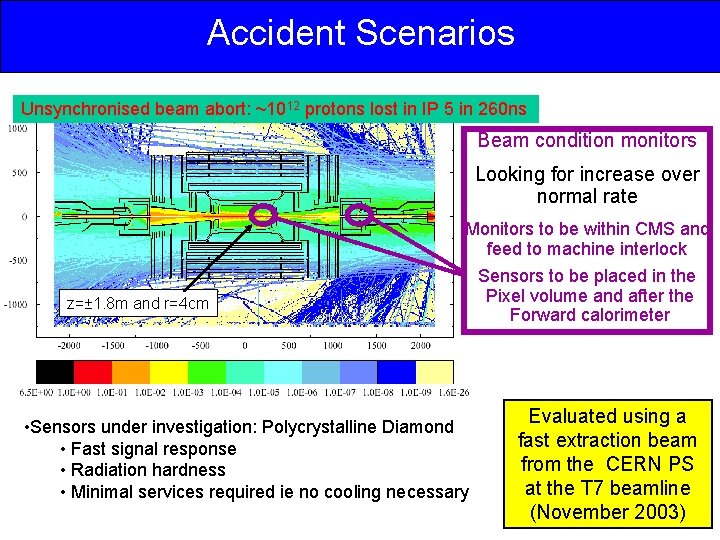
Accident Scenarios Unsynchronised beam abort: ~1012 protons lost in IP 5 in 260 ns Beam condition monitors Looking for increase over normal rate Monitors to be within CMS and feed to machine interlock z=± 1. 8 m and r=4 cm • Sensors under investigation: Polycrystalline Diamond • Fast signal response • Radiation hardness • Minimal services required ie no cooling necessary Sensors to be placed in the Pixel volume and after the Forward calorimeter Evaluated using a fast extraction beam from the CERN PS at the T 7 beamline (November 2003)
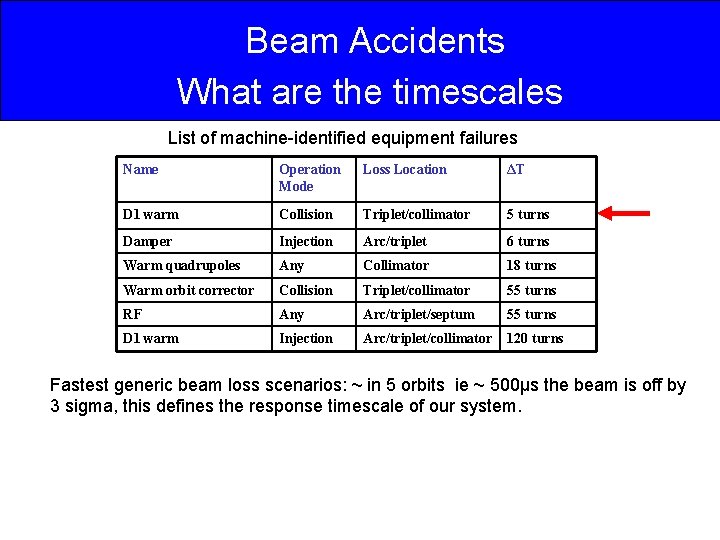
Beam Accidents What are the timescales List of machine-identified equipment failures Name Operation Mode Loss Location ΔT D 1 warm Collision Triplet/collimator 5 turns Damper Injection Arc/triplet 6 turns Warm quadrupoles Any Collimator 18 turns Warm orbit corrector Collision Triplet/collimator 55 turns RF Any Arc/triplet/septum 55 turns D 1 warm Injection Arc/triplet/collimator 120 turns Fastest generic beam loss scenarios: ~ in 5 orbits ie ~ 500µs the beam is off by 3 sigma, this defines the response timescale of our system.
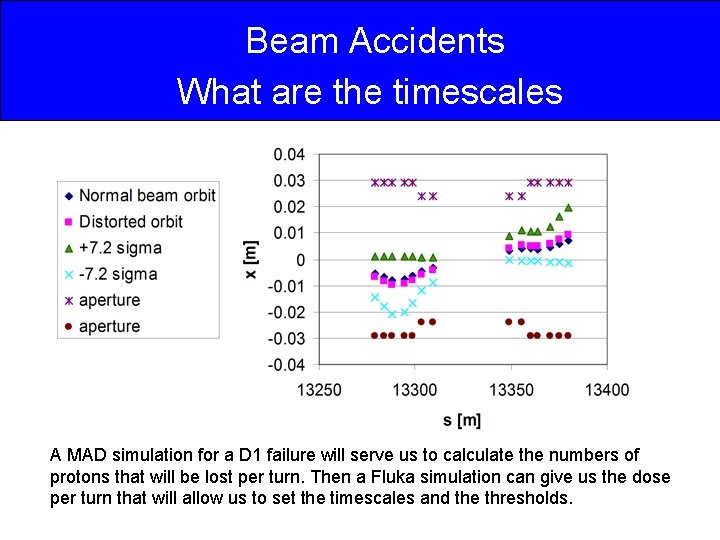
Beam Accidents What are the timescales A MAD simulation for a D 1 failure will serve us to calculate the numbers of protons that will be lost per turn. Then a Fluka simulation can give us the dose per turn that will allow us to set the timescales and the thresholds.
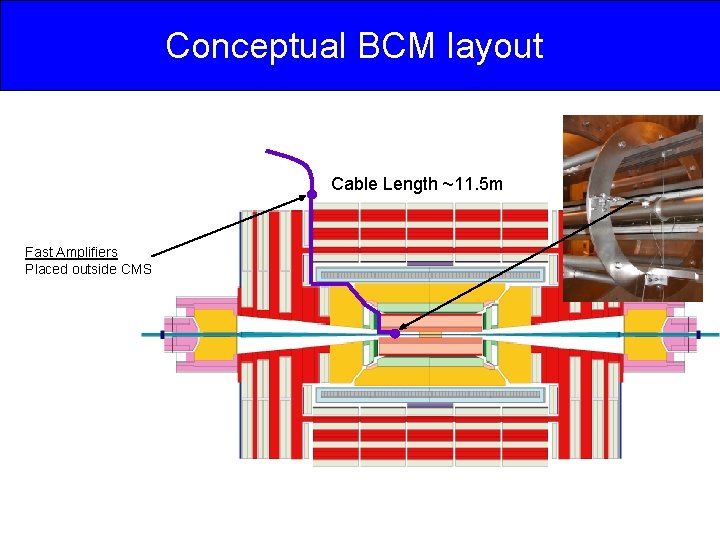
Conceptual BCM layout Cable Length ~11. 5 m Fast Amplifiers Placed outside CMS
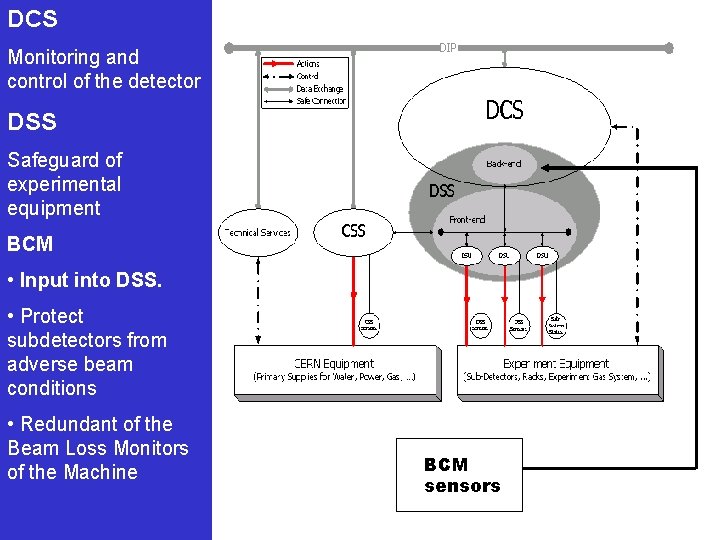
DCS Monitoring and control of the detector DSS Safeguard of experimental equipment BCM • Input into DSS. • Protect subdetectors from adverse beam conditions • Redundant of the Beam Loss Monitors of the Machine BCM sensors
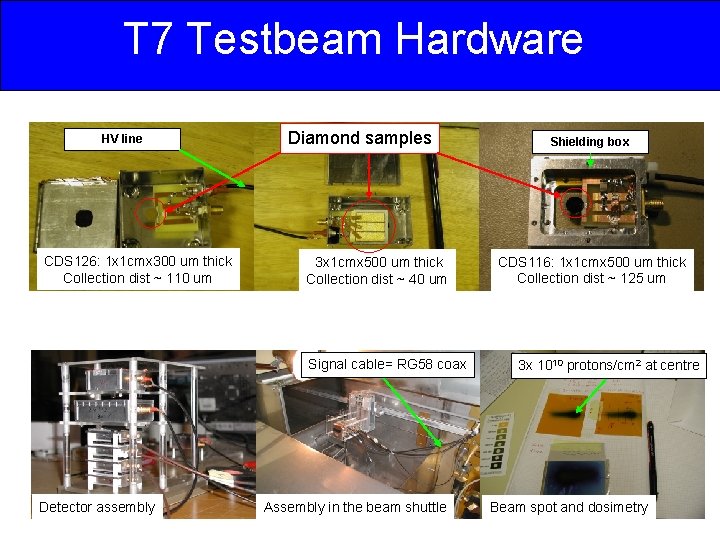
T 7 Testbeam Hardware HV line CDS 126: 1 x 1 cmx 300 um thick Collection dist ~ 110 um Diamond samples 3 x 1 cmx 500 um thick Collection dist ~ 40 um Signal cable= RG 58 coax Detector assembly Assembly in the beam shuttle Shielding box CDS 116: 1 x 1 cmx 500 um thick Collection dist ~ 125 um 3 x 10¹⁰ protons/cm 2 at centre Beam spot and dosimetry
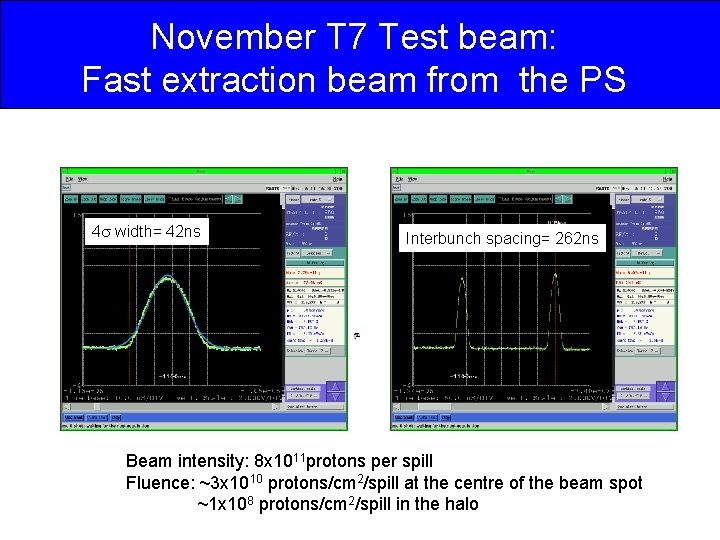
November T 7 Test beam: Fast extraction beam from the PS 4 width= 42 ns Interbunch spacing= 262 ns Beam intensity: 8 x 10¹¹ protons per spill Fluence: ~3 x 10¹⁰ protons/cm 2/spill at the centre of the beam spot ~1 x 10⁸ protons/cm 2/spill in the halo
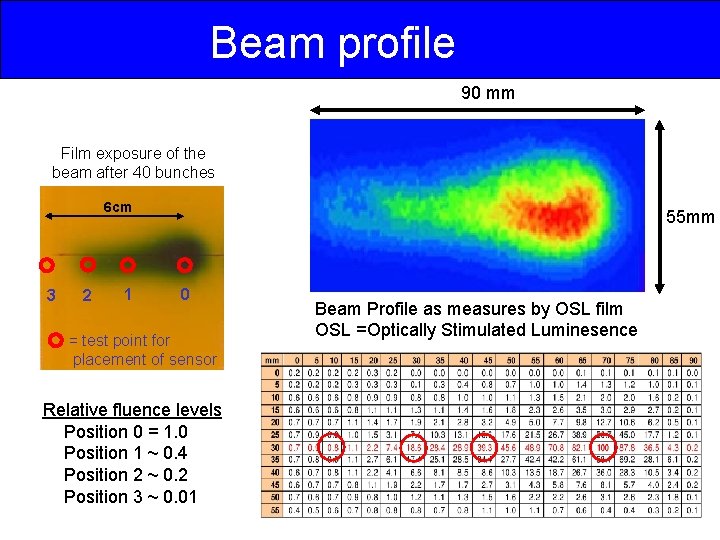
Beam profile 90 mm Film exposure of the beam after 40 bunches 6 cm 3 2 1 55 mm 0 = test point for placement of sensor Relative fluence levels Position 0 = 1. 0 Position 1 ~ 0. 4 Position 2 ~ 0. 2 Position 3 ~ 0. 01 Beam Profile as measures by OSL film OSL =Optically Stimulated Luminesence
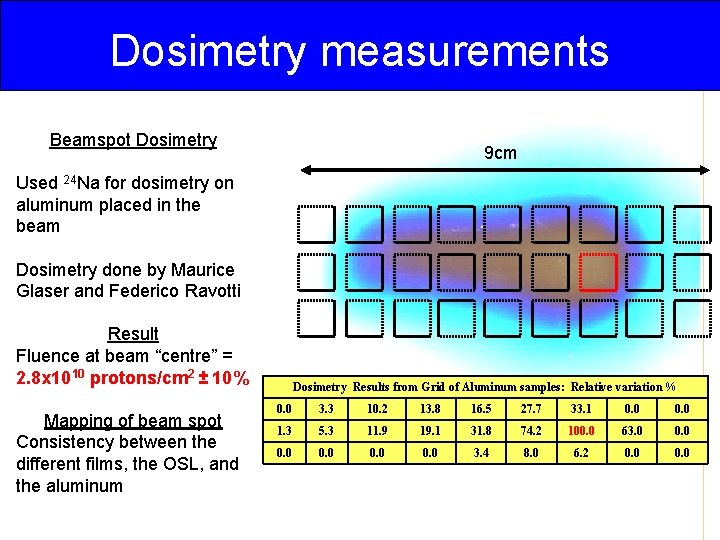
Dosimetry measurements Beamspot Dosimetry 9 cm Used 24 Na for dosimetry on aluminum placed in the beam Dosimetry done by Maurice Glaser and Federico Ravotti Result Fluence at beam “centre” = 2. 8 x 10¹⁰ protons/cm 2 ± 10% Mapping of beam spot Consistency between the different films, the OSL, and the aluminum Dosimetry Results from Grid of Aluminum samples: Relative variation % 0. 0 3. 3 10. 2 13. 8 16. 5 27. 7 33. 1 0. 0 1. 3 5. 3 11. 9 19. 1 31. 8 74. 2 100. 0 63. 0 0. 0 3. 4 8. 0 6. 2 0. 0
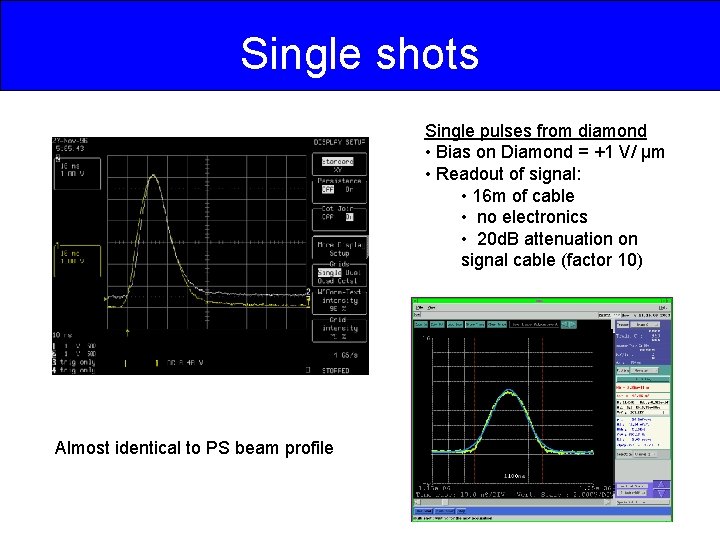
Single shots Single pulses from diamond • Bias on Diamond = +1 V/ µm • Readout of signal: • 16 m of cable • no electronics • 20 d. B attenuation on signal cable (factor 10) Almost identical to PS beam profile
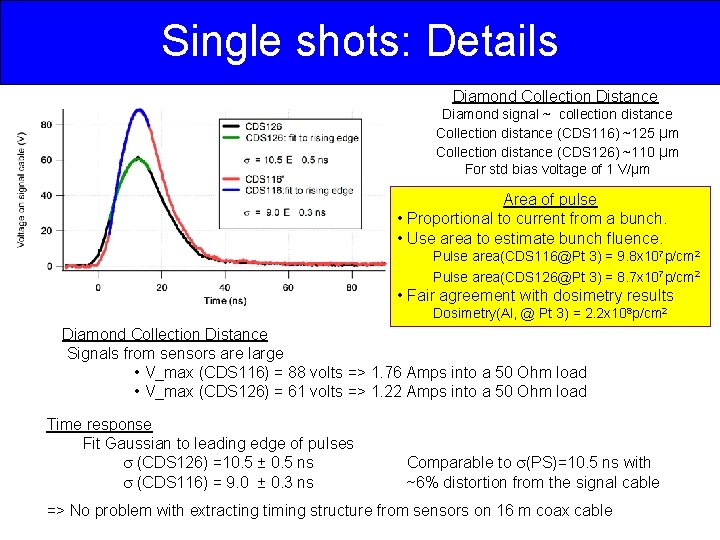
Single shots: Details Diamond Collection Distance Diamond signal ~ collection distance Collection distance (CDS 116) ~125 µm Collection distance (CDS 126) ~110 µm For std bias voltage of 1 V/µm Area of pulse • Proportional to current from a bunch. • Use area to estimate bunch fluence. Pulse area(CDS 116@Pt 3) = 9. 8 x 10⁷ p/cm 2 Pulse area(CDS 126@Pt 3) = 8. 7 x 10⁷ p/cm 2 • Fair agreement with dosimetry results Dosimetry(Al, @ Pt 3) = 2. 2 x 10⁸ p/cm 2 Diamond Collection Distance Signals from sensors are large • V_max (CDS 116) = 88 volts => 1. 76 Amps into a 50 Ohm load • V_max (CDS 126) = 61 volts => 1. 22 Amps into a 50 Ohm load Time response Fit Gaussian to leading edge of pulses (CDS 126) =10. 5 ± 0. 5 ns (CDS 116) = 9. 0 ± 0. 3 ns Comparable to (PS)=10. 5 ns with ~6% distortion from the signal cable => No problem with extracting timing structure from sensors on 16 m coax cable
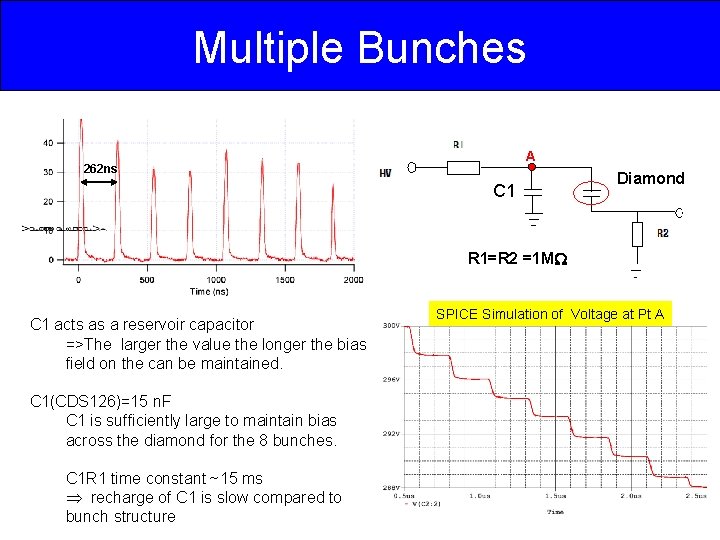
Multiple Bunches A 262 ns C 1 Diamond R 1=R 2 =1 M C 1 acts as a reservoir capacitor =>The larger the value the longer the bias field on the can be maintained. C 1(CDS 126)=15 n. F C 1 is sufficiently large to maintain bias across the diamond for the 8 bunches. C 1 R 1 time constant ~15 ms Þ recharge of C 1 is slow compared to bunch structure SPICE Simulation of Voltage at Pt A
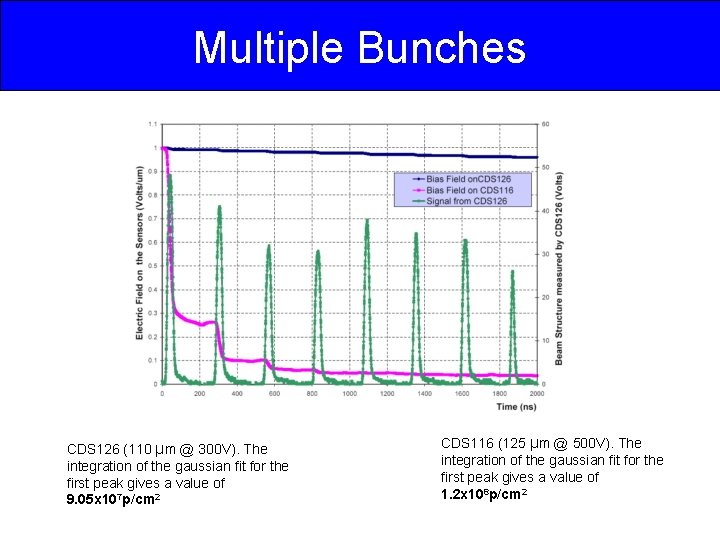
Multiple Bunches CDS 126 (110 µm @ 300 V). The integration of the gaussian fit for the first peak gives a value of 9. 05 x 107 p/cm 2 CDS 116 (125 µm @ 500 V). The integration of the gaussian fit for the first peak gives a value of 1. 2 x 10⁸ p/cm 2
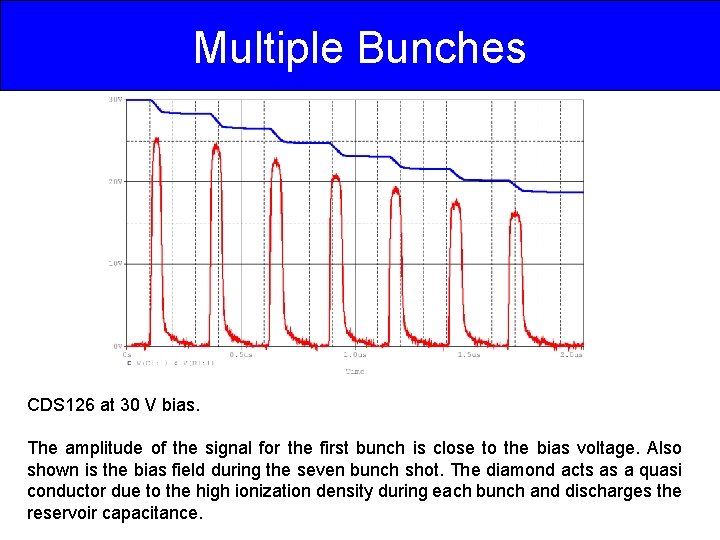
Multiple Bunches CDS 126 at 30 V bias. The amplitude of the signal for the first bunch is close to the bias voltage. Also shown is the bias field during the seven bunch shot. The diamond acts as a quasi conductor due to the high ionization density during each bunch and discharges the reservoir capacitance.
Conclusions CVD diamonds are able to withstand intense beams. They have been exposed to particle fluxes similar to an unsynchronized beam abort within the CMS experiment. Under such conditions the diamond samples are found to respond and recover from consecutive high intensity beam bunches. The observed high currents generated in the diamond from conditions similar to an unsynchronized beam abort require that a protection system for the BCM readout electronics be implemented.
- Slides: 17