
Beads of Life Pick a bead from the
Beads of Life Pick a bead from the pot that represents or reminds you of a person, person an event, event a place, place a time, time an object… object that is meaningful to you. You might want to share with the person next to you why the bead is special and what it represents and means to you.
Educational Psychology Service Beading It Using the Beads of Life Emma Stokes and Dr. Alex Wright
Best hopes for the workshop • To have an understanding of the Beads of Life (Bo. L) approach • To integrate aspect of the approach into your own narrative practice and conversations • To experience engagement and enjoyment whilst exploring the Bo. L approach
Beads of Life • Developed by Clinical Psychologists for children with a diagnosis of Cancer (Portnoy, Girling & Fredman, 2016) • Contribution acknowledged from the ‘Tree of Life’ approach • Beads of life uses hooks to hang rich, multi-stranded stories on • Used with any challenge event or problem story that dominates a person’s life
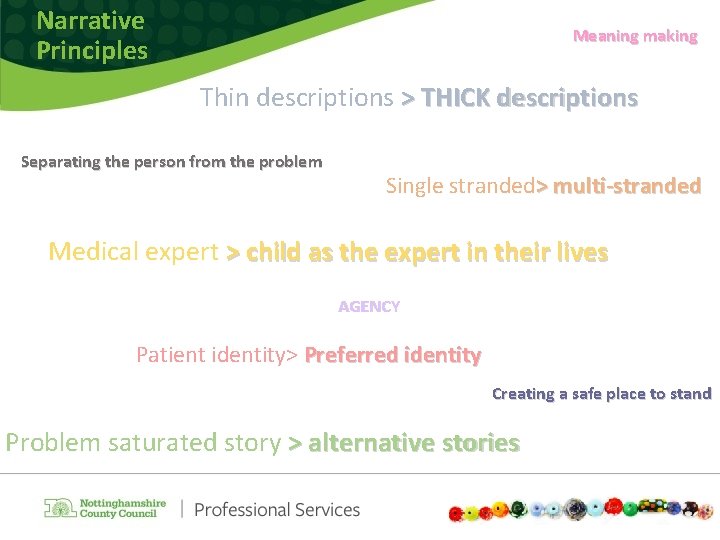
Narrative Principles Meaning making Thin descriptions > THICK descriptions Separating the person from the problem Single stranded> multi-stranded Medical expert > child as the expert in their lives AGENCY Patient identity> Preferred identity Creating a safe place to stand Problem saturated story > alternative stories
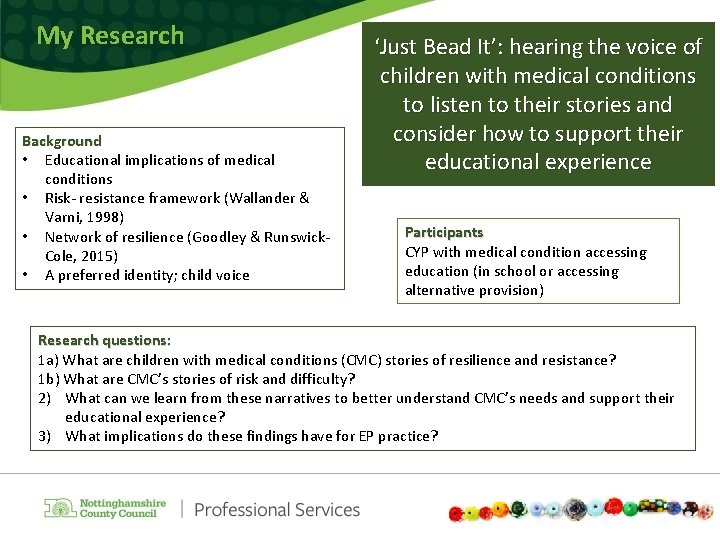
My Research Background • Educational implications of medical conditions • Risk- resistance framework (Wallander & Varni, 1998) • Network of resilience (Goodley & Runswick. Cole, 2015) • A preferred identity; child voice ‘Just Bead It’: hearing the voice of children with medical conditions to listen to their stories and consider how to support their educational experience Participants CYP with medical condition accessing education (in school or accessing alternative provision) Research questions: 1 a) What are children with medical conditions (CMC) stories of resilience and resistance? 1 b) What are CMC’s stories of risk and difficulty? 2) What can we learn from these narratives to better understand CMC’s needs and support their educational experience? 3) What implications do these findings have for EP practice?
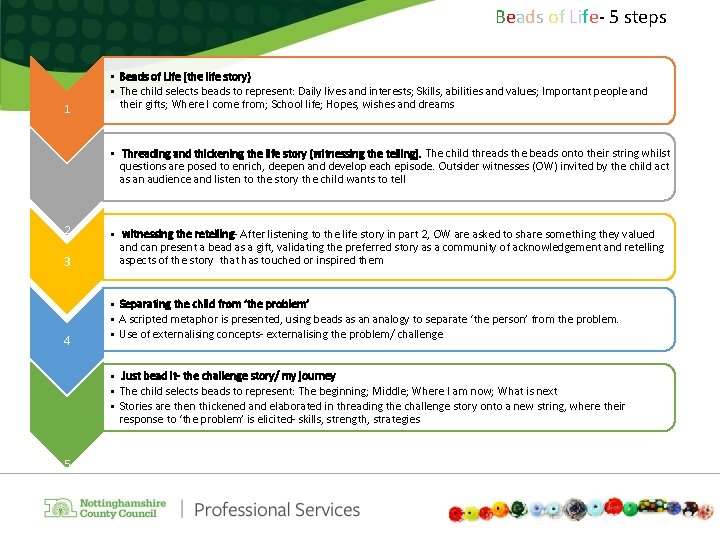
Beads of Life- 5 steps 1 • Beads of Life (the life story) • The child selects beads to represent: Daily lives and interests; Skills, abilities and values; Important people and their gifts; Where I come from; School life; Hopes, wishes and dreams • Threading and thickening the life story (witnessing the telling). The child threads the beads onto their string whilst questions are posed to enrich, deepen and develop each episode. Outsider witnesses (OW) invited by the child act as an audience and listen to the story the child wants to tell 2 3 4 • witnessing the retelling- After listening to the life story in part 2, OW are asked to share something they valued and can present a bead as a gift, validating the preferred story as a community of acknowledgement and retelling aspects of the story that has touched or inspired them • Separating the child from ‘the problem’ • A scripted metaphor is presented, using beads as an analogy to separate ‘the person’ from the problem. • Use of externalising concepts- externalising the problem/ challenge • Just bead it- the challenge story/ my journey • The child selects beads to represent: The beginning; Middle; Where I am now; What is next • Stories are then thickened and elaborated in threading the challenge story onto a new string, where their response to ‘the problem’ is elicited- skills, strength, strategies 5

Step 1 - The life story

Step 2 - Threading and thickening the life story (witnessing the story) Who else knows you have that skill? Is there anybody you enjoy doing that activity with? How long have you had that hope? Tell me about a time when you used. . . (skill)…?

Step 3 - witnessing the re-tellings
Activity • Choose three beads to represent: - an aspect of your daily life - a skill or ability - an important person in your life • With the person next to you, you may wish to take it in turns to use the narrative prompts to thicken the story, as you thread the bead onto your twine
Step 4 - separating the child from the problem It is introduced to the CYP that “things can happen in any person’s life which are not their fault…just like my beads, they can be secure on a thread one minute and then suddenly the knots holding them can come undone or threads snap and the beads fall off and scatter, creating panic and fuss for everyone trying to pick up the pieces. This is not the threads fault, it did not snap itself or ask to be undone… The ‘problem’ is spoke about in a similar way; …sometimes a problem/ challenge/ worry/ wobble/ difficulty …(as defined by the child) comes into people’s lives uninvited and creates problems so that like the beads, some parts of life come apart, get lost or the thread breaks. Like the beads and thread, this is not the person’s fault” We then ask “what has been happening since (the problem) came into your life”or “Can you think of anything that might make your beads unravel, snap or fall off? ”
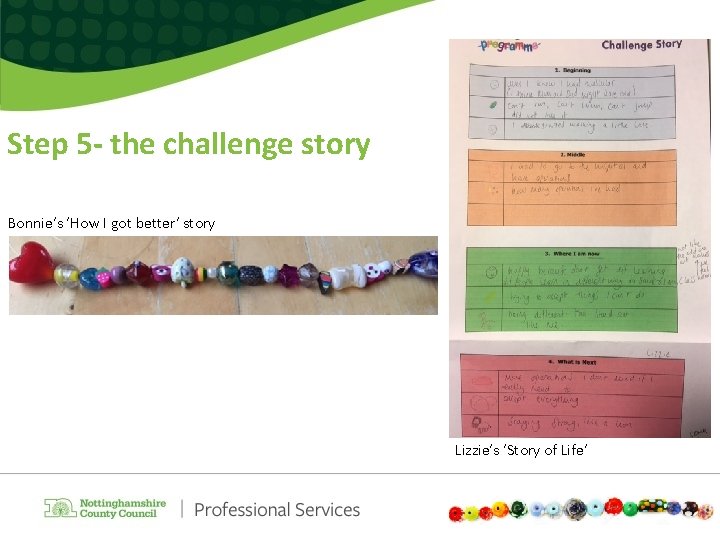
Step 5 - the challenge story Bonnie’s ‘How I got better’ story Lizzie’s ‘Story of Life’
Reframing the language for step 5 ‘My journey’
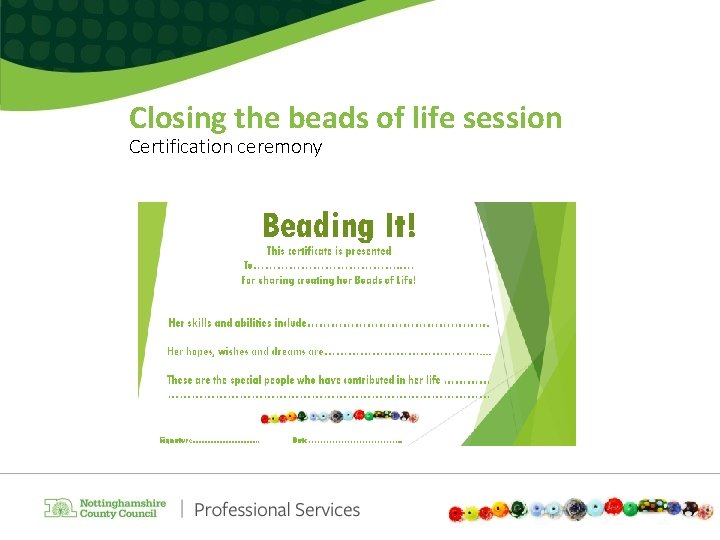
Closing the beads of life session Certification ceremony
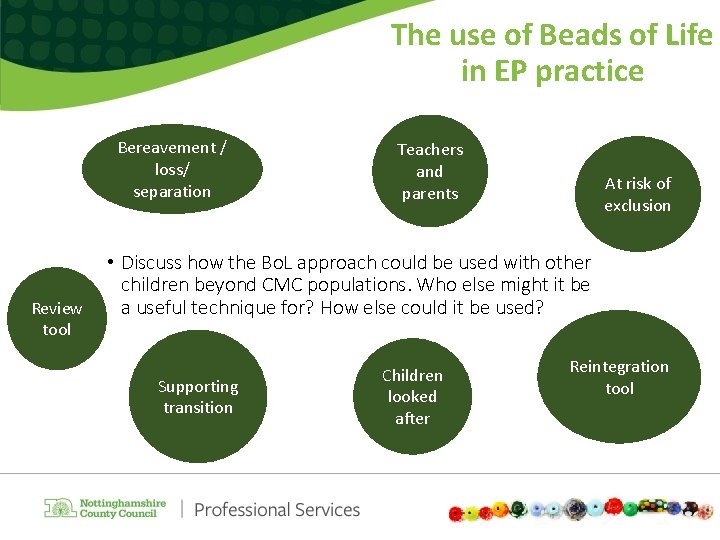
The use of Beads of Life in EP practice Bereavement / loss/ separation Review tool Teachers and parents At risk of exclusion • Discuss how the Bo. L approach could be used with other children beyond CMC populations. Who else might it be a useful technique for? How else could it be used? Supporting transition Children looked after Reintegration tool
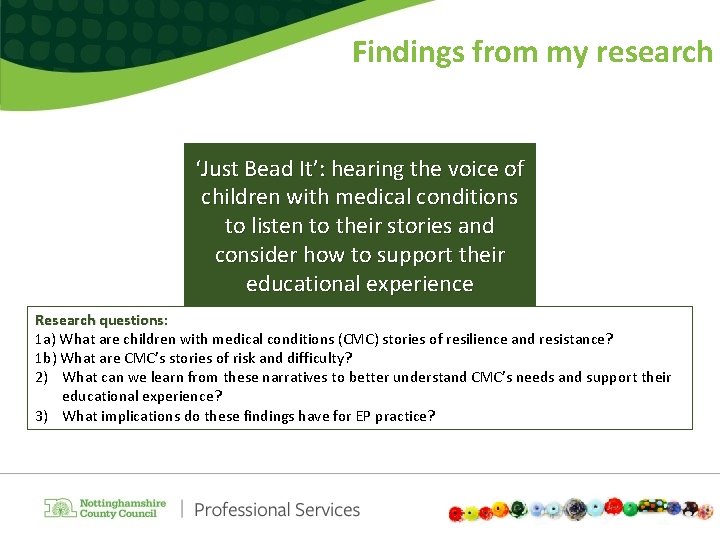
Findings from my research ‘Just Bead It’: hearing the voice of children with medical conditions to listen to their stories and consider how to support their educational experience Research questions: 1 a) What are children with medical conditions (CMC) stories of resilience and resistance? 1 b) What are CMC’s stories of risk and difficulty? 2) What can we learn from these narratives to better understand CMC’s needs and support their educational experience? 3) What implications do these findings have for EP practice?
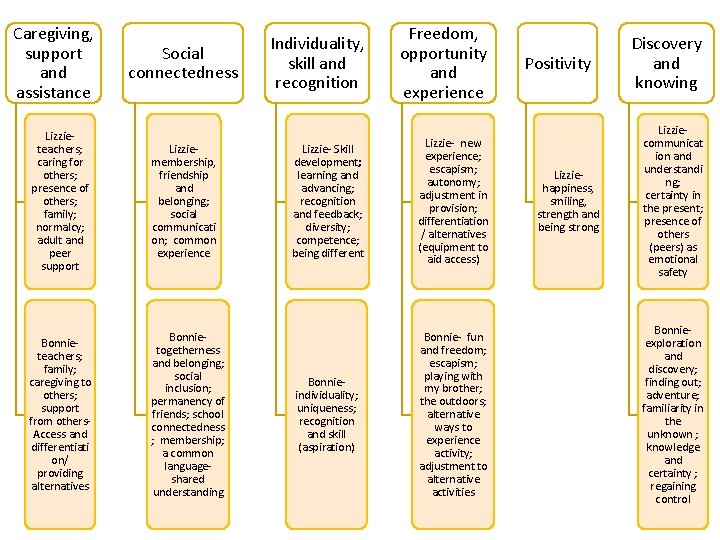
Caregiving, support and assistance Social connectedness Lizzieteachers; caring for others; presence of others; family; normalcy; adult and peer support Lizziemembership, friendship and belonging; social communicati on; common experience Bonnieteachers; family; caregiving to others; support from others. Access and differentiati on/ providing alternatives Bonnietogetherness and belonging; social inclusion; permanency of friends; school connectedness ; membership; a common languageshared understanding Individuality, skill and recognition Freedom, opportunity and experience Lizzie- Skill development; learning and advancing; recognition and feedback; diversity; competence; being different Lizzie- new experience; escapism; autonomy; adjustment in provision; differentiation / alternatives (equipment to aid access) Bonnieindividuality; uniqueness; recognition and skill (aspiration) Bonnie- fun and freedom; escapism; playing with my brother; the outdoors; alternative ways to experience activity; adjustment to alternative activities Positivity Lizziehappiness, smiling, strength and being strong Discovery and knowing Lizziecommunicat ion and understandi ng; certainty in the present; presence of others (peers) as emotional safety Bonnieexploration and discovery; finding out; adventure; familiarity in the unknown ; knowledge and certainty ; regaining control
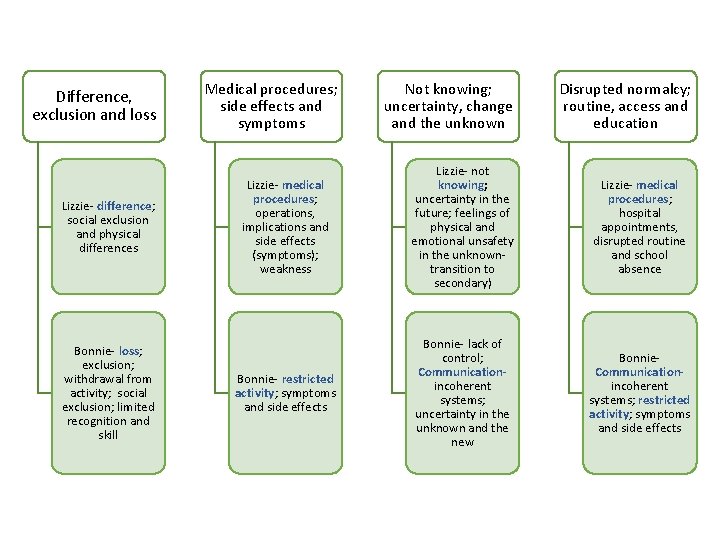
Difference, exclusion and loss Lizzie- difference; social exclusion and physical differences Bonnie- loss; exclusion; withdrawal from activity; social exclusion; limited recognition and skill Medical procedures; side effects and symptoms Not knowing; uncertainty, change and the unknown Disrupted normalcy; routine, access and education Lizzie- medical procedures; operations, implications and side effects (symptoms); weakness Lizzie- not knowing; uncertainty in the future; feelings of physical and emotional unsafety in the unknowntransition to secondary) Lizzie- medical procedures; hospital appointments, disrupted routine and school absence Bonnie- restricted activity; symptoms and side effects Bonnie- lack of control; Communicationincoherent systems; uncertainty in the unknown and the new Bonnie. Communicationincoherent systems; restricted activity; symptoms and side effects
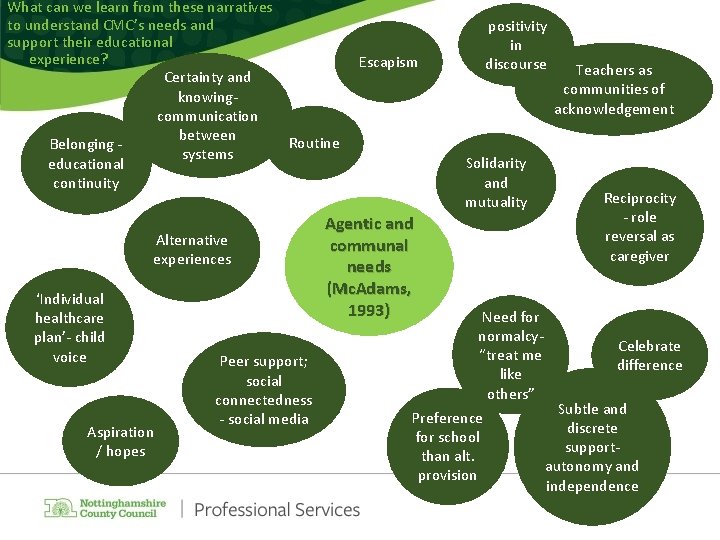
What can we learn from these narratives to understand CMC’s needs and support their educational experience? Certainty and knowingcommunication between Routine Belonging systems educational continuity Alternative experiences ‘Individual healthcare plan’- child voice Aspiration / hopes Peer support; social connectedness - social media positivity in discourse Escapism Solidarity and mutuality Agentic and communal needs (Mc. Adams, 1993) Need for normalcy“treat me like others” Preference for school than alt. provision Teachers as communities of acknowledgement Reciprocity - role reversal as caregiver Celebrate difference Subtle and discrete supportautonomy and independence
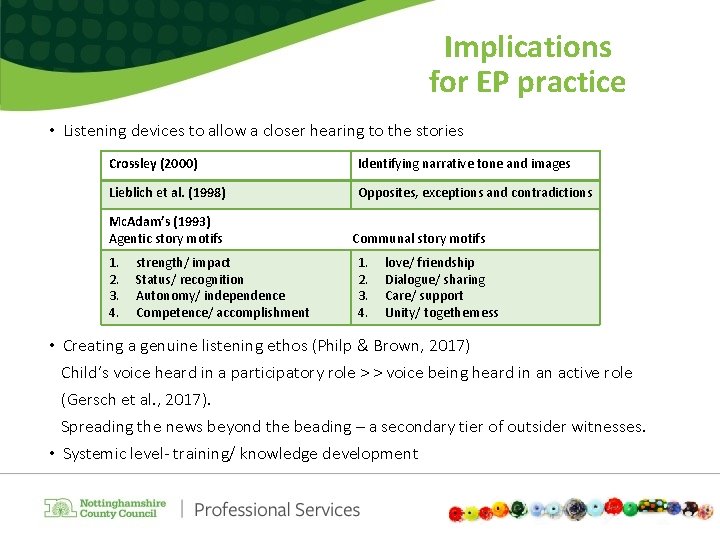
Implications for EP practice • Listening devices to allow a closer hearing to the stories Crossley (2000) Identifying narrative tone and images Lieblich et al. (1998) Opposites, exceptions and contradictions Mc. Adam’s (1993) Agentic story motifs 1. 2. 3. 4. strength/ impact Status/ recognition Autonomy/ independence Competence/ accomplishment Communal story motifs 1. 2. 3. 4. love/ friendship Dialogue/ sharing Care/ support Unity/ togetherness • Creating a genuine listening ethos (Philp & Brown, 2017) Child’s voice heard in a participatory role > > voice being heard in an active role (Gersch et al. , 2017). Spreading the news beyond the beading – a secondary tier of outsider witnesses. • Systemic level- training/ knowledge development
“it was really nice using beads to express my life” Lizzie, aged 9

Questions? alex. wright 2@nottscc. gov. uk
References Crossley, M. (2000) Introducing Narrative Psychology: Self, Trauma and the Construction of Meaning. Buckingham: Open University Press. Frank, A. W. (1995). The Wounded Storyteller: Body, Illness and Ethics. London: University of Chicago Press. Gersch, I. , Lipscomb, A. & Potton, A. (2017). The history of research by educational psychologists into ascertaining the voice of the child and young person. In Hardy, J. & Hobbs, C. Using Qualitative Research to Hear the Voice of Children and Young People: The Work of British Educational Psychologists. Leicester: The British Psychological Society. Goodley, D. & Runswick-Cole (2015). Critical Disability Studies and Critical Health Psychology: Comrades in Arms? In M. Murray (2015) Critical Health Psychology. Palgrave Macmillan. Mc. Adams, D. (1993). The Stories we Live by: Personal Myths and the Making of the Self. New York: Guildford.
References Philp, S. & Brown, F. (2017). Educational Psychologists involving young people in their own learning: A person-centred planning approach. In Hardy, J. & Hobbs, C. Using qualitative research to hear the voice of children and young people: The work of British educational psychologists. BPS: Leicester. Portnoy, S. , Girling, I. & Fredman, G. (2016). Supporting young people with cancer to tell their stories in ways that make them stronger: The Beads of Life approach. Clinical Child Psychology and Psychiatry, 21 (2), 255 -267. https: //www. researchgate. net/publication/277252317_Supporting_young_people_livin g_with_cancer_to_tell_their_stories_in_ways_that_make_them_stronger_The_Beads_o f_Life_approach Wallander, J. & Varni, J. (1998). Effects of Pediatric Chronic Physical Disorders on Child and Family Adjustment. Journal of Child Psychology and Psychiatry, 39(1), 29 -46. Walther, S. & Fox, H. (2012)Narrative therapy and outsider witness practice: Teachers as a community of acknowledgement. Educational & Child Psychology, 29, 2. http: //www. theinstituteofnarrativetherapy. com/Narrative%20 therapy%20 and%20 outsid er%20 witness. pdf
- Slides: 25