
Be Ready Stay Safe Be Ready Stay Safe
Be Ready - Stay Safe

Be Ready - Stay Safe
With Thanks to the Following Organisations Who Supported the Development of this Material Human Factors Wellbeing Group

Who is this package of material for? • This package is for organisations and particularly for leaders and managers who are developing their own Ramp-up preparations. • Organisations should use this material to support a people-centred Ramp-up as it relates to their own operation (add your logo to the top right of the main powerpoint slides and go!) • It is designed to help staff representatives in supporting their organisations and colleagues during the Ramp-up. • This material is designed to align our ramp up approaches across the industry and to save you time when developing your own messages.
What is in the package? • Organisational definition of Ready" and "Stay Safe" "Be • Key messages for aviation personnel during the Ramp-up • Examples of the key actions for each of the domain groups • Domain safety issues • Domain Ramp-up resources
Be Ready - Stay Safe: For Organisations The importance of an industry-wide campaign Aviation services are interconnected and rely upon organisations working together seamlessly. Start-up strategies need to be addressed by all organisations to ensure the safe delivery of services. We all need to focus on key behaviours during the ramp-up of operations over the coming months. Be Ready means Ensuring that you have the right tools, equipment and infrastructure in place. Having enough skilled, trained and qualified people who are operationally ready and fit for duty. Putting your staff and their wellbeing at the heart of a people centred ramp-up. Stay Safe means Encouraging people to follow recognised processes, procedures and practices. Knowing your risks and mitigating them effectively as part of a resilient management system. Setting a culture of trust that encourages reporting and for people to talk openly about safety and wellbeing.
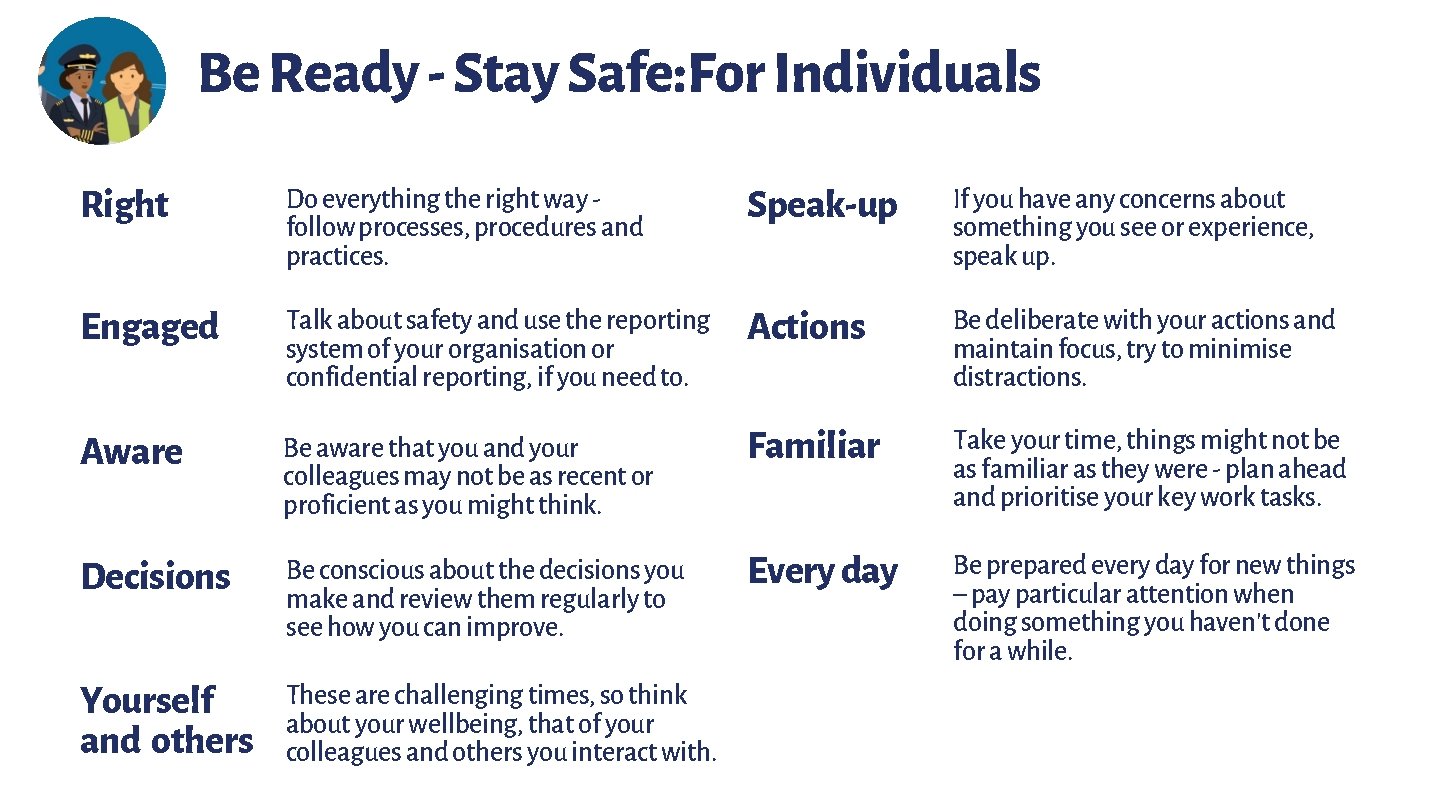
Be Ready - Stay Safe: For Individuals Right Do everything the right way follow processes, procedures and practices. Speak-up If you have any concerns about something you see or experience, speak up. Engaged Talk about safety and use the reporting system of your organisation or confidential reporting, if you need to. Actions Be deliberate with your actions and maintain focus, try to minimise distractions. Aware Be aware that you and your colleagues may not be as recent or proficient as you might think. Familiar Take your time, things might not be as familiar as they were - plan ahead and prioritise your key work tasks. Decisions Be conscious about the decisions you make and review them regularly to see how you can improve. Every day Yourself and others Be prepared every day for new things – pay particular attention when doing something you haven't done for a while. These are challenging times, so think about your wellbeing, that of your colleagues and others you interact with.
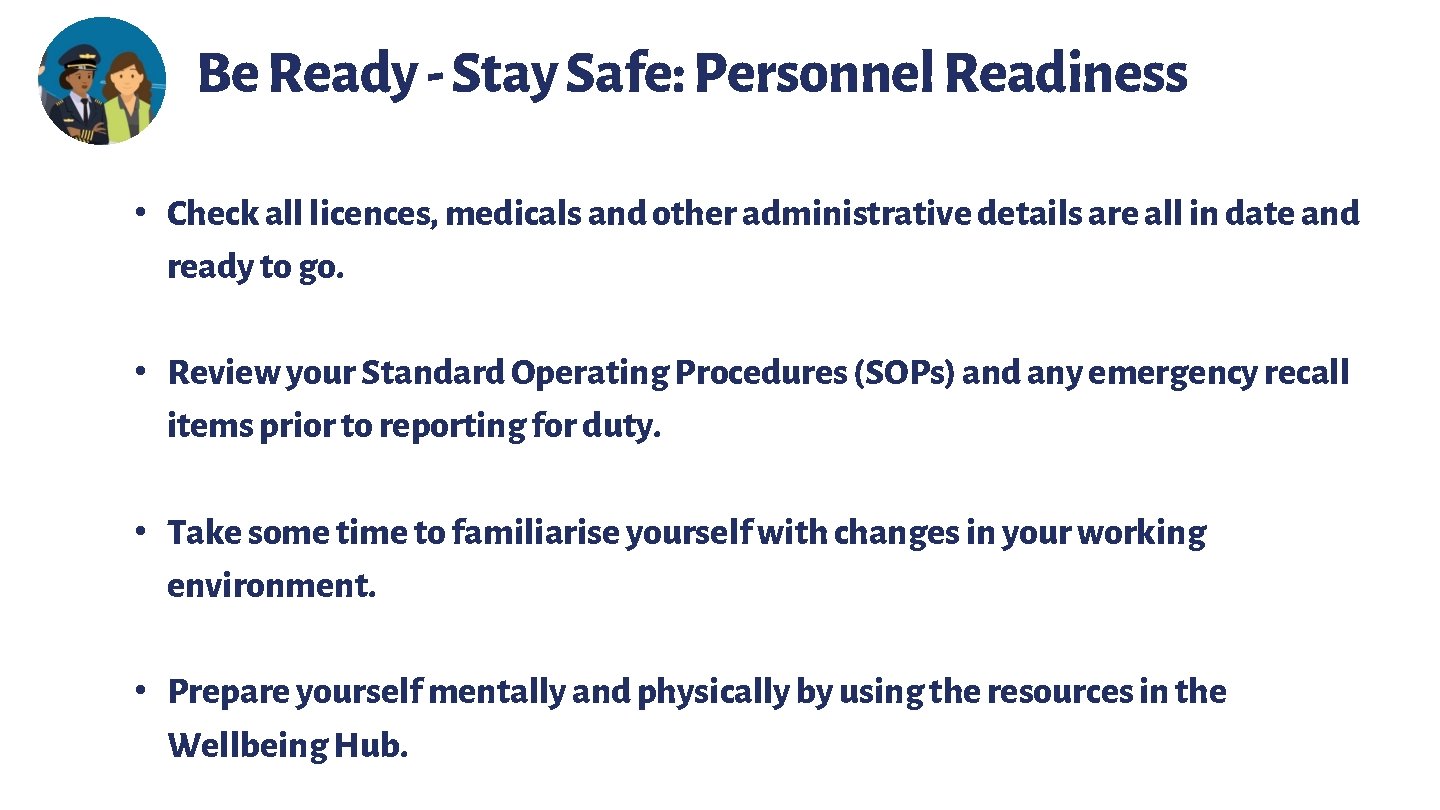
Be Ready - Stay Safe: Personnel Readiness • Check all licences, medicals and other administrative details are all in date and ready to go. • Review your Standard Operating Procedures (SOPs) and any emergency recall items prior to reporting for duty. • Take some time to familiarise yourself with changes in your working environment. • Prepare yourself mentally and physically by using the resources in the Wellbeing Hub.
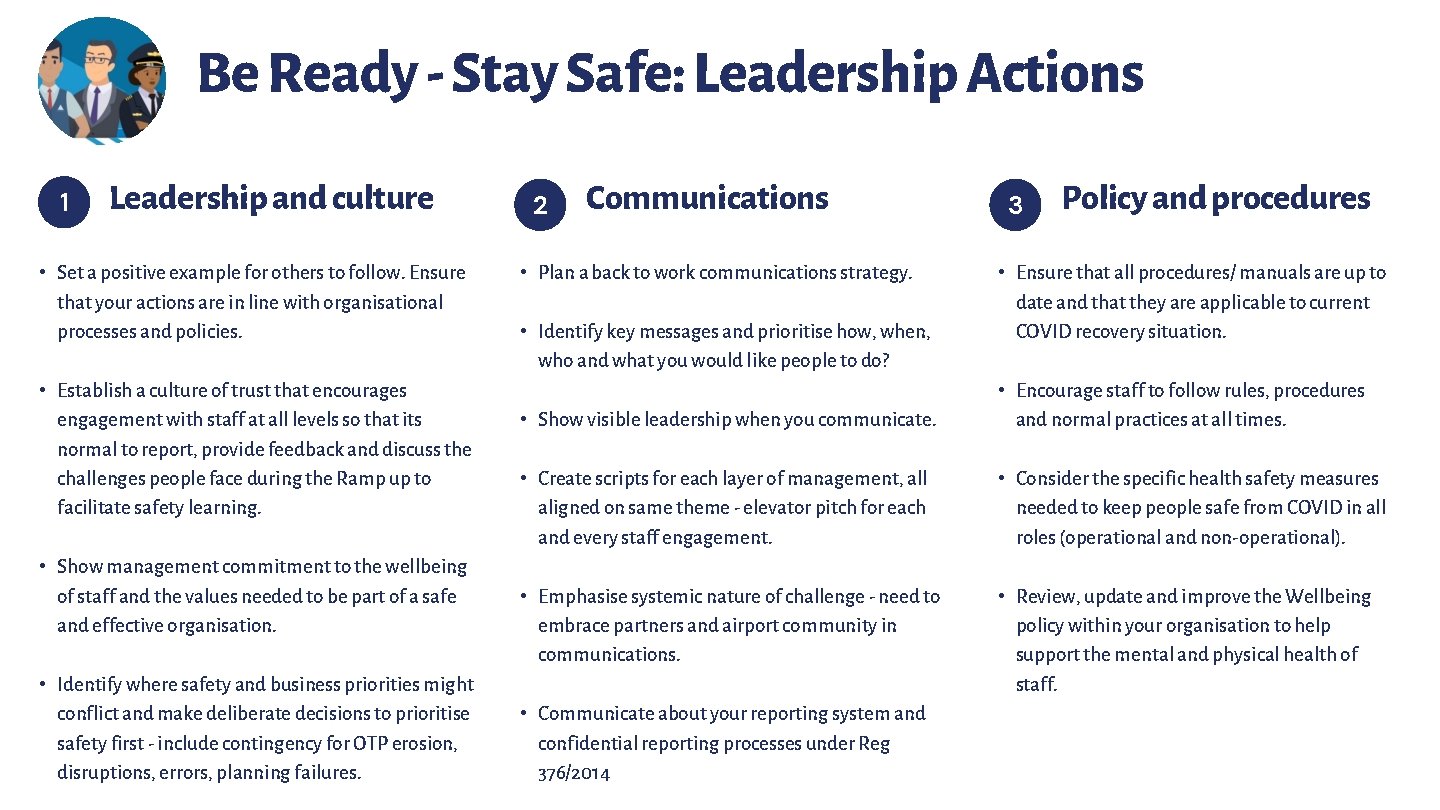
Be Ready - Stay Safe: Leadership Actions 1 Leadership and culture • Set a positive example for others to follow. Ensure that your actions are in line with organisational processes and policies. • Establish a culture of trust that encourages engagement with staff at all levels so that its normal to report, provide feedback and discuss the challenges people face during the Ramp up to facilitate safety learning. • Show management commitment to the wellbeing of staff and the values needed to be part of a safe and effective organisation. • Identify where safety and business priorities might conflict and make deliberate decisions to prioritise safety first - include contingency for OTP erosion, disruptions, errors, planning failures. 2 Communications • Plan a back to work communications strategy. • Identify key messages and prioritise how, when, who and what you would like people to do? 3 Policy and procedures • Ensure that all procedures/ manuals are up to date and that they are applicable to current COVID recovery situation. • Show visible leadership when you communicate. • Encourage staff to follow rules, procedures and normal practices at all times. • Create scripts for each layer of management, all aligned on same theme - elevator pitch for each and every staff engagement. • Consider the specific health safety measures needed to keep people safe from COVID in all roles (operational and non-operational). • Emphasise systemic nature of challenge - need to embrace partners and airport community in communications. • Review, update and improve the Wellbeing policy within your organisation to help support the mental and physical health of staff. • Communicate about your reporting system and confidential reporting processes under Reg 376/2014
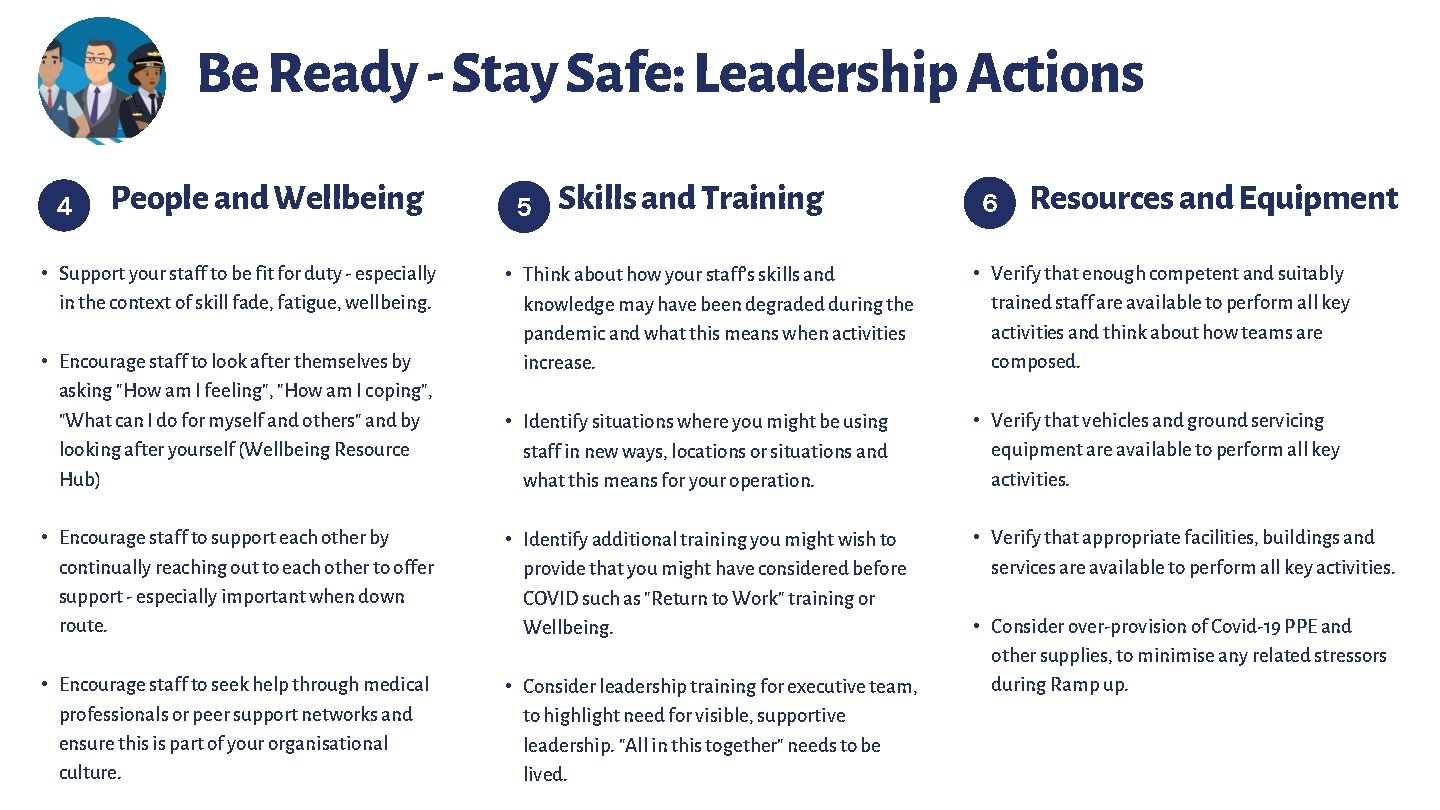
Be Ready - Stay Safe: Leadership Actions 4 People and Wellbeing • Support your staff to be fit for duty - especially in the context of skill fade, fatigue, wellbeing. 5 Skills and Training 6 Resources and Equipment • Think about how your staff's skills and knowledge may have been degraded during the pandemic and what this means when activities increase. • Verify that enough competent and suitably trained staff are available to perform all key activities and think about how teams are composed. • Identify situations where you might be using staff in new ways, locations or situations and what this means for your operation. • Verify that vehicles and ground servicing equipment are available to perform all key activities. • Encourage staff to support each other by continually reaching out to each other to offer support - especially important when down route. • Identify additional training you might wish to provide that you might have considered before COVID such as "Return to Work" training or Wellbeing. • Verify that appropriate facilities, buildings and services are available to perform all key activities. • Encourage staff to seek help through medical professionals or peer support networks and ensure this is part of your organisational culture. • Consider leadership training for executive team, to highlight need for visible, supportive leadership. "All in this together" needs to be lived. • Encourage staff to look after themselves by asking "How am I feeling", "How am I coping", "What can I do for myself and others" and by looking after yourself (Wellbeing Resource Hub) • Consider over-provision of Covid-19 PPE and other supplies, to minimise any related stressors during Ramp up.
Be Ready - Stay Safe: Leadership Actions 7 Management Systems • Utilise your management system to effectively manage safety in your actual day-today operation - the situation is dynamic so be aware of changes. • Know your risks, mitigate them continously and properly - use the EASA COVID-19 Risk Portfolio to help you. • Encourage people to report occurrences and hazards and be prepared to investigate them - with appropraite feedback throughout the organisation. • Ensure you are able to turn your data into intelligence that you can then talk about and use to manage the risks in your organisation. • Ensure that Cyber, Security and Wellbeing are included in your management system. • Consider pro-active seeking of operational feedback - use a "pull" campaign rather than relying on voluntary submission of reports. No reports doesn't necessarily mean no issues. 8 Third Party Providers • Don’t assume that all third party providers are in the same situation as you are or where they were before the pandemic - reach out and engage with them. • Verify the status of any new service providers or companies that you plan to contract. • Check that suppliers/ providers are not taking short cuts to keep afloat, your success depends on them - reach out and offer support.
Be Ready - Stay Safe: Support Teams 1 General Create some headspace by putting key priorities in your diary up to 4 weeks ahead and create distractionfree moments. Create times when you are able to disconnect from work. Think about your own wellbeing and take care of those around you. 2 Email 3 Meetings 4 Communication Schedule time in your diary to do email so that it doesn't take over your day. Think about who you invite to a meeting so that everyone is clear on the need for their time. Don't just communicate via email, pick up the phone, video call or even in person if possible. If you send an email be clear about the purpose and what you would actually like people to do. Use the scheduling assistant to check that people are free. Reach out to colleagues across Teams etc whenever possible. Avoid back to back online meetings by planning 45 minute meetings instead of an hour. Don't just do the work, communicate that it is done to people who need to know. Avoid scheduling meetings outside normal office hours, keeping time zones in mind - consider local time lunch breaks as well. Consider outdoor walking meetings if feasible. Try to schedule walking or stand-up meetings to break up the day Don't leave colleagues waiting for a long time for a reply, send at least a holding reply. Minimise use of CC. Does that person really need to be made aware? Why not include them in direct email?
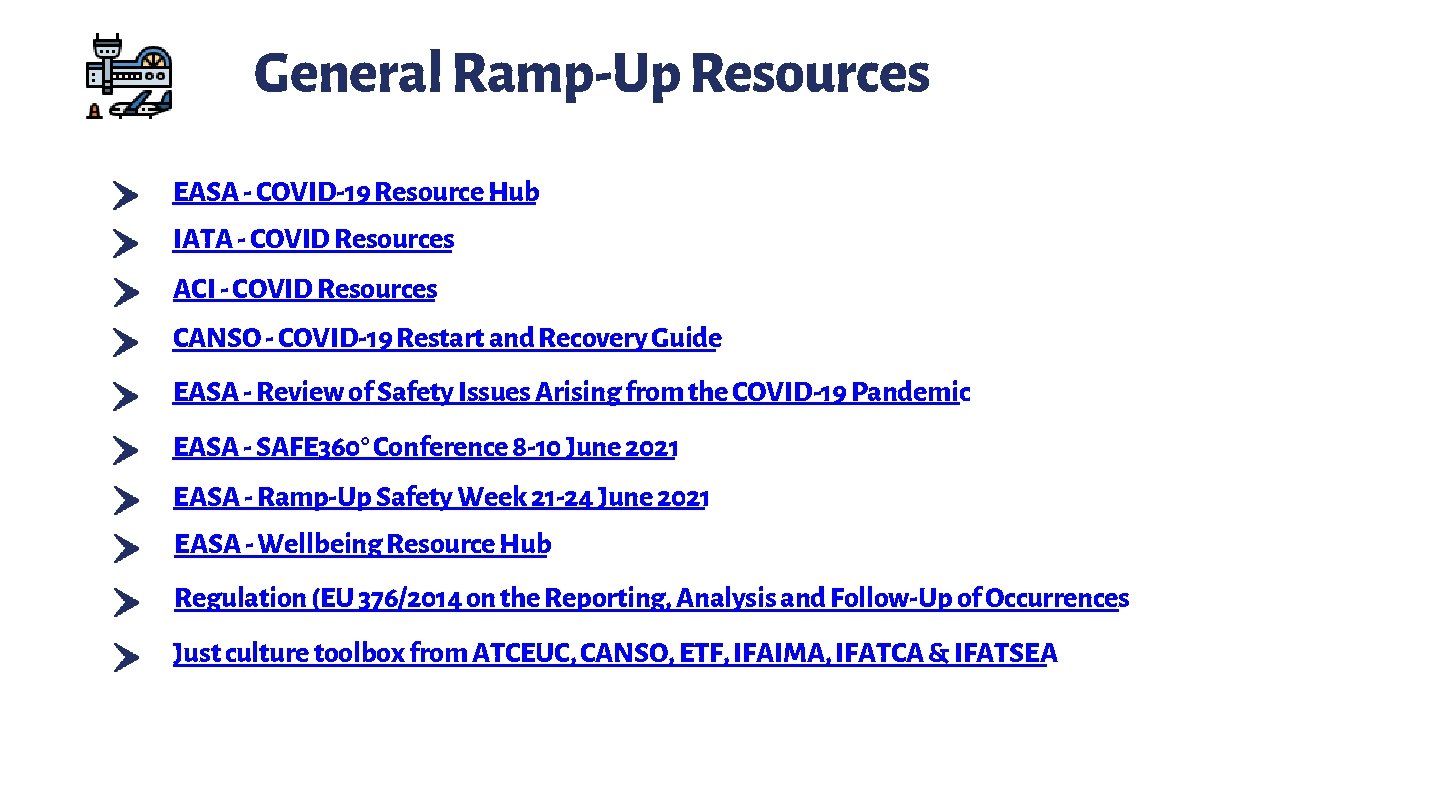
General Ramp-Up Resources EASA - COVID-19 Resource Hub IATA - COVID Resources ACI - COVID Resources CANSO - COVID-19 Restart and Recovery Guide EASA - Review of Safety Issues Arising from the COVID-19 Pandemic EASA - SAFE 360° Conference 8 -10 June 2021 EASA - Ramp-Up Safety Week 21 -24 June 2021 EASA - Wellbeing Resource Hub Regulation (EU 376/2014 on the Reporting, Analysis and Follow-Up of Occurrences Just culture toolbox from ATCEUC, CANSO, ETF, IFAIMA, IFATCA & IFATSEA
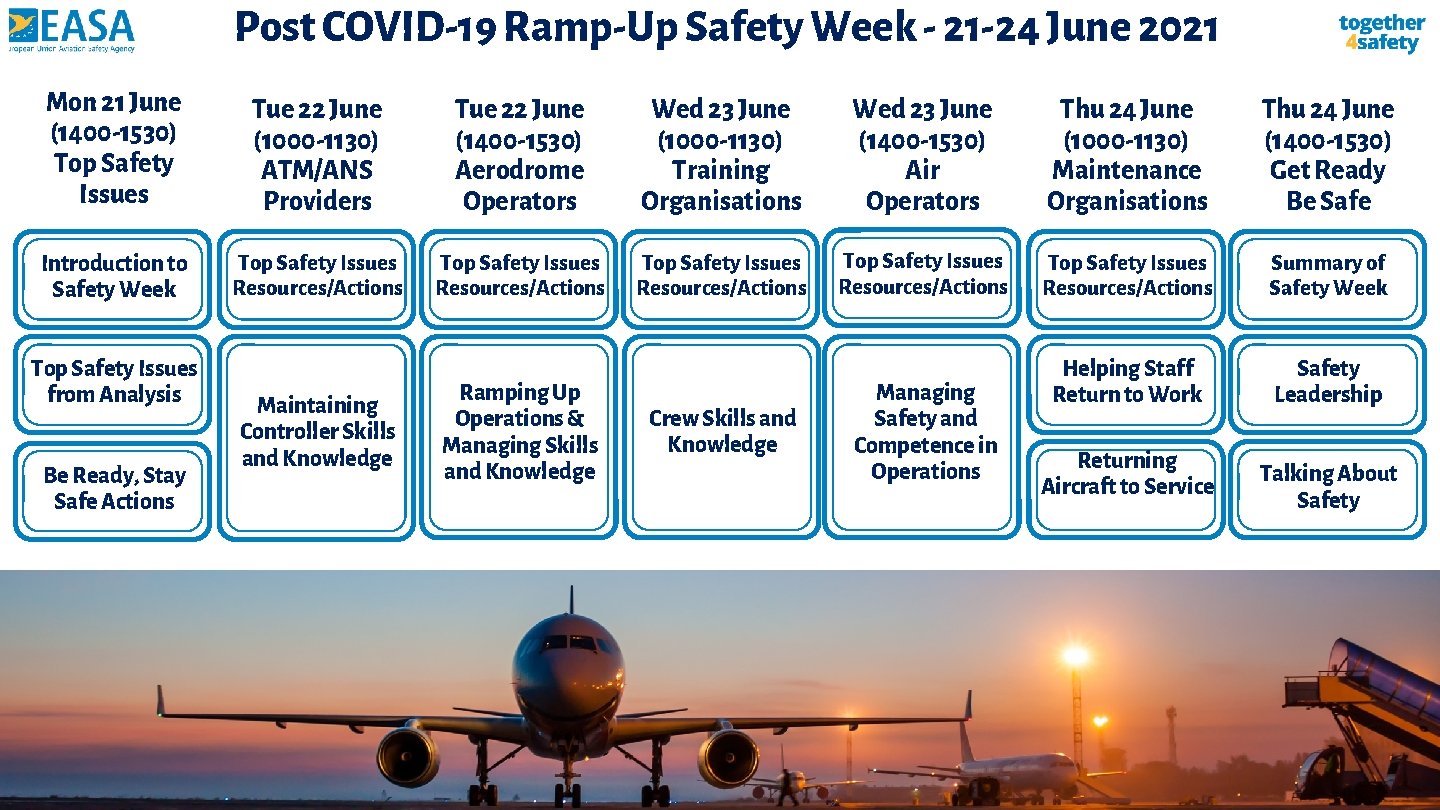
Post COVID-19 Ramp-Up Safety Week - 21 -24 June 2021 Mon 21 June (1400 -1530) Top Safety Issues Tue 22 June (1000 -1130) ATM/ANS Providers Tue 22 June (1400 -1530) Aerodrome Operators Wed 23 June (1000 -1130) Training Organisations Wed 23 June (1400 -1530) Air Operators Thu 24 June (1000 -1130) Maintenance Organisations Thu 24 June (1400 -1530) Get Ready Be Safe Introduction to Safety Week Top Safety Issues Resources/Actions Top Safety Issues Resources/Actions Summary of Safety Week Helping Staff Return to Work Safety Leadership Top Safety Issues from Analysis Be Ready, Stay Safe Actions Maintaining Controller Skills and Knowledge Ramping Up Operations & Managing Skills and Knowledge Crew Skills and Knowledge Managing Safety and Competence in Operations Returning Aircraft to Service Talking About Safety
ATM/ ANS Providers
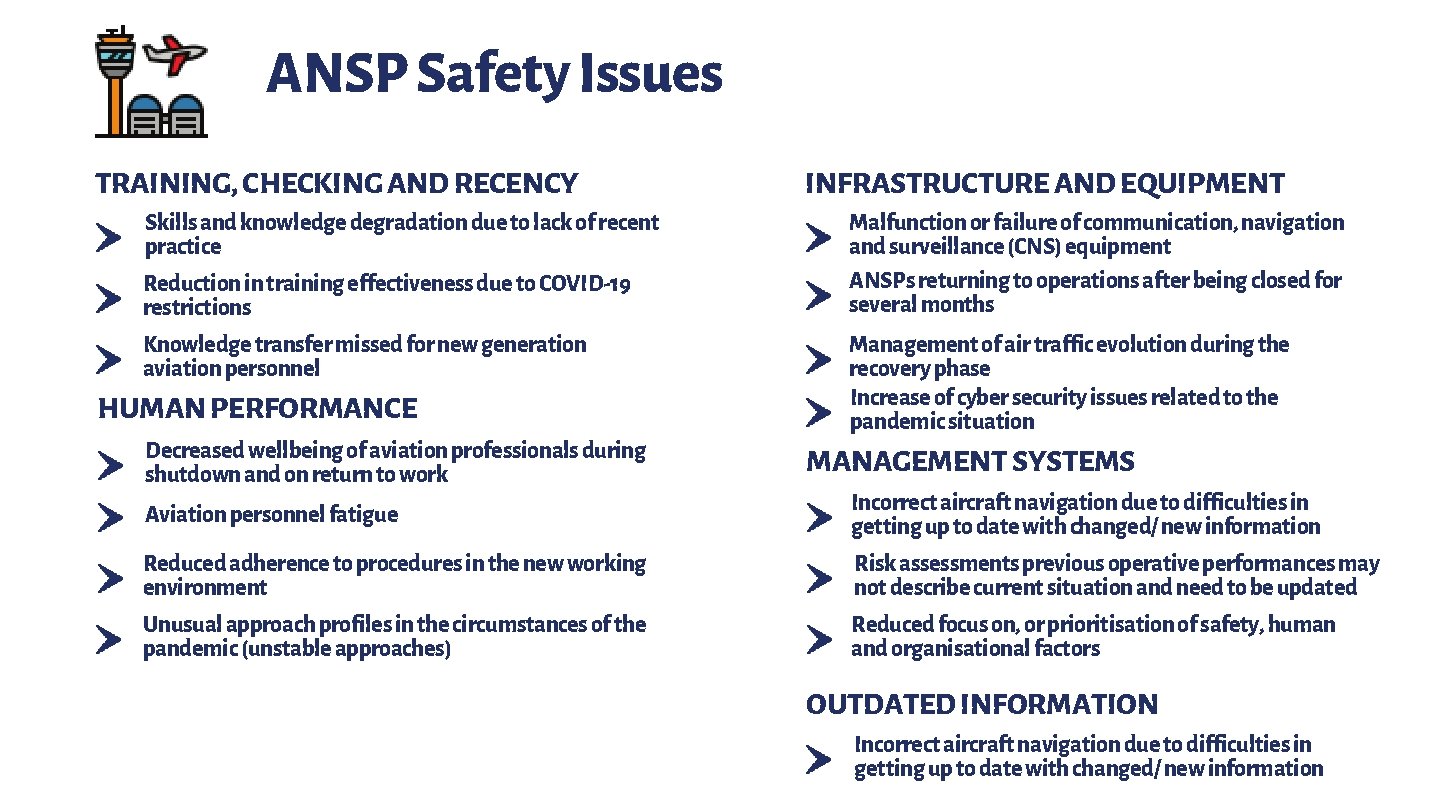
ANSP Safety Issues TRAINING, CHECKING AND RECENCY Skills and knowledge degradation due to lack of recent practice Reduction in training effectiveness due to COVID-19 restrictions Knowledge transfer missed for new generation aviation personnel HUMAN PERFORMANCE Decreased wellbeing of aviation professionals during shutdown and on return to work INFRASTRUCTURE AND EQUIPMENT Malfunction or failure of communication, navigation and surveillance (CNS) equipment ANSPs returning to operations after being closed for several months Management of air traffic evolution during the recovery phase Increase of cyber security issues related to the pandemic situation MANAGEMENT SYSTEMS Aviation personnel fatigue Incorrect aircraft navigation due to difficulties in getting up to date with changed/ new information Reduced adherence to procedures in the new working environment Risk assessments previous operative performances may not describe current situation and need to be updated Unusual approach profiles in the circumstances of the pandemic (unstable approaches) Reduced focus on, or prioritisation of safety, human and organisational factors OUTDATED INFORMATION Incorrect aircraft navigation due to difficulties in getting up to date with changed/ new information
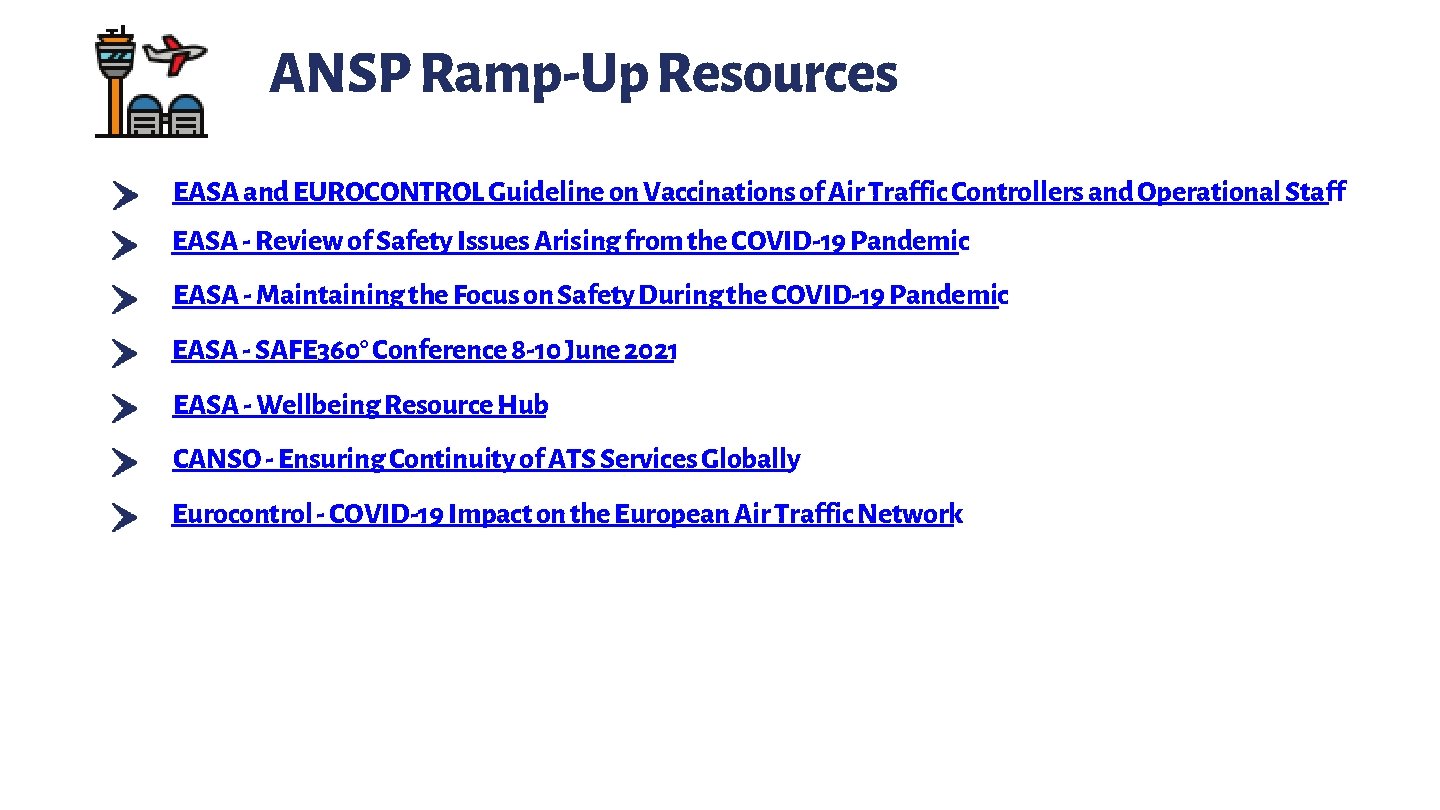
ANSP Ramp-Up Resources EASA and EUROCONTROL Guideline on Vaccinations of Air Traffic Controllers and Operational Staff EASA - Review of Safety Issues Arising from the COVID-19 Pandemic EASA - Maintaining the Focus on Safety During the COVID-19 Pandemic EASA - SAFE 360° Conference 8 -10 June 2021 EASA - Wellbeing Resource Hub CANSO - Ensuring Continuity of ATS Services Globally Eurocontrol - COVID-19 Impact on the European Air Traffic Network

Be Ready - Stay Safe: ATM/ ANS 1 1 General 2 Policy and Procedures • Carry out pre-shift briefings to ensure all duty staff are aware of the current situations/ plans. • Be careful of long, complex procedures, rely on cognitive cues to avoid errors. • Continually evaluate capacity and keep all parties informed on the latest situation • Limit use of RNAV approach procedures during the initial phase of the transition period. (Contrary to using automation for pilots? ) • Assess what are the activities you have practiced less. Pay special attention to coordinations with sectors typically collapsed during the pandemic period and to airport configurations less used during this period. • Keep support controllers available. • Consider keeping section occupation below capacity and consider splitting early. • Carefully consider short cuts before offering during all flight phases. • Carefully monitoring pilot compliance with instructions and clearances. 3 Rostering and Management of Staff • Implement tactical rostering which takes into account ATCO experience and skills. Ensure newly recruited or less experienced staff are supported by experienced staff • Ensure Assessors and OJT Instructor (OJTIs) retain the competence through refresher training and prioritising them on shift. • Consideration should also be given to introduce shift patterns that allow more staff exposure to the available traffic in order to remain current.
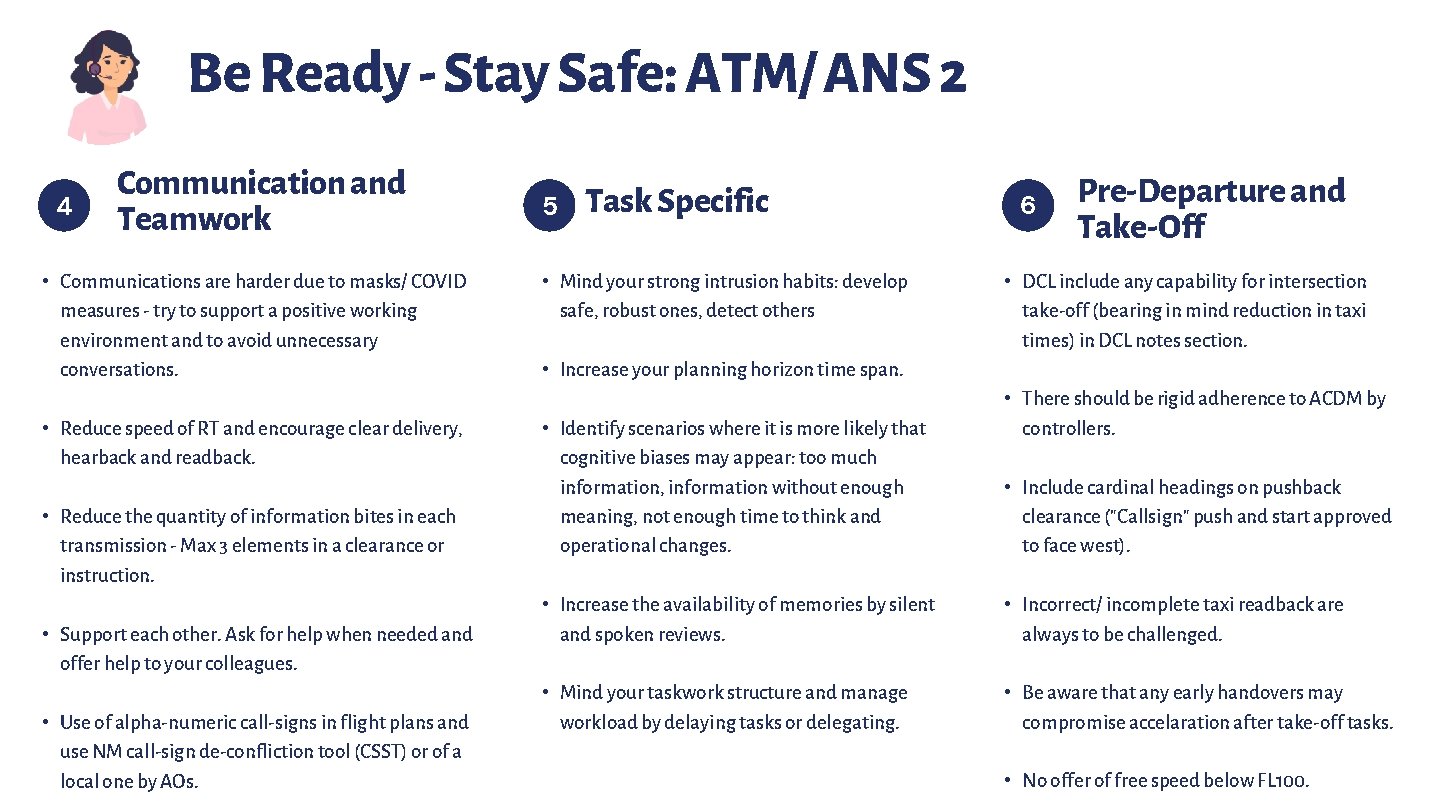
Be Ready - Stay Safe: ATM/ ANS 2 4 Communication and Teamwork 5 Task Specific • Communications are harder due to masks/ COVID measures - try to support a positive working environment and to avoid unnecessary conversations. • Mind your strong intrusion habits: develop safe, robust ones, detect others • Reduce speed of RT and encourage clear delivery, hearback and readback. • Identify scenarios where it is more likely that cognitive biases may appear: too much information, information without enough meaning, not enough time to think and operational changes. • Reduce the quantity of information bites in each transmission - Max 3 elements in a clearance or instruction. • Support each other. Ask for help when needed and offer help to your colleagues. • Use of alpha-numeric call-signs in flight plans and use NM call-sign de-confliction tool (CSST) or of a local one by AOs. • Increase your planning horizon time span. 6 Pre-Departure and Take-Off • DCL include any capability for intersection take-off (bearing in mind reduction in taxi times) in DCL notes section. • There should be rigid adherence to ACDM by controllers. • Include cardinal headings on pushback clearance ("Callsign" push and start approved to face west). • Increase the availability of memories by silent and spoken reviews. • Incorrect/ incomplete taxi readback are always to be challenged. • Mind your taskwork structure and manage workload by delaying tasks or delegating. • Be aware that any early handovers may compromise accelaration after take-off tasks. • No offer of free speed below FL 100.
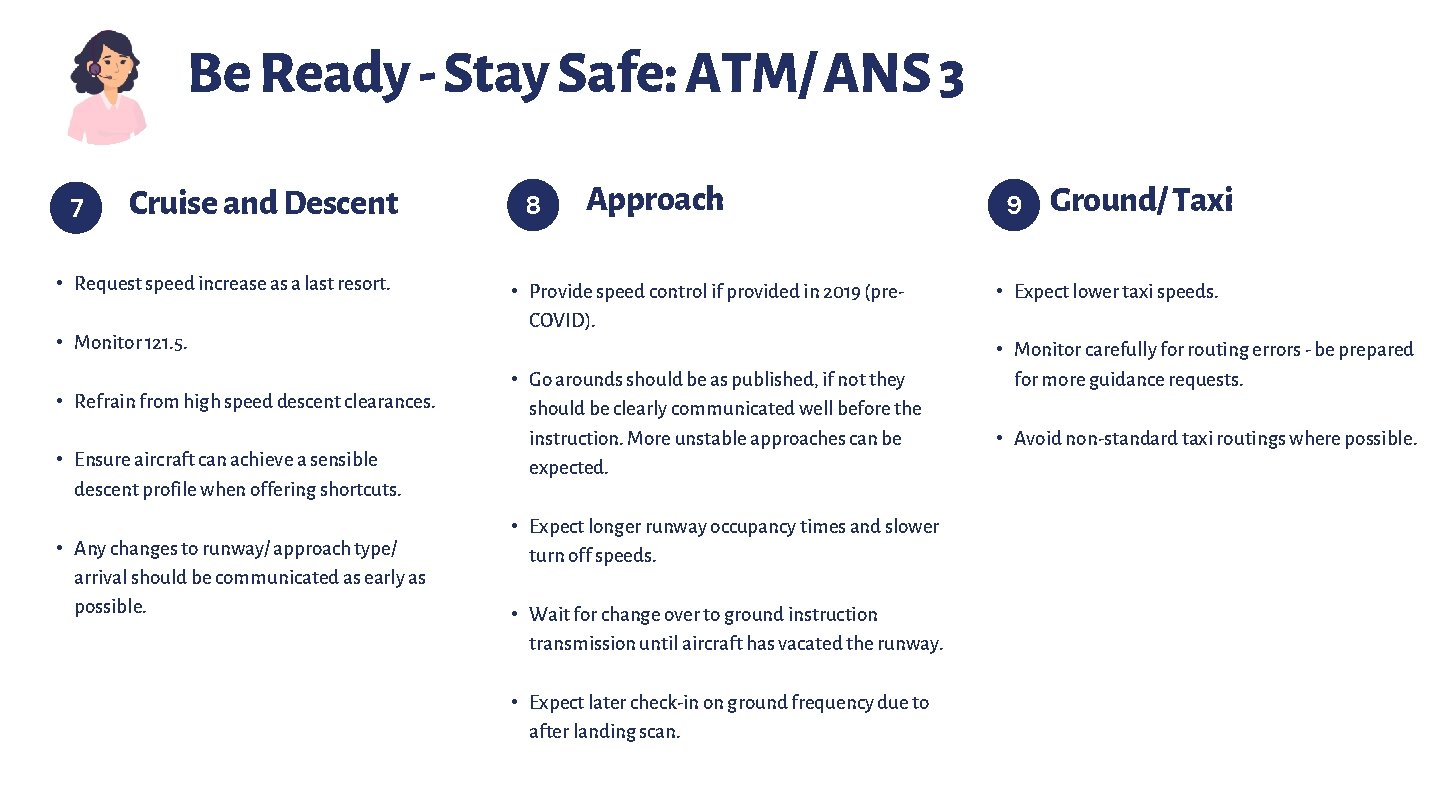
Be Ready - Stay Safe: ATM/ ANS 3 7 Cruise and Descent • Request speed increase as a last resort. • Monitor 121. 5. • Refrain from high speed descent clearances. • Ensure aircraft can achieve a sensible descent profile when offering shortcuts. • Any changes to runway/ approach type/ arrival should be communicated as early as possible. 8 Approach • Provide speed control if provided in 2019 (pre. COVID). • Go arounds should be as published, if not they should be clearly communicated well before the instruction. More unstable approaches can be expected. • Expect longer runway occupancy times and slower turn off speeds. • Wait for change over to ground instruction transmission until aircraft has vacated the runway. • Expect later check-in on ground frequency due to after landing scan. 9 Ground/ Taxi • Expect lower taxi speeds. • Monitor carefully for routing errors - be prepared for more guidance requests. • Avoid non-standard taxi routings where possible.

Questions?
- Slides: 21