
Be Business 3 11 ECONOMIC POLICY ECONOMIC POLICY
Be Business 3. 11 ECONOMIC POLICY
ECONOMIC POLICY 3. 11 Learning Intentions At the end of this unit I will: • Know the meaning of government policy • Understand the benefits of government polices • Understand the costs of government polices • Understand choices from different perspectives with regard to taxation • Value the benefits of government policies • Know how to apply my research skills 2
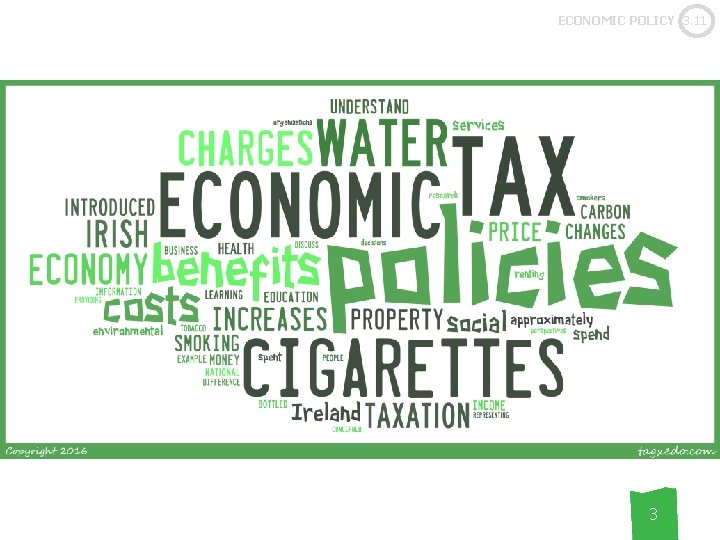
ECONOMIC POLICY 3. 11 3
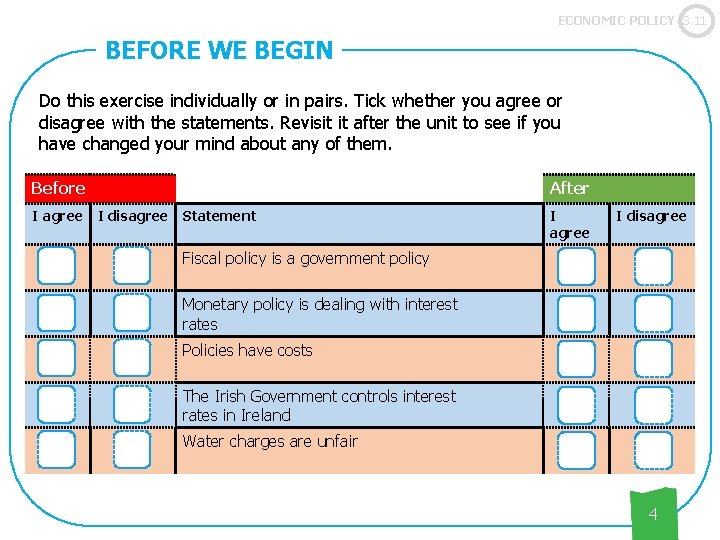
ECONOMIC POLICY 3. 11 BEFORE WE BEGIN Do this exercise individually or in pairs. Tick whether you agree or disagree with the statements. Revisit it after the unit to see if you have changed your mind about any of them. Before I agree After I disagree Statement I agree I disagree Fiscal policy is a government policy #04 AFEF Monetary policy is dealing with interest rates Policies have costs The Irish Government controls interest rates in Ireland Water charges are unfair 4

ECONOMIC POLICY 3. 11 Websites Wonderful Worthwhile Websites www. publicpolicy. ie www. revenue. ie www. cso. ie 5
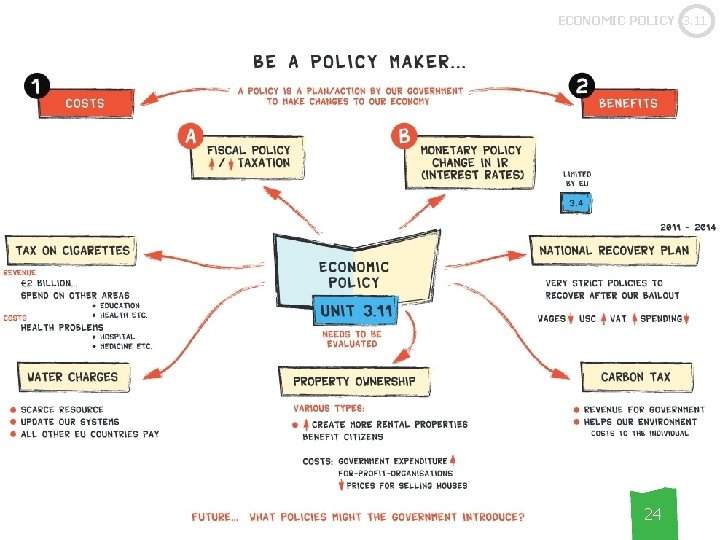
ECONOMIC POLICY 3. 11 Economic Policies An economic policy is a course of action taken by a government to influence its country’s economy. The two main types of economic policy are: • Fiscal policy – public revenues, public spending, changes in taxation, government spending • Monetary policy – supply and circulation of money in an economy, changes in interest rates 6
ECONOMIC POLICY 3. 11 Economic Policies • We can see the government’s economic policies in the national budget • Policies include taxation, budget cuts, national ownership • Governments through: • Taxation pay for the goods and services they provide • Borrowing from lending institutions, such as the ECB • Government departments make policies that affect our lives • For example, education, health, social, defence, environmental services • Some government policies try to redistribute income by providing the less well off with income through social welfare payments 7
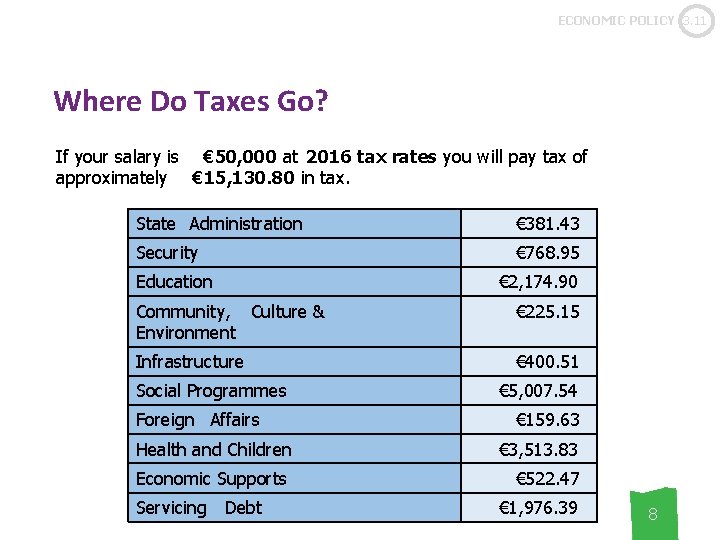
ECONOMIC POLICY 3. 11 Where Do Taxes Go? If your salary is € 50, 000 at 2016 tax rates you will pay tax of approximately € 15, 130. 80 in tax. State Administration € 381. 43 Security € 768. 95 Education € 2, 174. 90 Community, Culture & Environment € 225. 15 Infrastructure € 400. 51 Social Programmes Foreign Affairs Health and Children Economic Supports Servicing Debt € 5, 007. 54 € 159. 63 € 3, 513. 83 € 522. 47 € 1, 976. 39 8
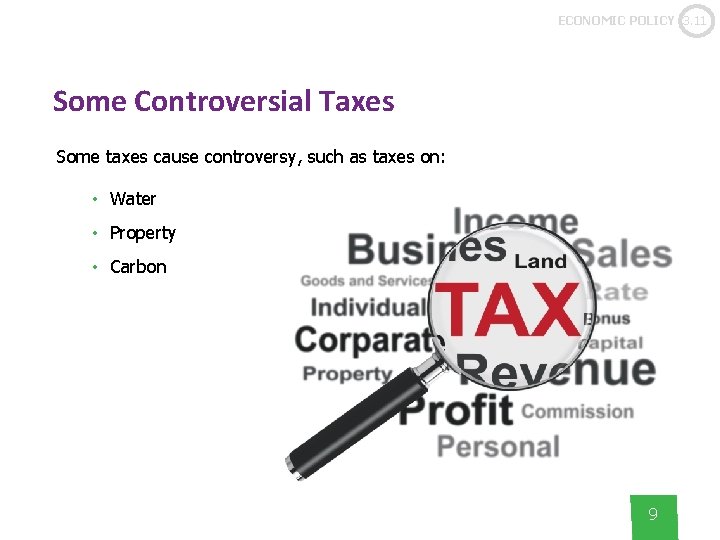
ECONOMIC POLICY 3. 11 Some Controversial Taxes Some taxes cause controversy, such as taxes on: • Water • Property • Carbon 9
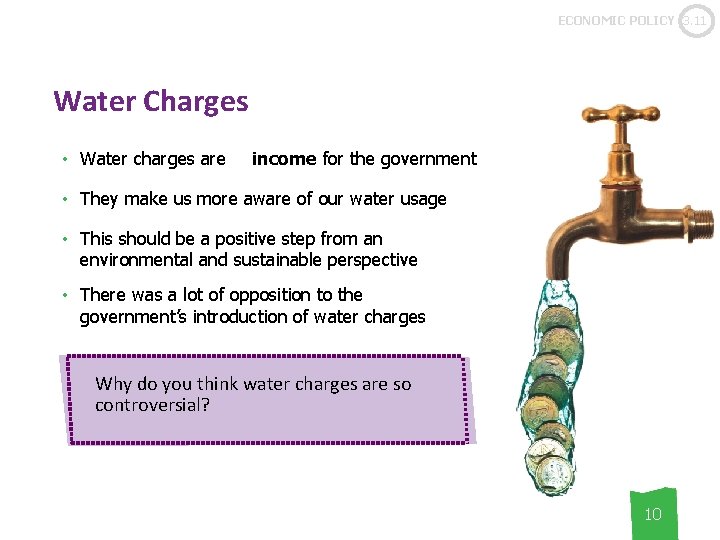
ECONOMIC POLICY 3. 11 Water Charges • Water charges are income for the government • They make us more aware of our water usage • This should be a positive step from an environmental and sustainable perspective • There was a lot of opposition to the government’s introduction of water charges Why do you think water charges are so controversial? 10
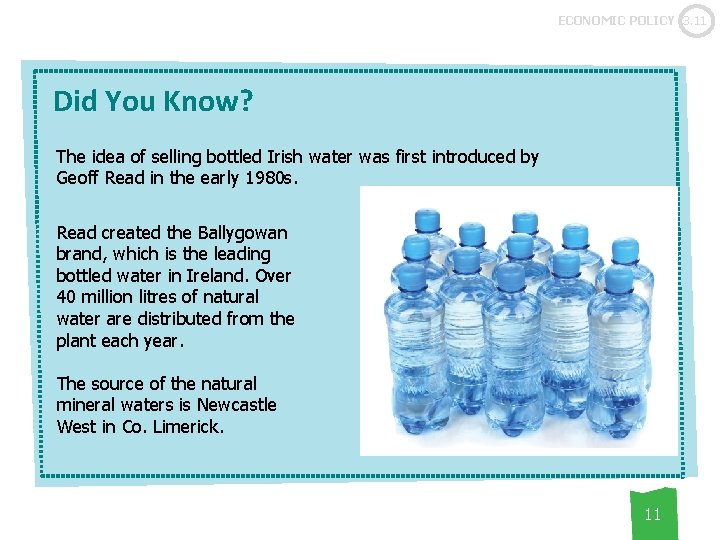
ECONOMIC POLICY 3. 11 Did You Know? The idea of selling bottled Irish water was first introduced by Geoff Read in the early 1980 s. Read created the Ballygowan brand, which is the leading bottled water in Ireland. Over 40 million litres of natural water are distributed from the plant each year. The source of the natural mineral waters is Newcastle West in Co. Limerick. 11
ECONOMIC POLICY 3. 11 Property Ownership • Property prices in Ireland are very high • There is not enough supply to meet demand • It is difficult for first-time buyers • Deposits are required for mortgages and mortgages aren’t easy to get • Renting is the norm in many parts of Europe Why do you think Irish people want to own their own homes? Could renting be the future for the Irish property market? 12
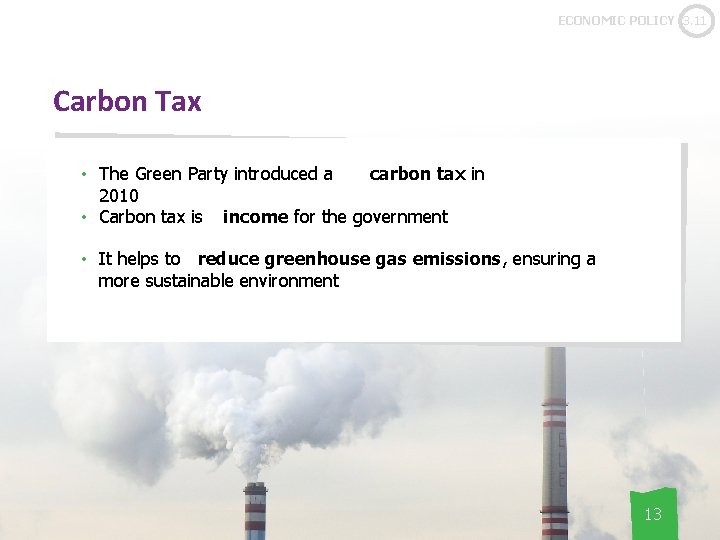
ECONOMIC POLICY 3. 11 Carbon Tax • The Green Party introduced a carbon tax in 2010 • Carbon tax is income for the government • It helps to reduce greenhouse gas emissions, ensuring a more sustainable environment 13
ECONOMIC POLICY 3. 11 WORKING WITH OTHERS Have a class debate on environmental taxes and carbon emissions. Motion: ‘The government should abolish the carbon tax’. #04 AFEF A government could abolish a tax in the hope that it will be reelected. What tax or charge would you abolish if you were the government? Page 515 14
ECONOMIC POLICY 3. 11 N I G N I K C CHE If the government introduced a policy to create more rental accommodation, who might benefit? What might be the cost? Watch a current affairs programme on television, e. g. Prime Time. What government policy was discussed? What did you learn? 15
ECONOMIC POLICY 3. 11 Policy Decisions • Policies can sometimes conflict with each other • The government needs to be decisive about what to do and how best to do it • For example, the government introduced the Plan after our EU bailout National Recovery • Wages were cut • Minimum wage decreased • Universal Social Charge (USC) was introduced • VAT increased • Since the introduction of these strict budget cuts, our economy has improved 16
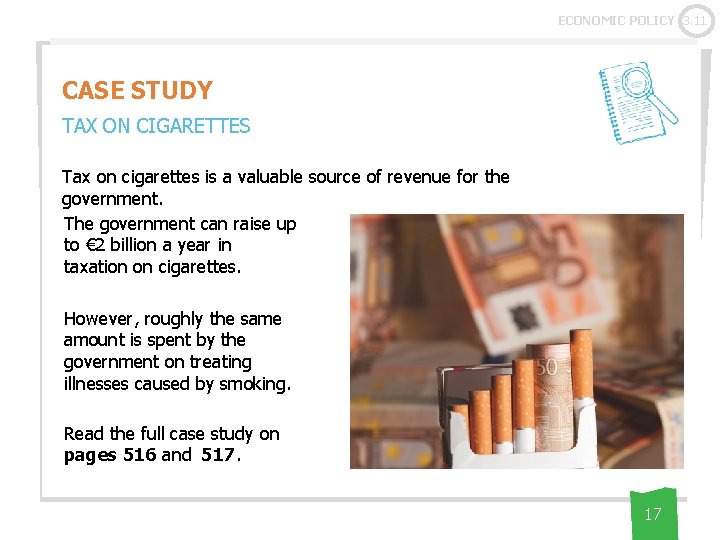
ECONOMIC POLICY 3. 11 CASE STUDY TAX ON CIGARETTES Tax on cigarettes is a valuable source of revenue for the government. The government can raise up to € 2 billion a year in taxation on cigarettes. However, roughly the same amount is spent by the government on treating illnesses caused by smoking. Read the full case study on pages 516 and 517. 17
ECONOMIC POLICY 3. 11 Time to think Be the Government: How would you choose to spend tax received from cigarette sales? Be the Manufacturer: Would you be happy with the heavy tax on cigarettes and the work of organisations such as ASH Ireland? 18
ECONOMIC POLICY 3. 11 Be a Researcher Use websites to source information on one of Ireland’s economic policies. Compare the prices with the price of the same products today. Copy and fill in the ‘Government Economic Policy Learning Sheet’ on page 517. Make a note of the websites you used and the date you used them. 19
ECONOMIC POLICY 3. 11 Quick Quiz What type of economic policy is concerned with changes in interest rates? Fiscal policy Monetary policy 20
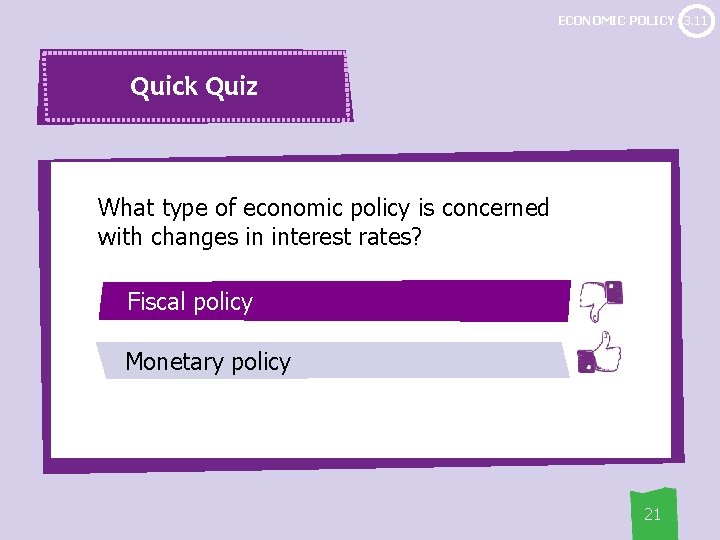
ECONOMIC POLICY 3. 11 Quick Quiz What type of economic policy is concerned with changes in interest rates? Fiscal policy Monetary policy 21
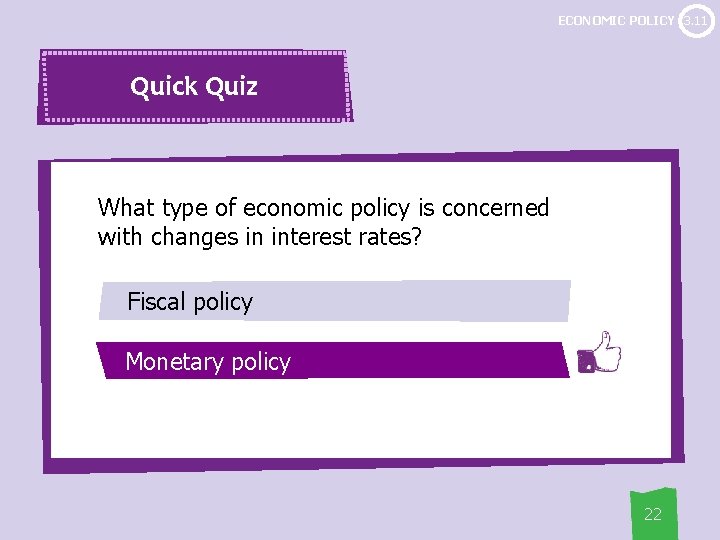
ECONOMIC POLICY 3. 11 Quick Quiz What type of economic policy is concerned with changes in interest rates? Fiscal policy Monetary policy 22
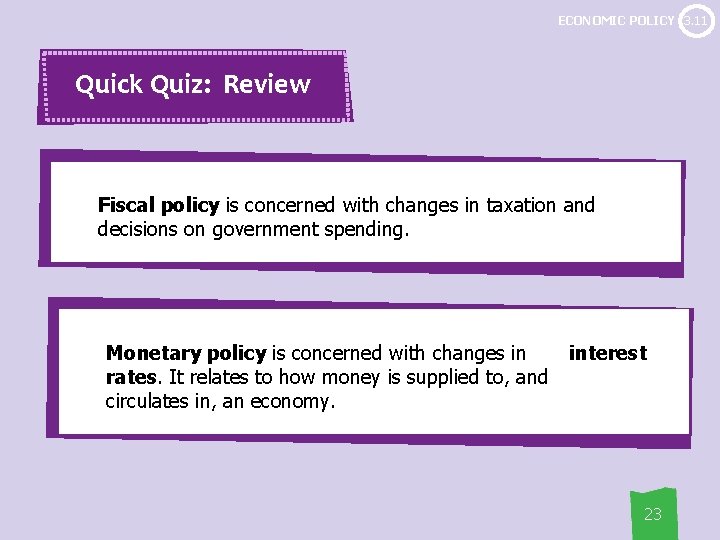
ECONOMIC POLICY 3. 11 Quick Quiz: Review Fiscal policy is concerned with changes in taxation and decisions on government spending. Monetary policy is concerned with changes in rates. It relates to how money is supplied to, and circulates in, an economy. interest 23
ECONOMIC POLICY 3. 11 24
ECONOMIC POLICY 3. 11 Key Words • Carbon tax • Economic policy • Fiscal policy • Monetary policy • National budget 25
- Slides: 25