
BCP DRP Overview business continuity plan disaster recovery
BCP & DRP Overview (business continuity plan, disaster recovery plan) Daniel L. Benway Systems & Network Administrator / Engineer Information Security Architect Lead BSc CS, MCSE (NT 4, 2000), MCTS (SCCM 2012), Security+, Network+, CCNA (2. 0), CLP (AD R 4) https: //www. Linked. In. com/in/Daniel. LBenway https: //www. Daniel. LBenway. net @Daniel_L_Benway
BCP & DRP Terminology:
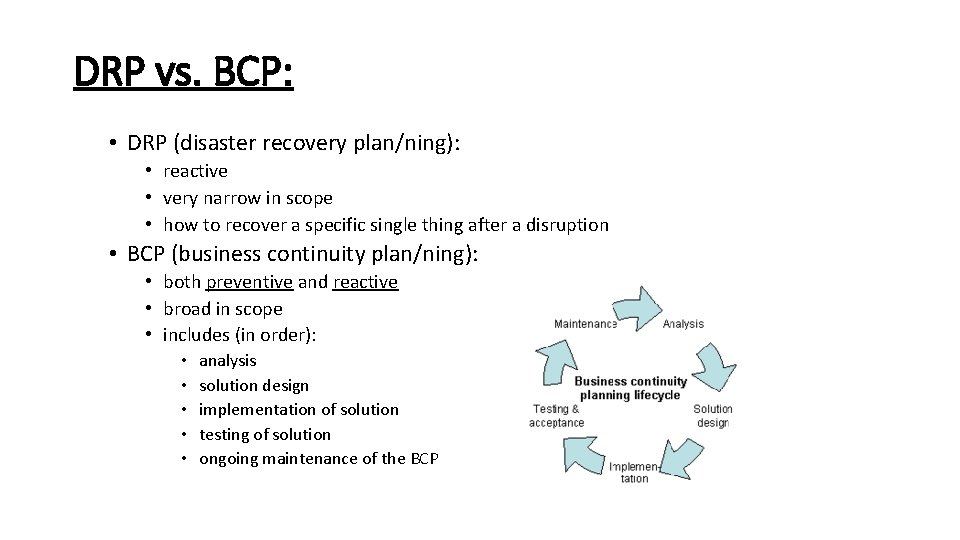
DRP vs. BCP: • DRP (disaster recovery plan/ning): • reactive • very narrow in scope • how to recover a specific single thing after a disruption • BCP (business continuity plan/ning): • both preventive and reactive • broad in scope • includes (in order): • • • analysis solution design implementation of solution testing of solution ongoing maintenance of the BCP
Which Do We Need? • A corporate BCP includes all parts of the business, including but not limited to IT. • An IT BCP handles all of the services IT provides as if the IT department were itself a business. • An IT BCP is more than just a collection of IT DRPs; it includes all of the normal parts of a BCP (analysis, solution design, implementation of solution, testing of solution, ongoing maintenance of the BCP).
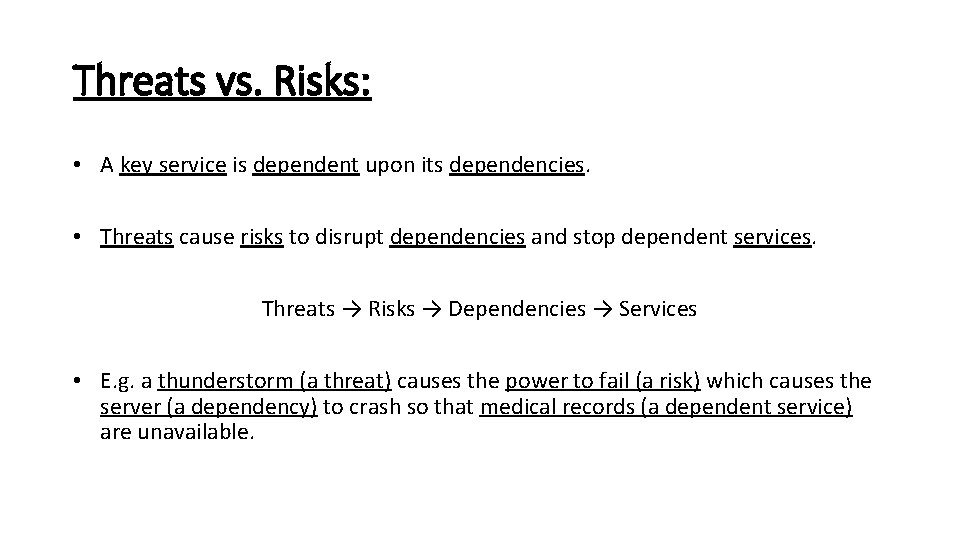
Threats vs. Risks: • A key service is dependent upon its dependencies. • Threats cause risks to disrupt dependencies and stop dependent services. Threats → Risks → Dependencies → Services • E. g. a thunderstorm (a threat) causes the power to fail (a risk) which causes the server (a dependency) to crash so that medical records (a dependent service) are unavailable.
BCP Ideology:
The Critical, Overlooked Principles of BCP: • "No battle plan survives contact with the enemy. " -German military strategist Helmuth von Moltke • "Plans are useless, but planning is indispensable. " -General Dwight David Eisenhower • BCP is still very much an evolving field so each ‘authoritative’ source simply tries in its own way to get you to consider: • • • what you do what you need most to do it what can go wrong how you prevent things from going wrong (resilience) how you recover when things do go wrong (recoverability)
The Critical, Overlooked Principles of BCP: • BCP must be a useful tool, not just something on paper that you can point to and say you have (pragmatic versus academic). • BCP should be concise and useful, providing actionable value, not complex and verbose for its own sake.
The Critical, Overlooked Principles of BCP: • Do not sensationalize: • more likely to be faced with a burst pipe than you are a hurricane or flood • Disruptions can be: • sudden or slow • from outside or inside • from external forces or oneself • You cannot protect every thing from every threat or risk: • focus on key services and their key dependencies • focus on most probable threats and risks • this level of planning and effort will help for all other services, dependencies, threats, and risks
The Critical, Overlooked Principles of BCP: • BCP must be maintained (it has a full and continuous ‘lifecycle’, not done once and ‘finished’) • BCP should change as your organization does: • what your business does will change • your business values will change • your abilities to fulfill a BCP will change (location, personnel, processes, resources, suppliers)
Benefits of BCP:
Some Benefits of BCP: • increases the likelihood of success during and after a disruption • gets you prepared for, and started on the right track during a disruption • during normal operations. . . • gets you focused on what your organization does and how, thus clarifying all manner of decisions to those ends • gets you focused on your key items so they don’t get neglected or forgotten • increases smoothness and efficacy • creates an environment where BCP is a normal activity - i. e. ‘buy-in’ • helps with the onboarding of new personnel • enhances your organization’s reputation • fulfills contractual obligations • demonstrates due diligence • increasingly required for regulatory compliance • reduces insurance premiums
BCP Lifecycle:
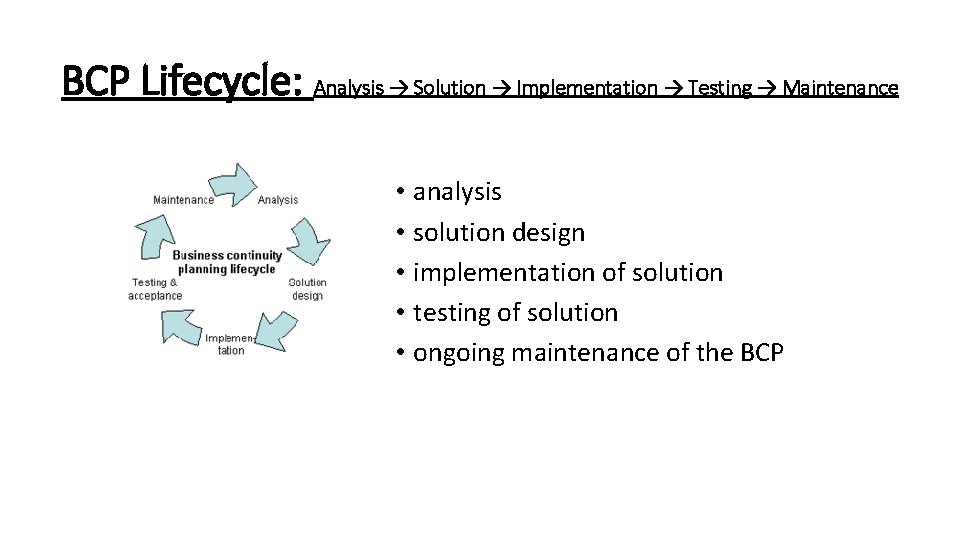
BCP Lifecycle: Analysis → Solution → Implementation → Testing → Maintenance • analysis • solution design • implementation of solution • testing of solution • ongoing maintenance of the BCP
BCP Lifecycle: Analysis → Solution → Implementation → Testing → Maintenance BCP Analysis is comprised of four parts: • BIA (business impact analysis) • TRA (threat and risk analysis) • Impact Scenarios • Recovery Requirements
BCP Lifecycle: Analysis: BIA → Solution → Implementation → Testing → Maintenance BIA (business impact analysis) - a detailed assessment of your organization’s key services, the dependencies thereof, and your outage/recovery tolerances
BCP Lifecycle: Analysis: BIA → Solution → Implementation → Testing → Maintenance • What are your key services? Daily, weekly, bi-weekly, monthly, quarterly, yearly? (e. g. applications, files/data, email, network, phone, etc. ) • What is the criticality of each key service? • Who are the owners of each key service? • What are the key dependencies of each key service? Consider ‘LPPRS’ - location, personnel, processes, resources, and suppliers. • Who are the owners of each key dependency? • What are the recovery tolerances of each key dependency? • • • MTPOD (maximum tolerable period of disruption) RTO (recovery time objective) - the reasonable and expected time to resolve a disruption MTDL (maximum tolerable data loss) RPO (recovery point objective) - the reasonable and expected level of resolution SLAs - the agreements have been made with the business
BCP Lifecycle: Analysis: TRA → Solution → Implementation → Testing → Maintenance TRA (threat and risk analysis) - an assessment of the threats and risks to each key dependency • begin looking for and thinking in terms of threats and risks • become familiar with TRA concepts and terminology (next slide) • not possible or efficient to exhaustively delineate all threats and risks, or completely protect all dependencies • do not over-sensationalize when considering threats and risks • disruptions can be sudden onset or slow onset, they can come from outside or inside, they can be caused by external forces or oneself • look at previously occurring threats and risks which are likely to happen again
BCP Lifecycle: Analysis: TRA → Solution → Implementation → Testing → Maintenance TRA Terminology: • threats cause risks to cause disruptions to dependencies which stop dependent services • risk tolerance / appetite - the acceptable level of threat and risk • TRA environment scope: • wide - over which you have almost no control (global or national) • immediate - over which you have some control (national or local) • internal - over which you have the most control (local or internal) • TRA approach: • simple - one considers only the impact of each threat and risk to key dependencies • managed - one considers the likelihood of each threat and risk as well as their impact to key dependencies • risk response strategies: • accept, create contingencies, eliminate, reduce, transfer • residual risk - what remains after implementing risk response strategies
BCP Lifecycle: Analysis: TRA → Solution → Implementation → Testing → Maintenance Some threats and risks to consider: • • • attack (physical or cyber) civil disturbance depletion of resources (internal or external) facilities failure hardware failure human sickness and absenteeism malware natural disaster site disaster software failure theft utility failure
BCP Lifecycle: Analysis: TRA → Solution → Implementation → Testing → Maintenance Datacenter analysis and audit for resilience and recoverability: documentation monitoring physical access environmental control (temperature and humidity) electrical (load, UPSs, generators, fuel) fire prevention, detection, and suppression hardware (network, firewalls, security appliances, proxies, gateways, servers, firmware, upgrade schedule) • software (patches, upgrade schedule) • data (mirroring, backups, archiving, tiering) • •
BCP Lifecycle: Analysis: Impact Scenarios → Solution → Implementation → Testing → Maintenance • how does each specific threat impact each specific key dependency • how does each key dependency being down affect the dependent key services
BCP Lifecycle: Analysis: Recovery Requirements → Solution → Implementation → Testing → Maintenance • what business requirements constitute a recovery (e. g. , people can receive and send email) • what technical requirements meet the business requirements that constitute a recovery (e. g. , the mail servers, network, gateways, etc. are online)
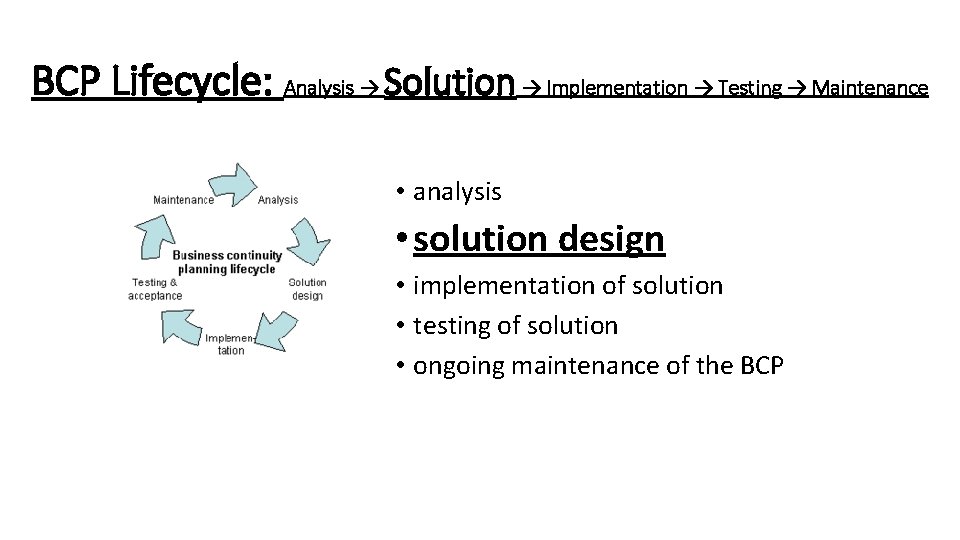
BCP Lifecycle: Analysis → Solution → Implementation → Testing → Maintenance • analysis • solution design • implementation of solution • testing of solution • ongoing maintenance of the BCP
BCP Lifecycle: Analysis → Solution → Implementation → Testing → Maintenance Solutions should create resilience and recoverability of ‘LPPRS’* (location, personnel, processes, resources, suppliers). *not an industry-adopted term
BCP Lifecycle: Analysis → Solution: Location → Implementation → Testing → Maintenance IT is seldom truly dependent upon location (unlike, for example, a mining company). • multiple sites • remote access
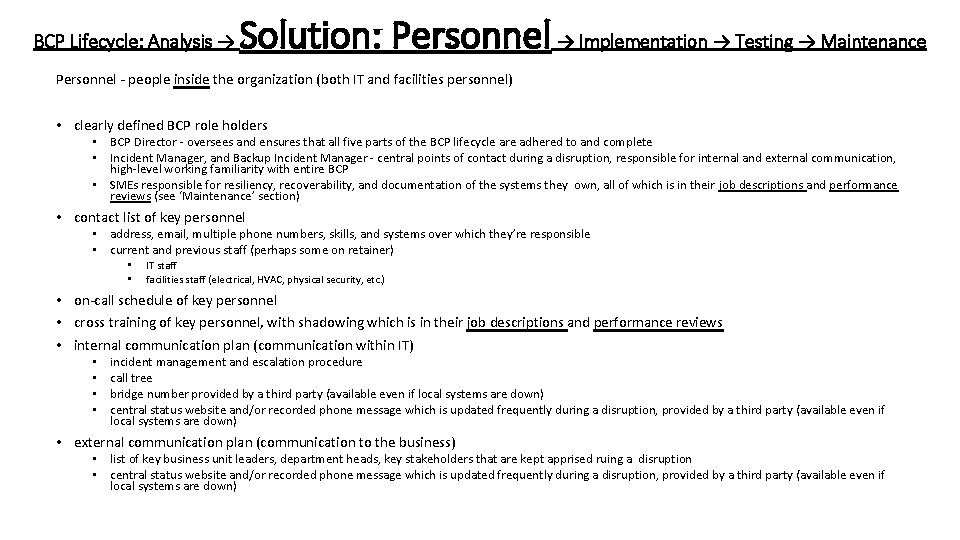
BCP Lifecycle: Analysis → Solution: Personnel → Implementation → Testing → Maintenance Personnel - people inside the organization (both IT and facilities personnel) • clearly defined BCP role holders • BCP Director - oversees and ensures that all five parts of the BCP lifecycle are adhered to and complete • Incident Manager, and Backup Incident Manager - central points of contact during a disruption, responsible for internal and external communication, high-level working familiarity with entire BCP • SMEs responsible for resiliency, recoverability, and documentation of the systems they own, all of which is in their job descriptions and performance reviews (see ‘Maintenance’ section) • contact list of key personnel • address, email, multiple phone numbers, skills, and systems over which they’re responsible • current and previous staff (perhaps some on retainer) • • IT staff facilities staff (electrical, HVAC, physical security, etc. ) • on-call schedule of key personnel • cross training of key personnel, with shadowing which is in their job descriptions and performance reviews • internal communication plan (communication within IT) • • incident management and escalation procedure call tree bridge number provided by a third party (available even if local systems are down) central status website and/or recorded phone message which is updated frequently during a disruption, provided by a third party (available even if local systems are down) • external communication plan (communication to the business) • list of key business unit leaders, department heads, key stakeholders that are kept apprised ruing a disruption • central status website and/or recorded phone message which is updated frequently during a disruption, provided by a third party (available even if local systems are down)
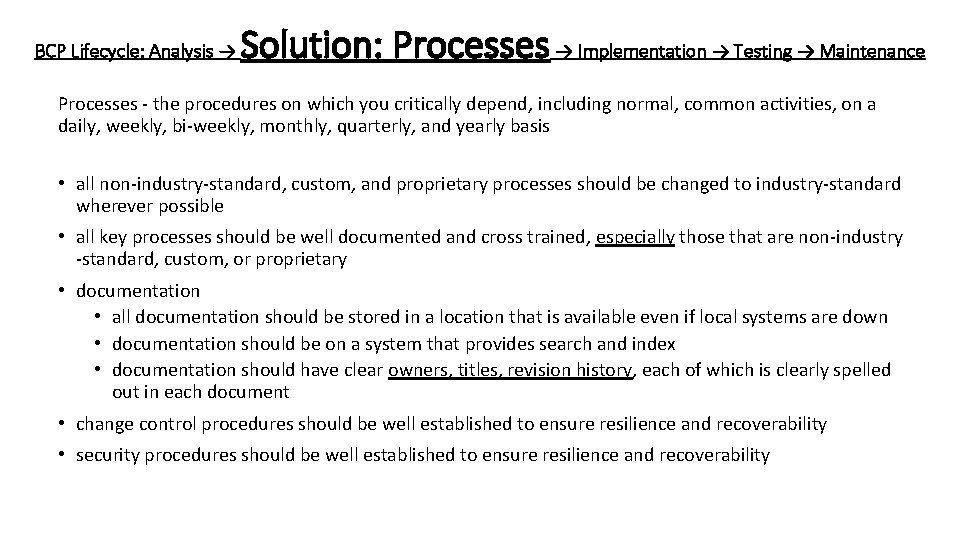
BCP Lifecycle: Analysis → Solution: Processes → Implementation → Testing → Maintenance Processes - the procedures on which you critically depend, including normal, common activities, on a daily, weekly, bi-weekly, monthly, quarterly, and yearly basis • all non-industry-standard, custom, and proprietary processes should be changed to industry-standard wherever possible • all key processes should be well documented and cross trained, especially those that are non-industry -standard, custom, or proprietary • documentation • all documentation should be stored in a location that is available even if local systems are down • documentation should be on a system that provides search and index • documentation should have clear owners, titles, revision history, each of which is clearly spelled out in each document • change control procedures should be well established to ensure resilience and recoverability • security procedures should be well established to ensure resilience and recoverability
BCP Lifecycle: Analysis → Solution: Resources → Implementation → Testing → Maintenance Resources - facilities, hardware (including network), software, data Datacenter configured for resilience and recoverability: (from previous slide) • documentation • monitoring • physical access • environmental control (temperature and humidity) • electrical (load, UPSs, generators, fuel) • fire prevention, detection, and suppression • hardware (network, firewalls, security appliances, proxies, gateways, servers, firmware, upgrade schedule) • software (patches, upgrade schedule) • data (mirroring, backups, archiving, tiering)
BCP Lifecycle: Analysis → Solution: Suppliers → Implementation → Testing → Maintenance suppliers - companies and people outside of the organization that provide resources • contact list of suppliers currently needed for key dependencies • redundant simultaneous sourcing when appropriate • warranties • SLAs • contingency suppliers for key dependencies • contact list of local authorities (e. g. FBI for cyber security issues) • insurance
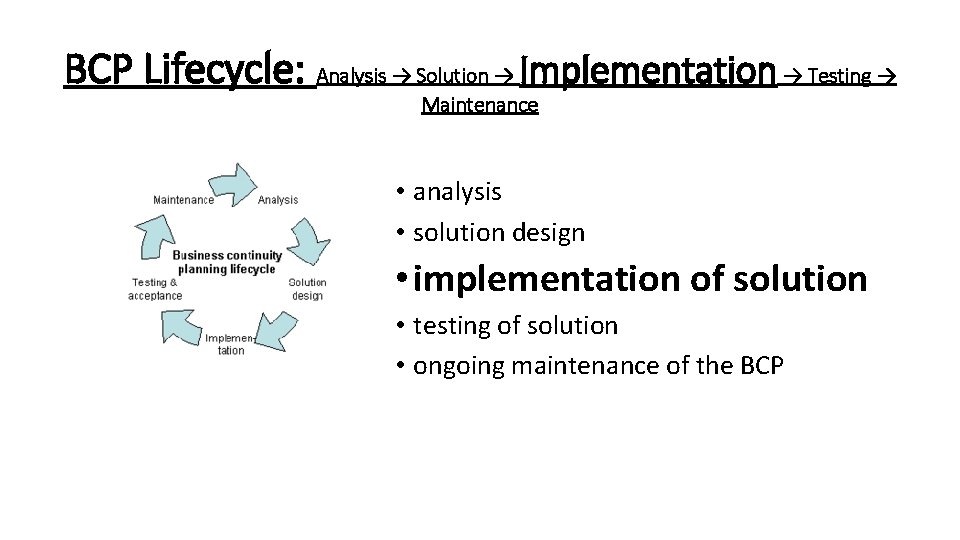
BCP Lifecycle: Analysis → Solution → Implementation → Testing → Maintenance • analysis • solution design • implementation of solution • testing of solution • ongoing maintenance of the BCP
BCP Lifecycle: Analysis → Solution→ Implementation → Testing → Maintenance • prioritization of the completion of solution items • the BCP Director should work with the managers, team leads, and, most importantly, the SMEs to prioritize the solution items • scheduling and milestones for the completion of solution items above • the BCP Director should work with the managers, team leads, and, most importantly, the SMEs to set the scheduling and milestoning of the solution items • ‘LPPRS’ (location, personnel, processes, resources, suppliers) - in addition to the resources needed for the completed solution, increased resources will be needed during the implementation of the solution • personnel will have increased workloads • suppliers will have increased workloads
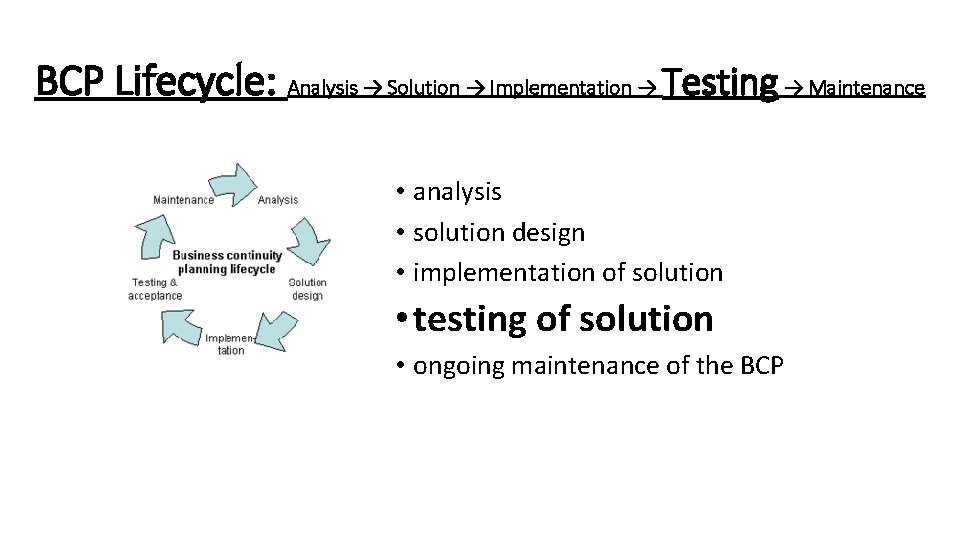
BCP Lifecycle: Analysis → Solution → Implementation → Testing → Maintenance • analysis • solution design • implementation of solution • testing of solution • ongoing maintenance of the BCP
BCP Lifecycle: Analysis → Solution→ Implementation → Testing → Maintenance Recurrent Testing and Acceptance of Solution: • different types of tests should occur at different intervals. From most to least frequent: • communication - a test of the internal and external communication plans • walkthrough - analysis and discussion of the plan by key personnel • desktop scenario - a verbal implementation of the plan by key personnel given a specific set of contrived circumstances. Occasionally, these should be timed with added difficulties injected at random intervals. All circumstances and difficulties should be kept secret until the test begins. • lab - tests of the plan on lab environment by key personnel • live - tests of the plan on production environment by key personnel • there is tremendous ROI in even the first three types of test, and they require very little additional resources, and virtually no risk • create a permanent schedule of regular recurrent testing • these are tests of the BCP, not of your personnel or suppliers
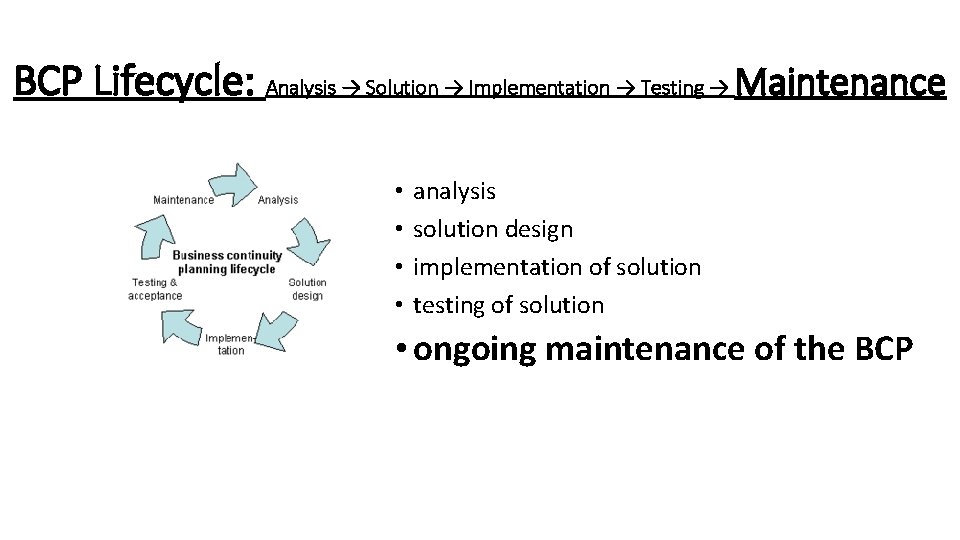
BCP Lifecycle: Analysis → Solution → Implementation → Testing → Maintenance • • analysis solution design implementation of solution testing of solution • ongoing maintenance of the BCP
BCP Lifecycle: Analysis → Solution→ Implementation → Testing → Maintenance Ongoing Maintenance of BCP: • BCP and DRP become out of date very quickly: changes to business, key services, personnel, processes, resources, suppliers • Establish a simple process by which normal IT staff report new and changed services, dependencies, threats, risks, locations, personnel, processes, resources, suppliers, etc. to the BCP Director. • All owners of and contributors to the BCP have clearly defined accountability: • integral part of their job descriptions • line items in goals and performance reviews • BCP documentation • SME cross training and shadowing • BCP tests • Create a schedule for the regular repetition of entire BCP lifecycle (analysis, solution design, implementation of solution, recurrent testing and acceptance of solution, ongoing maintenance of BCP).
BCP & DRP Overview (business continuity plan, disaster recovery plan) Daniel L. Benway Systems & Network Administrator / Engineer Information Security Architect Lead BSc CS, MCSE (NT 4, 2000), MCTS (SCCM 2012), Security+, Network+, CCNA (2. 0), CLP (AD R 4) https: //www. Linked. In. com/in/Daniel. LBenway https: //www. Daniel. LBenway. net @Daniel_L_Benway
- Slides: 38