
BCI Review paper Sections 8 9 BCI Target

BCI Review paper Sections 8 &9
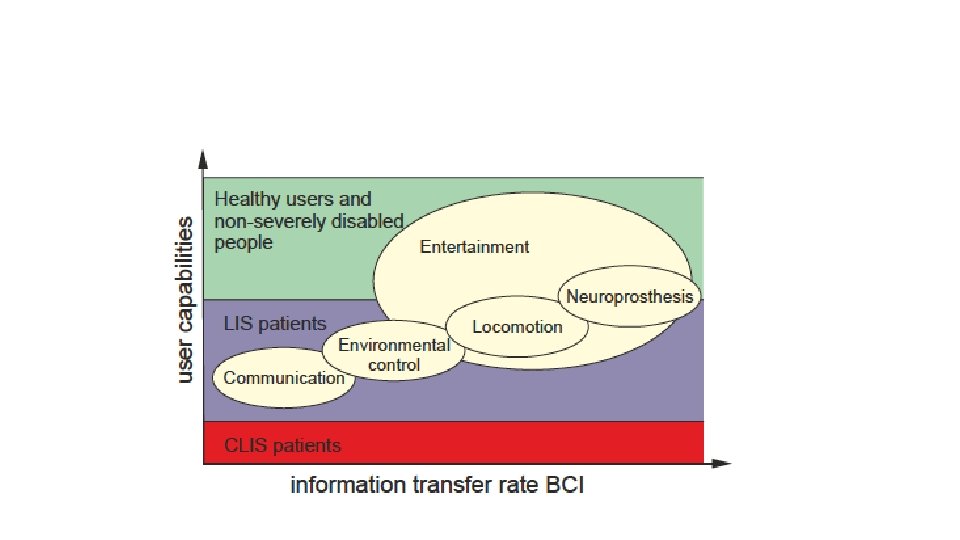
BCI Target Populations • CLIS – completely locked in – no movement ability • LIS – almost completely paralyzed but able to do some movements (e. g. eye movements, eye blinks, facial muscle twitches). This is the main target population for communication BCIs • Able bodied/ healthy people • CLIS patients have been unable to control a BCI • Within LIS patients ability to control BCI not related to their physical impairment level

Hybrid BCIs • Use brain activity combined with other assistive technology (e. g. eye trackers) • Or combination of different BCIs

Challenges in BCIs • Low information transfer rate • High error rate (related to the first point) • BCIs require assistants to apply electrodes/caps • How to turn on the system? • High cognitive load to use the systems
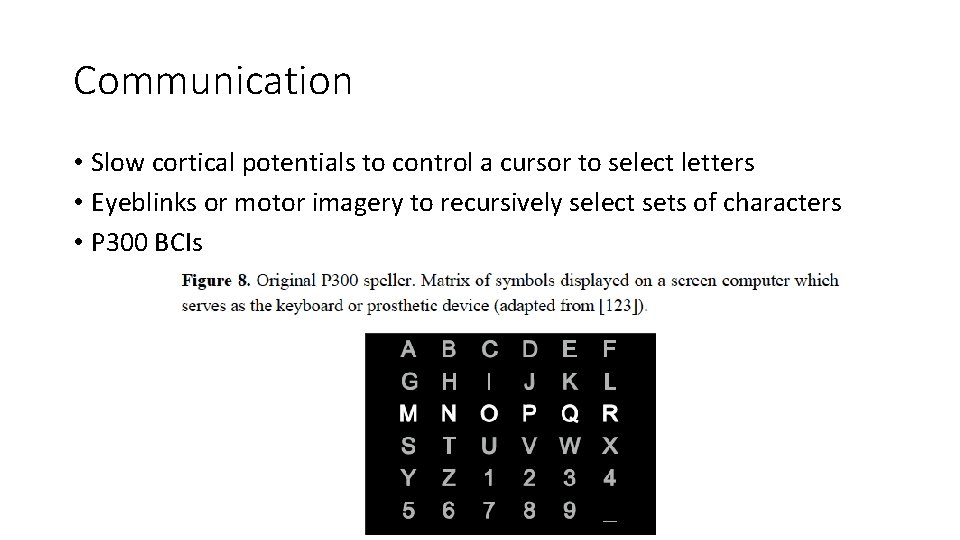
Communication • Slow cortical potentials to control a cursor to select letters • Eyeblinks or motor imagery to recursively select sets of characters • P 300 BCIs
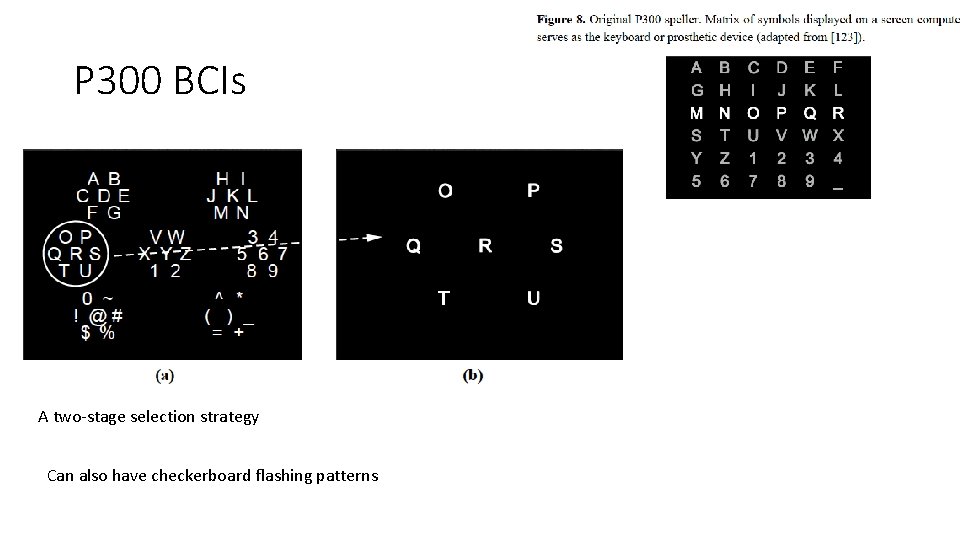
P 300 BCIs A two-stage selection strategy Can also have checkerboard flashing patterns
• The most severely paralyzed people will not be able to foveate stimuli, so systems that flash individual letters centrally or use auditory or tactile P 300 BCIs are being developed • Web browsers can also be controlled with SCP, P 300, and SSVEP systems
Motor Restoration • FES (Functional Electrical Stimulation) can be used to activate intact muscles • FES can be controlled by BCI (often by motor imagery) • Neuroprosthetics can also be used when there is insufficient muscle control • MEG can be used in stroke rehab to pair motor imagery with movement of a mechanical orthosis
Environmental Control • Control lights, TV remote control, door opening, telephone
Locomotion • Important for those who have other methods of communication/environmental control) • Important to give more autonomy/independence • Simplify the user controls and have the wheelchair/device take care of obstacle avoidance etc. • P 300 and SSVEP systems used
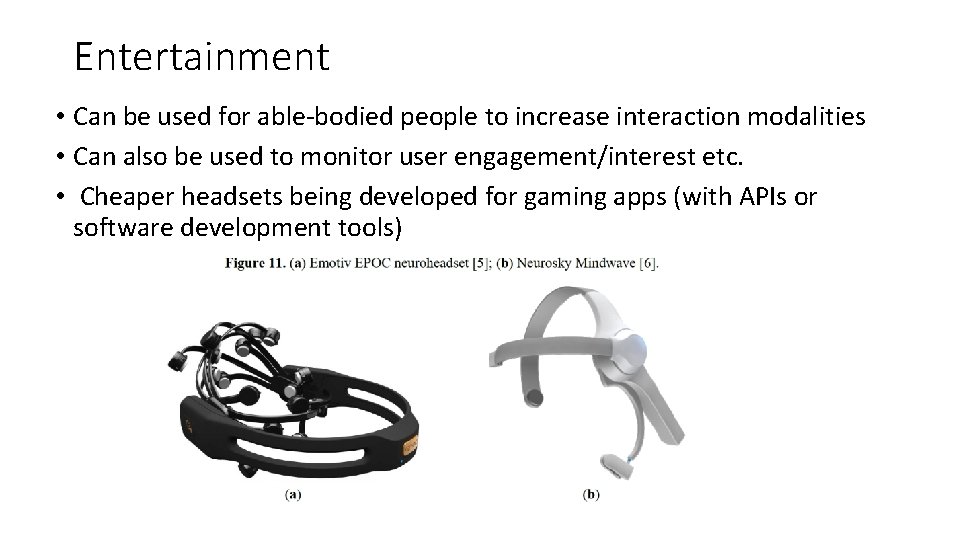
Entertainment • Can be used for able-bodied people to increase interaction modalities • Can also be used to monitor user engagement/interest etc. • Cheaper headsets being developed for gaming apps (with APIs or software development tools)
Other Application Areas • Neurofeedback – feedback info on brain activity to help users better control various aspects of the activity (used for epilepsy, ADD, schizophrenia, depression, alcohol dependence, autism, paedophilia, …) • Neuromarketing – look at brain responses to advertisements/products
Terms and concepts you should know • EEG vs MEG/f. MRI/NIRS/invasive methods • Exogenous vs Endogenous • Synchronous vs Asynchronous • Temporal Filtering basics • Basic features of ICA, CSP • Idea of what types of signals different BCIs are looking for
- Slides: 14