
BCHM 313 Physical Biochemistry Spectroscopy Dr Bruce Hill
BCHM 313 – Physical Biochemistry Spectroscopy Dr. Bruce Hill Email: hillb@queensu. ca Office: Rm. 628 Botterell Hall Lab: Rm. 633
BCHM 313 – Spectroscopy refers to the study of the interaction of electromagnetic radiation with matter. Spectroscopy is useful in both qualitative (what does the matter look like) and quantitative analysis (how much). We are going to consider aspects of, 1) UV-visible absorption 2) Fluorescence 3) Circular dichroism 4) Electron Paramagnetic Resonance (very briefly)
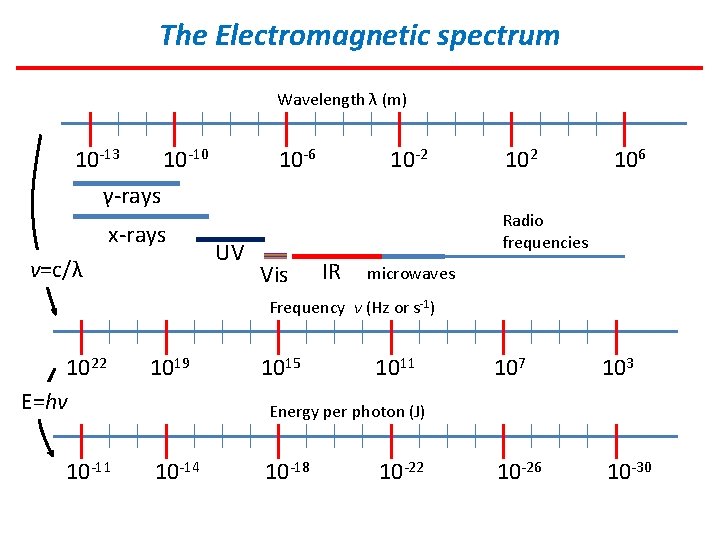
The Electromagnetic spectrum Wavelength λ (m) 10 -13 10 -10 10 -6 10 -2 γ-rays x-rays v=c/λ UV 102 106 Radio frequencies Vis IR microwaves Frequency ν (Hz or s-1) 1022 E=hv 10 -11 1019 1015 1011 107 103 10 -26 10 -30 Energy per photon (J) 10 -14 10 -18 10 -22

Useful spectroscopic regions for biomolecules Typical λ (m) Energy (k. J/mol) Spectroscopic region Application 10 -13 109 γ-ray 10 -10 106 X-ray 10 -7 5 x 10 -6 10 -5 -10 -4 Mössbauer Diffraction, scattering 103 Vacuum UV-UV Electronic spectra C-C bond energy 5 x 10² Visible Electronic spectra 1 -10 • • • RT at 25 o. C • • • IR Vibrational spectra 10 -2 Microwaves EPR 1 10 -3 Radiowaves NMR
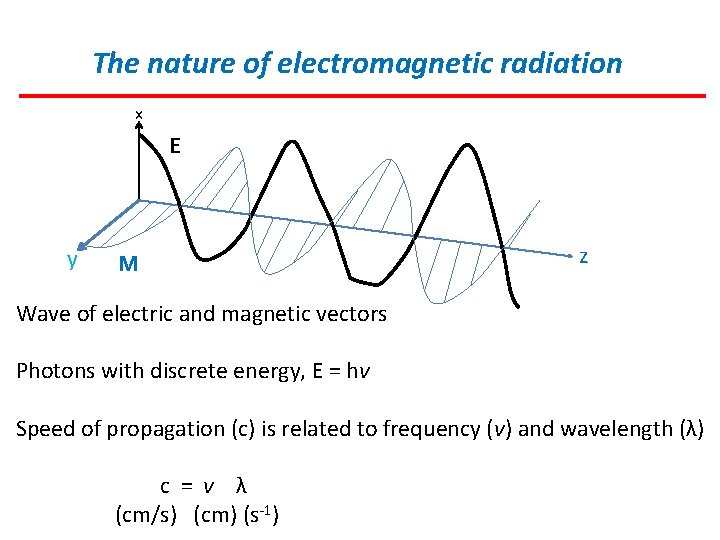
The nature of electromagnetic radiation x E y M z Wave of electric and magnetic vectors Photons with discrete energy, E = hν Speed of propagation (c) is related to frequency (ν) and wavelength (λ) c = ν λ (cm/s) (cm) (s-1)
Stuff, what stuff- what is matter? Properties of matter are dependent on, 1) Energetic state- energy levels are quantized 2) Shape- e. g. , bond angle between H and O atoms in H 2 Ominimal energy - the well-defined shape of folded protein-energetic minimum 3) Dynamics- molecules in solution have kinetic energy rotate, translate, vibrate These properties are interrelated
Energy levels Ground state- state of lowest energy Excited state – states of energy higher than ground state States of equal energy are referred to as degenerate Energy classes translation rotation vibration electronic electron spin orientation nuclear spin orientation
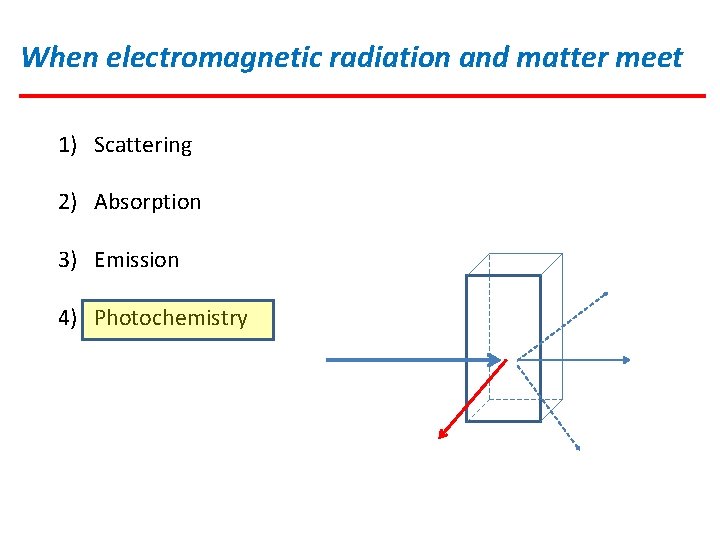
When electromagnetic radiation and matter meet 1) Scattering 2) Absorption 3) Emission 4) Photochemistry

The absorption process Excited state E 2 hv E 1 Absorption occurs when there is a match between the energy of the impinging radiation and the gap between the two states Ground state E 2 -E 1= ΔE = hν, h= Planck’constant ν= frequency (s-1) For there to be net absorption there must be a population difference between the two states, favouring the ground state
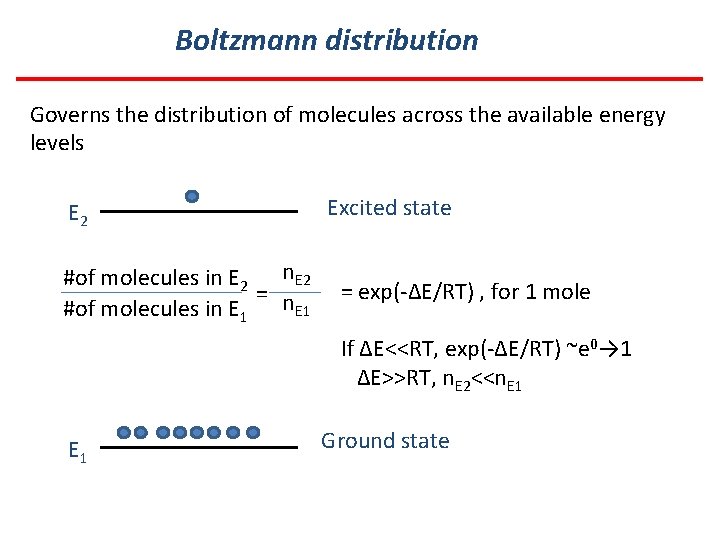
Boltzmann distribution Governs the distribution of molecules across the available energy levels E 2 #of molecules in E 2 n. E 2 = #of molecules in E 1 n. E 1 Excited state = exp(-ΔE/RT) , for 1 mole If ΔE<<RT, exp(-ΔE/RT) ~e 0→ 1 ΔE>>RT, n. E 2<<n. E 1 Ground state
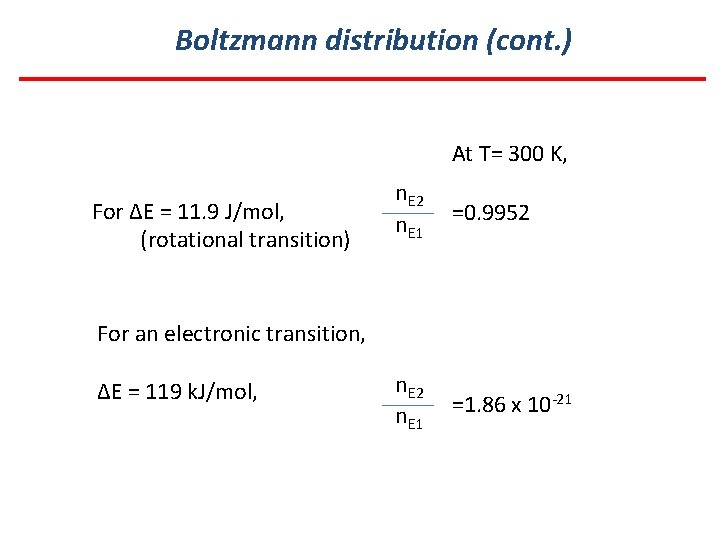
Boltzmann distribution (cont. ) At T= 300 K, For ΔE = 11. 9 J/mol, (rotational transition) n. E 2 n. E 1 =0. 9952 n. E 1 =1. 86 x 10 -21 For an electronic transition, ΔE = 119 k. J/mol,
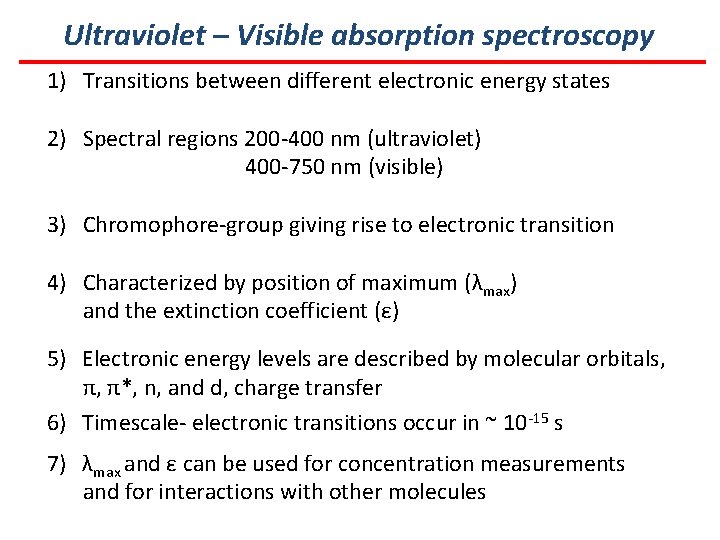
Ultraviolet – Visible absorption spectroscopy 1) Transitions between different electronic energy states 2) Spectral regions 200 -400 nm (ultraviolet) 400 -750 nm (visible) 3) Chromophore-group giving rise to electronic transition 4) Characterized by position of maximum (λmax) and the extinction coefficient (ε) 5) Electronic energy levels are described by molecular orbitals, π, π*, n, and d, charge transfer 6) Timescale- electronic transitions occur in ~ 10 -15 s 7) λmax and ε can be used for concentration measurements and for interactions with other molecules
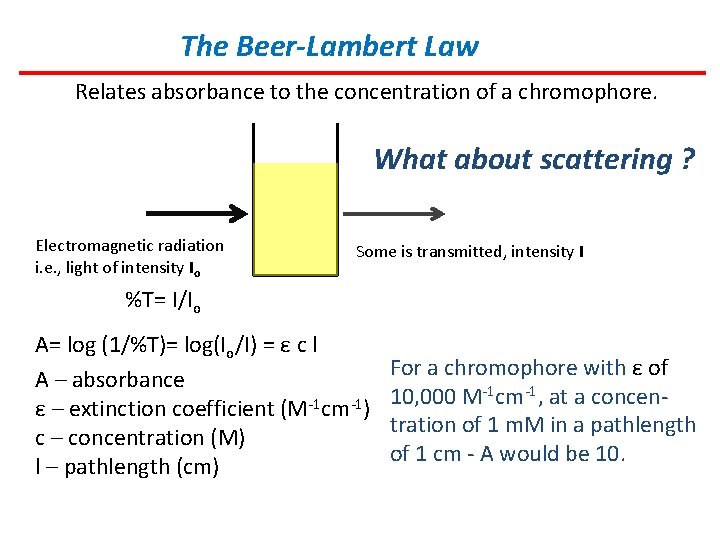
The Beer-Lambert Law Relates absorbance to the concentration of a chromophore. What about scattering ? Electromagnetic radiation i. e. , light of intensity Io Some is transmitted, intensity I %T= I/Io A= log (1/%T)= log(Io/I) = ε c l A – absorbance ε – extinction coefficient (M-1 cm-1) c – concentration (M) l – pathlength (cm) For a chromophore with ε of 10, 000 M-1 cm-1, at a concentration of 1 m. M in a pathlength of 1 cm - A would be 10.
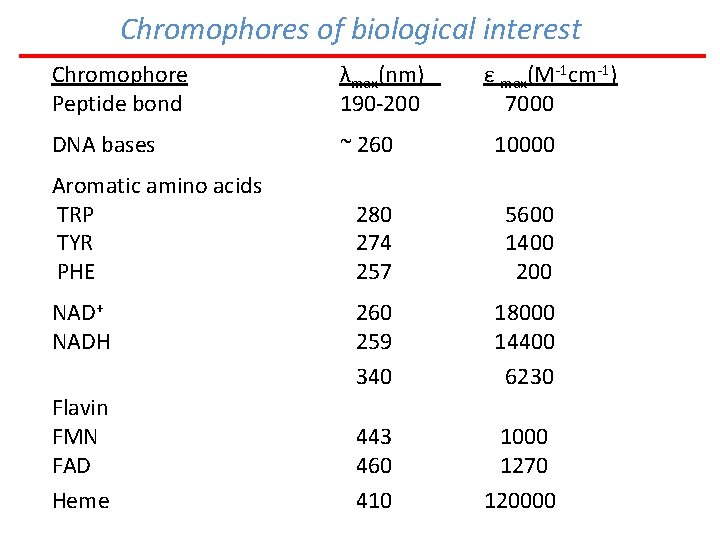
Chromophores of biological interest Chromophore Peptide bond λmax(nm) 190 -200 DNA bases ~ 260 10000 280 274 257 5600 1400 260 259 340 18000 14400 6230 443 460 410 1000 1270 120000 Aromatic amino acids TRP TYR PHE NAD+ NADH Flavin FMN FAD Heme ε max(M-1 cm-1) 7000
- Slides: 14