
BCH 201 Medical Biochemistry I Module II Acids
BCH 201: Medical Biochemistry I Module II Acids, Bases and Buffers
§ Many biologically important molecules are acids or bases. § Hydrochloric, sulfuric, and nitric acids, commonly called strong acids, are completely ionized in dilute aqueous solutions; § the strong bases Na. OH and KOH are also completely ionized. § Of more interest to biochemists is the behaviour of weak acids and bases - those not completely ionized when dissolved in water. § These are common in biological systems and play important roles in metabolism and its regulation.
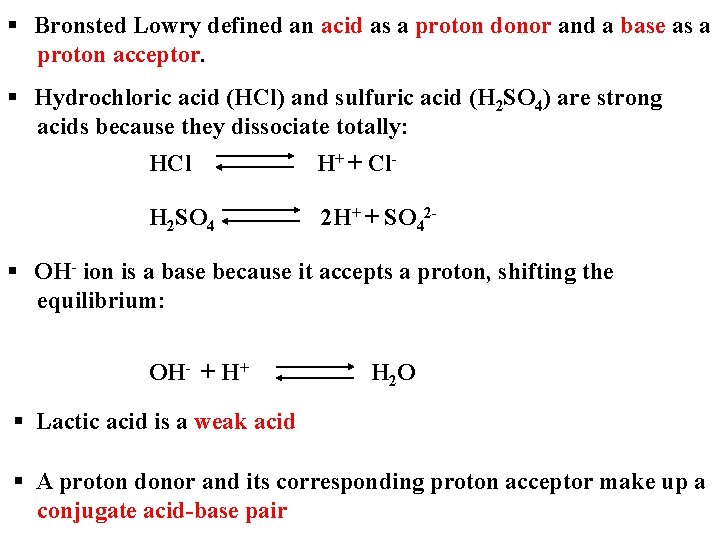
§ Bronsted Lowry defined an acid as a proton donor and a base as a proton acceptor. § Hydrochloric acid (HCl) and sulfuric acid (H 2 SO 4) are strong acids because they dissociate totally: HCl H+ + Cl- H 2 SO 4 2 H+ + SO 42 - § OH- ion is a base because it accepts a proton, shifting the equilibrium: OH- + H+ H 2 O § Lactic acid is a weak acid § A proton donor and its corresponding proton acceptor make up a conjugate acid-base pair
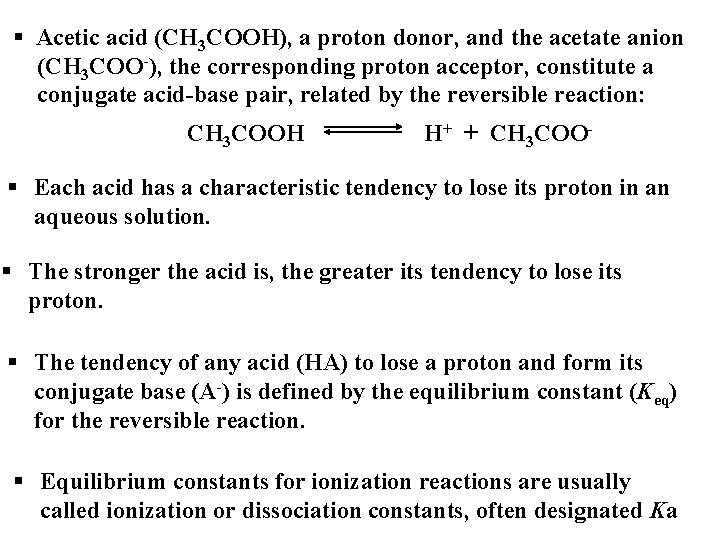
§ Acetic acid (CH 3 COOH), a proton donor, and the acetate anion (CH 3 COO-), the corresponding proton acceptor, constitute a conjugate acid-base pair, related by the reversible reaction: CH 3 COOH H+ + CH 3 COO- § Each acid has a characteristic tendency to lose its proton in an aqueous solution. § The stronger the acid is, the greater its tendency to lose its proton. § The tendency of any acid (HA) to lose a proton and form its conjugate base (A-) is defined by the equilibrium constant (Keq) for the reversible reaction. § Equilibrium constants for ionization reactions are usually called ionization or dissociation constants, often designated Ka
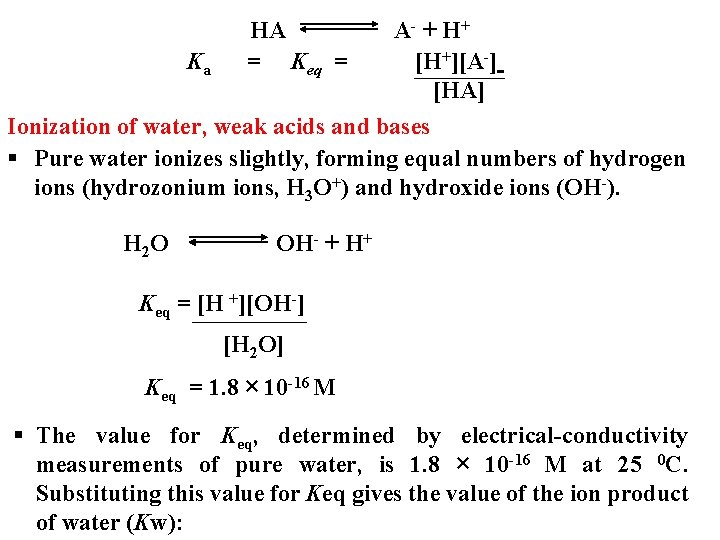
Ka HA = Keq = A- + H + [H+][A-] [HA] Ionization of water, weak acids and bases § Pure water ionizes slightly, forming equal numbers of hydrogen ions (hydrozonium ions, H 3 O+) and hydroxide ions (OH-). H 2 O OH- + H+ Keq = [H +][OH-] [H 2 O] Keq = 1. 8 × 10 -16 M § The value for Keq, determined by electrical-conductivity measurements of pure water, is 1. 8 × 10 -16 M at 25 0 C. Substituting this value for Keq gives the value of the ion product of water (Kw):
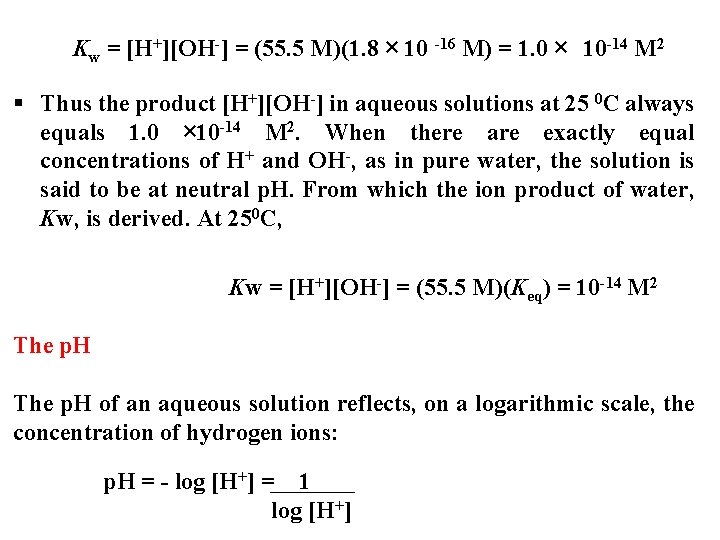
Kw = [H+][OH-] = (55. 5 M)(1. 8 × 10 -16 M) = 1. 0 × 10 -14 M 2 § Thus the product [H+][OH-] in aqueous solutions at 25 0 C always equals 1. 0 × 10 -14 M 2. When there are exactly equal concentrations of H+ and OH-, as in pure water, the solution is said to be at neutral p. H. From which the ion product of water, Kw, is derived. At 250 C, Kw = [H+][OH-] = (55. 5 M)(Keq) = 10 -14 M 2 The p. H of an aqueous solution reflects, on a logarithmic scale, the concentration of hydrogen ions: p. H = - log [H+] = 1 log [H+]
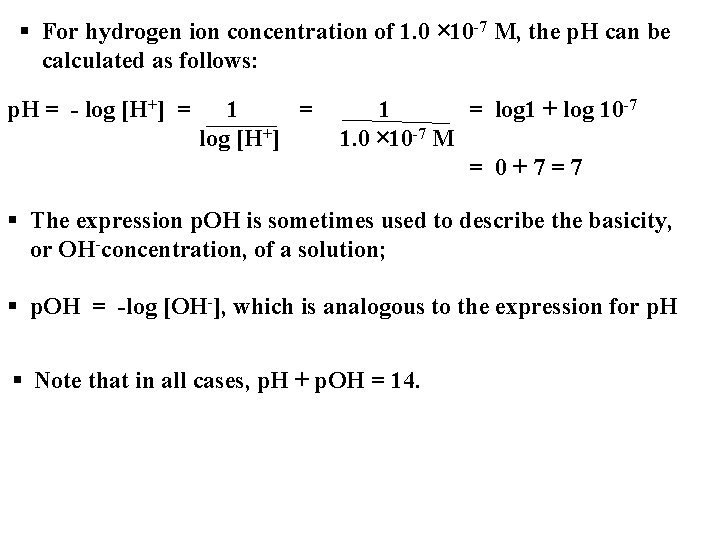
§ For hydrogen ion concentration of 1. 0 × 10 -7 M, the p. H can be calculated as follows: p. H = - log [H+] = 1 = log [H+] 1 = log 1 + log 10 -7 1. 0 × 10 -7 M = 0+7=7 § The expression p. OH is sometimes used to describe the basicity, or OH-concentration, of a solution; § p. OH = -log [OH-], which is analogous to the expression for p. H § Note that in all cases, p. H + p. OH = 14.
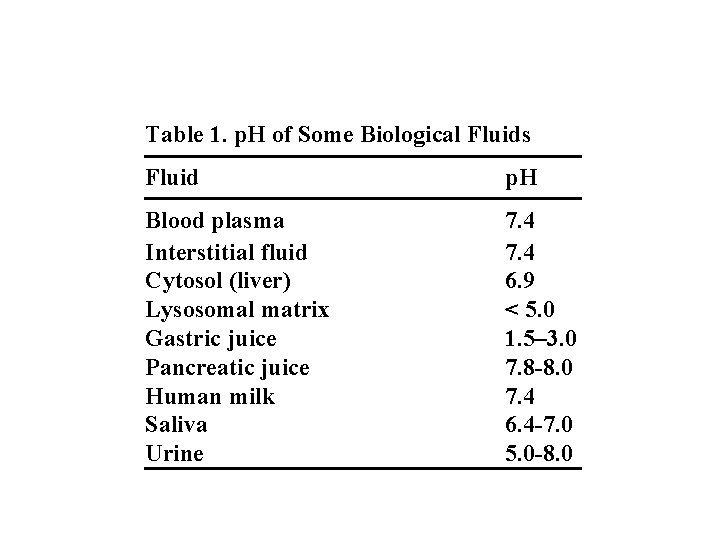
Table 1. p. H of Some Biological Fluids Fluid p. H Blood plasma Interstitial fluid Cytosol (liver) Lysosomal matrix Gastric juice Pancreatic juice Human milk Saliva Urine 7. 4 6. 9 < 5. 0 1. 5– 3. 0 7. 8 -8. 0 7. 4 6. 4 -7. 0 5. 0 -8. 0
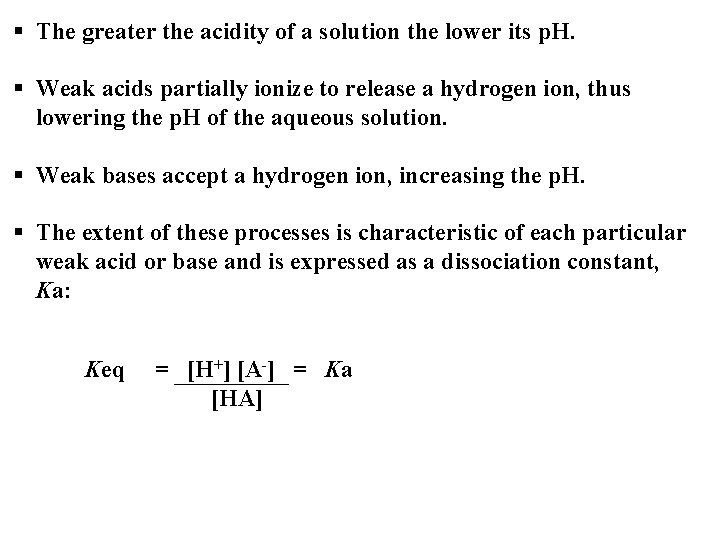
§ The greater the acidity of a solution the lower its p. H. § Weak acids partially ionize to release a hydrogen ion, thus lowering the p. H of the aqueous solution. § Weak bases accept a hydrogen ion, increasing the p. H. § The extent of these processes is characteristic of each particular weak acid or base and is expressed as a dissociation constant, Ka: Keq = [H+] [A-] = Ka [HA]
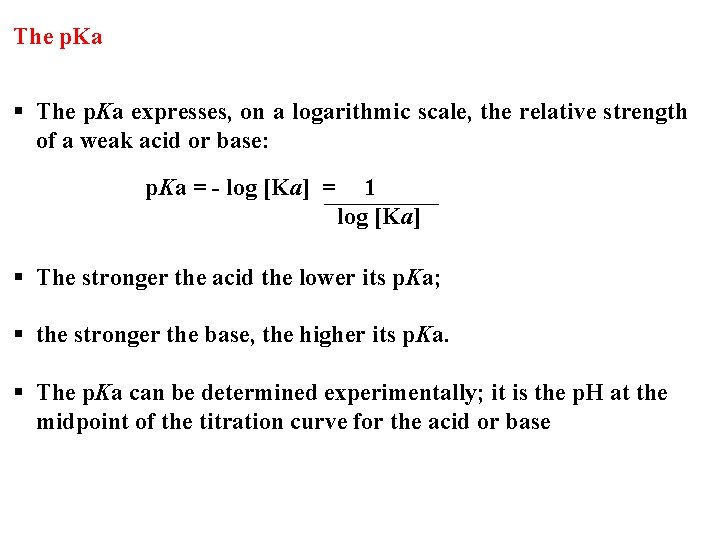
The p. Ka § The p. Ka expresses, on a logarithmic scale, the relative strength of a weak acid or base: p. Ka = - log [Ka] = 1 log [Ka] § The stronger the acid the lower its p. Ka; § the stronger the base, the higher its p. Ka. § The p. Ka can be determined experimentally; it is the p. H at the midpoint of the titration curve for the acid or base
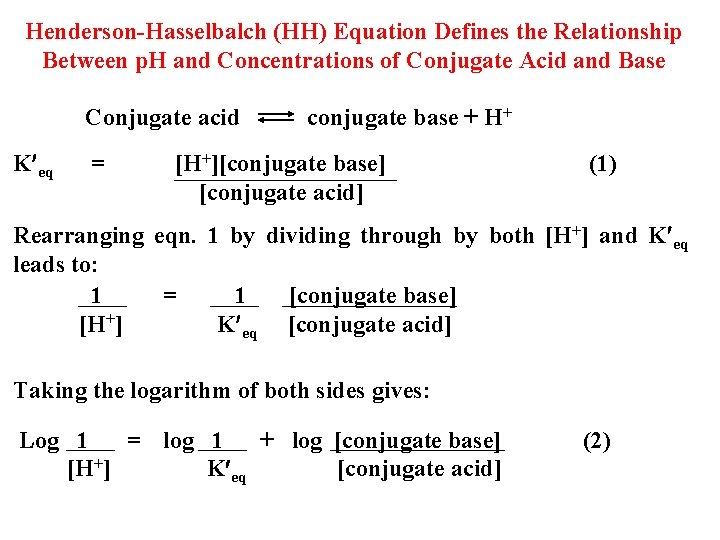
Henderson-Hasselbalch (HH) Equation Defines the Relationship Between p. H and Concentrations of Conjugate Acid and Base Conjugate acid K eq = conjugate base + H+ [H+][conjugate base] [conjugate acid] (1) Rearranging eqn. 1 by dividing through by both [H+] and K eq leads to: 1 = 1 [conjugate base] [H+] K eq [conjugate acid] Taking the logarithm of both sides gives: Log 1 = log 1 + log [conjugate base] [H+] K eq [conjugate acid] (2)
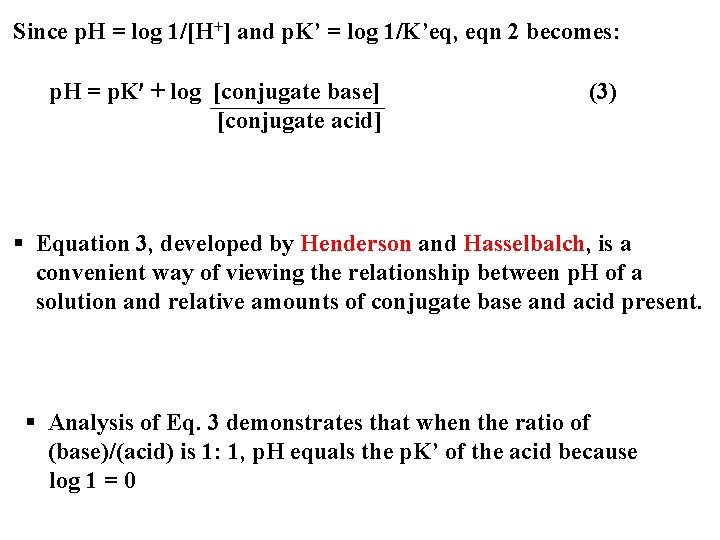
Since p. H = log 1/[H+] and p. K’ = log 1/K’eq, eqn 2 becomes: p. H = p. K + log [conjugate base] [conjugate acid] (3) § Equation 3, developed by Henderson and Hasselbalch, is a convenient way of viewing the relationship between p. H of a solution and relative amounts of conjugate base and acid present. § Analysis of Eq. 3 demonstrates that when the ratio of (base)/(acid) is 1: 1, p. H equals the p. K’ of the acid because log 1 = 0
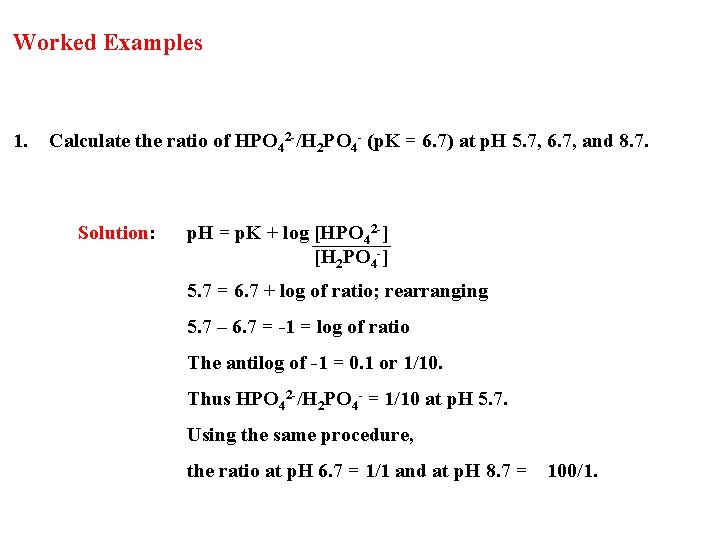
Worked Examples 1. Calculate the ratio of HPO 42 -/H 2 PO 4 - (p. K = 6. 7) at p. H 5. 7, 6. 7, and 8. 7. Solution: p. H = p. K + log [HPO 42 -] [H 2 PO 4 -] 5. 7 = 6. 7 + log of ratio; rearranging 5. 7 – 6. 7 = -1 = log of ratio The antilog of -1 = 0. 1 or 1/10. Thus HPO 42 -/H 2 PO 4 - = 1/10 at p. H 5. 7. Using the same procedure, the ratio at p. H 6. 7 = 1/1 and at p. H 8. 7 = 100/1.
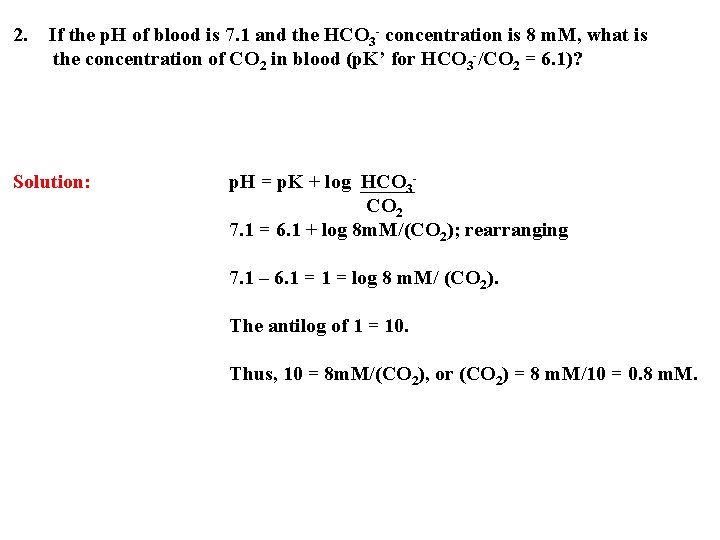
2. If the p. H of blood is 7. 1 and the HCO 3 - concentration is 8 m. M, what is the concentration of CO 2 in blood (p. K’ for HCO 3 -/CO 2 = 6. 1)? Solution: p. H = p. K + log HCO 3 CO 2 7. 1 = 6. 1 + log 8 m. M/(CO 2); rearranging 7. 1 – 6. 1 = log 8 m. M/ (CO 2). The antilog of 1 = 10. Thus, 10 = 8 m. M/(CO 2), or (CO 2) = 8 m. M/10 = 0. 8 m. M.
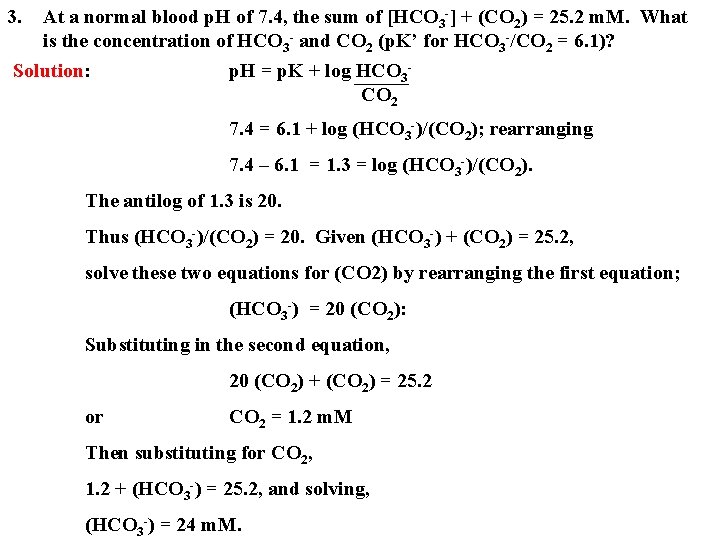
3. At a normal blood p. H of 7. 4, the sum of [HCO 3 -] + (CO 2) = 25. 2 m. M. What is the concentration of HCO 3 - and CO 2 (p. K’ for HCO 3 -/CO 2 = 6. 1)? Solution: p. H = p. K + log HCO 3 CO 2 7. 4 = 6. 1 + log (HCO 3 -)/(CO 2); rearranging 7. 4 – 6. 1 = 1. 3 = log (HCO 3 -)/(CO 2). The antilog of 1. 3 is 20. Thus (HCO 3 -)/(CO 2) = 20. Given (HCO 3 -) + (CO 2) = 25. 2, solve these two equations for (CO 2) by rearranging the first equation; (HCO 3 -) = 20 (CO 2): Substituting in the second equation, 20 (CO 2) + (CO 2) = 25. 2 or CO 2 = 1. 2 m. M Then substituting for CO 2, 1. 2 + (HCO 3 -) = 25. 2, and solving, (HCO 3 -) = 24 m. M.
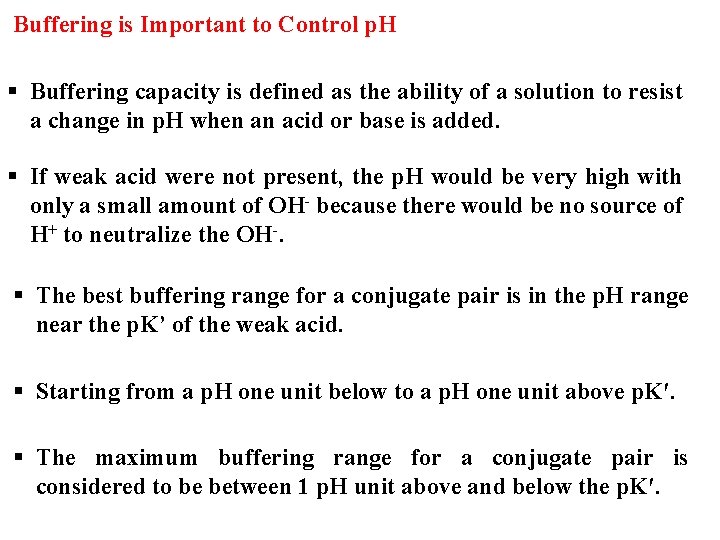
Buffering is Important to Control p. H § Buffering capacity is defined as the ability of a solution to resist a change in p. H when an acid or base is added. § If weak acid were not present, the p. H would be very high with only a small amount of OH- because there would be no source of H+ to neutralize the OH-. § The best buffering range for a conjugate pair is in the p. H range near the p. K’ of the weak acid. § Starting from a p. H one unit below to a p. H one unit above p. K′. § The maximum buffering range for a conjugate pair is considered to be between 1 p. H unit above and below the p. K′.
§ Lactic acid with p. K′ = 3. 86 is an effective buffer in the range of p. H 3 to 5 but has no buffering capacity at p. H = 7. 0. § The HPO 42 -/H 2 PO 4 - pair with p. K′ = 6. 7, however, is an effective buffer at p. H = 7. 0. Thus at the p. H of the cell’s cytosol (7. 0), the lactate-lactic acid pair is not an effective buffer but the phosphate system is. § Buffering capacity also depends on the concentrations of conjugate acid and base. § The higher the concentration of conjugate base, the more added H+ with which it can react. § The more conjugate acid the more added OH- can be neutralized by the dissociation of the acid.
§ A case in point is blood plasma at p. H 7. 4 for HPO 42 -/H 2 PO 4 - , the p. K of 6. 7 would suggest that this conjugate pair would be an effective buffer; the concentration of the phosphate pair, however, is low compared to that of the HCO 3 -/CO 2 system with a p. K’ of 6. 1, which is present at a 20 -fold higher concentration and accounts for most of the buffering capacity. § In considering the buffering capacity, both the p. K and the concentrations of the conjugate pair must be taken into account. § Most organic acids are relatively unimportant as buffers in cellular fluids because their p. K values are more than several p. H units lower than the p. H of the cell, and their concentrations are too low in comparison to such buffers as HPO 42 -/H 2 PO 4 - and the HCO 3 -/CO 2 system
Blood, Lungs, and Buffer: The Bicarbonate Buffer System § In animals with lungs, the bicarbonate buffer system is an effective physiological buffer near p. H 7. 4, because the H 2 CO 3 of blood plasma is in equilibrium with a large reserve capacity of CO 2 (g) in the air space of the lungs. § This buffer system involves three reversible equilibria between gaseous CO 2 in the lungs and bicarbonate (HCO 3 -) in the blood plasma. § When H+ (from lactic acid produced in muscle tissue during vigorous exercise, for example) is added to blood as it passes through the tissues, reaction 1 proceeds toward a new equilibrium, in which the concentration of H 2 CO 3 is increased.
§ This increases the concentration of CO 2 (d) in the blood plasma (reaction 2) and thus increases the pressure of CO 2 (g) exhaled. § Conversely, when the p. H of blood plasma is raised (by NH 3 production during protein catabolism, for example), the opposite events occur: H+ concentration of blood plasma is lowered, causing more H 2 CO 3 to dissociate into H+ and HCO 3 -. § This in turn causes more CO 2 (g) from the lungs to dissolve in the blood plasma. § The rate of breathing – that is, the rate of inhaling and exhaling CO 2 – can quickly adjust this equilibrium to keep the blood p. H nearly constant.
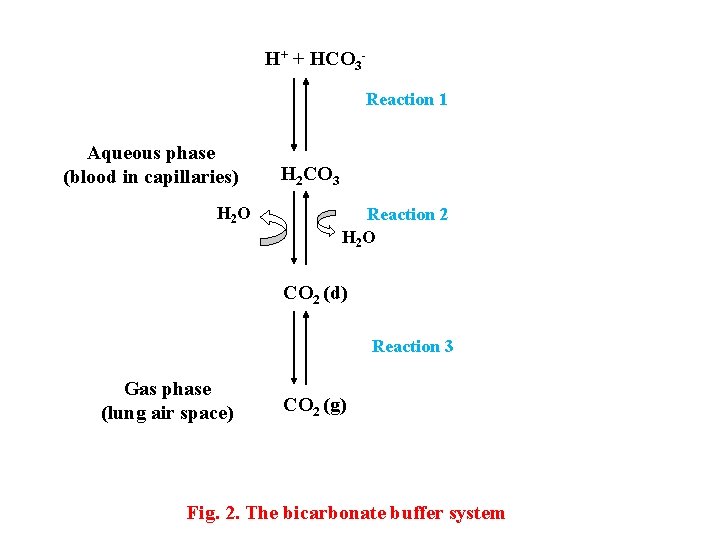
H+ + HCO 3 Reaction 1 Aqueous phase (blood in capillaries) H 2 O H 2 CO 3 Reaction 2 H 2 O CO 2 (d) Reaction 3 Gas phase (lung air space) CO 2 (g) Fig. 2. The bicarbonate buffer system
§ The CO 2 in the air space of the lung is in equilibrium with the biocarbonate buffer in the blood plasma passing through the lung capillaries. § Because the concentration of dissolved CO 2 can be adjusted rapidly through changes in the rate of breathing, the biocarbonate buffer system of the blood is in near-equilibrium with a large potential reservoir of CO 2
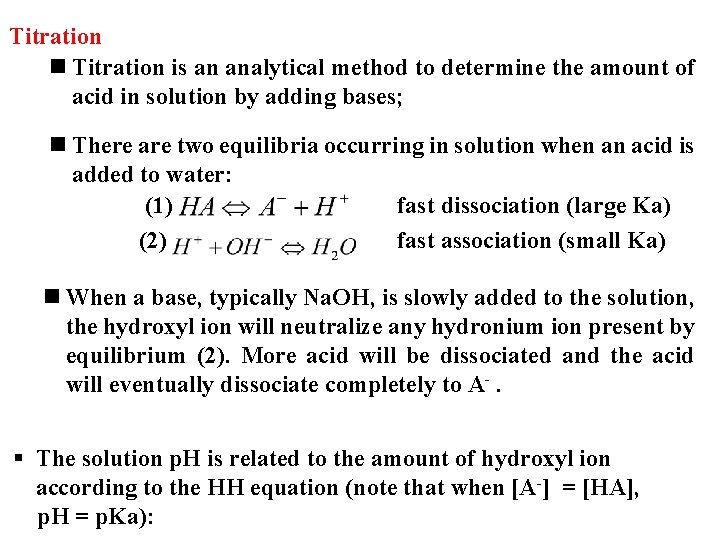
Titration is an analytical method to determine the amount of acid in solution by adding bases; There are two equilibria occurring in solution when an acid is added to water: (1) fast dissociation (large Ka) (2) fast association (small Ka) When a base, typically Na. OH, is slowly added to the solution, the hydroxyl ion will neutralize any hydronium ion present by equilibrium (2). More acid will be dissociated and the acid will eventually dissociate completely to A-. § The solution p. H is related to the amount of hydroxyl ion according to the HH equation (note that when [A-] = [HA], p. H = p. Ka):
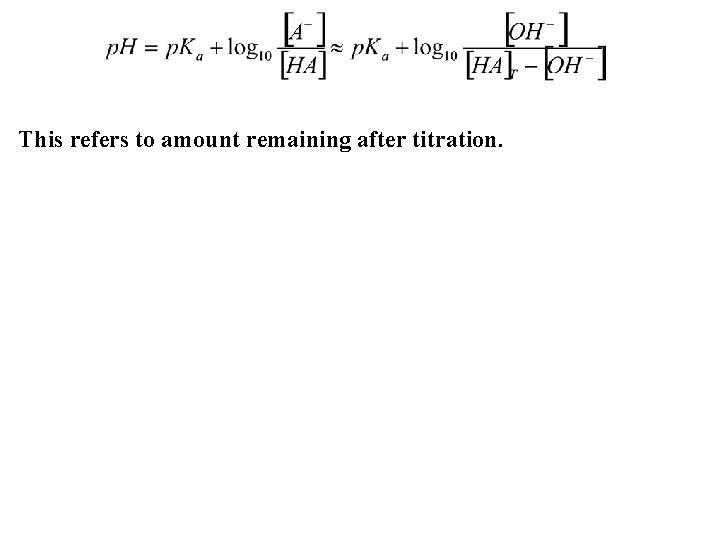
This refers to amount remaining after titration.
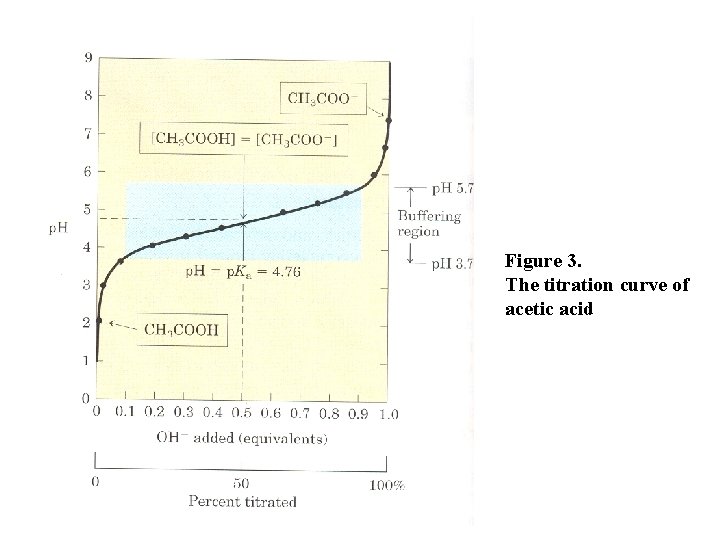
Figure 3. The titration curve of acetic acid
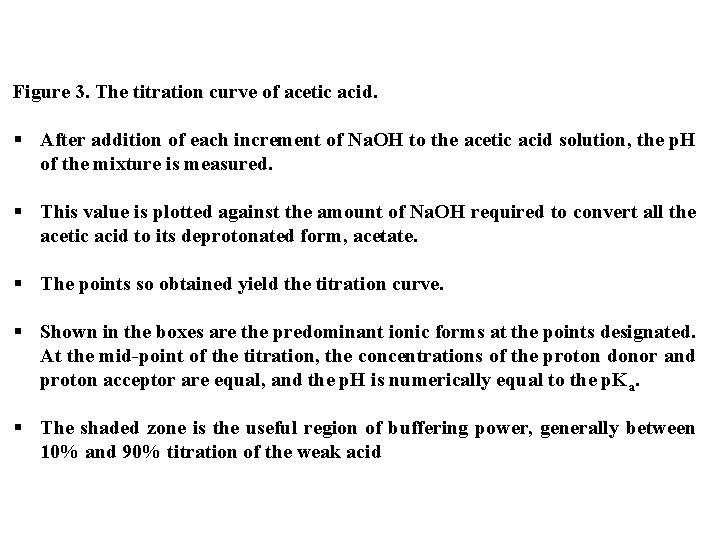
Figure 3. The titration curve of acetic acid. § After addition of each increment of Na. OH to the acetic acid solution, the p. H of the mixture is measured. § This value is plotted against the amount of Na. OH required to convert all the acetic acid to its deprotonated form, acetate. § The points so obtained yield the titration curve. § Shown in the boxes are the predominant ionic forms at the points designated. At the mid-point of the titration, the concentrations of the proton donor and proton acceptor are equal, and the p. H is numerically equal to the p. Ka. § The shaded zone is the useful region of buffering power, generally between 10% and 90% titration of the weak acid
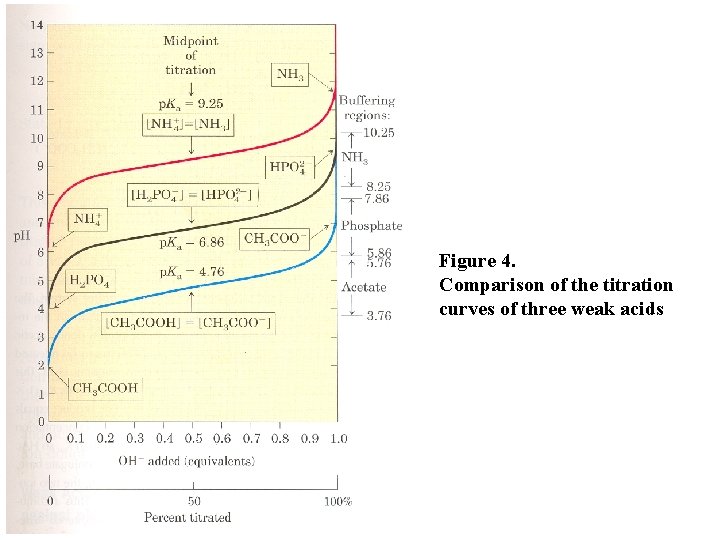
Figure 4. Comparison of the titration curves of three weak acids
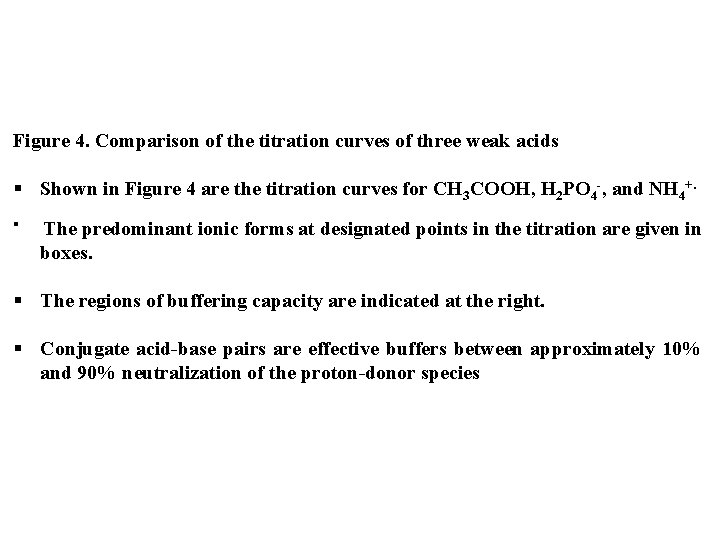
Figure 4. Comparison of the titration curves of three weak acids § Shown in Figure 4 are the titration curves for CH 3 COOH, H 2 PO 4 -, and NH 4+. § The predominant ionic forms at designated points in the titration are given in boxes. § The regions of buffering capacity are indicated at the right. § Conjugate acid-base pairs are effective buffers between approximately 10% and 90% neutralization of the proton-donor species
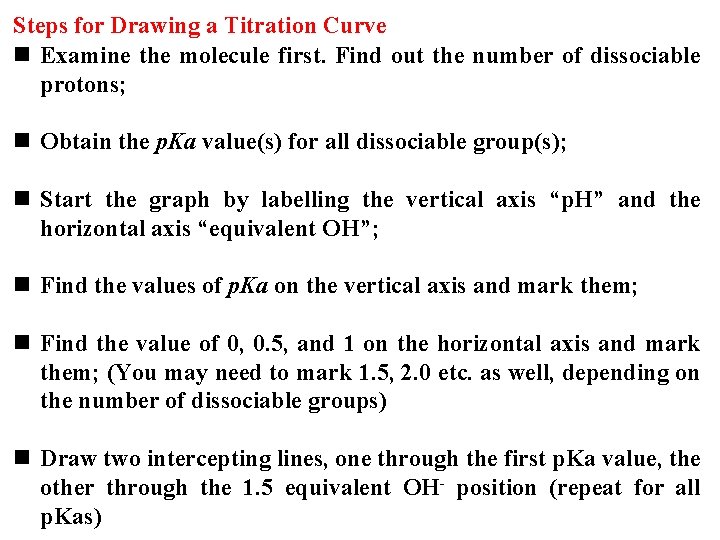
Steps for Drawing a Titration Curve Examine the molecule first. Find out the number of dissociable protons; Obtain the p. Ka value(s) for all dissociable group(s); Start the graph by labelling the vertical axis “p. H” and the horizontal axis “equivalent OH”; Find the values of p. Ka on the vertical axis and mark them; Find the value of 0, 0. 5, and 1 on the horizontal axis and mark them; (You may need to mark 1. 5, 2. 0 etc. as well, depending on the number of dissociable groups) Draw two intercepting lines, one through the first p. Ka value, the other through the 1. 5 equivalent OH- position (repeat for all p. Kas)
- Slides: 29