
BC Timber Sales Environmental Management System EMS and
BC Timber Sales Environmental Management System (EMS) and Sustainable Forest Management (SFM) Awareness Training for BCTS Staff Updated: April, 2012
Acronyms used in this training BCTS = BC Timber Sales BA = Business Area, i. e. : local BCTS office LPC = Licencee, Permittee or Contractor LWCP = Licencee With Cutting Permit EMS = Environmental Management System EOP = Environmental Operating Procedure EFP = Environmental Field Procedure e. ERP = Environmental Emergency Response Plan SFMP = Sustainable Forest Management Plan April 2012 - Version 3. 2
Section #1: EMS Overview v. The scope of the EMS v. ISO 14001 v. System overview April 2012 - Version 3. 2
EMS Review Scope of the BCTS EMS ü Defining the scope The activities where the EMS is applied and implemented by BCTS staff and LPCs ü Defining the activities ü ü Planning (i. e. assessments, layout, cruising, etc) Harvesting (i. e. falling, yarding, processing, loading, etc. ) Roads (i. e. subgrade construction, surfacing, culverts, etc. ) Silviculture (i. e. site prep, planting, surveys, etc. ) ü Defining the locations ü All areas covered under a BCTS license, permit or contract X Not LPC camps (except when covered under contracts, i. e. planting camps), shops or off-site facilities April 2012 - Version 3. 2
EMS Review Why Do We Need an EMS? • To protect the environment (through a systematic process) • To promote environmental Due Diligence (through training, monitoring, & follow up) • To allow an outside, 3 rd party auditor to verify our claims that BCTS protects the environment • To have an efficient system for improving our business April 2012 - Version 3. 2
EMS Review Why Do We Need an EMS? • Due Diligence defense considers if the following are in place: – – – Preventative system (e. g. EMS) Training programs Internal / external audits Risk assessments Contingency plans designed to prevents • BC Timber Sales EMS offers all of these elements April 2012 - Version 3. 2
EMS Review What is our EMS? • Defines the environmental performance we plan to achieve • Describes who will do what, when to achieve it • Clear roles and responsibilities at all levels of BCTS and for our LPCs • Always evaluating and improving the system and our performance April 2012 - Version 3. 2
EMS Review What is ISO 14001? • A standard (ISO 14001: 2004) that defines the necessary elements of an effective environmental management system • Recognized internationally • Implementation in Canada overseen by the Standards Council of Canada April 2012 - Version 3. 2
EMS Review What does ISO Certification mean? ü The BCTS EMS meets the ISO 14001 standard and ü Independent auditors confirm that BCTS is following the practices and procedures that are outlined in the EMS April 2012 - Version 3. 2
EMS Review ISO 14001 Certification Does Not: r. Verify the sustainability of our forest management practices r. Verify that our products come from certified forests r. Allow us to use a certification stamp on our products April 2012 - Version 3. 2
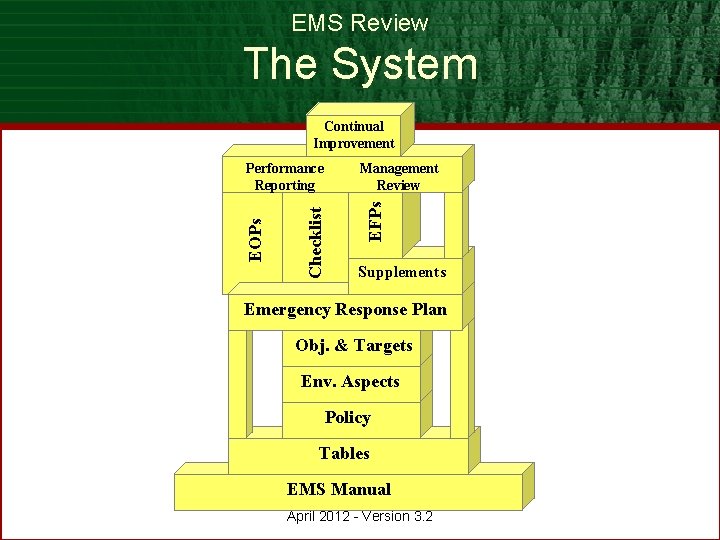
EMS Review The System Continual Improvement EFPs Management Review Checklist EOPs Performance Reporting Supplements Emergency Response Plan Obj. & Targets Env. Aspects Policy Tables EMS Manual April 2012 - Version 3. 2
Section #2: The EMS Cycle v. PLAN – Policy, Environmental Aspects v. DO – Operational controls, training v. CHECK – Monitoring, Inspection, Audits v. RESPOND – Incident and Action Plan Tracking April 2012 - Version 3. 2
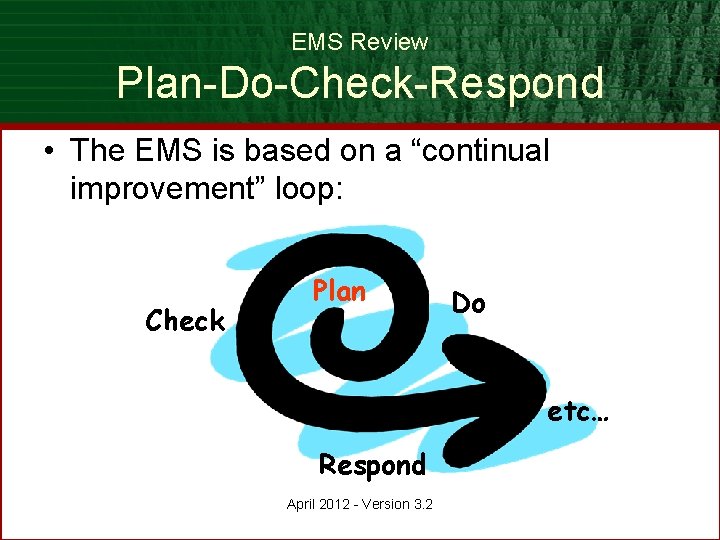
EMS Review Plan-Do-Check-Respond • The EMS is based on a “continual improvement” loop: Check Plan Do etc… Respond April 2012 - Version 3. 2
EMS Review 1. The PLAN • EMS Policy – States the guiding principles of our EMS – Commits to: • Meeting all laws and other requirements to which we subscribe • Strive for excellence in forest management, continually improving • Preventing pollution • Monitoring and evaluating key BCTS forestry operations • Communicating to staff and the public April 2012 - Version 3. 2
EMS Review 1. The PLAN • Environmental Aspects “An element of an organization’s activities that can interact with the environment” Significant environmental aspects have a higher risk of negatively impacting natural resources and the environment Examples can include: 1. Fuel Handling (refueling, servicing, storage, transport) Spillage of: Chemical products 2. Construction/rehabilitation of trails within harvest areas (Backspar and hoe forwarding, etc. ) April 2012 - Version 3. 2
EMS Review 2. DO • Implement “Operational Controls” to manage significant environmental aspects – Environmental Field Procedures (EFPs) – Environmental Operating Procedures(EOPs) – Preworks for all LPCs – Monitoring and inspecting of activities – Environmental emergency response plans • Must know the requirements for the tasks you are doing April 2012 - Version 3. 2
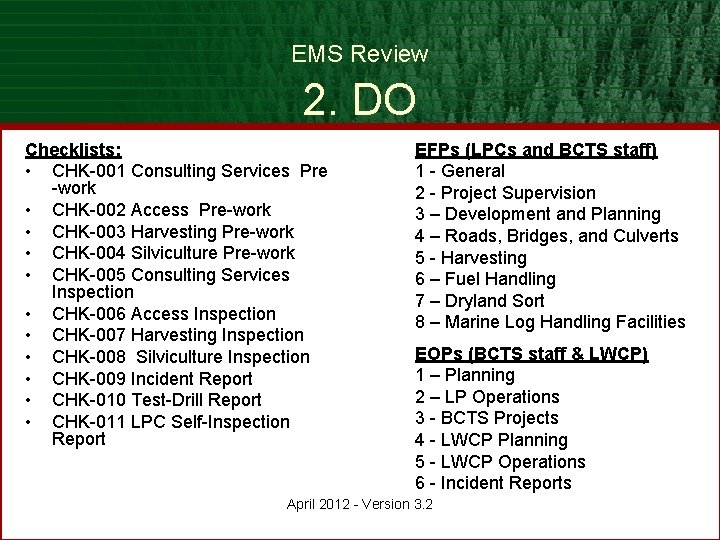
EMS Review 2. DO Checklists: • CHK-001 Consulting Services Pre -work • CHK-002 Access Pre-work • CHK-003 Harvesting Pre-work • CHK-004 Silviculture Pre-work • CHK-005 Consulting Services Inspection • CHK-006 Access Inspection • CHK-007 Harvesting Inspection • CHK-008 Silviculture Inspection • CHK-009 Incident Report • CHK-010 Test-Drill Report • CHK-011 LPC Self-Inspection Report EFPs (LPCs and BCTS staff) 1 - General 2 - Project Supervision 3 – Development and Planning 4 – Roads, Bridges, and Culverts 5 - Harvesting 6 – Fuel Handling 7 – Dryland Sort 8 – Marine Log Handling Facilities EOPs (BCTS staff & LWCP) 1 – Planning 2 – LP Operations 3 - BCTS Projects 4 - LWCP Planning 5 - LWCP Operations 6 - Incident Reports April 2012 - Version 3. 2
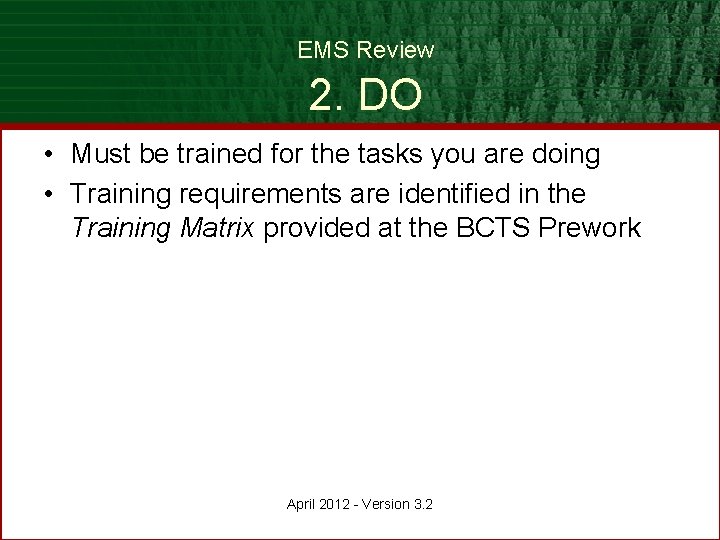
EMS Review 2. DO • Must be trained for the tasks you are doing • Training requirements are identified in the Training Matrix provided at the BCTS Prework April 2012 - Version 3. 2
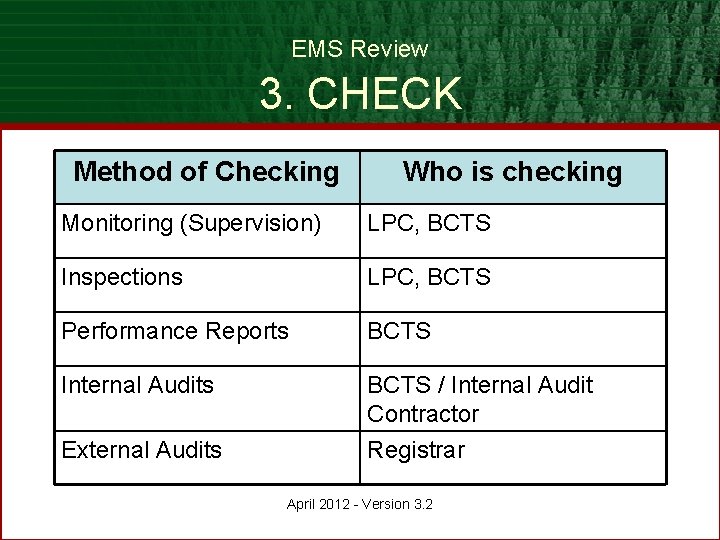
EMS Review 3. CHECK Method of Checking Who is checking Monitoring (Supervision) LPC, BCTS Inspections LPC, BCTS Performance Reports BCTS Internal Audits BCTS / Internal Audit Contractor Registrar External Audits April 2012 - Version 3. 2
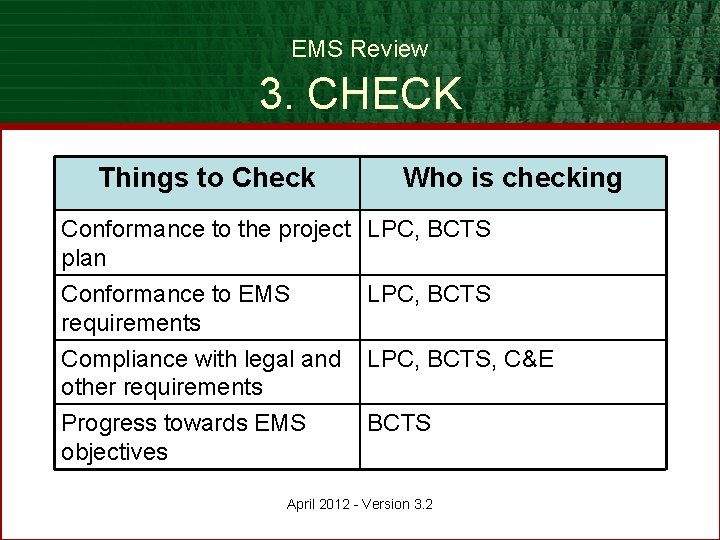
EMS Review 3. CHECK Things to Check Who is checking Conformance to the project LPC, BCTS plan Conformance to EMS LPC, BCTS requirements Compliance with legal and other requirements Progress towards EMS objectives LPC, BCTS, C&E BCTS April 2012 - Version 3. 2
EMS Review Checking the Progress • The BCTS staff approach – Monitoring • Informal visits to the worksite to focus on key risk issues • May or may not be documented using BCTS checklists. – Inspections • Formal visits to conduct thorough worksite assessments • Purpose: to identify deficiencies and trends, to collect data • Frequency: as determined by the Risk Ranking – Primary benefits of Inspections – identifying deficiencies and trends, initiating corrective action, ensuring follow up April 2012 - Version 3. 2
EMS Review Checking the Progress • The LPC Approach – Supervising (similar to monitoring by BCTS) • Continual on-site checking of work progress, conformance to operational and EMS requirements • May be documented in diaries or on forms – Inspections • Formal worksite assessments by the field supervisor • Purpose: to identify deficiencies and trends within the workplace • Frequency: as determined at the BCTS Prework – Type of Inspections • Operational and EMS April 2012 - Version 3. 2
EMS Review Required Records for LPC • Prework Records – Indicating points of discussion – Date • Inspection Records – Verify worksite requirements – Date and name of Inspector • Training Records – Names of workers – Type and date of training • Incident Records – Spills over 25 liters, Fires, Erosion events, Non-compliances – At least the Incident details must be completed • Test/Drill Records • Environmental Emergency Response Plan April 2012 - Version 3. 2
EMS Review 4. RESPOND • Action Plans are written during inspections – who is to do what, by when • EMS modifications / improvements will be assigned as Action Plans or in annual reviews • Issues will be investigated and Action Plans assigned to address root causes • All actions will be assigned, tracked & followed up April 2012 - Version 3. 2
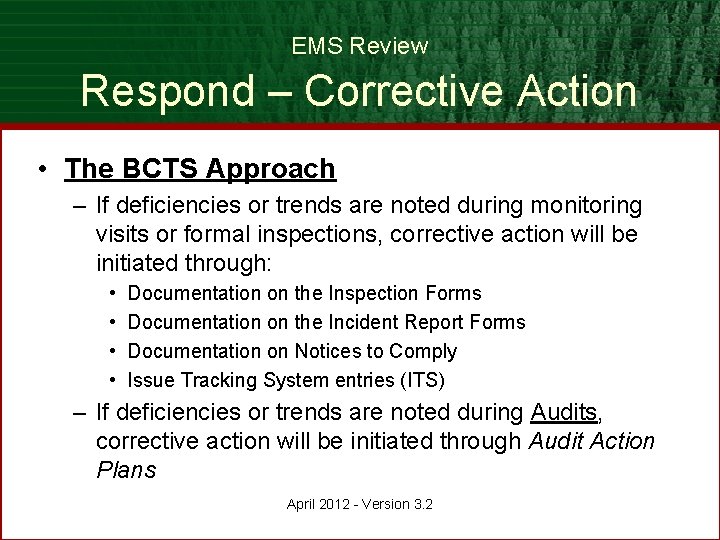
EMS Review Respond – Corrective Action • The BCTS Approach – If deficiencies or trends are noted during monitoring visits or formal inspections, corrective action will be initiated through: • • Documentation on the Inspection Forms Documentation on the Incident Report Forms Documentation on Notices to Comply Issue Tracking System entries (ITS) – If deficiencies or trends are noted during Audits, corrective action will be initiated through Audit Action Plans April 2012 - Version 3. 2
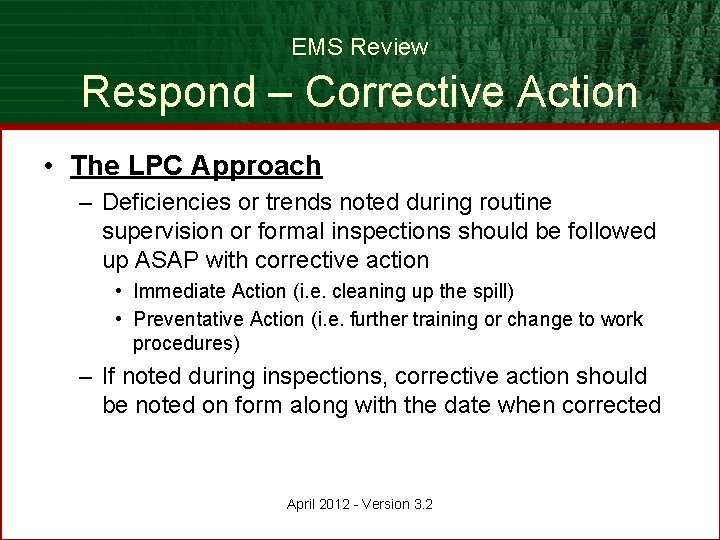
EMS Review Respond – Corrective Action • The LPC Approach – Deficiencies or trends noted during routine supervision or formal inspections should be followed up ASAP with corrective action • Immediate Action (i. e. cleaning up the spill) • Preventative Action (i. e. further training or change to work procedures) – If noted during inspections, corrective action should be noted on form along with the date when corrected April 2012 - Version 3. 2
Section #3: Document Detail v. EMS Manual v. Environmental Emergency Response Plan (e. ERP) v. Environmental Operating Procedures v. Checklists v. Environmental Field Procedures April 2012 - Version 3. 2
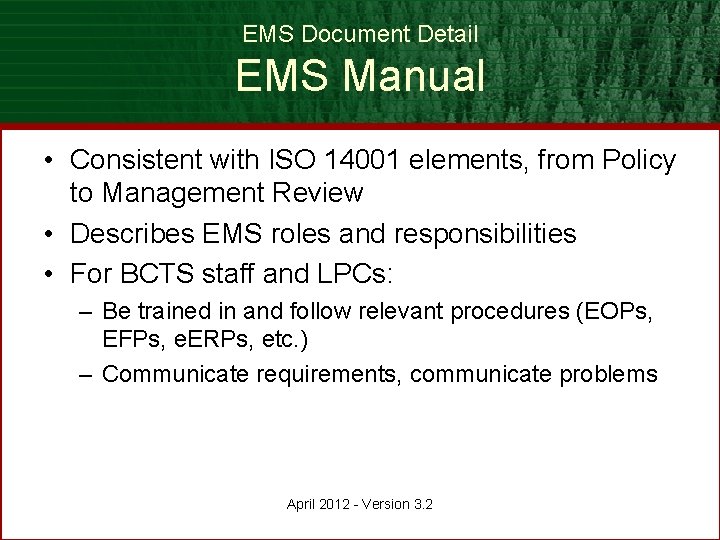
EMS Document Detail EMS Manual • Consistent with ISO 14001 elements, from Policy to Management Review • Describes EMS roles and responsibilities • For BCTS staff and LPCs: – Be trained in and follow relevant procedures (EOPs, EFPs, e. ERPs, etc. ) – Communicate requirements, communicate problems April 2012 - Version 3. 2
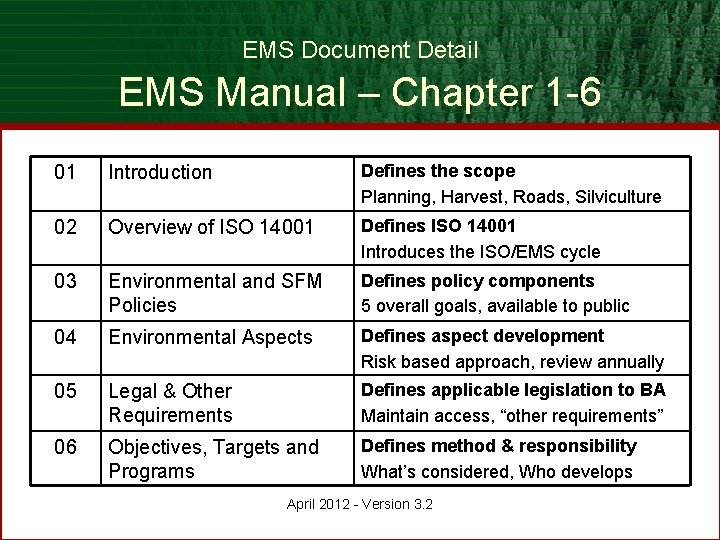
EMS Document Detail EMS Manual – Chapter 1 -6 01 Introduction Defines the scope Planning, Harvest, Roads, Silviculture 02 Overview of ISO 14001 Defines ISO 14001 Introduces the ISO/EMS cycle 03 Environmental and SFM Policies Defines policy components 5 overall goals, available to public 04 Environmental Aspects Defines aspect development Risk based approach, review annually 05 Legal & Other Requirements Defines applicable legislation to BA Maintain access, “other requirements” 06 Objectives, Targets and Programs Defines method & responsibility What’s considered, Who develops April 2012 - Version 3. 2
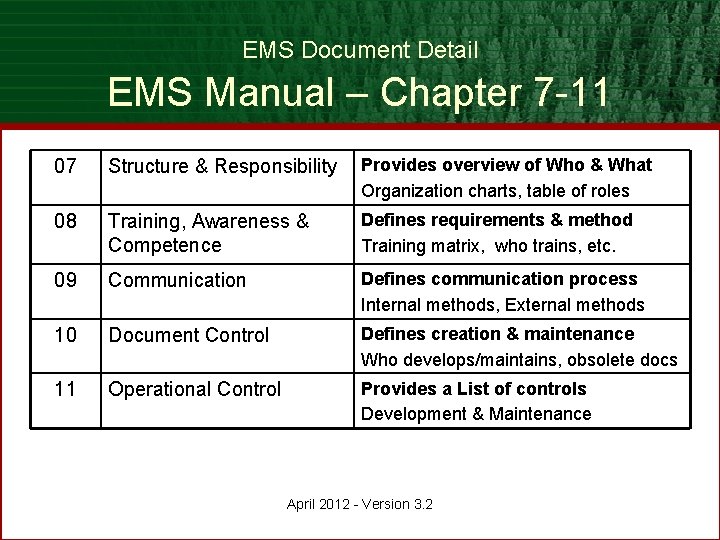
EMS Document Detail EMS Manual – Chapter 7 -11 07 Structure & Responsibility Provides overview of Who & What Organization charts, table of roles 08 Training, Awareness & Competence Defines requirements & method Training matrix, who trains, etc. 09 Communication Defines communication process Internal methods, External methods 10 Document Control Defines creation & maintenance Who develops/maintains, obsolete docs 11 Operational Control Provides a List of controls Development & Maintenance April 2012 - Version 3. 2
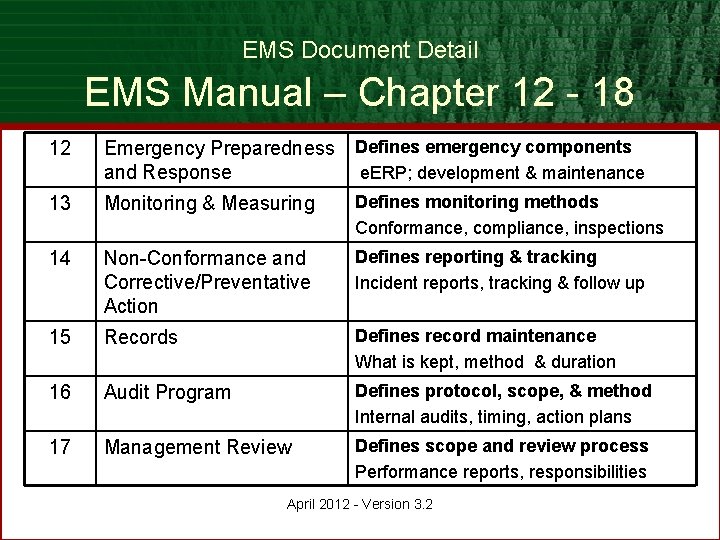
EMS Document Detail EMS Manual – Chapter 12 - 18 12 Emergency Preparedness and Response Defines emergency components e. ERP; development & maintenance 13 Monitoring & Measuring Defines monitoring methods Conformance, compliance, inspections 14 Non-Conformance and Corrective/Preventative Action Defines reporting & tracking Incident reports, tracking & follow up 15 Records Defines record maintenance What is kept, method & duration 16 Audit Program Defines protocol, scope, & method Internal audits, timing, action plans 17 Management Review Defines scope and review process Performance reports, responsibilities April 2012 - Version 3. 2
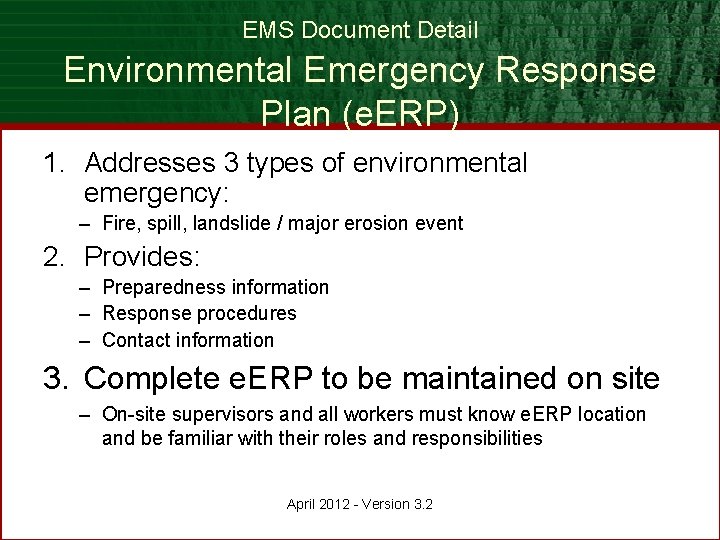
EMS Document Detail Environmental Emergency Response Plan (e. ERP) 1. Addresses 3 types of environmental emergency: – Fire, spill, landslide / major erosion event 2. Provides: – Preparedness information – Response procedures – Contact information 3. Complete e. ERP to be maintained on site – On-site supervisors and all workers must know e. ERP location and be familiar with their roles and responsibilities April 2012 - Version 3. 2
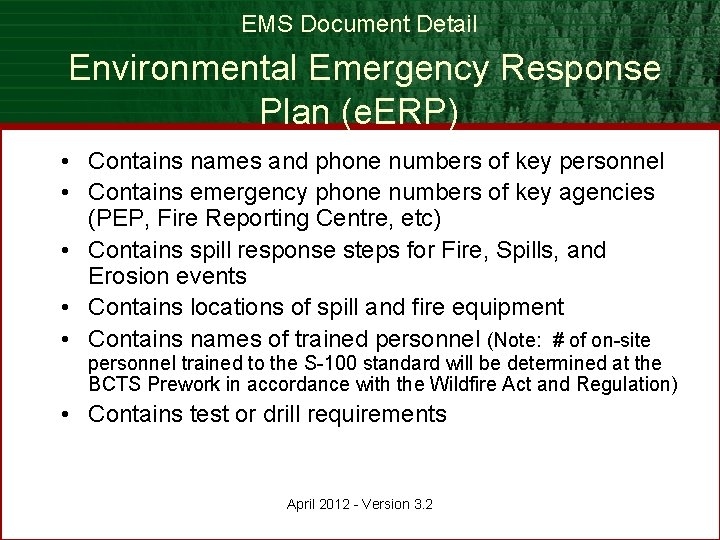
EMS Document Detail Environmental Emergency Response Plan (e. ERP) • Contains names and phone numbers of key personnel • Contains emergency phone numbers of key agencies (PEP, Fire Reporting Centre, etc) • Contains spill response steps for Fire, Spills, and Erosion events • Contains locations of spill and fire equipment • Contains names of trained personnel (Note: # of on-site personnel trained to the S-100 standard will be determined at the BCTS Prework in accordance with the Wildfire Act and Regulation) • Contains test or drill requirements April 2012 - Version 3. 2
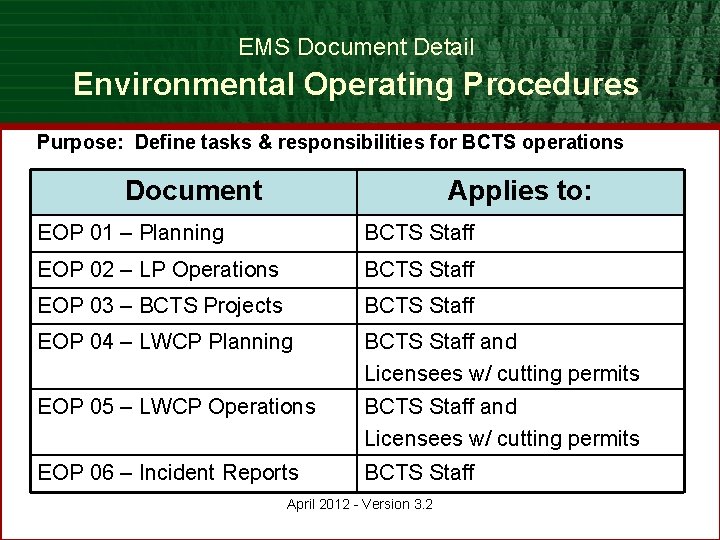
EMS Document Detail Environmental Operating Procedures Purpose: Define tasks & responsibilities for BCTS operations Document Applies to: EOP 01 – Planning BCTS Staff EOP 02 – LP Operations BCTS Staff EOP 03 – BCTS Projects BCTS Staff EOP 04 – LWCP Planning BCTS Staff and Licensees w/ cutting permits EOP 05 – LWCP Operations BCTS Staff and Licensees w/ cutting permits EOP 06 – Incident Reports BCTS Staff April 2012 - Version 3. 2
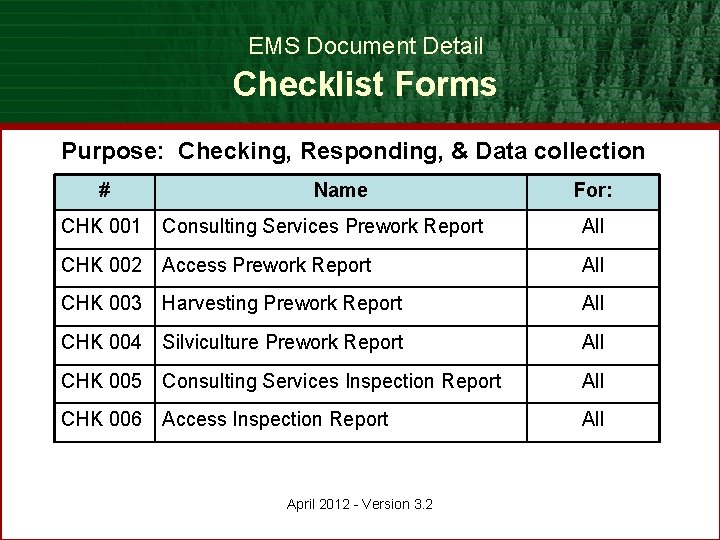
EMS Document Detail Checklist Forms Purpose: Checking, Responding, & Data collection # Name For: CHK 001 Consulting Services Prework Report All CHK 002 Access Prework Report All CHK 003 Harvesting Prework Report All CHK 004 Silviculture Prework Report All CHK 005 Consulting Services Inspection Report All CHK 006 Access Inspection Report All April 2012 - Version 3. 2
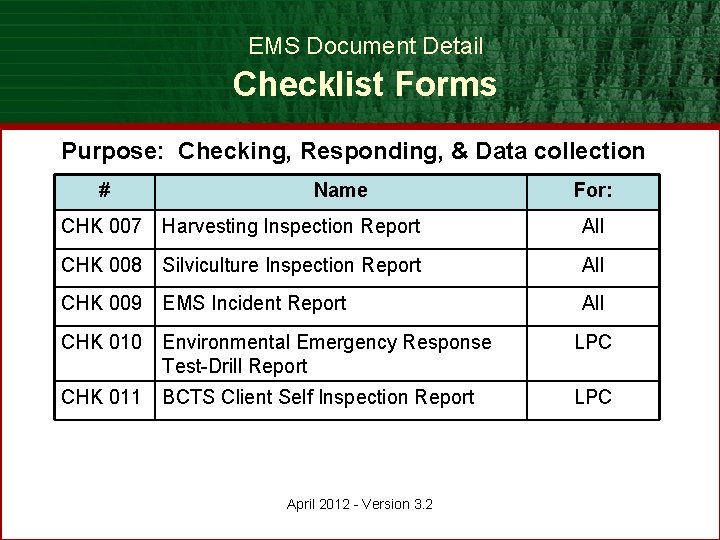
EMS Document Detail Checklist Forms Purpose: Checking, Responding, & Data collection # Name For: CHK 007 Harvesting Inspection Report All CHK 008 Silviculture Inspection Report All CHK 009 EMS Incident Report All CHK 010 Environmental Emergency Response Test-Drill Report LPC CHK 011 BCTS Client Self Inspection Report LPC April 2012 - Version 3. 2
EMS Document Detail Prework Forms (CHK 001 -004) • Used by BCTS staff during Preworks with Licensees or Contractors and may be used by a LPC if they have no other documentation method • Significant issues captured at Preworks – Operational requirements (Project Plans) – Legislative & Regulatory requirements – Contractual or License, Safety and SFM requirements – EMS requirements i. e. Emergency Response, Fuel Management • On-site supervisors, all LPC staff and sub-contractors must have a documented prework before starting work • Primary benefits of Pre-works – outlines the expectations for sitespecific environmental management to the recipient prior to commencement of work • Note: Guidance Documents are available to assist in completing BCTS Pre-work Forms April 2012 - Version 3. 2
EMS Document Detail Inspection Forms (CHK 005 -008) • Used by BCTS staff and can be used by LPC if no other documentation method exists • Significant Issues captured during inspections: – Conformance and compliance to contractual and legal documents, Safety and SFM requirements – Conformance to operational plans i. e. Site Plans, Road Plans and Profiles – Conformance to EMS requirements i. e. Proof of training, Emergency Preparedness and Response, Fuel Management • Note: Guidance Documents are available to assist in completing BCTS Inspection Forms April 2012 - Version 3. 2
EMS Document Detail Incident Report Form (CHK 009) • To be used by LPC and BCTS staff to report EMS/SFM incidents and initiate investigations • When Incident Reports are required: – Spills of BCTS reportable size or greater to land, or any amount spilled to water – Fires (Natural, man-caused, or industrial) – Erosion events or landslides – Potential non-compliance – Significant non-conformance (BCTS staff) • Information captured during Incident reporting and investigations – Description of the Incident (scene details) – Determination of preliminary and root causes – Recommendations and Corrective Action to mitigate future events April 2012 - Version 3. 2
EMS Document Detail Test-Drill Report Form (CHK 010) • To be used by LPC to record details of tests or drills conducted for environmental emergency response • Requirement and frequency of tests or drills are outlined at BCTS Preworks • Information captured during Test-Drill reports – – Type of test or drill (Fire, Spill, Erosion) Description of the test or drill Description of the deficiencies during the event Recommendations for improvement April 2012 - Version 3. 2
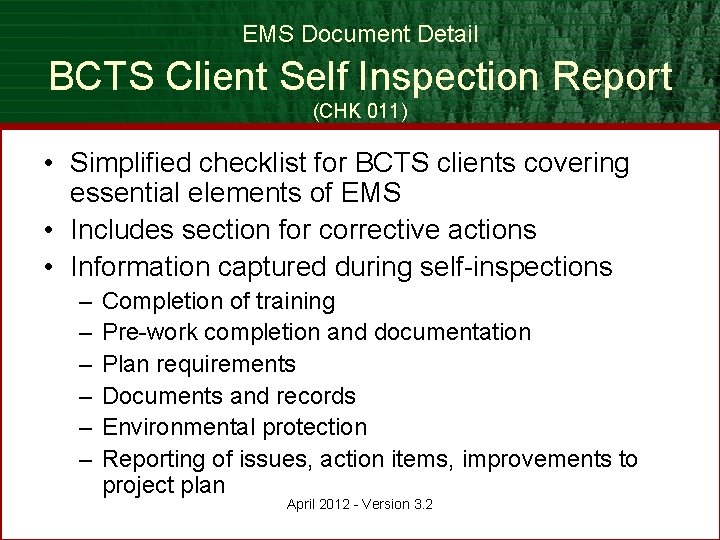
EMS Document Detail BCTS Client Self Inspection Report (CHK 011) • Simplified checklist for BCTS clients covering essential elements of EMS • Includes section for corrective actions • Information captured during self-inspections – – – Completion of training Pre-work completion and documentation Plan requirements Documents and records Environmental protection Reporting of issues, action items, improvements to project plan April 2012 - Version 3. 2
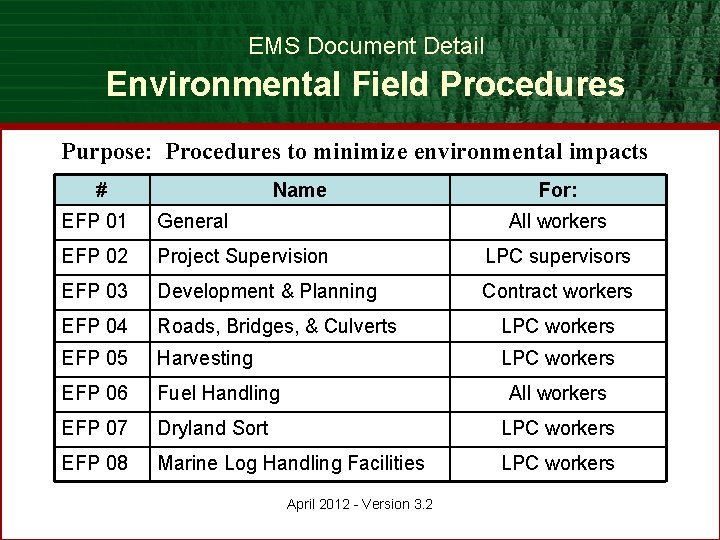
EMS Document Detail Environmental Field Procedures Purpose: Procedures to minimize environmental impacts # Name For: EFP 01 General All workers EFP 02 Project Supervision LPC supervisors EFP 03 Development & Planning Contract workers EFP 04 Roads, Bridges, & Culverts LPC workers EFP 05 Harvesting LPC workers EFP 06 Fuel Handling EFP 07 Dryland Sort LPC workers EFP 08 Marine Log Handling Facilities LPC workers All workers April 2012 - Version 3. 2
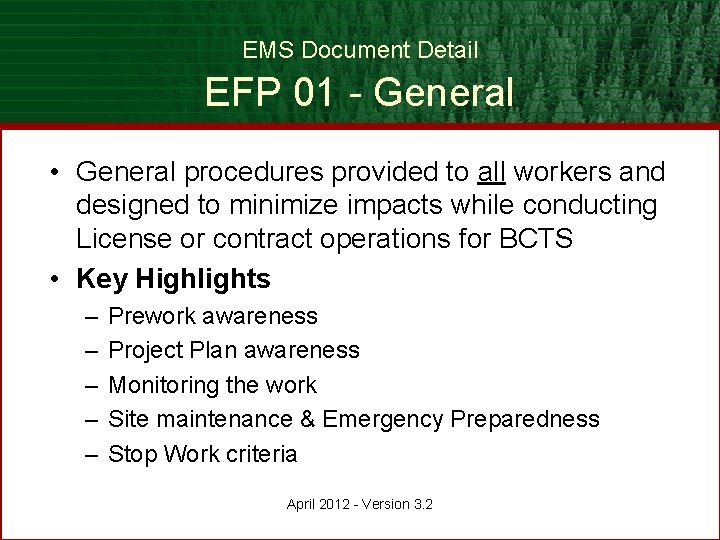
EMS Document Detail EFP 01 - General • General procedures provided to all workers and designed to minimize impacts while conducting License or contract operations for BCTS • Key Highlights – – – Prework awareness Project Plan awareness Monitoring the work Site maintenance & Emergency Preparedness Stop Work criteria April 2012 - Version 3. 2
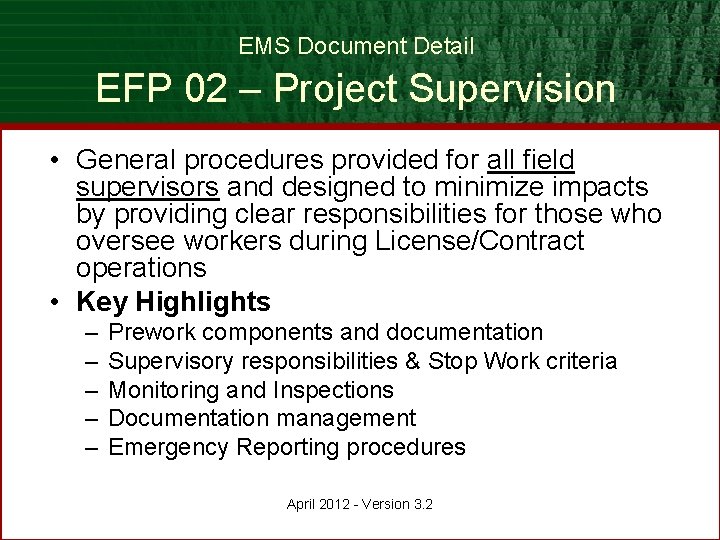
EMS Document Detail EFP 02 – Project Supervision • General procedures provided for all field supervisors and designed to minimize impacts by providing clear responsibilities for those who oversee workers during License/Contract operations • Key Highlights – – – Prework components and documentation Supervisory responsibilities & Stop Work criteria Monitoring and Inspections Documentation management Emergency Reporting procedures April 2012 - Version 3. 2
EMS Document Detail EFP 03 – Development & Planning • General procedures provided to all workers performing operational planning activities and designed to minimize impacts in the field • Key Highlights – Project Plan preparation – Field work requirements – Data integration into layout & design work – Stop Work criteria April 2012 - Version 3. 2
EMS Document Detail EFP 04 – Roads, Bridges, & Culverts • General procedures provided to workers performing construction, maintenance, inspection and deactivation activities and designed to minimize impacts in the field • Key Highlights – Road & Bridge inspection criteria – Construction, maintenance, deactivation procedures – Bridge & Major Culvert installation, maintenance, and removal precautions and criteria – Disposal procedures – Stop Work criteria April 2012 - Version 3. 2
EMS Document Detail EFP 05 - Harvesting • General procedures provided to workers performing harvesting activities and designed to minimize impacts in the field • Key Highlights – Procedures and criteria for: • Falling • Yarding, Skidding and Forwarding • Loading, processing, and hauling – Stop Work criteria April 2012 - Version 3. 2
EMS Document Detail EFP 06 – Fuel Handling • General procedures provided to all workers involved in handling, storing, and transporting of fuel during regular activities and designed to minimize the potential of pollution • Key Highlights – – Fuel Storage and Handling Refueling requirements Spill response references Stop work criteria April 2012 - Version 3. 2
EMS Document Detail EFP 07 – Dryland Sort & Log Loading • General procedures provided to workers performing sort yard activities and designed to minimize impacts to sensitive areas and watercourses or water bodies • Key Highlights – Sort yard operational requirements – Stockpiling & disposal of waste – Stop Work criteria April 2012 - Version 3. 2
EMS Document Detail EFP 08 – Marine Log Handling Facilities • Procedures provided to workers performing construction, maintenance and operations of log dumps, helicopter water drop zones and direct barge-loading facilities • Key Highlights – General, construction and operations requirements – Stop Work criteria April 2012 - Version 3. 2
Section #4: EMS Final Points v. Audit Preparation v. Summary April 2012 - Version 3. 2
Be Prepared for Audits • BCTS Staff – Know your responsibilities as per EMS Manual, EMS/SFM Org Chart (Table 007 -1) and applicable Environmental Operating Procedures. – Continually check to ensure TSL and Contract files are up to date with all legal and EMS information – Conduct Pre-works on a consistent basis in accordance with BA requirements – Conduct worksite inspections as per the frequency required by the EMS. Note: External auditors look for conformance to ISO 14001, EMS/SFM requirements and compliance with legislation and regulations when visiting a work site. – Ensure that deficiencies are being closed out and uploaded to an appropriate tracking system (See EMS Issue Reporting Business Map) April 2012 - Version 3. 2
Be Prepared for Audits • LPC Supervisors – Ensure workers are instructed by an authorized trainer (can be a company trainer if holding a BCTS EMS training certificate) as per the Training Matrix – Make appropriate documents available at the worksite (e. ERP, EFPs, etc. ) – Conduct Preworks prior to commencement of the project – Follow the procedures outlined in the EFPs to minimize site deg, contamination, and erosion – Conduct Inspections at the frequency outlined at the BCTS Prework session – Take action if non-conformances or non-compliances are discovered – Maintain records as required for the EMS April 2012 - Version 3. 2
Be Prepared for Audits • LPC Workers – Know the location of the EFPs, the e. ERP and Project Plans, and have them readily accessible – Participate in Preworks prior to commencement of the project – Follow the procedures outlined in the EFPs to minimize site deg, contamination, and erosion – Be able to explain how to respond to spills, fires, and major landslides or erosion events – Make sure you have spill kits and fire tools available to you and they are in working order April 2012 - Version 3. 2
EMS SUMMARY • Plan – Know how to operate with regard to the environment • Do – Follow procedures while conducting business that protect the environment / achieve your plan • Check – Take the time to review how you do vs. what the plan states • Respond – Take action and learn from your performance to do better next time April 2012 - Version 3. 2
Section #5: Sustainable Forest Management v. Why do we need SFM? v. Types of SFM Certifications v. Requirements of SFM v. SFM Plans v. SFM Summary April 2012 - Version 3. 2
SFM Review Why do we need SFM? • Market Demand – Buyers world-wide are incorporating Sustainable Forest Management (SFM) commitments into their purchasing agreements – Many Canadian & US firms have SFM commitments in their procurement policies • Enhanced performance – – Improvement in SFM planning and performance Better community relations Stronger aboriginal relations Important indicator for the public of the commitment towards long -term forest management & sustainability April 2012 - Version 3. 2
SFM Review Types of SFM Certifications • CSA-Z 809 – Canadian Standards Association. Canadian National Standard. Internationally endorsed (PEFC). Public Advisory Groups required • SFI – Sustainable Forestry Initiative. North American Standard developed in US but applicable to US and Canada. PEFC endorsed. • FSC – Forest Stewardship Council. International Principles and Criteria with Regional Standards April 2012 - Version 3. 2
SFM Review Sustainable Forest Management Requirements • Requires a Sustainable Forest Management Plan (SFMP) to be in place • Requires a Management System to be in place (i. e. an EMS) • Requires management to principles, criteria, objectives, etc. for well managed forests as defined in SFM Standards • Requires third party audits to determine conformance to Standards April 2012 - Version 3. 2
SFM Review Scope of SFM Plans ü Defining the scope üThe Defined Forest Area (DFA) as outlined in the Sustainable Forest Management Plan üA DFA may consist of an entire Timber Supply Area or be comprised of any number of smaller areas üDFAs must be areas where the participant can maintain control of the activities in order to ensure the achievement of goals outlined in the SFM Plan April 2012 - Version 3. 2
SFM Review What are the Key Objectives of an SFM Plan? • Describes the area under the plan (DFA) • States objectives, performance measures, indicators and targets, as applicable • Ensures that responsibilities for these actions are assigned • Ensures that SFM progress is properly reported and achieved April 2012 - Version 3. 2
SFM Review SFM Plans DO NOT r. Provide a management system framework to ensure the goals are achieved (that’s what an EMS is for) April 2012 - Version 3. 2
SFM Review Where SFM Plans need an EMS to Work • To become SFM certified, a management system that defines the following must be in place: – – – Legal requirements Roles and Responsibilities Training and Awareness Internal & External communication Document management and control Operational procedures Emergency Preparedness & Response Monitoring and Measuring Corrective & Preventative Action Record Keeping Internal Audits Management Reviews April 2012 - Version 3. 2
SFM Review Where SFM Plans have their Impact • Influences higher-level planning by introducing their own criteria forest management • Requires data gathering and reporting to verify adherence to SFM targets • Can produce changes to operational plans – Modification of block size and shapes – Introduction of additional protective measures for resource features and sensitive zones – Changes in road locations and design, etc. April 2012 - Version 3. 2
SFM Review How YOU conform to SFM Plans • Follow the Operational Plans • Follow SFMP requirements and applicable Roles and Responsibilities Matrices • Follow EMS requirements – – Environmental Field Procedures Emergency Response Plans Legislation and Regulations Training requirements • Follow Contract & License requirements • Follow Legislative and Regulatory requirements April 2012 - Version 3. 2
SFM SUMMARY • A Strategic Level Plan – SFM Plans influence changes primarily at the planning stage for an organization • SFM Standards – The SFM certification standards currently in use in BC are SFI, CSA and FSC • Your Role • Follow the Project Plans and your EMS requirements • Use good environmental practices in the workplace April 2012 - Version 3. 2
- Slides: 66