
BC Science Connections 10 Unit 1 DNA is
BC Science Connections 10 Unit 1: DNA is the foundation for the unity and diversity of living things.
GENETICS Topic 1. 2: How is hereditary information passed from one generation to the next? • Genes pass on inherited traits from parent to offspring. • Punnett squares show the probability of offspring inheriting specific traits. • Both alleles are expressed in codominance. • In incomplete dominance, alleles are neither dominant nor recessive. • Some inherited traits are due to alleles on the sex chromosomes.
Concept 1: Genes pass on inherited traits from parent to offspring. • Genetics: field of biology that studies heredity, or the passing of traits from parents to offspring • Trait: an inherited characteristic, such as eye colour or hair colour • Examples: • • • Face shape Skin colour Curly or straight hair Shape of your ears Personality (Environment also plays a role)
First Modern Experiments in Genetics • Gregor Mendel discovered how traits are inherited by experimenting with pea plants.
Mendel’s Experiments • Mendel used true-breeding pea plants that produce offspring with only one form of a trait. • Parent plants produced new plants called offspring in the first generation (F 1). • Plants from the first generation were allowed to self-fertilize to produce offspring in the second generation (F 2).
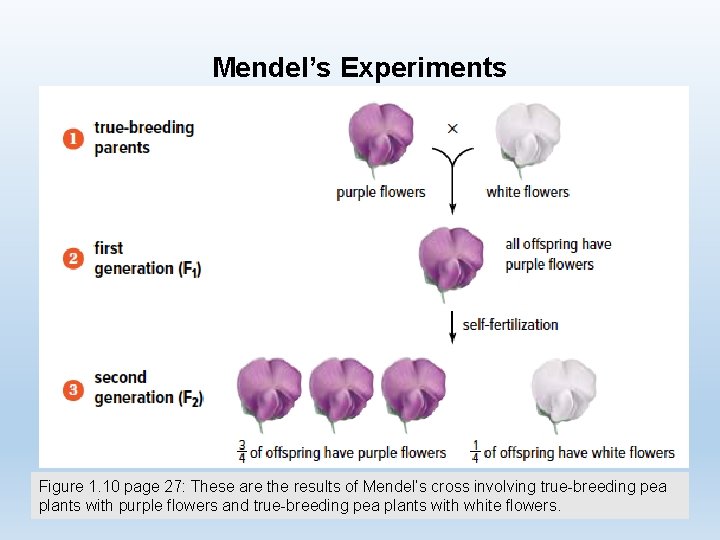
Mendel’s Experiments Figure 1. 10 page 27: These are the results of Mendel’s cross involving true-breeding pea plants with purple flowers and true-breeding pea plants with white flowers.
Mendel’s Experiments (cont’d) • When two different true-breeding pea plants are crossed, one trait disappears in the F 1 offspring, but reappears in the F 2 offspring. • Based on this observation, Mendel proposed: • Each plant has two factors for a trait. • Each parent gives one factor for each trait. • One factor dominates over the other if present. • The “factors” Mendel referred to in his conclusions are what we now call alleles.
Homologous Chromosomes and Gametes • Chromosomes may carry different alleles. • During gamete formation, pairs of homologous chromosomes separate. • Each gamete receives one member of each pair, so it receives only one allele of each pair. • During fertilization when the male and female gametes meet, homologous chromosomes and alleles are paired again. • This is to prevent death due to disease by increasing genetic diversity
The Law of Segregation • Law of segregation: states that alleles for a trait separate during meiosis • Each gamete carries one allele for each trait. • During fertilization, each gamete contributes an allele for each trait.
Dominant and Recessive Alleles • Alleles that are dominant will always be expressed if present. • Alleles that are recessive will be expressed only if there are two recessive alleles.
Dominant and Recessive Alleles • Dominant alleles are represented with a capital letter. • R, B • Recessive alleles are represented with a lower -case letter. • r, b
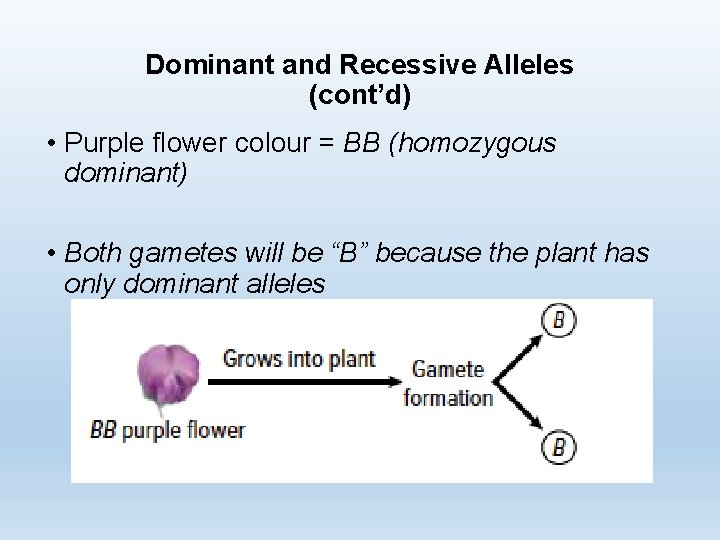
Dominant and Recessive Alleles (cont’d) • Purple flower colour = BB (homozygous dominant) • Both gametes will be “B” because the plant has only dominant alleles
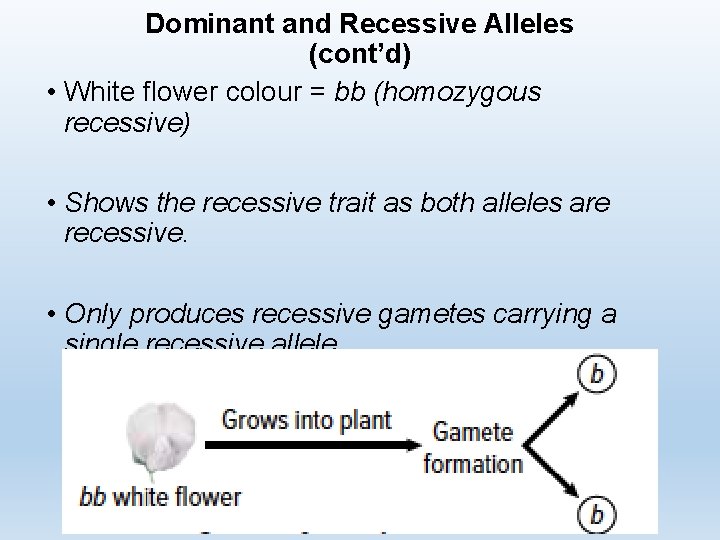
Dominant and Recessive Alleles (cont’d) • White flower colour = bb (homozygous recessive) • Shows the recessive trait as both alleles are recessive. • Only produces recessive gametes carrying a single recessive allele
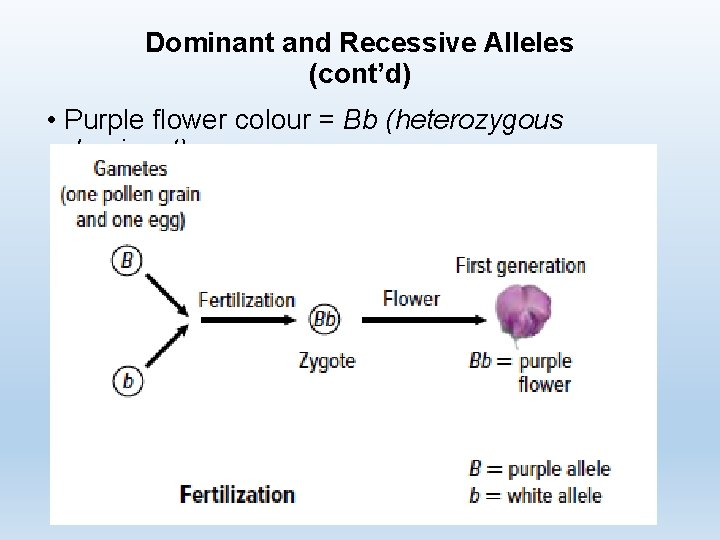
Dominant and Recessive Alleles (cont’d) • Purple flower colour = Bb (heterozygous dominant)
Genotypes and Phenotypes • Phenotype: the physical description of an organism’s trait (brown eyes) – what you look like • Genotype: the specific combination of alleles an organism has for a trait (Bb) – what genetics you have • Homozygous: an organism with two of the same alleles for a particular trait (BB - dominant or bb – recessive )
Genotypes and Phenotypes (cont’d) • There are three possible genotypes: 1) Homozygous dominant: two dominant alleles (BB) 2) Homozygous recessive: two recessive alleles (bb) 3) Heterozygous: one dominant allele and one recessive allele (Bb) • The big letter must always come first
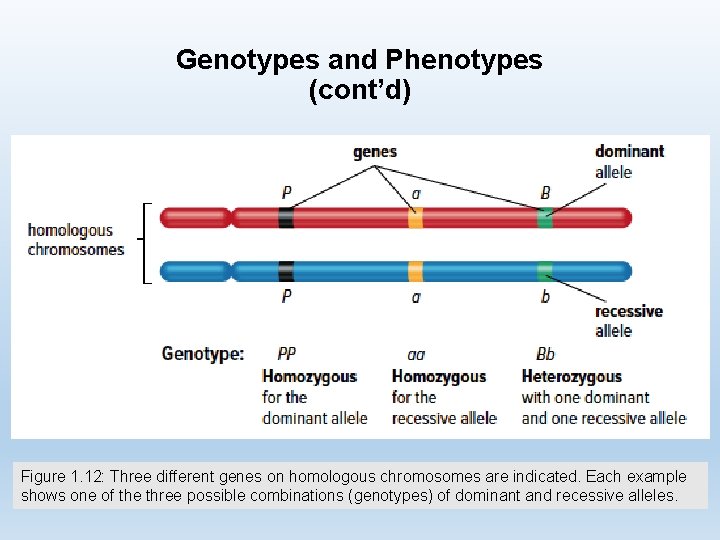
Genotypes and Phenotypes (cont’d) Figure 1. 12: Three different genes on homologous chromosomes are indicated. Each example shows one of the three possible combinations (genotypes) of dominant and recessive alleles.
Discussion Questions 1. Write a definition for genetics in your own words. 2. Seed shape in pea plants can either be round or wrinkled. The allele for round shape is indicated by R. Is round seed shape dominant or recessive? 3. The allele for freckles is indicated by F. What is the genotype of a person who is heterozygous for freckles?
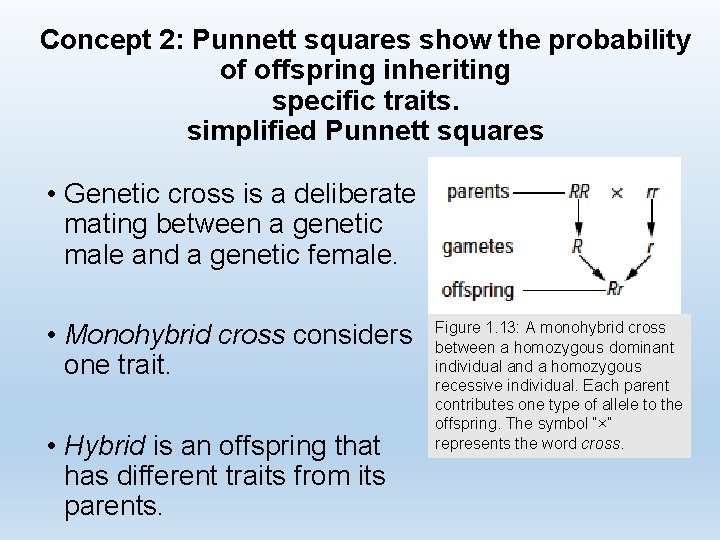
Concept 2: Punnett squares show the probability of offspring inheriting specific traits. simplified Punnett squares • Genetic cross is a deliberate mating between a genetic male and a genetic female. • Monohybrid cross considers one trait. • Hybrid is an offspring that has different traits from its parents. Figure 1. 13: A monohybrid cross between a homozygous dominant individual and a homozygous recessive individual. Each parent contributes one type of allele to the offspring. The symbol “×” represents the word cross.
Punnett Squares • A Punnett square is a tool used to help determine the probability of inheriting traits in a monohybrid cross. • It shows the genotypes of the parents and the offspring.
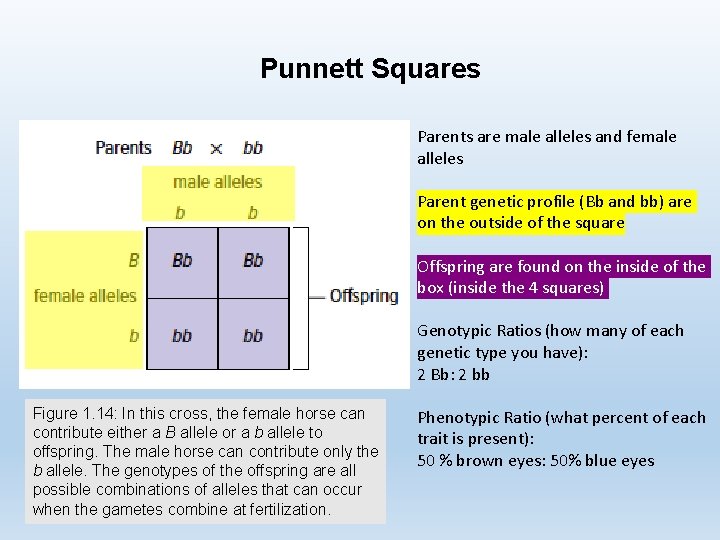
Punnett Squares Parents are male alleles and female alleles Parent genetic profile (Bb and bb) are on the outside of the square Offspring are found on the inside of the box (inside the 4 squares) Genotypic Ratios (how many of each genetic type you have): 2 Bb: 2 bb Figure 1. 14: In this cross, the female horse can contribute either a B allele or a b allele to offspring. The male horse can contribute only the b allele. The genotypes of the offspring are all possible combinations of alleles that can occur when the gametes combine at fertilization. Phenotypic Ratio (what percent of each trait is present): 50 % brown eyes: 50% blue eyes
Punnett Squares (cont’d) • Phenotypic ratio shows the frequency of the phenotypes in offspring. • Example: 3 purple flowers: 1 white flower • 75% purple flowers: 25% white flowers • Genotypic ratio shows the frequency of the genotypes in offspring. • Example: 1 BB: 2 Bb: 1 bb
Punnett Squares (cont’d) • Example (eye colour): • Homozygous Dominant Brown Eyes (BB) • Heterozygous Dominant Brown Eyes (Bb) • Homozygous Recessive Blue Eyes (bb) • Assume this is the case for gray, green and hazel eyes • Different crosses can occur which will be shown on the following slides • For each example, we will consider genotypic and phenotypic ratios
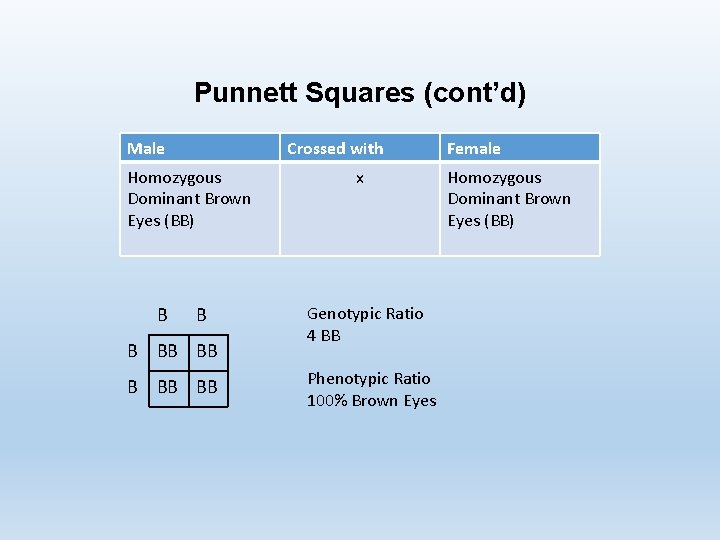
Punnett Squares (cont’d) Male Crossed with Homozygous Dominant Brown Eyes (BB) B BB BB BB x Genotypic Ratio 4 BB Phenotypic Ratio 100% Brown Eyes Female Homozygous Dominant Brown Eyes (BB)
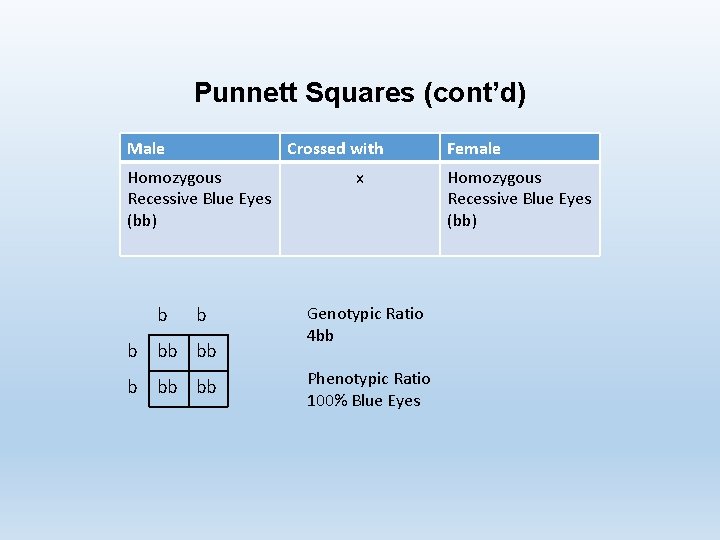
Punnett Squares (cont’d) Male Crossed with Homozygous Recessive Blue Eyes (bb) b bb bb bb x Genotypic Ratio 4 bb Phenotypic Ratio 100% Blue Eyes Female Homozygous Recessive Blue Eyes (bb)
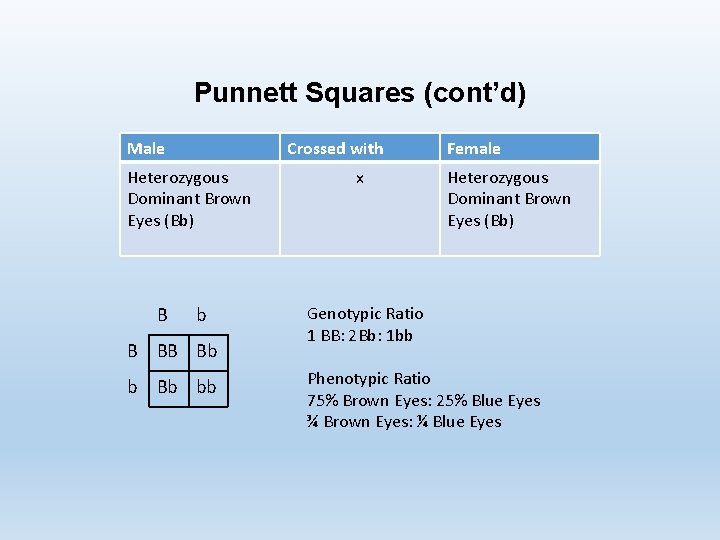
Punnett Squares (cont’d) Male Crossed with Heterozygous Dominant Brown Eyes (Bb) B b B BB Bb bb x Female Heterozygous Dominant Brown Eyes (Bb) Genotypic Ratio 1 BB: 2 Bb: 1 bb Phenotypic Ratio 75% Brown Eyes: 25% Blue Eyes ¾ Brown Eyes: ¼ Blue Eyes
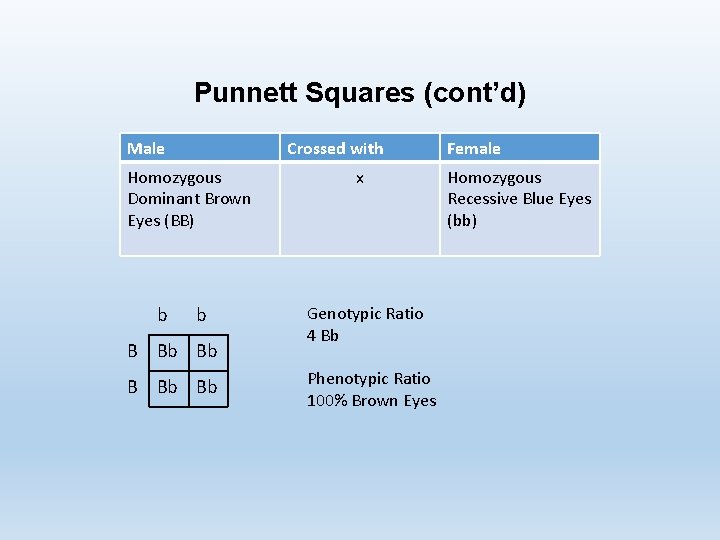
Punnett Squares (cont’d) Male Crossed with Homozygous Dominant Brown Eyes (BB) b b B Bb Bb x Genotypic Ratio 4 Bb Phenotypic Ratio 100% Brown Eyes Female Homozygous Recessive Blue Eyes (bb)
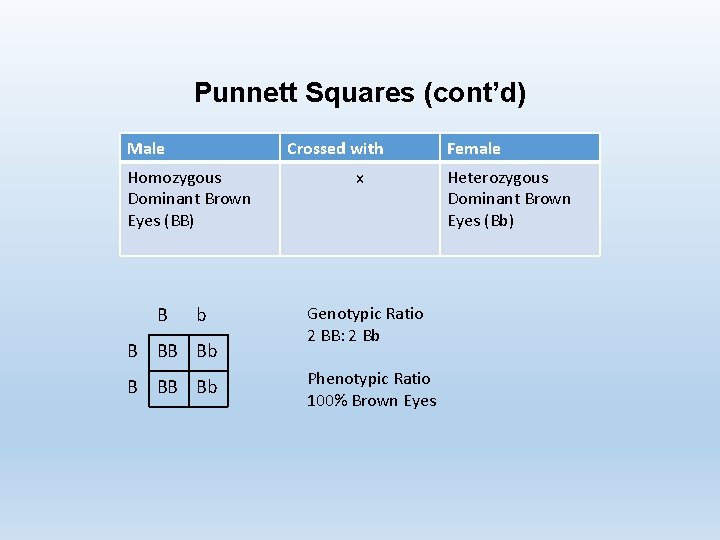
Punnett Squares (cont’d) Male Crossed with Homozygous Dominant Brown Eyes (BB) B b B BB Bb x Genotypic Ratio 2 BB: 2 Bb Phenotypic Ratio 100% Brown Eyes Female Heterozygous Dominant Brown Eyes (Bb)
Discussion Questions 1. A monohybrid cross produces half the offspring with one genotype and half the offspring with another genotype. Express this in the form of a ratio. 2. What do the alleles that are written along the top and beside a Punnett square represent?
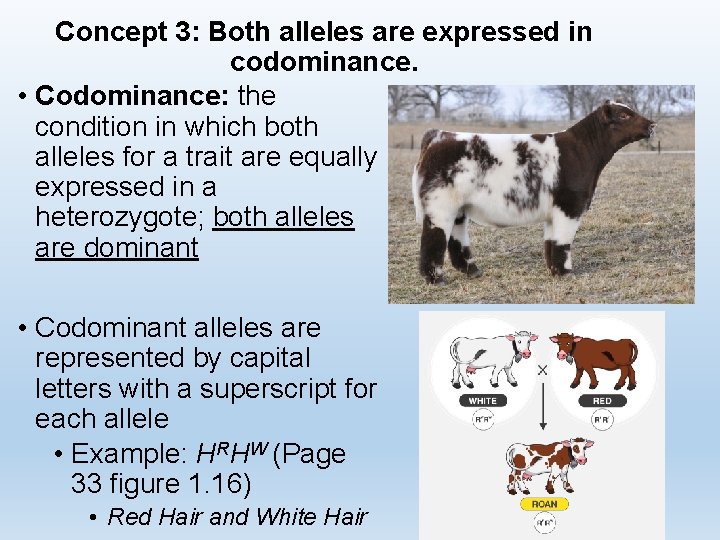
Concept 3: Both alleles are expressed in codominance. • Codominance: the condition in which both alleles for a trait are equally expressed in a heterozygote; both alleles are dominant • Codominant alleles are represented by capital letters with a superscript for each allele • Example: HRHW (Page 33 figure 1. 16) • Red Hair and White Hair
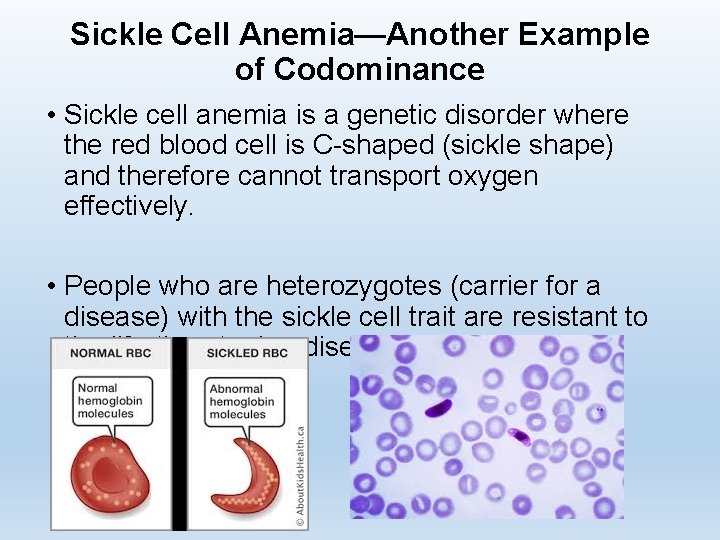
Sickle Cell Anemia—Another Example of Codominance • Sickle cell anemia is a genetic disorder where the red blood cell is C-shaped (sickle shape) and therefore cannot transport oxygen effectively. • People who are heterozygotes (carrier for a disease) with the sickle cell trait are resistant to the life-threatening disease malaria.
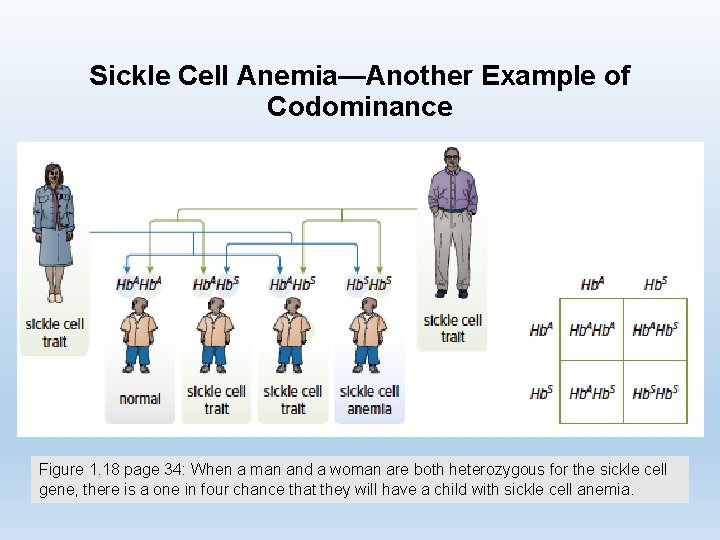
Sickle Cell Anemia—Another Example of Codominance Figure 1. 18 page 34: When a man and a woman are both heterozygous for the sickle cell gene, there is a one in four chance that they will have a child with sickle cell anemia.
Discussion Questions 1. What is codominance? Give three examples of codominance. 2. Hypothesize why the frequency of the sickle cell allele is much higher in Africa than in other areas of the world.
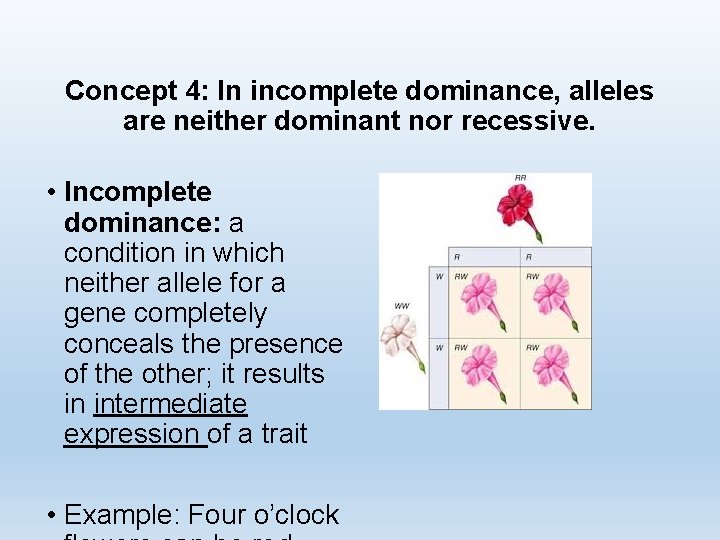
Concept 4: In incomplete dominance, alleles are neither dominant nor recessive. • Incomplete dominance: a condition in which neither allele for a gene completely conceals the presence of the other; it results in intermediate expression of a trait • Example: Four o’clock
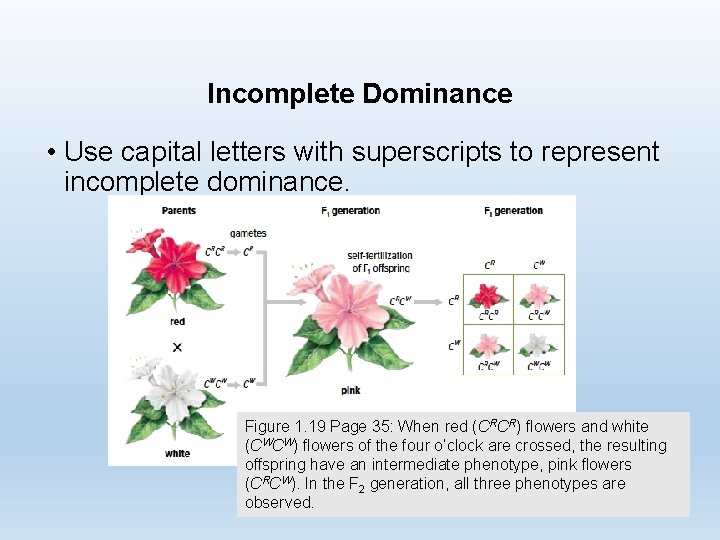
Incomplete Dominance • Use capital letters with superscripts to represent incomplete dominance. Figure 1. 19 Page 35: When red (CRCR) flowers and white (CWCW) flowers of the four o’clock are crossed, the resulting offspring have an intermediate phenotype, pink flowers (CRCW). In the F 2 generation, all three phenotypes are observed.
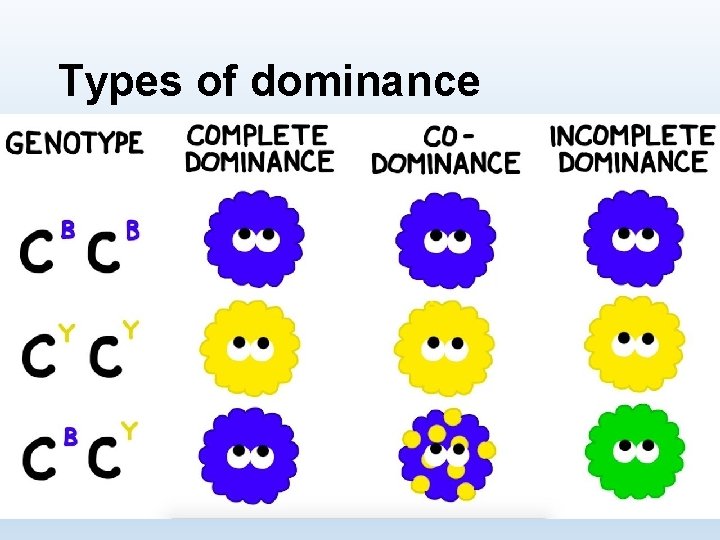
Types of dominance
Discussion Questions 1. What is the difference between incomplete dominance and codominance? 2. A plant that produces white flowers is crossed with a plant that produces purple flowers. Describe the phenotype of the offspring if the inheritance pattern for flower colour is a) incomplete dominance b) codominance
Traits Lab • Run through the traits in the table • Circle the traits that you have • The PTC Paper can be very bitter, please ensure you have a candy for after to get rid of the taste • Omit Wrist Chords from the table
Concept 5: Some inherited traits are due to alleles on the sex chromosomes. • Sex-linked trait: a trait controlled by genes on sex chromosomes • X-linked trait: a trait controlled by genes on the X chromosome • Males are affected by recessive X-linked traits more often because they have only one X chromosome.
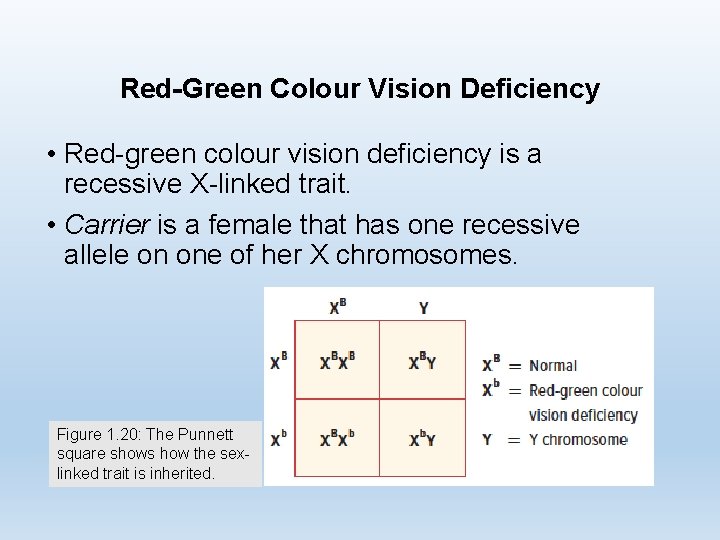
Red-Green Colour Vision Deficiency • Red-green colour vision deficiency is a recessive X-linked trait. • Carrier is a female that has one recessive allele on one of her X chromosomes. Figure 1. 20: The Punnett square shows how the sexlinked trait is inherited.
Discussion Questions 1. What are sex-linked traits? 2. Use vocabulary terms to describe the genotype of a male who is red-green colour vision deficient.

Topic 1. 2 Summary: How is hereditary information passed from one generation to the next? • Genes pass on inherited traits from parent to offspring. • Punnett squares show the probability of offspring inheriting specific traits. • Both alleles are expressed in codominance. • In incomplete dominance, alleles are neither dominant nor recessive. • Some inherited traits are due to alleles on the sex chromosomes.
- Slides: 42