
BBFC Role and Purpose The BBFC officially named
BBFC
Role and Purpose The BBFC, officially named the ‘British Board of Film Classification’, was formed back 1912 as the ‘British Board of Film Censors’. It is currently in place as a nongovernmental organisation to help with the classification and censorship of films in cinemas and video works across the nation. In their position, what the organisation must focus on is the content of the media that is sent to them for review, classifying the age rating group and including a description for why the rating is alongside the certain scenes that link to the ratings. Not primarily focused on censorship as much today, but there is always the case where a scene might have to be altered or removed to fit with what both the BBFC and the production company want.

Legal Powers Legal Power – (law) the right and power to interpret and apply the law. In the BBFC’s position, they have the rights to rate, cut or reject films for viewing in the United Kingdom. Despite being an independent organisation and a nongovernmental body, they have the legal rights to film distribution. Although, different city councils across the United Kingdom can also have a final saw, and impose rules on film rating and contents of the media product, alongside possibly not distributing the product altogether, dependant on public opinion and viewpoints, with on any occasion the councils completely ignoring a BBFC’s rating.
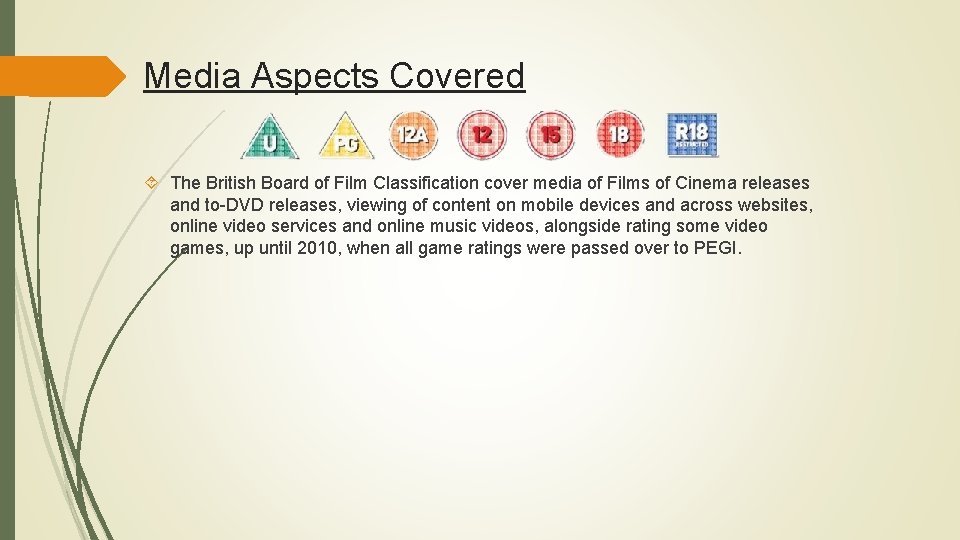
Media Aspects Covered The British Board of Film Classification cover media of Films of Cinema releases and to-DVD releases, viewing of content on mobile devices and across websites, online video services and online music videos, alongside rating some video games, up until 2010, when all game ratings were passed over to PEGI.
Case Study The Bunny Game is a low budget horror film created in 2010, co-created and co-written by Rodleen Getsic and Adam Rehmeier. It follows the story of a prostitute stuck in the desert, who is then abducted by a truck driver and subjected to very extreme "games" of torture. It had a limited release and viewing in cinemas across the United States, but in the United Kingdom, its an example of a film that was refused classification by the British Board of Film Classification, with no official release in the United Kingdom. The reasoning behind the film’s classification refusal was due to the graphic scenes of sexual and physical abuse. The film was rejected classification in October 2011, and due to the rejection, the production cannot be legally distributed in the United Kingdom. When it comes to the boards guidelines around the focused topic, its states that, “A strict policy on sexual violence and rape is applied. Content which might eroticise or endorse sexual violence may require cuts at any classification level. This is more likely with video works than film because of the potential for replaying scenes out of context. Any association of sex with non-consensual restraint, pain or humiliation may be cut” , and applying that to the film being very prominent in showcasing the sexual and physical abuse on the female character, alongside the sadistic and sexual pleasure the male character receives from it, it was thought that viewers of the film may be encourage by the acts.
Controversies The Dark Knight is a superhero film based on the popular DC Comics protagonist, Batman, of the Batman franchise, with the film being released in 2008, alongside being directed, co-produced and co-written by Christopher Nolan, along with being the director’s 2 nd film in ‘The Dark Knight Trilogy’ and being a sequel to ‘Batman Begins’ released in 2005. In the United Kingdom, when the film was reviewed for theatrical release in cinemas, the BBFC gave the film a 12 A (individuals below 12 must be accompanied by an adult). The main classification issues with the production was the use of violence and threat. At the time, the BBFC Guidelines for a 12 A film stated that ‘Violence must not dwell on detail. There should be no emphasis on injuries and blood’ and ‘Sustained moderate threat and menace are permitted. Occasional gory moments only. ’, with the film showing violence that is quickly edited, alongside lacking details of blood or injury, with the impact of blows being hidden by the actors or walls with the camera angles, but the impression of violence is strong. In regard to complaints from the showing of violence, the BBFC judged the clear fantasy action and audience familiarity with the superhero genre to go against the dark tones the film sometimes showcases, thus given the 12 A rating.
Impact on the Production of a Media Product With the change from censor to classification, alongside the guidelines of a media product, production companies and the teams behind the films to need to think about suitability to the ratings and what will seem fitting and not fitting to a British audience, alongside still keeping the films identity, and this can be a hard balance when also keeping in-mind other factors, for example, the other rating guidelines around the world.
- Slides: 7