
BBC Linked Data Platform Profile of Triple Store
BBC Linked Data Platform Profile of Triple Store usage & implications for benchmarking
• • OWLIM Enterprise Current version 3. 5 (SPARQL 1. 0) Imminent upgrade to 5. 3 (SPARQL 1. 1) Dual Data Centre comprising 6 replicated triple stores What we use
• Using Linked Data to ‘join-up’ the BBC • News, TV, Radio, Learning… • Across common concepts • London, Tony Blair, Tigers • On content creation/update: • Meta-data published to Triple Store, including ‘tags’ • Tag = content URI -> predicate -> concept URI • SPARQL queries power user experience • 10 most recent content items about ‘Wales’ • Most recent News Article for each team in the Premier League LDP in 1 slide
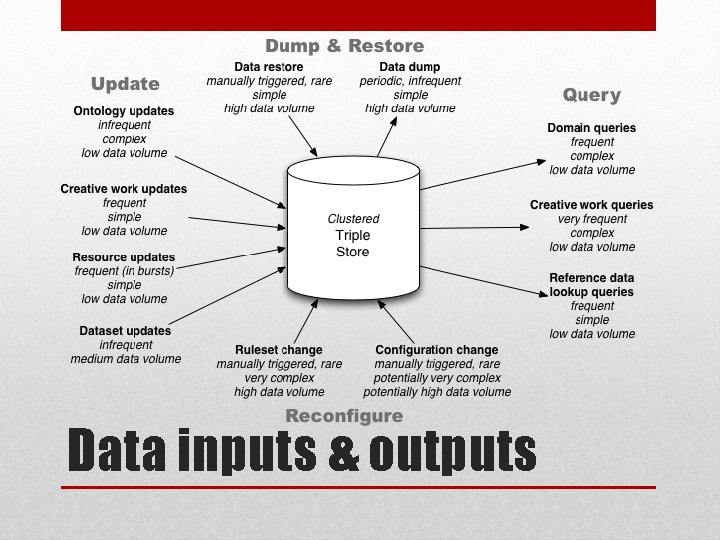
Data inputs & outputs
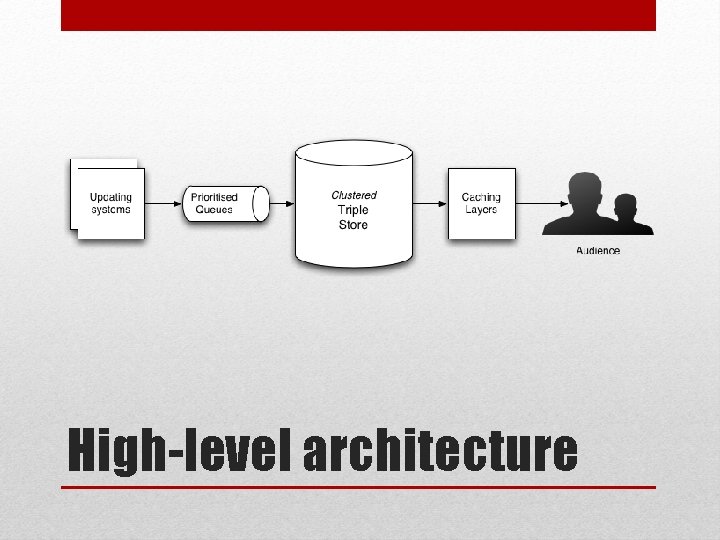
High-level architecture
• Resource = Geo Location, Politician, 2016 Olympics • i. e. concepts or things that can be used in ‘tags’ • • • 90% Creation 10% Update Variable data structure Small data volume < 100 statements SPARQL 1. 1 Update Frequent (10, 000/hour) • Bursts in response to periodic update • Bursts in response to bulk loading • Low level of manual updates • Medium latency requirement Update: Resource
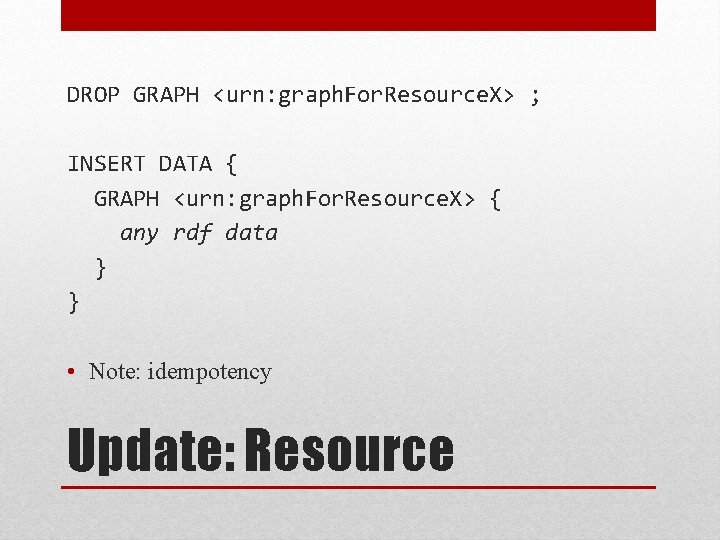
DROP GRAPH <urn: graph. For. Resource. X> ; INSERT DATA { GRAPH <urn: graph. For. Resource. X> { any rdf data } } • Note: idempotency Update: Resource
• • • Creative Work = News Article, TV Programme, Recipe etc… 99% Creation 1% Update Uniform data structure Currently Sesame Imminently: SPARQL 1. 1 Update Frequent (100/hour) • Occurs in response to action by content creator • E. g. Journalist publishes news article • Caveat • Bootstrapping of bulk content • E. g. Archive • Low latency requirement Update: Creative Works
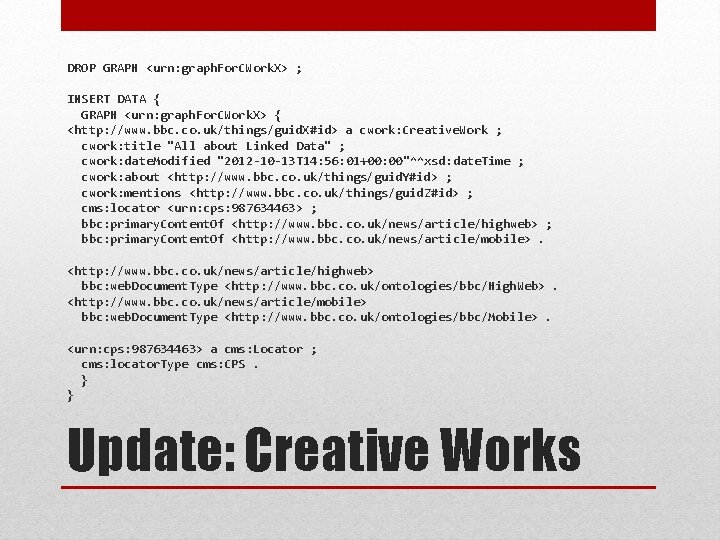
DROP GRAPH <urn: graph. For. CWork. X> ; INSERT DATA { GRAPH <urn: graph. For. CWork. X> { <http: //www. bbc. co. uk/things/guid. X#id> a cwork: Creative. Work ; cwork: title "All about Linked Data" ; cwork: date. Modified "2012 -10 -13 T 14: 56: 01+00: 00"^^xsd: date. Time ; cwork: about <http: //www. bbc. co. uk/things/guid. Y#id> ; cwork: mentions <http: //www. bbc. co. uk/things/guid. Z#id> ; cms: locator <urn: cps: 987634463> ; bbc: primary. Content. Of <http: //www. bbc. co. uk/news/article/highweb> ; bbc: primary. Content. Of <http: //www. bbc. co. uk/news/article/mobile>. <http: //www. bbc. co. uk/news/article/highweb> bbc: web. Document. Type <http: //www. bbc. co. uk/ontologies/bbc/High. Web>. <http: //www. bbc. co. uk/news/article/mobile> bbc: web. Document. Type <http: //www. bbc. co. uk/ontologies/bbc/Mobile>. <urn: cps: 987634463> a cms: Locator ; cms: locator. Type cms: CPS. } } Update: Creative Works
• Dataset = A grouping of resources that are managed as a single serialised, versioned file • 10% Creation 90% Update • Variable data structure • SPARQL 1. 1 Update • Infrequent (10/hour) • Low level of manual updates • Higher data volume: current limit is 1 MB • Medium latency requirement • Legacy solution? Update: Dataset
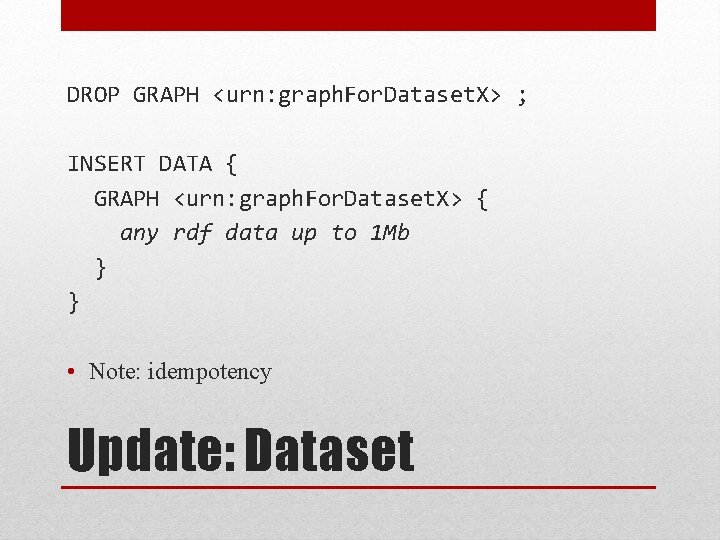
DROP GRAPH <urn: graph. For. Dataset. X> ; INSERT DATA { GRAPH <urn: graph. For. Dataset. X> { any rdf data up to 1 Mb } } • Note: idempotency Update: Dataset
• • 10% Creation 90% Update Restricted to ontological statements SPARQL 1. 1 Update Infrequent (1/hour) • Low level of manual updates • Low data volume • Medium latency requirement • Conflict: high impact change vs. versioning • Solution: difference analysis? • Solution: maintain separately with semi-automatic change Update: Ontology
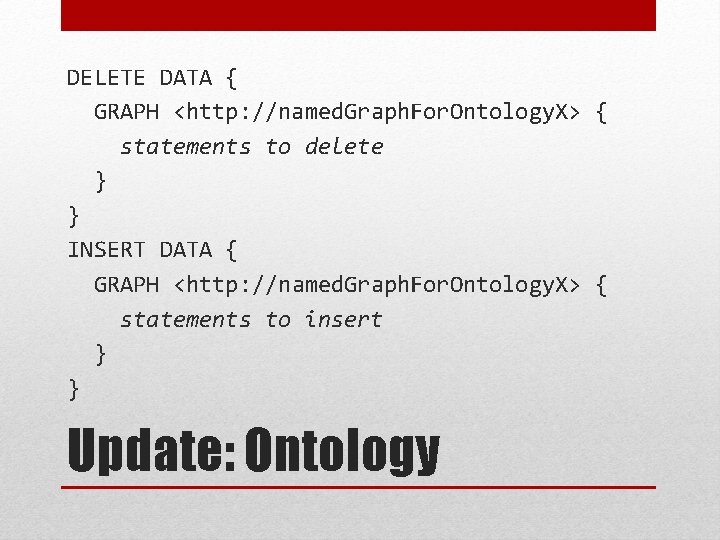
DELETE DATA { GRAPH <http: //named. Graph. For. Ontology. X> { statements to delete } } INSERT DATA { GRAPH <http: //named. Graph. For. Ontology. X> { statements to insert } } Update: Ontology
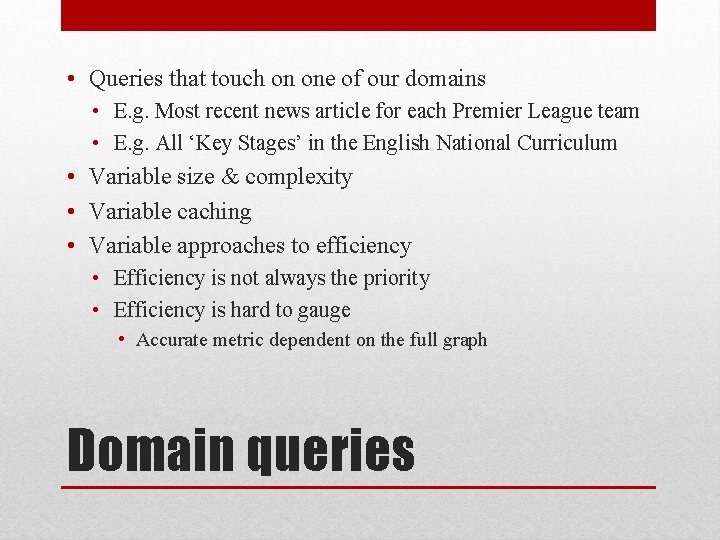
• Queries that touch on one of our domains • E. g. Most recent news article for each Premier League team • E. g. All ‘Key Stages’ in the English National Curriculum • Variable size & complexity • Variable caching • Variable approaches to efficiency • Efficiency is not always the priority • Efficiency is hard to gauge • Accurate metric dependent on the full graph Domain queries
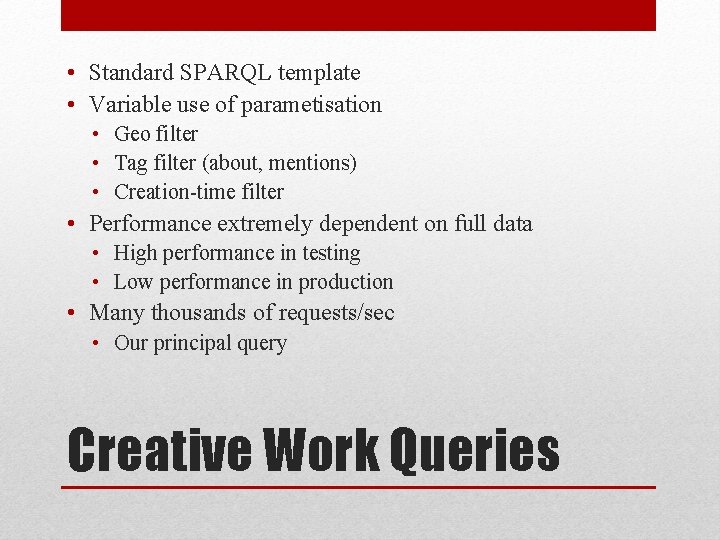
• Standard SPARQL template • Variable use of parametisation • Geo filter • Tag filter (about, mentions) • Creation-time filter • Performance extremely dependent on full data • High performance in testing • Low performance in production • Many thousands of requests/sec • Our principal query Creative Work Queries
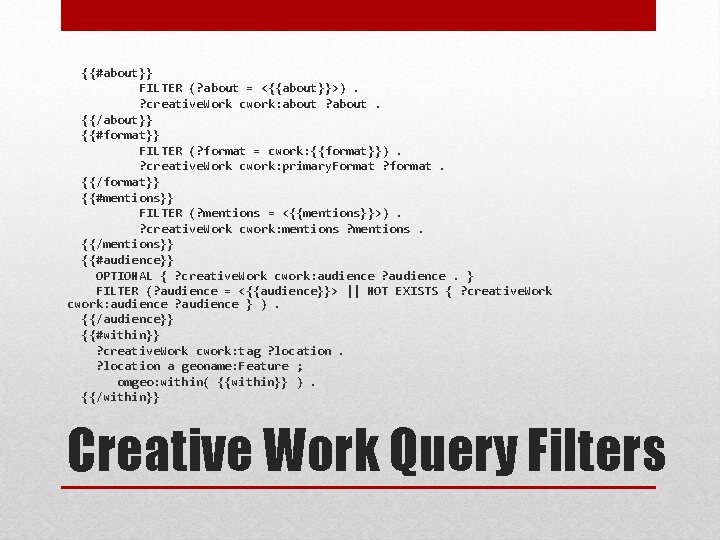
{{#about}} FILTER (? about = <{{about}}>). ? creative. Work cwork: about ? about. {{/about}} {{#format}} FILTER (? format = cwork: {{format}}). ? creative. Work cwork: primary. Format ? format. {{/format}} {{#mentions}} FILTER (? mentions = <{{mentions}}>). ? creative. Work cwork: mentions ? mentions. {{/mentions}} {{#audience}} OPTIONAL { ? creative. Work cwork: audience ? audience. } FILTER (? audience = <{{audience}}> || NOT EXISTS { ? creative. Work cwork: audience ? audience } ). {{/audience}} {{#within}} ? creative. Work cwork: tag ? location a geoname: Feature ; omgeo: within( {{within}} ). {{/within}} Creative Work Query Filters
• Fundamental changes need to be fast in production • Ruleset changes • Configuration/administrative changes • • Index creation/update Re-indexing Memory allocation Naming • Dumping and restoring data can support this • Other approaches? Fundamental changes
• Most important part of the BBC use-case: • We need 99. 99% availability of reads • We need 99% availability of writes • We need 99. 99% availability of writes during critical periods • Ontologies and rules can and should change over time • Changes to these must limit their effect on: • Availability • Latency • Our approaches are constantly evolving Finally
- Slides: 18