
Bayesian Subtree Alignment Model based on Dependency Trees
Bayesian Subtree Alignment Model based on Dependency Trees Toshiaki Nakazawa Sadao Kurohashi Kyoto University 1 2011/11/11 @ IJCNLP 2011
Outline • • • Background Related Work Bayesian Subtree Alignment Model Training Experiments Conclusion 2
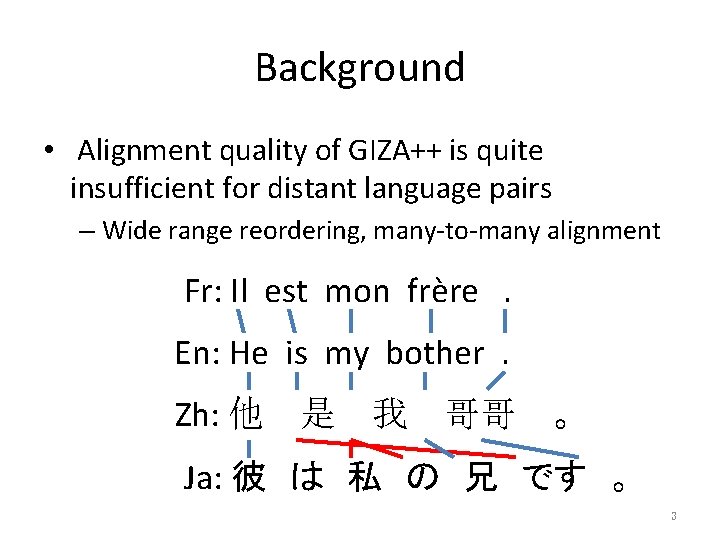
Background • Alignment quality of GIZA++ is quite insufficient for distant language pairs – Wide range reordering, many-to-many alignment Fr: Il est mon frère. En: He is my bother. Zh: 他 是 我 哥哥 。 Ja: 彼 は 私 の 兄 です 。 3
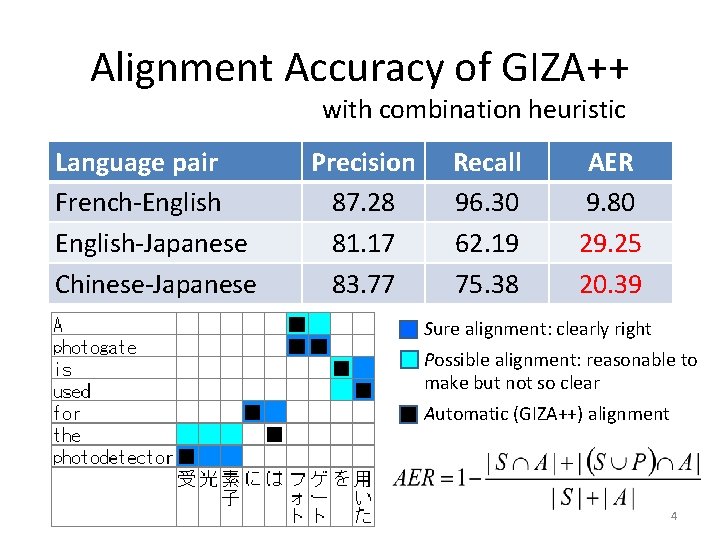
Alignment Accuracy of GIZA++ with combination heuristic Language pair French-English-Japanese Chinese-Japanese Precision 87. 28 81. 17 83. 77 Recall 96. 30 62. 19 75. 38 AER 9. 80 29. 25 20. 39 Sure alignment: clearly right Possible alignment: reasonable to make but not so clear Automatic (GIZA++) alignment 4
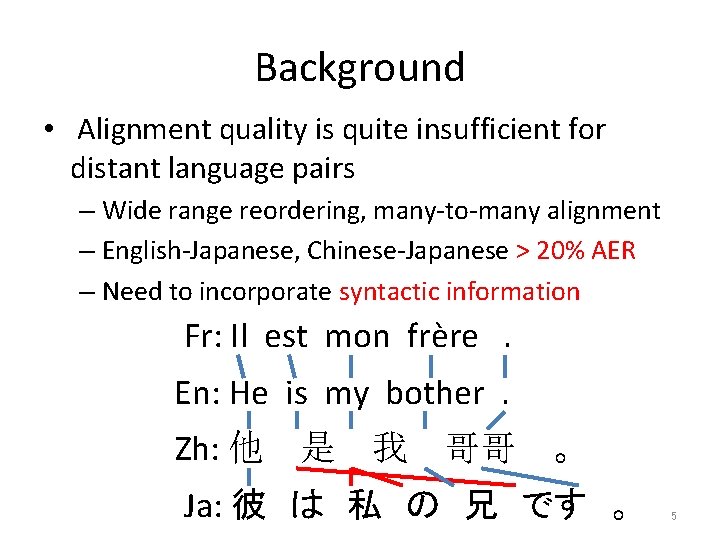
Background • Alignment quality is quite insufficient for distant language pairs – Wide range reordering, many-to-many alignment – English-Japanese, Chinese-Japanese > 20% AER – Need to incorporate syntactic information Fr: Il est mon frère. En: He is my bother. Zh: 他 是 我 哥哥 。 Ja: 彼 は 私 の 兄 です 。 5
Related Work • Cherry and Lin (2003) – Discriminative alignment model using source side dependency tree – Allows one-to-one alignment only • Nakazawa and Kurohashi (2009) – Generative model using both side dependency trees – Allows phrasal alignment – Degeneracy of acquiring incorrect larger phrases derived from Maximum Likelihood Estimation 6
Related Work • De. Nero et al. (2008) – Incorporate prior knowledge about the parameter to void the degeneracy of the model – Place Dirichlet Process (DP) prior over phrase generation model – Simple distortion model: position-based • This work – Take advantage of two works by Nakazawa et al. and De. Nero et al. 7
![Related Work [De. Nero et al. , 2008] • Generative story of (sequential) phrase-based](http://slidetodoc.com/presentation_image_h2/abcda06968d82022db4ce321a2a871e3/image-8.jpg "Related Work [De. Nero et al. , 2008] • Generative story of (sequential) phrase-based")
Related Work [De. Nero et al. , 2008] • Generative story of (sequential) phrase-based joint probability model 1. Choose a number of components 2. Generate each of phrase pairs independently • Nonparametric Bayesian prior 3. Choose an ordering for the phrases • Model Step 1 Step 2 Step 3 8
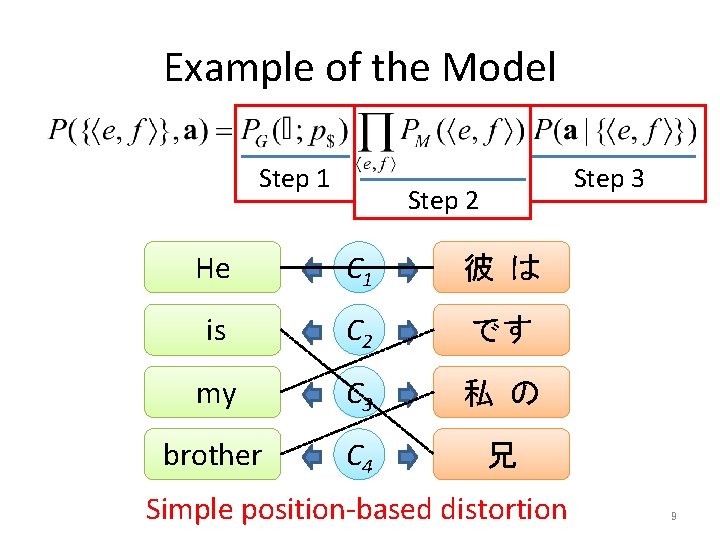
Example of the Model Step 1 Step 3 Step 2 He C 1 彼 は is C 2 です my C 3 私 の brother C 4 兄 Simple position-based distortion 9
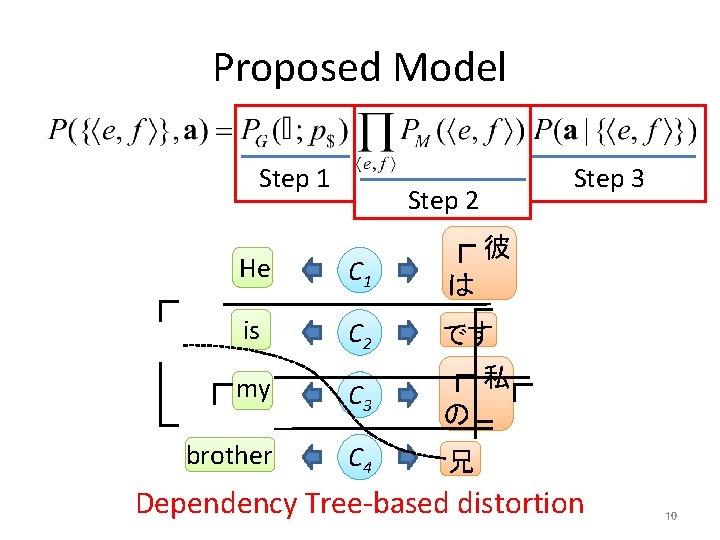
Proposed Model Step 1 Step 3 Step 2 彼 He C 1 は is C 2 です 私 my C 3 の brother C 4 兄 Dependency Tree-based distortion 10
Bayesian Subtree Alignment Model based on Dependency Trees 11
![Model Decomposition Null dependency of phrases cf. [De. Nero et al. , 2008] Non-null](http://slidetodoc.com/presentation_image_h2/abcda06968d82022db4ce321a2a871e3/image-12.jpg "Model Decomposition Null dependency of phrases cf. [De. Nero et al. , 2008] Non-null")
Model Decomposition Null dependency of phrases cf. [De. Nero et al. , 2008] Non-null dependency relations 12
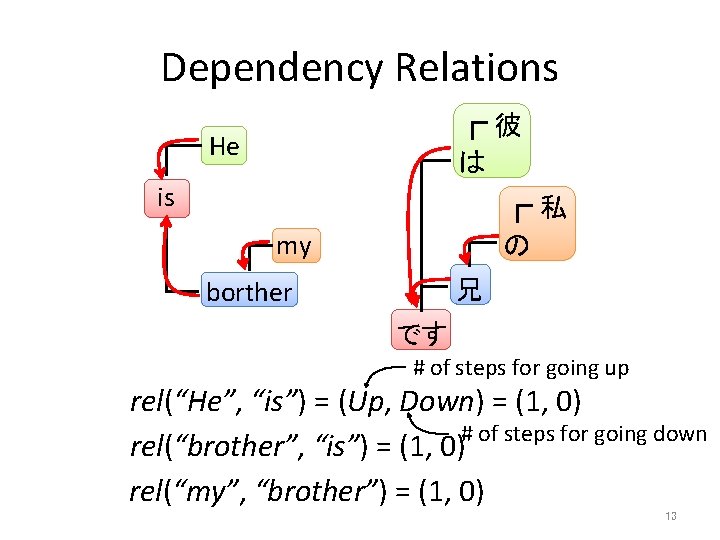
Dependency Relations 彼 He は is 私 my の borther 兄 です # of steps for going up rel(“He”, “is”) = (Up, Down) = (1, 0) rel(“brother”, “is”) = (1, 0)# of steps for going down rel(“my”, “brother”) = (1, 0) 13
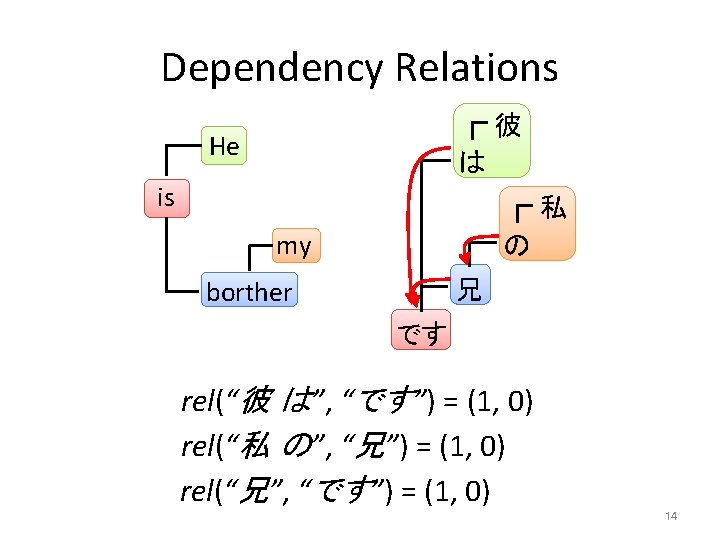
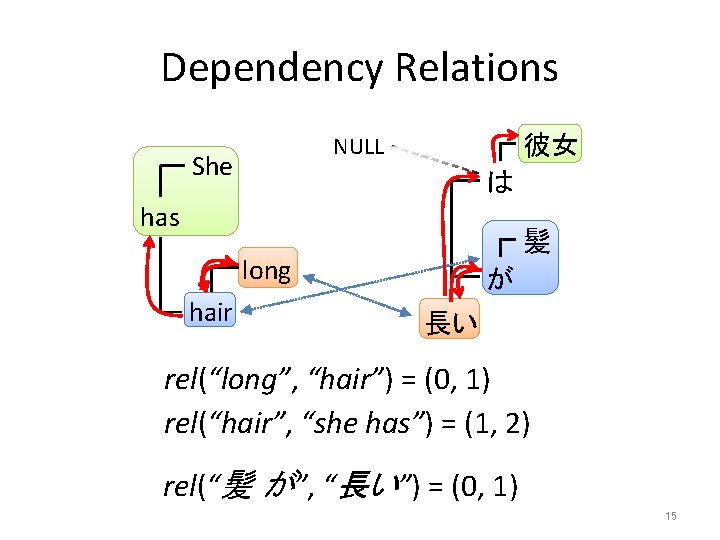
Dependency Relations 彼女 NULL She は has 髪 long hair が 長い rel(“long”, “hair”) = (0, 1) rel(“hair”, “she has”) = (1, 2) rel(“髪 が”, “長い”) = (0, 1) 15
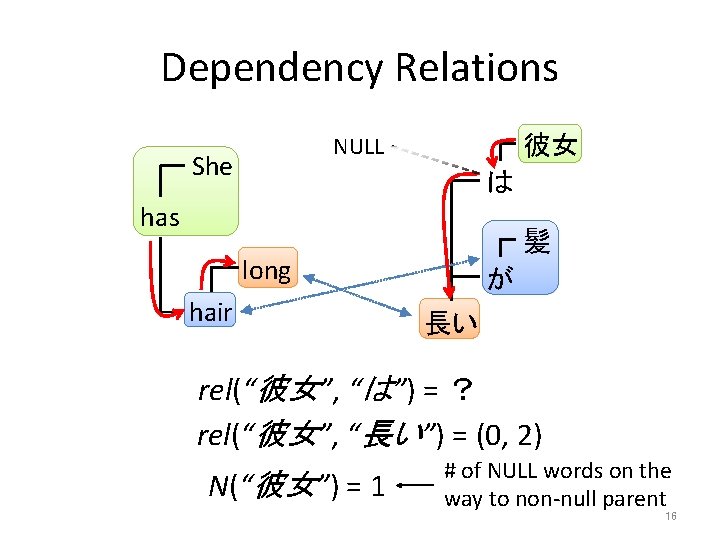
Dependency Relations 彼女 NULL She は has 髪 long hair が 長い rel(“彼女”, “は”) = ? rel(“彼女”, “長い”) = (0, 2) N(“彼女”) = 1 # of NULL words on the way to non-null parent 16
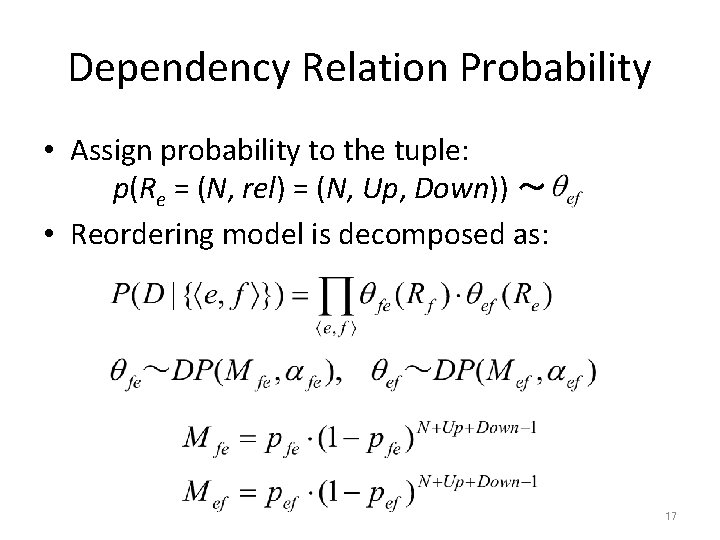
Dependency Relation Probability • Assign probability to the tuple: p(Re = (N, rel) = (N, Up, Down)) ~ • Reordering model is decomposed as: 17
Model Training 18
Model Training • Initialization – Create heuristic phrase alignment like ‘grow-diagfinal-and’ on dependency trees using results from GIZA++ – Count phrase alignment and dependency relations • Refine the model by Gibbs sampling – Operators: SWAP, TOGGLE, EXPAND 19
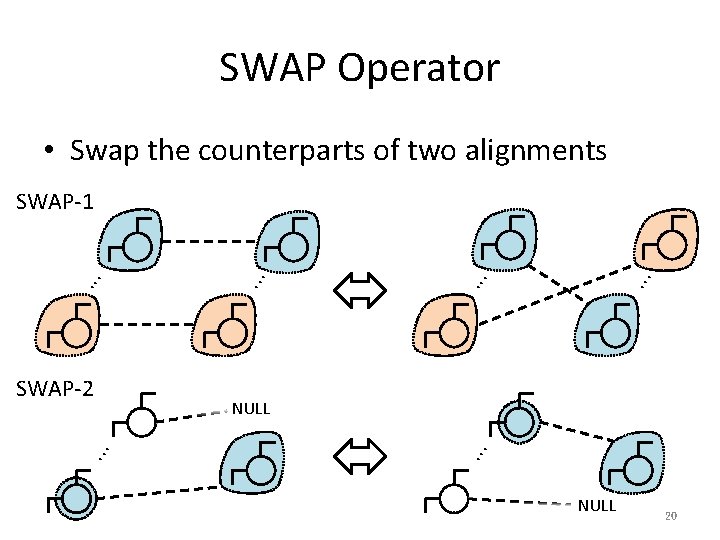
SWAP Operator • Swap the counterparts of two alignments SWAP-2 ・ ・・ ・・ ・ SWAP-1 ・ ・・ ・・ ・ NULL 20
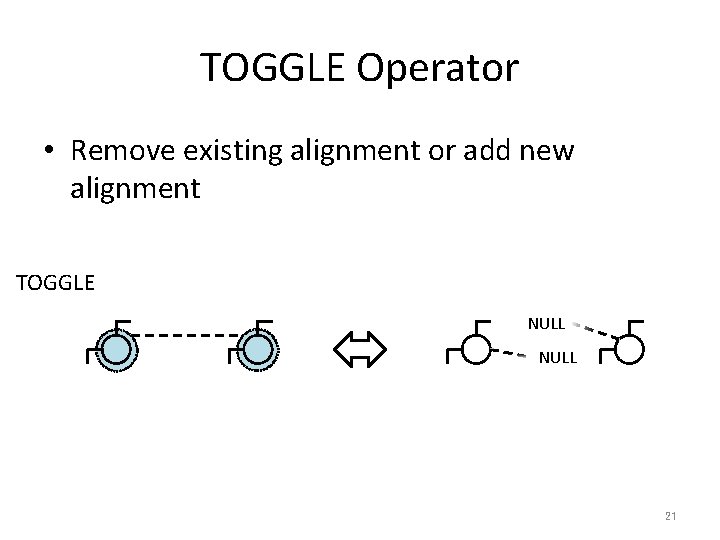
TOGGLE Operator • Remove existing alignment or add new alignment TOGGLE NULL 21
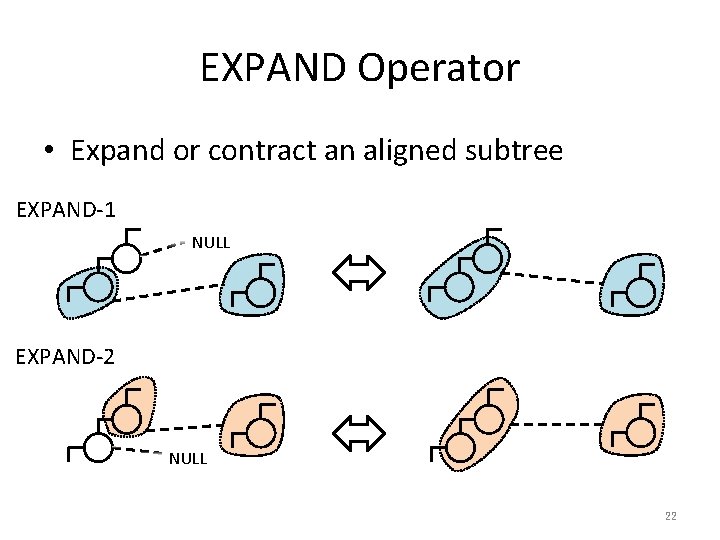
EXPAND Operator • Expand or contract an aligned subtree EXPAND-1 NULL EXPAND-2 NULL 22
Alignment Experiment • Training: 1 M for Ja-En, 678 K for Ja-Zh • Testing: about 500 hand-annotated parallel sentences (with Sure and Possible alignments) • Measure: Precision, Recall, Alignment Error Rate • Japanese Tools: JUMAN and KNP • English Tool: Charniak’s nlparser • Chinese Tools: MMA and CNP (from NICT) 23
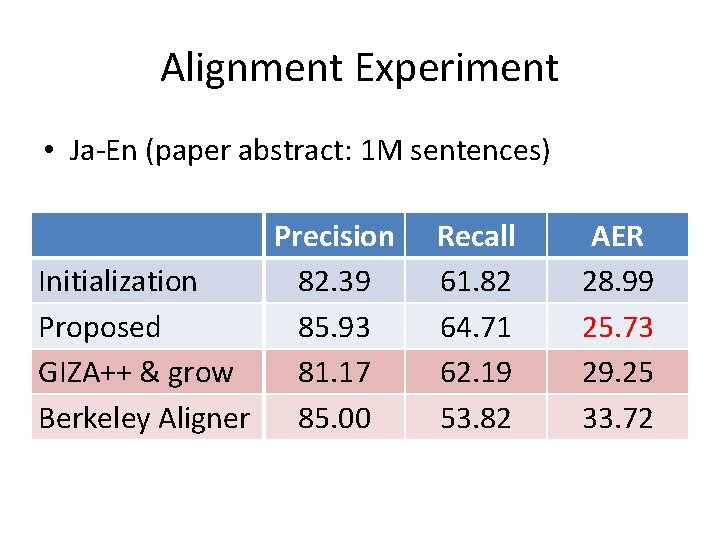
Alignment Experiment • Ja-En (paper abstract: 1 M sentences) Precision Initialization 82. 39 Proposed 85. 93 GIZA++ & grow 81. 17 Berkeley Aligner 85. 00 Recall 61. 82 64. 71 62. 19 53. 82 AER 28. 99 25. 73 29. 25 33. 72
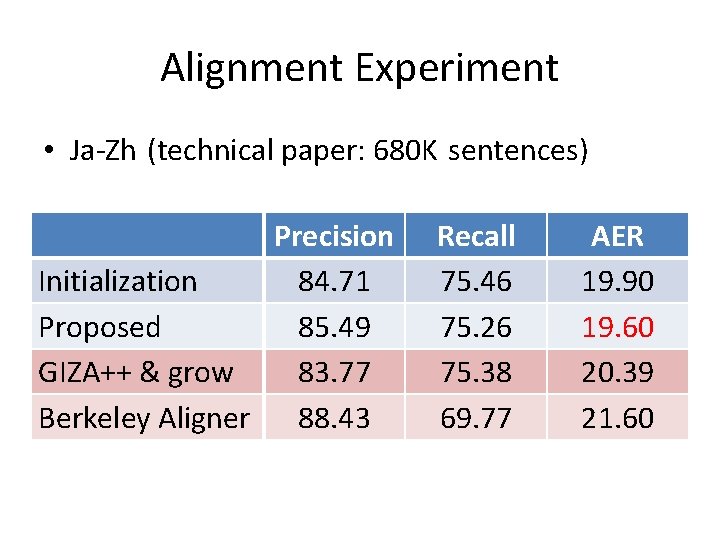
Alignment Experiment • Ja-Zh (technical paper: 680 K sentences) Precision Initialization 84. 71 Proposed 85. 49 GIZA++ & grow 83. 77 Berkeley Aligner 88. 43 Recall 75. 46 75. 26 75. 38 69. 77 AER 19. 90 19. 60 20. 39 21. 60
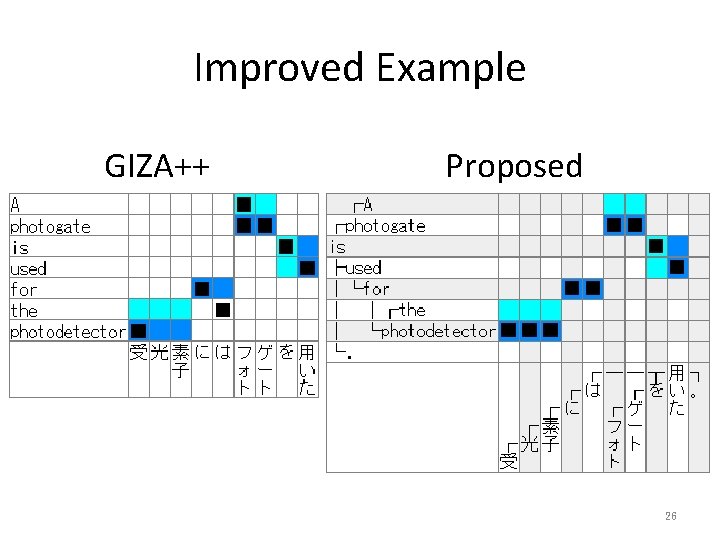
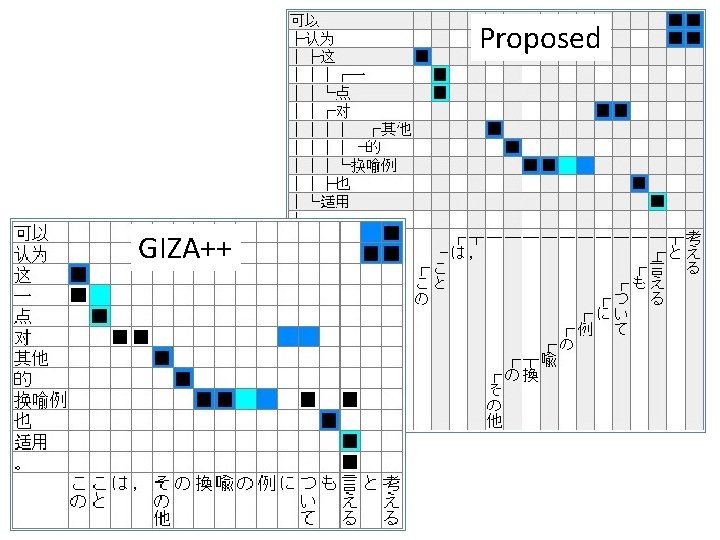
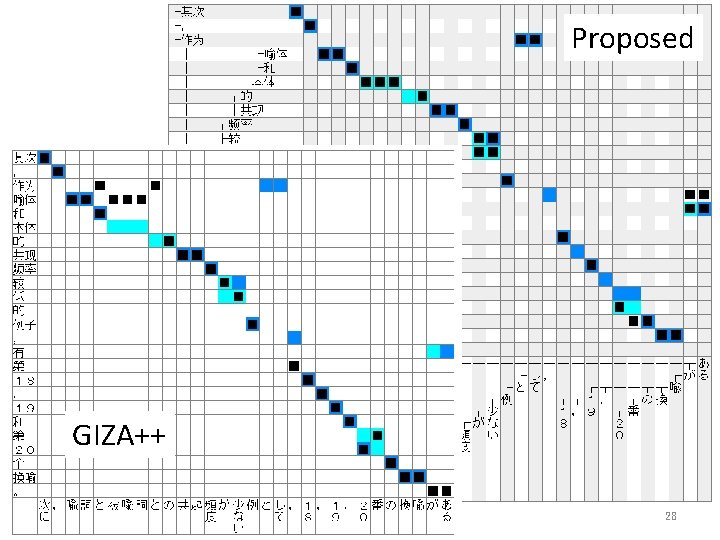
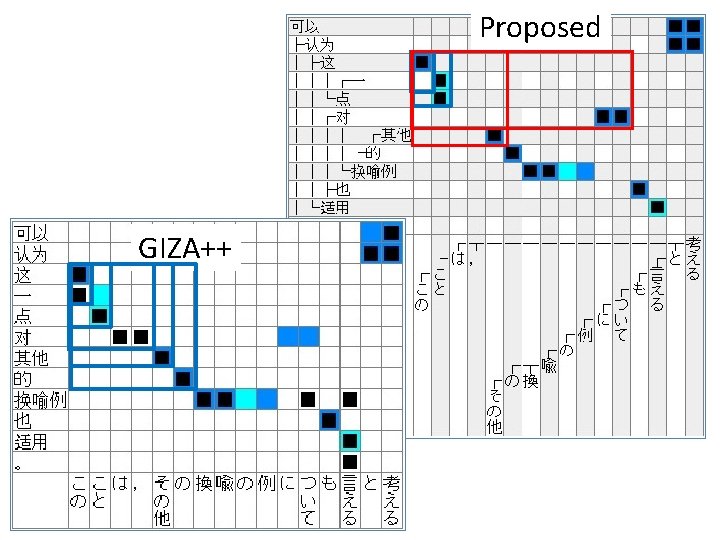
Improved Example GIZA++ Proposed 26
Proposed GIZA++
Proposed GIZA++ 28
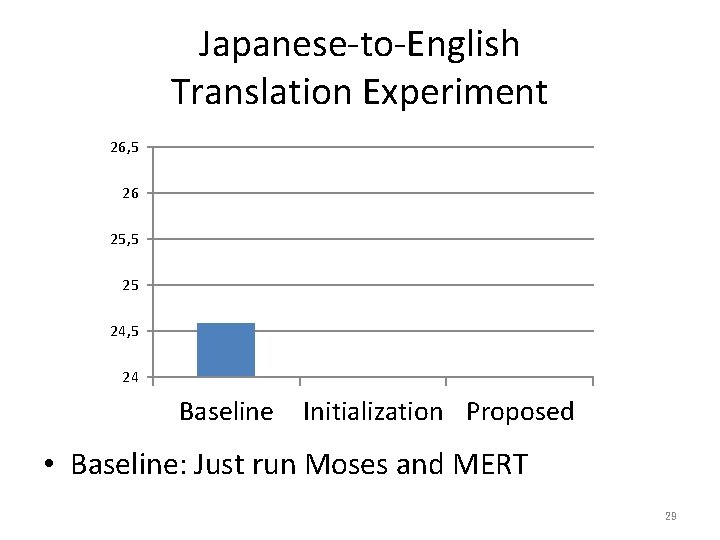
Japanese-to-English Translation Experiment 26, 5 26 25, 5 25 24, 5 24 Baseline Initialization Proposed • Baseline: Just run Moses and MERT 29
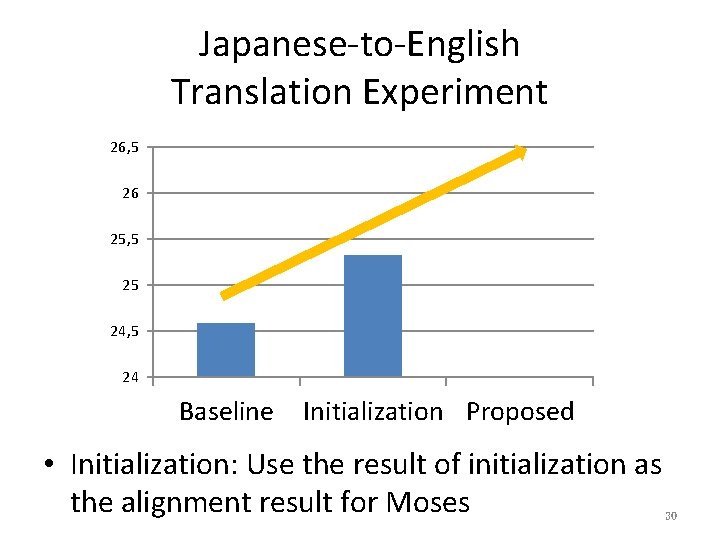
Japanese-to-English Translation Experiment 26, 5 26 25, 5 25 24, 5 24 Baseline Initialization Proposed • Initialization: Use the result of initialization as the alignment result for Moses 30
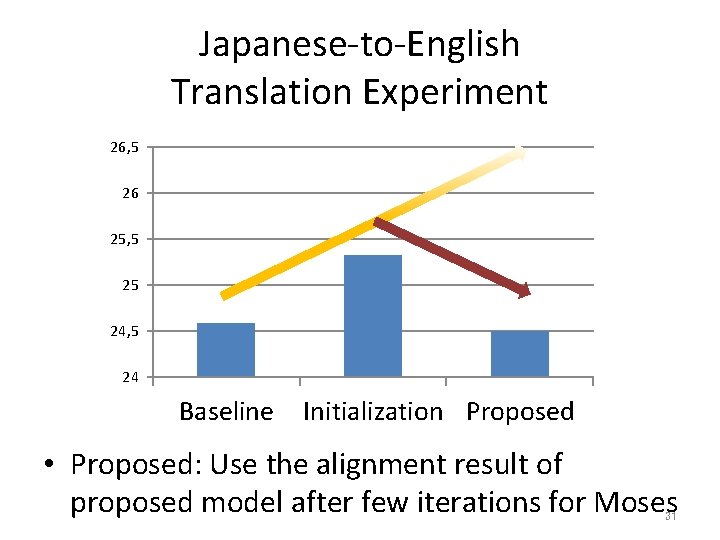
Japanese-to-English Translation Experiment 26, 5 26 25, 5 25 24, 5 24 Baseline Initialization Proposed • Proposed: Use the alignment result of proposed model after few iterations for Moses 31
Proposed GIZA++
Conclusion • Bayesian Tree-based Phrase Alignment Model – Better alignment accuracy than GIZA++ in distant language pairs • Translation – Currently (temporally), not improved • Future work – Robustness for parsing errors • Using N-best parsing result or forest – Show improvement in translation • Tree-based decoder(, Hiero? ) 33
- Slides: 33