
Bayesian Network Model for Evaluation of Ecological River

Bayesian Network Model for Evaluation of Ecological River Construction M. Arshad Awan
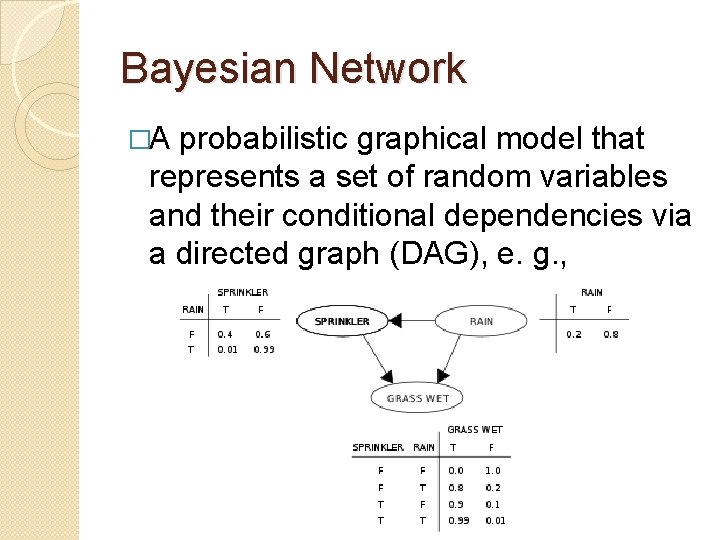
Bayesian Network �A probabilistic graphical model that represents a set of random variables and their conditional dependencies via a directed graph (DAG), e. g. ,

Ecology �The study of the interactions of living organisms with each other and with their environment.
General River Management �Flood Control ◦ Embanking ◦ Waterway management �Water ◦ ◦ resource management Irrigation Drinking water supply Industrial water supply Hydraulic power generation
New Demands in River Management �Environment-friendly ◦ Landscape, temperature, humidity, oxygen �Ecological healthiness ◦ Species diversity, balance of food chain ◦ Abundant number of species ◦ Habitats for animals �Water-friendly activity ◦ Exercise, rest, walking, picnic, fishing, learning, observation

Ecological River Construction �Nature-shaped river ◦ Recover the natural environments as close as possible (shallows, swamp, tree, grass, etc. ) ◦ Within the limit of flood controllability ◦ Ecological system recovery ◦ Sustainability �Supply the area for water-friendly activity ◦ Rest area, shelter, walkway, sports area ◦ Accessibility
Successful Ecological River �How to evaluate? �Possible variables ◦ ◦ ◦ Sufficient water-quantity Clean water-quality Good landscape Secure structure of nature-recovery Convenient facility Sufficient space, etc.
Research Definition �Goals ◦ To develop a model to evaluate the ecological river construction ◦ To find the required/desired plan quantitatively �Technical tool ◦ Bayesian Network Model �Expected effects ◦ Evaluation of existing rivers ◦ Evaluation of results on investment ◦ Provide the suggestion to reconstruct and manage the facility ◦ Provide the guideline for the new project
Progress in term project �Survey: ◦ Ecological river engineering ◦ Bayesian belief networks (BBN) �Selection of input variables for BBN �Tool to develop BBN ◦ Netica �Development of proposed BBN
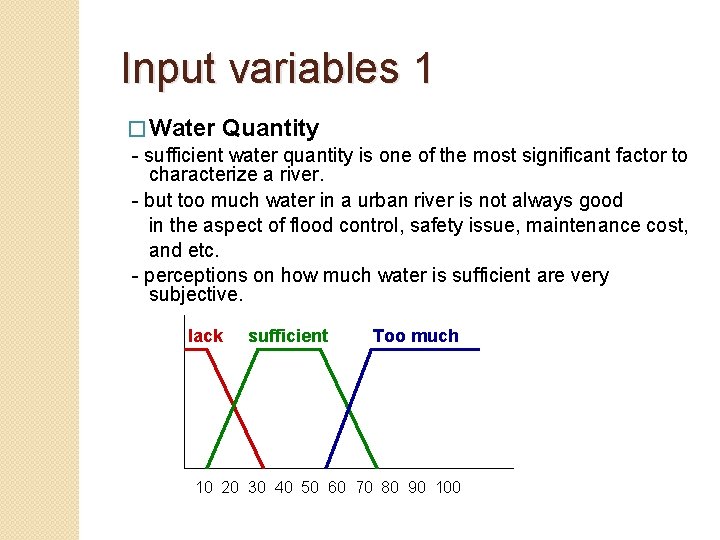
Input variables 1 � Water Quantity - sufficient water quantity is one of the most significant factor to characterize a river. - but too much water in a urban river is not always good in the aspect of flood control, safety issue, maintenance cost, and etc. - perceptions on how much water is sufficient are very subjective. lack sufficient Too much 10 20 30 40 50 60 70 80 90 100
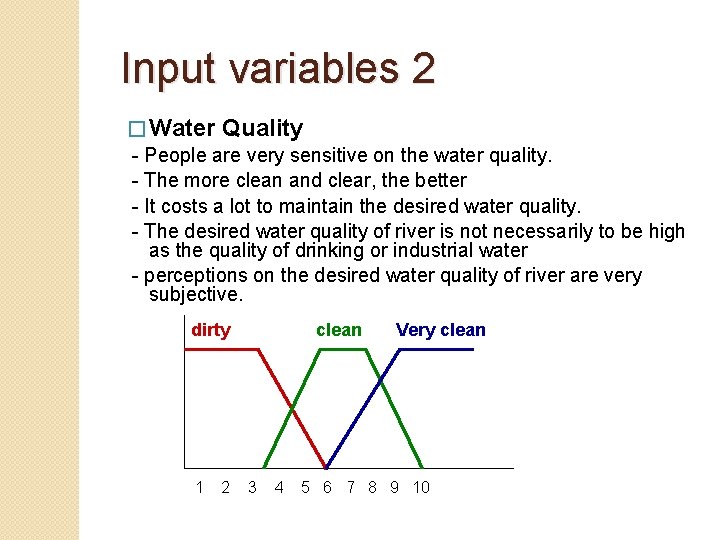
Input variables 2 � Water Quality - People are very sensitive on the water quality. - The more clean and clear, the better - It costs a lot to maintain the desired water quality. - The desired water quality of river is not necessarily to be high as the quality of drinking or industrial water - perceptions on the desired water quality of river are very subjective. dirty 1 2 clean 3 4 Very clean 5 6 7 8 9 10
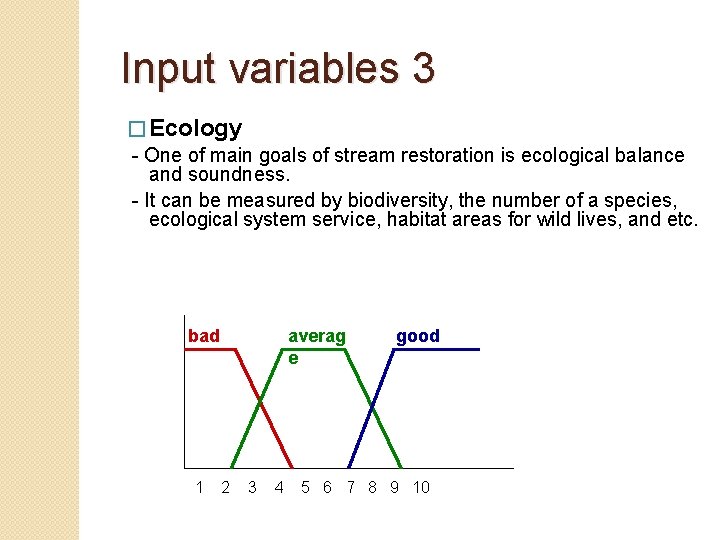
Input variables 3 � Ecology - One of main goals of stream restoration is ecological balance and soundness. - It can be measured by biodiversity, the number of a species, ecological system service, habitat areas for wild lives, and etc. bad 1 averag e 2 3 4 good 5 6 7 8 9 10
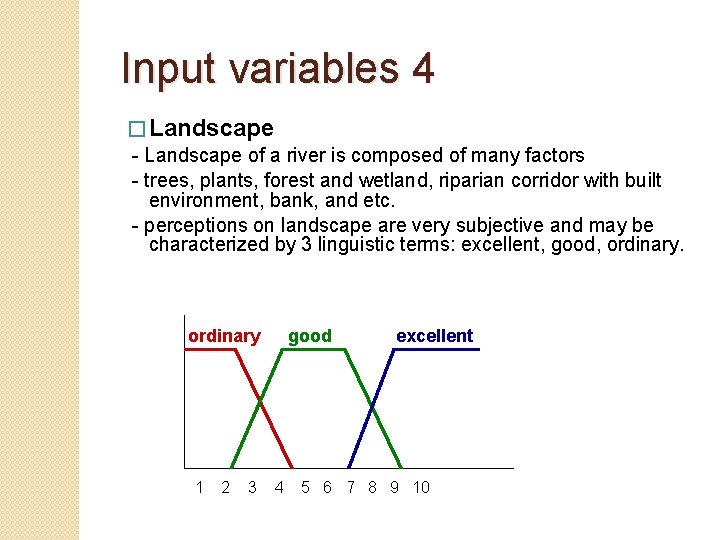
Input variables 4 � Landscape - Landscape of a river is composed of many factors - trees, plants, forest and wetland, riparian corridor with built environment, bank, and etc. - perceptions on landscape are very subjective and may be characterized by 3 linguistic terms: excellent, good, ordinary 1 2 3 good 4 excellent 5 6 7 8 9 10
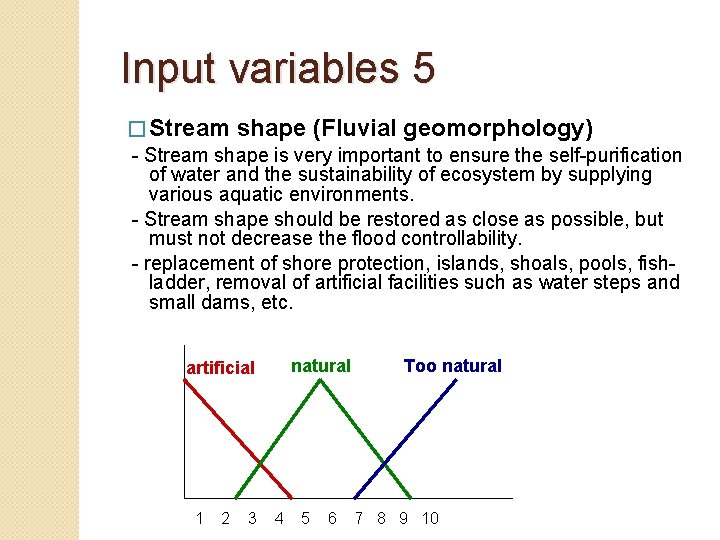
Input variables 5 � Stream shape (Fluvial geomorphology) - Stream shape is very important to ensure the self-purification of water and the sustainability of ecosystem by supplying various aquatic environments. - Stream shape should be restored as close as possible, but must not decrease the flood controllability. - replacement of shore protection, islands, shoals, pools, fishladder, removal of artificial facilities such as water steps and small dams, etc. natural artificial 1 2 3 4 5 6 Too natural 7 8 9 10
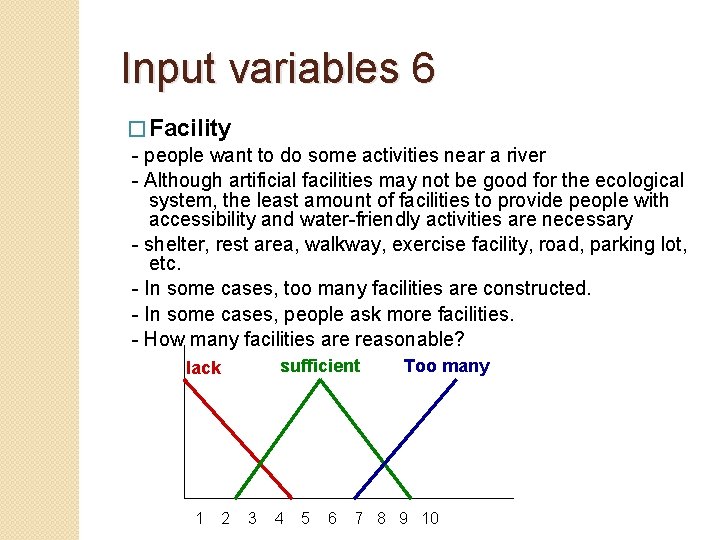
Input variables 6 � Facility - people want to do some activities near a river - Although artificial facilities may not be good for the ecological system, the least amount of facilities to provide people with accessibility and water-friendly activities are necessary - shelter, rest area, walkway, exercise facility, road, parking lot, etc. - In some cases, too many facilities are constructed. - In some cases, people ask more facilities. - How many facilities are reasonable? sufficient lack 1 2 3 4 5 6 Too many 7 8 9 10
Bayesian Belief Network (BBN) �Structure ◦ Connection of nodes (DAG) �Inference ◦ Infer the value of variables �Learning ◦ Training examples
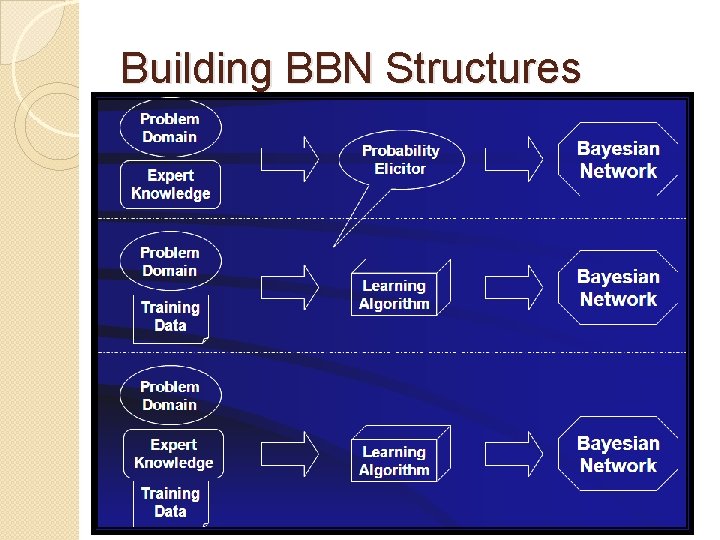
Building BBN Structures

Netica (BBN Tool)
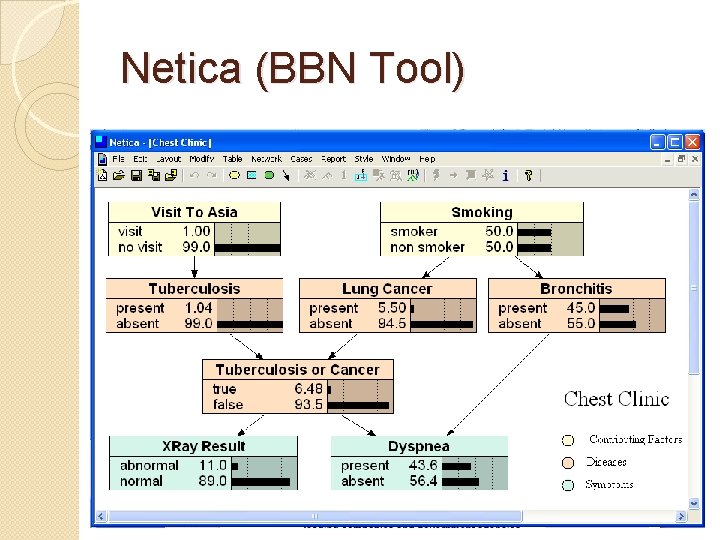
Netica (BBN Tool)
Proposed BBN �To evaluate a river, a set of nodes are connected: ◦ based on the combination of 6 input variables �The output of evaluation can be differentiated based on the criteria which uses different sets of variables ◦ comprehensive evaluation : 6 inputs ◦ aquatic environment evaluation: �quantity, quality, ecology ◦ land environment evaluation: �landscape, stream shape, facility ◦ Balance/successful evaluation : 6 inputs comparison
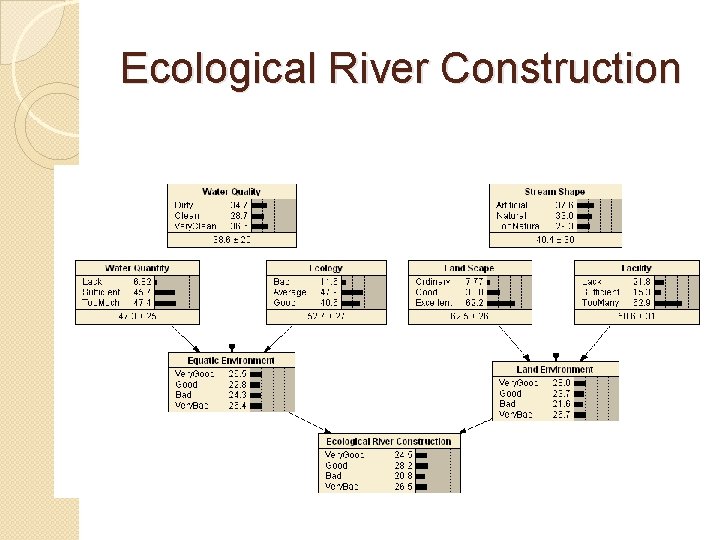
Ecological River Construction
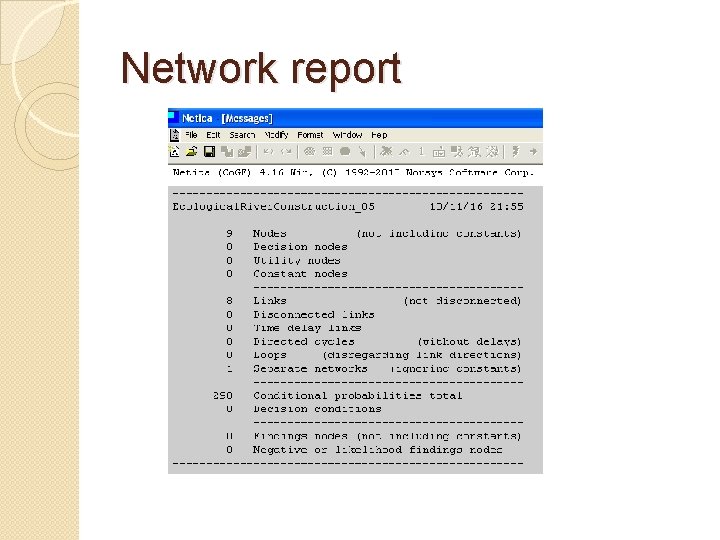
Network report
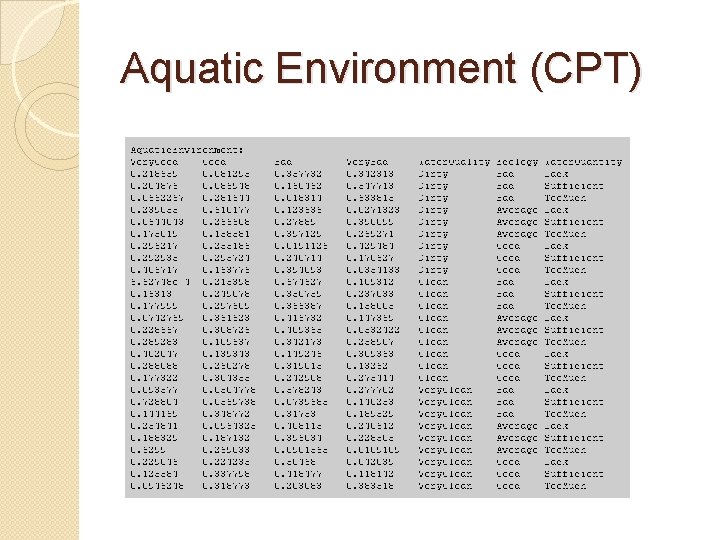
Aquatic Environment (CPT)
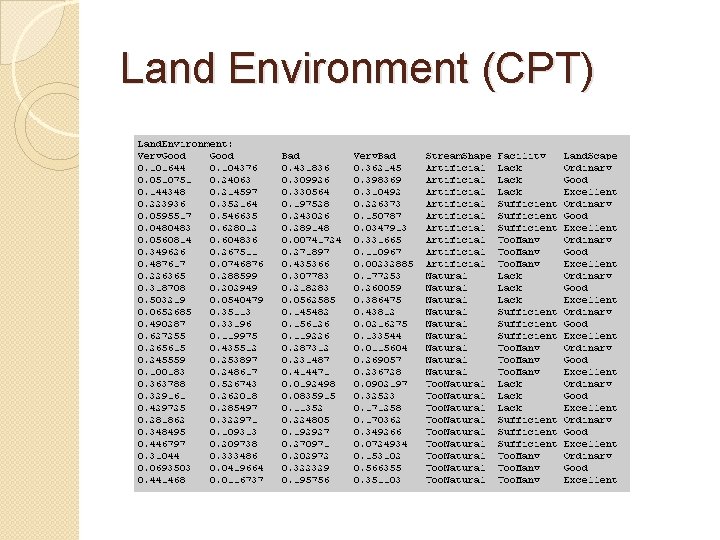
Land Environment (CPT)
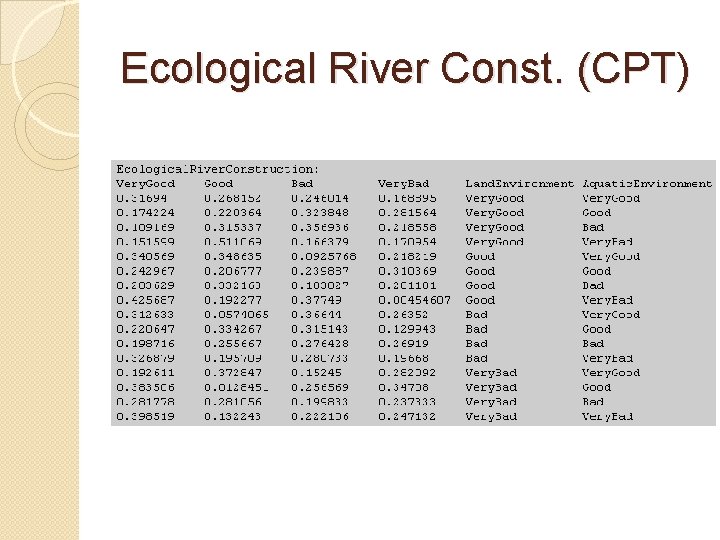
Ecological River Const. (CPT)
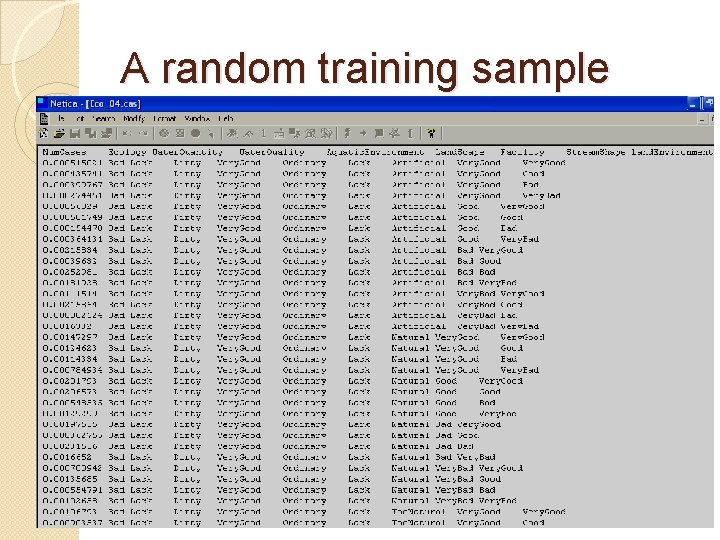
A random training sample
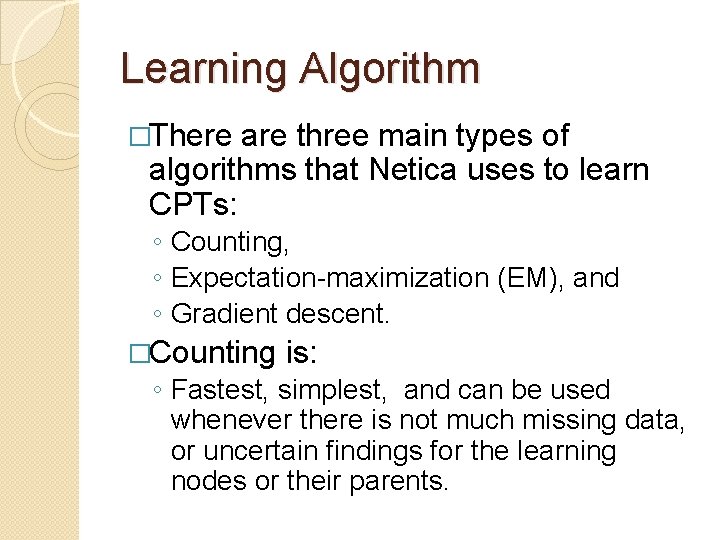
Learning Algorithm �There are three main types of algorithms that Netica uses to learn CPTs: ◦ Counting, ◦ Expectation-maximization (EM), and ◦ Gradient descent. �Counting is: ◦ Fastest, simplest, and can be used whenever there is not much missing data, or uncertain findings for the learning nodes or their parents.
References Woo, H. , Trends in ecological river engineering in Korea, Journal of Hydro-environment Research (2010), doi: 10. 1016/j. jher. 2010. 06. 003. � Finn V. Jensen and Thomas D. Nielsen, “Bayesian Networks and Decision Graphs”, February 8, 2007, Springer. � Judea Pearl, “Probabilistic Reasoning in Intelligent Systems: Networks of Plausible Inference”. � Marcot, B. G. , J. D. Steventon, G. D. Sutherland, and R. K. Mc. Cann. 2006. Guidelines for developing and updating Bayesian belief networks applied to ecological modeling and conservation. Canadian Journal of Forest Research 36: 30633074. � Mc. Cann, R. , B. G. Marcot, and R. Ellis. 2006. Bayesian belief networks: applications in natural resource management. Canadian Journal of Forest Research 36: 3053 -3062. �
References Marcot, B. G. , R. S. Holthausen, M. G. Raphael, M. M. Rowland, and M. J. Wisdom. 2001. Using Bayesian belief networks to evaluate fish and wildlife population viability under land management alternatives from an environmental impact statement. Forest Ecology and Management 153(13): 29 -42. � The Anticipated Impacts of the Four Rivers Project (ROK) on Waterbirds (Birds Korea Preliminary Report). � Workshop on hydro-ecological modeling of riverine organisms and habitats, ecological processes and functions (6 th to 7 th of June 2005, The Netherlands). � http: //www. gleon. org/ (Global Lake Ecological Observatory Network). � http: //en. wikipedia. org/. � Sandra Lanini, “Water Management Impact Assessment Using A Bayesian Network Model”, 7 th International Conference on Hydroinformatics, HIC 2006, Nice, FRANCE. �

Thanks!
- Slides: 30