
Bayesian Methods for Monitoring Public Health Surveillance Data
Bayesian Methods for Monitoring Public Health Surveillance Data October 17, 2002 Owen Devine Division of STD Prevention National Center for HIV, STD and TB Prevention Centers for Disease Control and Prevention
• Spatially referenced data • Temporally referenced data Focus on detection of aberrations in public health surveillance data
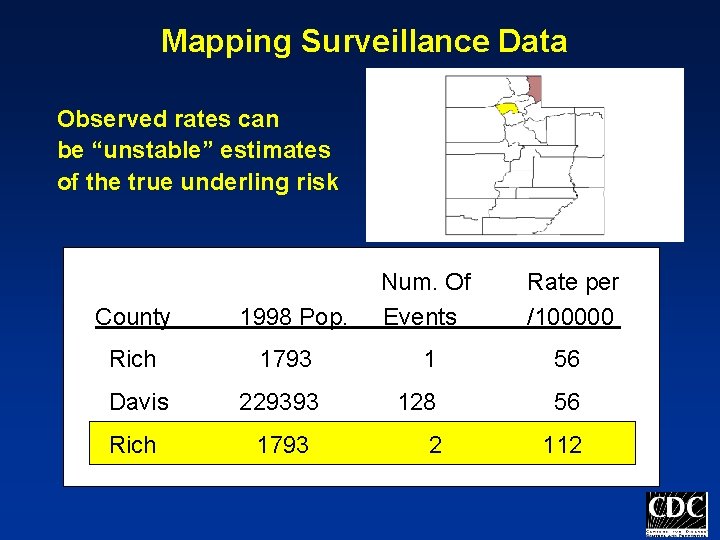
Mapping Surveillance Data Observed rates can be “unstable” estimates of the true underling risk County 1998 Pop. Num. Of Events Rate per /100000 Rich 1793 1 56 Davis 229393 128 56 Rich 1793 2 112
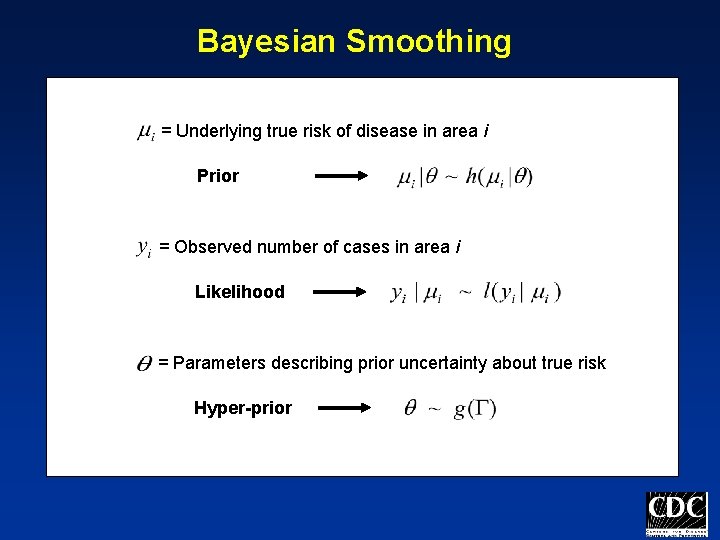
Bayesian Smoothing = Underlying true risk of disease in area i Prior = Observed number of cases in area i Likelihood = Parameters describing prior uncertainty about true risk Hyper-prior
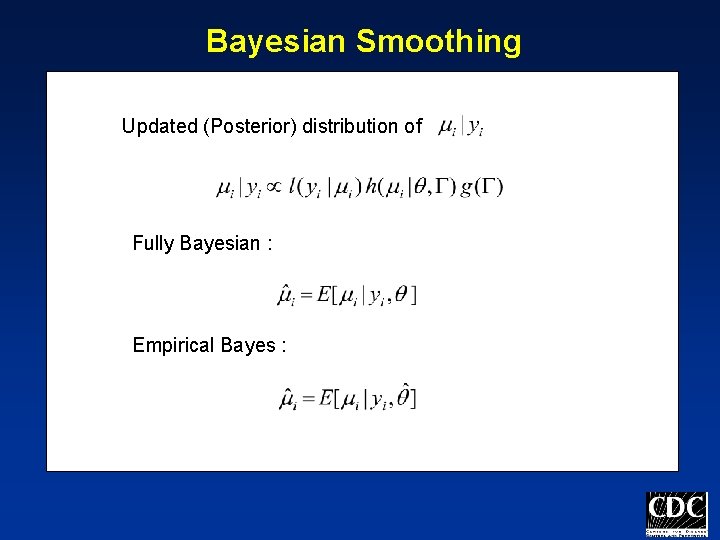
Bayesian Smoothing Updated (Posterior) distribution of Fully Bayesian : Empirical Bayes :
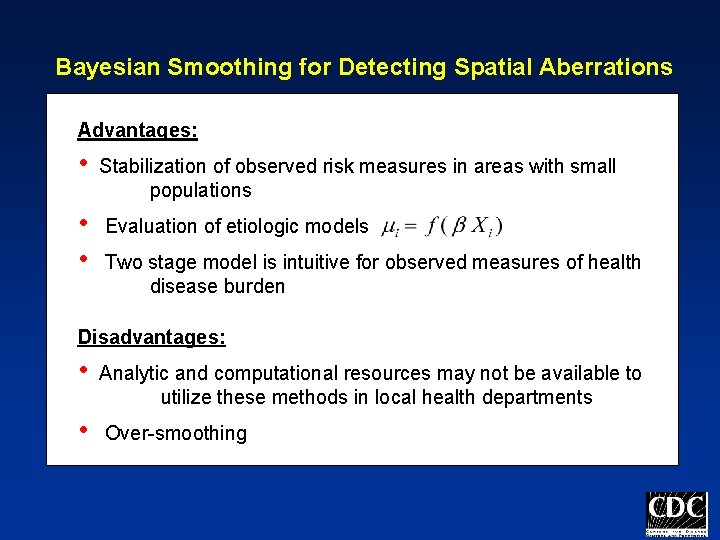
Bayesian Smoothing for Detecting Spatial Aberrations Advantages: • Stabilization of observed risk measures in areas with small populations • • Evaluation of etiologic models Two stage model is intuitive for observed measures of health disease burden Disadvantages: • Analytic and computational resources may not be available to utilize these methods in local health departments • Over-smoothing
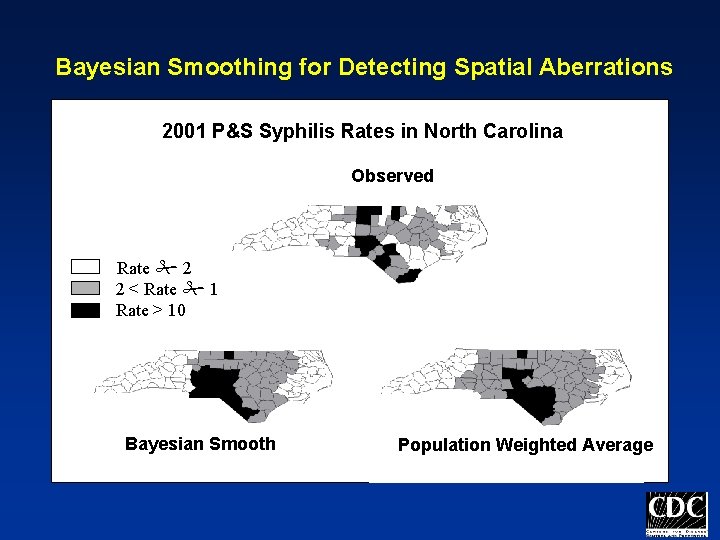
Bayesian Smoothing for Detecting Spatial Aberrations 2001 P&S Syphilis Rates in North Carolina Observed Rate 2 2 < Rate 10 Rate > 10 Bayesian Smooth Population Weighted Average
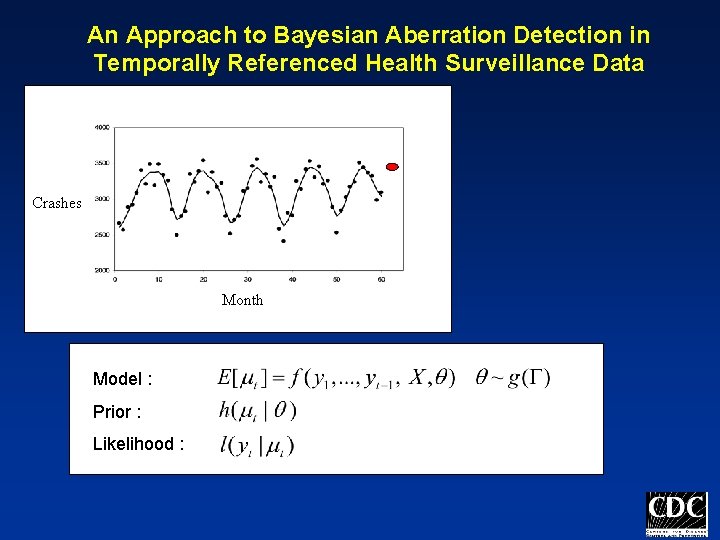
An Approach to Bayesian Aberration Detection in Temporally Referenced Health Surveillance Data Crashes Month Model : Prior : Likelihood :
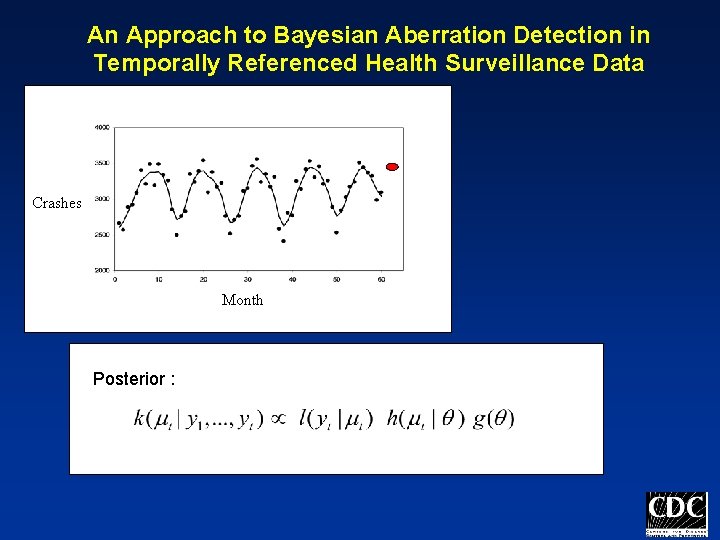
An Approach to Bayesian Aberration Detection in Temporally Referenced Health Surveillance Data Crashes Month Posterior :
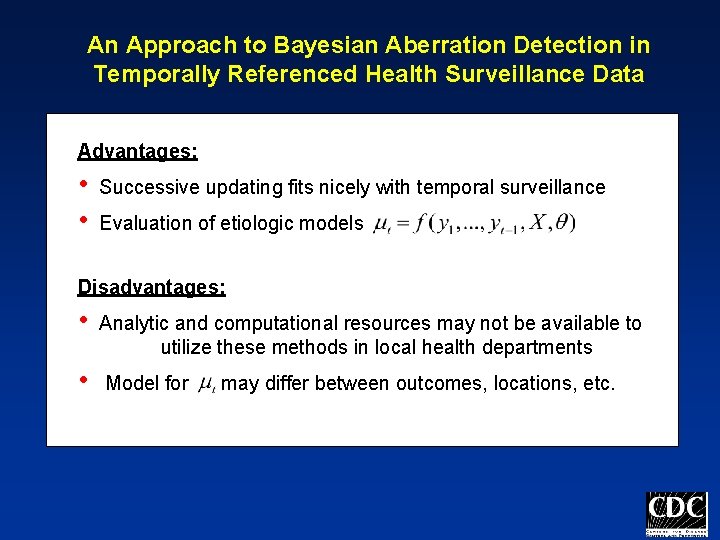
An Approach to Bayesian Aberration Detection in Temporally Referenced Health Surveillance Data Advantages: • • Successive updating fits nicely with temporal surveillance Evaluation of etiologic models Disadvantages: • Analytic and computational resources may not be available to utilize these methods in local health departments • Model for may differ between outcomes, locations, etc.
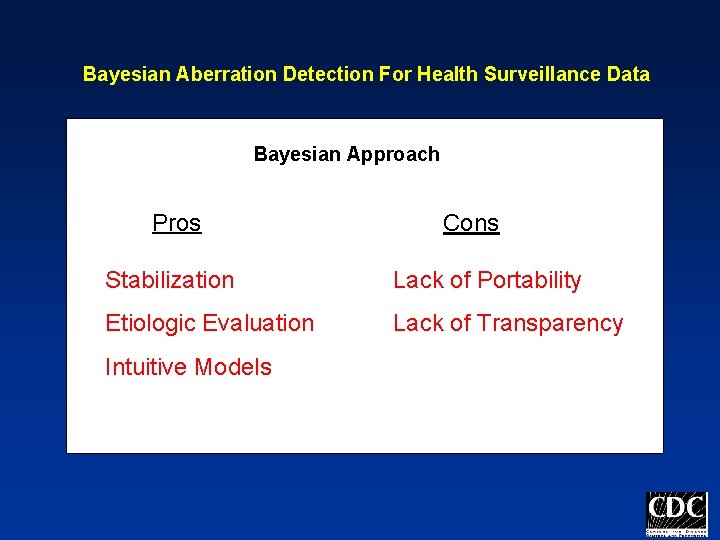
Bayesian Aberration Detection For Health Surveillance Data Bayesian Approach Pros Cons Stabilization Lack of Portability Etiologic Evaluation Lack of Transparency Intuitive Models
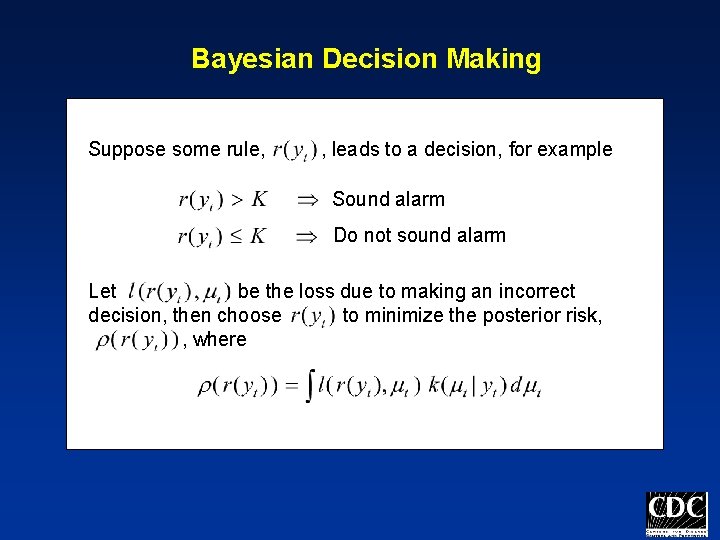
Bayesian Decision Making Suppose some rule, , leads to a decision, for example Sound alarm Do not sound alarm Let be the loss due to making an incorrect decision, then choose to minimize the posterior risk, , where
- Slides: 12