
Bayesian Inference for Mixture Language Models Chase Geigle
Bayesian Inference for Mixture Language Models Chase Geigle, Cheng. Xiang Zhai Department of Computer Science University of Illinois, Urbana-Champaign 1
Deficiency of PLSA • Not a generative model – Can’t compute probability of a new document (why do we care about this? ) – Heuristic workaround is possible, though • Many parameters high complexity of models – Many local maxima – Prone to overfitting • Overfitting is not necessarily a problem for text mining (only interested in fitting the “training” documents) 2
Latent Dirichlet Allocation (LDA) • Make PLSA a generative model by imposing a Dirichlet prior on the model parameters – LDA = Bayesian version of PLSA – Parameters are regularized • Can achieve the same goal as PLSA for text mining purposes – Topic coverage and topic word distributions can be inferred using Bayesian inference 3
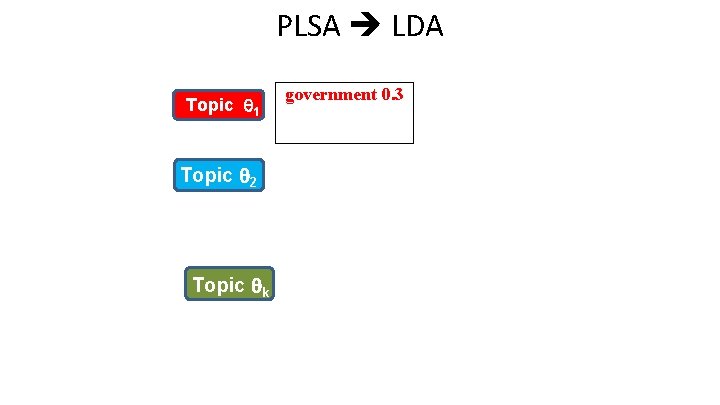
PLSA LDA Topic 1 Topic 2 Topic k government 0. 3
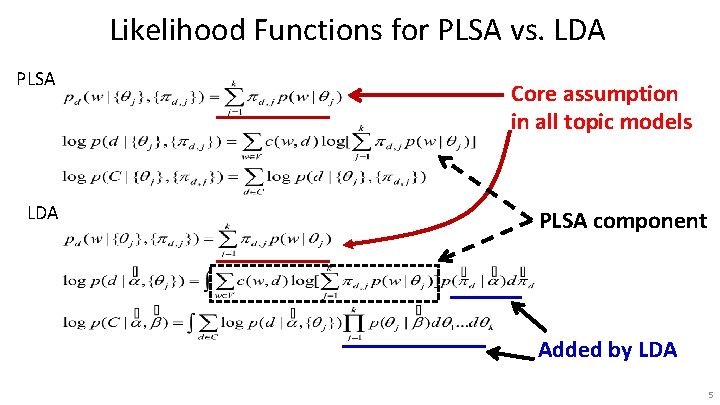
Likelihood Functions for PLSA vs. LDA PLSA LDA Core assumption in all topic models PLSA component Added by LDA 5
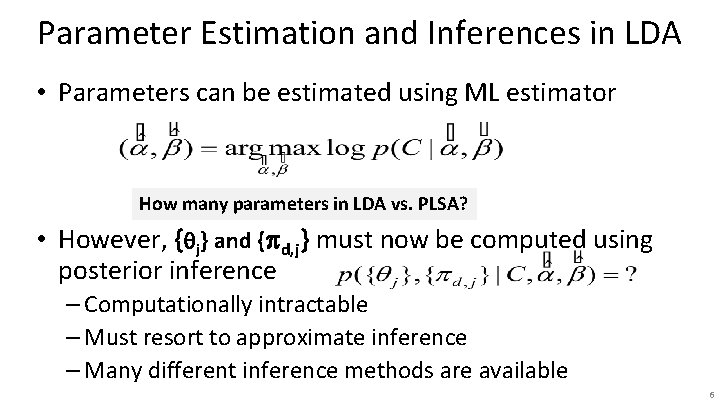
Parameter Estimation and Inferences in LDA • Parameters can be estimated using ML estimator How many parameters in LDA vs. PLSA? • However, { j} and { d, j} must now be computed using posterior inference – Computationally intractable – Must resort to approximate inference – Many different inference methods are available 6
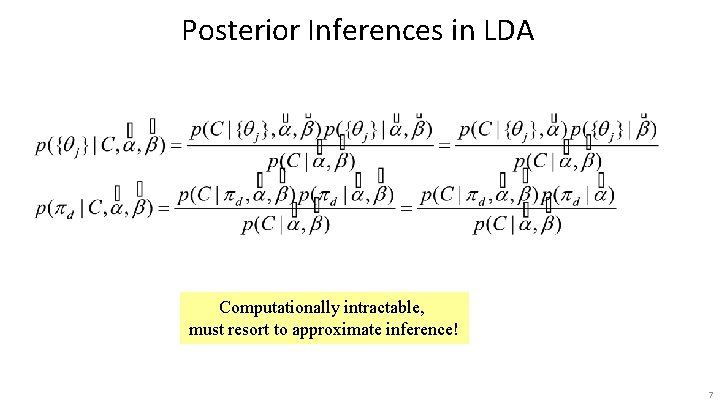
Posterior Inferences in LDA Computationally intractable, must resort to approximate inference! 7
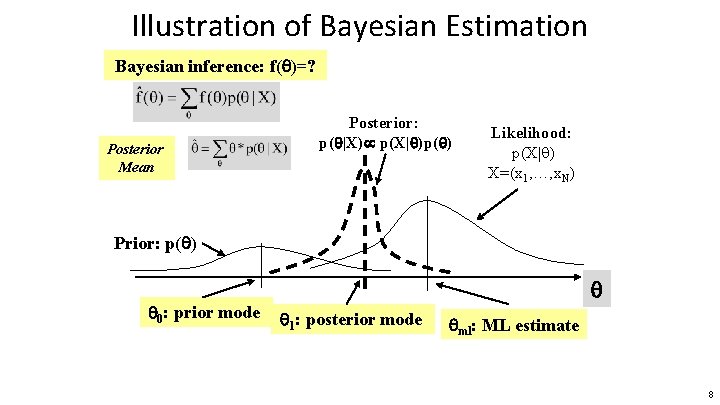
Illustration of Bayesian Estimation Bayesian inference: f( )=? Posterior Mean Posterior: p( |X) p(X| )p( ) Likelihood: p(X| ) X=(x 1, …, x. N) Prior: p( ) 0: prior mode 1: posterior mode ml: ML estimate 8
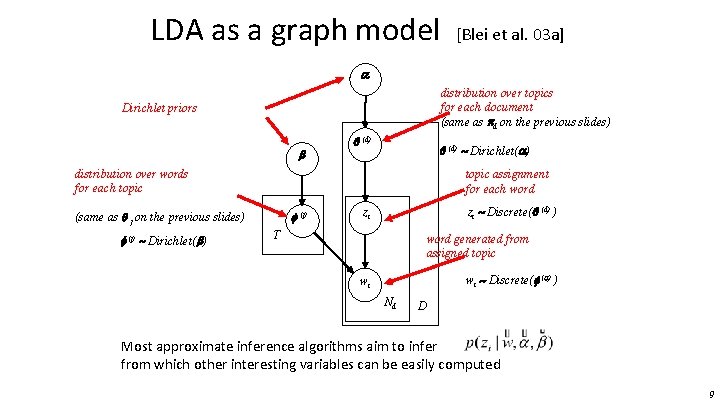
LDA as a graph model [Blei et al. 03 a] distribution over topics for each document (same as d on the previous slides) Dirichlet priors (d) Dirichlet( ) distribution over words for each topic assignment for each word (j) (same as j on the previous slides) (j) Dirichlet( ) zi Discrete( (d) ) zi T word generated from assigned topic wi Discrete( (zi) ) wi Nd D Most approximate inference algorithms aim to infer from which other interesting variables can be easily computed 9
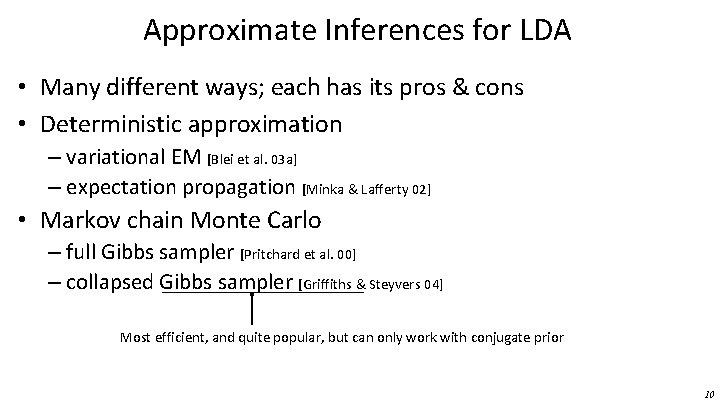
Approximate Inferences for LDA • Many different ways; each has its pros & cons • Deterministic approximation – variational EM [Blei et al. 03 a] – expectation propagation [Minka & Lafferty 02] • Markov chain Monte Carlo – full Gibbs sampler [Pritchard et al. 00] – collapsed Gibbs sampler [Griffiths & Steyvers 04] Most efficient, and quite popular, but can only work with conjugate prior 10
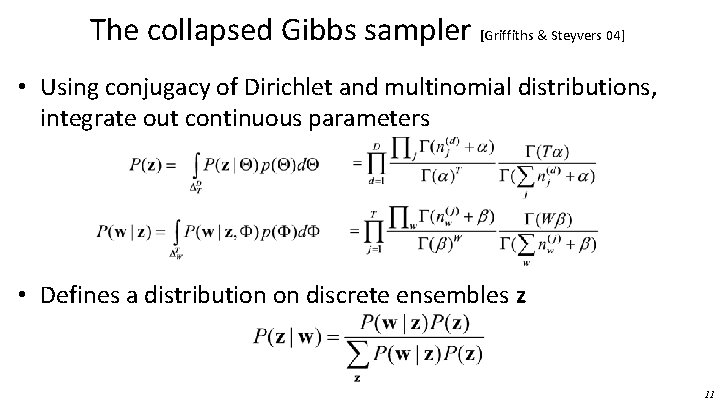
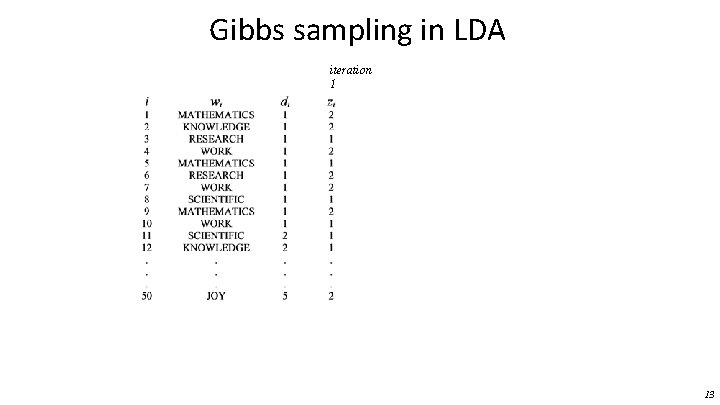
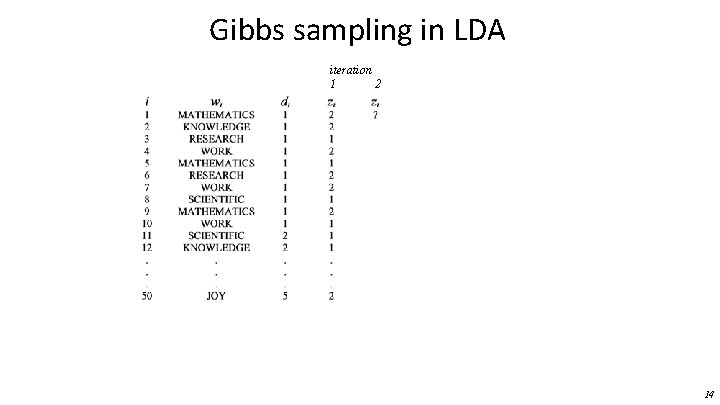
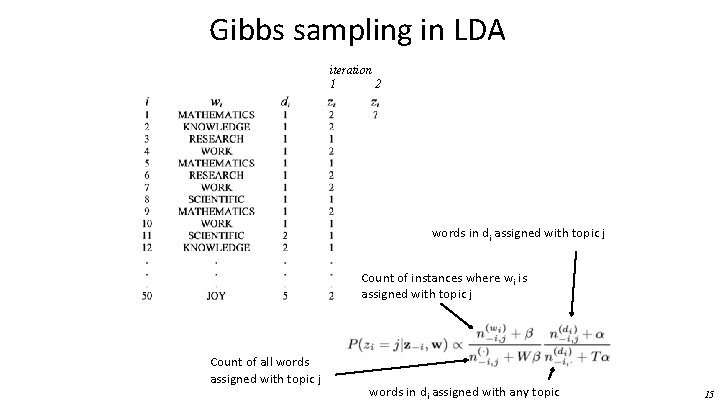
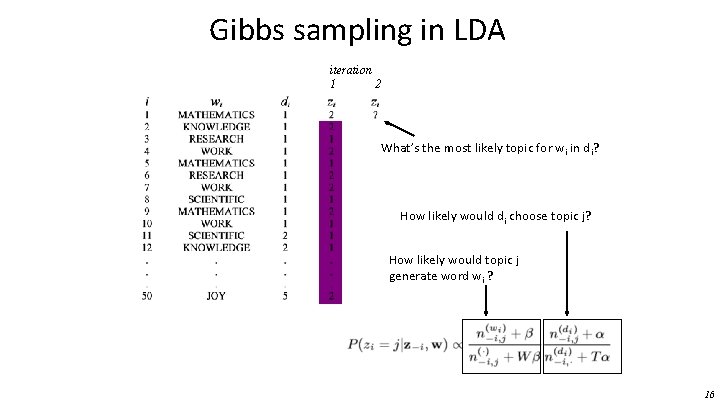
The collapsed Gibbs sampler [Griffiths & Steyvers 04] • Using conjugacy of Dirichlet and multinomial distributions, integrate out continuous parameters • Defines a distribution on discrete ensembles z 11
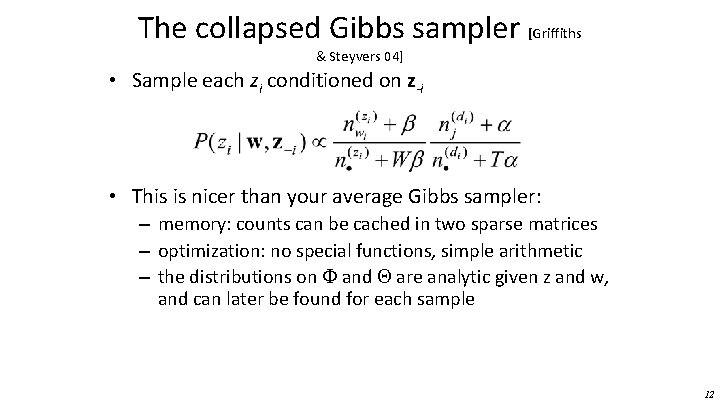
The collapsed Gibbs sampler [Griffiths & Steyvers 04] • Sample each zi conditioned on z-i • This is nicer than your average Gibbs sampler: – memory: counts can be cached in two sparse matrices – optimization: no special functions, simple arithmetic – the distributions on and are analytic given z and w, and can later be found for each sample 12
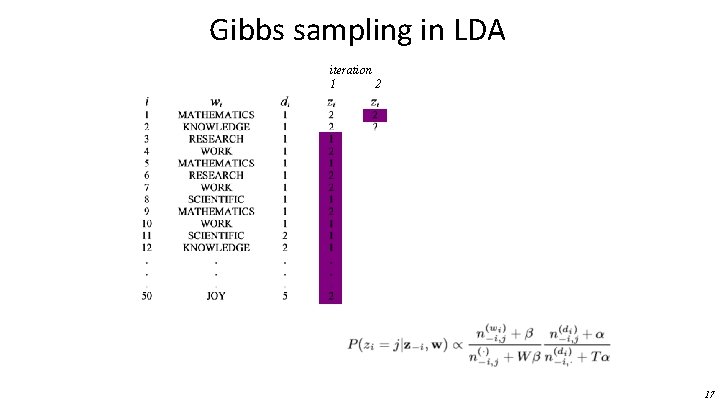
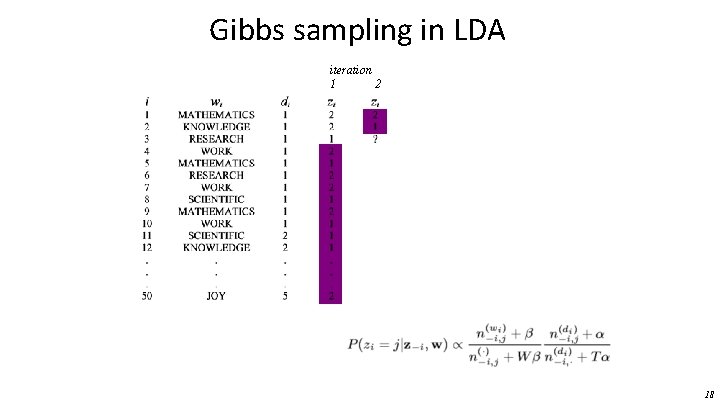
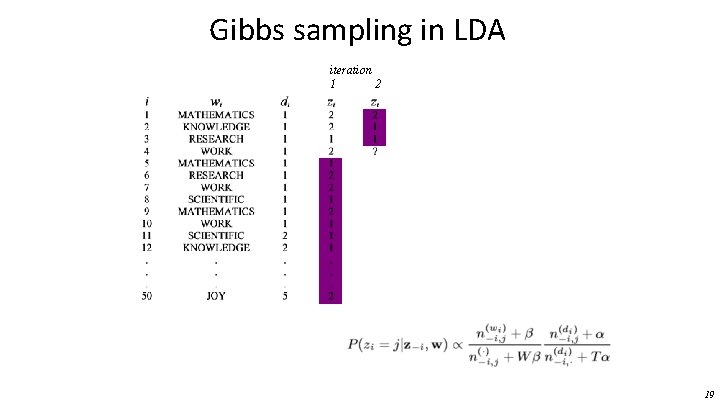
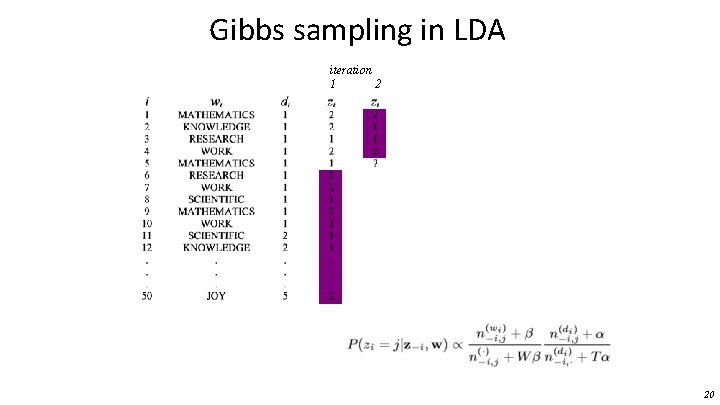
Gibbs sampling in LDA iteration 1 13
Gibbs sampling in LDA iteration 1 2 14
Gibbs sampling in LDA iteration 1 2 words in di assigned with topic j Count of instances where wi is assigned with topic j Count of all words assigned with topic j words in di assigned with any topic 15
Gibbs sampling in LDA iteration 1 2 What’s the most likely topic for wi in di? How likely would di choose topic j? How likely would topic j generate word wi ? 16
Gibbs sampling in LDA iteration 1 2 17
Gibbs sampling in LDA iteration 1 2 18
Gibbs sampling in LDA iteration 1 2 19
Gibbs sampling in LDA iteration 1 2 20
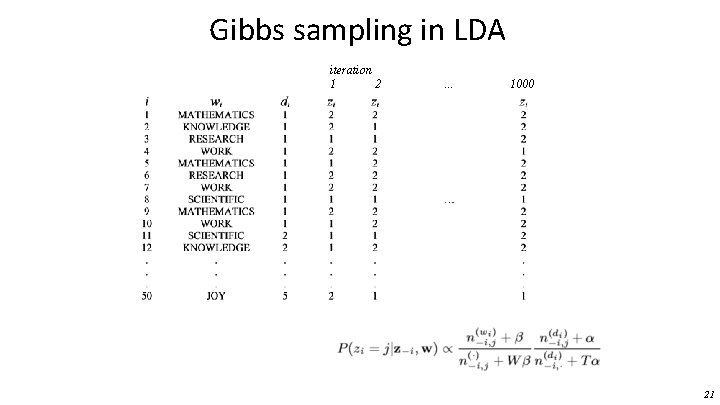
Gibbs sampling in LDA iteration 1 2 … 1000 21
- Slides: 21