
Bayesian Inference for Mixture Language Models Chase Geigle
Bayesian Inference for Mixture Language Models Chase Geigle, Cheng. Xiang Zhai Department of Computer Science University of Illinois, Urbana-Champaign 1
Deficiency of PLSA • Not a generative model – Can’t compute probability of a new document (why do we care about this? ) – Heuristic workaround is possible, though • Many parameters high complexity of models – Many local maxima – Prone to overfitting • Overfitting is not necessarily a problem for text mining (only interested in fitting the “training” documents) 2
Latent Dirichlet Allocation (LDA) • Make PLSA a generative model by imposing a Dirichlet prior on the model parameters – LDA = Bayesian version of PLSA – Parameters are regularized • Can achieve the same goal as PLSA for text mining purposes – Topic coverage and topic word distributions can be inferred using Bayesian inference 3
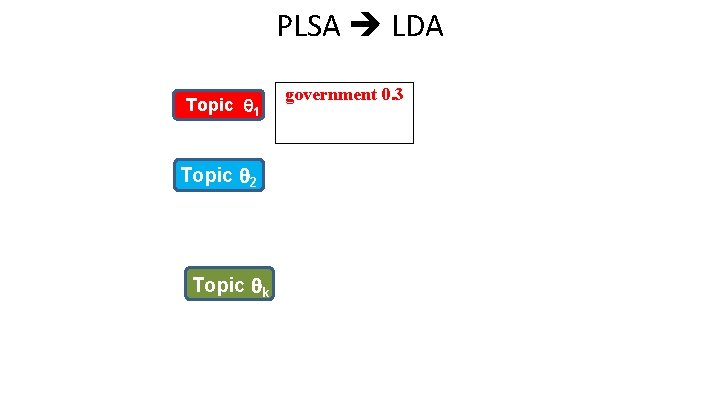
PLSA LDA Topic 1 Topic 2 Topic k government 0. 3
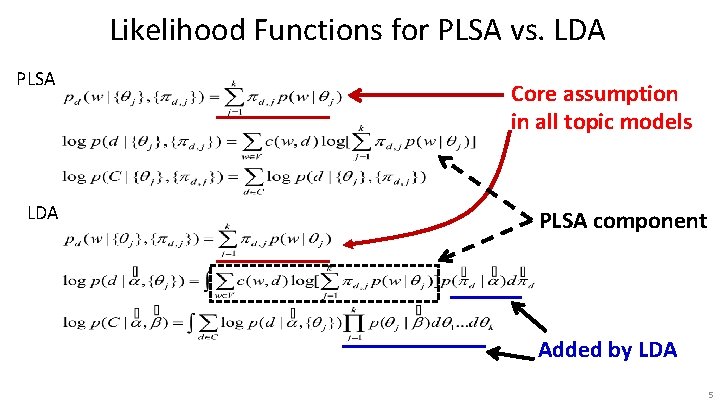
Likelihood Functions for PLSA vs. LDA PLSA LDA Core assumption in all topic models PLSA component Added by LDA 5
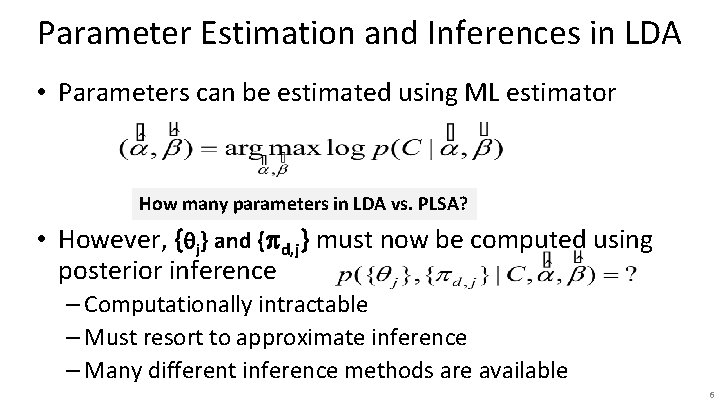
Parameter Estimation and Inferences in LDA • Parameters can be estimated using ML estimator How many parameters in LDA vs. PLSA? • However, { j} and { d, j} must now be computed using posterior inference – Computationally intractable – Must resort to approximate inference – Many different inference methods are available 6
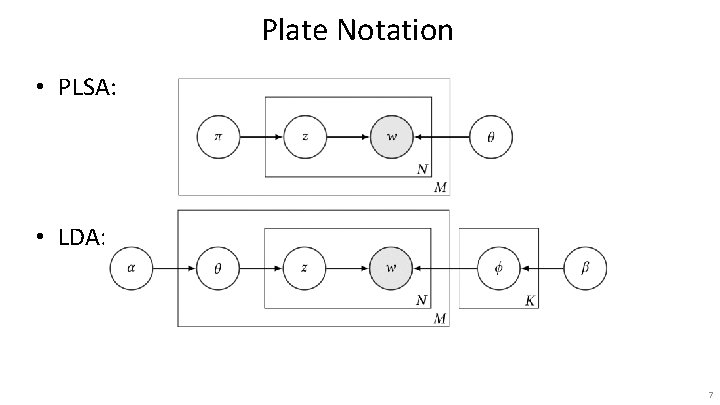
Plate Notation • PLSA: • LDA: 7
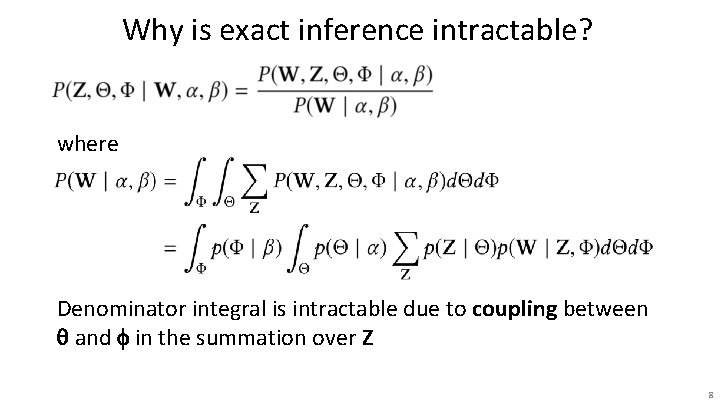
Why is exact inference intractable? where Denominator integral is intractable due to coupling between and in the summation over Z 8
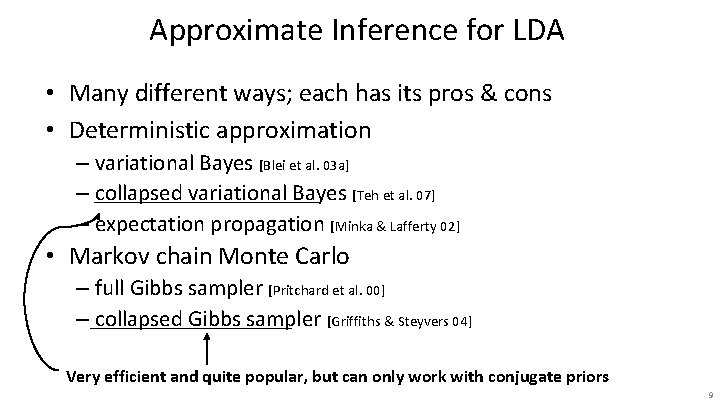
Approximate Inference for LDA • Many different ways; each has its pros & cons • Deterministic approximation – variational Bayes [Blei et al. 03 a] – collapsed variational Bayes [Teh et al. 07] – expectation propagation [Minka & Lafferty 02] • Markov chain Monte Carlo – full Gibbs sampler [Pritchard et al. 00] – collapsed Gibbs sampler [Griffiths & Steyvers 04] Very efficient and quite popular, but can only work with conjugate priors 9
Variational Inference • Key idea: Use a surrogate distribution to approximate the posterior – Surrogate distribution is simpler than the true posterior (typically by making strong independence assumptions to break coupling) • Goal: Find the “best” surrogate distribution from a certain parametric family by minimizing the KL-divergence from the surrogate (Q) to the true posterior (P) – Transforms inference into a deterministic optimization! No free lunch: approximation quality depends on variational family chosen 10
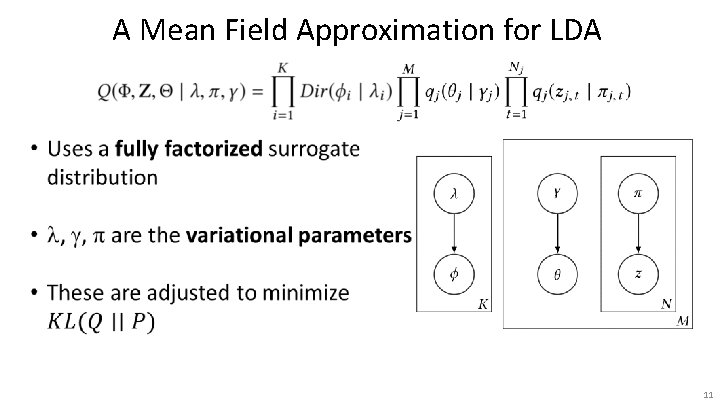
A Mean Field Approximation for LDA 11
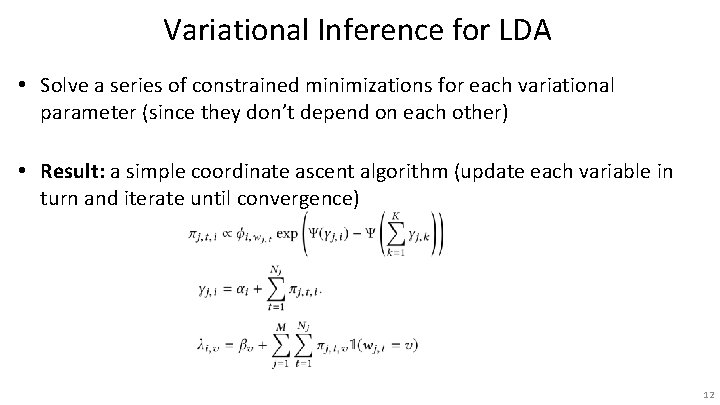
Variational Inference for LDA • Solve a series of constrained minimizations for each variational parameter (since they don’t depend on each other) • Result: a simple coordinate ascent algorithm (update each variable in turn and iterate until convergence) 12
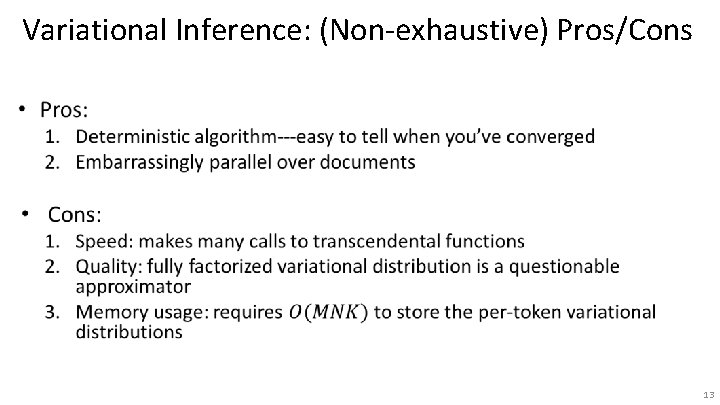
Variational Inference: (Non-exhaustive) Pros/Cons • 13
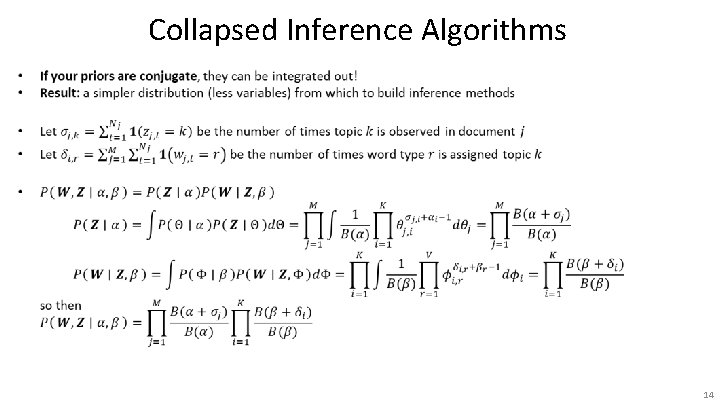
Collapsed Inference Algorithms • 14
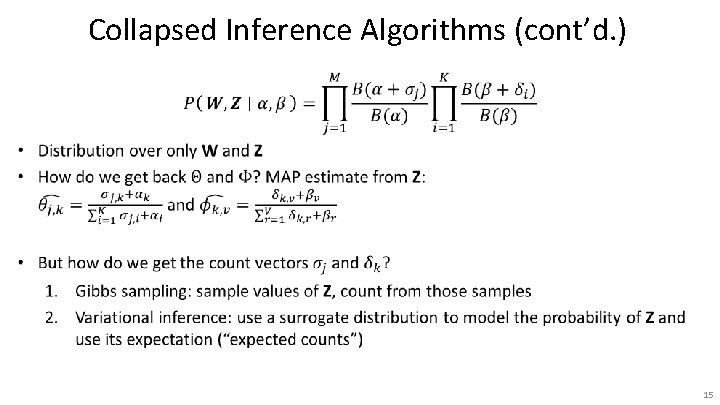
Collapsed Inference Algorithms (cont’d. ) • 15
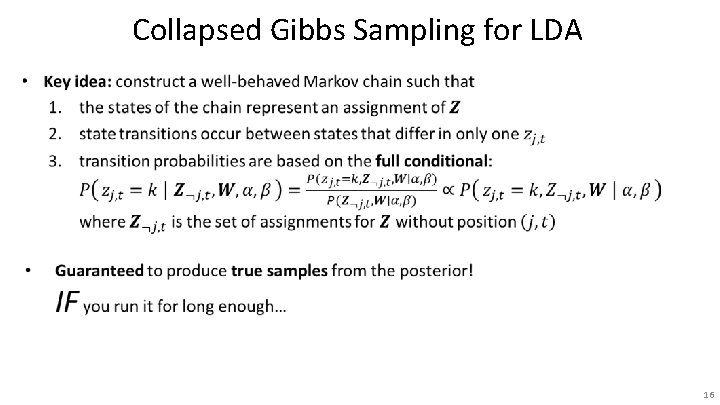
Collapsed Gibbs Sampling for LDA • 16
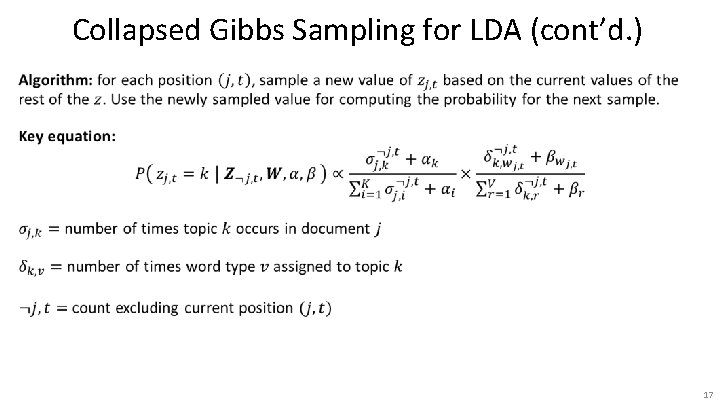
Collapsed Gibbs Sampling for LDA (cont’d. ) • 17
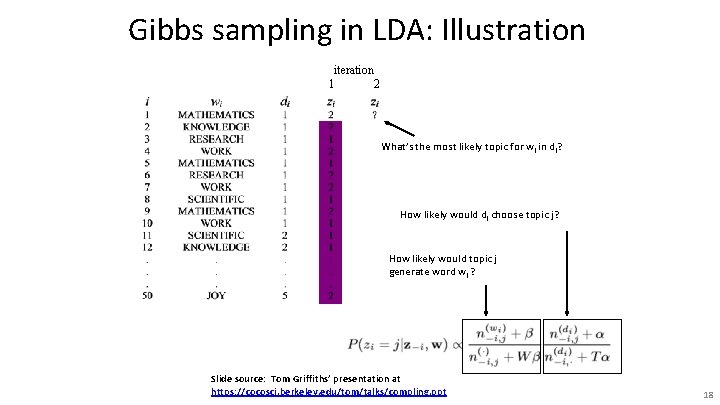
Gibbs sampling in LDA: Illustration iteration 1 2 What’s the most likely topic for wi in di? How likely would di choose topic j? How likely would topic j generate word wi ? Slide source: Tom Griffiths’ presentation at https: //cocosci. berkeley. edu/tom/talks/compling. ppt 18
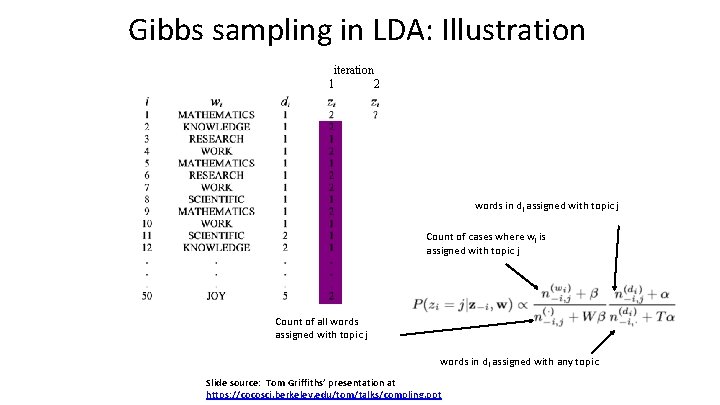
Gibbs sampling in LDA: Illustration iteration 1 2 words in di assigned with topic j Count of cases where wi is assigned with topic j Count of all words assigned with topic j words in di assigned with any topic Slide source: Tom Griffiths’ presentation at https: //cocosci. berkeley. edu/tom/talks/compling. ppt
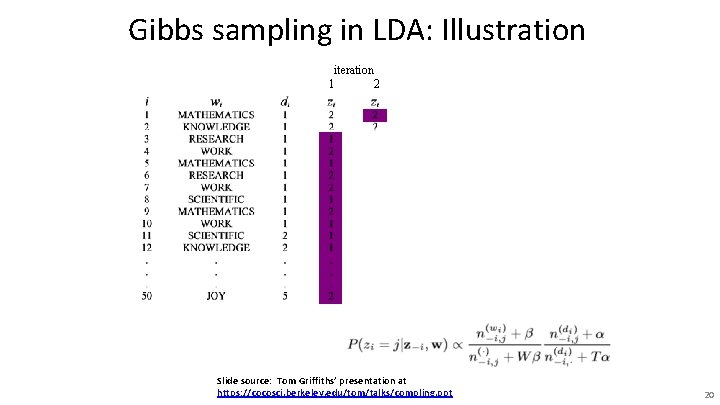
Gibbs sampling in LDA: Illustration iteration 1 2 Slide source: Tom Griffiths’ presentation at https: //cocosci. berkeley. edu/tom/talks/compling. ppt 20
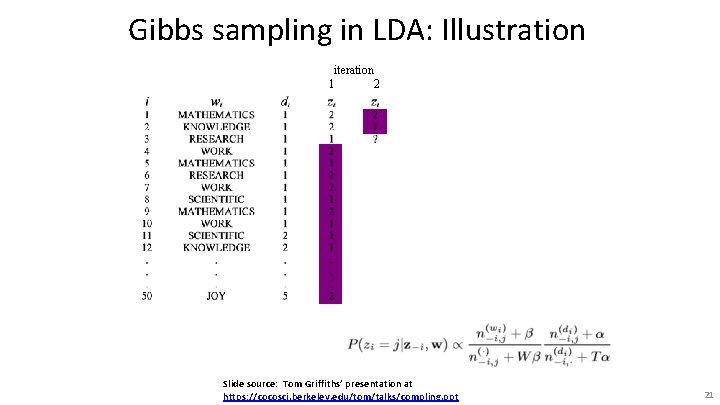
Gibbs sampling in LDA: Illustration iteration 1 2 Slide source: Tom Griffiths’ presentation at https: //cocosci. berkeley. edu/tom/talks/compling. ppt 21
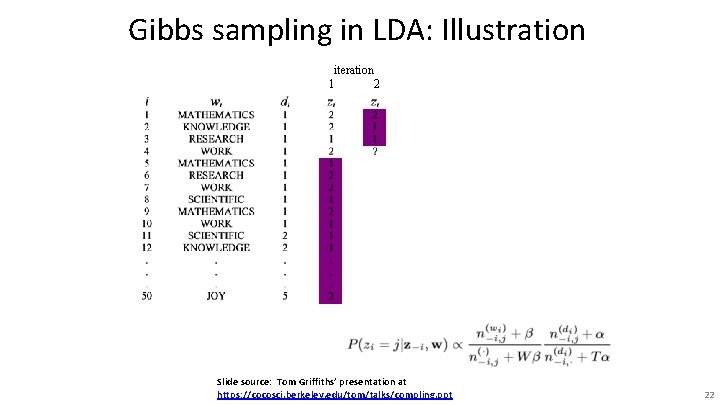
Gibbs sampling in LDA: Illustration iteration 1 2 Slide source: Tom Griffiths’ presentation at https: //cocosci. berkeley. edu/tom/talks/compling. ppt 22
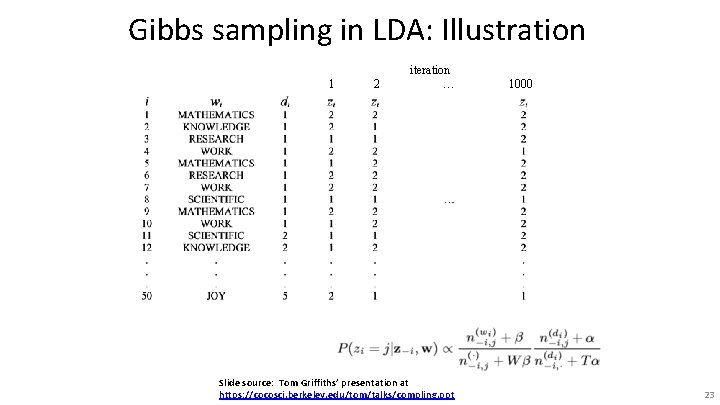
Gibbs sampling in LDA: Illustration 1 2 iteration … Slide source: Tom Griffiths’ presentation at https: //cocosci. berkeley. edu/tom/talks/compling. ppt 1000 23
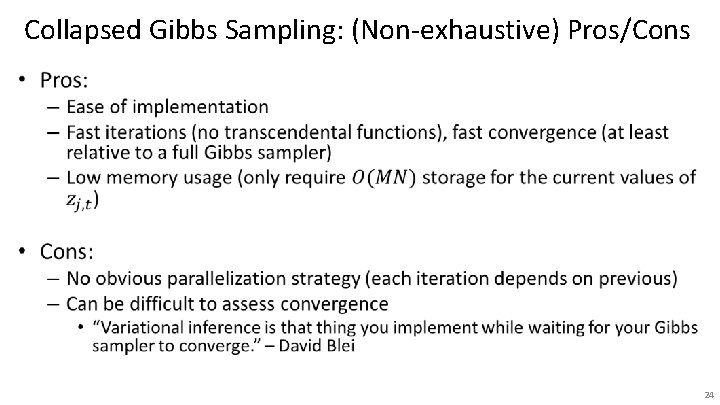
Collapsed Gibbs Sampling: (Non-exhaustive) Pros/Cons • 24
Other Inference Variations • Parallelization: AD-LDA [Newman et al. 09] – Idea: Distribute documents across cores (or machines) • locally maintain “differences” instead of updating globally shared counts • Resolve these “differences” once all documents have been sampled • Can be used for both CGS and CVB/CVB 0 • Online learning: Stochastic Variational Inference [Hoffman et al. 13] – Idea: Learn LDA models on streaming data (learned Wikipedia topic model with low resource usage – Stochastic Collapsed VI also possible [Foulds et al. 13] 25
Extensions of LDA • Capturing topic structures • Capturing context • With supervision 26
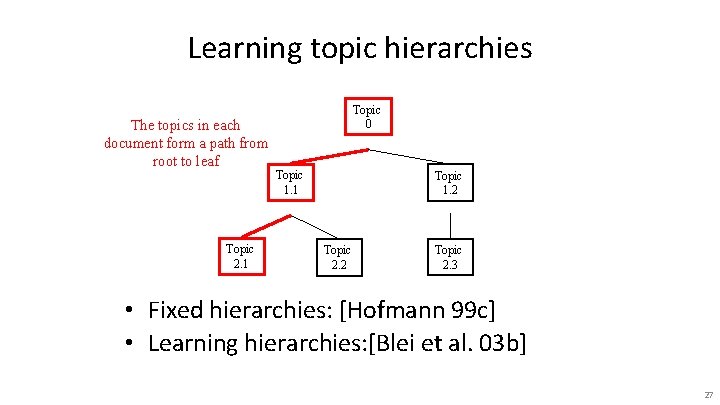
Learning topic hierarchies The topics in each document form a path from root to leaf Topic 2. 1 Topic 0 Topic 1. 1 Topic 1. 2 Topic 2. 3 • Fixed hierarchies: [Hofmann 99 c] • Learning hierarchies: [Blei et al. 03 b] 27
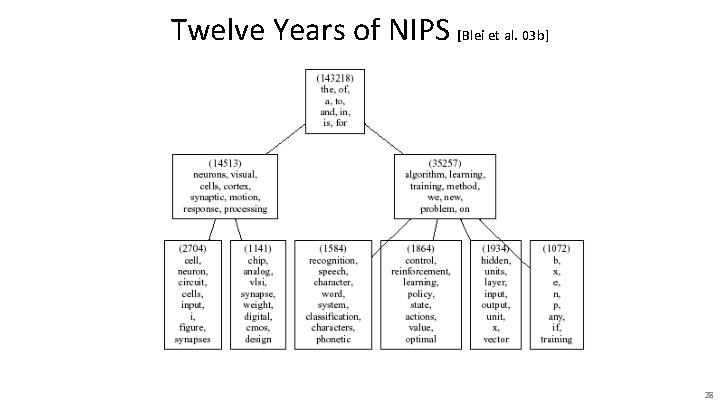
Twelve Years of NIPS [Blei et al. 03 b] 28
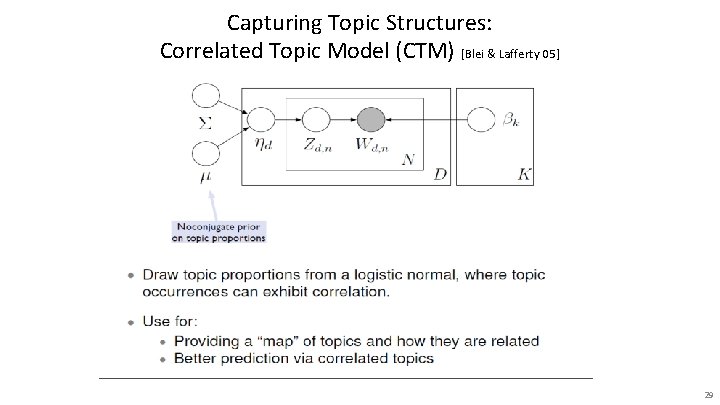
Capturing Topic Structures: Correlated Topic Model (CTM) [Blei & Lafferty 05] 29
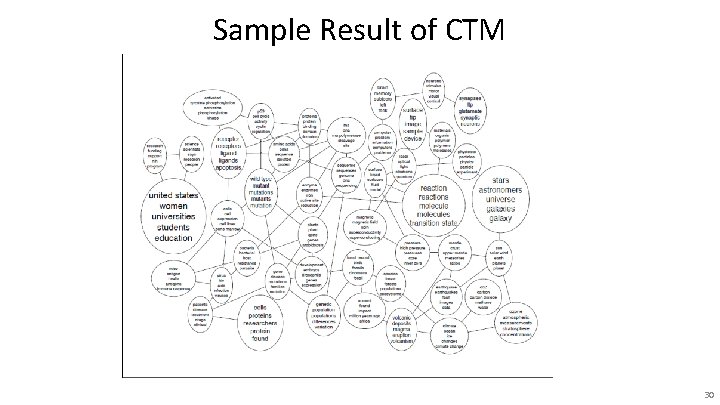
Sample Result of CTM 30
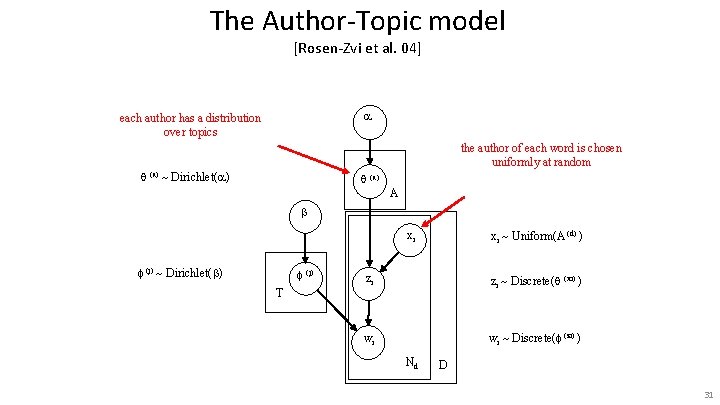
The Author-Topic model [Rosen-Zvi et al. 04] each author has a distribution over topics the author of each word is chosen uniformly at random (a) Dirichlet( ) (a) A xi Uniform(A (d) ) xi (j) Dirichlet( ) (j) T zi zi Discrete( (xi) ) wi wi Discrete( (zi) ) Nd D 31
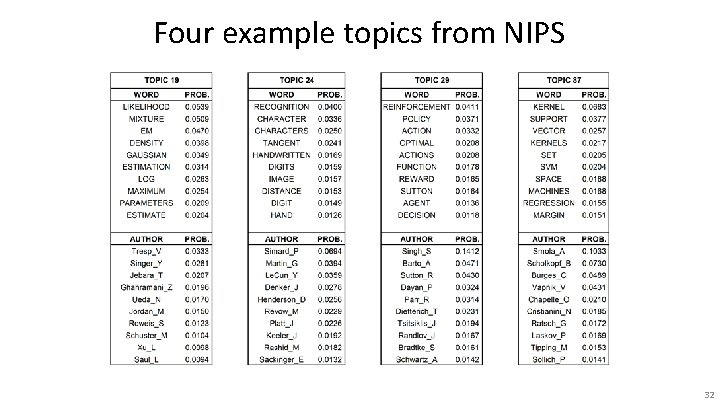
Four example topics from NIPS 32
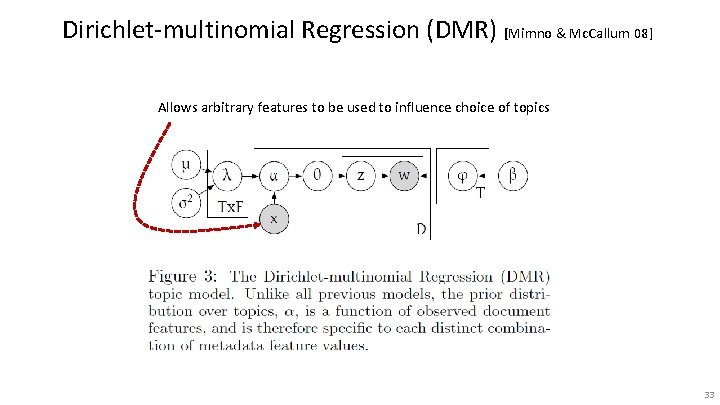
Dirichlet-multinomial Regression (DMR) [Mimno & Mc. Callum 08] Allows arbitrary features to be used to influence choice of topics 33
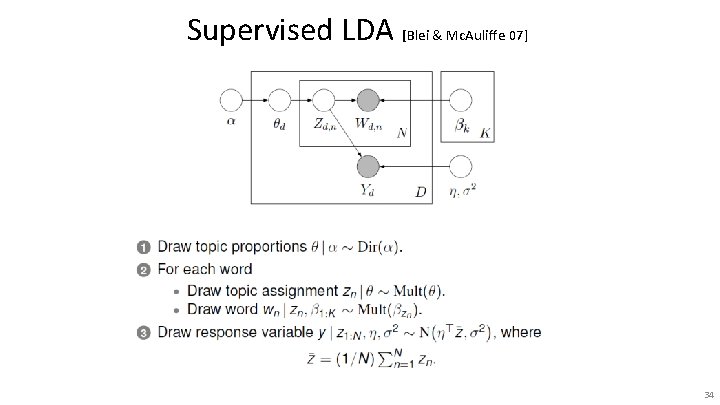
Supervised LDA [Blei & Mc. Auliffe 07] 34
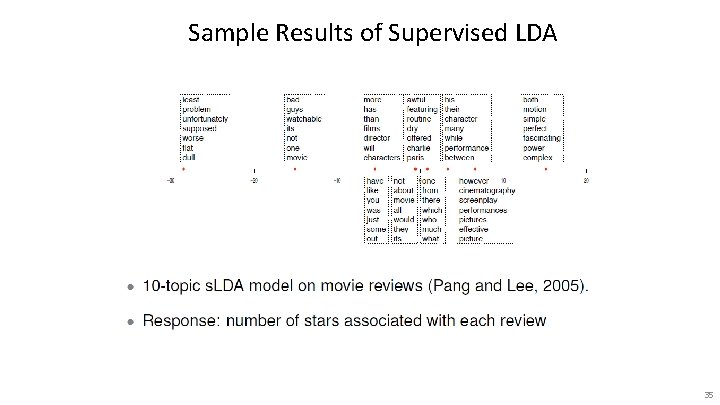
Sample Results of Supervised LDA 35
Challenges and Directions for Future Research • Challenge 1: How can we quantitatively evaluate the benefit of topic models for text mining? – Currently, most quantitative evaluation is based on perplexity which doesn’t reflect the actual utility of a topic model for text mining – Need to separately evaluate the quality of both topic word distributions and topic coverage (do more in line with “intrusion test”[Chang et al. 09]) – Need to consider multiple aspects of a topic (e. g. , coherent? , meaningful? ) and define appropriate measures – Need to compare topic models with alternative approaches to solving the same text mining problem (e. g. , traditional IR methods, non-negative matrix factorization) – Need to create standard test collections 36
Challenges and Directions for Future Research (cont. ) • Challenge 2: How can we help users interpret a topic? – Most of the time, a topic is manually labeled in a research paper; this is insufficient for real applications – Automatic labeling can help, but the utility still needs to evaluated – Need to generate a summary for a topic to enable a user to navigate into text documents to better understand a topic – Need to facilitate post-processing of discovered topics (e. g. , ranking, comparison) 37
Challenges and Directions for Future Research (cont. ) • Challenge 3: How can we address the problem of multiple local maxima? – All topic models have the problem of multiple local maxima, causing problems with reproducing results – Need to compute the variance of a discovered topic – Need to define and report the confidence interval for a topic • Challenge 4: How can we develop efficient estimation and inference algorithms for sophisticated models? – How can we leverage a user’s knowledge to speed up inferences for topic models? – Need to develop parallel estimation/inference algorithms 38
Challenges and Directions for Future Research (cont. ) • Challenge 5: How can we incorporate linguistic knowledge into topic models? – Most current topic models are purely statistical – Some progress has been made to incorporate linguistic knowledge (e. g. , [Griffiths et al. 04, Wallach 08]) – More needs to be done • Challenge 6: How can we incorporate more sophisticated supervision into topic modeling to maximize its support for user tasks? – Current models are mostly pre-specified with little flexibility for an analyst to “steer” the analysis process; need to develop a general analysis framework to enable an analyst to use multiple topic models together to perform complex text mining tasks – Need to combine topic modeling (as a generative model for feature learning) with deep learning to optimize task support 39
- Slides: 39