
Bayesian Hypothesis Testing for Proportions Antonio Nieto Sonia
Bayesian Hypothesis Testing for Proportions Antonio Nieto / Sonia Extremera / Javier Gómez Ph. USE Annual Conference, 9 th-12 th Oct 2011, Brighton UK
Introduction • Tests on proportions –Frequentist approach If pvalue < significance level → Null hypothesis will be rejected –Bayesian approach Probability under any hypotheses → Comparison to see what is the most plausible alternative Both approaches can coexist and they should be used in the statistical interest
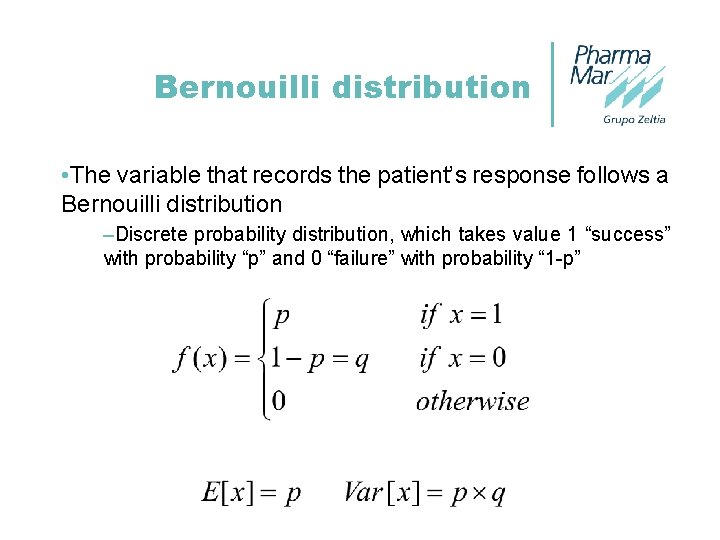
Bernouilli distribution • The variable that records the patient’s response follows a Bernouilli distribution –Discrete probability distribution, which takes value 1 “success” with probability “p” and 0 “failure” with probability “ 1 -p”
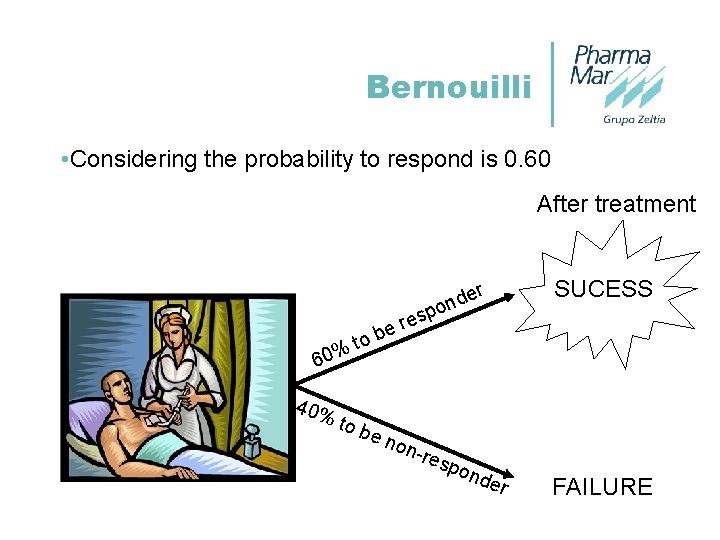
Bernouilli • Considering the probability to respond is 0. 60 After treatment r SUCESS der FAILURE de n o p s e r e ob t % 60 40% to b en on- res pon
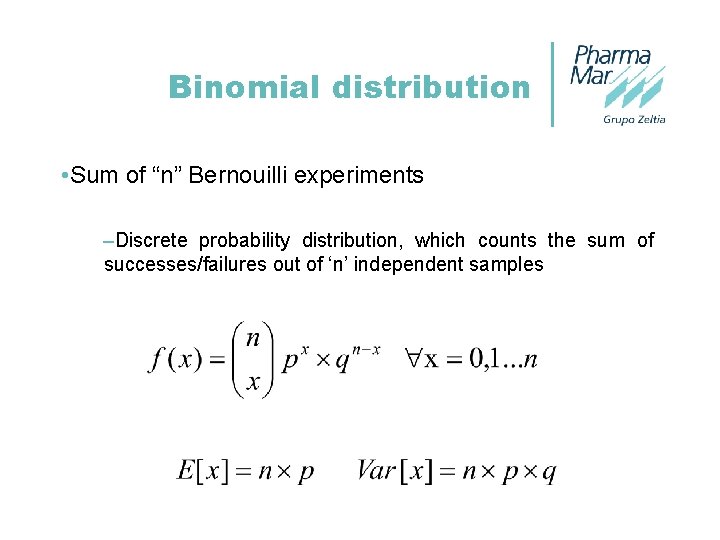
Binomial distribution • Sum of “n” Bernouilli experiments –Discrete probability distribution, which counts the sum of successes/failures out of ‘n’ independent samples
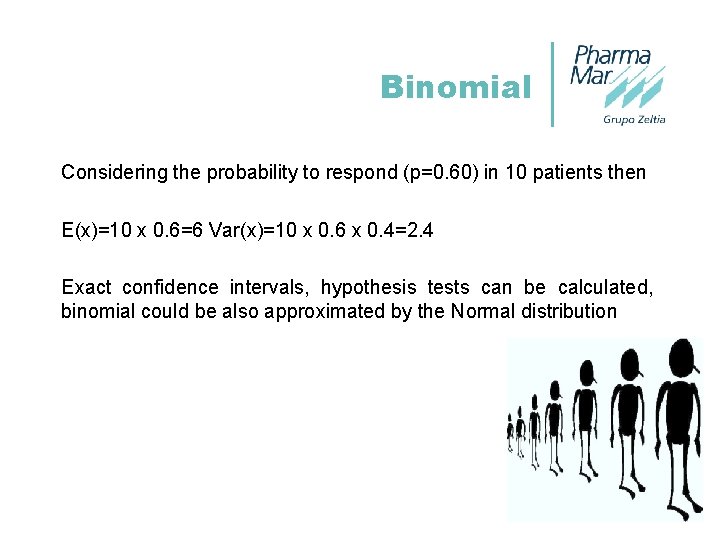
Binomial Considering the probability to respond (p=0. 60) in 10 patients then E(x)=10 x 0. 6=6 Var(x)=10 x 0. 6 x 0. 4=2. 4 Exact confidence intervals, hypothesis tests can be calculated, binomial could be also approximated by the Normal distribution
Frequentist approach A possible solution: Binomial distribution will be approximated with the Normal distribution and then taking a decision based on the pvalue associated to the Gauss curve
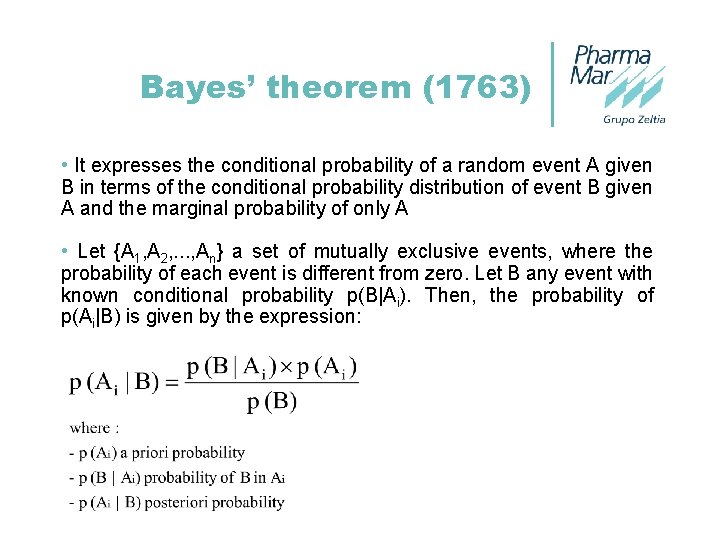
Bayes’ theorem (1763) • It expresses the conditional probability of a random event A given B in terms of the conditional probability distribution of event B given A and the marginal probability of only A • Let {A 1, A 2, . . . , An} a set of mutually exclusive events, where the probability of each event is different from zero. Let B any event with known conditional probability p(B|Ai). Then, the probability of p(Ai|B) is given by the expression:
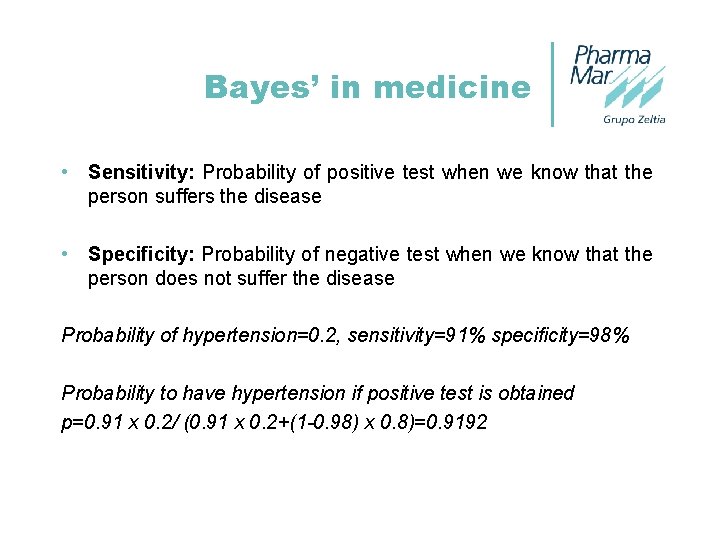
Bayes’ in medicine • Sensitivity: Probability of positive test when we know that the person suffers the disease • Specificity: Probability of negative test when we know that the person does not suffer the disease Probability of hypertension=0. 2, sensitivity=91% specificity=98% Probability to have hypertension if positive test is obtained p=0. 91 x 0. 2/ (0. 91 x 0. 2+(1 -0. 98) x 0. 8)=0. 9192
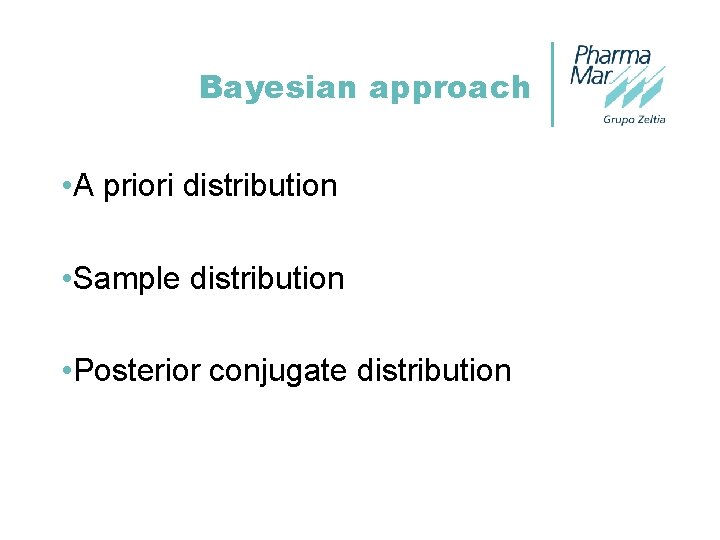
Bayesian approach • A priori distribution • Sample distribution • Posterior conjugate distribution
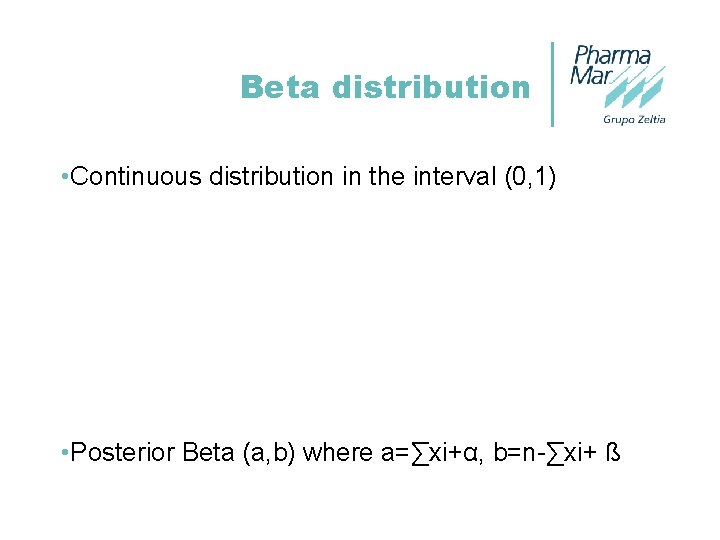
Beta distribution • Continuous distribution in the interval (0, 1) • Posterior Beta (a, b) where a=∑xi+α, b=n-∑xi+ ß
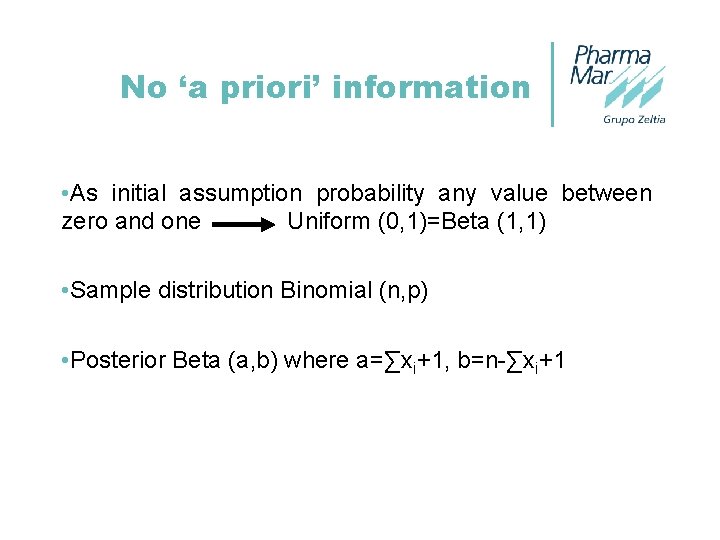
No ‘a priori’ information • As initial assumption probability any value between zero and one Uniform (0, 1)=Beta (1, 1) • Sample distribution Binomial (n, p) • Posterior Beta (a, b) where a=∑xi+1, b=n-∑xi+1
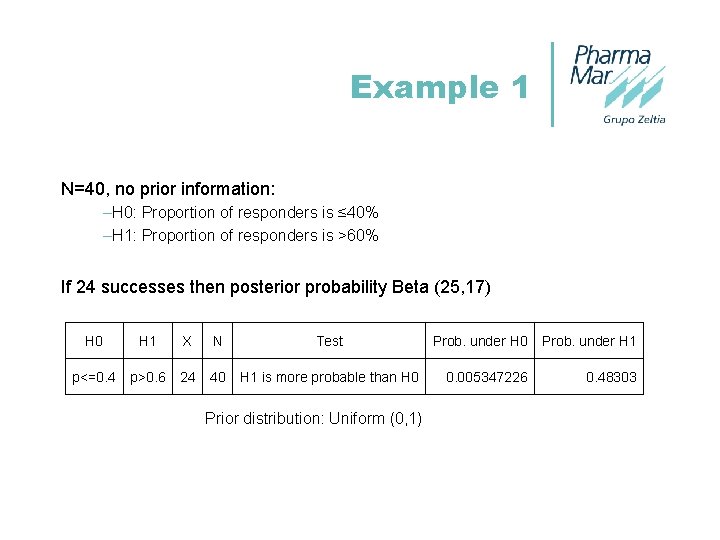
Example 1 N=40, no prior information: –H 0: Proportion of responders is ≤ 40% –H 1: Proportion of responders is >60% If 24 successes then posterior probability Beta (25, 17) H 0 H 1 X N Test p<=0. 4 p>0. 6 24 40 H 1 is more probable than H 0 Prior distribution: Uniform (0, 1) Prob. under H 0 Prob. under H 1 0. 005347226 0. 48303
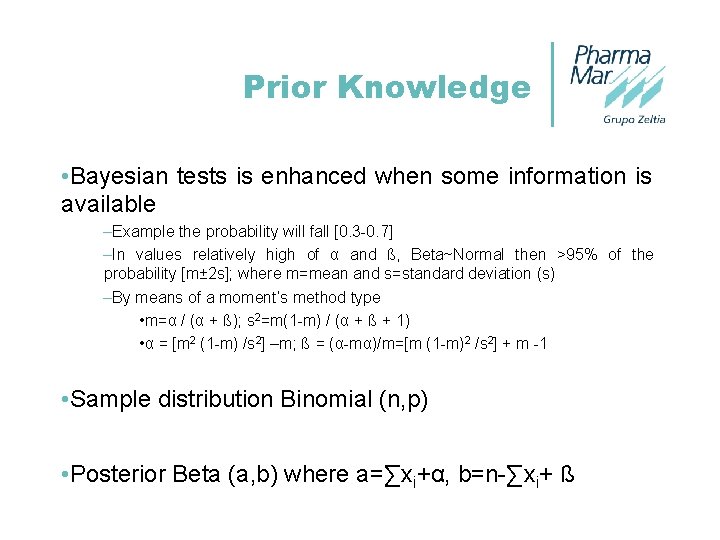
Prior Knowledge • Bayesian tests is enhanced when some information is available –Example the probability will fall [0. 3 -0. 7] –In values relatively high of α and ß, Beta~Normal then >95% of the probability [m± 2 s]; where m=mean and s=standard deviation (s) –By means of a moment‘s method type • m=α / (α + ß); s 2=m(1 -m) / (α + ß + 1) • α = [m 2 (1 -m) /s 2] –m; ß = (α-mα)/m=[m (1 -m)2 /s 2] + m -1 • Sample distribution Binomial (n, p) • Posterior Beta (a, b) where a=∑xi+α, b=n-∑xi+ ß
![Example 2 N=40, probability will fall [0. 3 -0. 7] with a 95% probability:](http://slidetodoc.com/presentation_image_h2/cf248912e5fc54475169bf43828f50e8/image-15.jpg "Example 2 N=40, probability will fall [0. 3 -0. 7] with a 95% probability:")
Example 2 N=40, probability will fall [0. 3 -0. 7] with a 95% probability: –H 0: Proportion of responders is ≤ 40% –H 1: Proportion of responders is >60% If 24 successes then posterior probability Beta (36, 28) H 0 H 1 X N Test p<=0. 4 p>0. 6 24 40 H 1 is more probable than H 0 Prior distribution: Beta (12, 12) Prob. under H 0 Prob. under H 1 0. 004406341 0. 27539
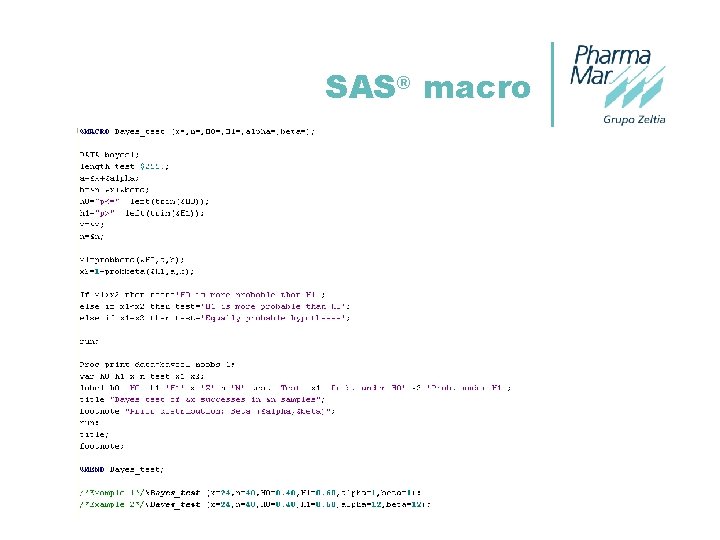
SAS® macro
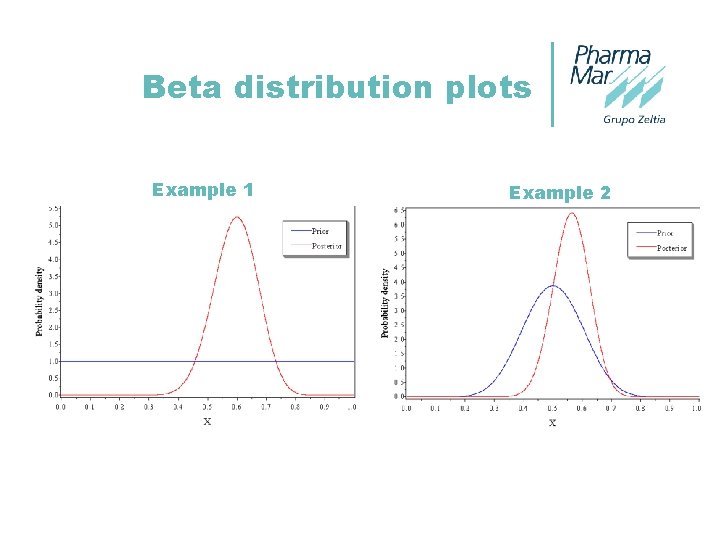
Beta distribution plots Example 1 Example 2
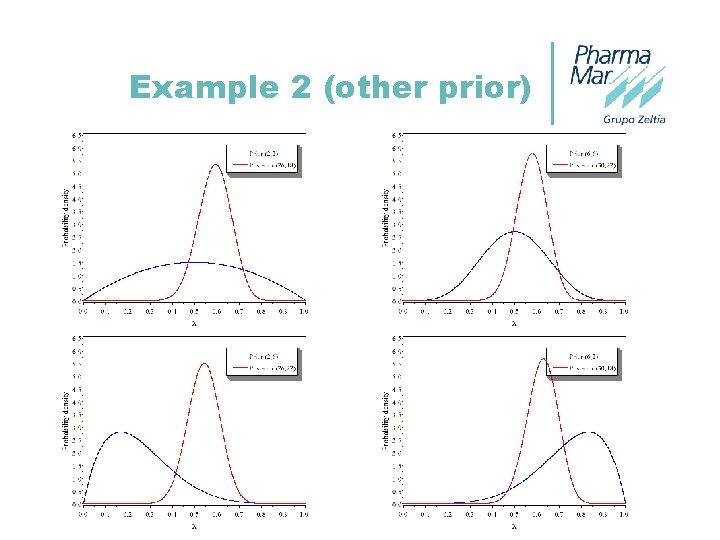
Example 2 (other prior)
Conclusion • Bayesian tests are nowadays being increasingly used, especially in the context of adaptive designs • Very important aspects are: – Good selection of the distributions – Clear definition of the ”a priori” information collected • A Bayesian approach has been presented to be included in the statistical armamentarium to test proportion hypotheses – It can be also extended to other endpoints and distributions

Questions
- Slides: 20