
Bayesian Disease Outbreak Detection that Includes a Model
Bayesian Disease Outbreak Detection that Includes a Model of Unknown Diseases Yanna Shen and Gregory F. Cooper Intelligent Systems Program and Department of Biomedical Informatics University of Pittsburgh
Introduction n Outbreak detection algorithms: – Specific detection algorithms n Look data for pre-defined anomalous pattern in the – Non-specific detection algorithms n Try to detect any anomalous events, relative to some baseline of “normal” behavior
Safety-net detection approaches n Our safety-net algorithm: – A hybrid method that combines the specific and non-specific detection approaches – Detect known causes of anomalies well while having the non-specific approach serve as a “safety-net” – Bayesian approach – Operate on a time series of Emergency Department (ED) patient symptoms such as cough, fever and diarrhea
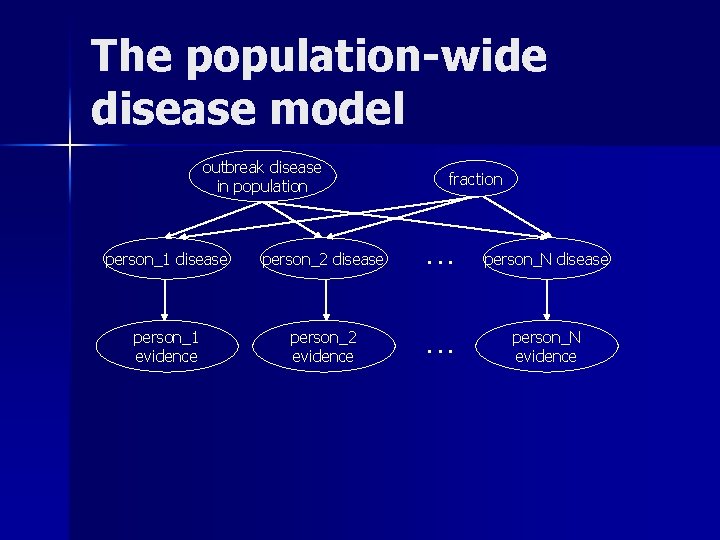
The population-wide disease model outbreak disease in population fraction person_1 disease person_2 disease . . . person_N disease person_1 evidence person_2 evidence . . . person_N evidence

An example populationwide disease model outbreak disease in population fraction person_1 disease person_2 disease . . . person_N disease person_1 cough state person_2 cough state . . . person_N cough state person’s disease state P(cough state = true | person’s disease state) Non-outbreak disease (d 0) specific outbreak disease (dk) Unknown disease (d*) p 0 ~ Beta(α 0 , β 0) pk ~ Beta(αk , βk) p* ~ Beta(1, 1)
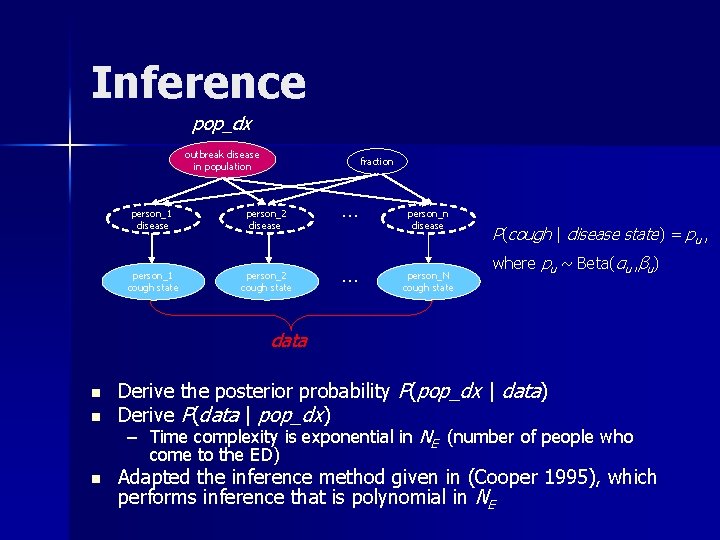
Inference pop_dx outbreak disease in population fraction person_1 disease person_2 disease . . . person_1 cough state person_2 cough state . . . person_n disease person_N cough state P(cough | disease state) = pu , where pu ~ Beta(αu , βu) data n n Derive the posterior probability P(pop_dx | data) Derive P(data | pop_dx) – Time complexity is exponential in NE (number of people who come to the ED) n Adapted the inference method given in (Cooper 1995), which performs inference that is polynomial in NE
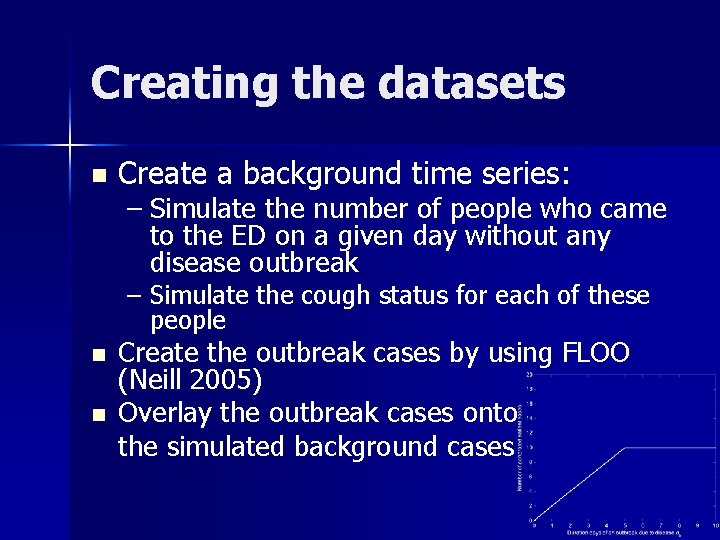
Creating the datasets n Create a background time series: – Simulate the number of people who came to the ED on a given day without any disease outbreak – Simulate the cough status for each of these people n n Create the outbreak cases by using FLOO (Neill 2005) Overlay the outbreak cases onto the simulated background cases
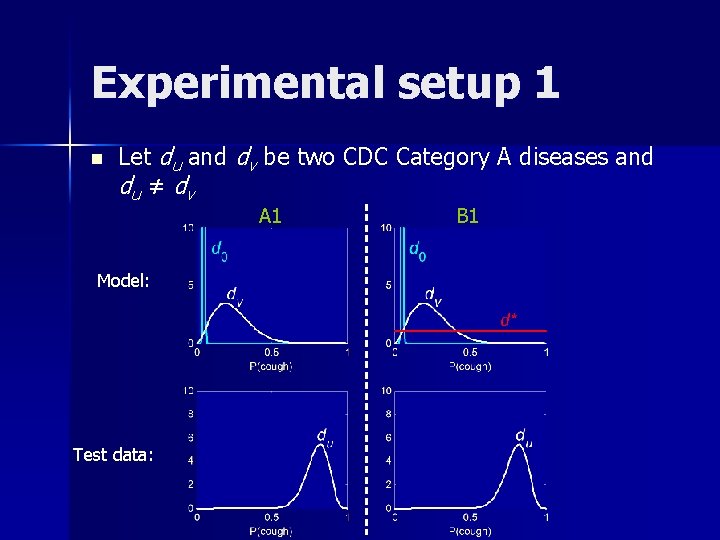
Experimental setup 1 n Let du and dv be two CDC Category A diseases and du ≠ dv A 1 Model: Test data: B 1
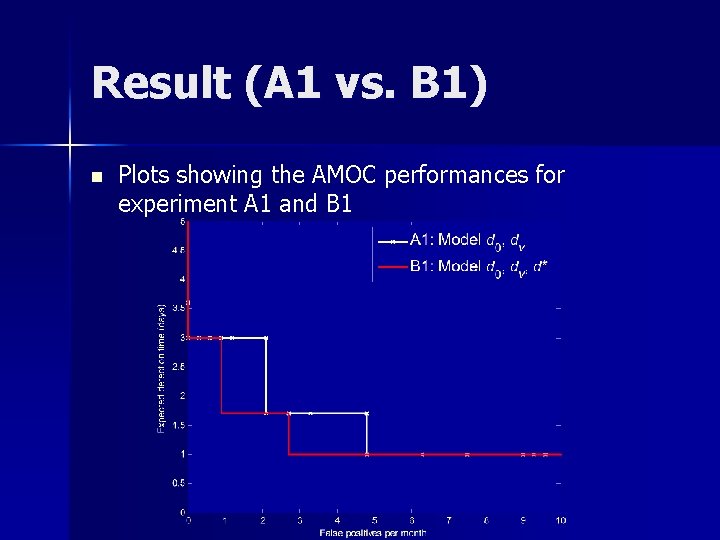
Result (A 1 vs. B 1) n Plots showing the AMOC performances for experiment A 1 and B 1
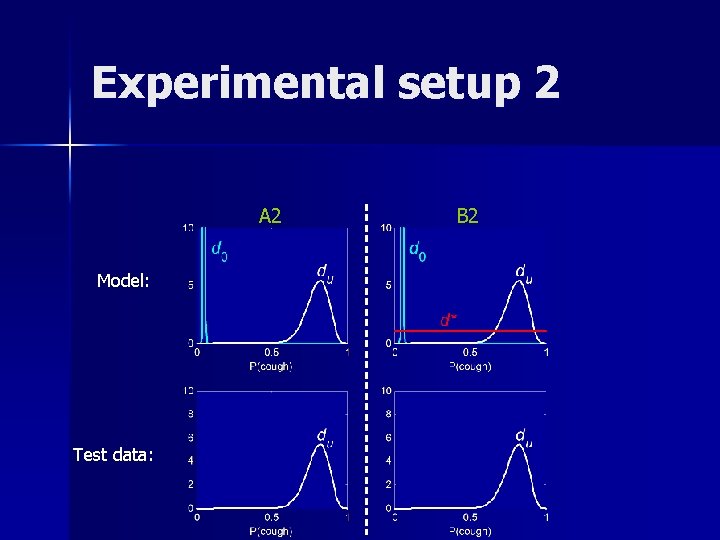
Experimental setup 2 A 2 Model: Test data: B 2
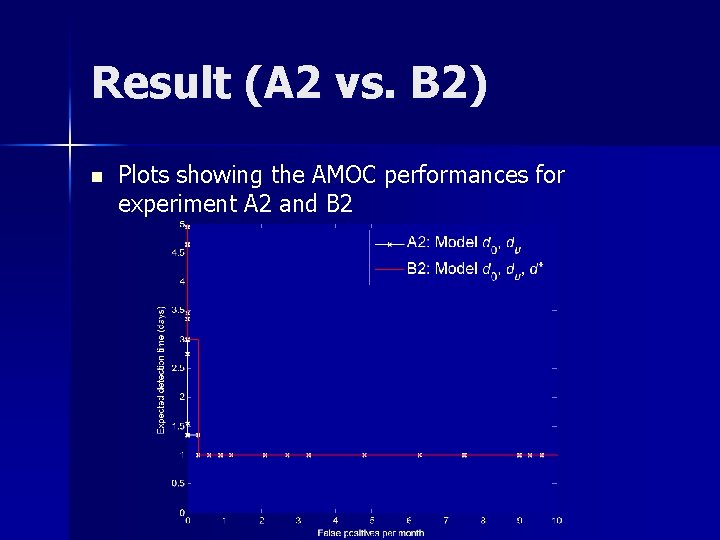
Result (A 2 vs. B 2) n Plots showing the AMOC performances for experiment A 2 and B 2
Summary Introduced a Bayesian method for detecting disease outbreaks that combines a specific detection method with a non-specific method n Provided support that this hybrid approach helps detect unexpected disease more than it interferes with detecting unknown diseases n
Future work Explore distributions other than the uniform distribution for a disease symptom, such as cough, for the safety-net disease n Extend the model to consider multiple person evidences n

Acknowledgements n n This research was funded by a grant from the National Science Foundation (NSF IIS-0325581) We thank the colleagues from the Department of Biomedical Informatics, the University of Pittsburgh, for their helpful comments on this work. – – – Wendy Chapman John Dowling John Levander Melissa Saul Garrick Wallstrom
- Slides: 14