
Bayesian Decision Theory Case Studies CS 479679 Pattern

Bayesian Decision Theory Case Studies CS 479/679 Pattern Recognition Dr. George Bebis
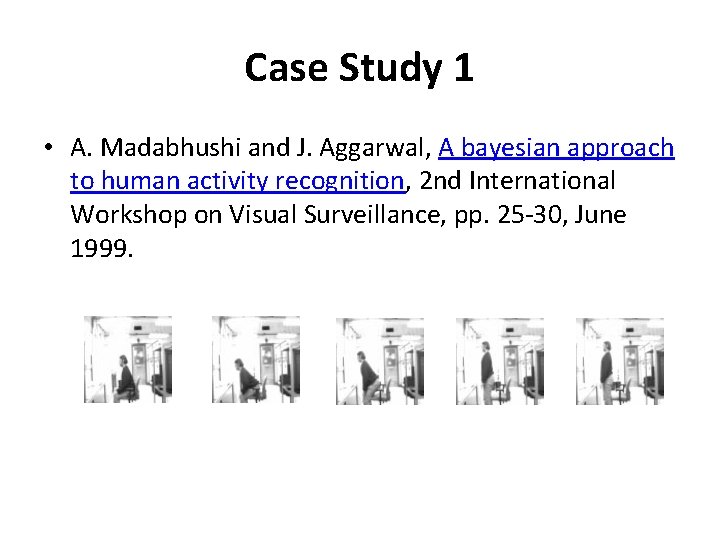
Case Study 1 • A. Madabhushi and J. Aggarwal, A bayesian approach to human activity recognition, 2 nd International Workshop on Visual Surveillance, pp. 25 -30, June 1999.
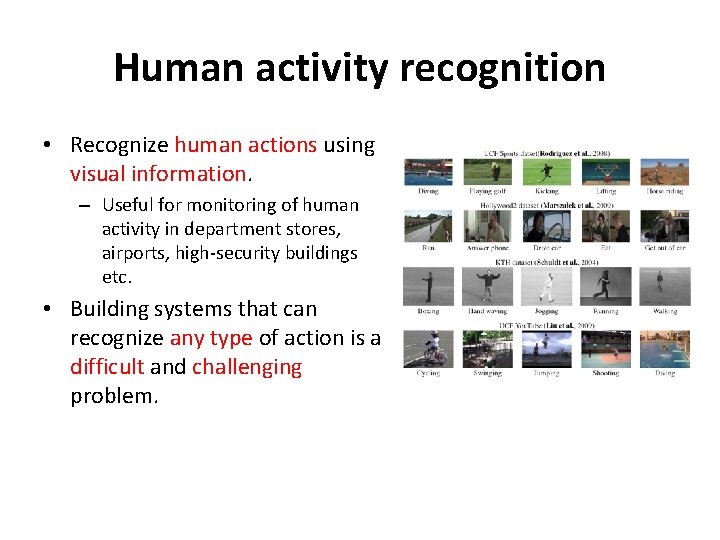
Human activity recognition • Recognize human actions using visual information. – Useful for monitoring of human activity in department stores, airports, high-security buildings etc. • Building systems that can recognize any type of action is a difficult and challenging problem.
Goal (this paper) • Build a system that is capable of recognizing the following 10 actions, from a frontal or lateral view: • • • sitting down standing up bending down getting up hugging squatting rising from a squatting position bending sideways falling backward walking Multi-classification problem 10 x 2 = 20 classes
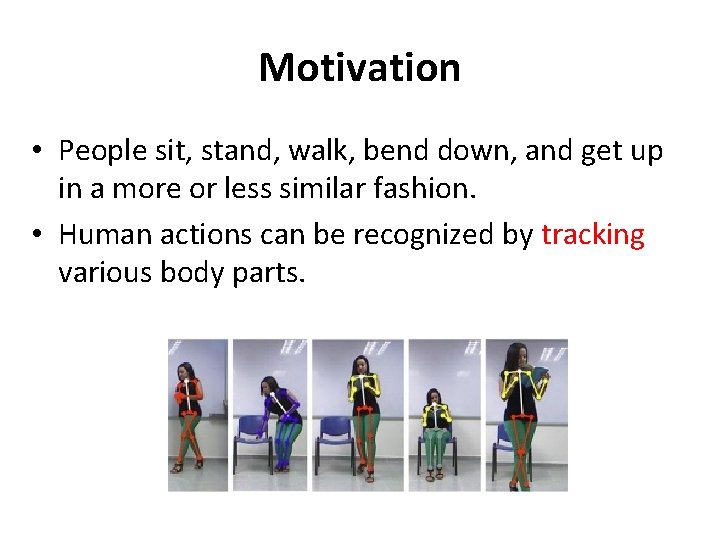
Motivation • People sit, stand, walk, bend down, and get up in a more or less similar fashion. • Human actions can be recognized by tracking various body parts.
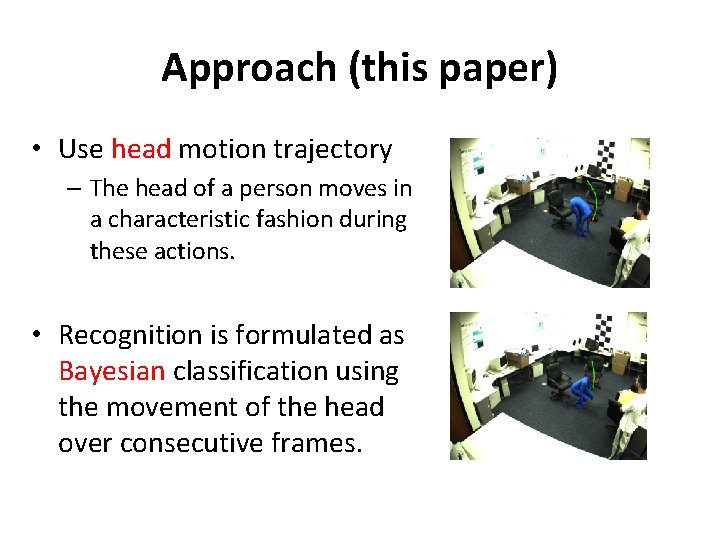
Approach (this paper) • Use head motion trajectory – The head of a person moves in a characteristic fashion during these actions. • Recognition is formulated as Bayesian classification using the movement of the head over consecutive frames.
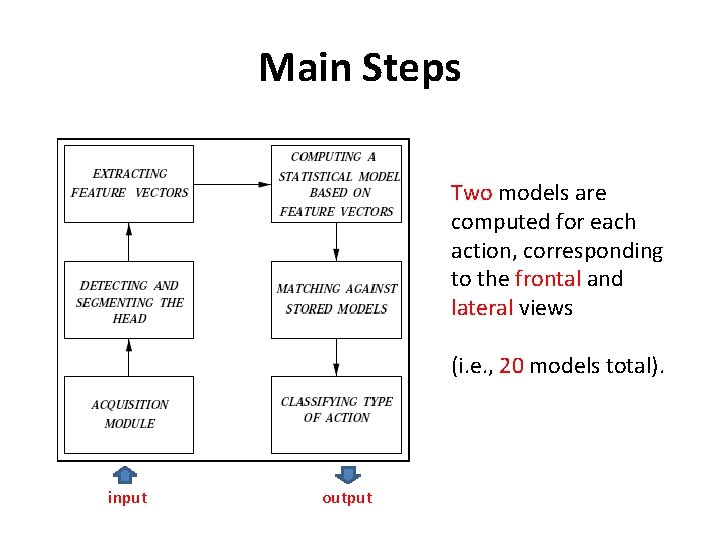
Main Steps Two models are computed for each action, corresponding to the frontal and lateral views (i. e. , 20 models total). input output
Strengths and Weaknesses • Strengths – The system can recognize actions where the gait of the subject in the test sequence differs considerably from the training sequences. – It can recognize actions for people of varying physical appearance (i. e. , tall, short, fat, thin etc. ). • Limitations – Only actions in the frontal or lateral view can be recognized successfully by this system. – Makes some non-realistic assumptions.
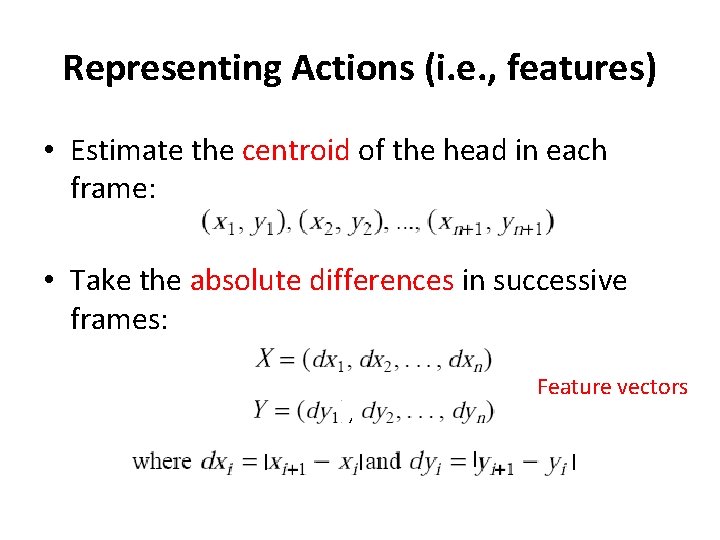
Representing Actions (i. e. , features) • Estimate the centroid of the head in each frame: • Take the absolute differences in successive frames: Feature vectors , | |
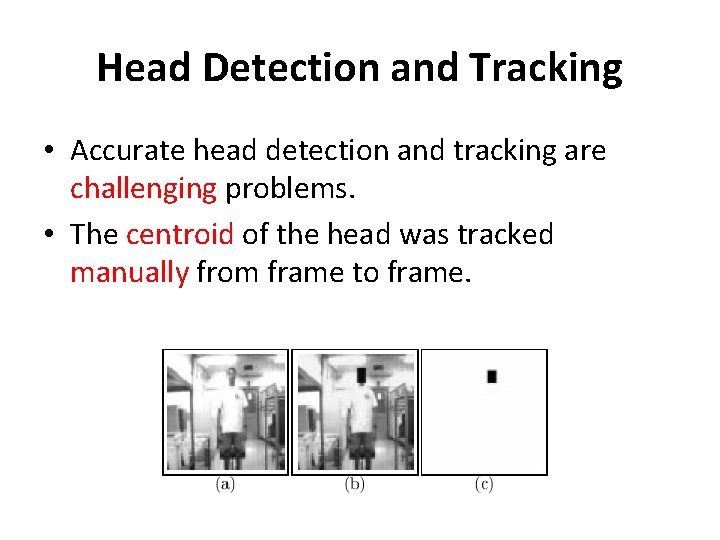
Head Detection and Tracking • Accurate head detection and tracking are challenging problems. • The centroid of the head was tracked manually from frame to frame.
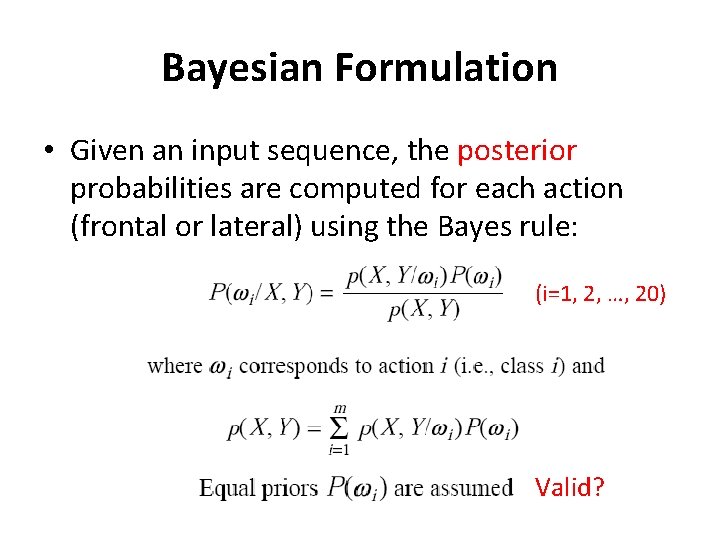
Bayesian Formulation • Given an input sequence, the posterior probabilities are computed for each action (frontal or lateral) using the Bayes rule: (i=1, 2, …, 20) Valid?
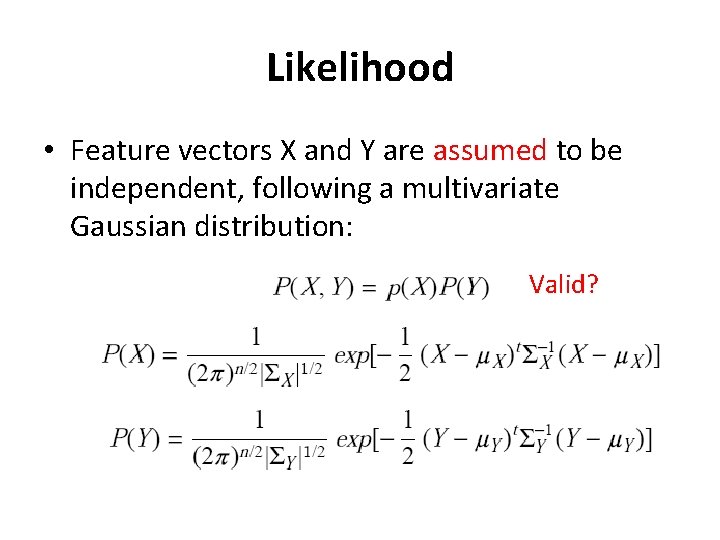
Likelihood • Feature vectors X and Y are assumed to be independent, following a multivariate Gaussian distribution: Valid?
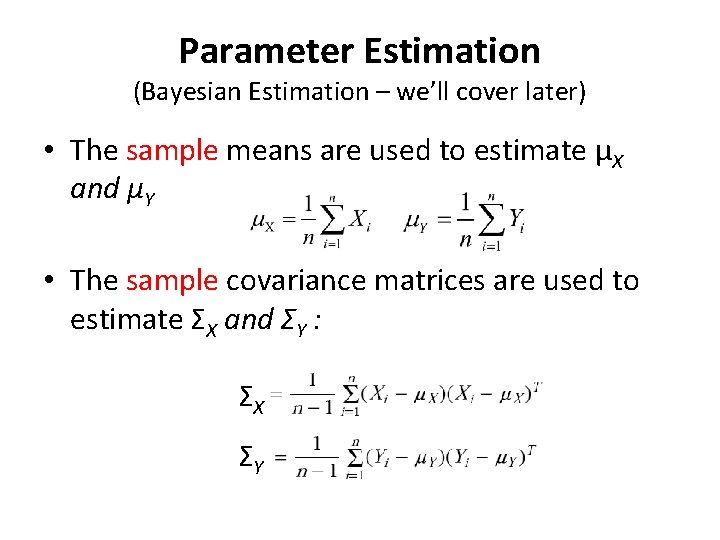
Parameter Estimation (Bayesian Estimation – we’ll cover later) • The sample means are used to estimate μX and μY • The sample covariance matrices are used to estimate ΣX and ΣY : ΣX ΣY
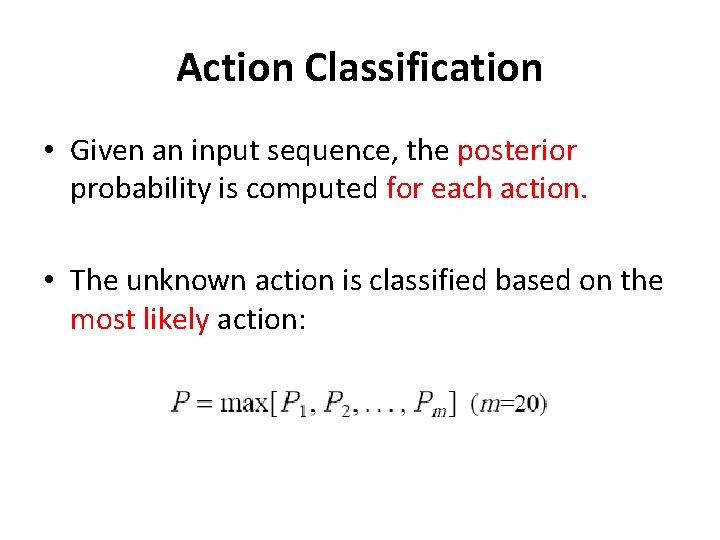
Action Classification • Given an input sequence, the posterior probability is computed for each action. • The unknown action is classified based on the most likely action:
Discriminating Among Similar Actions • In some actions, the head moves in a similar fashion, making it difficult to distinguish these actions from one another. • Heuristics are used to distinguish among similar actions. – e. g. , when bending down, the head goes much lower than when sitting down.
Training • A fixed CCD camera working at 2 frames per second was used to obtain the training data. – They collected a total of 38 sequences (i. e. , each person performed all the actions in both the frontal and lateral views). – People of diverse physical appearance were used to model the actions. – Subjects were asked to perform the actions at a comfortable pace.
Training (cont’d) • Assumptions – It was found that each action can be completed within 10 frames. – Only the first 10 frames from each sequence were used for training (i. e. , 5 seconds) Valid?
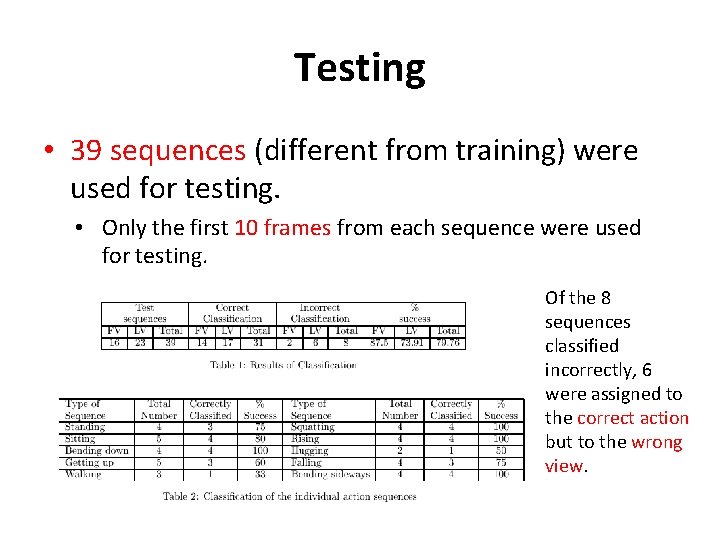
Testing • 39 sequences (different from training) were used for testing. • Only the first 10 frames from each sequence were used for testing. Of the 8 sequences classified incorrectly, 6 were assigned to the correct action but to the wrong view.
Practical Issues/Limitations • How would one find the first and last frames of an action in general (segmentation)? • How would one deal with actions performed at various speeds or with incomplete sequences (i. e. , missing frames)? • How would one deal different viewpoints? – i. e. , other than front or lateral
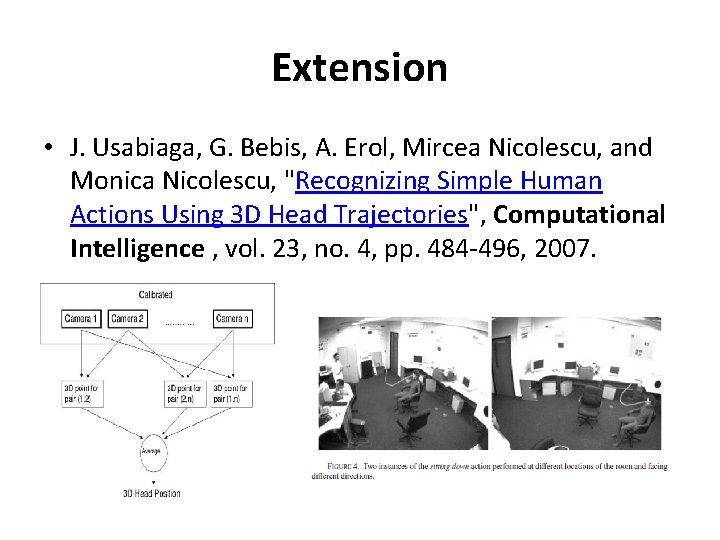
Extension • J. Usabiaga, G. Bebis, A. Erol, Mircea Nicolescu, and Monica Nicolescu, "Recognizing Simple Human Actions Using 3 D Head Trajectories", Computational Intelligence , vol. 23, no. 4, pp. 484 -496, 2007.
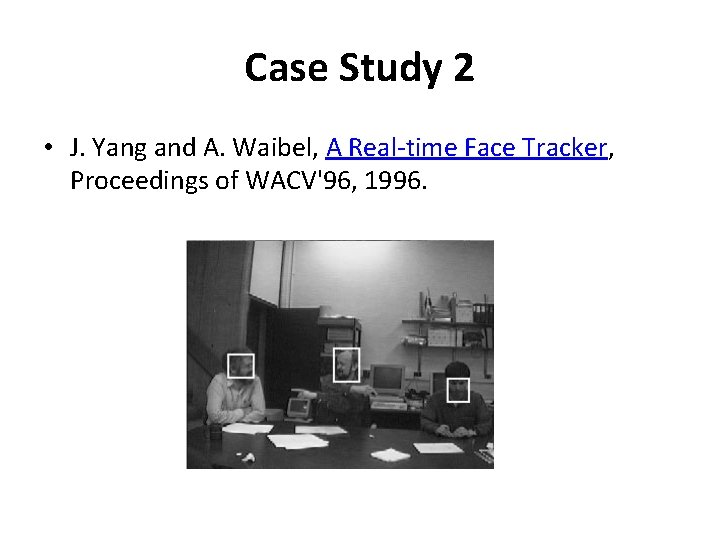
Case Study 2 • J. Yang and A. Waibel, A Real-time Face Tracker, Proceedings of WACV'96, 1996.
Overview • Goal: build a system that can detect and track a person’s face while the person moves freely in some environment. – Useful in a number of applications such as video conference, visual surveillance, face recognition, etc. • Approach: model skin color distribution using probabilistic models.
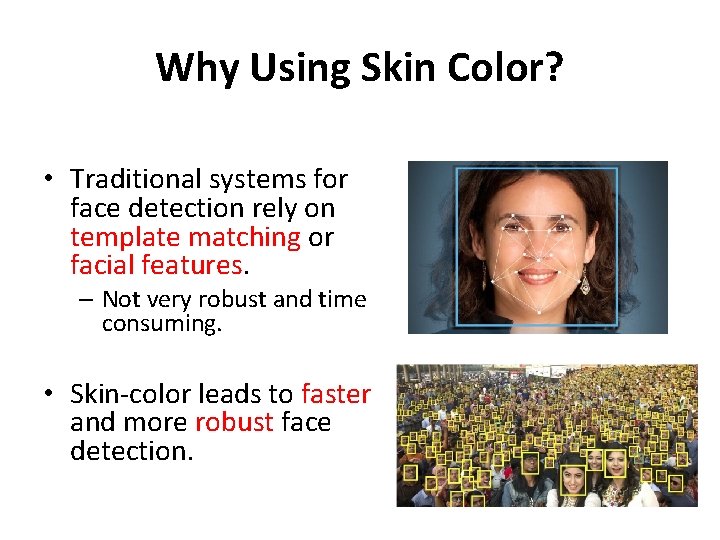
Why Using Skin Color? • Traditional systems for face detection rely on template matching or facial features. – Not very robust and time consuming. • Skin-color leads to faster and more robust face detection.
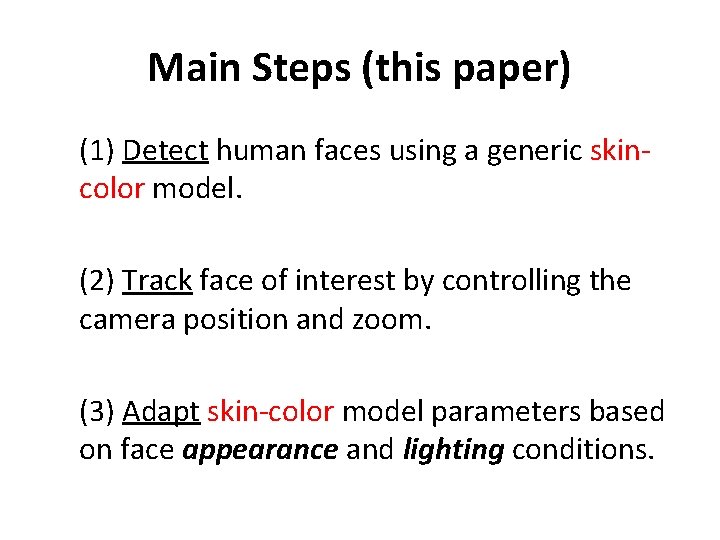
Main Steps (this paper) (1) Detect human faces using a generic skincolor model. (2) Track face of interest by controlling the camera position and zoom. (3) Adapt skin-color model parameters based on face appearance and lighting conditions.
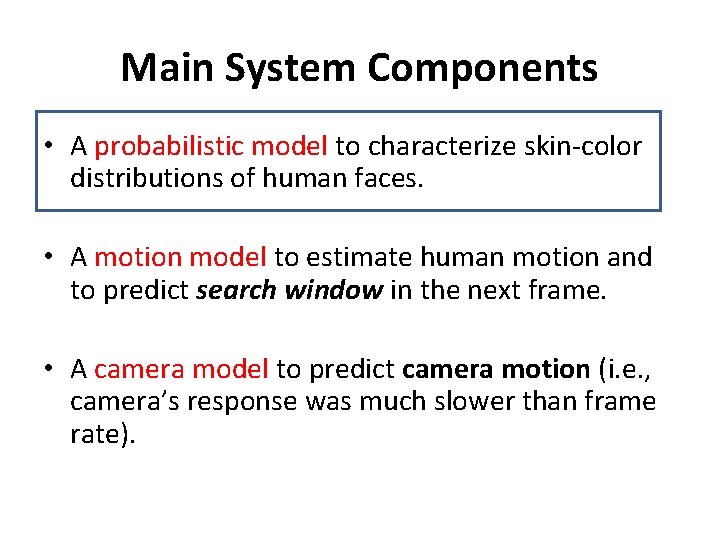
Main System Components • A probabilistic model to characterize skin-color distributions of human faces. • A motion model to estimate human motion and to predict search window in the next frame. • A camera model to predict camera motion (i. e. , camera’s response was much slower than frame rate).
Modeling Skin Color • Skin color is influenced by several factors: – Skin color varies from person to person. – Skin color can be affected by ambient light, motion etc. – Different cameras produce significantly different color values, even for the same person.
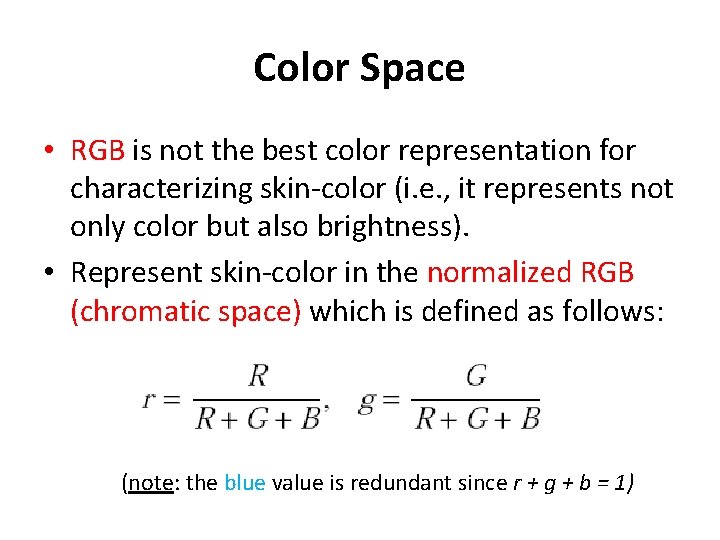
Color Space • RGB is not the best color representation for characterizing skin-color (i. e. , it represents not only color but also brightness). • Represent skin-color in the normalized RGB (chromatic space) which is defined as follows: (note: the blue value is redundant since r + g + b = 1)
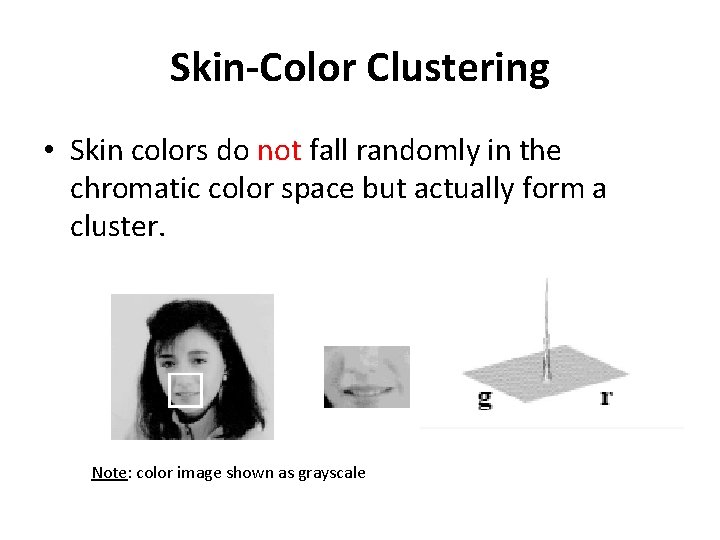
Skin-Color Clustering • Skin colors do not fall randomly in the chromatic color space but actually form a cluster. Note: color image shown as grayscale
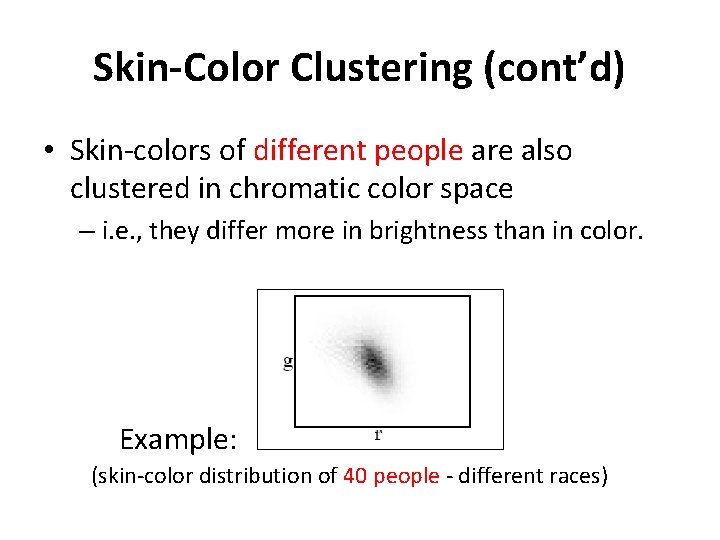
Skin-Color Clustering (cont’d) • Skin-colors of different people are also clustered in chromatic color space – i. e. , they differ more in brightness than in color. Example: (skin-color distribution of 40 people - different races)
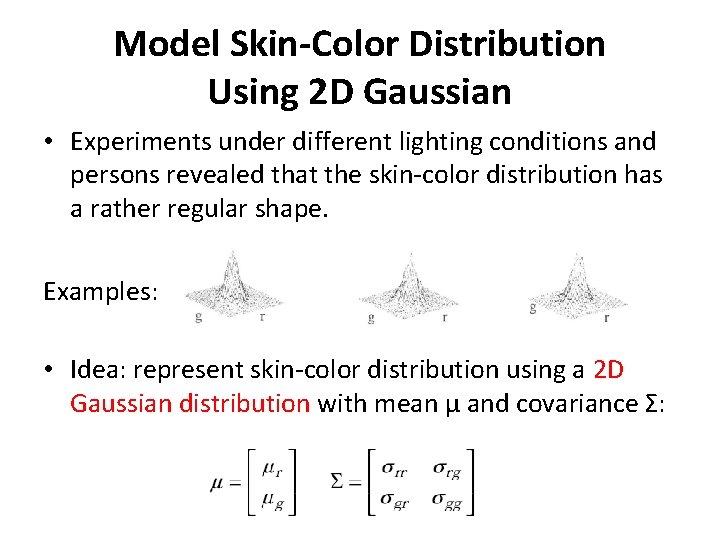
Model Skin-Color Distribution Using 2 D Gaussian • Experiments under different lighting conditions and persons revealed that the skin-color distribution has a rather regular shape. Examples: • Idea: represent skin-color distribution using a 2 D Gaussian distribution with mean μ and covariance Σ:
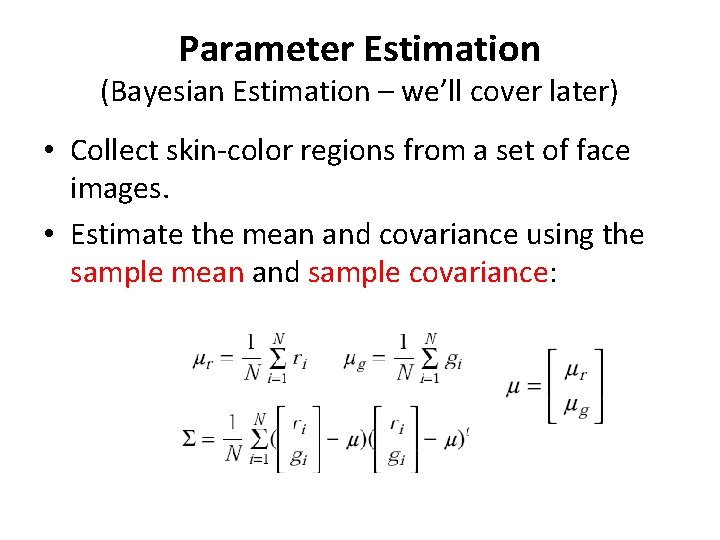
Parameter Estimation (Bayesian Estimation – we’ll cover later) • Collect skin-color regions from a set of face images. • Estimate the mean and covariance using the sample mean and sample covariance:
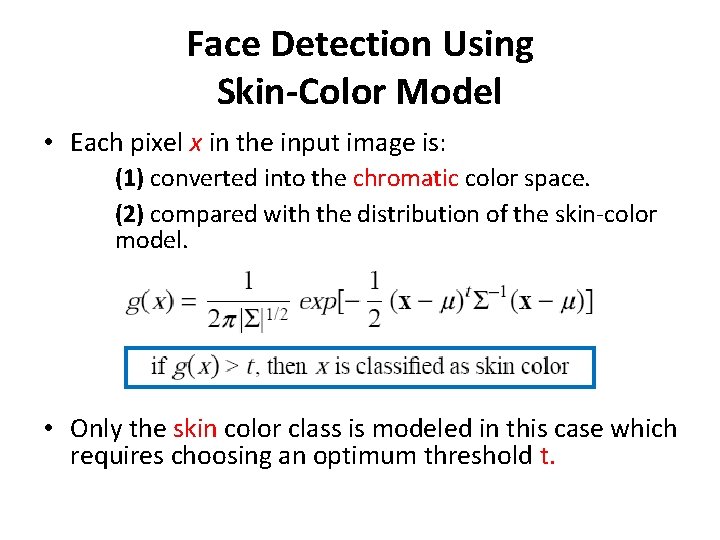
Face Detection Using Skin-Color Model • Each pixel x in the input image is: (1) converted into the chromatic color space. (2) compared with the distribution of the skin-color model. • Only the skin color class is modeled in this case which requires choosing an optimum threshold t.
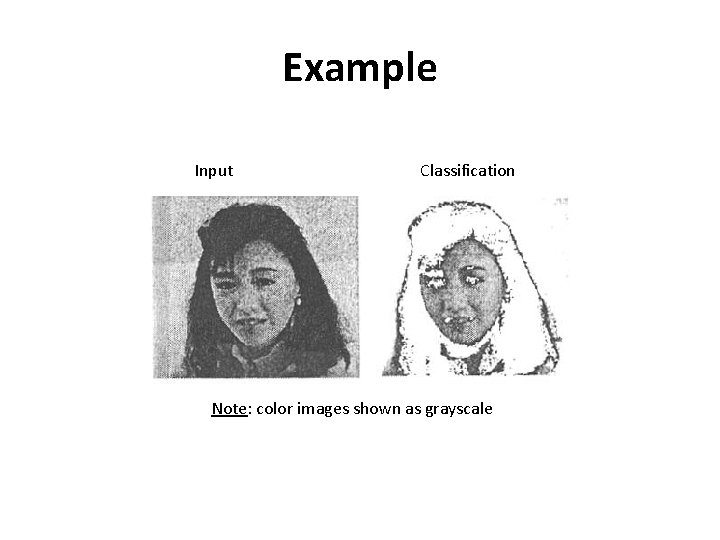
Example Input Classification Note: color images shown as grayscale
Modeling both skin and non-skin color distributions • • One can also model the non-skin color distribution. Becomes a two-classification: skin vs non-skin Compute max posterior probability using Bayes rule. How does this approach compare with the previous approach? – No need to explicitly select a threshold t. – Prior probabilities are needed for each class. – Modeling the non-skin color distribution is challenging.
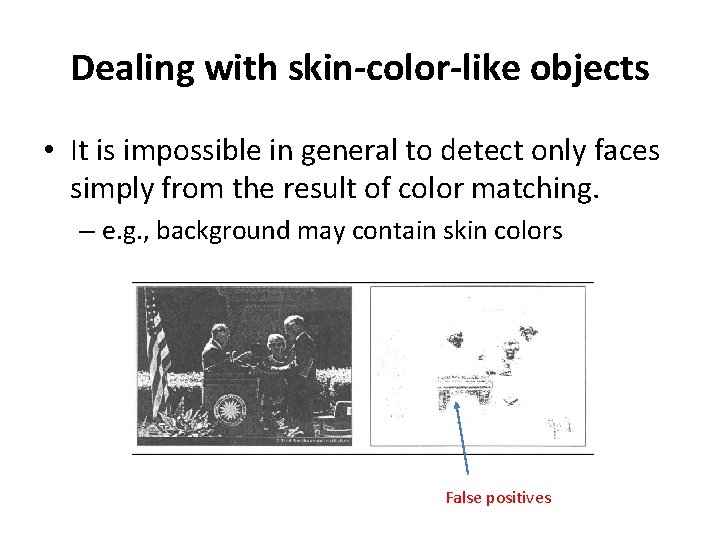
Dealing with skin-color-like objects • It is impossible in general to detect only faces simply from the result of color matching. – e. g. , background may contain skin colors False positives
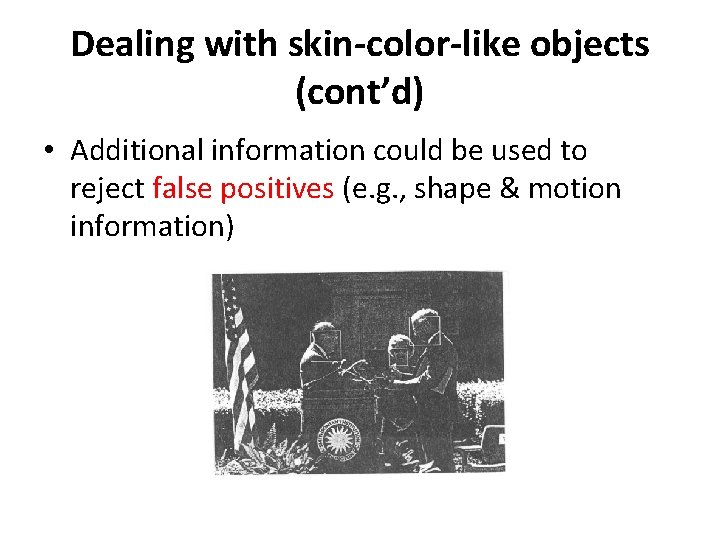
Dealing with skin-color-like objects (cont’d) • Additional information could be used to reject false positives (e. g. , shape & motion information)
Skin-color model adaptation • If a person is moving, the apparent skin colors change as the person’s position relative to the camera or light changes. • Idea: adapt model parameters (μ, Σ) to account for such changes.
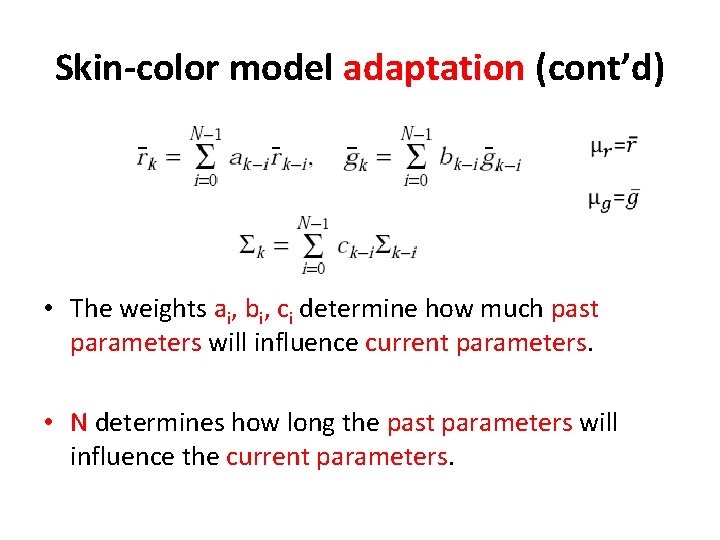
Skin-color model adaptation (cont’d) • The weights ai, bi, ci determine how much past parameters will influence current parameters. • N determines how long the past parameters will influence the current parameters.
System initialization • Automatic mode – A general skin-color model is used to identify skincolor regions. – Motion and shape information is used to reject non-face regions. – The largest face region is selected (i. e. , face closest to the camera). – Skin-color model is adapted to the face being tracked.
System initialization (cont’d) • Interactive mode – The user selects a point on the face of interest using the mouse. – The tracker searches around the point to find the face using a general skin-color model. – Skin-color model is adapted to the face being tracked.
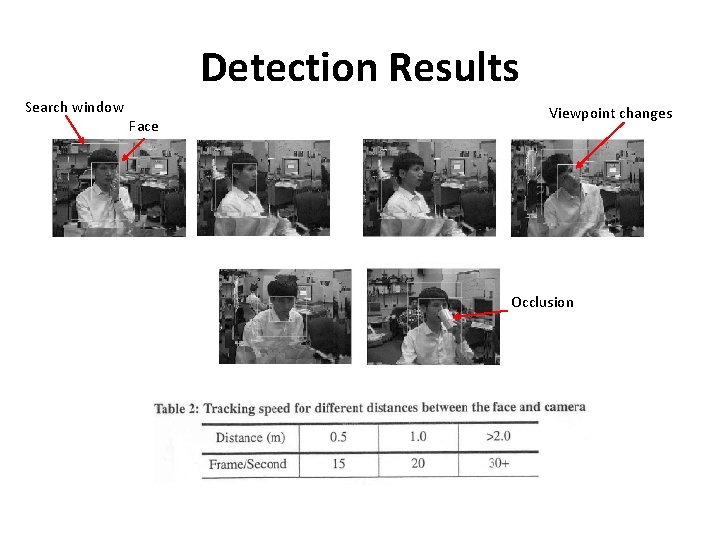
Detection Results Search window Face Viewpoint changes Occlusion
- Slides: 41