
Bayesian Brain Chapter 11 Neural Models of Bayesian
Bayesian Brain - Chapter 11 Neural Models of Bayesian Belief Propagation Rajesh P. N. Rao 2008 -12 -29 Summary by B. -H. Kim Biointelligence Lab School of Computer Sci. & Eng. Seoul National University
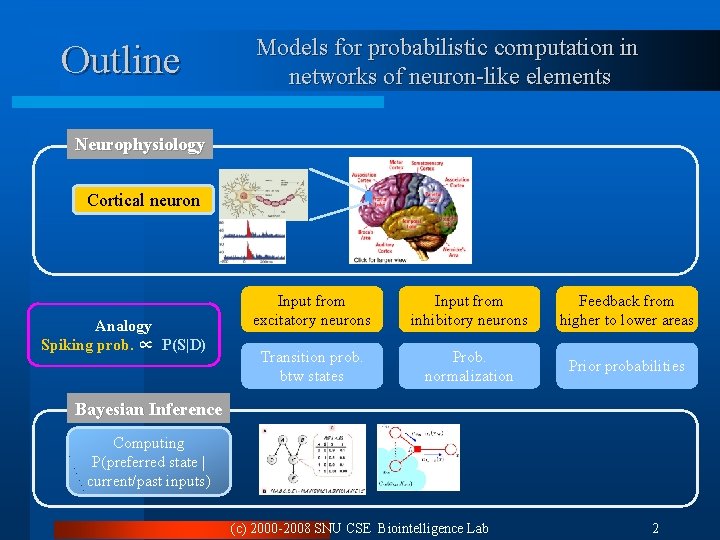
Outline Models for probabilistic computation in networks of neuron-like elements Neurophysiology Cortical neuron Analogy Spiking prob. ∝ P(S|D) Input from excitatory neurons Input from inhibitory neurons Feedback from higher to lower areas Transition prob. btw states Prob. normalization Prior probabilities Bayesian Inference Computing P(preferred state | current/past inputs) (c) 2000 -2008 SNU CSE Biointelligence Lab 2
![Introduction Models for neural implementation of the belief propagation algorithm For Bayesian inference [B]](http://slidetodoc.com/presentation_image_h2/9a22a8bdf4c670bdd21e8d7f22b5d2b2/image-3.jpg "Introduction Models for neural implementation of the belief propagation algorithm For Bayesian inference [B]")
Introduction Models for neural implementation of the belief propagation algorithm For Bayesian inference [B] model Inference over time using hidden Markov model (HMM) [A] Inference in a hierarchical graphical model [A] application Visual motion detection and decision-making Understanding attentional effects in the primate visual cortex (c) 2000 -2008 SNU CSE Biointelligence Lab 3

Bayesian Inference through Belief Propagation P(R) P(M) m. C R Sum over many r. v. exponential growth of comp. time Belief propagation (local operations) Efficient computation of the posterior probabilites (c) 2000 -2008 SNU CSE Biointelligence Lab 4
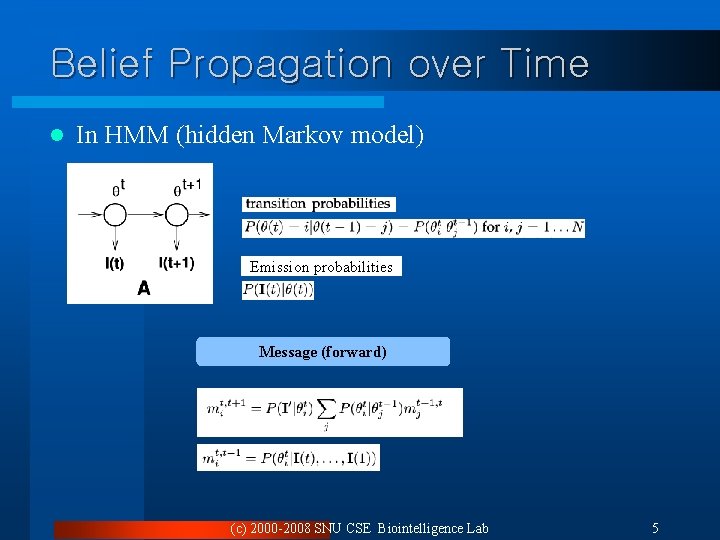
Belief Propagation over Time l In HMM (hidden Markov model) Emission probabilities Message (forward) (c) 2000 -2008 SNU CSE Biointelligence Lab 5
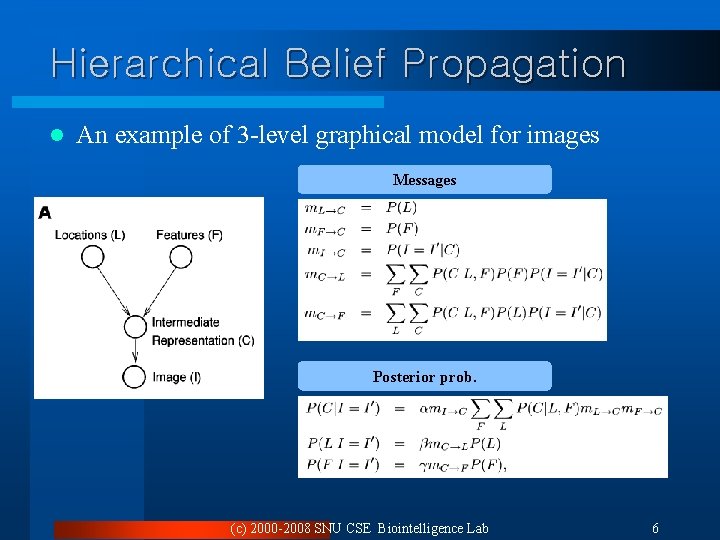
Hierarchical Belief Propagation l An example of 3 -level graphical model for images Messages Posterior prob. (c) 2000 -2008 SNU CSE Biointelligence Lab 6
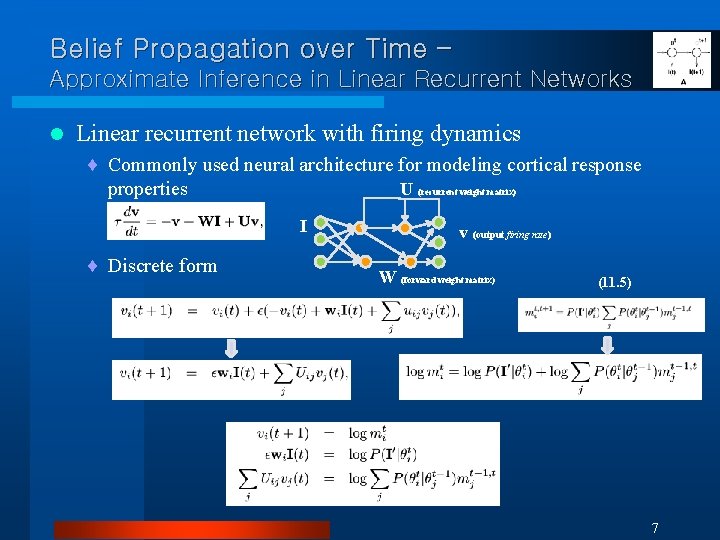
Belief Propagation over Time – Approximate Inference in Linear Recurrent Networks l Linear recurrent network with firing dynamics ¨ Commonly used neural architecture for modeling cortical response properties U (recurrent weight matrix) I ¨ Discrete form v (output firing rate) W (forward weight matrix) (11. 5) 7
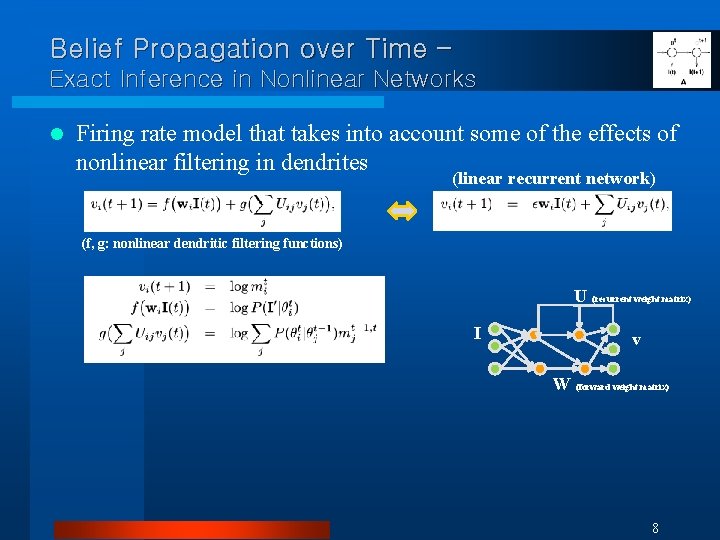
Belief Propagation over Time – Exact Inference in Nonlinear Networks l Firing rate model that takes into account some of the effects of nonlinear filtering in dendrites (linear recurrent network) (f, g: nonlinear dendritic filtering functions) U (recurrent weight matrix) I v W (forward weight matrix) 8
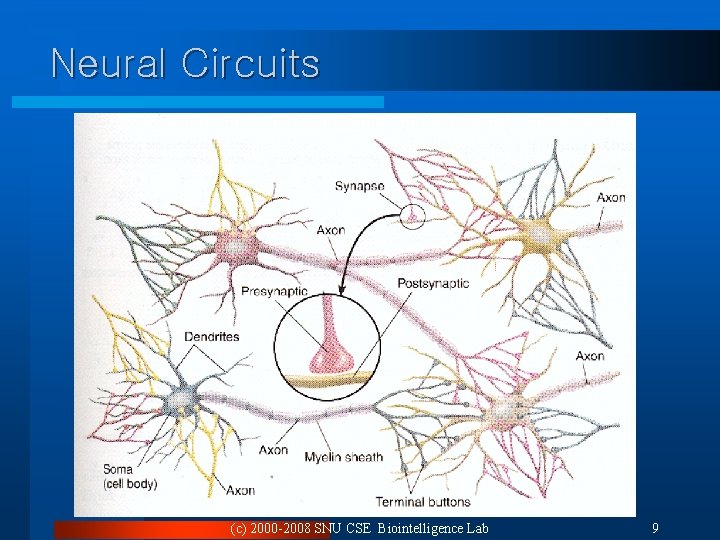
Neural Circuits (c) 2000 -2008 SNU CSE Biointelligence Lab 9
Results Example 1: Detecting Visual Motion l A prominent property of visual cortical cells in area (e. g. V 1, MT) is selectivity to the direction of visual motion l Interpretation on the activity of these cells ¨ the posterior probability of stimulus motion in a particular direction ¨ Given a series of input images l Experiment ¨ 1 D motion in an image with two possible motion directions: L or R (c) 2000 -2008 SNU CSE Biointelligence Lab 10
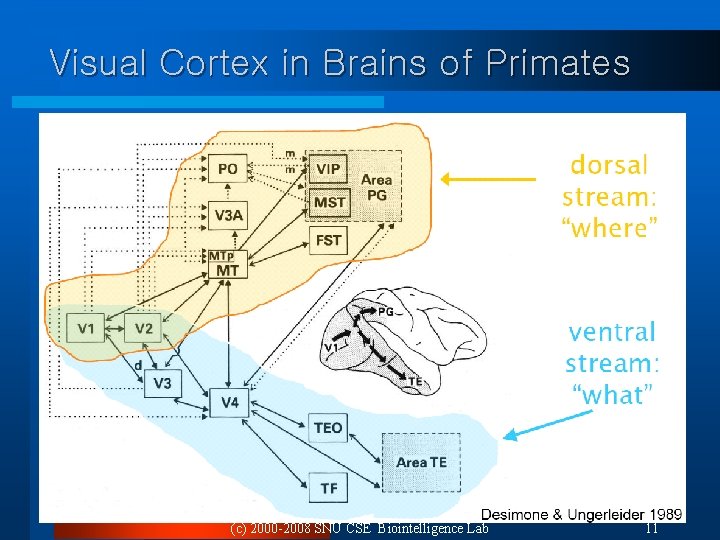
Visual Cortex in Brains of Primates (c) 2000 -2008 SNU CSE Biointelligence Lab 11
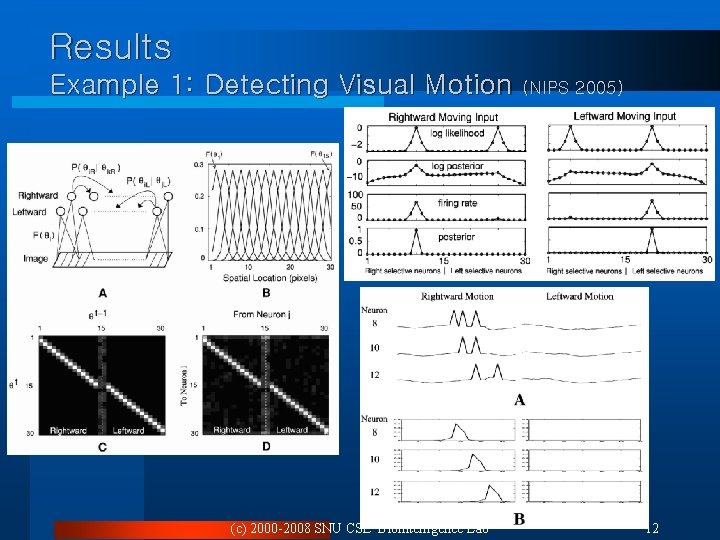
Results Example 1: Detecting Visual Motion (c) 2000 -2008 SNU CSE Biointelligence Lab (NIPS 2005) 12
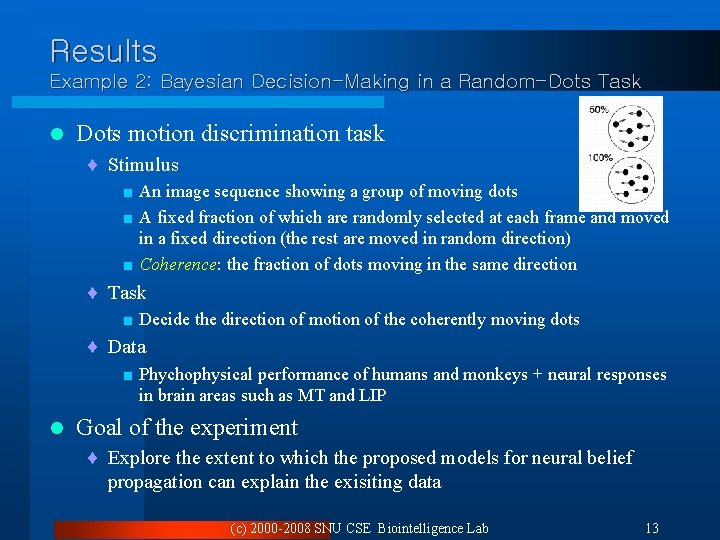
Results Example 2: Bayesian Decision-Making in a Random-Dots Task l Dots motion discrimination task ¨ Stimulus < An image sequence showing a group of moving dots < A fixed fraction of which are randomly selected at each frame and moved in a fixed direction (the rest are moved in random direction) < Coherence: the fraction of dots moving in the same direction ¨ Task < Decide the direction of motion of the coherently moving dots ¨ Data < Phychophysical performance of humans and monkeys + neural responses in brain areas such as MT and LIP l Goal of the experiment ¨ Explore the extent to which the proposed models for neural belief propagation can explain the exisiting data (c) 2000 -2008 SNU CSE Biointelligence Lab 13
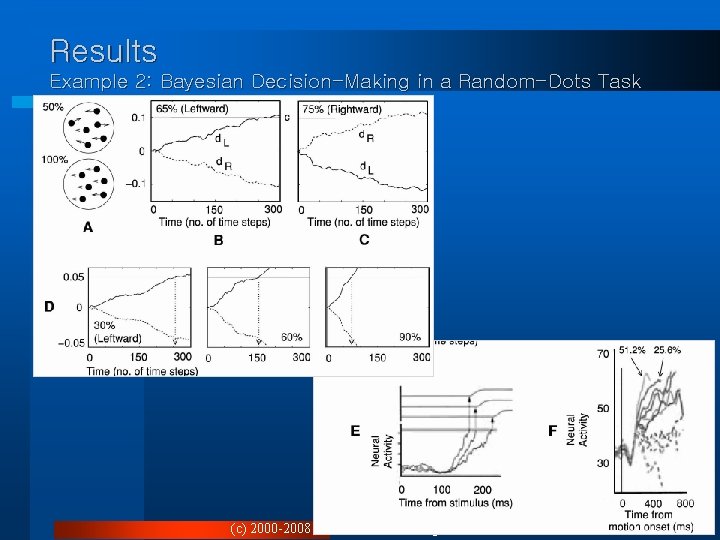
Results Example 2: Bayesian Decision-Making in a Random-Dots Task (c) 2000 -2008 SNU CSE Biointelligence Lab 14
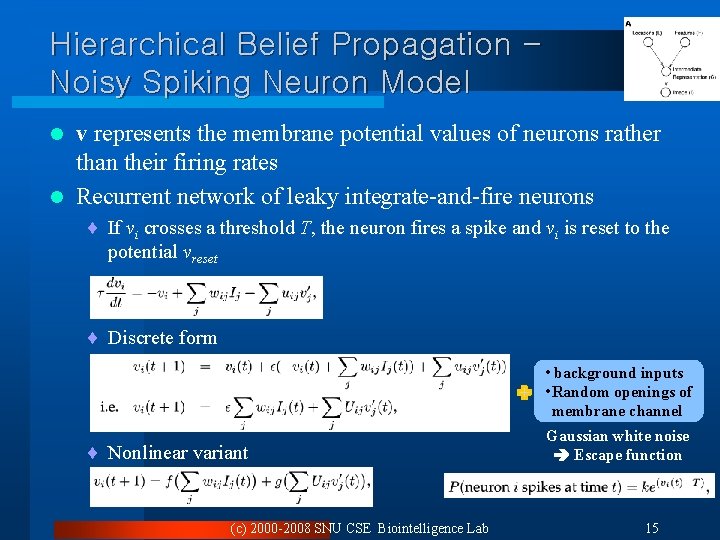
Hierarchical Belief Propagation Noisy Spiking Neuron Model v represents the membrane potential values of neurons rather than their firing rates l Recurrent network of leaky integrate-and-fire neurons l ¨ If vi crosses a threshold T, the neuron fires a spike and vi is reset to the potential vreset ¨ Discrete form • background inputs • Random openings of membrane channel ¨ Nonlinear variant (c) 2000 -2008 SNU CSE Biointelligence Lab Gaussian white noise Escape function 15
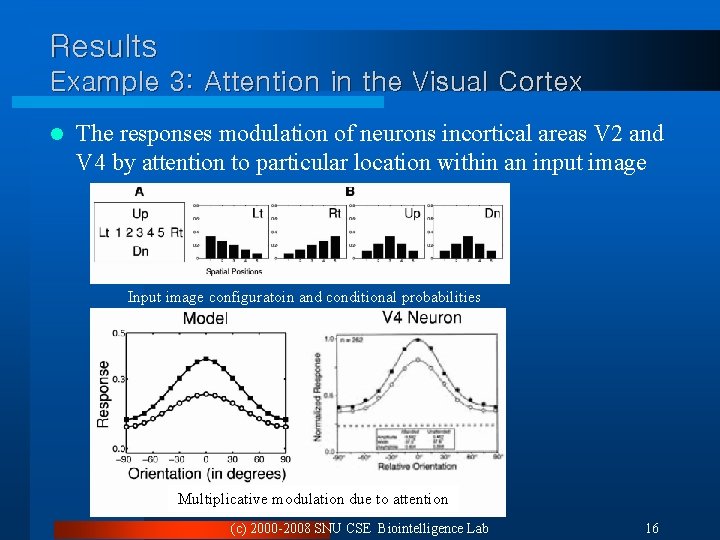
Results Example 3: Attention in the Visual Cortex l The responses modulation of neurons incortical areas V 2 and V 4 by attention to particular location within an input image Input image configuratoin and conditional probabilities Multiplicative modulation due to attention (c) 2000 -2008 SNU CSE Biointelligence Lab 16
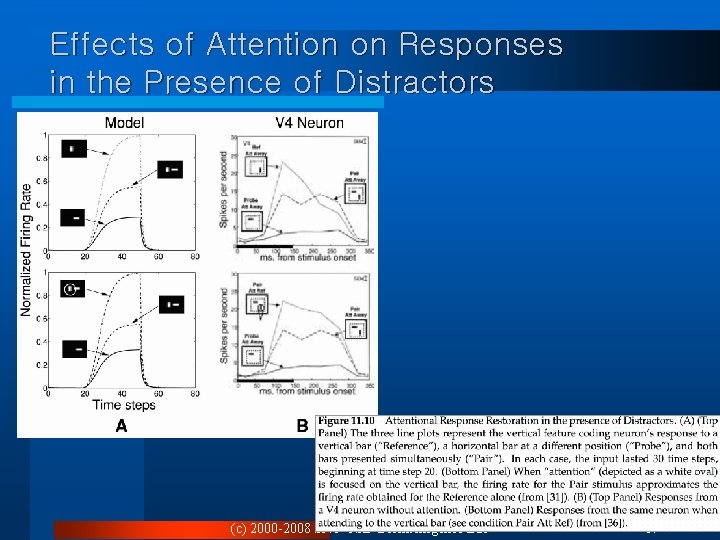
Effects of Attention on Responses in the Presence of Distractors (c) 2000 -2008 SNU CSE Biointelligence Lab 17
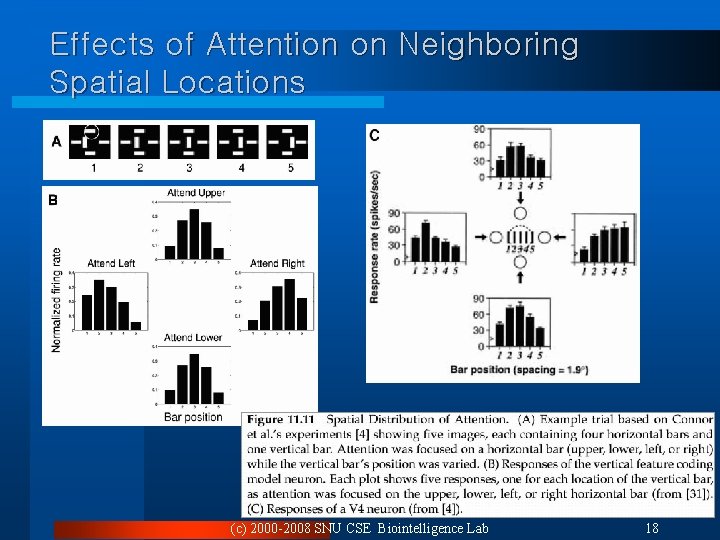
Effects of Attention on Neighboring Spatial Locations (c) 2000 -2008 SNU CSE Biointelligence Lab 18
11. 5. 1 Related Models l Models based on log-likelihood ratios l Inference using distributional codes l Hierarchical inference (c) 2000 -2008 SNU CSE Biointelligence Lab 19
11. 5. 2 Open Problems and Future Challenges l Learning and adaptation l The use of spikes in prob. Representations l How the dendritic nonlinearities could be exploited to implement belief propagation l Exploring graphical models that are inspired by neurobiology (c) 2000 -2008 SNU CSE Biointelligence Lab 20
- Slides: 20