
Bayesian Brain 2 Spike Coding Adrienne Fairhall Summary
![[Bayesian Brain] 2 Spike Coding Adrienne Fairhall Summary by Kim, Hoon Hee (SNU-BI LAB)](https://slidetodoc.com/presentation_image/4c8006dc36e614e3aaa3375b15c2c316/image-1.jpg "[Bayesian Brain] 2 Spike Coding Adrienne Fairhall Summary by Kim, Hoon Hee (SNU-BI LAB)")
[Bayesian Brain] 2 Spike Coding Adrienne Fairhall Summary by Kim, Hoon Hee (SNU-BI LAB) 1

Spike Coding l Spikes information ¨ Single ¨ Sequences l Spike encoding ¨ Cascade model ¨ Covariance Method l Spike decoding l Adaptive spike coding (C) 2007 SNU CSE Biointelligence Lab 2

Spikes: What kind of Code? (C) 2007 SNU CSE Biointelligence Lab 3
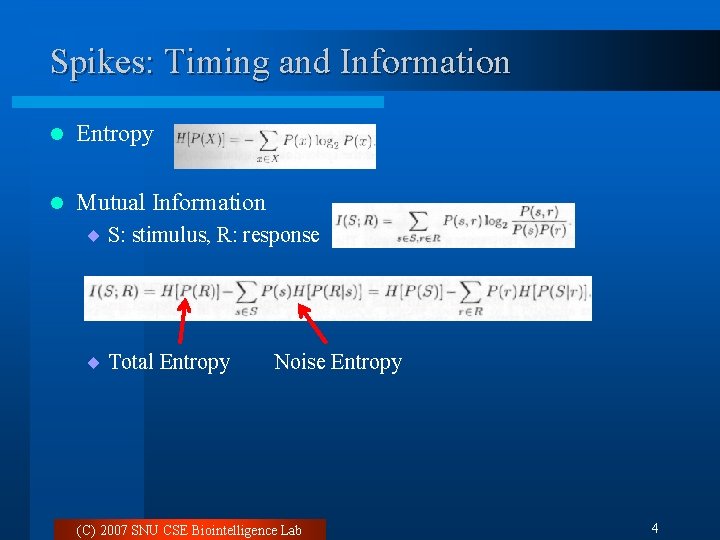
Spikes: Timing and Information l Entropy l Mutual Information ¨ S: stimulus, R: response ¨ Total Entropy Noise Entropy (C) 2007 SNU CSE Biointelligence Lab 4
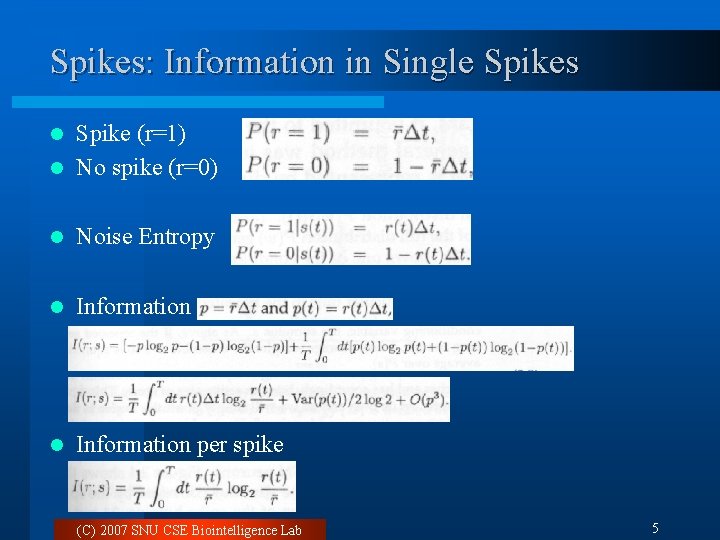
Spikes: Information in Single Spikes Spike (r=1) l No spike (r=0) l l Noise Entropy l Information per spike (C) 2007 SNU CSE Biointelligence Lab 5

Spikes: Information in Spike Sequences (1) P(w|s(t)) A spike train and its representation in terms of binary “letters. ” l N bins : N-letter binary words, w. l (C) 2007 SNU CSE Biointelligence Lab 6
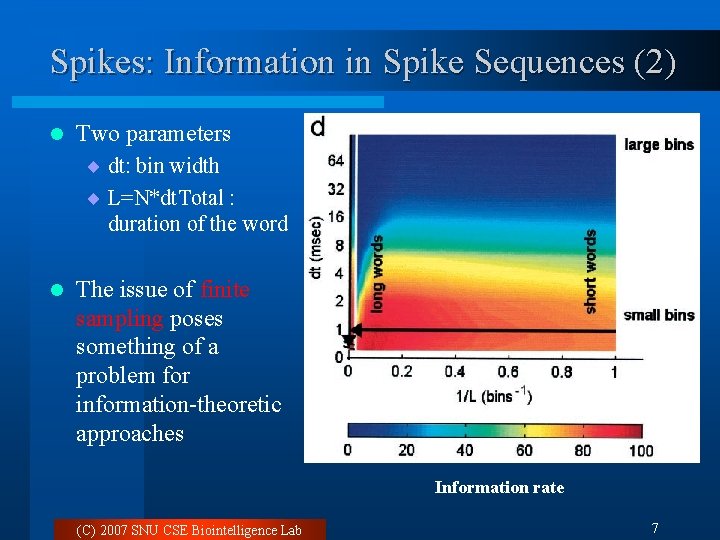
Spikes: Information in Spike Sequences (2) l Two parameters ¨ dt: bin width ¨ L=N*dt. Total : duration of the word l The issue of finite sampling poses something of a problem for information-theoretic approaches Information rate (C) 2007 SNU CSE Biointelligence Lab 7
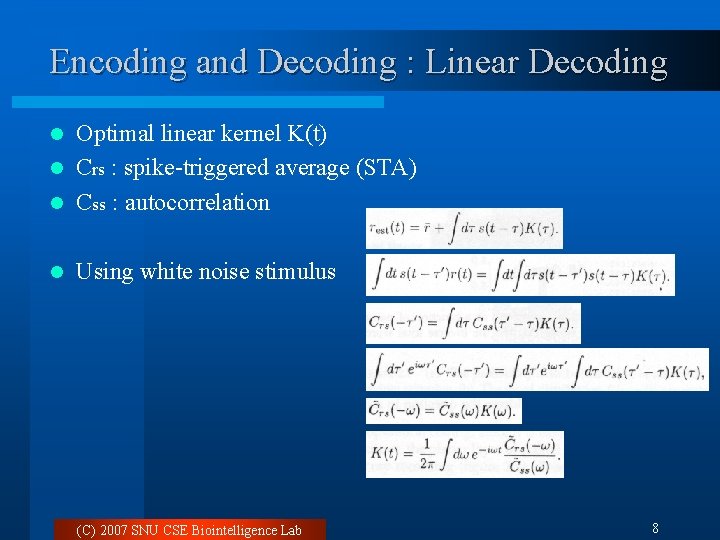
Encoding and Decoding : Linear Decoding Optimal linear kernel K(t) l Crs : spike-triggered average (STA) l Css : autocorrelation l l Using white noise stimulus (C) 2007 SNU CSE Biointelligence Lab 8
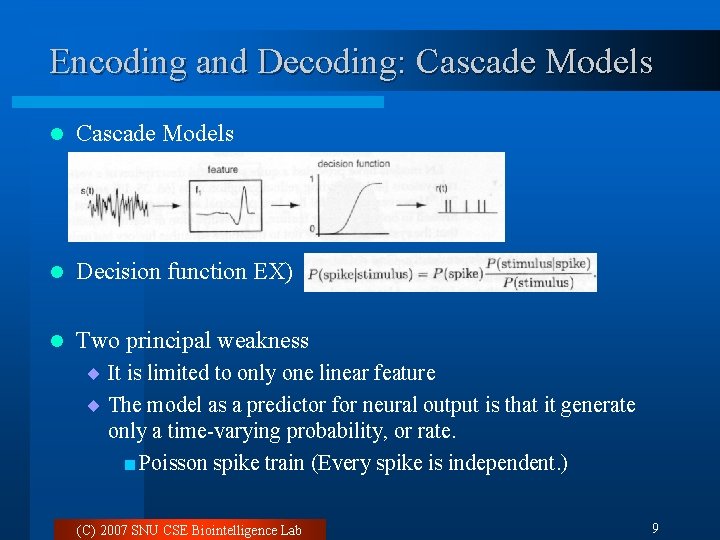
Encoding and Decoding: Cascade Models l Decision function EX) l Two principal weakness ¨ It is limited to only one linear feature ¨ The model as a predictor for neural output is that it generate only a time-varying probability, or rate. < Poisson spike train (Every spike is independent. ) (C) 2007 SNU CSE Biointelligence Lab 9
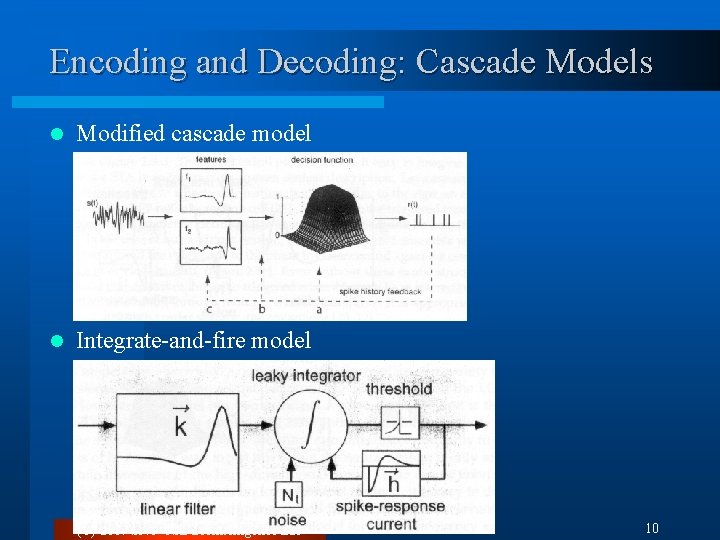
Encoding and Decoding: Cascade Models l Modified cascade model l Integrate-and-fire model (C) 2007 SNU CSE Biointelligence Lab 10
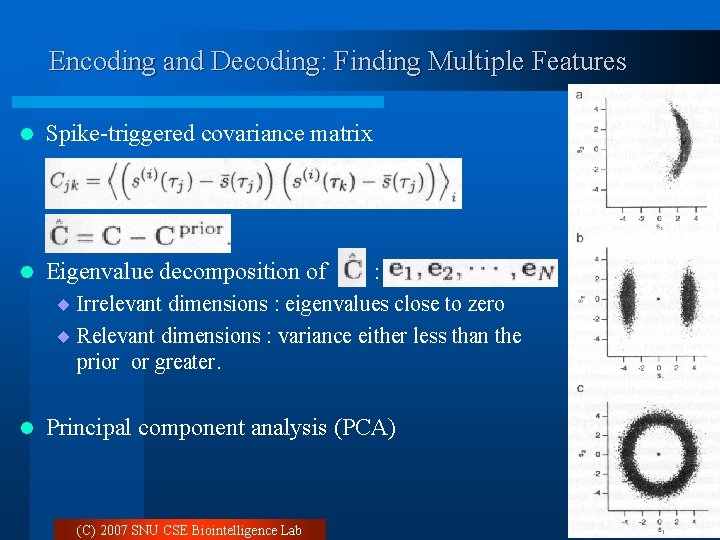
Encoding and Decoding: Finding Multiple Features l Spike-triggered covariance matrix l Eigenvalue decomposition of : ¨ Irrelevant dimensions : eigenvalues close to zero ¨ Relevant dimensions : variance either less than the prior or greater. l Principal component analysis (PCA) (C) 2007 SNU CSE Biointelligence Lab 11
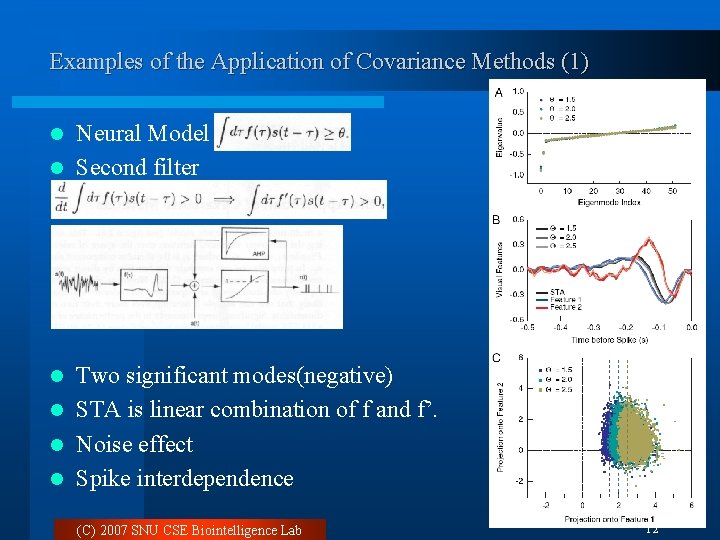
Examples of the Application of Covariance Methods (1) Neural Model l Second filter l Two significant modes(negative) l STA is linear combination of f and f’. l Noise effect l Spike interdependence l (C) 2007 SNU CSE Biointelligence Lab 12
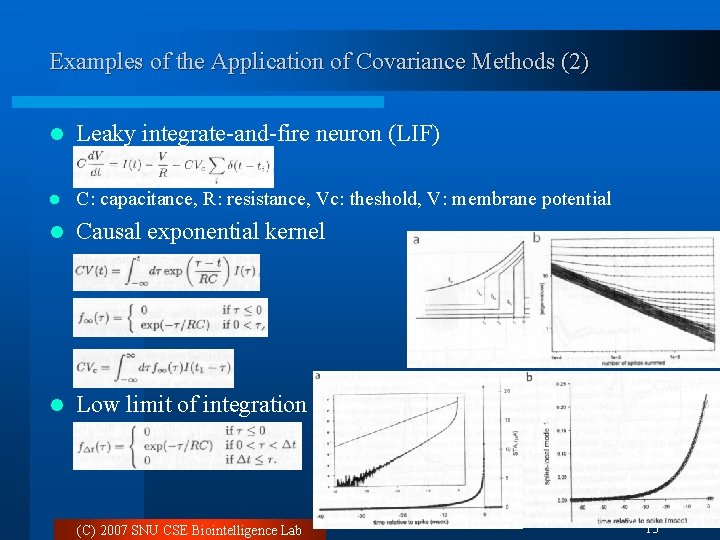
Examples of the Application of Covariance Methods (2) l Leaky integrate-and-fire neuron (LIF) l C: capacitance, R: resistance, Vc: theshold, V: membrane potential l Causal exponential kernel l Low limit of integration (C) 2007 SNU CSE Biointelligence Lab 13
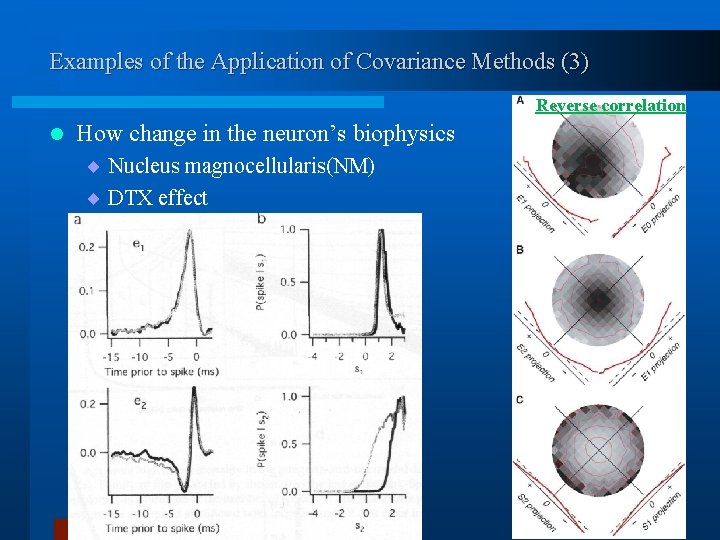
Examples of the Application of Covariance Methods (3) Reverse correlation l How change in the neuron’s biophysics ¨ Nucleus magnocellularis(NM) ¨ DTX effect (C) 2007 SNU CSE Biointelligence Lab 14
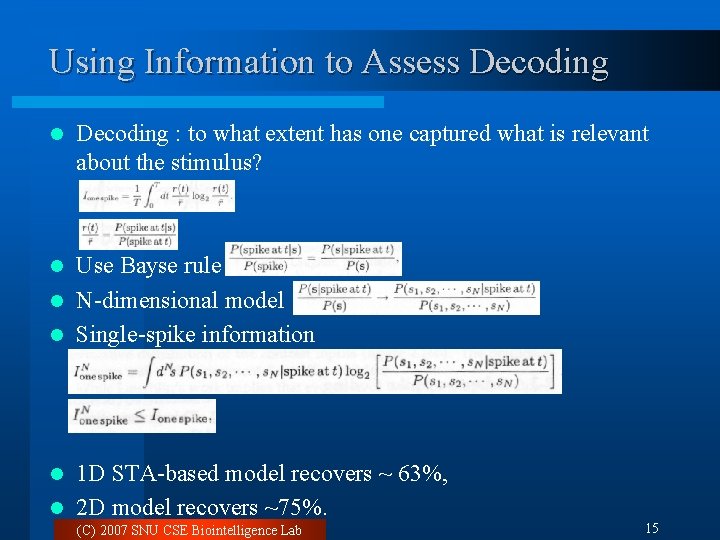
Using Information to Assess Decoding l Decoding : to what extent has one captured what is relevant about the stimulus? Use Bayse rule l N-dimensional model l Single-spike information l 1 D STA-based model recovers ~ 63%, l 2 D model recovers ~75%. l (C) 2007 SNU CSE Biointelligence Lab 15
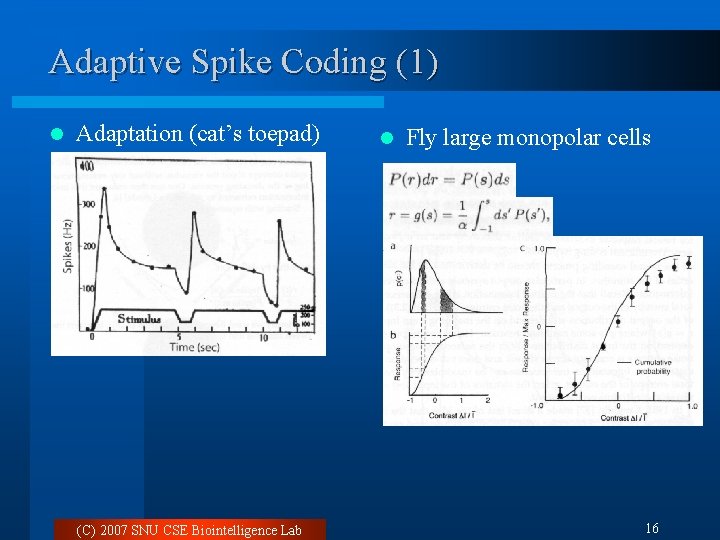
Adaptive Spike Coding (1) l Adaptation (cat’s toepad) (C) 2007 SNU CSE Biointelligence Lab l Fly large monopolar cells 16
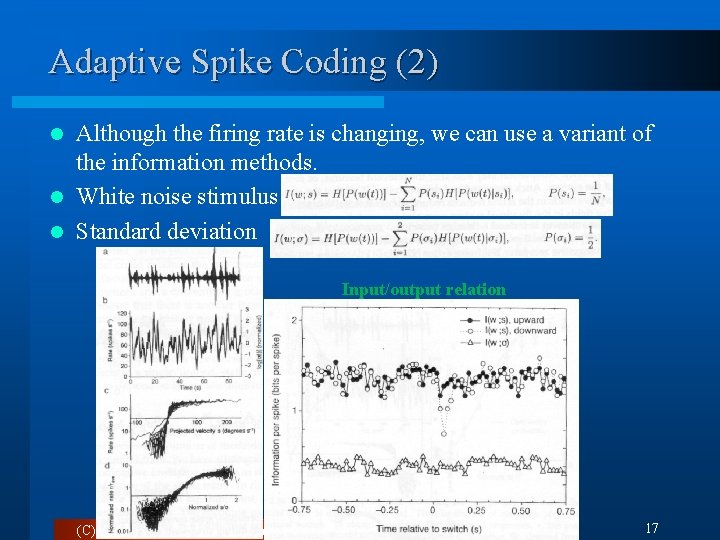
Adaptive Spike Coding (2) Although the firing rate is changing, we can use a variant of the information methods. l White noise stimulus l Standard deviation l Input/output relation (C) 2007 SNU CSE Biointelligence Lab 17
- Slides: 17