
Bayesian analysis with a discrete distribution Source Stattrek
Bayesian analysis with a discrete distribution Source: Stattrek. com
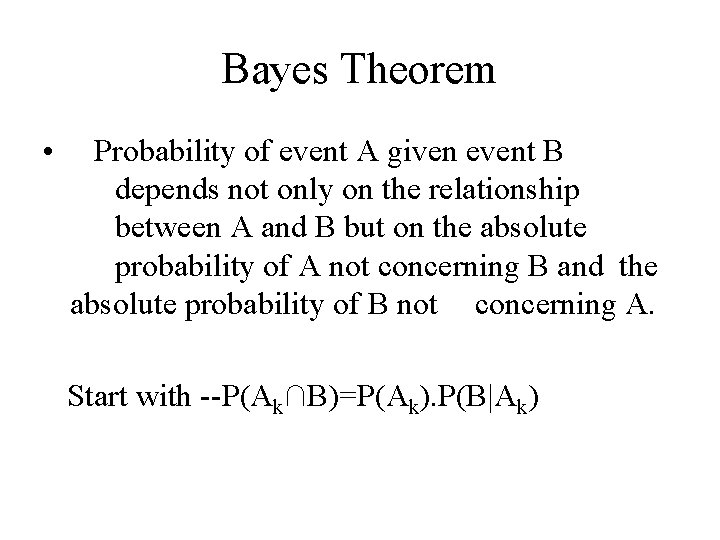
Bayes Theorem • Probability of event A given event B depends not only on the relationship between A and B but on the absolute probability of A not concerning B and the absolute probability of B not concerning A. Start with --P(Ak∩B)=P(Ak). P(B|Ak)
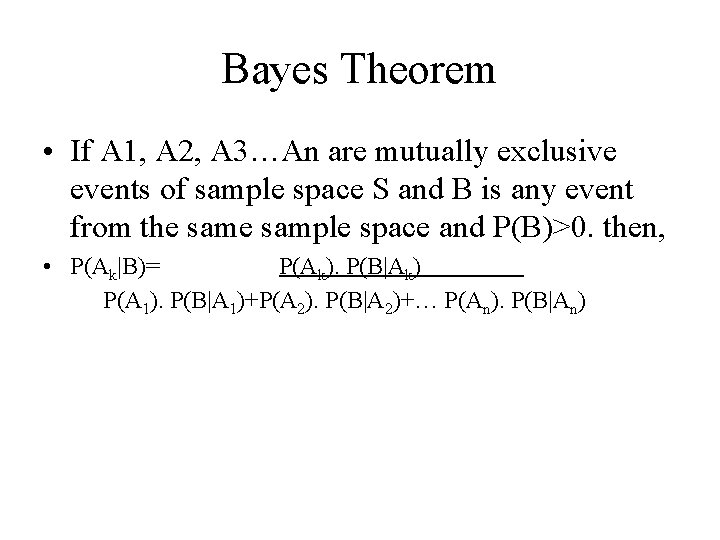
Bayes Theorem • If A 1, A 2, A 3…An are mutually exclusive events of sample space S and B is any event from the sample space and P(B)>0. then, • P(Ak|B)= P(Ak). P(B|Ak) P(A 1). P(B|A 1)+P(A 2). P(B|A 2)+… P(An). P(B|An)
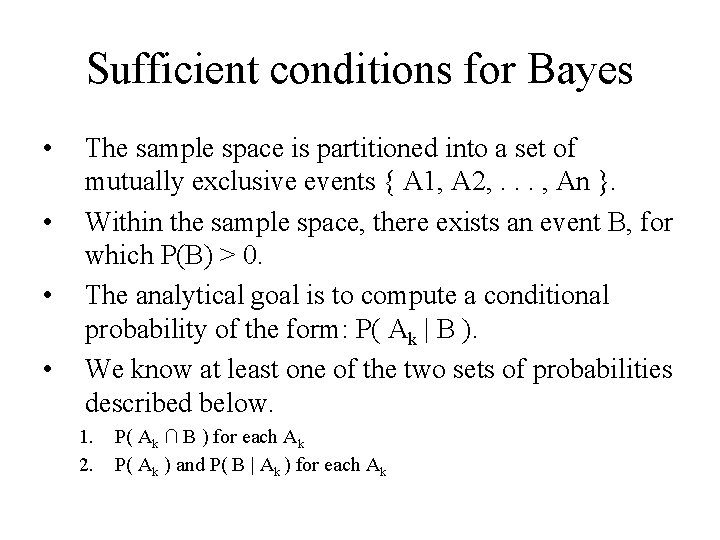
Sufficient conditions for Bayes • • The sample space is partitioned into a set of mutually exclusive events { A 1, A 2, . . . , An }. Within the sample space, there exists an event B, for which P(B) > 0. The analytical goal is to compute a conditional probability of the form: P( Ak | B ). We know at least one of the two sets of probabilities described below. 1. 2. P( Ak ∩ B ) for each Ak P( Ak ) and P( B | Ak ) for each Ak
Eg. of Discrete Distribution • Marie is getting married tomorrow, at an outdoor ceremony in the desert. In recent years, it has rained only 5 days each year.
Eg. of Discrete Distribution • The weatherman has predicted rain for tomorrow. • When it actually rains, the weatherman correctly forecasts rain 90% P( B | A 1 )of the time. • When it doesn't rain, he incorrectly forecasts rain 10% P( B | A 2 ) of the time. • What is the probability that it will rain on the day of Marie's wedding (P(A 1))? • A 2==does not rain on wedding.
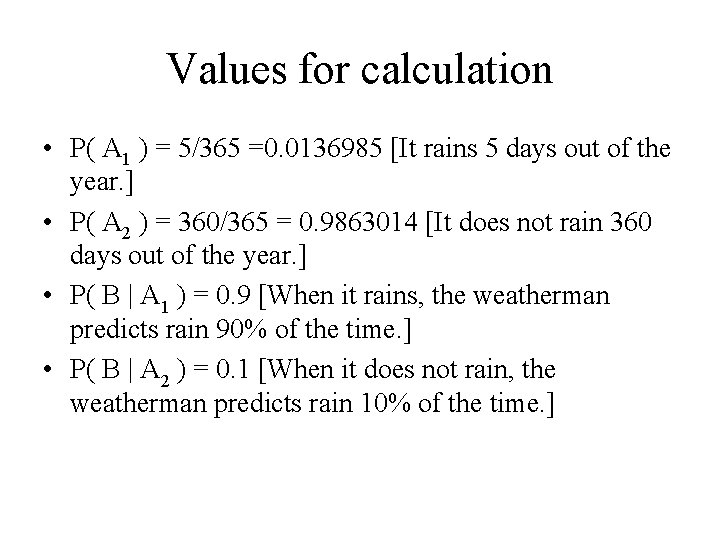
Values for calculation • P( A 1 ) = 5/365 =0. 0136985 [It rains 5 days out of the year. ] • P( A 2 ) = 360/365 = 0. 9863014 [It does not rain 360 days out of the year. ] • P( B | A 1 ) = 0. 9 [When it rains, the weatherman predicts rain 90% of the time. ] • P( B | A 2 ) = 0. 1 [When it does not rain, the weatherman predicts rain 10% of the time. ]
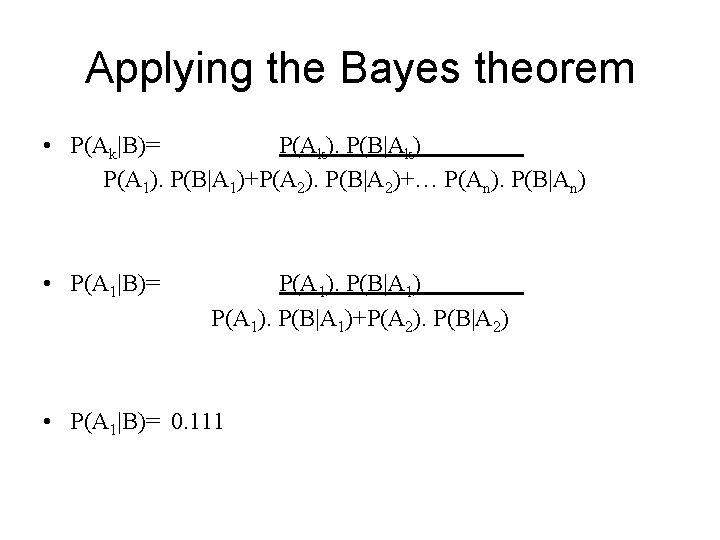
Applying the Bayes theorem • P(Ak|B)= P(Ak). P(B|Ak) P(A 1). P(B|A 1)+P(A 2). P(B|A 2)+… P(An). P(B|An) • P(A 1|B)= P(A 1). P(B|A 1)+P(A 2). P(B|A 2) • P(A 1|B)= 0. 111
- Slides: 8