
Bayesian analysis of microarray traits Arabidopsis Microarray Workshop
Bayesian analysis of microarray traits Arabidopsis Microarray Workshop Brian S. Yandell University of Wisconsin-Madison www. stat. wisc. edu/~yandell/statgen Yandell © June 2005 1
studying diabetes in an F 2 • segregating cross of inbred lines – B 6. ob x BTBR. ob F 1 F 2 – selected mice with ob/ob alleles at leptin gene (chr 6) – measured and mapped body weight, insulin, glucose at various ages (Stoehr et al. 2000 Diabetes) – sacrificed at 14 weeks, tissues preserved • gene expression data – Affymetrix microarrays on parental strains, F 1 • (Nadler et al. 2000 PNAS; Ntambi et al. 2002 PNAS) – RT-PCR for a few m. RNA on 108 F 2 mice liver tissues • (Lan et al. 2003 Diabetes; Lan et al. 2003 Genetics) – Affymetrix microarrays on 60 F 2 mice liver tissues • design (Jin et al. 2004 Genetics tent. accept) • analysis (work in prep. ) Yandell © June 2005 2
Type 2 Diabetes Mellitus Yandell © June 2005 3
nt e irem in ul s n I qu e R decompensation Yandell June. FASEB 2005 J. (2001) 15, 312 from Unger © & Orci 4
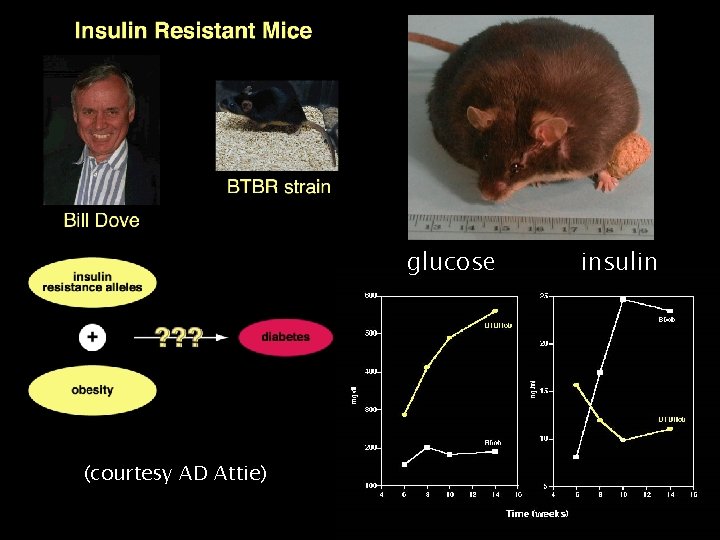
glucose insulin (courtesy AD Attie) Yandell © June 2005 5
why map gene expression as a quantitative trait? • cis- or trans-action? – does gene control its own expression? – or is it influenced by one or more other genomic regions? – evidence for both modes (Brem et al. 2002 Science) • simultaneously measure all m. RNA in a tissue – ~5, 000 m. RNA active per cell on average – ~30, 000 genes in genome – use genetic recombination as natural experiment • mechanics of gene expression mapping – measure gene expression in intercross (F 2) population – map expression as quantitative trait (QTL) – adjust for multiple testing Yandell © June 2005 6
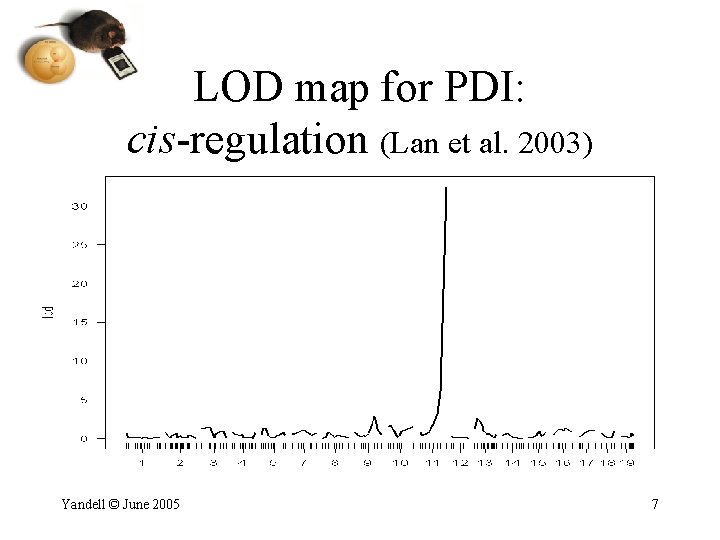
LOD map for PDI: cis-regulation (Lan et al. 2003) Yandell © June 2005 7
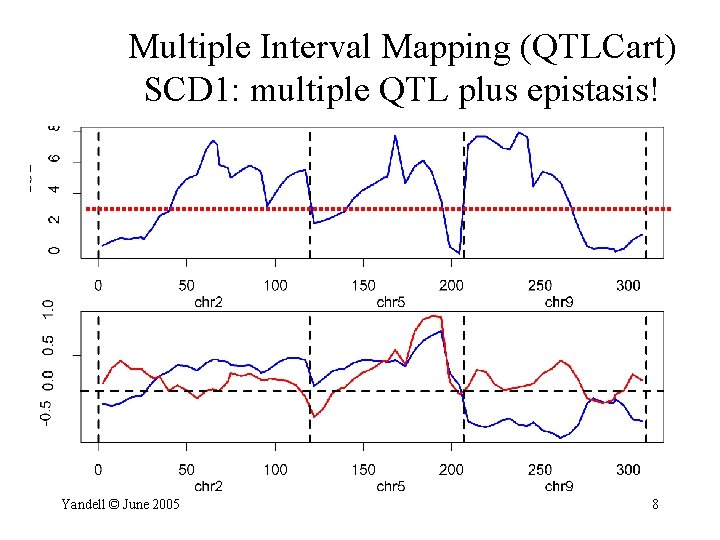
Multiple Interval Mapping (QTLCart) SCD 1: multiple QTL plus epistasis! Yandell © June 2005 8
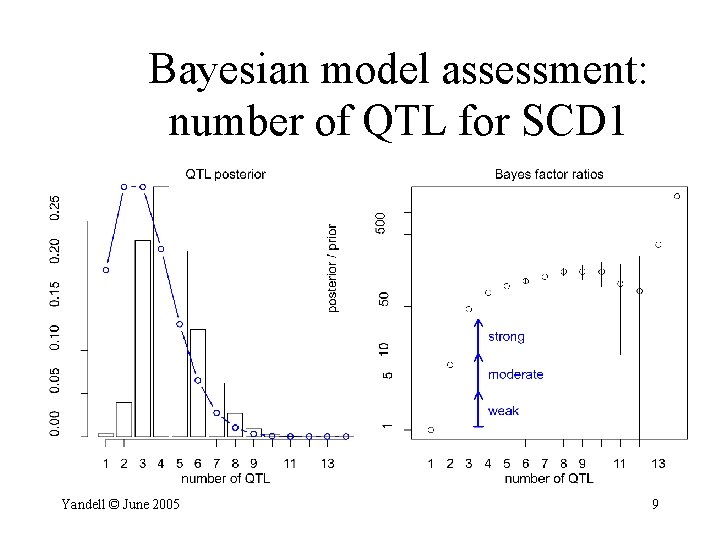
Bayesian model assessment: number of QTL for SCD 1 Yandell © June 2005 9
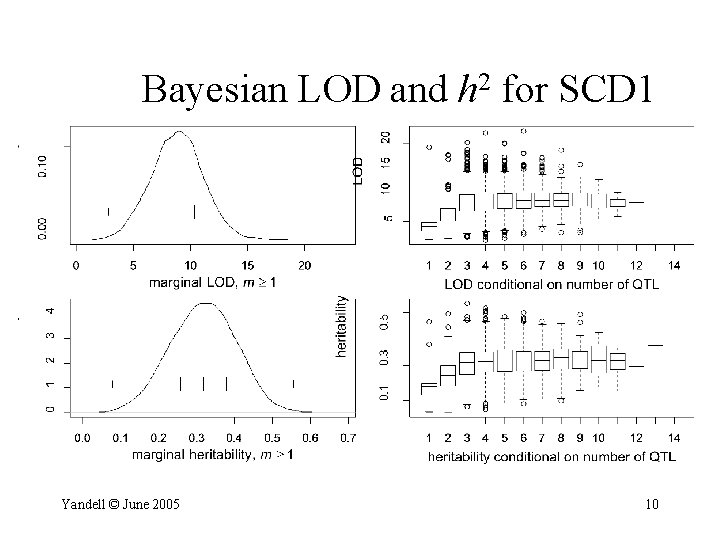
Bayesian LOD and h 2 for SCD 1 Yandell © June 2005 10
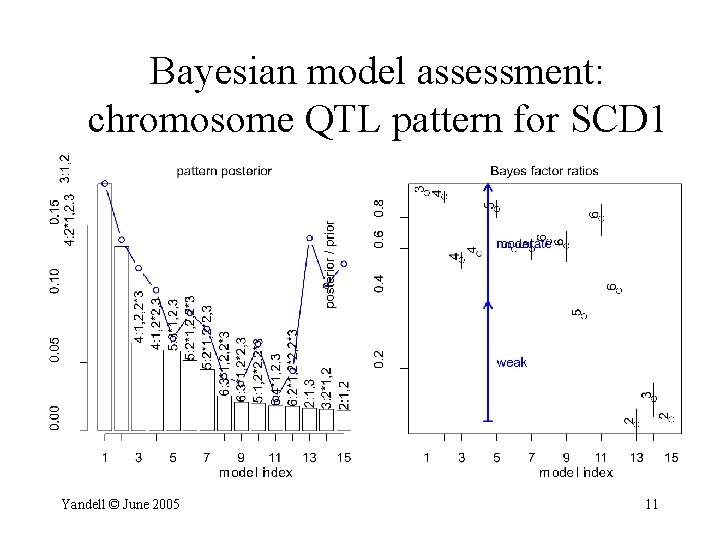
Bayesian model assessment: chromosome QTL pattern for SCD 1 Yandell © June 2005 11
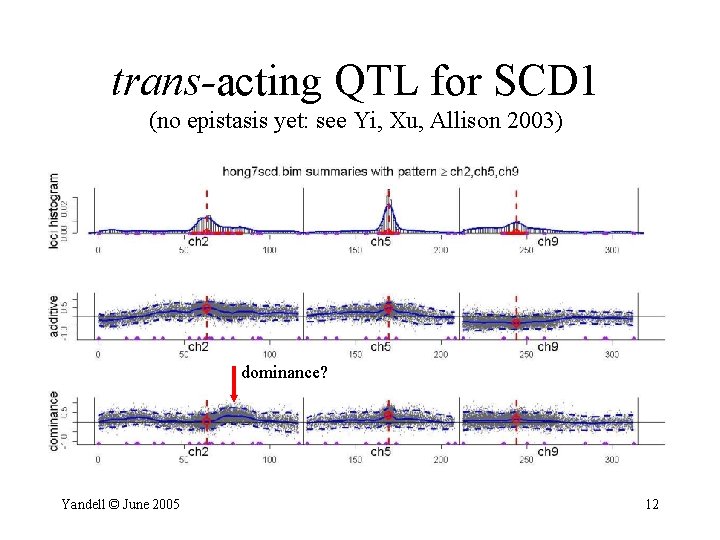
trans-acting QTL for SCD 1 (no epistasis yet: see Yi, Xu, Allison 2003) dominance? Yandell © June 2005 12
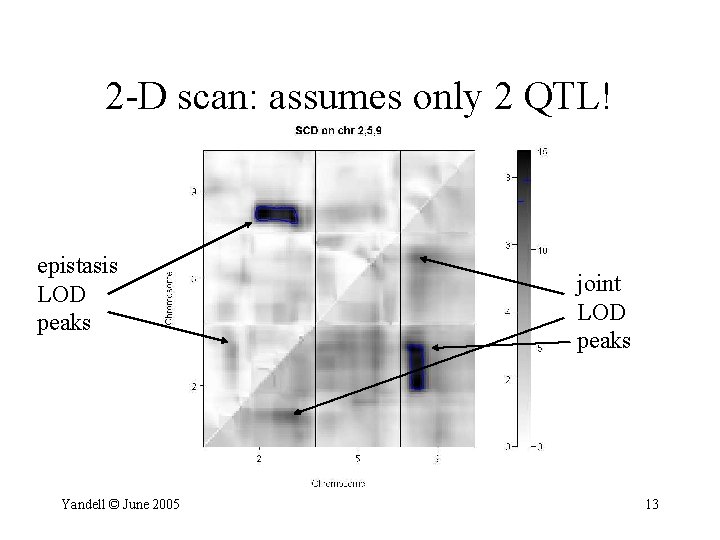
2 -D scan: assumes only 2 QTL! epistasis LOD peaks Yandell © June 2005 joint LOD peaks 13
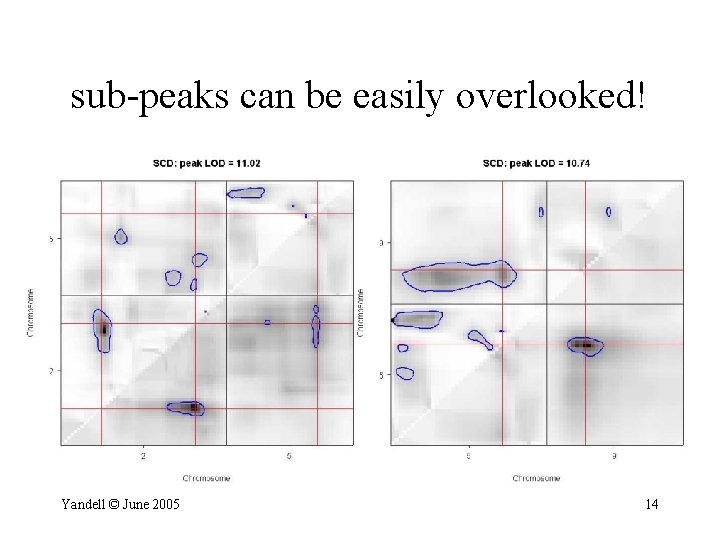
sub-peaks can be easily overlooked! Yandell © June 2005 14

epistatic model fit Yandell © June 2005 15
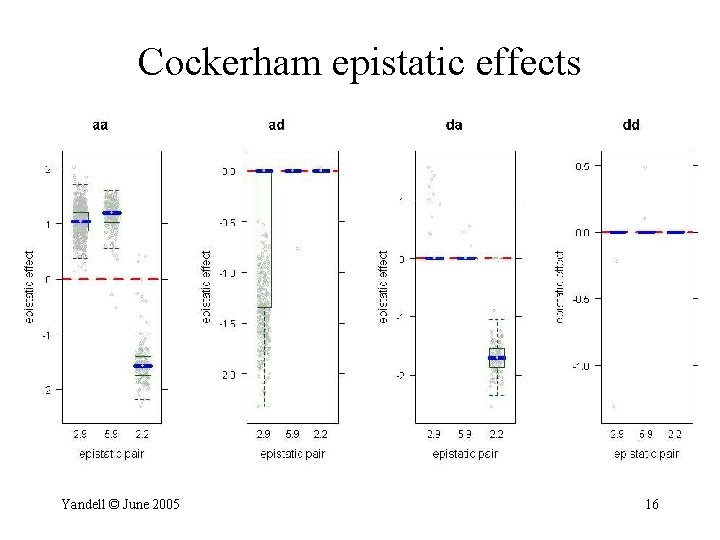
Cockerham epistatic effects Yandell © June 2005 16
our Bayesian QTL software • R: www. r-project. org – freely available statistical computing application R – library(bim) builds on Broman’s library(qtl) • QTLCart: statgen. ncsu. edu/qtlcart – Bmapqtl incorporated into QTLCart (S Wang 2003) • www. stat. wisc. edu/~yandell/qtl/software/bmqtl • R/bim – initially designed by JM Satagopan (1996) – major revision and extension by PJ Gaffney (2001) • whole genome, multivariate and long range updates • speed improvements, pre-burnin – built as official R library (H Wu, Yandell, Gaffney, CF Jin 2003) • R/bmqtl – – collaboration with N Yi, H Wu, GA Churchill initial working module: Winter 2005 improved module and official release: Summer/Fall 2005 major NIH grant (PI: Yi) Yandell © June 2005 17
Yandell © June 2005 18
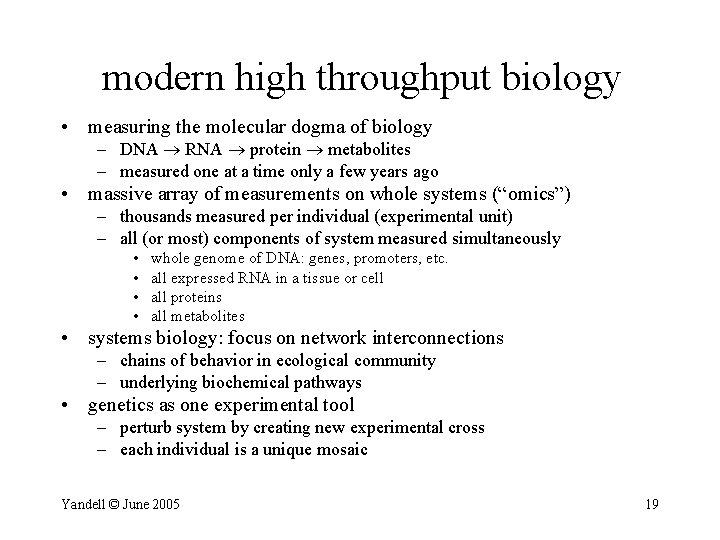
modern high throughput biology • measuring the molecular dogma of biology – DNA RNA protein metabolites – measured one at a time only a few years ago • massive array of measurements on whole systems (“omics”) – thousands measured per individual (experimental unit) – all (or most) components of system measured simultaneously • • whole genome of DNA: genes, promoters, etc. all expressed RNA in a tissue or cell all proteins all metabolites • systems biology: focus on network interconnections – chains of behavior in ecological community – underlying biochemical pathways • genetics as one experimental tool – perturb system by creating new experimental cross – each individual is a unique mosaic Yandell © June 2005 19
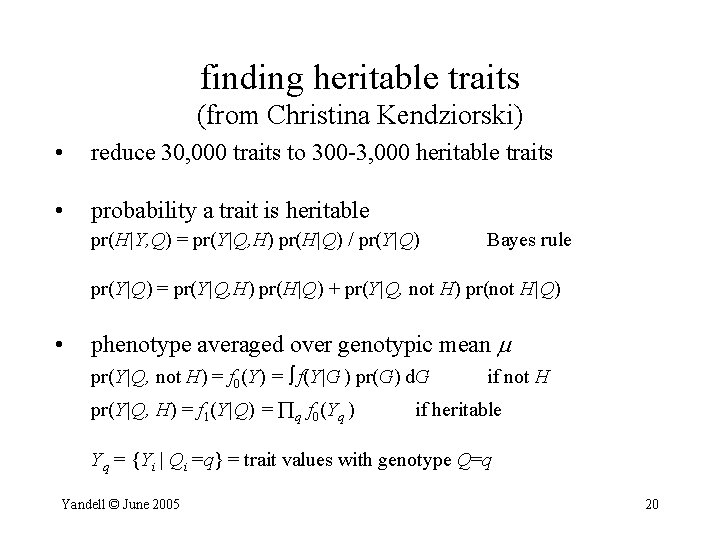
finding heritable traits (from Christina Kendziorski) • reduce 30, 000 traits to 300 -3, 000 heritable traits • probability a trait is heritable pr(H|Y, Q) = pr(Y|Q, H) pr(H|Q) / pr(Y|Q) Bayes rule pr(Y|Q) = pr(Y|Q, H) pr(H|Q) + pr(Y|Q, not H) pr(not H|Q) • phenotype averaged over genotypic mean pr(Y|Q, not H) = f 0(Y) = f(Y|G ) pr(G) d. G pr(Y|Q, H) = f 1(Y|Q) = q f 0(Yq ) if not H if heritable Yq = {Yi | Qi =q} = trait values with genotype Q=q Yandell © June 2005 20
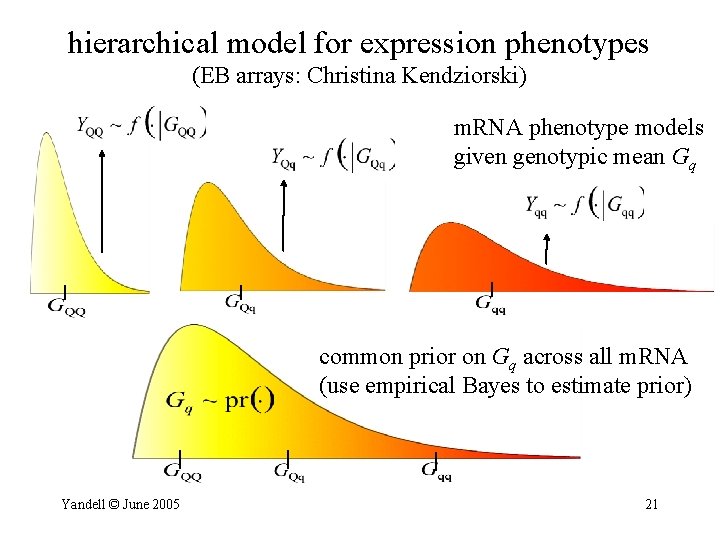
hierarchical model for expression phenotypes (EB arrays: Christina Kendziorski) m. RNA phenotype models given genotypic mean Gq common prior on Gq across all m. RNA (use empirical Bayes to estimate prior) Yandell © June 2005 21
why study multiple traits together? • avoid reductionist approach to biology – address physiological/biochemical mechanisms – Schmalhausen (1942); Falconer (1952) • separate close linkage from pleiotropy – 1 locus or 2 linked loci? • identify epistatic interaction or canalization – influence of genetic background • establish QTL x environment interactions • decompose genetic correlation among traits • increase power to detect QTL Yandell © June 2005 22
expression meta-traits: pleiotropy • reduce 3, 000 heritable traits to 3 meta-traits(!) • what are expression meta-traits? – pleiotropy: a few genes can affect many traits • transcription factors, regulators – weighted averages: Z = YW • principle components, discriminant analysis • infer genetic architecture of meta-traits – model selection issues are subtle • missing data, non-linear search • what is the best criterion for model selection? – time consuming process • heavy computation load for many traits • subjective judgement on what is best Yandell © June 2005 23
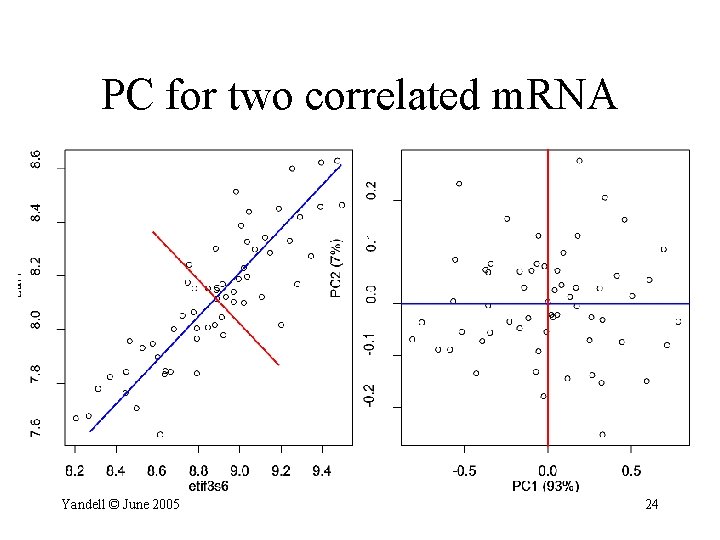
PC for two correlated m. RNA Yandell © June 2005 24
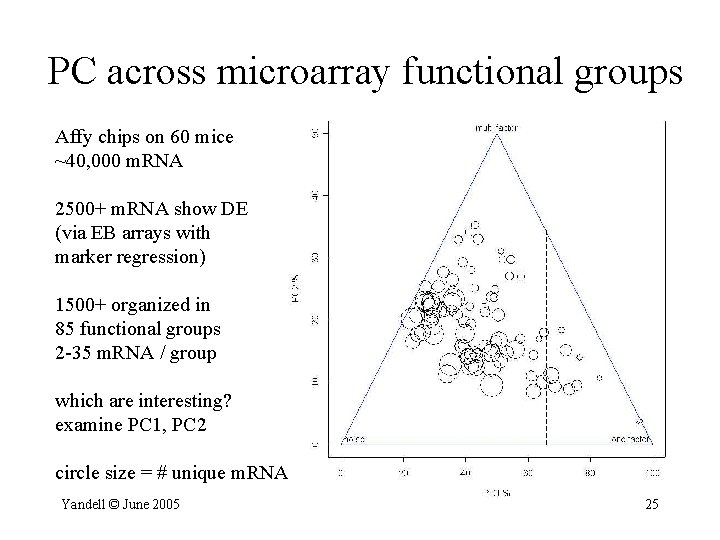
PC across microarray functional groups Affy chips on 60 mice ~40, 000 m. RNA 2500+ m. RNA show DE (via EB arrays with marker regression) 1500+ organized in 85 functional groups 2 -35 m. RNA / group which are interesting? examine PC 1, PC 2 circle size = # unique m. RNA Yandell © June 2005 25
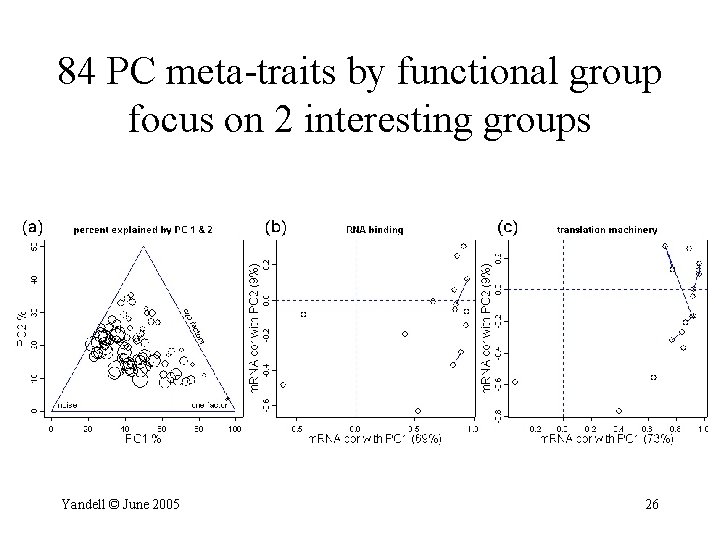
84 PC meta-traits by functional group focus on 2 interesting groups Yandell © June 2005 26
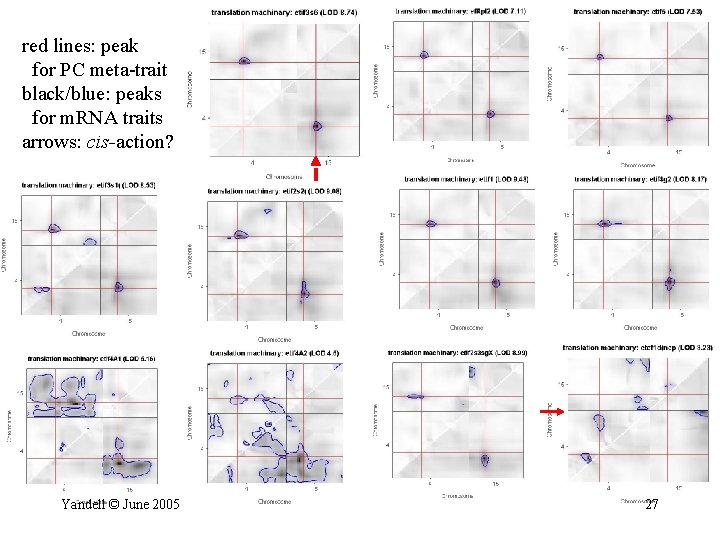
red lines: peak for PC meta-trait black/blue: peaks for m. RNA traits arrows: cis-action? Yandell © June 2005 27
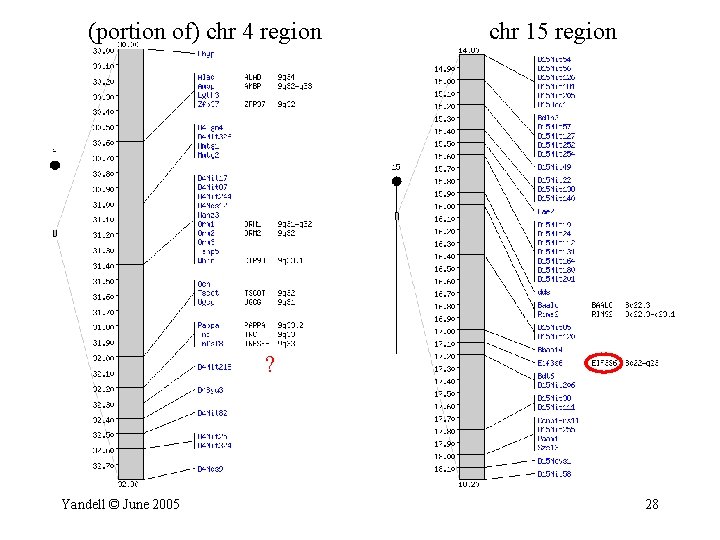
(portion of) chr 4 region chr 15 region ? Yandell © June 2005 28

DA meta-traits on 1500+ m. RNA traits genotypes from Chr 4/Chr 15 locus pair (circle= centroid) DA creates best separation by genotype Yandell © June 2005 29
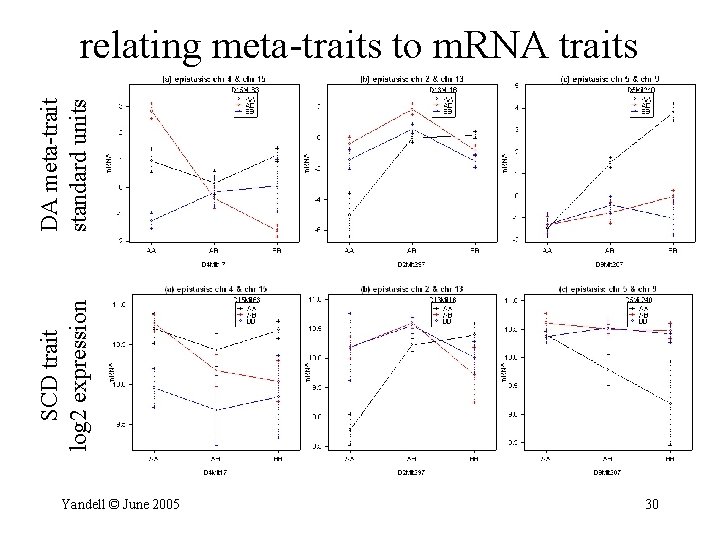
SCD trait log 2 expression DA meta-trait standard units relating meta-traits to m. RNA traits Yandell © June 2005 30
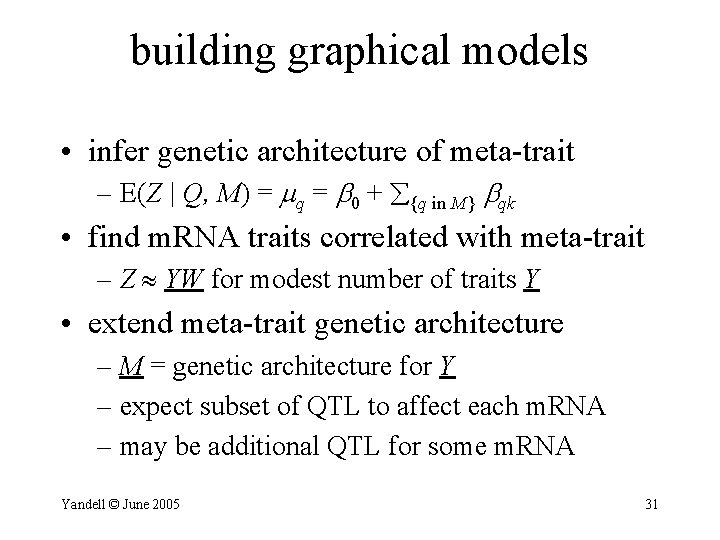
building graphical models • infer genetic architecture of meta-trait – E(Z | Q, M) = q = 0 + {q in M} qk • find m. RNA traits correlated with meta-trait – Z YW for modest number of traits Y • extend meta-trait genetic architecture – M = genetic architecture for Y – expect subset of QTL to affect each m. RNA – may be additional QTL for some m. RNA Yandell © June 2005 31
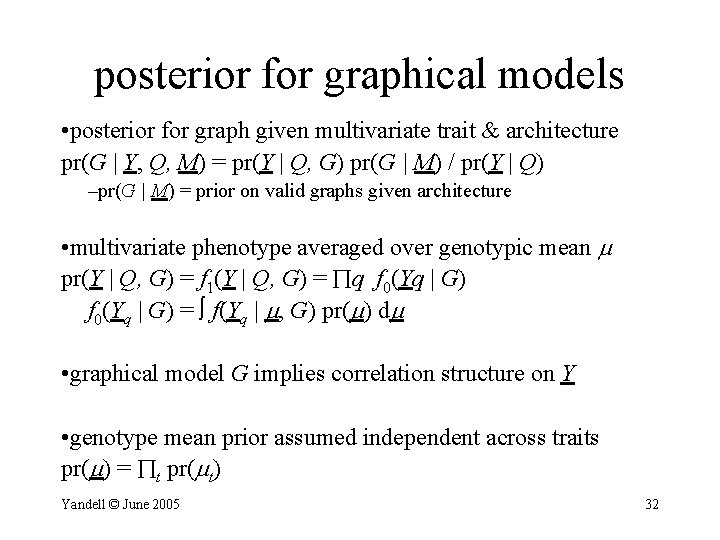
posterior for graphical models • posterior for graph given multivariate trait & architecture pr(G | Y, Q, M) = pr(Y | Q, G) pr(G | M) / pr(Y | Q) –pr(G | M) = prior on valid graphs given architecture • multivariate phenotype averaged over genotypic mean pr(Y | Q, G) = f 1(Y | Q, G) = q f 0(Yq | G) = f(Yq | , G) pr( ) d • graphical model G implies correlation structure on Y • genotype mean prior assumed independent across traits pr( ) = t pr( t) Yandell © June 2005 32
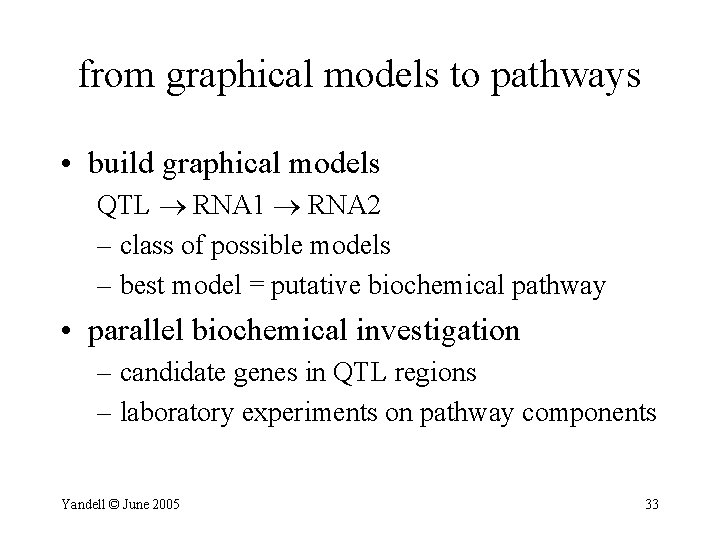
from graphical models to pathways • build graphical models QTL RNA 1 RNA 2 – class of possible models – best model = putative biochemical pathway • parallel biochemical investigation – candidate genes in QTL regions – laboratory experiments on pathway components Yandell © June 2005 33
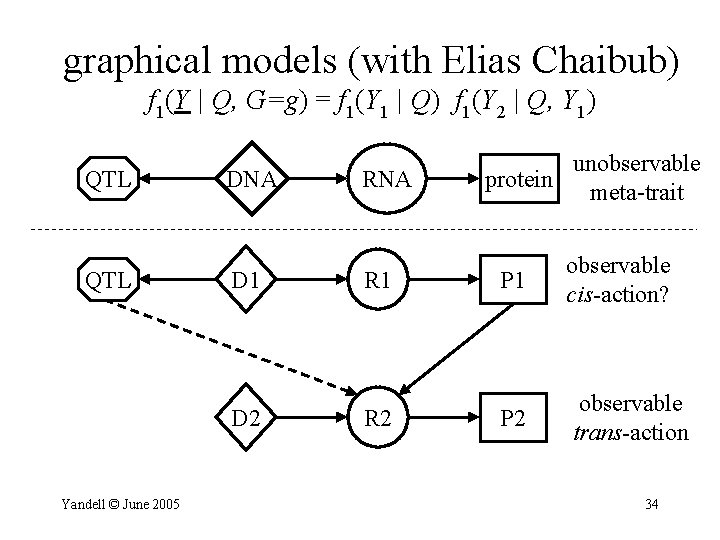
graphical models (with Elias Chaibub) f 1(Y | Q, G=g) = f 1(Y 1 | Q) f 1(Y 2 | Q, Y 1) QTL DNA RNA QTL D 1 R 1 D 2 Yandell © June 2005 R 2 unobservable protein meta-trait P 1 observable cis-action? P 2 observable trans-action 34
summary • expression QTL are complicated – need to consider multiple interacting QTL • coherent approach for high-throughput traits – – identify heritable traits dimension reduction to meta-traits mapping genetic architecture extension via graphical models to networks • many open questions – model selection – computation efficiency – inference on graphical models Yandell © June 2005 35
- Slides: 35