
Bayesian analysis a brief introduction Robert West University
Bayesian analysis: a brief introduction Robert West University College London @robertjwest Image from Wikipedia

Thomas Bayes (1701 – 1761) An English statistician, philosopher and Presbyterian minister who formulated Bayes' theorem. Bayes never published what would eventually become his most famous accomplishment; his notes were edited and published after his death by Richard Price. (Wikipedia)

Some key advantages of Bayesian analysis • It provides a rational way of revising beliefs with each new piece of data • It tests the experimental hypothesis directly, rather than the null hypothesis • It can be undertaken at any point in a data-gathering exercise without incurring a penalty for ‘data peeking’ and so makes much more efficient use of resources • It prevents the common mistake of confusing ‘lack of clear evidence for an effect’ with ‘no effect’

What is probability? Interpretation of probability Description Frequentist Long-run proportion Bayesian Justified strength of belief Example: Probability of rolling a 6 from a die roll The long-run proportion of times a 6 will occur A justified strength of belief that a 6 will occur on a given roll The Bayesian approach applies to all situations where there is uncertainty, not just ones where there is presumed to be an indefinite sequence of similar situations
Bayes-Price Rule A rule for updating strength of belief in a hypothesis (H 1), relative to another hypothesis (H 0), in the light of evidence Example H 1: Varenicline is more effective than nicotine transdermal patch at helping smokers to stop H 0: There is no difference between varenicline and nicotine transdermal patch Evidence: Findings from an RCT comparing the two types of treatment
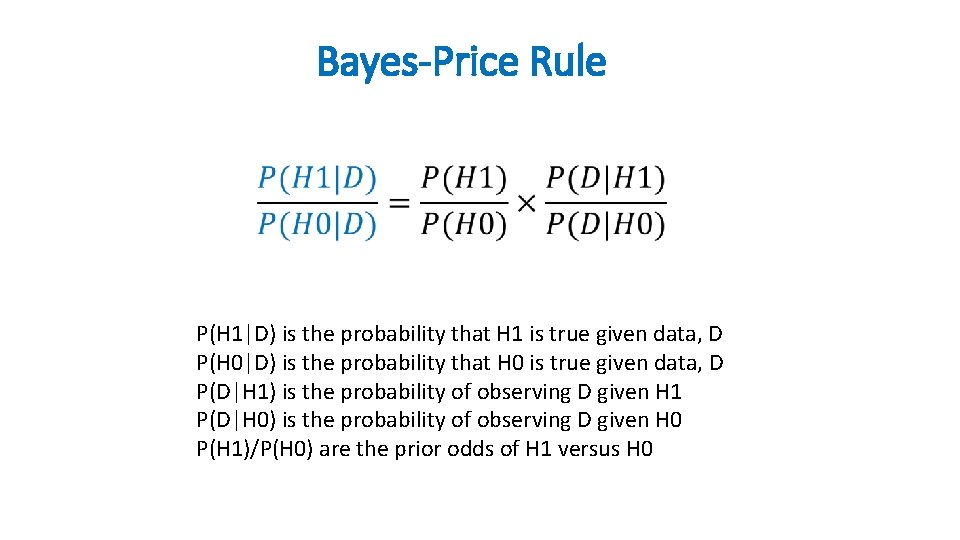
Bayes-Price Rule P(H 1|D) is the probability that H 1 is true given data, D P(H 0|D) is the probability that H 0 is true given data, D P(D|H 1) is the probability of observing D given H 1 P(D|H 0) is the probability of observing D given H 0 P(H 1)/P(H 0) are the prior odds of H 1 versus H 0

Bayes-Price Rule Posterior odds Prior odds Likelihood ratio Aka ‘Bayes Factor’
Mrs Jones • Mrs Jones is pregnant. She is in a ‘high-risk’ group for the fetus having ‘sick baby syndrome (SBS)’ with prevalence of 1 in 100 • There is a test for SBS which is 90% sensitive (picks up SBS 90% of the time if it present), and 90% specific (correctly indicates when SBS is not present 90% of the time) • Mrs Jones takes the test and it is positive (the ‘bad’ result) What is the probability that the baby has SBS?
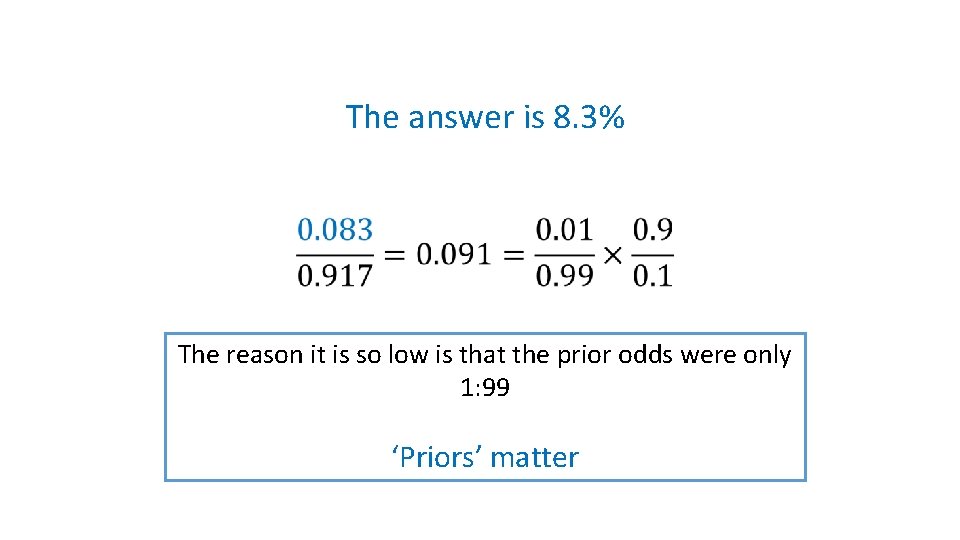
The answer is 8. 3% The reason it is so low is that the prior odds were only 1: 99 ‘Priors’ matter
Mrs Jones again • We now repeat the test using the probability of 0. 08 to create the new prior odds • The result is once again positive (the ‘bad’ one) What is the probability now that the baby has SBS?
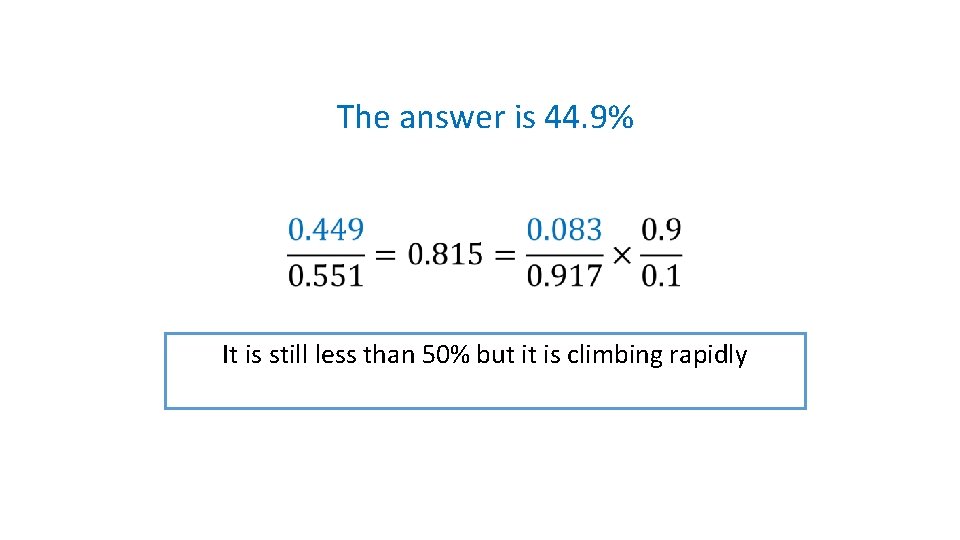
The answer is 44. 9% It is still less than 50% but it is climbing rapidly
Mrs Jones a third time • We now repeat the test using the probability of 0. 45 to create the new prior odds • The result is once again positive (the ‘bad’ one) What is the probability now that the baby has SBS?

The answer is 88% Now the probability is high, after 3 positive results ‘Priors’ can rapidly become less important as new data is accumulated
So what does a Bayesian analysis tell us? • As we collect more data it allows us to update our justified strength of belief in a hypothesis relative to another hypothesis • The more discriminating the data we collect, the greater its impact on our belief
Effect size estimation versus hypothesis testing • Bayesian analysis goes beyond working out Bayes Factors and Posterior Odds, to estimation of effect sizes with ‘credibility intervals’ • Effect size estimation with credibility intervals is the Bayesian equivalent to ‘confidence intervals’ in frequentist statistics • As data are gathered Bayesian analysis cumulatively adjusts the effect size and its probability distribution: this can be more useful in many circumstances than comparative hypothesis testing because it provides a direct estimation of what one is trying to assess: how big is the effect?

Some key advantages of Bayesian analysis • It provides a rational way of revising beliefs with each new piece of data • It tests the experimental hypothesis directly, rather than the null hypothesis • It can be undertaken at any point in a data-gathering exercise without incurring a penalty for ‘data peeking’ and so makes much more efficient use of resources • It prevents the common mistake of confusing ‘lack of clear evidence for an effect’ with ‘no effect’

What has Bayesian analysis been used for? • Decrypting cyphers • Calculating insurance premiums • Face recognition • Identifying email SPAM • Courtroom decisions • Locating lost valuables (e. g. an A-bomb dropped in the ocean)
Further reading A re-analysis of RCTs in Addiction: Beard E et al (2016) Using Bayes factors for testing hypotheses about intervention effectiveness in addictions research. Addiction, doi: 10. 1111/add. 13501. An example RCT: Brown J et al (2016) An Online Documentary Film to Motivate Quit Attempts Among Smokers in the General Population (4 Weeks 2 Freedom): A Randomized Controlled Trial. Nicotine Tob Res. 2016 May; 18(5): 1093 -100. doi: 10. 1093/ntr/ntv 161. Zoltan Dienes’ Bayes Calculator: http: //www. lifesci. sussex. ac. uk/home/Zoltan_Dienes/infere nce/Bayes. htm
- Slides: 18