
Bayes Rule Which is shorthand for 10 Mar
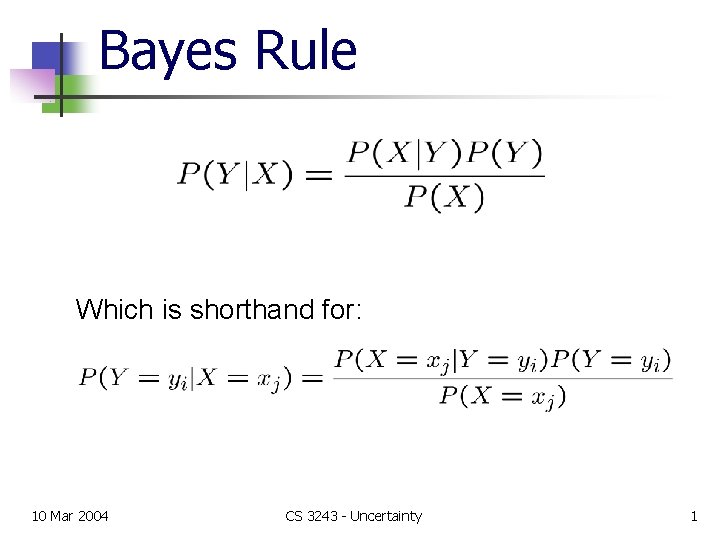
Bayes Rule Which is shorthand for: 10 Mar 2004 CS 3243 - Uncertainty 1

Bayes' Rule n Product rule P(a b) = P(a | b) P(b) = P(b | a) P(a) Bayes' rule: P(a | b) = P(b | a) P(a) / P(b) n or in distribution form P(Y|X) = P(X|Y) P(Y) / P(X) = αP(X|Y) P(Y) n Useful for assessing diagnostic probability from causal probability: n P(Cause|Effect) = P(Effect|Cause) P(Cause) / P(Effect) 10 Mar 2004 n CS 3243 - Uncertainty E. g. , let M be meningitis, S be stiff neck: 2
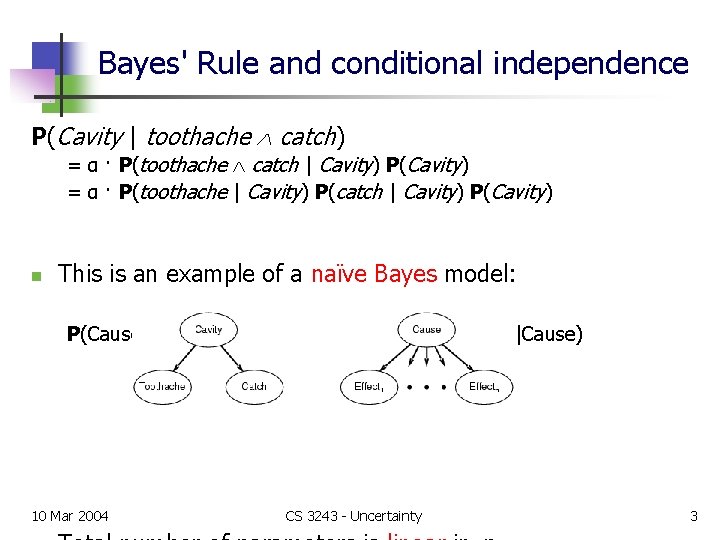
Bayes' Rule and conditional independence P(Cavity | toothache catch) = α · P(toothache catch | Cavity) P(Cavity) = α · P(toothache | Cavity) P(catch | Cavity) P(Cavity) n This is an example of a naïve Bayes model: P(Cause, Effect 1, … , Effectn) = P(Cause) πi. P(Effecti|Cause) 10 Mar 2004 CS 3243 - Uncertainty 3
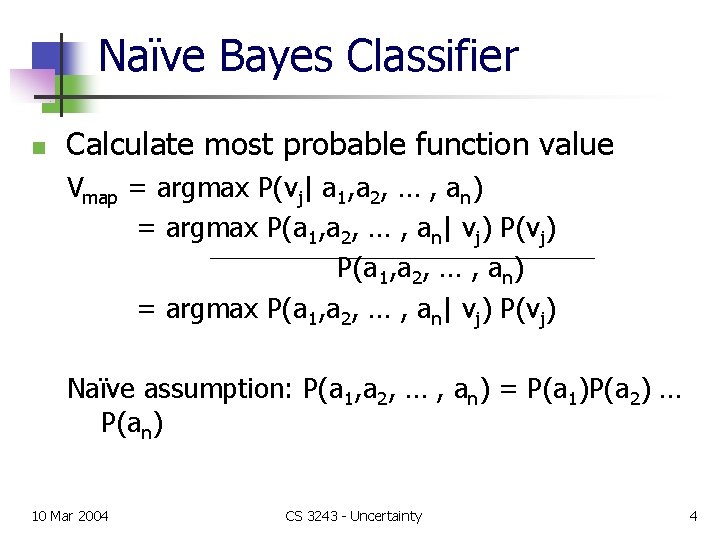
Naïve Bayes Classifier n Calculate most probable function value Vmap = argmax P(vj| a 1, a 2, … , an) = argmax P(a 1, a 2, … , an| vj) P(a 1, a 2, … , an) = argmax P(a 1, a 2, … , an| vj) P(vj) Naïve assumption: P(a 1, a 2, … , an) = P(a 1)P(a 2) … P(an) 10 Mar 2004 CS 3243 - Uncertainty 4
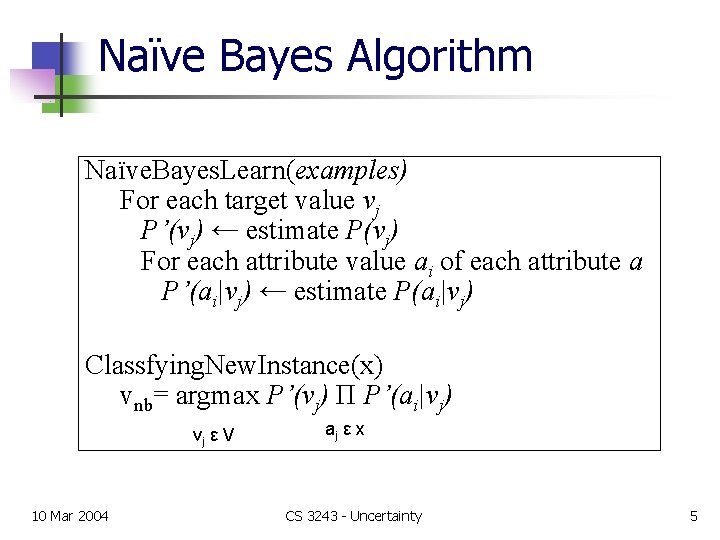
Naïve Bayes Algorithm Naïve. Bayes. Learn(examples) For each target value vj P’(vj) ← estimate P(vj) For each attribute value ai of each attribute a P’(ai|vj) ← estimate P(ai|vj) Classfying. New. Instance(x) vnb= argmax P’(vj) Π P’(ai|vj) vj ε V 10 Mar 2004 aj ε x CS 3243 - Uncertainty 5

An Example (due to MIT’s open coursework slides) f 1 f 2 f 3 f 4 y 0 1 1 0 1 0 0 1 1 0 0 1 1 0 1 0 10 Mar 2004 R 1(1, 1) = 1/5: fraction of all positive examples that have feature 1 = 1 R 1(0, 1) = 4/5: fraction of all positive examples that have feature 1 = 0 R 1(1, 0) = 5/5: fraction of all negative examples that have feature 1 = 1 R 1(0, 0) = 0/5: fraction of all negative examples that have feature 1 = 0 Continue calculation of R 2(1, 0) … CS 3243 - Uncertainty 6

An Example (due to MIT’s open coursework slides) f 1 f 2 f 3 f 4 y (1, 1) (0, 1) (1, 0) (0, 0) 0 1 1 0 1 0 0 1 1 1 0 0 1 R 1 = 1/5, 4/5, 5/5, 0/5 R 2 = 1/5, 4/5, 2/5, 3/5 R 3 = 4/5, 1/5, 4/5 R 4 = 2/5, 3/5, 4/5, 1/5 1 0 0 1 0 New x = <0, 0, 1, 1> 1 1 0 1 0 0 1 1 0 S(1) = R 1(0, 1)*R 2(0, 1)*R 3(1, 1)*R 4(1, 1) =. 205 S(0) = R 1(0, 0)*R 2(0, 0)*R 3(1, 0)*R 4(1, 0) = 0 S(1) > S(0), so predict v = 1. 1 0 10 Mar 2004 CS 3243 - Uncertainty 7
- Slides: 7