
Bayes Nets These slides were created by Dan
Bayes’ Nets [These slides were created by Dan Klein and Pieter Abbeel for CS 188 Intro to AI at UC Berkeley. All CS 188 materials are available at http: //ai. berkeley. edu. ]
Probabilistic Models § Models describe how (a portion of) the world works § Models are always simplifications § May not account for every variable § May not account for all interactions between variables § “All models are wrong; but some are useful. ” – George E. P. Box § What do we do with probabilistic models? § We (or our agents) need to reason about unknown variables, given evidence § Example: explanation (diagnostic reasoning) § Example: prediction (causal reasoning) § Example: value of information 2
Independence 3
Independence § Two variables are independent if: § This says that their joint distribution factors into a product two simpler distributions § Another form: § We write: § Independence is a simplifying modeling assumption § Empirical joint distributions: at best “close” to independent § What could we assume for {Weather, Traffic, Cavity, Toothache}? 4
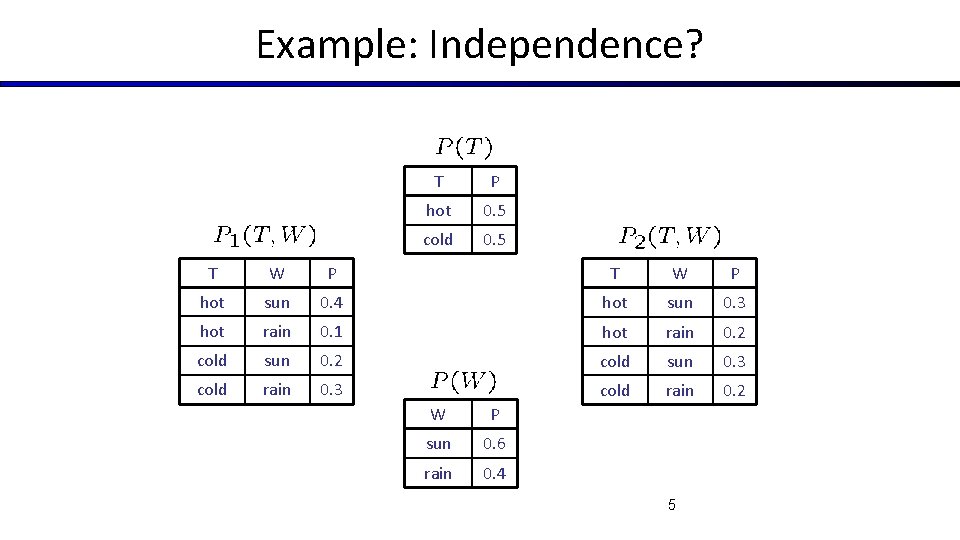
Example: Independence? T P hot 0. 5 cold 0. 5 T W P hot sun 0. 4 hot sun 0. 3 hot rain 0. 1 hot rain 0. 2 cold sun 0. 3 cold rain 0. 2 W P sun 0. 6 rain 0. 4 5
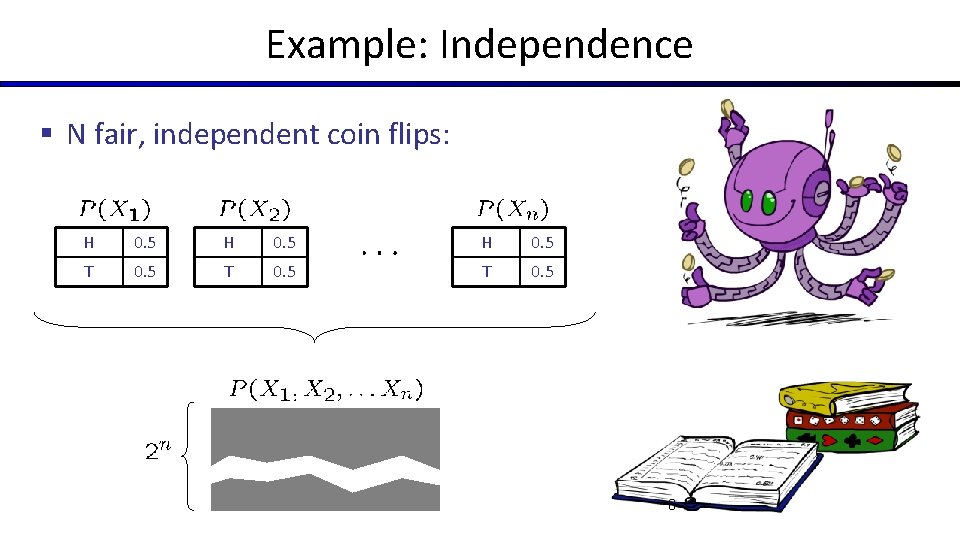
Example: Independence § N fair, independent coin flips: H 0. 5 T 0. 5 6
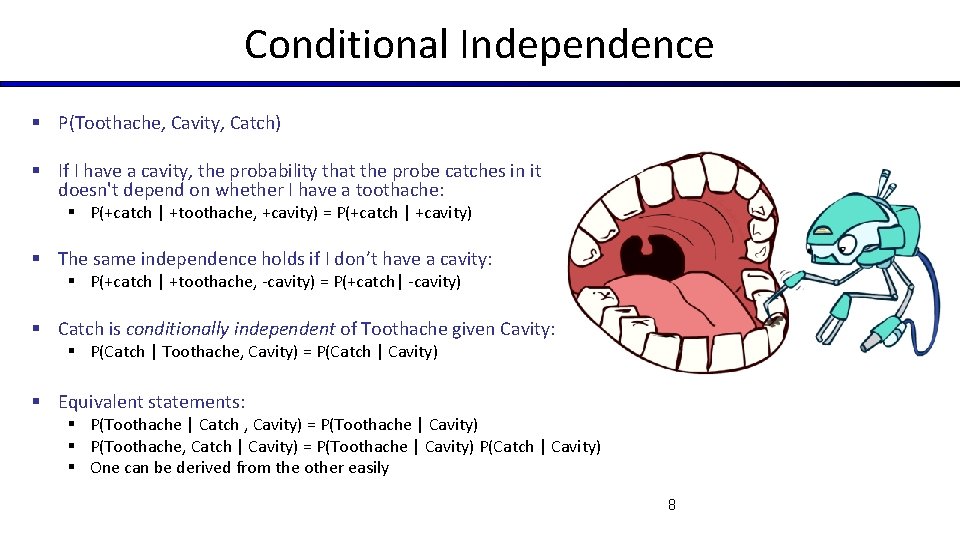
Conditional Independence § P(Toothache, Cavity, Catch) § If I have a cavity, the probability that the probe catches in it doesn't depend on whether I have a toothache: § P(+catch | +toothache, +cavity) = P(+catch | +cavity) § The same independence holds if I don’t have a cavity: § P(+catch | +toothache, -cavity) = P(+catch| -cavity) § Catch is conditionally independent of Toothache given Cavity: § P(Catch | Toothache, Cavity) = P(Catch | Cavity) § Equivalent statements: § P(Toothache | Catch , Cavity) = P(Toothache | Cavity) § P(Toothache, Catch | Cavity) = P(Toothache | Cavity) P(Catch | Cavity) § One can be derived from the other easily 8
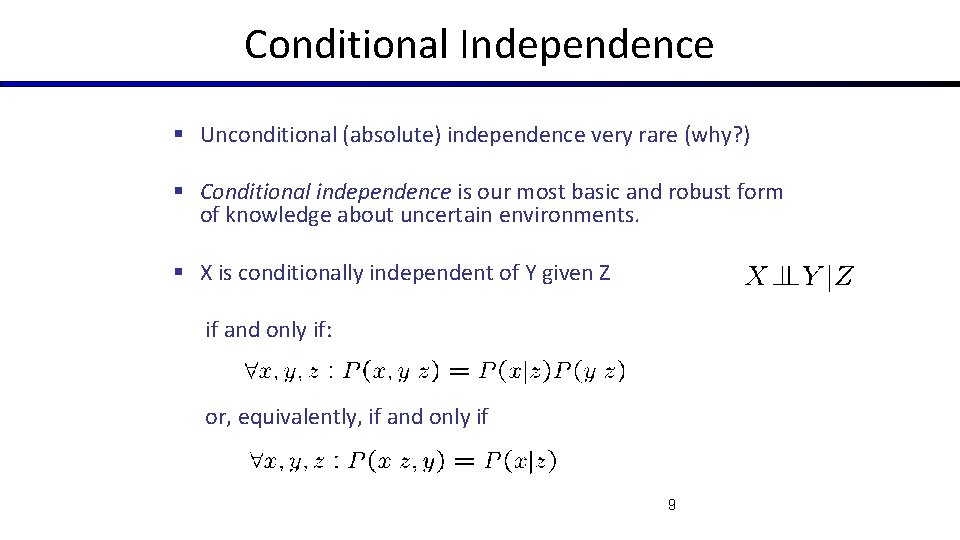
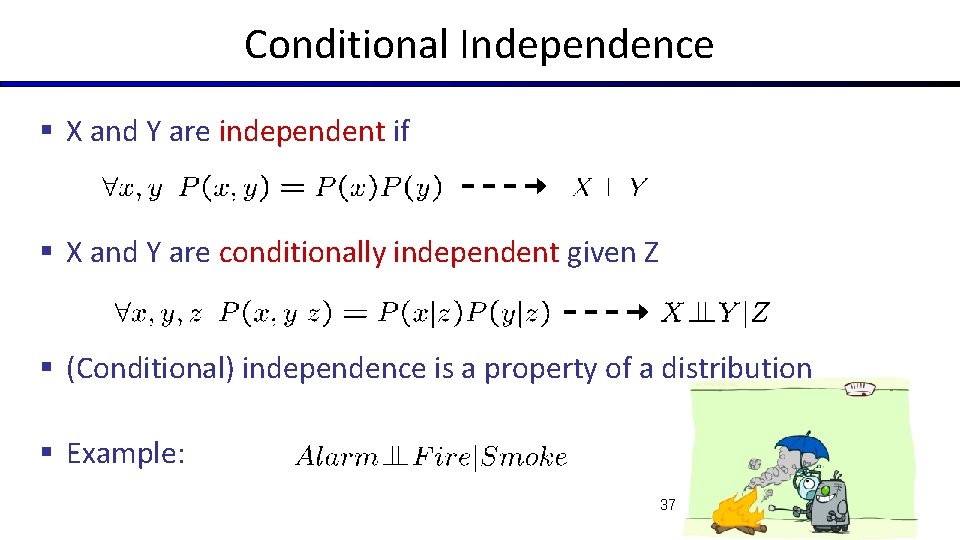
Conditional Independence § Unconditional (absolute) independence very rare (why? ) § Conditional independence is our most basic and robust form of knowledge about uncertain environments. § X is conditionally independent of Y given Z if and only if: or, equivalently, if and only if 9
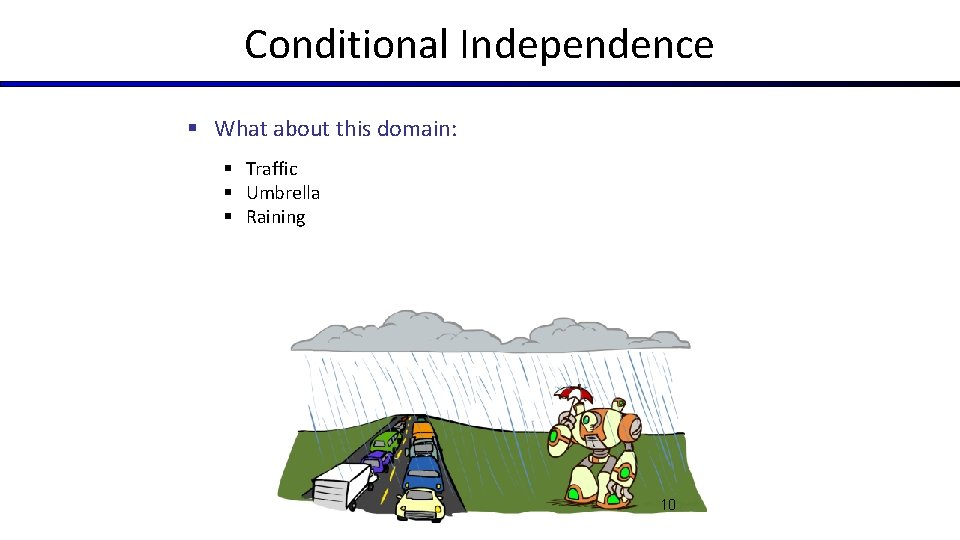
Conditional Independence § What about this domain: § Traffic § Umbrella § Raining 10
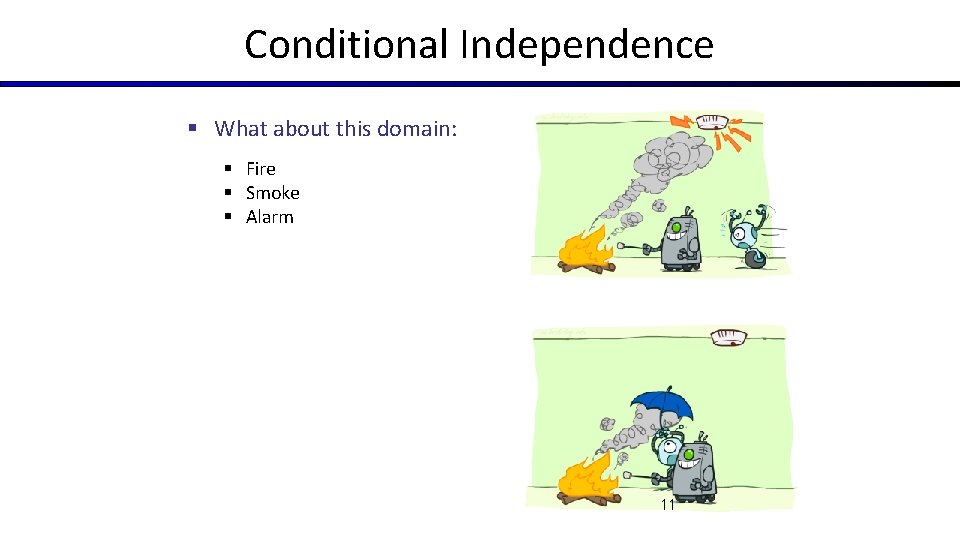
Conditional Independence § What about this domain: § Fire § Smoke § Alarm 11

Conditional Independence and the Chain Rule § Chain rule: § Trivial decomposition: § With assumption of conditional independence: § Bayes’nets / graphical models help us express conditional independence assumptions 12
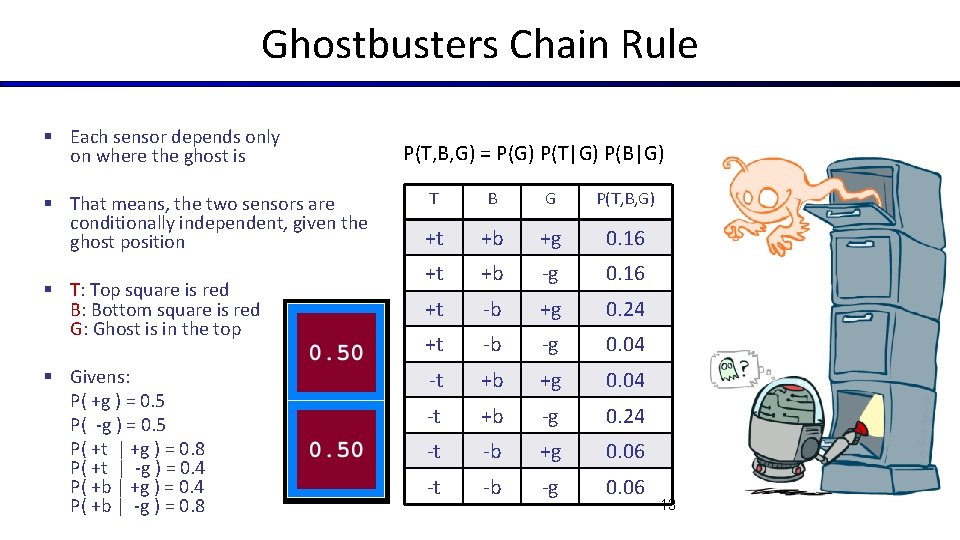
Ghostbusters Chain Rule § Each sensor depends only on where the ghost is § That means, the two sensors are conditionally independent, given the ghost position § T: Top square is red B: Bottom square is red G: Ghost is in the top § Givens: P( +g ) = 0. 5 P( -g ) = 0. 5 P( +t | +g ) = 0. 8 P( +t | -g ) = 0. 4 P( +b | +g ) = 0. 4 P( +b | -g ) = 0. 8 P(T, B, G) = P(G) P(T|G) P(B|G) T B G P(T, B, G) +t +b +g 0. 16 +t +b -g 0. 16 +t -b +g 0. 24 +t -b -g 0. 04 -t +b +g 0. 04 -t +b -g 0. 24 -t -b +g 0. 06 -t -b -g 0. 06 13
Bayes’Nets: Big Picture 14
Bayes’ Nets: Big Picture § Two problems with using full joint distribution tables as our probabilistic models: § Unless there are only a few variables, the joint is WAY too big to represent explicitly § Hard to learn (estimate) anything empirically about more than a few variables at a time § Bayes’ nets: a technique for describing complex joint distributions (models) using simple, local distributions (conditional probabilities) § More properly called graphical models § We describe how variables locally interact § Local interactions chain together to give global, indirect interactions § For about 10 min, we’ll be vague about how these interactions are specified 15
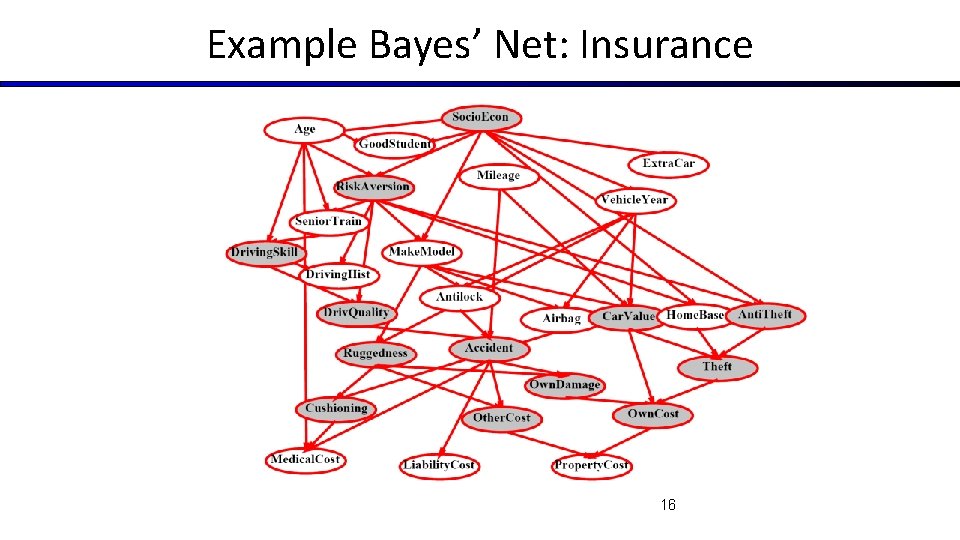
Example Bayes’ Net: Insurance 16

Example Bayes’ Net: Car 17
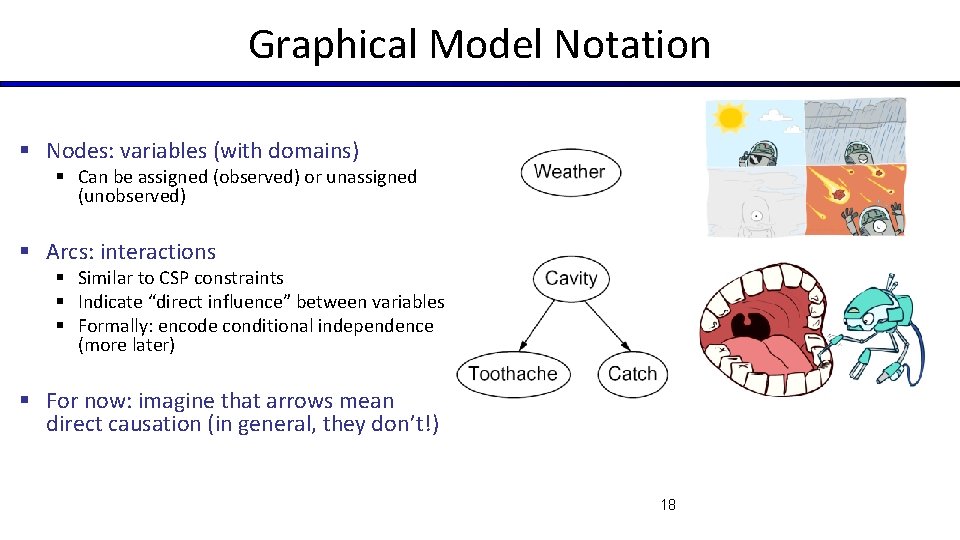
Graphical Model Notation § Nodes: variables (with domains) § Can be assigned (observed) or unassigned (unobserved) § Arcs: interactions § Similar to CSP constraints § Indicate “direct influence” between variables § Formally: encode conditional independence (more later) § For now: imagine that arrows mean direct causation (in general, they don’t!) 18
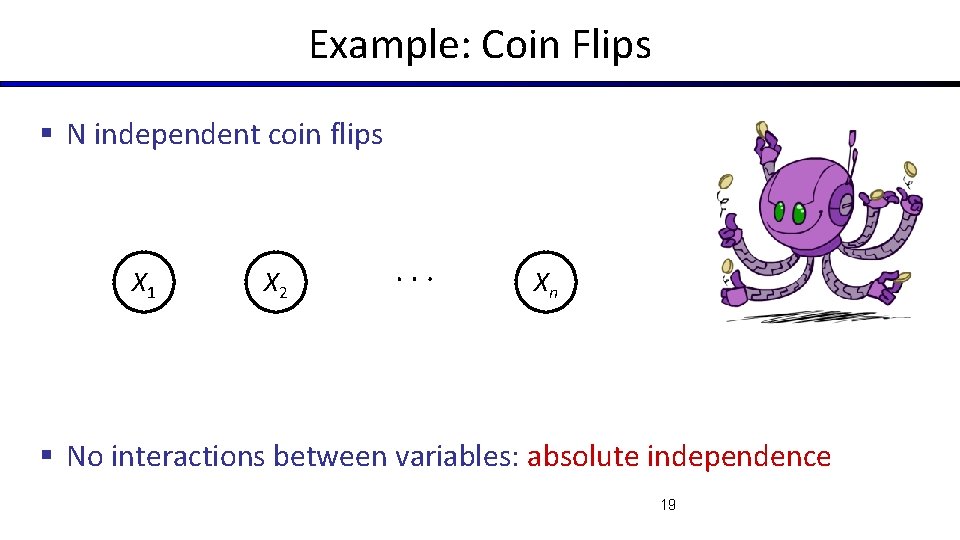
Example: Coin Flips § N independent coin flips X 1 X 2 Xn § No interactions between variables: absolute independence 19
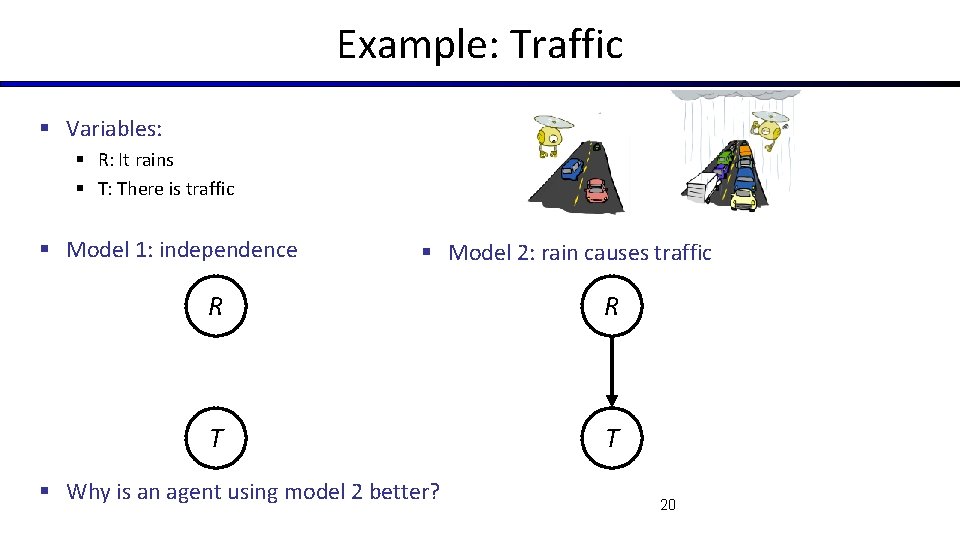
Example: Traffic § Variables: § R: It rains § T: There is traffic § Model 1: independence § Model 2: rain causes traffic R R T T § Why is an agent using model 2 better? 20
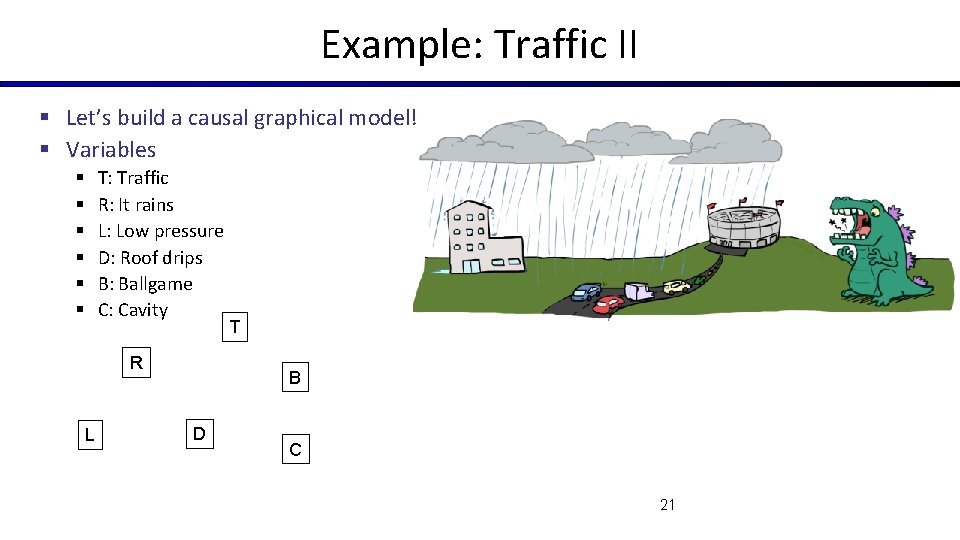
Example: Traffic II § Let’s build a causal graphical model! § Variables T: Traffic R: It rains L: Low pressure D: Roof drips B: Ballgame C: Cavity § § § R L T B D C 21
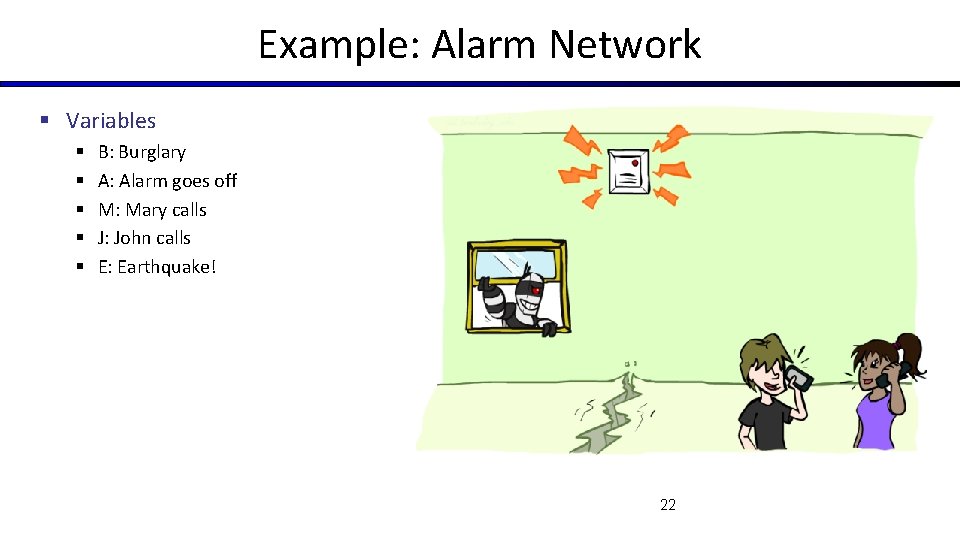
Example: Alarm Network § Variables § § § B: Burglary A: Alarm goes off M: Mary calls J: John calls E: Earthquake! 22
Bayes’ Net Semantics 23

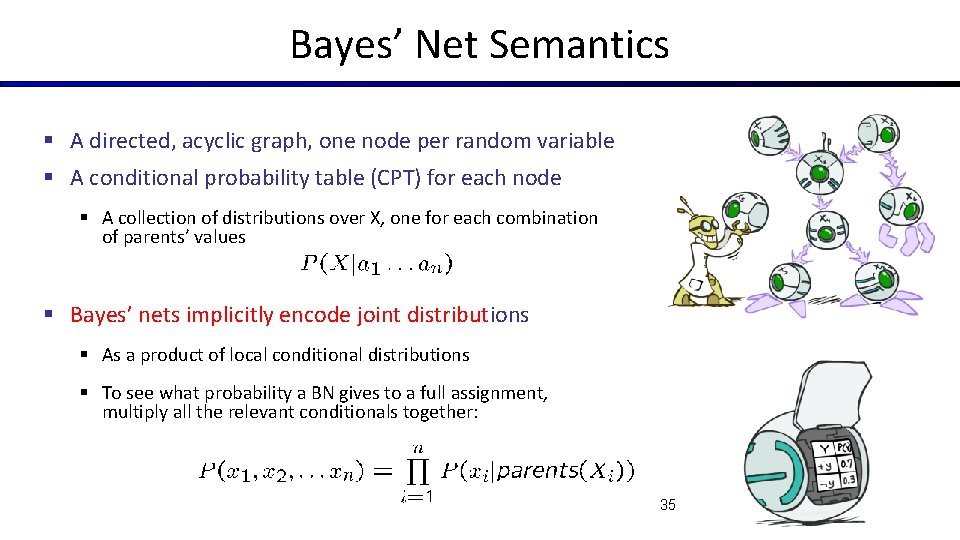
Bayes’ Net Semantics § A set of nodes, one per variable X § A directed, acyclic graph A 1 An § A conditional distribution for each node § A collection of distributions over X, one for each combination of parents’ values X § CPT: conditional probability table § Description of a noisy “causal” process A Bayes net = Topology (graph) + Local Conditional Probabilities 24

Probabilities in BNs § Bayes’ nets implicitly encode joint distributions § As a product of local conditional distributions § To see what probability a BN gives to a full assignment, multiply all the relevant conditionals together: § Example: 25
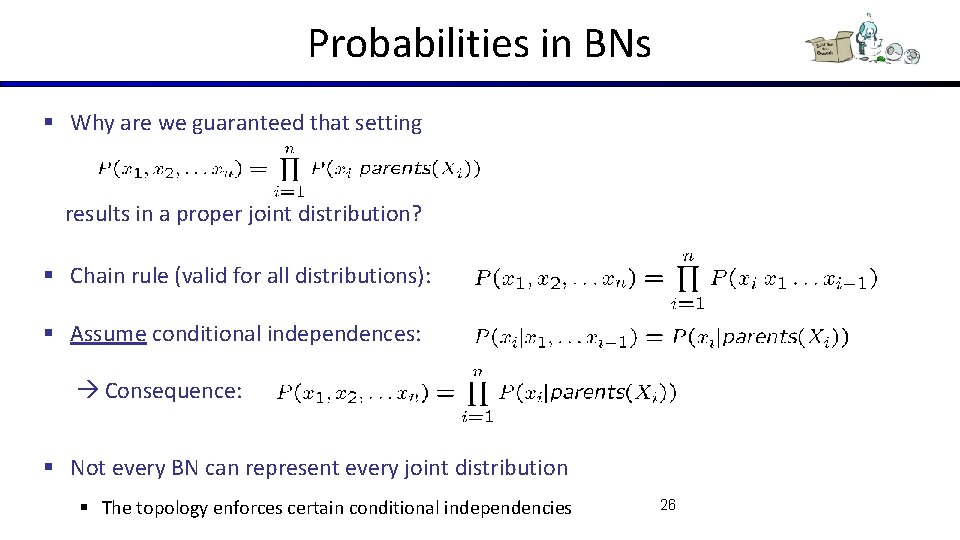
Probabilities in BNs § Why are we guaranteed that setting results in a proper joint distribution? § Chain rule (valid for all distributions): § Assume conditional independences: Consequence: § Not every BN can represent every joint distribution § The topology enforces certain conditional independencies 26
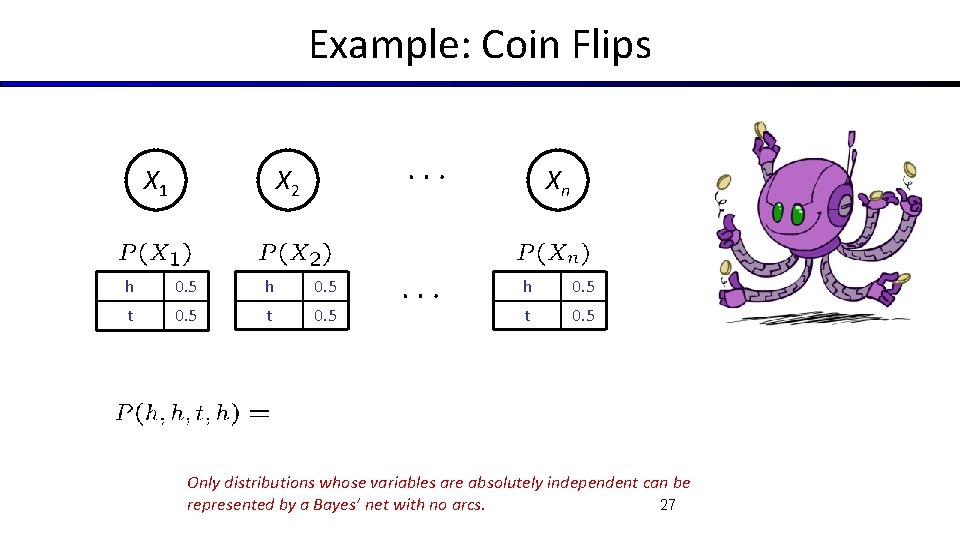
Example: Coin Flips X 1 X 2 Xn h 0. 5 t 0. 5 Only distributions whose variables are absolutely independent can be 27 represented by a Bayes’ net with no arcs.
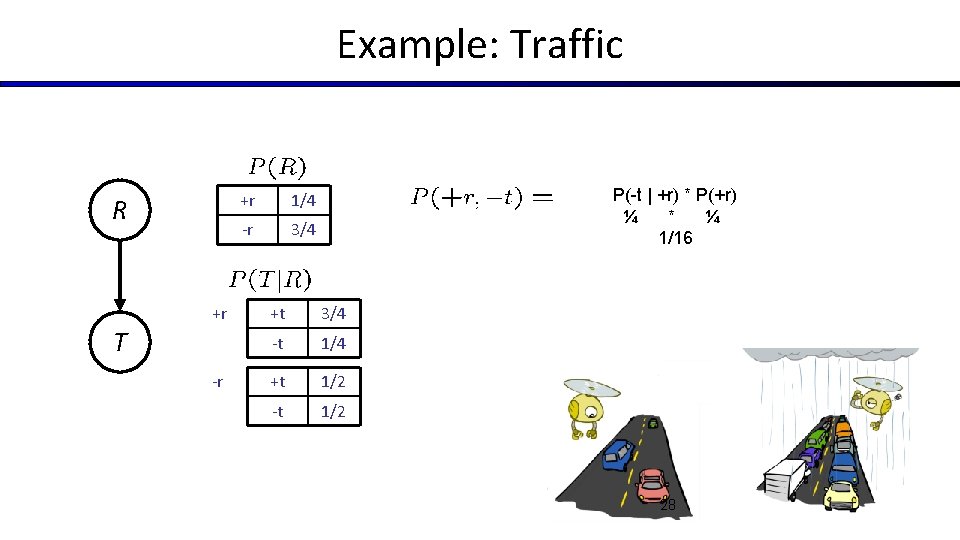
Example: Traffic R +r T -r +r 1/4 -r 3/4 P(-t | +r) * P(+r) ¼ * ¼ 1/16 +t 3/4 -t 1/4 +t 1/2 -t 1/2 28
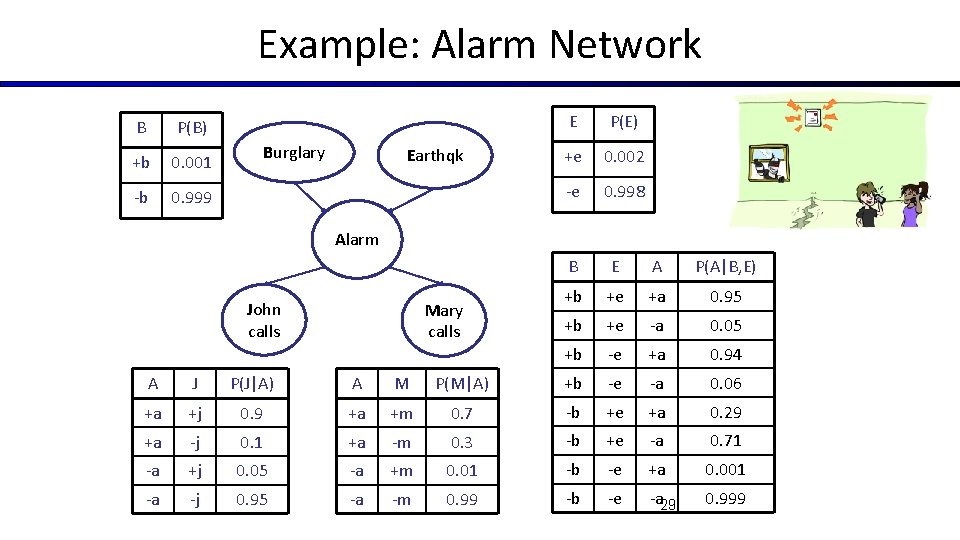
Example: Alarm Network B P(B) +b 0. 001 -b 0. 999 Burglary Earthqk E P(E) +e 0. 002 -e 0. 998 Alarm John calls Mary calls B E A P(A|B, E) +b +e +a 0. 95 +b +e -a 0. 05 +b -e +a 0. 94 A J P(J|A) A M P(M|A) +b -e -a 0. 06 +a +j 0. 9 +a +m 0. 7 -b +e +a 0. 29 +a -j 0. 1 +a -m 0. 3 -b +e -a 0. 71 -a +j 0. 05 -a +m 0. 01 -b -e +a 0. 001 -a -j 0. 95 -a -m 0. 99 -b -e -a 29 0. 999
Bayes’ Nets § So far: how a Bayes’ net encodes a joint distribution § Next: how to answer queries about that distribution 30
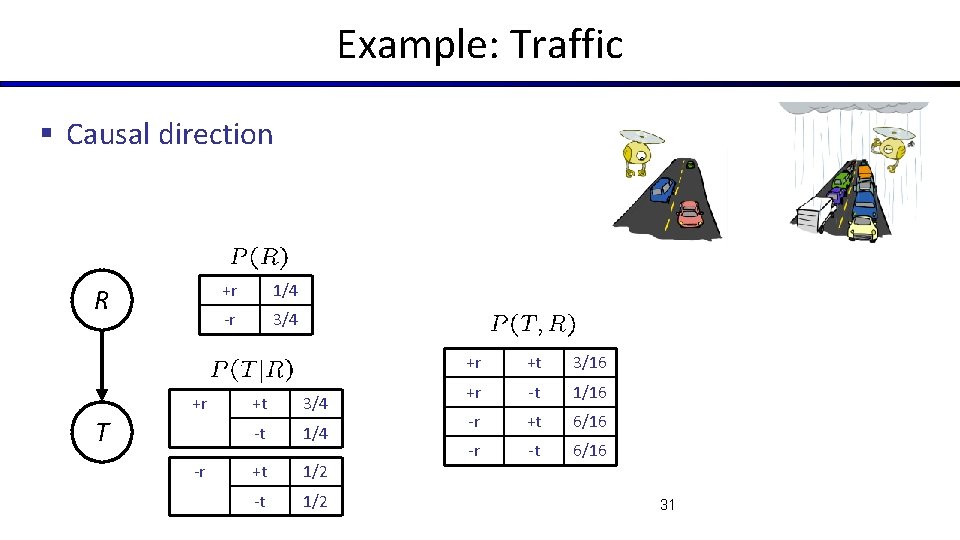
Example: Traffic § Causal direction R +r T -r +r 1/4 -r 3/4 +t 3/4 -t 1/4 +t 1/2 -t 1/2 +r +t 3/16 +r -t 1/16 -r +t 6/16 -r -t 6/16 31
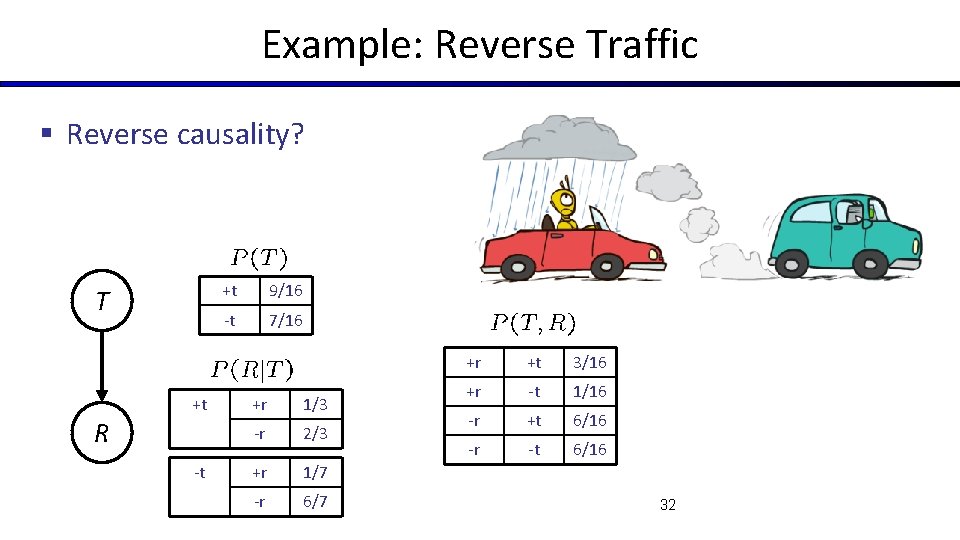
Example: Reverse Traffic § Reverse causality? T +t R -t +t 9/16 -t 7/16 +r 1/3 -r 2/3 +r 1/7 -r 6/7 +r +t 3/16 +r -t 1/16 -r +t 6/16 -r -t 6/16 32
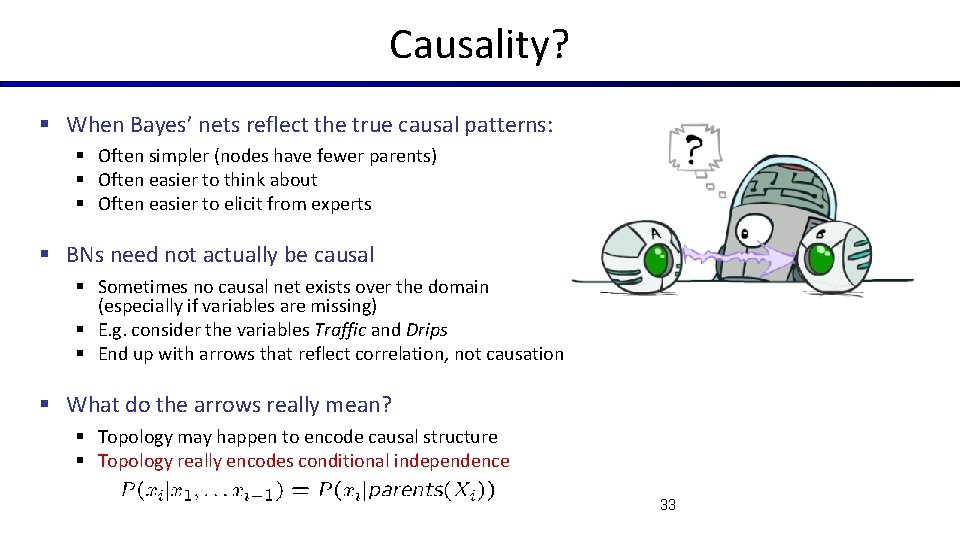
Causality? § When Bayes’ nets reflect the true causal patterns: § Often simpler (nodes have fewer parents) § Often easier to think about § Often easier to elicit from experts § BNs need not actually be causal § Sometimes no causal net exists over the domain (especially if variables are missing) § E. g. consider the variables Traffic and Drips § End up with arrows that reflect correlation, not causation § What do the arrows really mean? § Topology may happen to encode causal structure § Topology really encodes conditional independence 33
Bayes’ Nets: Independence [These slides were created by Dan Klein and Pieter Abbeel for CS 188 Intro to AI at UC Berkeley. All CS 188 materials are available at http: //ai. berkeley. edu. ]
Bayes’ Net Semantics § A directed, acyclic graph, one node per random variable § A conditional probability table (CPT) for each node § A collection of distributions over X, one for each combination of parents’ values § Bayes’ nets implicitly encode joint distributions § As a product of local conditional distributions § To see what probability a BN gives to a full assignment, multiply all the relevant conditionals together: 35

Size of a Bayes’ Net § How big is a joint distribution over N Boolean variables? 2 N § How big is an N-node net if nodes have up to k parents? O(N * 2 k+1) § Both give you the power to calculate § BNs: Huge space savings! § Also easier to elicit local CPTs § Also faster to answer queries (coming) 36
Conditional Independence § X and Y are independent if § X and Y are conditionally independent given Z § (Conditional) independence is a property of a distribution § Example: 37
Bayes Nets: Assumptions § Assumptions we are required to make to define the Bayes net when given the graph: § Beyond above “chain rule Bayes net” conditional independence assumptions § Often additional conditional independences § They can be read off the graph § Important for modeling: understand assumptions made when choosing a Bayes net graph 38
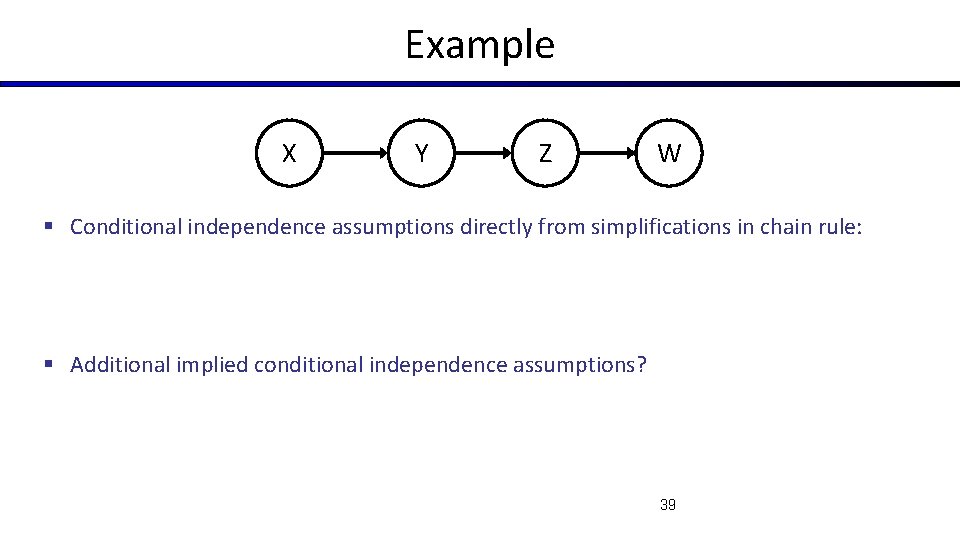
Example X Y Z W § Conditional independence assumptions directly from simplifications in chain rule: § Additional implied conditional independence assumptions? 39
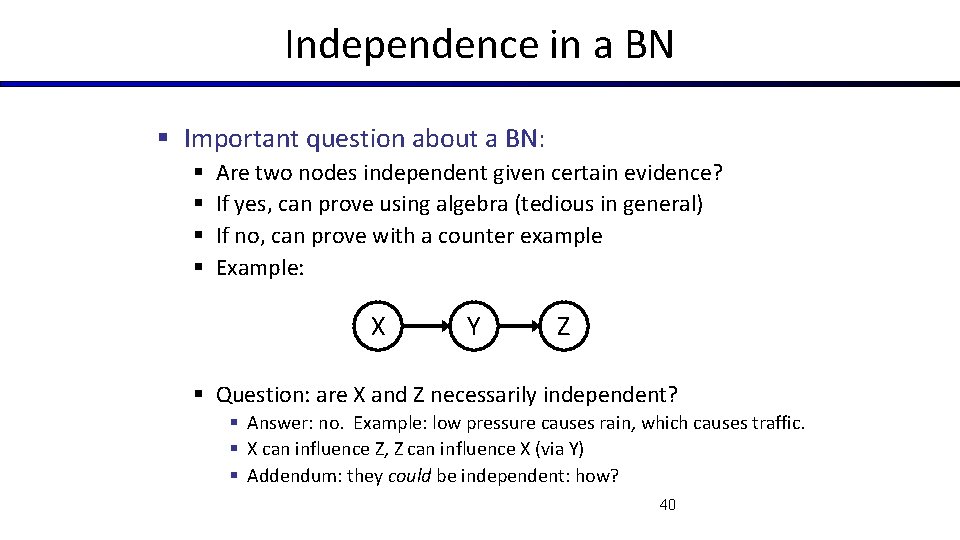
Independence in a BN § Important question about a BN: § § Are two nodes independent given certain evidence? If yes, can prove using algebra (tedious in general) If no, can prove with a counter example Example: X Y Z § Question: are X and Z necessarily independent? § Answer: no. Example: low pressure causes rain, which causes traffic. § X can influence Z, Z can influence X (via Y) § Addendum: they could be independent: how? 40
D-separation: Outline 41
D-separation: Outline § Study independence properties for triples § Analyze complex cases in terms of member triples § D-separation: a condition / algorithm for answering such queries 42
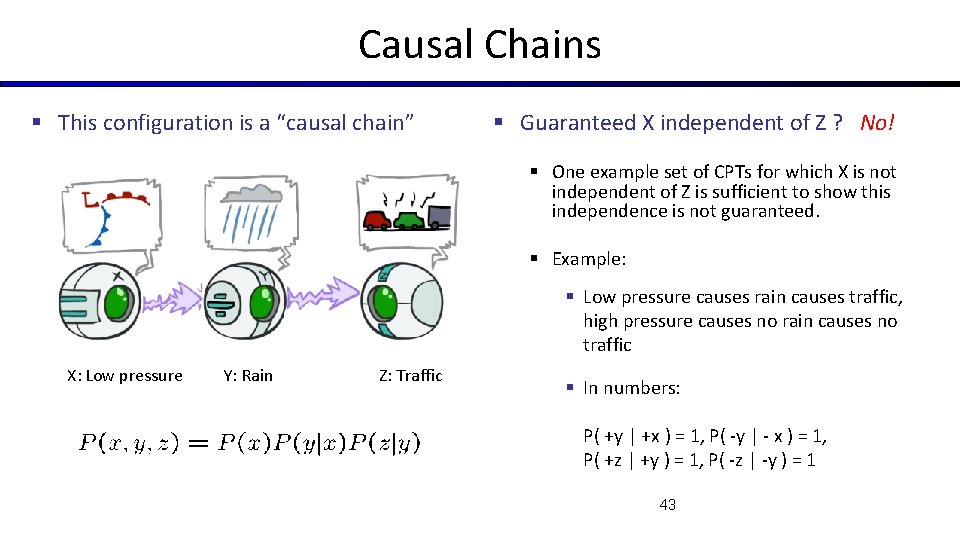
Causal Chains § This configuration is a “causal chain” § Guaranteed X independent of Z ? No! § One example set of CPTs for which X is not independent of Z is sufficient to show this independence is not guaranteed. § Example: § Low pressure causes rain causes traffic, high pressure causes no rain causes no traffic X: Low pressure Y: Rain Z: Traffic § In numbers: P( +y | +x ) = 1, P( -y | - x ) = 1, P( +z | +y ) = 1, P( -z | -y ) = 1 43
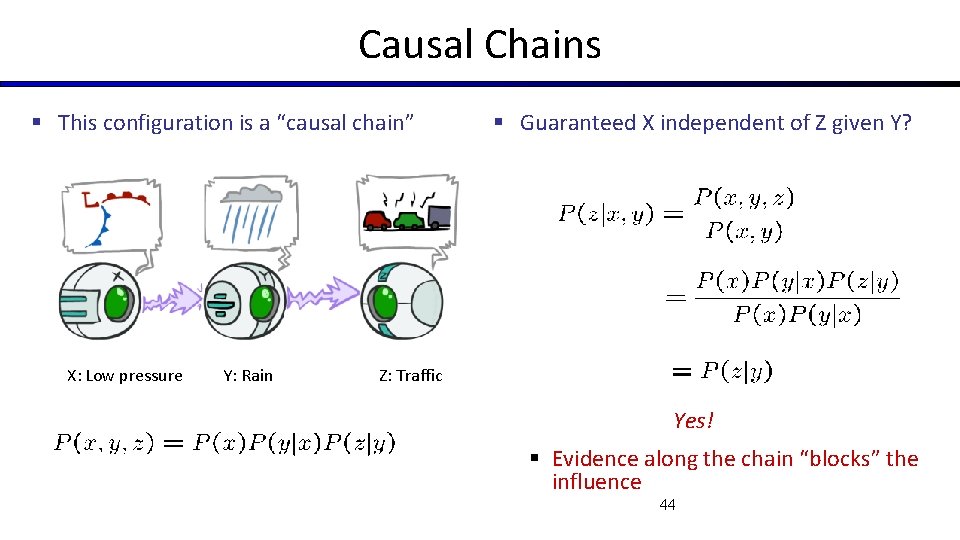
Causal Chains § This configuration is a “causal chain” X: Low pressure Y: Rain § Guaranteed X independent of Z given Y? Z: Traffic Yes! § Evidence along the chain “blocks” the influence 44
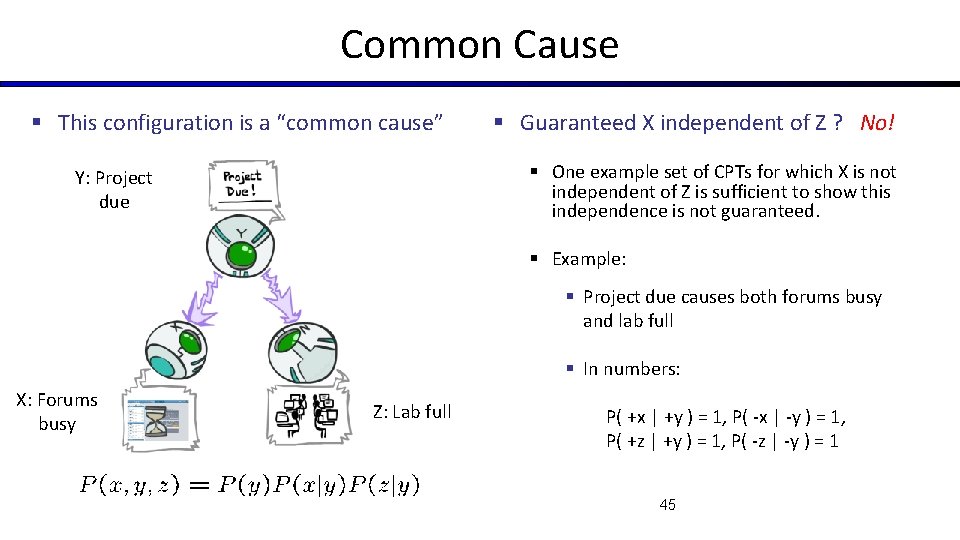
Common Cause § This configuration is a “common cause” § Guaranteed X independent of Z ? No! § One example set of CPTs for which X is not independent of Z is sufficient to show this independence is not guaranteed. Y: Project due § Example: § Project due causes both forums busy and lab full § In numbers: X: Forums busy Z: Lab full P( +x | +y ) = 1, P( -x | -y ) = 1, P( +z | +y ) = 1, P( -z | -y ) = 1 45
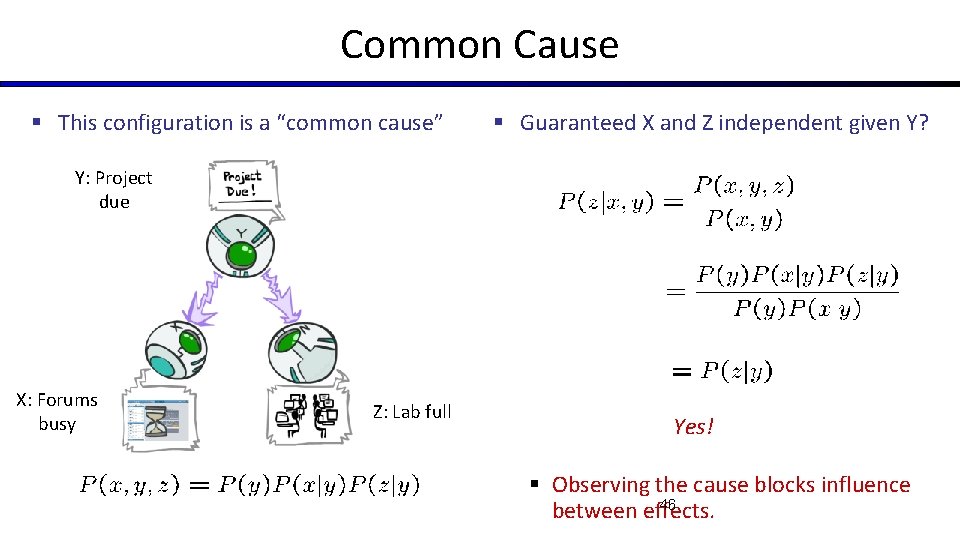
Common Cause § This configuration is a “common cause” § Guaranteed X and Z independent given Y? Y: Project due X: Forums busy Z: Lab full Yes! § Observing the cause blocks influence 46 between effects.
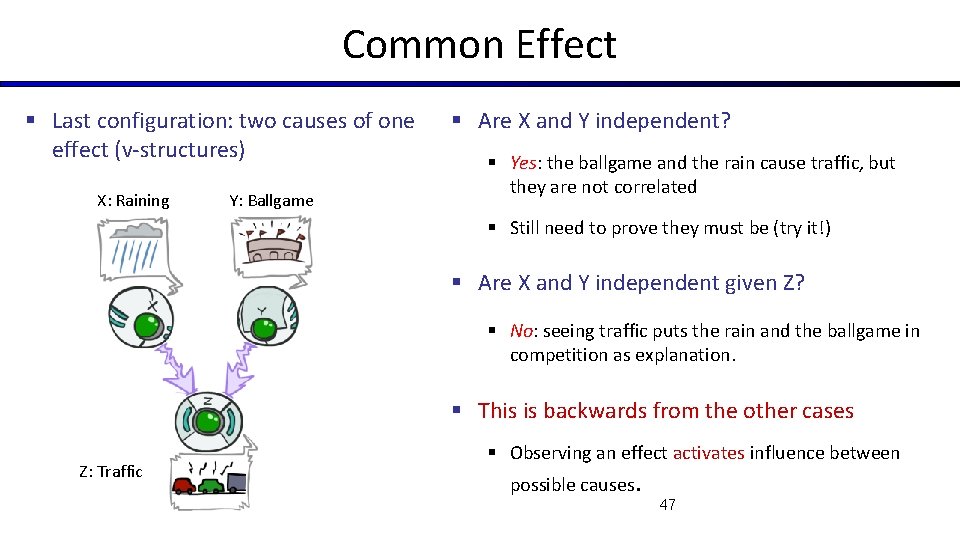
Common Effect § Last configuration: two causes of one effect (v-structures) X: Raining Y: Ballgame § Are X and Y independent? § Yes: the ballgame and the rain cause traffic, but they are not correlated § Still need to prove they must be (try it!) § Are X and Y independent given Z? § No: seeing traffic puts the rain and the ballgame in competition as explanation. § This is backwards from the other cases Z: Traffic § Observing an effect activates influence between possible causes. 47
The General Case 48
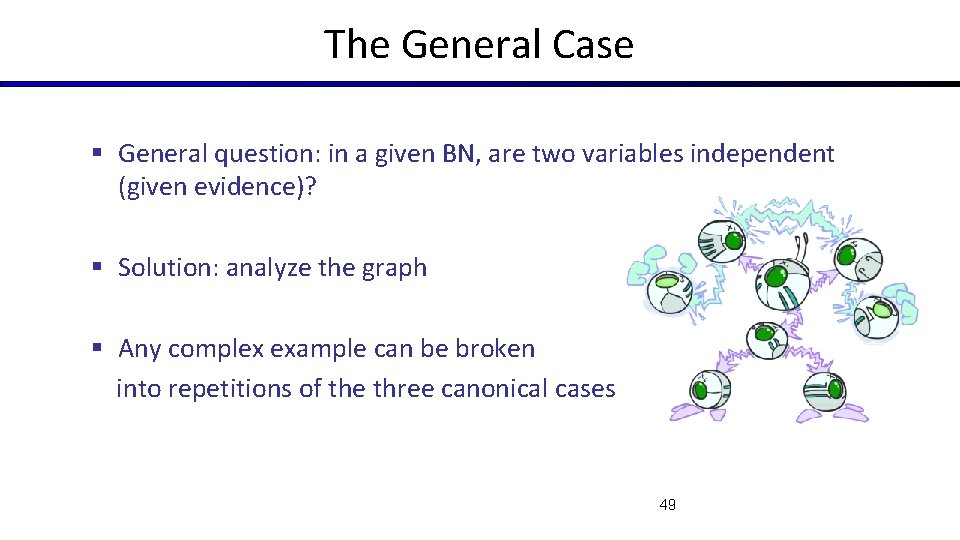
The General Case § General question: in a given BN, are two variables independent (given evidence)? § Solution: analyze the graph § Any complex example can be broken into repetitions of the three canonical cases 49
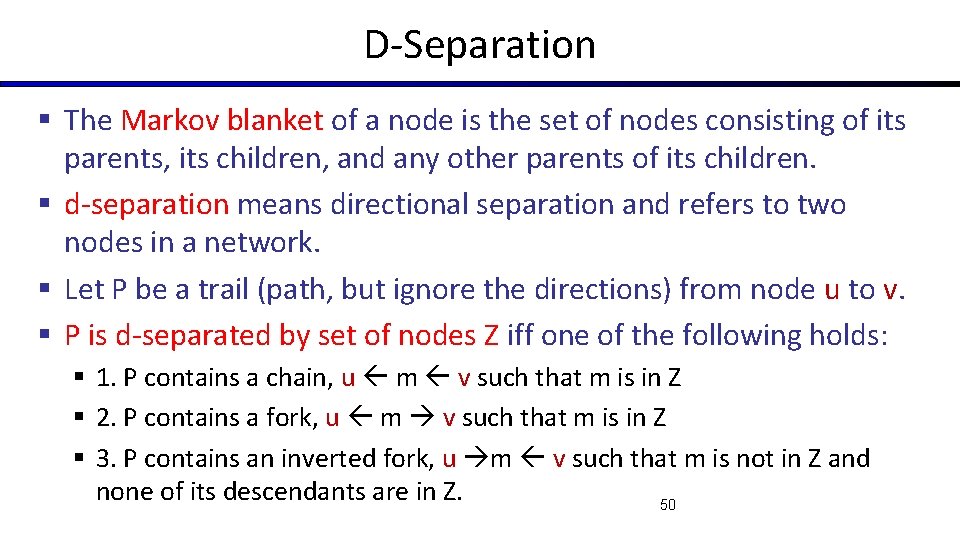
D-Separation § The Markov blanket of a node is the set of nodes consisting of its parents, its children, and any other parents of its children. § d-separation means directional separation and refers to two nodes in a network. § Let P be a trail (path, but ignore the directions) from node u to v. § P is d-separated by set of nodes Z iff one of the following holds: § 1. P contains a chain, u m v such that m is in Z § 2. P contains a fork, u m v such that m is in Z § 3. P contains an inverted fork, u m v such that m is not in Z and none of its descendants are in Z. 50
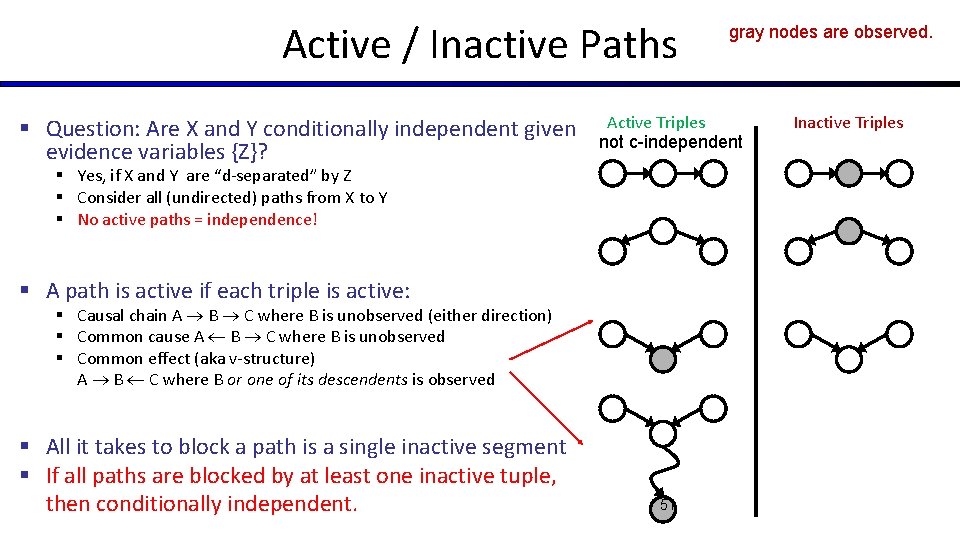
Active / Inactive Paths § Question: Are X and Y conditionally independent given evidence variables {Z}? Active Triples not c-independent § Yes, if X and Y are “d-separated” by Z § Consider all (undirected) paths from X to Y § No active paths = independence! § A path is active if each triple is active: § Causal chain A B C where B is unobserved (either direction) § Common cause A B C where B is unobserved § Common effect (aka v-structure) A B C where B or one of its descendents is observed § All it takes to block a path is a single inactive segment § If all paths are blocked by at least one inactive tuple, then conditionally independent. gray nodes are observed. 51 Inactive Triples
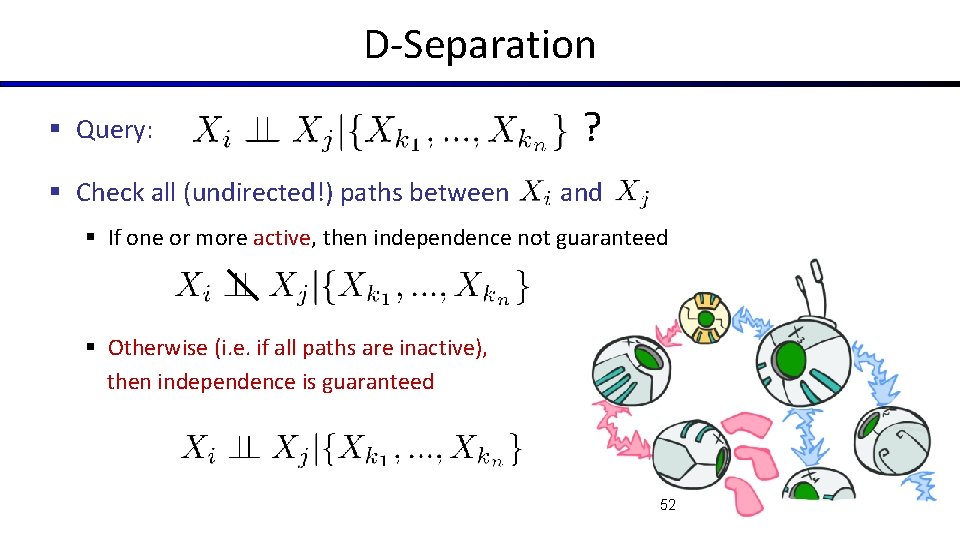
D-Separation § Query: § Check all (undirected!) paths between ? and § If one or more active, then independence not guaranteed § Otherwise (i. e. if all paths are inactive), then independence is guaranteed 52
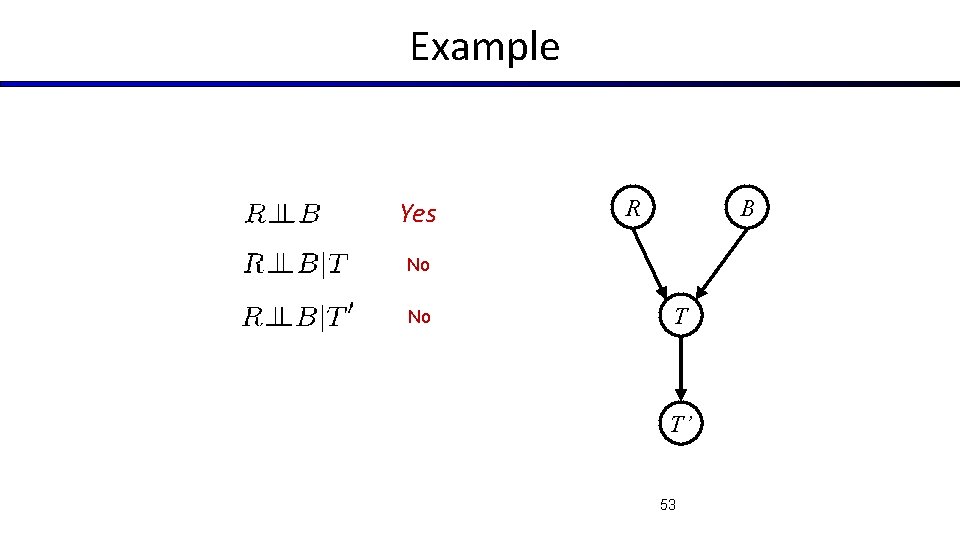
Example Yes R B No No T T’ 53
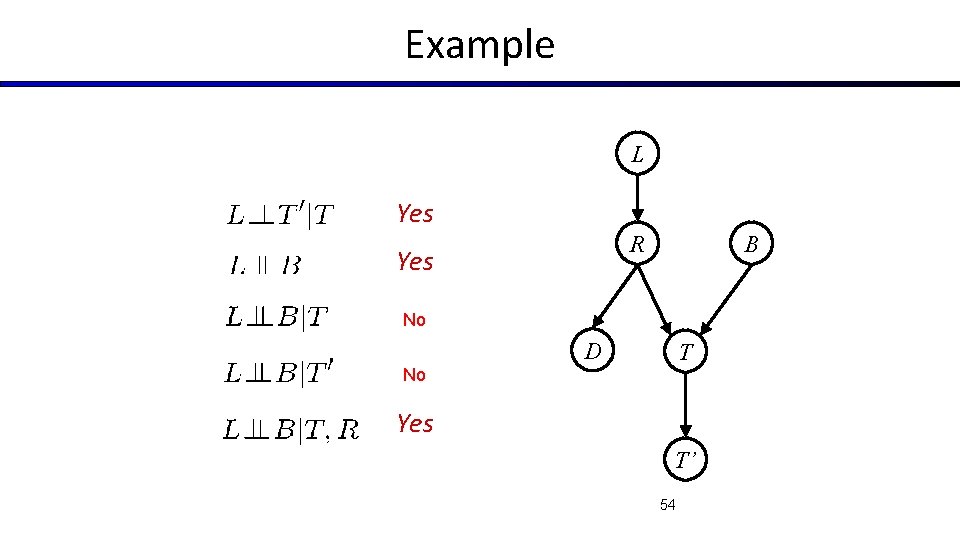
Example L Yes R Yes B No D T No Yes T’ 54
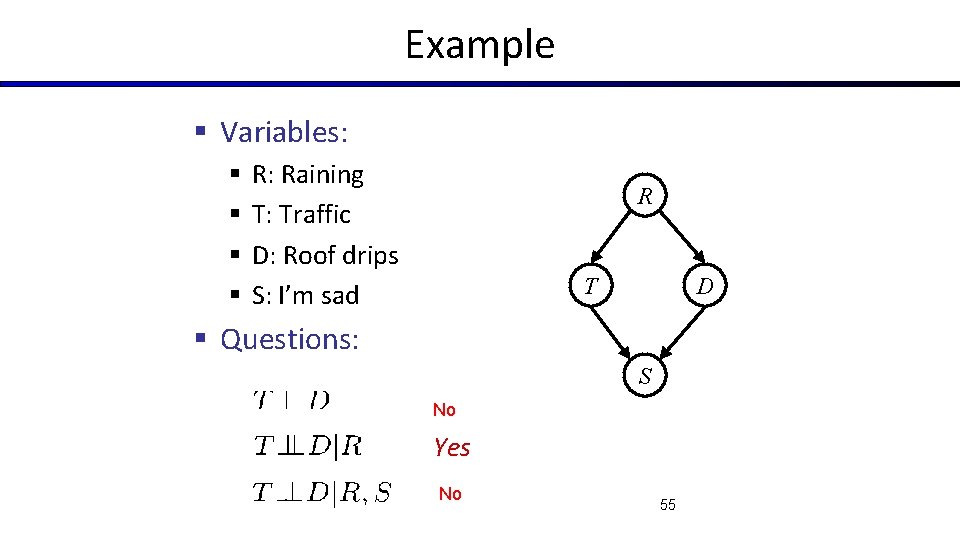
Example § Variables: § § R: Raining T: Traffic D: Roof drips S: I’m sad R T D § Questions: S No Yes No 55
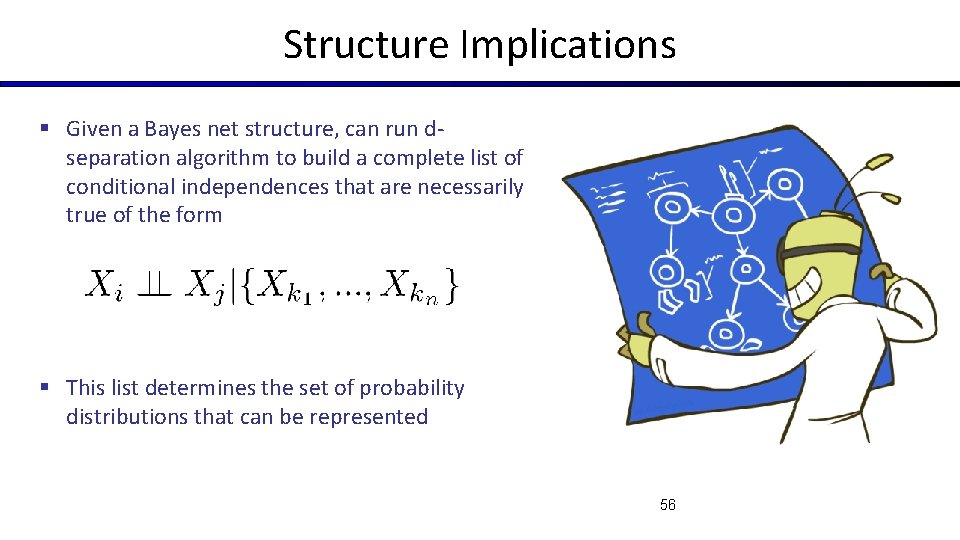
Structure Implications § Given a Bayes net structure, can run dseparation algorithm to build a complete list of conditional independences that are necessarily true of the form § This list determines the set of probability distributions that can be represented 56
Bayes Nets Representation Summary § Bayes nets compactly encode joint distributions § Guaranteed independencies of distributions can be deduced from BN graph structure § D-separation gives precise conditional independence guarantees from graph alone § A Bayes’ net’s joint distribution may have further (conditional) independence that is not detectable until you inspect its specific distribution 57
- Slides: 56