
Bayes Classifiers and Generative Methods CSE 4309 Machine
Bayes Classifiers and Generative Methods CSE 4309 – Machine Learning Vassilis Athitsos Computer Science and Engineering Department University of Texas at Arlington 1
The Stages of Supervised Learning • To build a supervised learning system, we must implement two distinct stages. • The training stage is the stage where the system uses training data to learn a model of the data. • The decision stage (also known as test stage) is the stage where the system is given new inputs (not included in the training data), and the system has to decide the appropriate output for each of those inputs. • The problem of deciding the appropriate output for an input is called the decision problem. 2
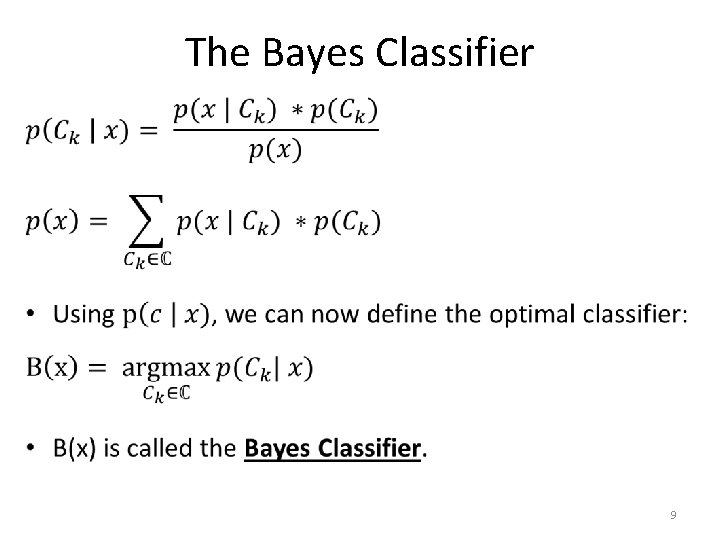
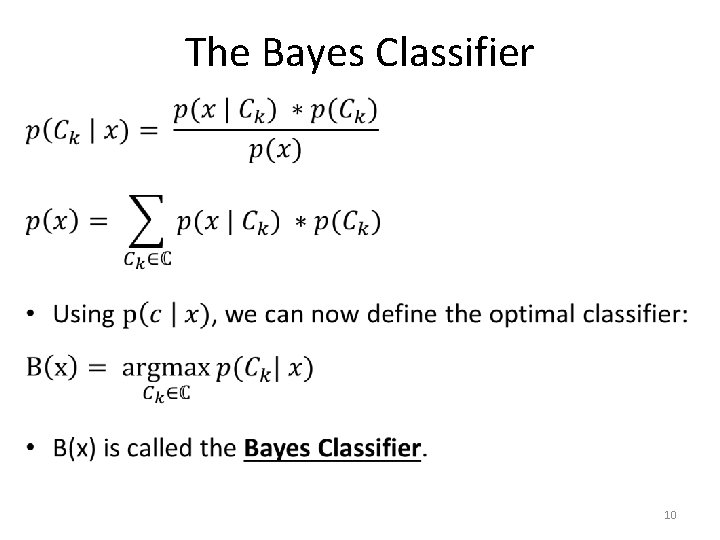
The Bayes Classifier • Let X be the input space for some classification problem. • Suppose that we have a function p(x | Ck) that produces the conditional probability of any x in X given any class label Ck. • Suppose that we also know the prior probabilities p(Ck) of all classes Ck. • Given this information, we can build the optimal (most accurate possible) classifier for our problem. – We can prove that no other classifier can do better. • This optimal classifier is called the Bayes classifier. 3
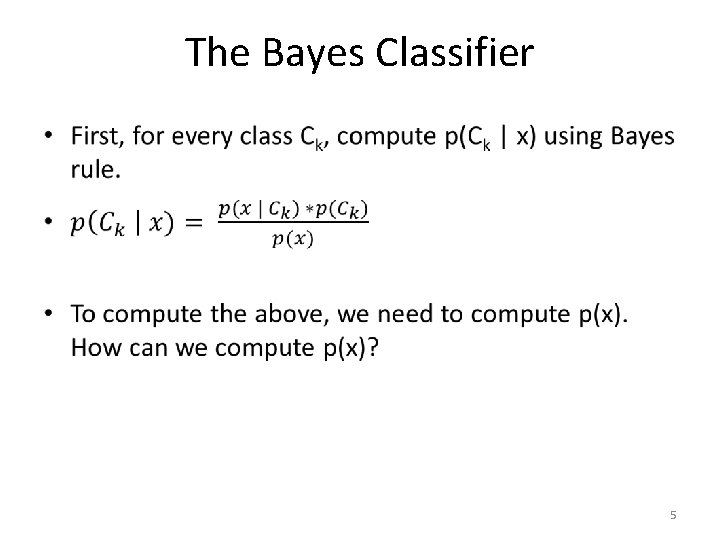
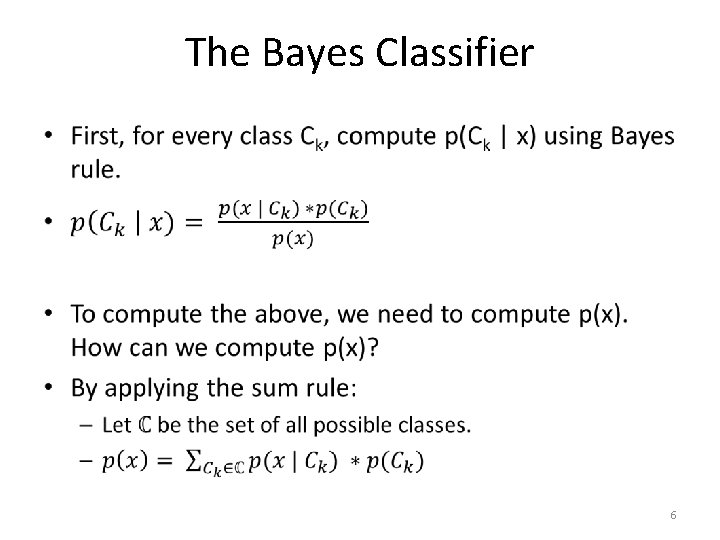
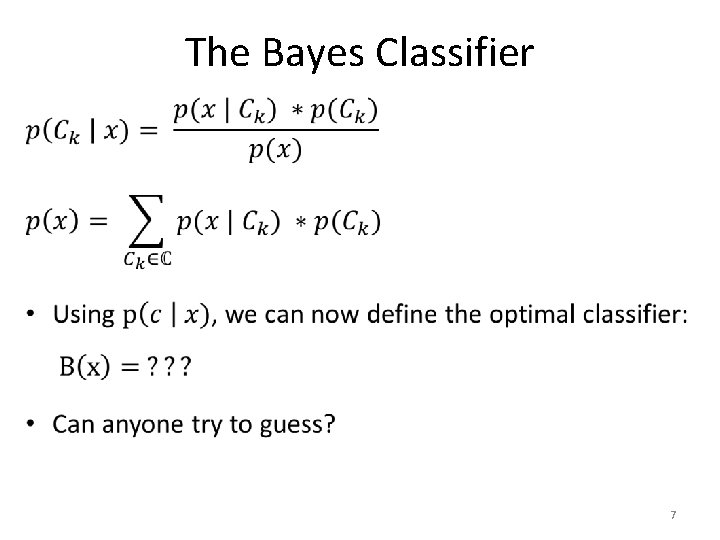
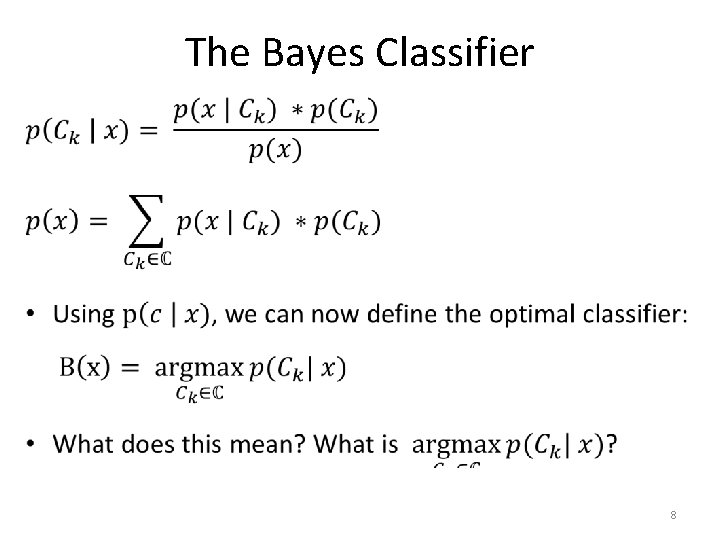
The Bayes Classifier • So, how do we define this optimal classifier? Let's call it B. • B(x) = ? ? ? • Any ideas? 4
The Bayes Classifier • 5
The Bayes Classifier • 6
The Bayes Classifier • 7
The Bayes Classifier • 8
The Bayes Classifier • 9
The Bayes Classifier • 10
Bayes Classifier Optimality • 11
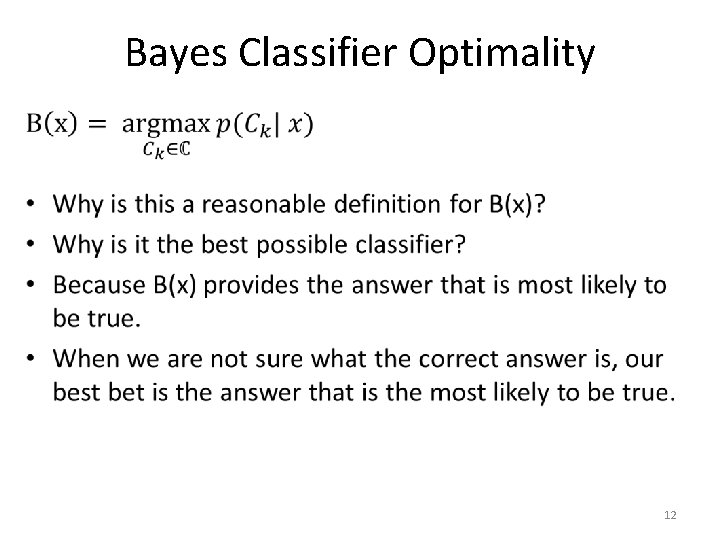
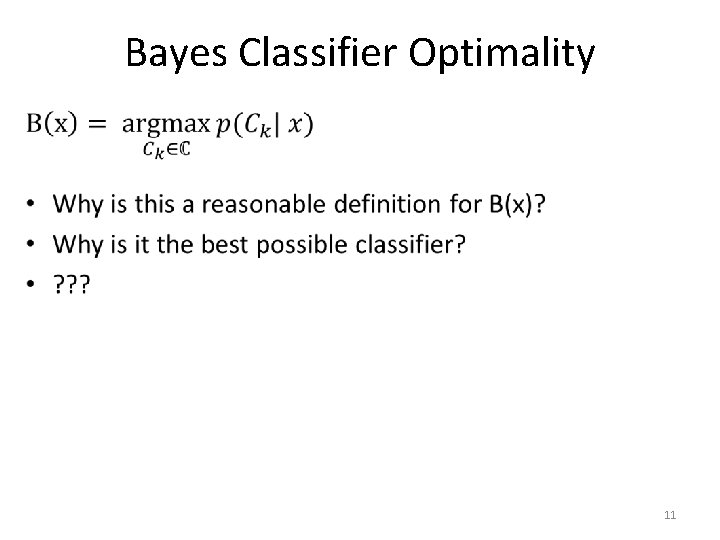
Bayes Classifier Optimality • 12
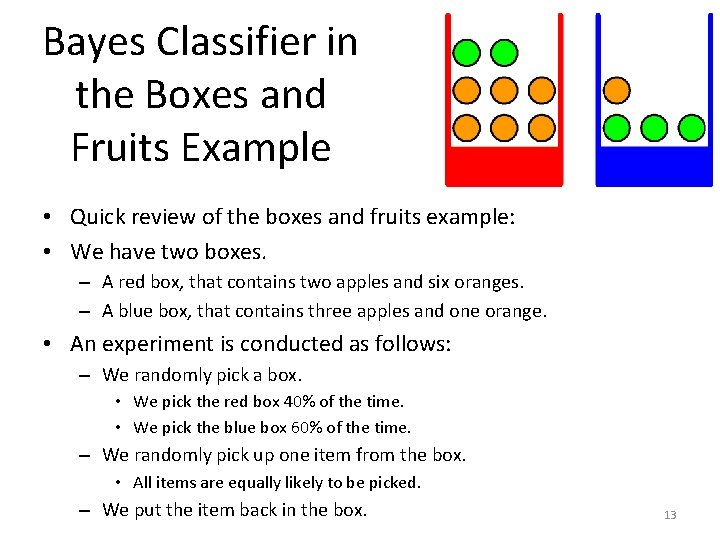
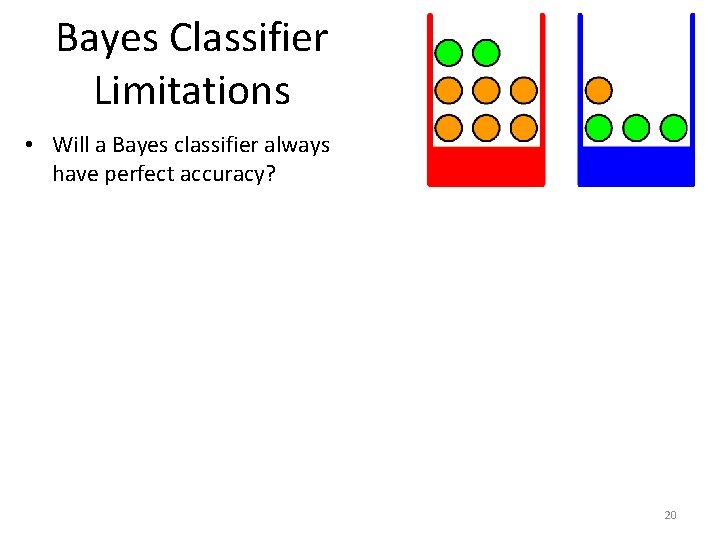
Bayes Classifier in the Boxes and Fruits Example • Quick review of the boxes and fruits example: • We have two boxes. – A red box, that contains two apples and six oranges. – A blue box, that contains three apples and one orange. • An experiment is conducted as follows: – We randomly pick a box. • We pick the red box 40% of the time. • We pick the blue box 60% of the time. – We randomly pick up one item from the box. • All items are equally likely to be picked. – We put the item back in the box. 13
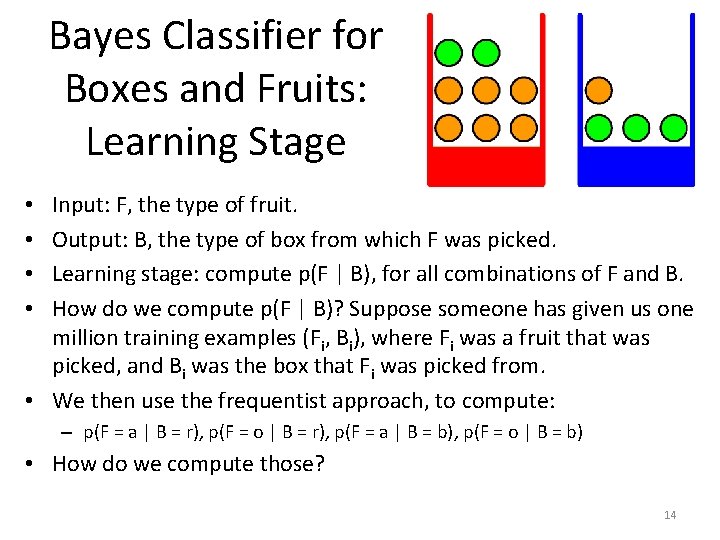
Bayes Classifier for Boxes and Fruits: Learning Stage Input: F, the type of fruit. Output: B, the type of box from which F was picked. Learning stage: compute p(F | B), for all combinations of F and B. How do we compute p(F | B)? Suppose someone has given us one million training examples (Fi, Bi), where Fi was a fruit that was picked, and Bi was the box that Fi was picked from. • We then use the frequentist approach, to compute: • • – p(F = a | B = r), p(F = o | B = r), p(F = a | B = b), p(F = o | B = b) • How do we compute those? 14
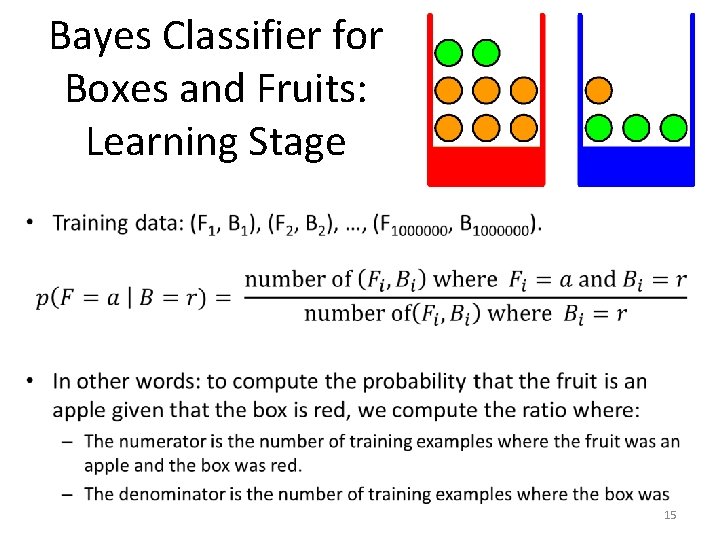
Bayes Classifier for Boxes and Fruits: Learning Stage • 15
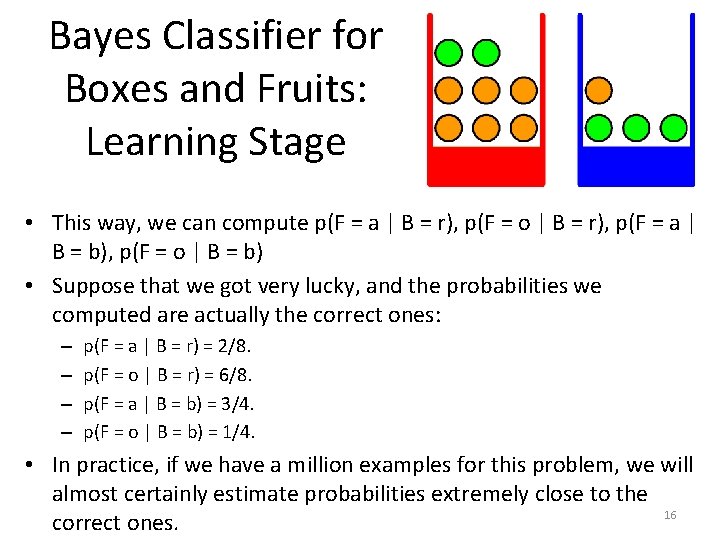
Bayes Classifier for Boxes and Fruits: Learning Stage • This way, we can compute p(F = a | B = r), p(F = o | B = r), p(F = a | B = b), p(F = o | B = b) • Suppose that we got very lucky, and the probabilities we computed are actually the correct ones: – – p(F = a | B = r) = 2/8. p(F = o | B = r) = 6/8. p(F = a | B = b) = 3/4. p(F = o | B = b) = 1/4. • In practice, if we have a million examples for this problem, we will almost certainly estimate probabilities extremely close to the 16 correct ones.
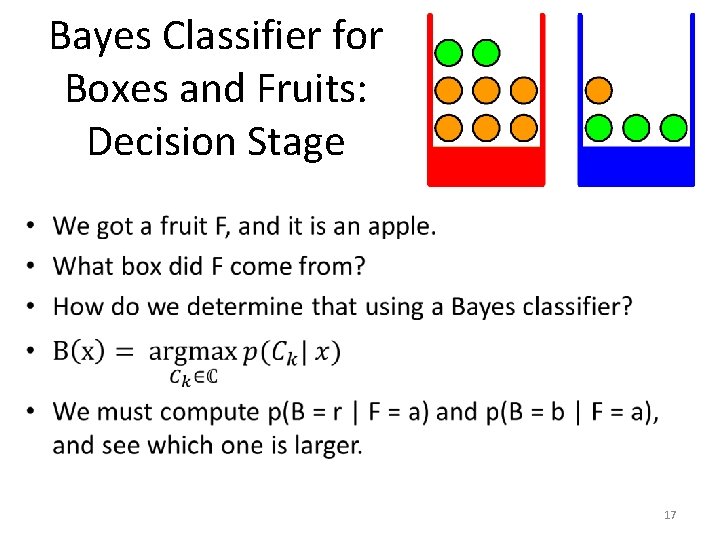
Bayes Classifier for Boxes and Fruits: Decision Stage • 17
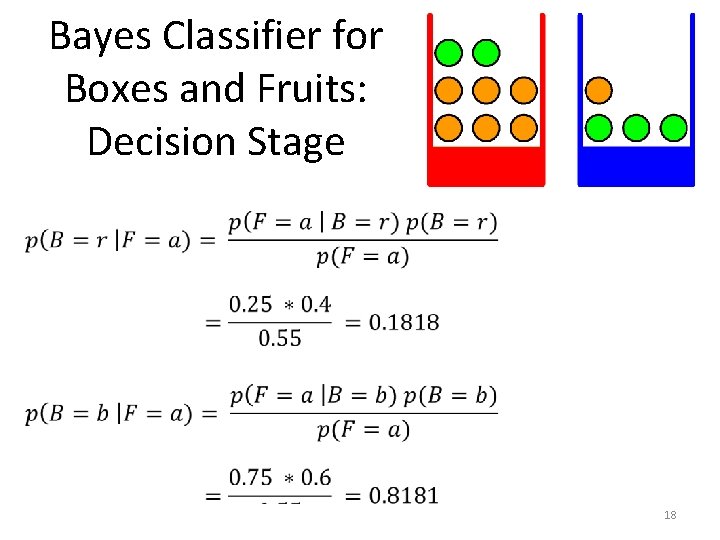
Bayes Classifier for Boxes and Fruits: Decision Stage • 18
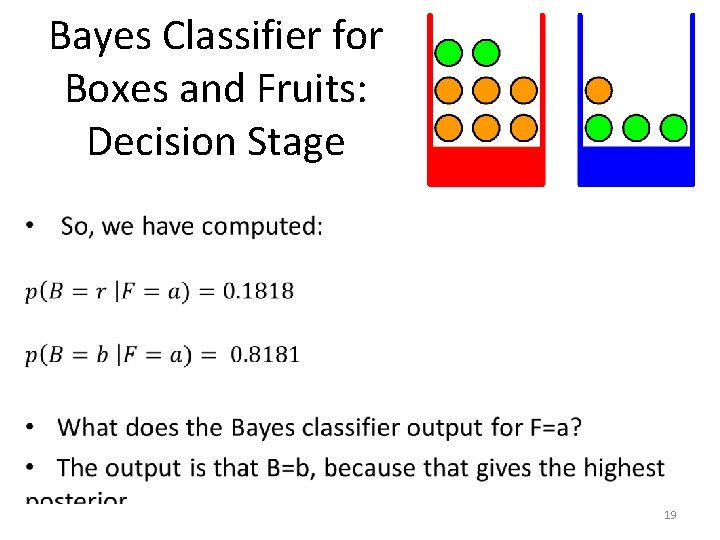
Bayes Classifier for Boxes and Fruits: Decision Stage • 19
Bayes Classifier Limitations • Will a Bayes classifier always have perfect accuracy? 20
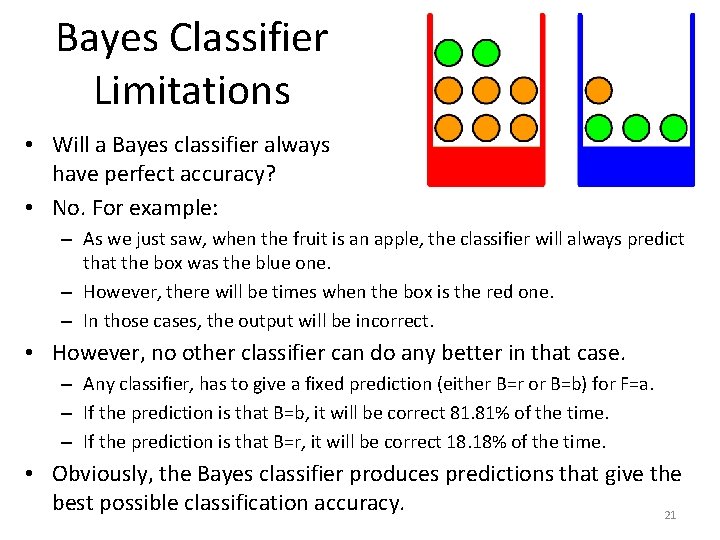
Bayes Classifier Limitations • Will a Bayes classifier always have perfect accuracy? • No. For example: – As we just saw, when the fruit is an apple, the classifier will always predict that the box was the blue one. – However, there will be times when the box is the red one. – In those cases, the output will be incorrect. • However, no other classifier can do any better in that case. – Any classifier, has to give a fixed prediction (either B=r or B=b) for F=a. – If the prediction is that B=b, it will be correct 81. 81% of the time. – If the prediction is that B=r, it will be correct 18. 18% of the time. • Obviously, the Bayes classifier produces predictions that give the best possible classification accuracy. 21
Bayes Classifier Limitations • So, we know the formula for the optimal classifier for any classification problem. • Why don't we always use the Bayes classifier? – Why are we going to study other classification methods in this class? – Why are people still trying to come up with new classification methods, if we already know that none of them can beat the Bayes classifier? 22
Bayes Classifier Limitations • So, we know the formula for the optimal classifier for any classification problem. • Why don't we always use the Bayes classifier? – Why are we going to study other classification methods in this class? – Why are researchers still trying to come up with new classification methods, if we already know that none of them can beat the Bayes classifier? • Because, sadly, the Bayes classifier has a catch. – To construct the Bayes classifier, we need to compute P(x | c), for every x and every c. – In most cases, we cannot compute P(x | c) precisely enough. 23
An Example: Recognizing Faces • As an example of how difficult it can be to estimate probabilities, let's consider the problem of recognizing faces in 100 x 100 images. • Suppose that we want to build a Bayesian classifier B(x) that estimates, given a 100 x 100 image x, whether x is a photograph of Michael Jordan or Kobe Bryant. • Input space: the space of 100 x 100 color images. • Output space: {Jordan, Bryant}. • We need to compute: – P(x | Jordan). – P(x | Bryant). • How feasible is that? • To answer this question, we must understand how images are represented mathematically. 24
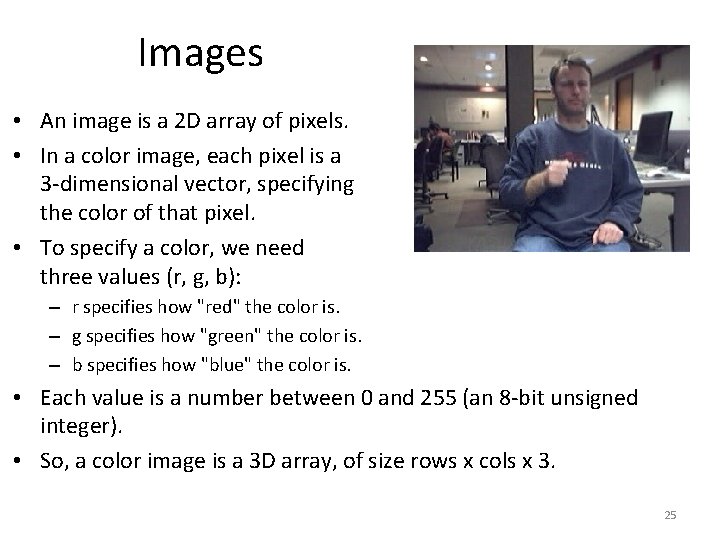
Images • An image is a 2 D array of pixels. • In a color image, each pixel is a 3 -dimensional vector, specifying the color of that pixel. • To specify a color, we need three values (r, g, b): – r specifies how "red" the color is. – g specifies how "green" the color is. – b specifies how "blue" the color is. • Each value is a number between 0 and 255 (an 8 -bit unsigned integer). • So, a color image is a 3 D array, of size rows x cols x 3. 25
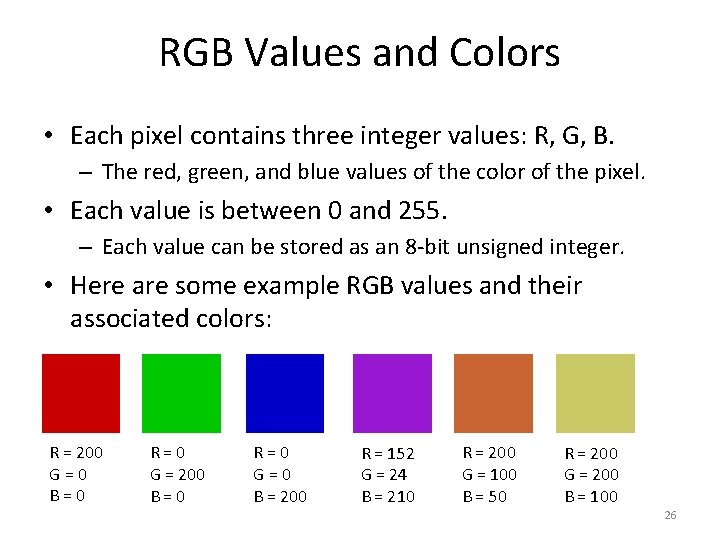
RGB Values and Colors • Each pixel contains three integer values: R, G, B. – The red, green, and blue values of the color of the pixel. • Each value is between 0 and 255. – Each value can be stored as an 8 -bit unsigned integer. • Here are some example RGB values and their associated colors: R = 200 G = 0 B = 0 R = 0 G = 200 B = 0 R = 0 G = 0 B = 200 R = 152 G = 24 B = 210 R = 200 G = 100 B = 50 R = 200 G = 200 B = 100 26
Images as Vectors • Suppose we have a color image, with R rows and C columns. • Then, that image is specified using R*C*3 numbers. • The image is represented as a vector, whose number of dimensions is R*C*3. • If the image is grayscale, then we "only" need R*C dimensions. • Either way, the number of dimensions is huge. – For a small 100 x 100 color image, we have 30, 000 dimensions. – For an 1920 x 1080 image (the standard size for HD movies these days), we have 6, 220, 800 dimensions. 27
Estimating Probabilities of Images • We want a classifier B(x) that estimates, given a 100 x 100 image x, whether x is a photograph of Michael Jordan or Kobe Bryant. • Input space: the space of 100 x 100 color images. • Output space: {Jordan, Bryant}. • We need to compute: – P(x | Jordan). – P(x | Bryant). • P(x | Jordan) is a joint distribution of 30, 000 real-valued variables. – Each variable has 256 possible values. – We need to compute and store 25630, 000 numbers. • We have neither enough storage to store so many numbers, nor enough training data to compute all these values. 28
Generative Methods • Supervised learning methods are divided into generative methods and discriminative methods. • Generative methods: – Learning stage: use the training data to estimate classconditional probabilities p(x | Ck), where x is an element of the input space, and Ck is a class label (i. e. , Ck is an element of the output space). – Decision stage: given an input x: • Use Bayes rule to compute P(Ck | x) for every possible output Ck. • Output the Ck that gives the highest P(Ck | x). • Generative methods use the Bayes classifier at decision stage. 29
Discriminative Methods • Discriminative methods: – Learning stage: use the training data to learn a discriminant function f(x), that directly maps inputs to class labels. – Decision stage: given input x, output f(x). • Discriminative methods do not need to learn p(x | Ck). • In many cases, p(x | Ck) is too complicated, and it requires too many resources (training data, computation time) to learn p(x | Ck) accurately. • In such cases, discriminative methods are a more realistic alternative. 30
Options when Accurate Probabilities are Unknown • In pattern classification problems, our data is oftentimes too complex to allow us to compute probability distributions precisely. • So, what can we do? • ? ? ? 31
Options when Accurate Probabilities are Unknown • In pattern classification problems, our data is oftentimes too complex to allow us to compute probability distributions precisely. • So, what can we do? • We have two options. • One is to not use a Bayes classifier, and instead use a discriminative method. – There are several such methods, such as neural networks, nearest neighbor classifiers, support vector machines, Ada. Boost. . . 32
Options when Accurate Probabilities are Unknown • The second option is to still use a Bayes classifier, and estimate approximate probabilities p(x | Ck). • In an approximate method, we do not aim to find the true underlying probability distributions. • Instead, approximate methods are designed to require reasonable memory and reasonable amounts of training data, so that we can actually use them in practice. 33
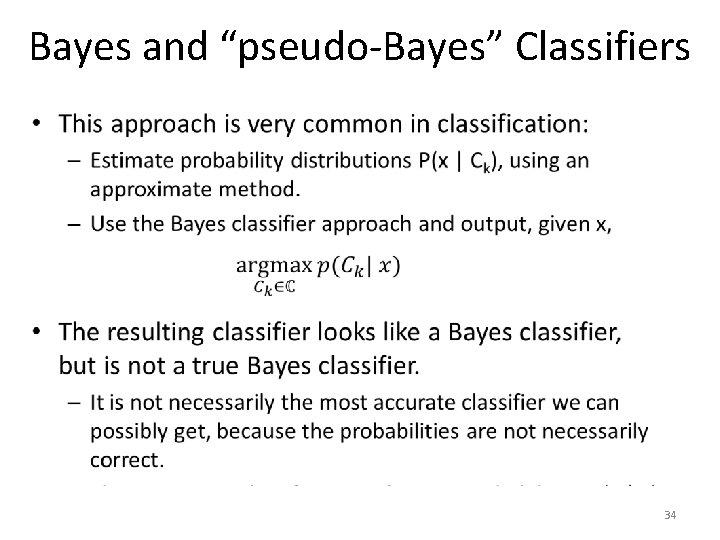
Bayes and “pseudo-Bayes” Classifiers • 34
Approximate Probability Estimation • Our next topic will be to look at some popular approximate methods for estimating probability distributions. – Histograms. – Gaussians (we have already discussed this). – Mixtures of Gaussians. 35
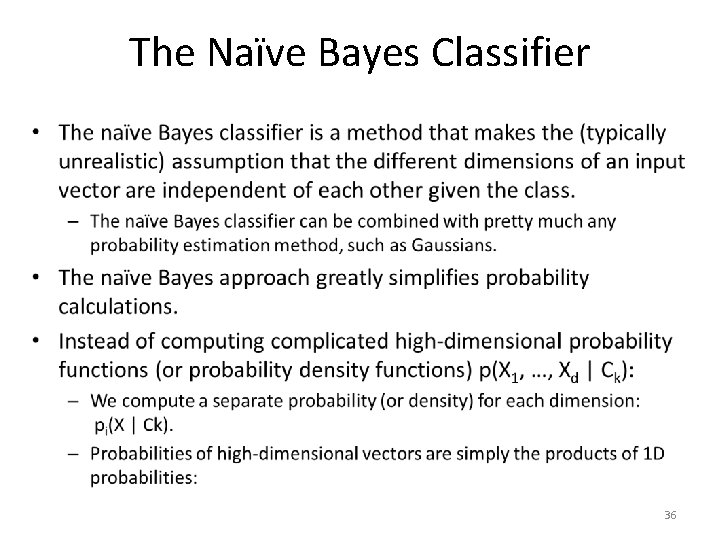
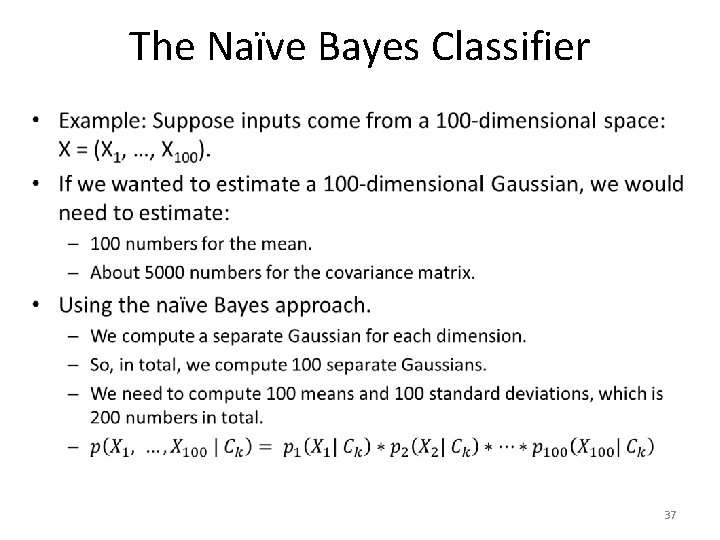
The Naïve Bayes Classifier • 36
The Naïve Bayes Classifier • 37
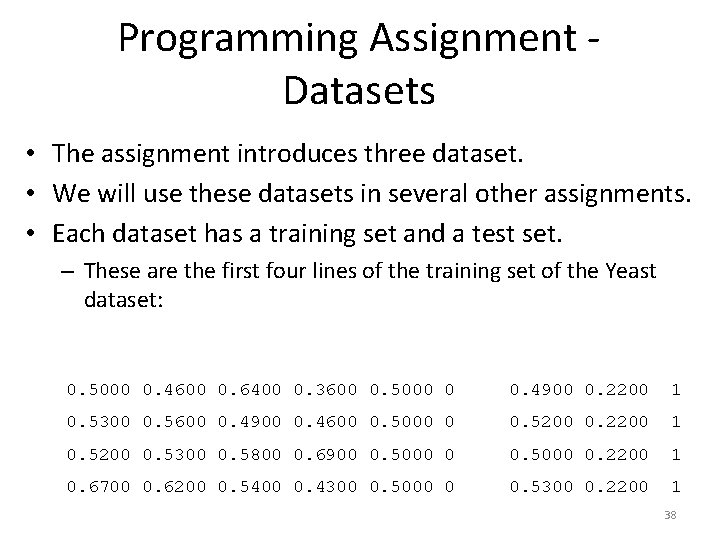
Programming Assignment - Datasets • The assignment introduces three dataset. • We will use these datasets in several other assignments. • Each dataset has a training set and a test set. – These are the first four lines of the training set of the Yeast dataset: 0. 5000 0. 4600 0. 6400 0. 3600 0. 5000 0 0. 4900 0. 2200 1 0. 5300 0. 5600 0. 4900 0. 4600 0. 5000 0 0. 5200 0. 2200 1 0. 5200 0. 5300 0. 5800 0. 6900 0. 5000 0. 2200 1 0. 6700 0. 6200 0. 5400 0. 4300 0. 5000 0 0. 5300 0. 2200 1 38
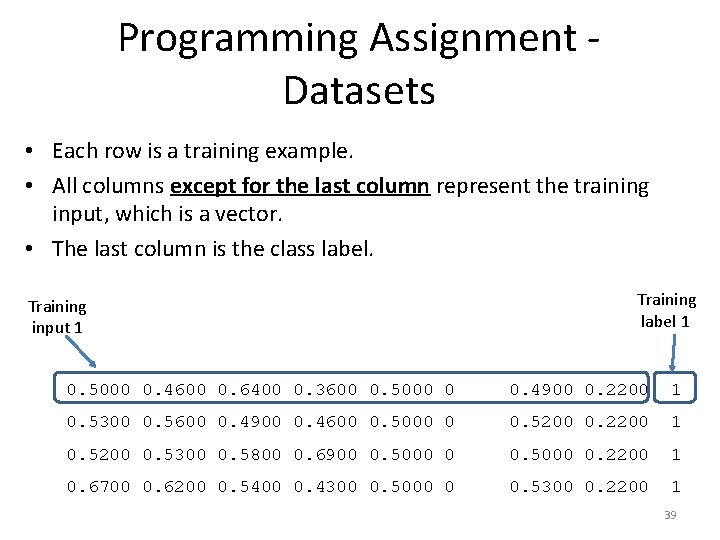
Programming Assignment - Datasets • Each row is a training example. • All columns except for the last column represent the training input, which is a vector. • The last column is the class label. Training input 1 Training label 1 0. 5000 0. 4600 0. 6400 0. 3600 0. 5000 0 0. 4900 0. 2200 1 0. 5300 0. 5600 0. 4900 0. 4600 0. 5000 0 0. 5200 0. 2200 1 0. 5200 0. 5300 0. 5800 0. 6900 0. 5000 0. 2200 1 0. 6700 0. 6200 0. 5400 0. 4300 0. 5000 0 0. 5300 0. 2200 1 39
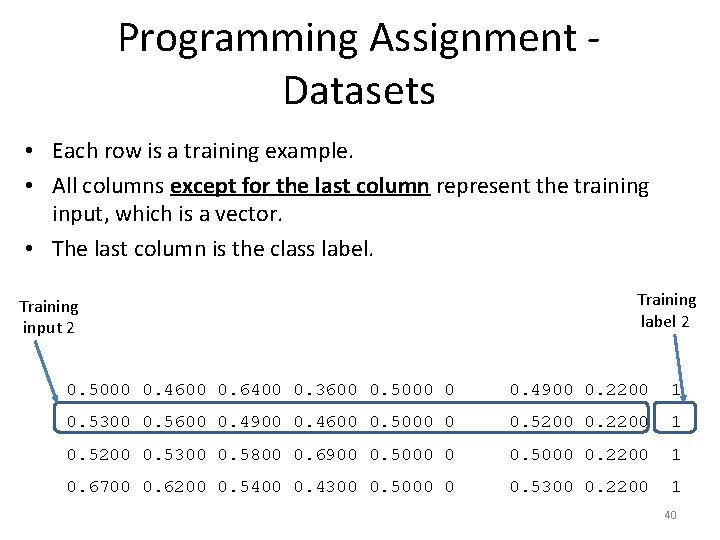
Programming Assignment - Datasets • Each row is a training example. • All columns except for the last column represent the training input, which is a vector. • The last column is the class label. Training input 2 Training label 2 0. 5000 0. 4600 0. 6400 0. 3600 0. 5000 0 0. 4900 0. 2200 1 0. 5300 0. 5600 0. 4900 0. 4600 0. 5000 0 0. 5200 0. 2200 1 0. 5200 0. 5300 0. 5800 0. 6900 0. 5000 0. 2200 1 0. 6700 0. 6200 0. 5400 0. 4300 0. 5000 0 0. 5300 0. 2200 1 40
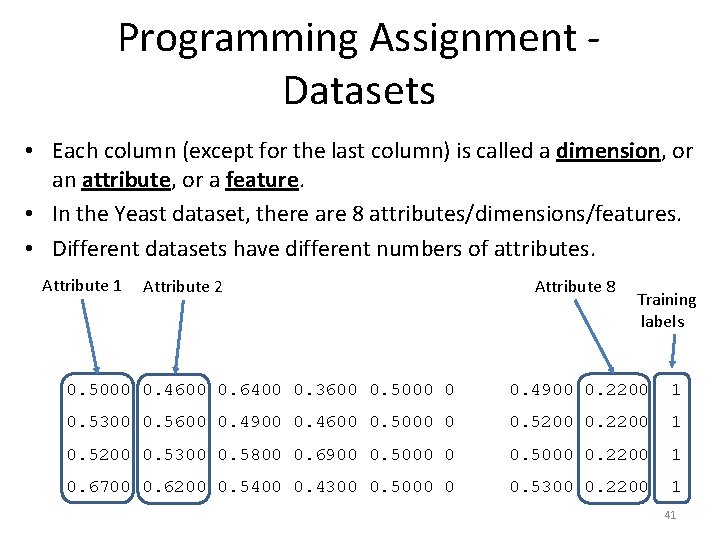
Programming Assignment - Datasets • Each column (except for the last column) is called a dimension, or an attribute, or a feature. • In the Yeast dataset, there are 8 attributes/dimensions/features. • Different datasets have different numbers of attributes. Attribute 1 Attribute 2 Attribute 8 Training labels 0. 5000 0. 4600 0. 6400 0. 3600 0. 5000 0 0. 4900 0. 2200 1 0. 5300 0. 5600 0. 4900 0. 4600 0. 5000 0 0. 5200 0. 2200 1 0. 5200 0. 5300 0. 5800 0. 6900 0. 5000 0. 2200 1 0. 6700 0. 6200 0. 5400 0. 4300 0. 5000 0 0. 5300 0. 2200 1 41
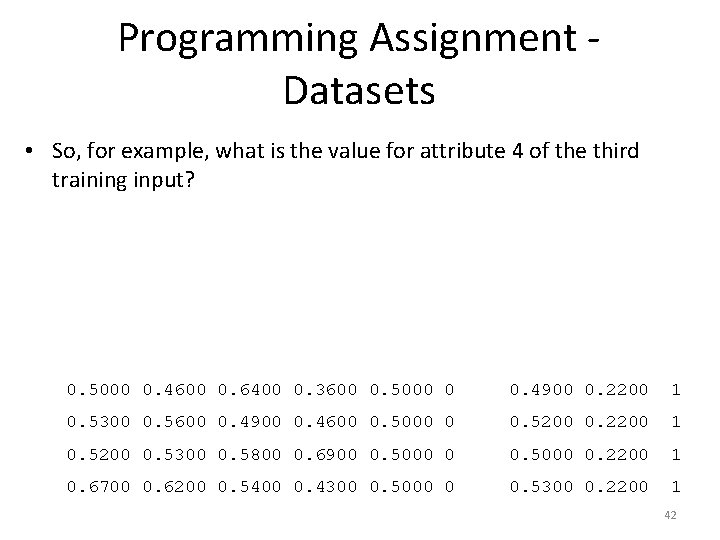
Programming Assignment - Datasets • So, for example, what is the value for attribute 4 of the third training input? 0. 5000 0. 4600 0. 6400 0. 3600 0. 5000 0 0. 4900 0. 2200 1 0. 5300 0. 5600 0. 4900 0. 4600 0. 5000 0 0. 5200 0. 2200 1 0. 5200 0. 5300 0. 5800 0. 6900 0. 5000 0. 2200 1 0. 6700 0. 6200 0. 5400 0. 4300 0. 5000 0 0. 5300 0. 2200 1 42
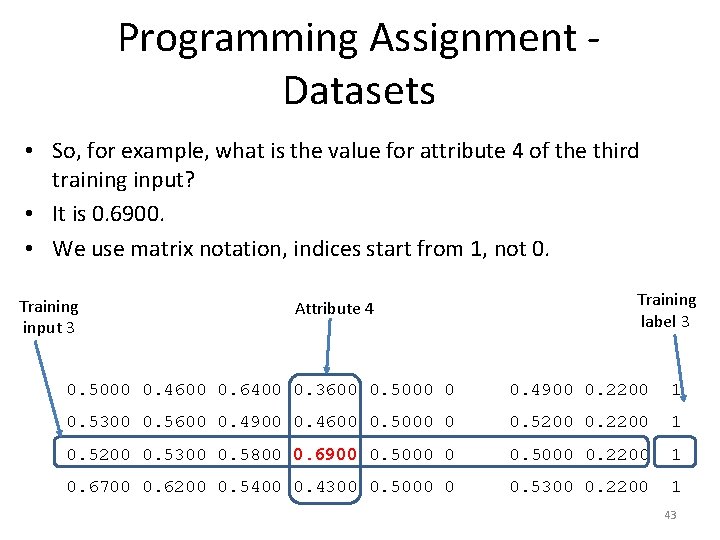
Programming Assignment - Datasets • So, for example, what is the value for attribute 4 of the third training input? • It is 0. 6900. • We use matrix notation, indices start from 1, not 0. Training input 3 Attribute 4 Training label 3 0. 5000 0. 4600 0. 6400 0. 3600 0. 5000 0 0. 4900 0. 2200 1 0. 5300 0. 5600 0. 4900 0. 4600 0. 5000 0 0. 5200 0. 2200 1 0. 5200 0. 5300 0. 5800 0. 6900 0. 5000 0. 2200 1 0. 6700 0. 6200 0. 5400 0. 4300 0. 5000 0 0. 5300 0. 2200 1 43
Programming Assignment – Naïve Bayes and Gaussians • You need to implement a Naïve Bayes classifier. • The assignment asks to use Gaussians to model densities. • Training stage: for every attribute A, for every class C: – identify all training examples that belong to class C. – for all the training examples you selected, find the mean and standard deviation of their values for attribute A. – That gives you the Gaussian for the density p(A | C) of attribute A given class C. • For the yeast dataset, we have 8 attributes, 10 classes. – So, you need to compute 80 means, 80 standard deviations. 44
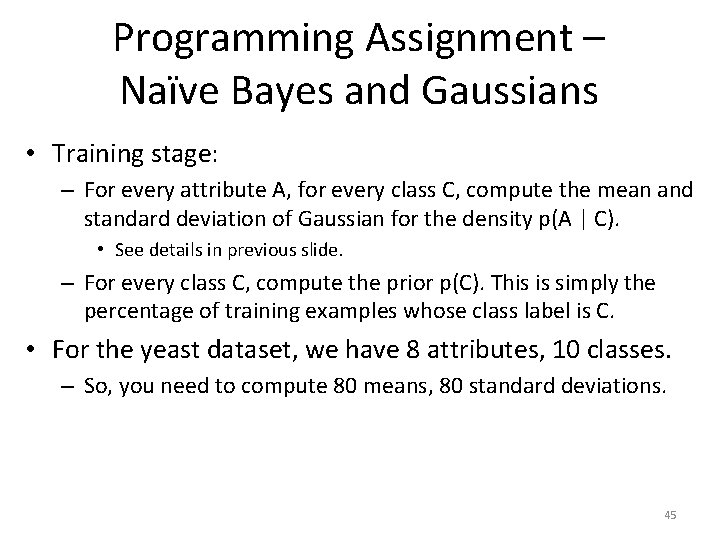
Programming Assignment – Naïve Bayes and Gaussians • Training stage: – For every attribute A, for every class C, compute the mean and standard deviation of Gaussian for the density p(A | C). • See details in previous slide. – For every class C, compute the prior p(C). This is simply the percentage of training examples whose class label is C. • For the yeast dataset, we have 8 attributes, 10 classes. – So, you need to compute 80 means, 80 standard deviations. 45
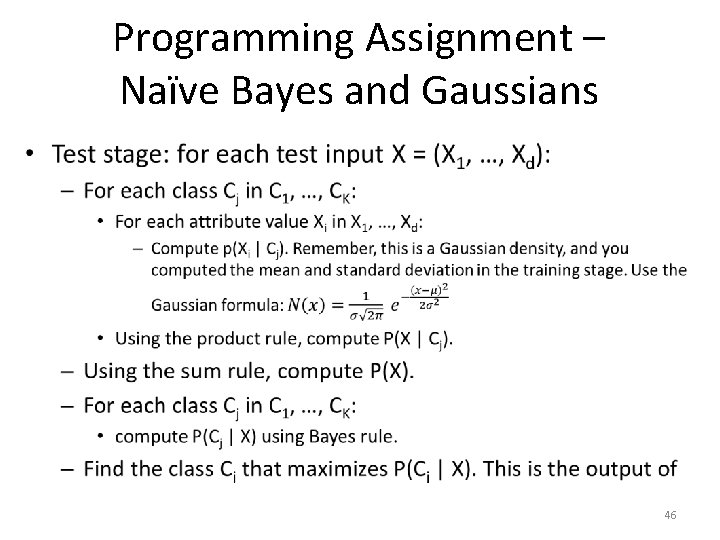
Programming Assignment – Naïve Bayes and Gaussians • 46
- Slides: 46