
Battling a BetaBlocker Overdose ANN MC ANDR EW
Battling a Beta-Blocker Overdose ANN MC ANDR EW PHARMD C ANDIDATE 2019 UNIVE RSIT Y OF PITTSBURG H SC HOO L OF PHARMACY
Objectives Demonstrate a patient case of a beta blocker overdose in the Emergency Dept. Describe presentation of beta blocker overdose and review key vitals and labs Evaluate antidotes utilized for beta blocker overdoses Assess the patient case and determine appropriate antidotes
Patient Case CC: SI/intentional OD DC is a 16 yo AAF who presents to the ED via EMS due to suspected overdose. Upon arrival, patient admitted to taking “a bunch of pills” including propranolol. Mother thought she had taken propranolol in addition to fluoxetine, clonazepam, lurasidone, and prazosin. She has a hx of PTSD and bipolar disorder. Vitals upon arrival: BP: 93/56 HR: 70 RR: 16 Sa. O 2: 100(RA) Weight: 68 kg Height: 156 cm Temp: 36. 8 C Pain: 8 Labs: Na: 134 K: 4. 3 Cl: 104 CO 2: 25 BUN: 8 Cr: 0. 86 Gluc: 91 Ca: 8. 7 Alb: 4. 1 WBC: 6. 8 RBC: 4. 46 Hgb: 13. 0 Plt: 288 Hct: 40. 4 Ethanol <3 Salicylate <1. 7 APAP<2
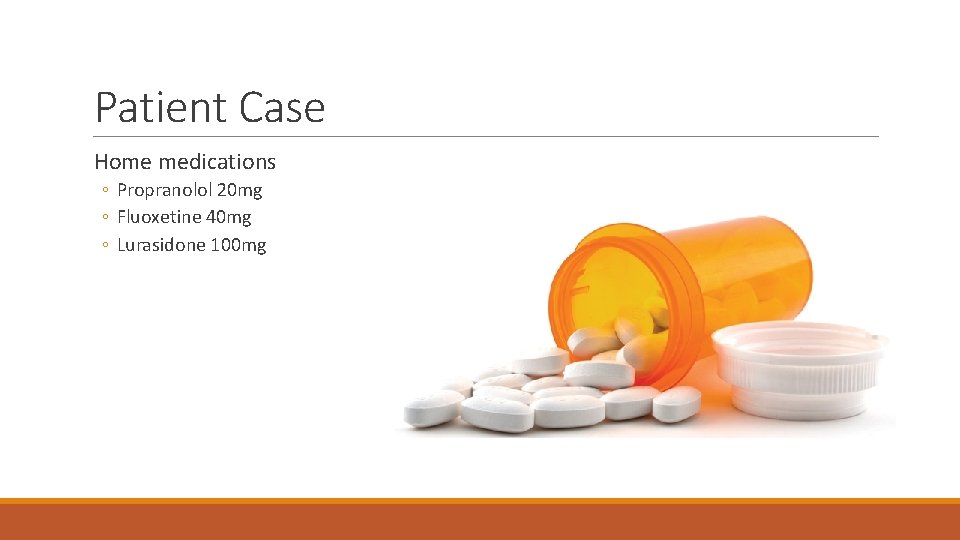
Patient Case Home medications ◦ Propranolol 20 mg ◦ Fluoxetine 40 mg ◦ Lurasidone 100 mg
Beta Blocker Overdose Manifestations of toxicity reflect therapeutic effects of the medications ◦ Hypotension ◦ Bradycardia ◦ Myocardial depression Beta blocker vs Calcium channel blocker ◦ Altered mental status ◦ Respiratory depression Propranolol ◦ ◦ High lipophilicity Greater sodium-channel blocking effects Seizure risk Widened QRS complex Marraffa JM et al. American Journal of Health-System Pharmacists.
Back to DC Vitals upon arrival: BP: 93/56 HR: 70 RR: 16 Sa. O 2: 100(RA) Weight: 68 kg Height: 156 cm Temp: 36. 8 C Pain: 8 Labs: Na: 134 K: 4. 3 Cl: 104 CO 2: 25 BUN: 8 Cr: 0. 86 Gluc: 91 Ca: 8. 7 Alb: 4. 1 WBC: 6. 8 RBC: 4. 46 Hgb: 13. 0 Plt: 288 Hct: 40. 4 Home medications ◦ Propranolol 20 mg ◦ Fluoxetine 40 mg ◦ Lurasidone 100 mg
Treatment options For severe bradycardia and hypotension ◦ Fluids ◦ Atropine ◦ Vasopressors Activated Charcoal ◦ May be given within 4 hours of ingestion for immediate release formulations Calcium ◦ Not used as frequently in beta blocker overdose compared to calcium channel blocker overdose Glucagon ◦ May not work in severely poisoned patients Intravenous Lipid Emulsion ◦ Rescue therapy High-dose insulin ◦ May avoid need for vasopressors or allow for lower doses of vasopressors Marraffa JM et al. American Journal of Health-System Pharmacists.
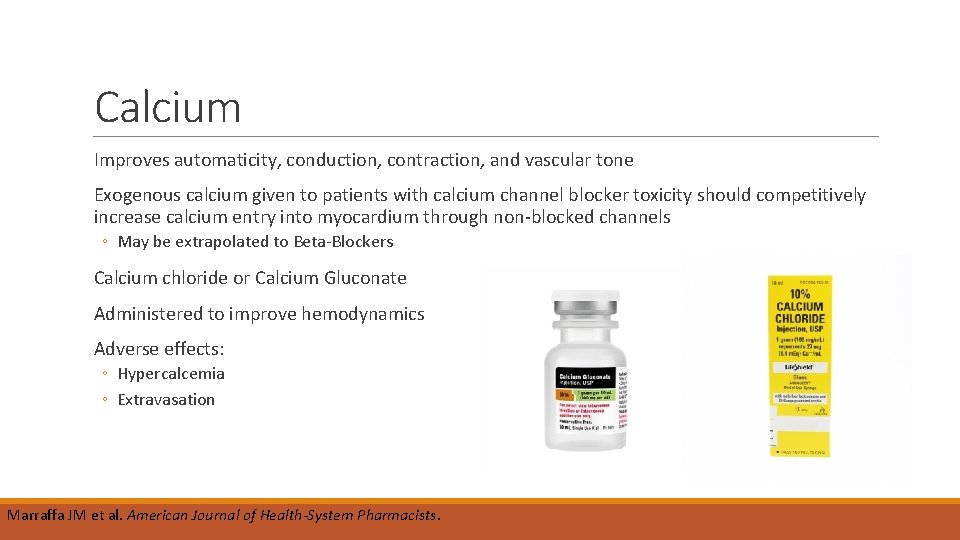
Calcium Improves automaticity, conduction, contraction, and vascular tone Exogenous calcium given to patients with calcium channel blocker toxicity should competitively increase calcium entry into myocardium through non-blocked channels ◦ May be extrapolated to Beta-Blockers Calcium chloride or Calcium Gluconate Administered to improve hemodynamics Adverse effects: ◦ Hypercalcemia ◦ Extravasation Marraffa JM et al. American Journal of Health-System Pharmacists.
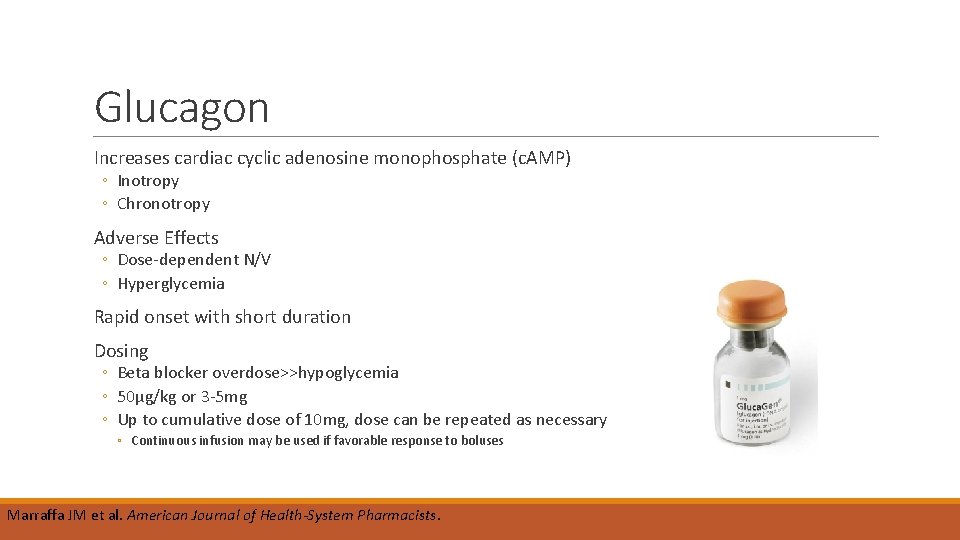
Glucagon Increases cardiac cyclic adenosine monophosphate (c. AMP) ◦ Inotropy ◦ Chronotropy Adverse Effects ◦ Dose-dependent N/V ◦ Hyperglycemia Rapid onset with short duration Dosing ◦ Beta blocker overdose>>hypoglycemia ◦ 50µg/kg or 3 -5 mg ◦ Up to cumulative dose of 10 mg, dose can be repeated as necessary ◦ Continuous infusion may be used if favorable response to boluses Marraffa JM et al. American Journal of Health-System Pharmacists.
Intravenous Lipid Emulsion Given as rescue therapy unresponsive to otherapies ◦ Hypotension ◦ Asystole Considered for lipophilic beta-blocker intoxication Mechanism: ◦ Theorized to work by sequestering highly lipophilic compounds ◦ Fatty acid substrate to myocardial cells improving function of calcium ion channels ◦ Increases inotropy and chronotropy Dosing ◦ Loading dose 1. 5 m. L/kg of 20% lipid emulsion ◦ 0. 25 m. L/kg/min for 30 -60 min (max 10 m. L/kg) Adverse effects ◦ Pancreatitis ◦ Acute lung injury Graudins A et al. British Journal of Clinical Pharmacology. Doepker B et al. Journal of Emergency Medicine.
Hyperinsulinemia euglycemia therapy (HIET) Used in severely poisoned patients MOA: not clearly defined, but thought to enhance carbohydrate use and energy production by myocardial cells—improving contractility Delayed onset– should be started early ◦ Used if patient remains hypotensive and bradycardic after fluids, atropine, calcium, and glucagon Adverse effects ◦ Hypoglycemia ◦ Serum glucose should remain above 100 mg/d. L ◦ Loading dose of dextrose should be administered followed by infusion ◦ Hypokalemia ◦ Supplementation considered when K <3 meq/L Marraffa JM et al. American Journal of Health-System Pharmacists.
High-dose insulin Dosing ◦ Loading dose of 1 unit/kg of regular insulin ◦ Infusion of 0. 5 -1 unit/kg/hr ◦ Infusion can be increased every 20 -30 minutes to maximum of 10 unit/kg/hr Dextrose (20 -25%) ◦ Glucose value <400 mg/d. L ◦ Loading dose of 0. 5 g/kg ◦ Infusion 0. 5 g/kg/hr Monitoring ◦ Maintain glucose concentration 100 -250 mg/d. L ◦ Serum potassium Marraffa JM et al. American Journal of Health-System Pharmacists.
Historical use of High Dose Insulin Hyperglycemia occurs commonly in calcium channel blocker overdoses ◦ Block L-type calcium channels impairing insulin release from pancreas ◦ Impairment of glucose uptake causing lack of fuel Giving high dose insulin can overcome these mechanisms Initial studies conducted with verapamil in canines ◦ Myocardial glucose uptake doubled ◦ Greater myocardial contractility than alternative antidotes Initial clinical data ◦ HIET started with 10 IU of insulin bolus plus 25 g of glucose, followed by infusion of 4 -10 IU/h with 8 -15 g/h of glucose ◦ Should be used earlier in treatment rather than rescue therapy (effect occurs 30 -45 min) Recommendation for HIET in CCB overdose ◦ 1. 0 IU/kg IV bolus followed by 0. 5 IU/kg/hr IV infusion ◦ Monitor serum glucose every 30 minutes Lheureux PE et al. Critical Care.
HIET in Beta Blocker Overdose? Not as well studied in beta blockers compared to calcium channel blockers Animal data suggested possible benefit of HIET therapy in beta-blocker toxicity ◦ Increased myocardial glucose uptake ◦ Sustained increase in blood pressure Most recently, use of HIET in beta blocker overdose is based on data reported in case studies Early administration can improve patient’s hemodynamics ◦ Should not wait for conventional therapies to fail in order to initiate Lheureux PE et al. Critical Care.
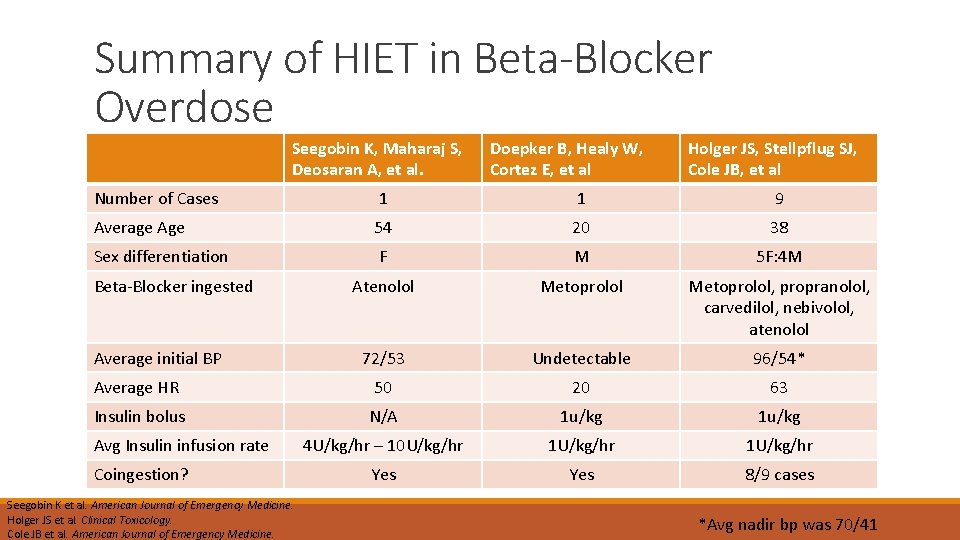
Summary of HIET in Beta-Blocker Overdose Seegobin K, Maharaj S, Deosaran A, et al. Doepker B, Healy W, Cortez E, et al Holger JS, Stellpflug SJ, Cole JB, et al Number of Cases 1 1 9 Average Age 54 20 38 Sex differentiation F M 5 F: 4 M Atenolol Metoprolol, propranolol, carvedilol, nebivolol, atenolol 72/53 Undetectable 96/54* Average HR 50 20 63 Insulin bolus N/A 1 u/kg 4 U/kg/hr – 10 U/kg/hr 1 U/kg/hr Yes 8/9 cases Beta-Blocker ingested Average initial BP Avg Insulin infusion rate Coingestion? Seegobin K et al. American Journal of Emergency Medicine. Holger JS et al. Clinical Toxicology. Cole JB et al. American Journal of Emergency Medicine. *Avg nadir bp was 70/41
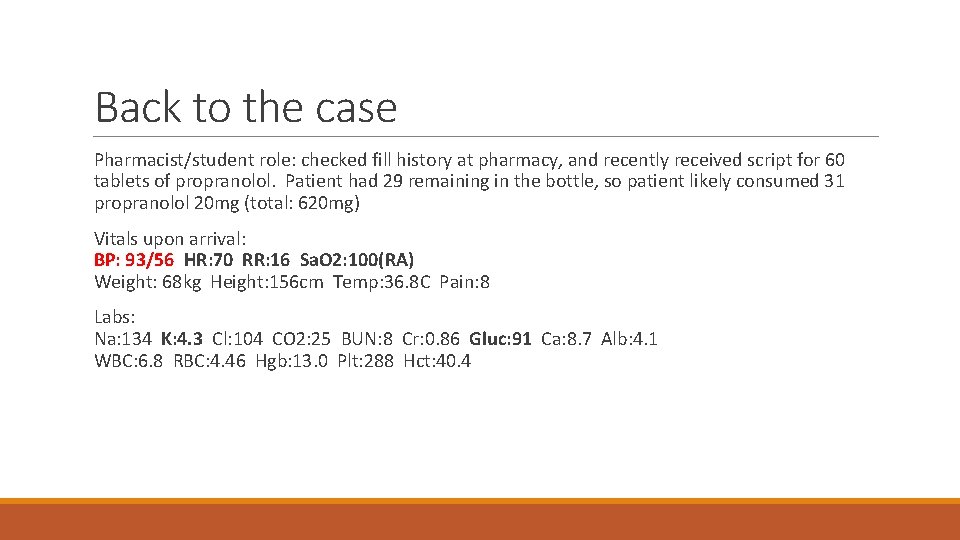
Back to the case Pharmacist/student role: checked fill history at pharmacy, and recently received script for 60 tablets of propranolol. Patient had 29 remaining in the bottle, so patient likely consumed 31 propranolol 20 mg (total: 620 mg) Vitals upon arrival: BP: 93/56 HR: 70 RR: 16 Sa. O 2: 100(RA) Weight: 68 kg Height: 156 cm Temp: 36. 8 C Pain: 8 Labs: Na: 134 K: 4. 3 Cl: 104 CO 2: 25 BUN: 8 Cr: 0. 86 Gluc: 91 Ca: 8. 7 Alb: 4. 1 WBC: 6. 8 RBC: 4. 46 Hgb: 13. 0 Plt: 288 Hct: 40. 4
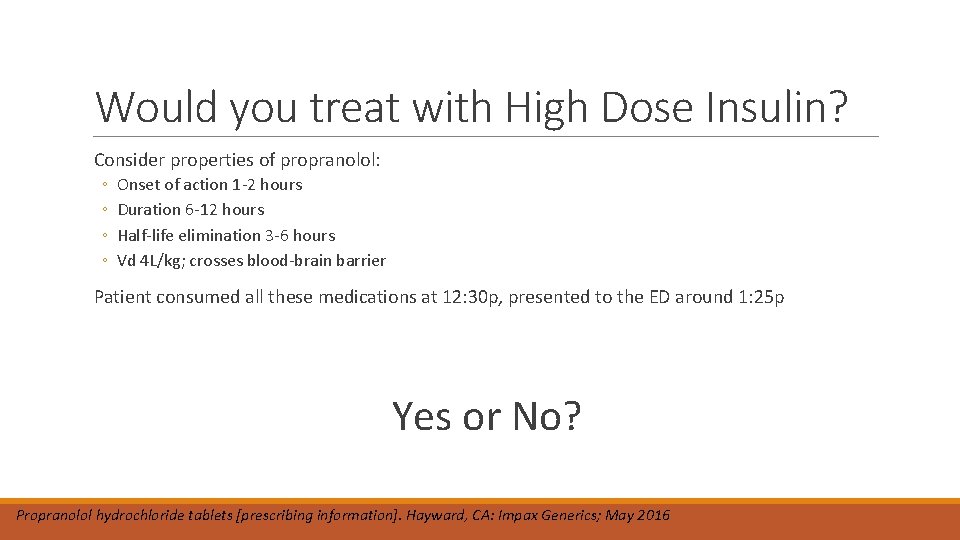
Would you treat with High Dose Insulin? Consider properties of propranolol: ◦ ◦ Onset of action 1 -2 hours Duration 6 -12 hours Half-life elimination 3 -6 hours Vd 4 L/kg; crosses blood-brain barrier Patient consumed all these medications at 12: 30 p, presented to the ED around 1: 25 p Yes or No? Propranolol hydrochloride tablets [prescribing information]. Hayward, CA: Impax Generics; May 2016
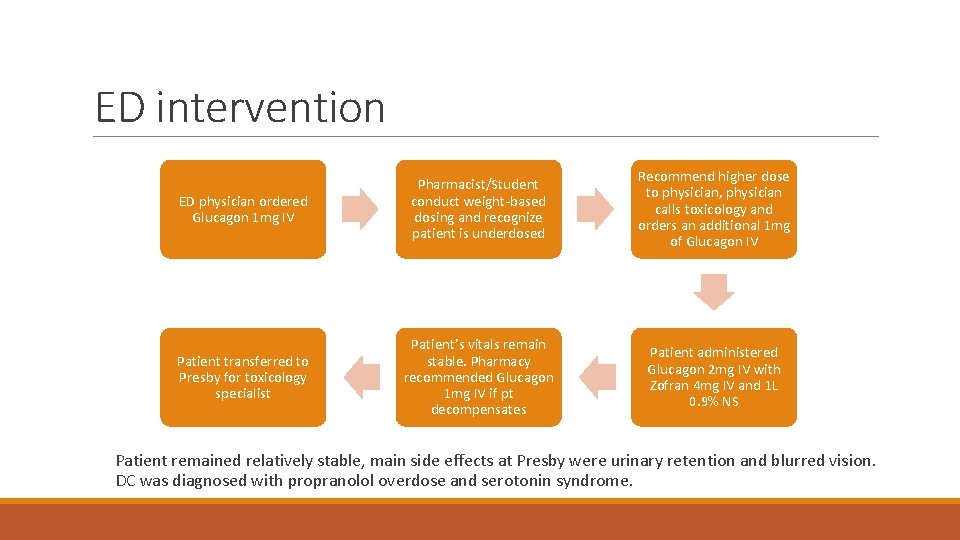
ED intervention ED physician ordered Glucagon 1 mg IV Pharmacist/Student conduct weight-based dosing and recognize patient is underdosed Recommend higher dose to physician, physician calls toxicology and orders an additional 1 mg of Glucagon IV Patient transferred to Presby for toxicology specialist Patient’s vitals remain stable. Pharmacy recommended Glucagon 1 mg IV if pt decompensates Patient administered Glucagon 2 mg IV with Zofran 4 mg IV and 1 L 0. 9% NS Patient remained relatively stable, main side effects at Presby were urinary retention and blurred vision. DC was diagnosed with propranolol overdose and serotonin syndrome.
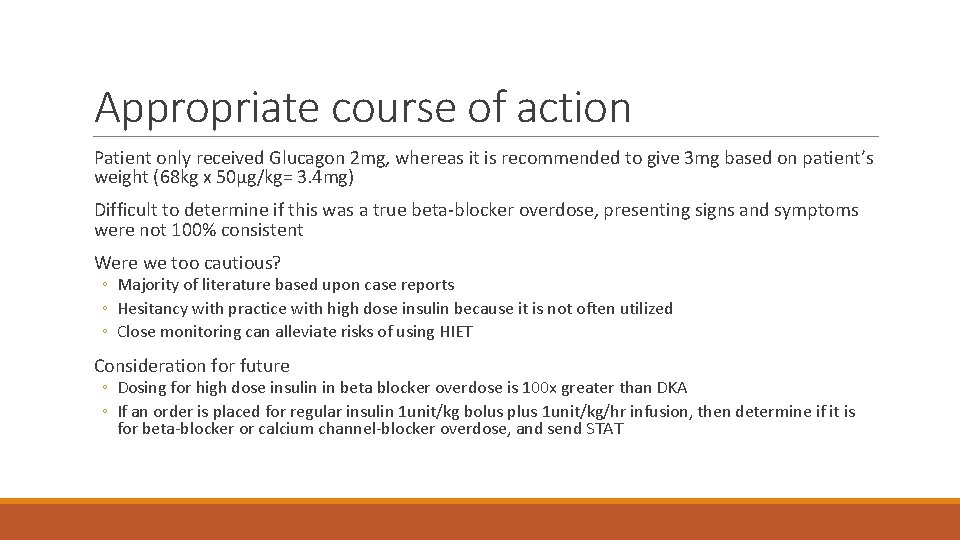
Appropriate course of action Patient only received Glucagon 2 mg, whereas it is recommended to give 3 mg based on patient’s weight (68 kg x 50µg/kg= 3. 4 mg) Difficult to determine if this was a true beta-blocker overdose, presenting signs and symptoms were not 100% consistent Were we too cautious? ◦ Majority of literature based upon case reports ◦ Hesitancy with practice with high dose insulin because it is not often utilized ◦ Close monitoring can alleviate risks of using HIET Consideration for future ◦ Dosing for high dose insulin in beta blocker overdose is 100 x greater than DKA ◦ If an order is placed for regular insulin 1 unit/kg bolus plus 1 unit/kg/hr infusion, then determine if it is for beta-blocker or calcium channel-blocker overdose, and send STAT
Thank you! Questions?
Resources Marraffa JM, Cohen V, Howland MA. Antidotes for toxicological emergencies: a practical review. American Journal of Health. System Pharmacists. 2012; 69: 199 -212. Graudins A, Lee HM, Druda D. Calcium channel antagonist and beta-blocker overdose: antidotes and adjunct therapies. British Journal of Clinical Pharmacology. 2015; 81(3): 453 -61. Doepker B, Healy W, Cortez E, et al. High-dose insulin and intravenous lipid emulsion therapy for cardiogenic shock induced by intentional calcium-channel blocker and beta-blocker overdose: a cases series. Journal of Emergency Medicine. 2014; 46(4): 486 -90. Lheureux PE, Zahir S, Gris M, et al. Bench-to-bedside review: Hyperinsulinaemia/euglycemia therapy in the management of overdose of calcium-channel blockers. Critical Care. 2006; 10(3): 212. Seegobin K, Maharaj S, Deosaran A, et al. Severe beta blocker and calcium channel blocker overdose: Role of high dose insulin. American Journal of Emergency Medicine. 2018; 36 (736 e 5 -e 6) Holger JS, Stellpflug SJ, Cole JB, et al. High-dose insulin: A consecutive case series in toxin-induced cardiogenic shock. Clinical Toxicology. 2011; 49: 653 -58. Cole JB, Arens AM, Laes JR, et al. High dose insulin for beta-blocker and calcium channel-blocker poisoning: 17 years of experience from a single poison center. American Journal of Emergency Medicine. 2018 pii. L S 0735 -6757 (18)30122 -0.
- Slides: 21