
Battleship overview l What are the use cases
Battleship overview l What are the use cases? Ø How does customer use the program? Ø What are scenarios as the game develops? Ø What parts of the "standard version" are good/bad? Ø What options might we want to have? l How will we design the program? Ø Brainstorm classes Ø Develop and test Ø Rethink design and use cases Ø Develop and test Ø … Software Design 3. 1
Battleship classes, Freecell classes l What are the classes in the program? Behaviors? Ø Look for objects, how do they act? Nouns? Verbs l What about a Ship class? Behaviors/Responsibilities? Ø State? Mutable? Ø Comparison? Other games? Ø Is there any behavior? l What about Card. Pile classes, similarities? Differences? Ø Free. Cell, Ace. Pile, Draw. Pile, … Ø Other card games? Software Design 3. 2
Inheritance (language independent) l First view: exploit common interfaces in programming Ø iterator, C++ function objects • Iterators in STL/C++ share interface by convention/templates Ø l Implementation varies while interface stays the same Second view: share code, factor code into parent class Ø Code in parent class shared by subclasses Ø Subclasses can override inherited method • Can subclasses override and call? l Polymorphism/late(runtime) binding (compare: static) Ø Actual function called determined when program runs, not when program is compiled Software Design 3. 3
Inheritance guidelines in C++ l Inherit from Abstract Base Classes (ABC) Ø one pure virtual function needed (=0) • Subclasses must implement, or they’re abstract too Ø must have virtual destructor implemented • can have pure virtual destructor with an implementation, but this is special case, not normally needed [force ABC] l l Avoid protected data, but sometimes this isn’t possible Ø data is private, subclasses have it, can’t access it Ø keep protected data to a minimum Single inheritance, assume most functions are virtual Ø multiple inheritance ok when using ABC, problem with data in super classes Ø virtual: some overhead, but open/closed principle intact Software Design 3. 4
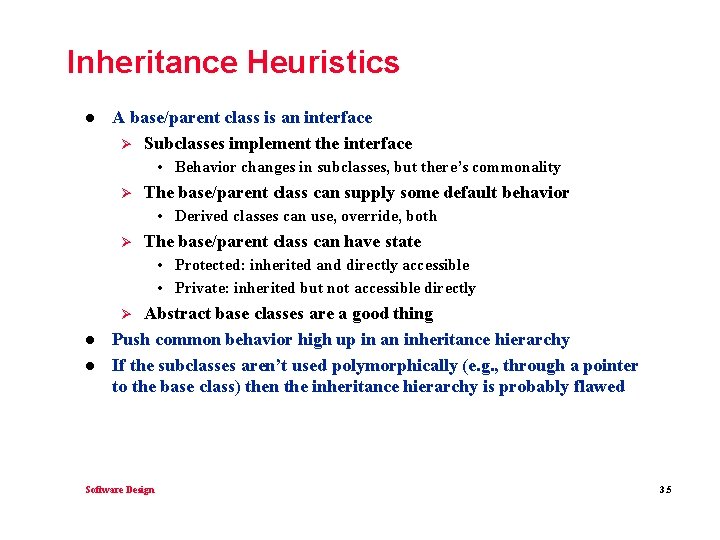
Inheritance Heuristics l A base/parent class is an interface Ø Subclasses implement the interface • Behavior changes in subclasses, but there’s commonality Ø The base/parent class can supply some default behavior • Derived classes can use, override, both Ø The base/parent class can have state • Protected: inherited and directly accessible • Private: inherited but not accessible directly Abstract base classes are a good thing Push common behavior high up in an inheritance hierarchy If the subclasses aren’t used polymorphically (e. g. , through a pointer to the base class) then the inheritance hierarchy is probably flawed Ø l l Software Design 3. 5
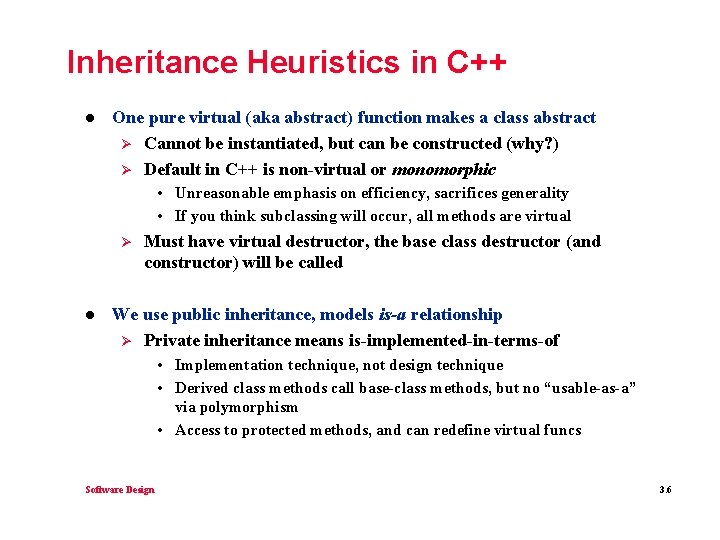
Inheritance Heuristics in C++ l One pure virtual (aka abstract) function makes a class abstract Ø Cannot be instantiated, but can be constructed (why? ) Ø Default in C++ is non-virtual or monomorphic • Unreasonable emphasis on efficiency, sacrifices generality • If you think subclassing will occur, all methods are virtual Ø l Must have virtual destructor, the base class destructor (and constructor) will be called We use public inheritance, models is-a relationship Ø Private inheritance means is-implemented-in-terms-of • Implementation technique, not design technique • Derived class methods call base-class methods, but no “usable-as-a” via polymorphism • Access to protected methods, and can redefine virtual funcs Software Design 3. 6
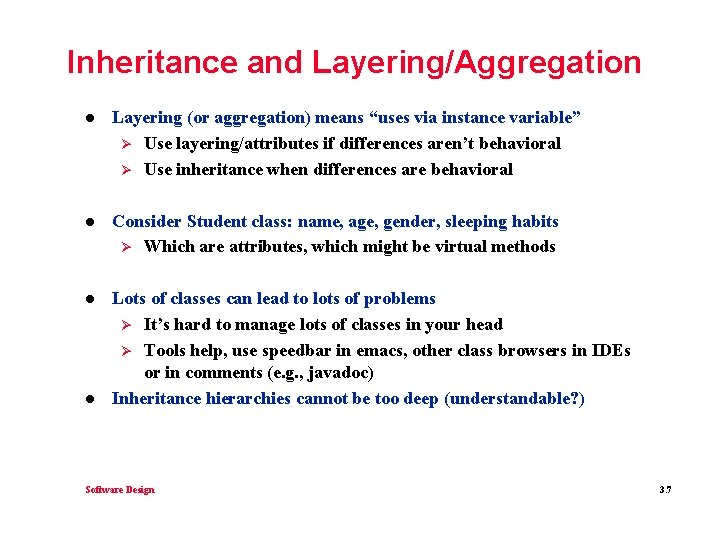
Inheritance and Layering/Aggregation l Layering (or aggregation) means “uses via instance variable” Ø Use layering/attributes if differences aren’t behavioral Ø Use inheritance when differences are behavioral l Consider Student class: name, age, gender, sleeping habits Ø Which are attributes, which might be virtual methods l Lots of classes can lead to lots of problems Ø It’s hard to manage lots of classes in your head Ø Tools help, use speedbar in emacs, other class browsers in IDEs or in comments (e. g. , javadoc) Inheritance hierarchies cannot be too deep (understandable? ) l Software Design 3. 7
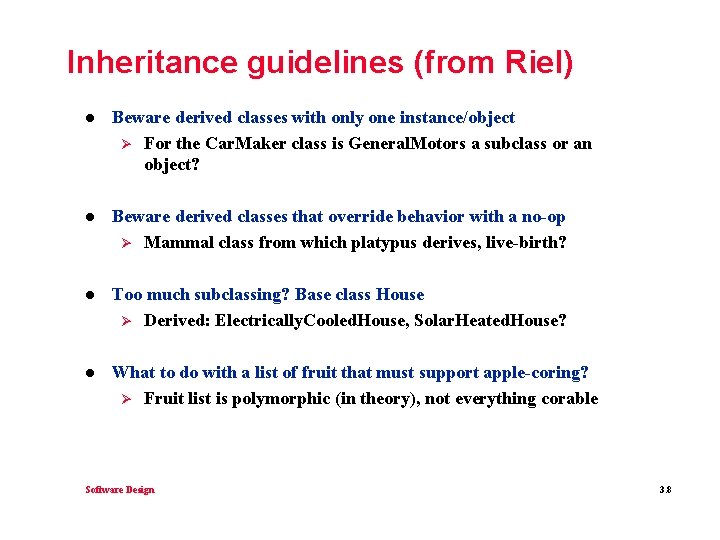
Inheritance guidelines (from Riel) l Beware derived classes with only one instance/object Ø For the Car. Maker class is General. Motors a subclass or an object? l Beware derived classes that override behavior with a no-op Ø Mammal class from which platypus derives, live-birth? l Too much subclassing? Base class House Ø Derived: Electrically. Cooled. House, Solar. Heated. House? l What to do with a list of fruit that must support apple-coring? Ø Fruit list is polymorphic (in theory), not everything corable Software Design 3. 8
Spreadsheet: Model, View, Controller l Model, View, Controller is MVC Ø Model stores and updates state of application • Example: calculator, what's the state of a GUI-calculator? Ø When model changes it notifies its views appropriately • Example: pressing a button on calculator, what happens? Ø The controller interprets commands, forwards them appropriately to model (usually not to view) • Example: code for calculator that reacts to button presses • Controller isn't always a separate class, often part of GUIbased view in M/VC Software Design 3. 9
How do Model/View communicate? l Model has-a view (or more than one) Ø Can call view methods Ø Can pass itself or its fields/info to view l View can call back on model passed (e. g. , by model itself) Ø Model passes this, view accepts Model as parameter Ø l Possible for controller/other class to pass model Controller contains both model and view (for example) Ø Constructs MV relationship Ø Possible for controller to be part of view (e. g. , GUI) Software Design 3. 10
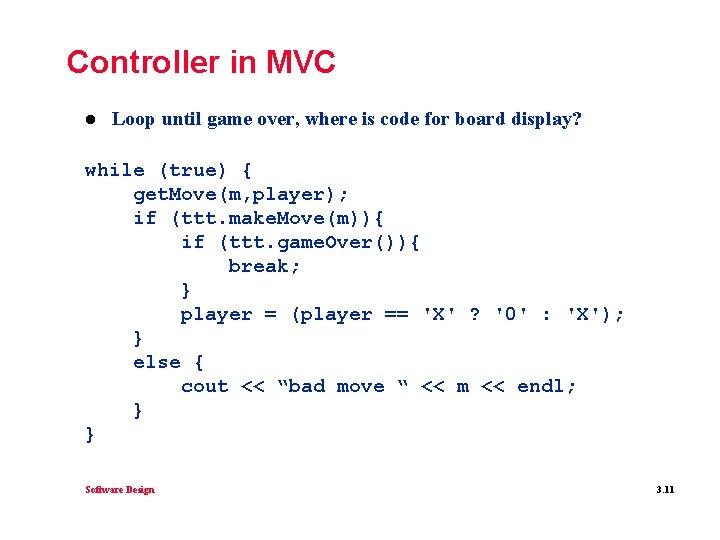
Controller in MVC l Loop until game over, where is code for board display? while (true) { get. Move(m, player); if (ttt. make. Move(m)){ if (ttt. game. Over()){ break; } player = (player == 'X' ? '0' : 'X'); } else { cout << “bad move “ << m << endl; } } Software Design 3. 11
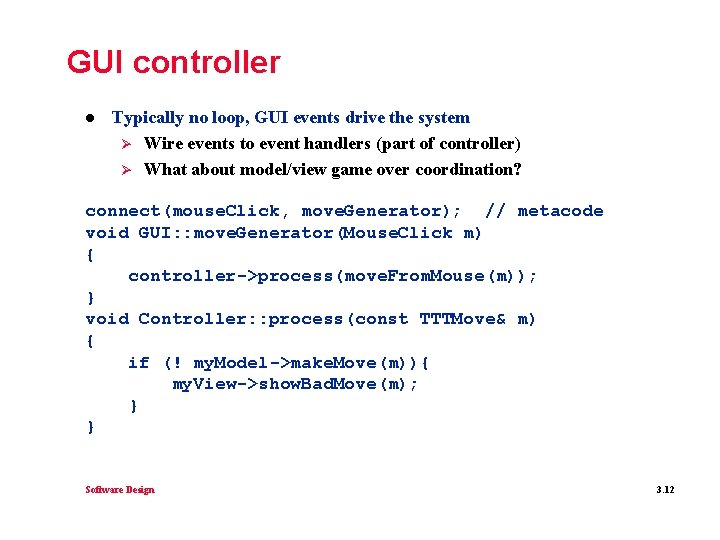
GUI controller l Typically no loop, GUI events drive the system Ø Wire events to event handlers (part of controller) Ø What about model/view game over coordination? connect(mouse. Click, move. Generator); // metacode void GUI: : move. Generator(Mouse. Click m) { controller->process(move. From. Mouse(m)); } void Controller: : process(const TTTMove& m) { if (! my. Model->make. Move(m)){ my. View->show. Bad. Move(m); } } Software Design 3. 12
Designing classes in general l Highly cohesive Ø Each class does one thing Ø Interface is minimally complete, avoid kitchen sink • What if client/user might want to hammer with an awl? l Loose coupling (and minimize coupling) Ø Classes depend on each other minimally Ø Changes in one don’t engender changes in another Ø Subclasses are tightly coupled, aggregates are not • Prefer Has-a to Is-a l Test classes independently Ø Unit testing means just that, and every class should have a unit test suite Software Design 3. 13
Tell/ask and the Law of Demeter l "Don't talk to strangers" Ø Call methods in this class, parameters, fields, for created local variables, for values returned by class methods Ø No good, why? from. Pile. top. Card(). get. Suit() From David. E. Smyth@jpl. nasa. gov Mon May 26 17: 33: 30 1997 >From: "David E. Smyth" >To: lieber@ccs. neu. edu >Subject: Law of Demeter > >I have been using Lo. D pervasively since about 1990, and it has taken >firm hold in many areas of the Jet Propulsion Laboratory. Major systems >which have used Lo. D extensively include the Telemetry Delivery System (a >real-time database begun in 1990), the Flight System Testbed, and Mars >Pathfinder flight software (both begun in 1993). We are going to use Lo. D >as a foundational software engineering principle for the X 2000 Europa >orbiter mission. I also used it within a couple of commercial systems >for Siemens in 91 -93, including a Lotus Notes like system, and a email >system. Software Design 3. 14
More heuristics (some from Riel) l Users depend on a class’s interface, but a class shouldn’t depend on its users l Be suspicious of “God”-classes, e. g. , Driver, Manager, System Ø Watch out for classes supporting method subsets l Beware of classes with lots of get/set methods l Support Model/View distinction Ø The model shouldn’t depend on the view, but should support multiple views l If a class contains an object it should directly use the object by sending it messages Software Design 3. 15
Working as part of a group see Mc. Carthy, Dynamics of Software Development l establish a shared vision Ø what was/is Freecell? what can we add? Ø harmonious sense of purpose l develop a creative environment Ø the more ideas the better, ideas are infectious Ø don’t flip the BOZO bit l scout the future Ø what’s coming, what’s the next project Ø what new technologies will affect this project Software Design 3. 16
Scheduling/Slipping l l Mc. Carthy page 50, Group Psyche, TEAM=SOFTWARE Ø anything you need to know about a team can be discovered by examining the software and vice versa Ø leadership is interpersonal choreography Ø greatness results from ministrations to group psyche which is an “abstract average of individual psyches” Ø mediocrity results from neglect of group psyche Slipping a schedule has no moral dimension (pp 124 -145) Ø no failure, no blame, inevitable consequence of complexity Ø don’t hide from problems Ø build from the slip, don’t destroy Ø hit the next milestone, even if redefined (“vegetate”) Software Design 3. 17
Towards being a hacker l See the hacker-faq (cps 108 web page) Ø Hackers solve problems and build things, and they believe in freedom and voluntary mutual help. To be accepted as a hacker, you have to behave as though you have this kind of attitude yourself. And to behave as though you have the attitude, you have to really believe the attitude. l The world is full of fascinating problems Ø no one should have to solve the same problem twice Ø boredom and drudgery are evil Ø freedom is good Ø attitude is no substitute for competence You may not work to get reputation, but the reputation is a real payment with consequences if you do the job well. Software Design 3. 18
Aside: ethics of software l What is intellectual property, why is it important? Ø what about FSF, GPL, copy-left, open source, … Ø what about money Ø what about monopolies l What does it mean to act ethically and responsibly? Ø What is the Unix philosophy? What about protection? What about copying? What about stealing? What about borrowing? Ø No harm, no foul? Is this a legitimate philosophy? l The future belongs to software developers/entrepreneurs Ø what can we do to ensure the world’s a good place? Software Design 3. 19
- Slides: 19