
Battery sizing worksheet E for Energy 2142022 IIT
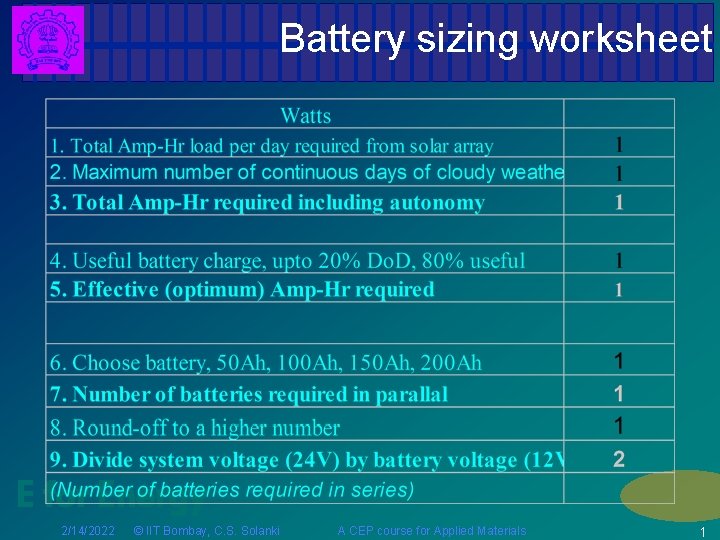
Battery sizing worksheet E for Energy 2/14/2022 © IIT Bombay, C. S. Solanki A CEP course for Applied Materials 1

Battery bank connections Battery E for Energy 2/14/2022 © IIT Bombay, C. S. Solanki A CEP course for Applied Materials 2
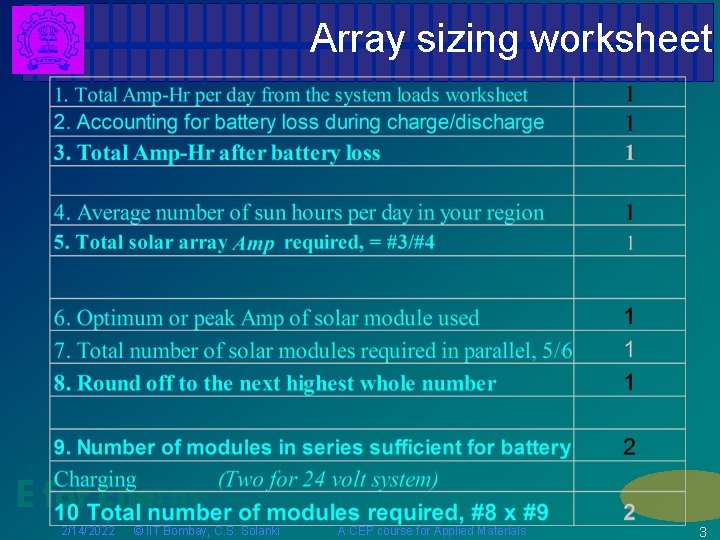
Array sizing worksheet E for Energy 2/14/2022 © IIT Bombay, C. S. Solanki A CEP course for Applied Materials 3

PV module array PV Module E for Energy 2/14/2022 © IIT Bombay, C. S. Solanki A CEP course for Applied Materials 4
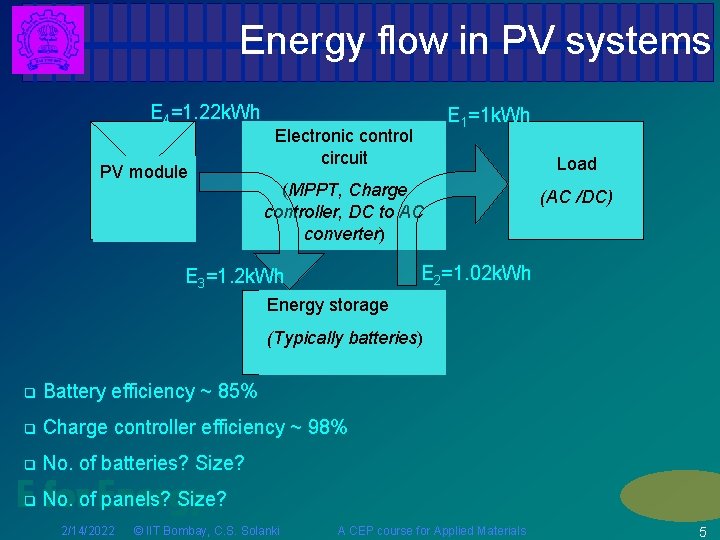
Energy flow in PV systems E 4=1. 22 k. Wh PV module E 1=1 k. Wh Electronic control circuit Load (MPPT, Charge controller, DC to AC converter) (AC /DC) E 2=1. 02 k. Wh E 3=1. 2 k. Wh Energy storage (Typically batteries) q Battery efficiency ~ 85% q Charge controller efficiency ~ 98% q No. of batteries? Size? No. of Energy panels? Size? E for q 2/14/2022 © IIT Bombay, C. S. Solanki A CEP course for Applied Materials 5
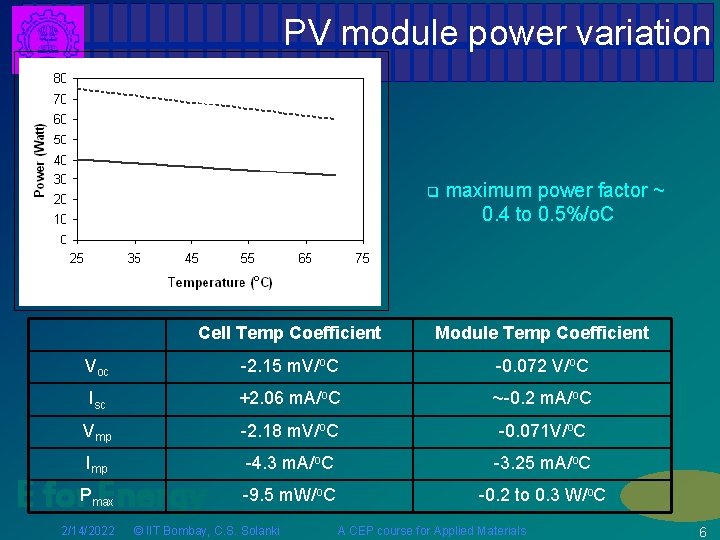
PV module power variation q maximum power factor ~ 0. 4 to 0. 5%/o. C Cell Temp Coefficient Module Temp Coefficient Voc -2. 15 m. V/o. C -0. 072 V/o. C Isc +2. 06 m. A/o. C ~-0. 2 m. A/o. C Vmp -2. 18 m. V/o. C -0. 071 V/o. C Imp -4. 3 m. A/o. C -3. 25 m. A/o. C -9. 5 m. W/o. C -0. 2 to 0. 3 W/o. C E for. P Energy max 2/14/2022 © IIT Bombay, C. S. Solanki A CEP course for Applied Materials 6

Design of PV irrigation system MPPT /inverter Motor & pump Storage tank PV module q Battery storage is not required, instead water storage can be used E for Energy 2/14/2022 © IIT Bombay, C. S. Solanki A CEP course for Applied Materials 7
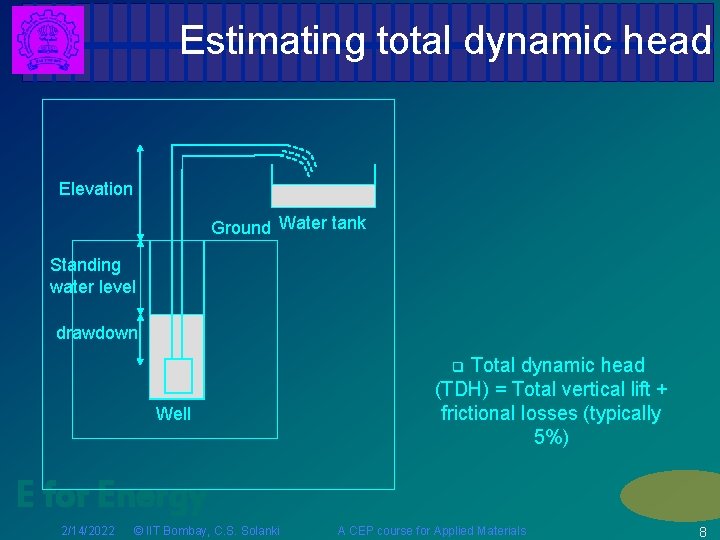
Estimating total dynamic head Elevation Ground Water tank Standing water level drawdown Total dynamic head (TDH) = Total vertical lift + frictional losses (typically 5%) q Well E for Energy 2/14/2022 © IIT Bombay, C. S. Solanki A CEP course for Applied Materials 8
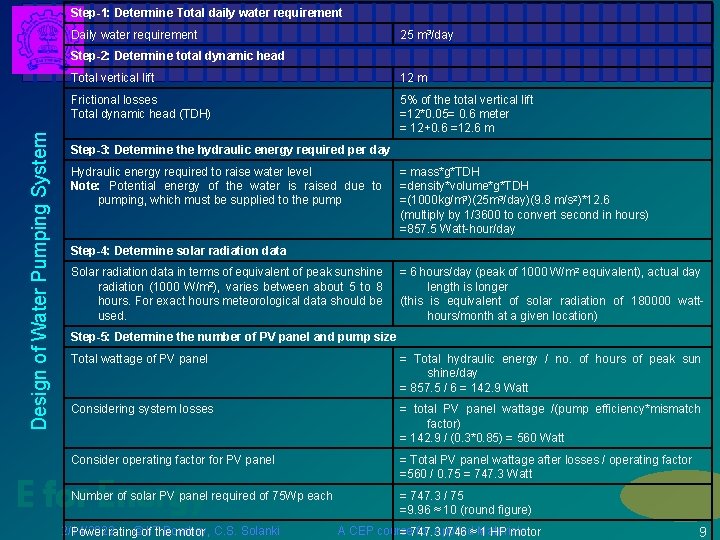
Step-1: Determine Total daily water requirement Daily water requirement 25 m 3/day Design of Water Pumping System Step-2: Determine total dynamic head Total vertical lift 12 m Frictional losses Total dynamic head (TDH) 5% of the total vertical lift =12*0. 05= 0. 6 meter = 12+0. 6 =12. 6 m Step-3: Determine the hydraulic energy required per day Hydraulic energy required to raise water level Note: Potential energy of the water is raised due to pumping, which must be supplied to the pump = mass*g*TDH =density*volume*g*TDH =(1000 kg/m 3)(25 m 3/day)(9. 8 m/s 2)*12. 6 (multiply by 1/3600 to convert second in hours) =857. 5 Watt-hour/day Step-4: Determine solar radiation data Solar radiation data in terms of equivalent of peak sunshine radiation (1000 W/m 2), varies between about 5 to 8 hours. For exact hours meteorological data should be used. = 6 hours/day (peak of 1000 W/m 2 equivalent), actual day length is longer (this is equivalent of solar radiation of 180000 watthours/month at a given location) Step-5: Determine the number of PV panel and pump size Total wattage of PV panel = Total hydraulic energy / no. of hours of peak sun shine/day = 857. 5 / 6 = 142. 9 Watt Considering system losses = total PV panel wattage /(pump efficiency*mismatch factor) = 142. 9 / (0. 3*0. 85) = 560 Watt Consider operating factor for PV panel = Total PV panel wattage after losses / operating factor =560 / 0. 75 = 747. 3 Watt E for Energy Number of solar PV panel required of 75 Wp each 2/14/2022 Bombay, Power rating©of. IITthe motor C. S. Solanki = 747. 3 / 75 =9. 96 ≈ 10 (round figure) A CEP course for Applied = 747. 3 /746 ≈Materials 1 HP motor 9
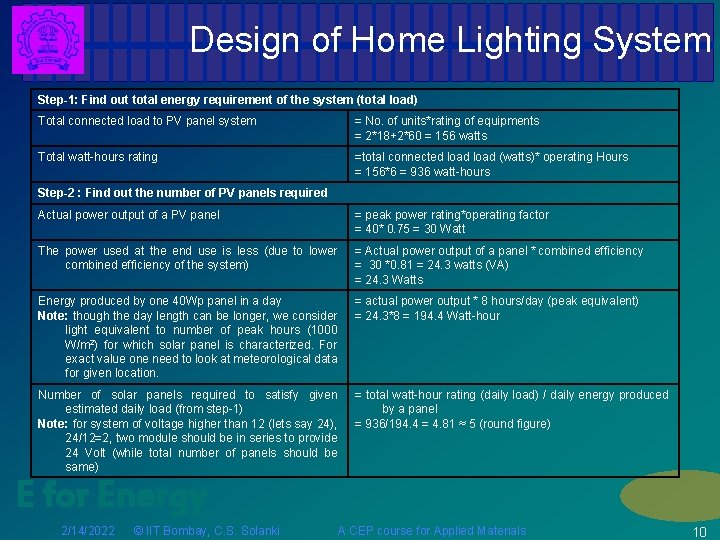
Design of Home Lighting System Step-1: Find out total energy requirement of the system (total load) Total connected load to PV panel system = No. of units*rating of equipments = 2*18+2*60 = 156 watts Total watt-hours rating =total connected load (watts)* operating Hours = 156*6 = 936 watt-hours Step-2 : Find out the number of PV panels required Actual power output of a PV panel = peak power rating*operating factor = 40* 0. 75 = 30 Watt The power used at the end use is less (due to lower combined efficiency of the system) = Actual power output of a panel * combined efficiency = 30 *0. 81 = 24. 3 watts (VA) = 24. 3 Watts Energy produced by one 40 Wp panel in a day Note: though the day length can be longer, we consider light equivalent to number of peak hours (1000 W/m 2) for which solar panel is characterized. For exact value one need to look at meteorological data for given location. = actual power output * 8 hours/day (peak equivalent) = 24. 3*8 = 194. 4 Watt-hour Number of solar panels required to satisfy given estimated daily load (from step-1) Note: for system of voltage higher than 12 (lets say 24), 24/12=2, two module should be in series to provide 24 Volt (while total number of panels should be same) = total watt-hour rating (daily load) / daily energy produced by a panel = 936/194. 4 = 4. 81 ≈ 5 (round figure) E for Energy 2/14/2022 © IIT Bombay, C. S. Solanki A CEP course for Applied Materials 10
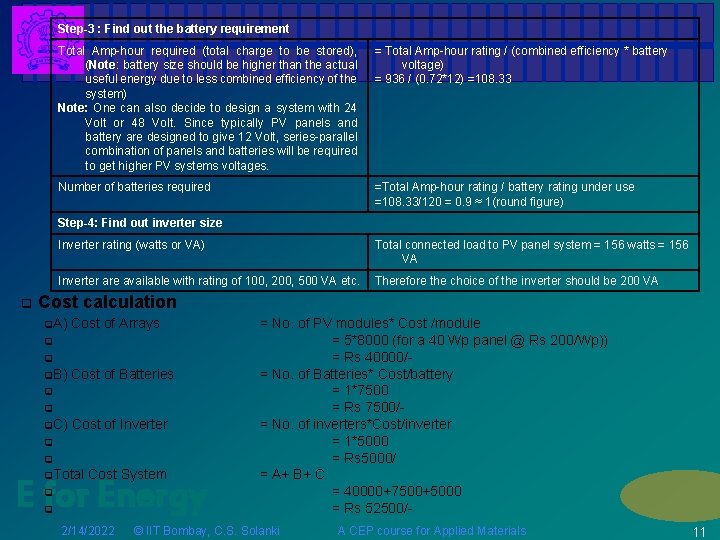
Step-3 : Find out the battery requirement Total Amp-hour required (total charge to be stored), (Note: battery size should be higher than the actual useful energy due to less combined efficiency of the system) Note: One can also decide to design a system with 24 Volt or 48 Volt. Since typically PV panels and battery are designed to give 12 Volt, series-parallel combination of panels and batteries will be required to get higher PV systems voltages. = Total Amp-hour rating / (combined efficiency * battery voltage) = 936 / (0. 72*12) =108. 33 Number of batteries required =Total Amp-hour rating / battery rating under use =108. 33/120 = 0. 9 ≈ 1(round figure) Step-4: Find out inverter size q Inverter rating (watts or VA) Total connected load to PV panel system = 156 watts = 156 VA Inverter are available with rating of 100, 200, 500 VA etc. Therefore the choice of the inverter should be 200 VA Cost calculation q. A) Cost of Arrays q q q. B) Cost of Batteries q q q. C) Cost of Inverter q q q. Total Cost System E for Energy q q 2/14/2022 = No. of PV modules* Cost /module = 5*8000 (for a 40 Wp panel @ Rs 200/Wp)) = Rs 40000/= No. of Batteries* Cost/battery = 1*7500 = Rs 7500/= No. of inverters*Cost/inverter = 1*5000 = Rs 5000/ = A+ B+ C = 40000+7500+5000 = Rs 52500/- © IIT Bombay, C. S. Solanki A CEP course for Applied Materials 11
Cost Analysis E for Energy 2/14/2022 © IIT Bombay, C. S. Solanki A CEP course for Applied Materials 12
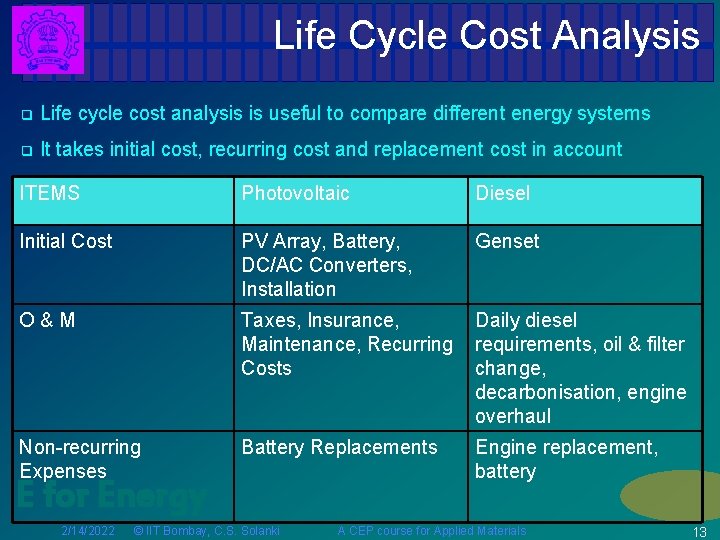
Life Cycle Cost Analysis q Life cycle cost analysis is useful to compare different energy systems q It takes initial cost, recurring cost and replacement cost in account ITEMS Photovoltaic Diesel Initial Cost PV Array, Battery, DC/AC Converters, Installation Genset O&M Taxes, Insurance, Maintenance, Recurring Costs Daily diesel requirements, oil & filter change, decarbonisation, engine overhaul Non-recurring Expenses Battery Replacements Engine replacement, battery E for Energy 2/14/2022 © IIT Bombay, C. S. Solanki A CEP course for Applied Materials 13
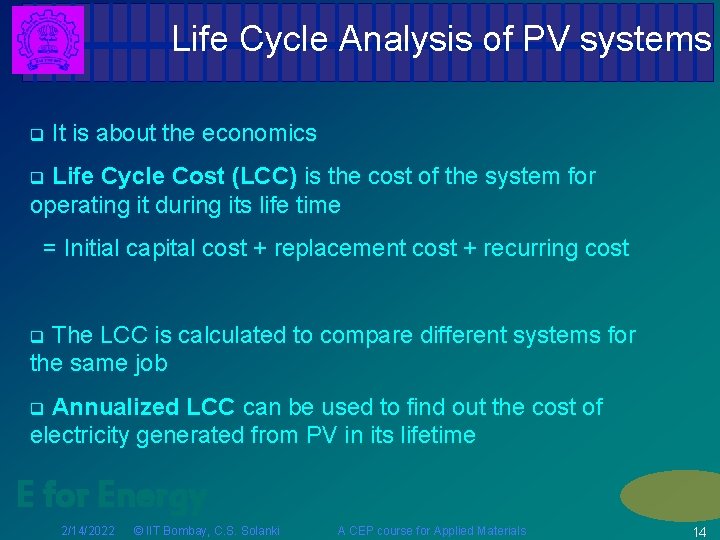
Life Cycle Analysis of PV systems q It is about the economics Life Cycle Cost (LCC) is the cost of the system for operating it during its life time q = Initial capital cost + replacement cost + recurring cost The LCC is calculated to compare different systems for the same job q Annualized LCC can be used to find out the cost of electricity generated from PV in its lifetime q E for Energy 2/14/2022 © IIT Bombay, C. S. Solanki A CEP course for Applied Materials 14
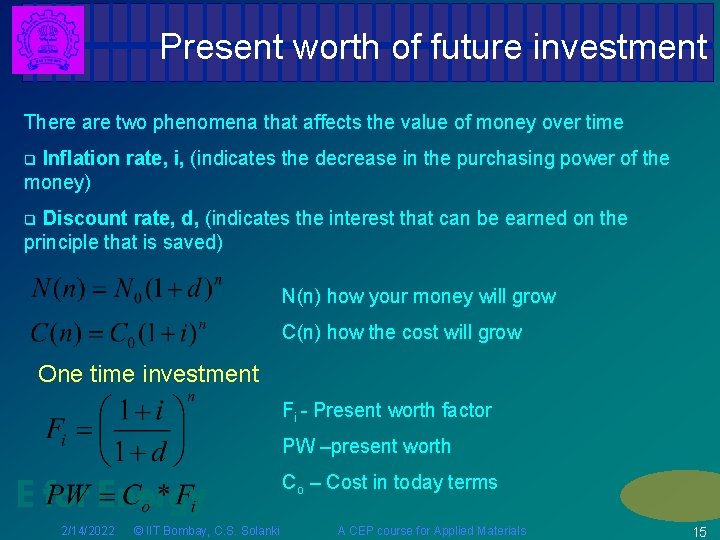
Present worth of future investment There are two phenomena that affects the value of money over time Inflation rate, i, (indicates the decrease in the purchasing power of the money) q Discount rate, d, (indicates the interest that can be earned on the principle that is saved) q N(n) how your money will grow C(n) how the cost will grow One time investment Fi - Present worth factor PW –present worth E for Energy 2/14/2022 © IIT Bombay, C. S. Solanki Co – Cost in today terms A CEP course for Applied Materials 15
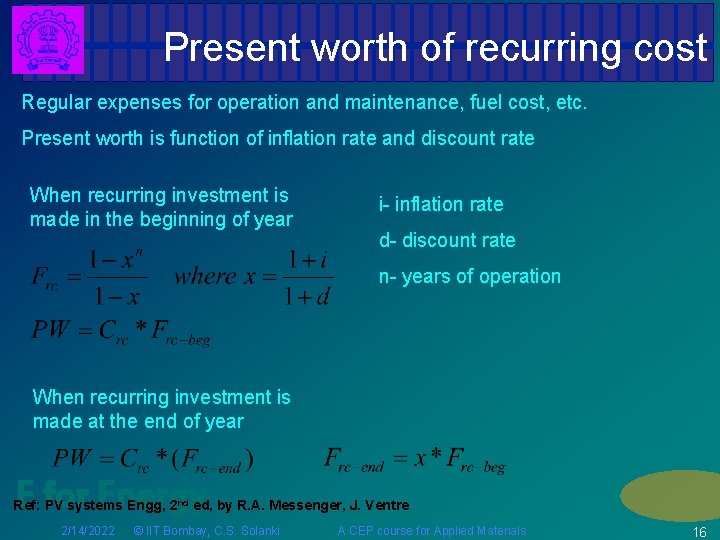
Present worth of recurring cost Regular expenses for operation and maintenance, fuel cost, etc. Present worth is function of inflation rate and discount rate When recurring investment is made in the beginning of year i- inflation rate d- discount rate n- years of operation When recurring investment is made at the end of year E for Energy Ref: PV systems Engg, 2 nd ed, by R. A. Messenger, J. Ventre 2/14/2022 © IIT Bombay, C. S. Solanki A CEP course for Applied Materials 16
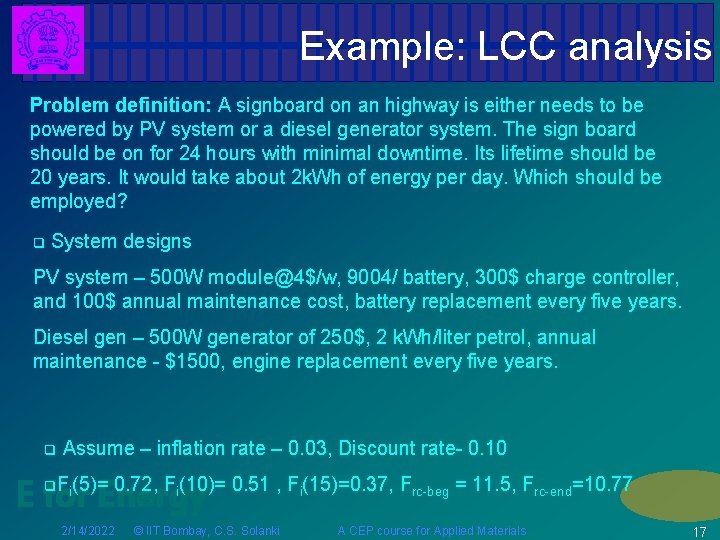
Example: LCC analysis Problem definition: A signboard on an highway is either needs to be powered by PV system or a diesel generator system. The sign board should be on for 24 hours with minimal downtime. Its lifetime should be 20 years. It would take about 2 k. Wh of energy per day. Which should be employed? q System designs PV system – 500 W module@4$/w, 9004/ battery, 300$ charge controller, and 100$ annual maintenance cost, battery replacement every five years. Diesel gen – 500 W generator of 250$, 2 k. Wh/liter petrol, annual maintenance - $1500, engine replacement every five years. q Assume – inflation rate – 0. 03, Discount rate- 0. 10 q. Fi(5)= 0. 72, Fi(10)= 0. 51 , Fi(15)=0. 37, Frc-beg = 11. 5, Frc-end=10. 77 E for Energy 2/14/2022 © IIT Bombay, C. S. Solanki A CEP course for Applied Materials 17
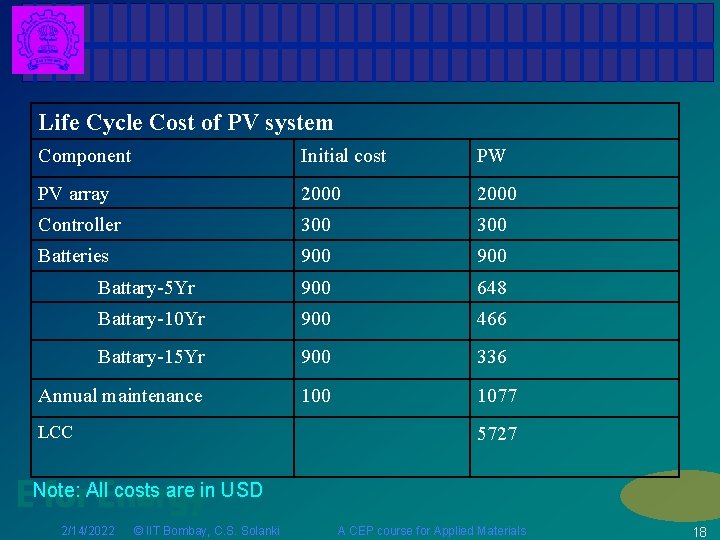
Life Cycle Cost of PV system Component Initial cost PW PV array 2000 Controller 300 Batteries 900 Battary-5 Yr 900 648 Battary-10 Yr 900 466 Battary-15 Yr 900 336 Annual maintenance 100 1077 LCC 5727 costs are in USD ENote: for. All. Energy 2/14/2022 © IIT Bombay, C. S. Solanki A CEP course for Applied Materials 18
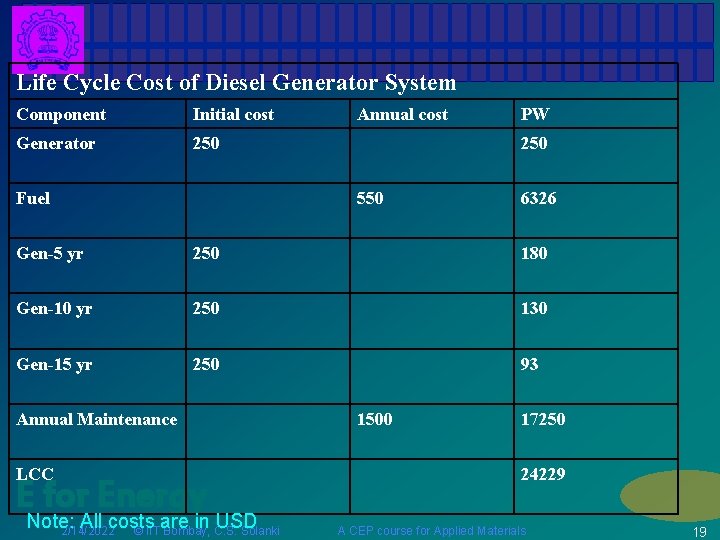
Life Cycle Cost of Diesel Generator System Component Initial cost Generator 250 Fuel Annual cost PW 250 550 6326 Gen-5 yr 250 180 Gen-10 yr 250 130 Gen-15 yr 250 93 Annual Maintenance LCC E for Energy Note: All costs are in USD 2/14/2022 © IIT Bombay, C. S. Solanki 1500 17250 24229 A CEP course for Applied Materials 19
Annualized LCC q It gives an idea about what is the annual cost at PW q Simply can not be obtained by dividing LCC by 12 q One should divide it by Frc-beg or Frc-end, q So what is ALCC for PV and DG systems? What would be the cost of electricity produced from the two systems? q E for Energy 2/14/2022 © IIT Bombay, C. S. Solanki A CEP course for Applied Materials 20
Thank you for your E for Energy attention 2/14/2022 © IIT Bombay, C. S. Solanki A CEP course for Applied Materials 21
E for Energy 2/14/2022 © IIT Bombay, C. S. Solanki Thank you for your attention A CEP course for Applied Materials 22
- Slides: 22