
Batteries and Galvanic Cells 1 Why Study Electrochemistry

Batteries and Galvanic Cells 1
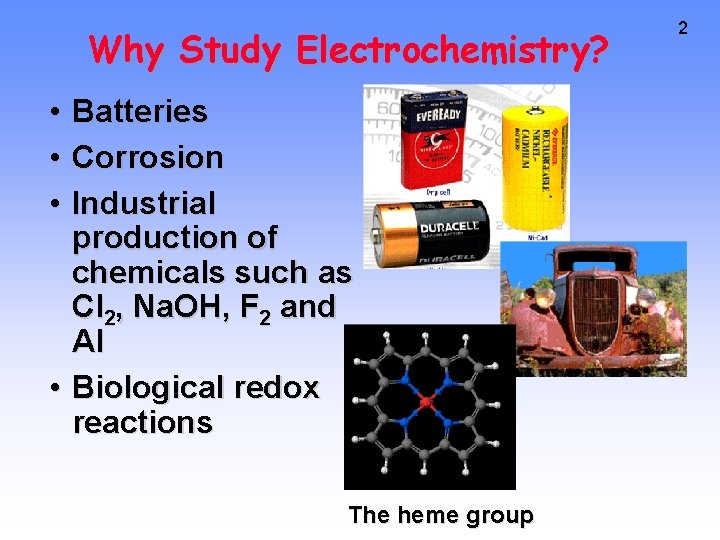
Why Study Electrochemistry? • • • Batteries Corrosion Industrial production of chemicals such as Cl 2, Na. OH, F 2 and Al • Biological redox reactions The heme group 2
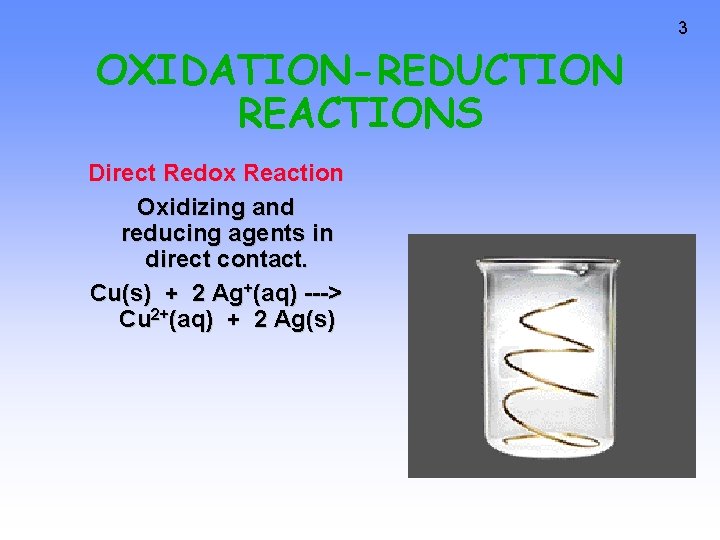
3 OXIDATION-REDUCTION REACTIONS Direct Redox Reaction Oxidizing and reducing agents in direct contact. Cu(s) + 2 Ag+(aq) ---> Cu 2+(aq) + 2 Ag(s)

4 OXIDATION-REDUCTION REACTIONS Indirect Redox Reaction A battery functions by transferring electrons through an external wire from the reducing agent to the oxidizing agent.
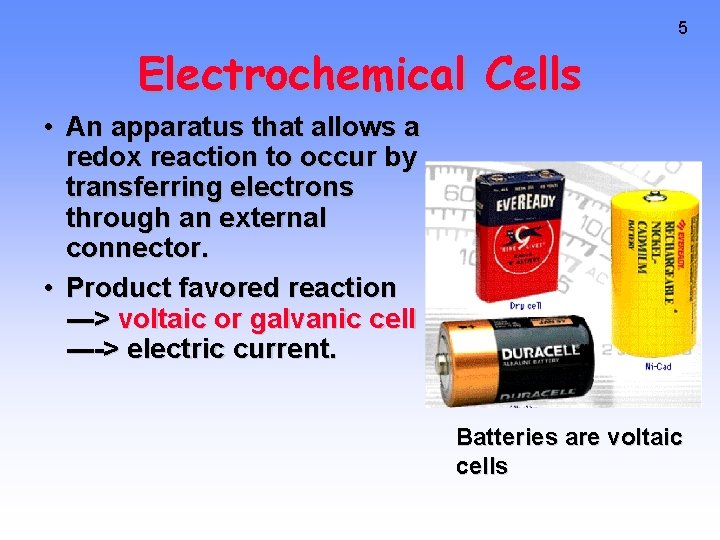
5 Electrochemical Cells • An apparatus that allows a redox reaction to occur by transferring electrons through an external connector. • Product favored reaction ---> voltaic or galvanic cell ----> electric current. Batteries are voltaic cells
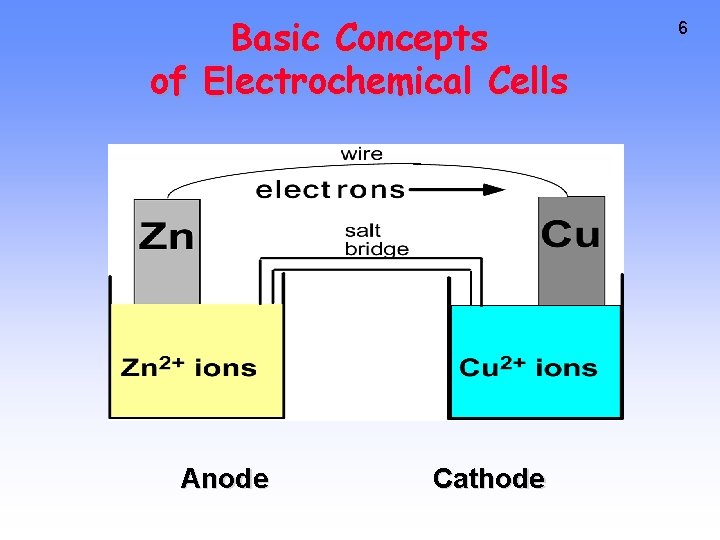
Basic Concepts of Electrochemical Cells Anode Cathode 6
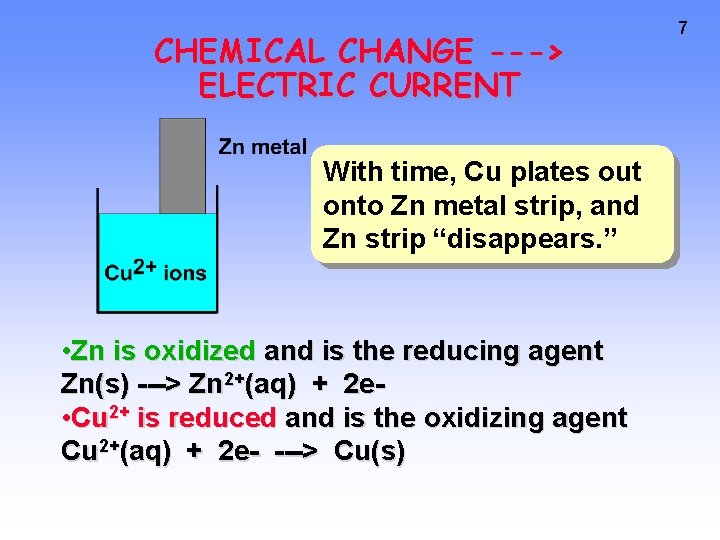
CHEMICAL CHANGE ---> ELECTRIC CURRENT With time, Cu plates out onto Zn metal strip, and Zn strip “disappears. ” • Zn is oxidized and is the reducing agent Zn(s) ---> Zn 2+(aq) + 2 e • Cu 2+ is reduced and is the oxidizing agent Cu 2+(aq) + 2 e- ---> Cu(s) 7
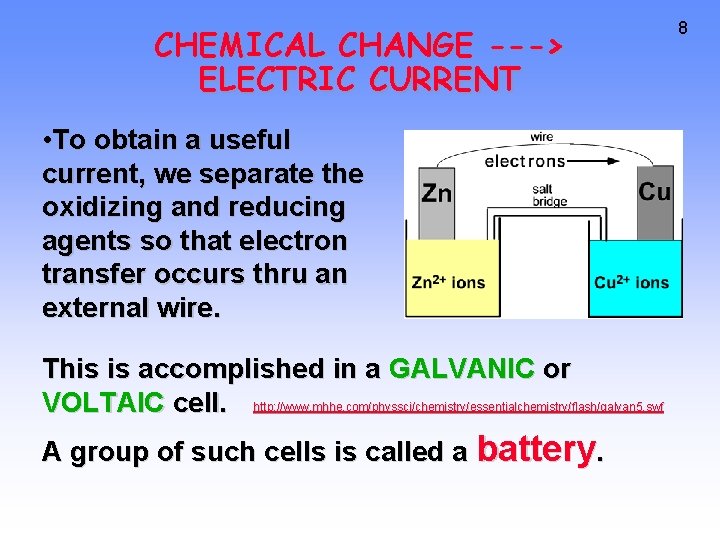
CHEMICAL CHANGE ---> ELECTRIC CURRENT • To obtain a useful current, we separate the oxidizing and reducing agents so that electron transfer occurs thru an external wire. This is accomplished in a GALVANIC or VOLTAIC cell. http: //www. mhhe. com/physsci/chemistry/essentialchemistry/flash/galvan 5. swf A group of such cells is called a battery. 8
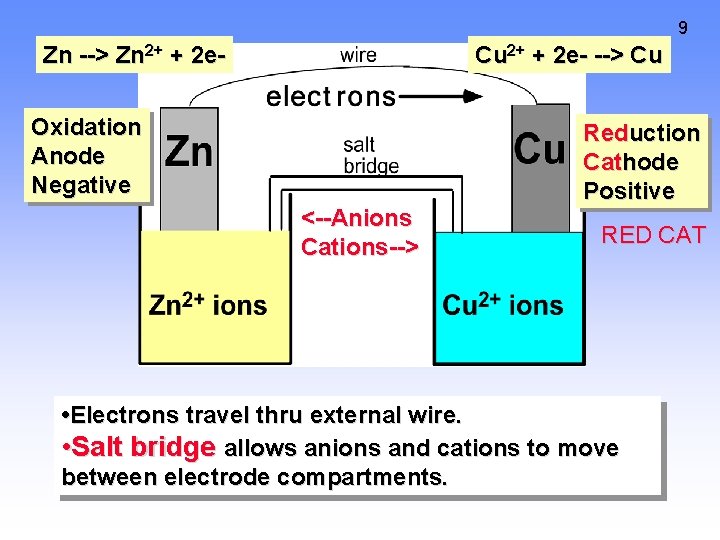
9 Zn --> Zn 2+ + 2 e- Cu 2+ + 2 e- --> Cu Oxidation Anode Negative <--Anions Cations--> Reduction Cathode Positive RED CAT • Electrons travel thru external wire. • Salt bridge allows anions and cations to move between electrode compartments.

10 Terms Used for Voltaic Cells
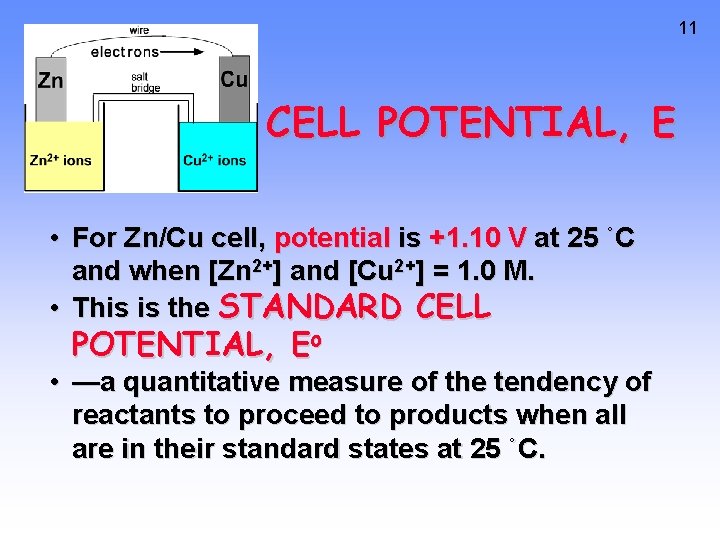
11 CELL POTENTIAL, E • For Zn/Cu cell, potential is +1. 10 V at 25 ˚C and when [Zn 2+] and [Cu 2+] = 1. 0 M. • This is the STANDARD CELL POTENTIAL, Eo • —a quantitative measure of the tendency of reactants to proceed to products when all are in their standard states at 25 ˚C.
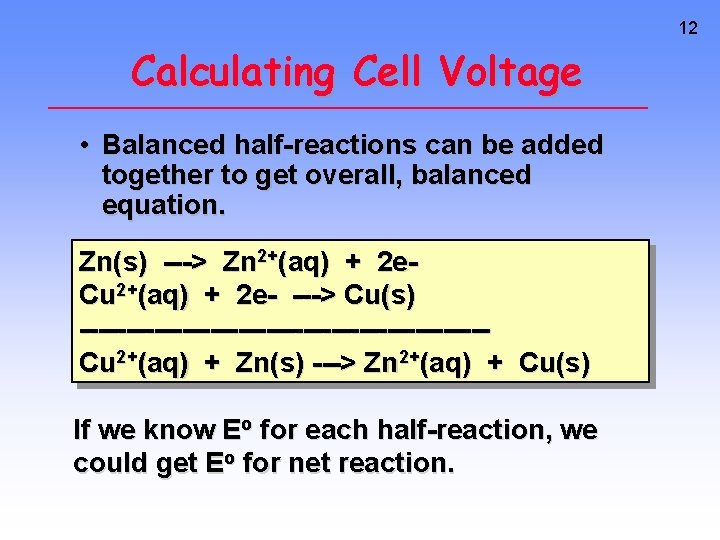
12 Calculating Cell Voltage • Balanced half-reactions can be added together to get overall, balanced equation. Zn(s) ---> Zn 2+(aq) + 2 e. Cu 2+(aq) + 2 e- ---> Cu(s) ----------------------Cu 2+(aq) + Zn(s) ---> Zn 2+(aq) + Cu(s) If we know Eo for each half-reaction, we could get Eo for net reaction.
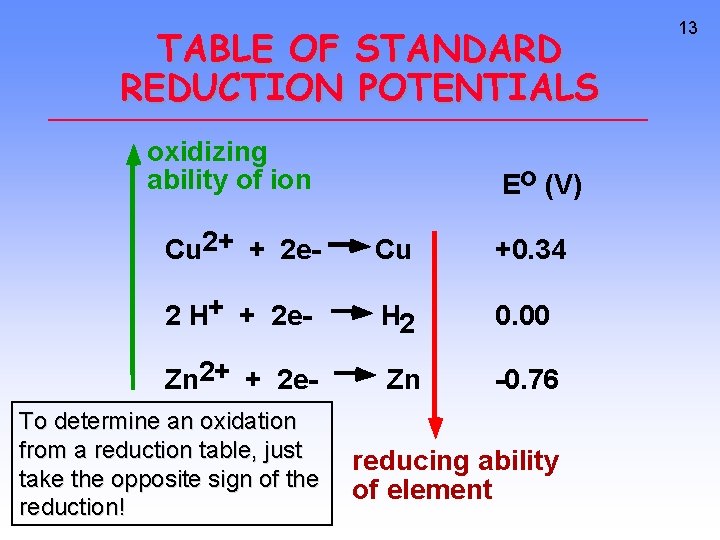
TABLE OF STANDARD REDUCTION POTENTIALS oxidizing ability of ion Eo (V) Cu 2+ + 2 e- Cu +0. 34 2 H+ + 2 e- H 2 0. 00 Zn 2+ + 2 e- Zn -0. 76 To determine an oxidation from a reduction table, just take the opposite sign of the reduction! reducing ability of element 13
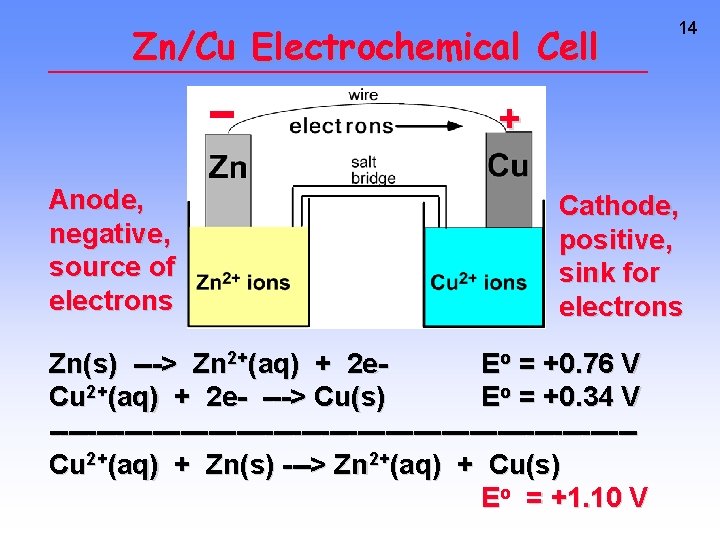
Zn/Cu Electrochemical Cell 14 + Anode, negative, source of electrons Cathode, positive, sink for electrons Zn(s) ---> Zn 2+(aq) + 2 e. Eo = +0. 76 V Cu 2+(aq) + 2 e- ---> Cu(s) Eo = +0. 34 V -------------------------------Cu 2+(aq) + Zn(s) ---> Zn 2+(aq) + Cu(s) Eo = +1. 10 V
15
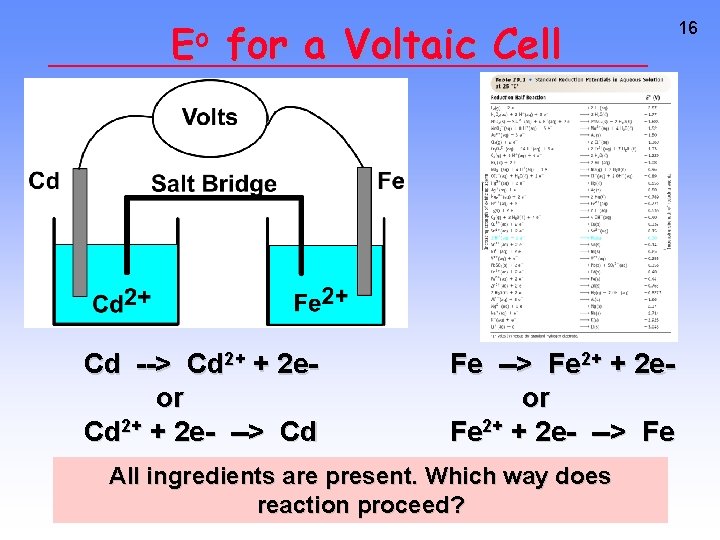
Eo for a Voltaic Cell Cd --> Cd 2+ + 2 eor Cd 2+ + 2 e- --> Cd Fe --> Fe 2+ + 2 eor Fe 2+ + 2 e- --> Fe All ingredients are present. Which way does reaction proceed? 16
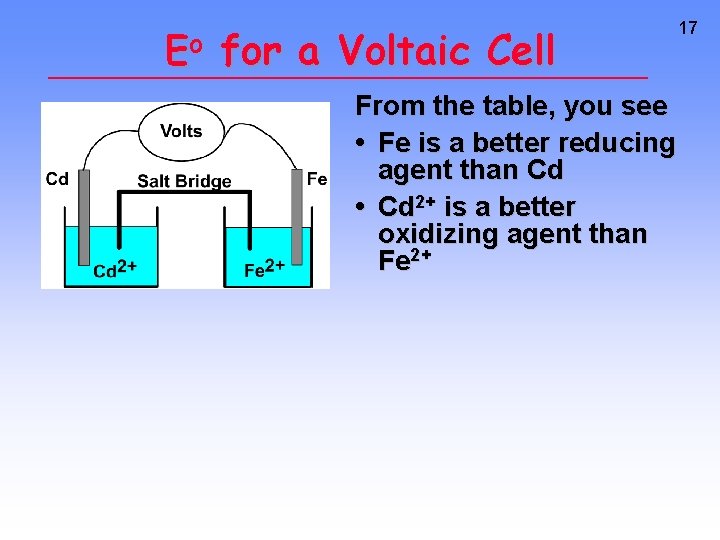
Eo for a Voltaic Cell From the table, you see • Fe is a better reducing agent than Cd • Cd 2+ is a better oxidizing agent than Fe 2+ 17
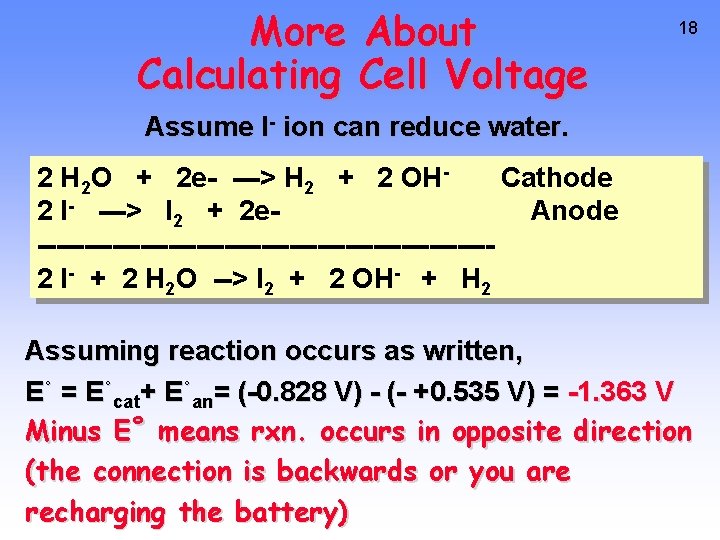
More About Calculating Cell Voltage 18 Assume I- ion can reduce water. 2 H 2 O + 2 e- ---> H 2 + 2 OHCathode 2 I- ---> I 2 + 2 e. Anode ------------------------2 I- + 2 H 2 O --> I 2 + 2 OH- + H 2 Assuming reaction occurs as written, E˚ = E˚cat+ E˚an= (-0. 828 V) - (- +0. 535 V) = -1. 363 V Minus E˚ means rxn. occurs in opposite direction (the connection is backwards or you are recharging the battery)
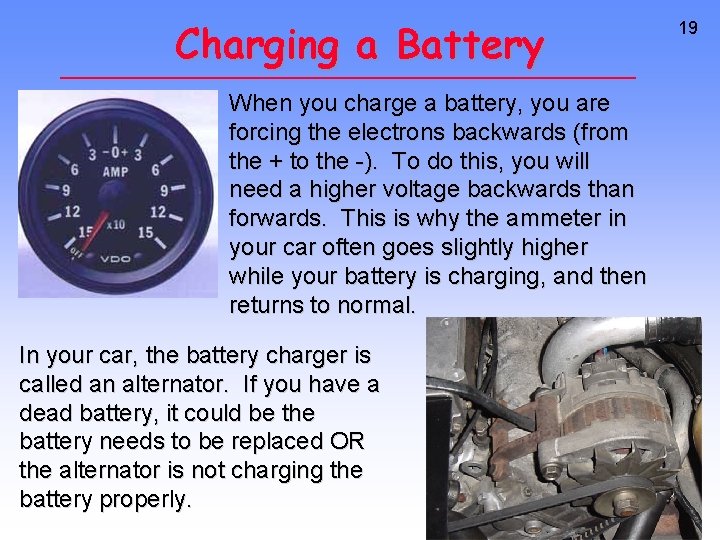
Charging a Battery When you charge a battery, you are forcing the electrons backwards (from the + to the -). To do this, you will need a higher voltage backwards than forwards. This is why the ammeter in your car often goes slightly higher while your battery is charging, and then returns to normal. In your car, the battery charger is called an alternator. If you have a dead battery, it could be the battery needs to be replaced OR the alternator is not charging the battery properly. 19
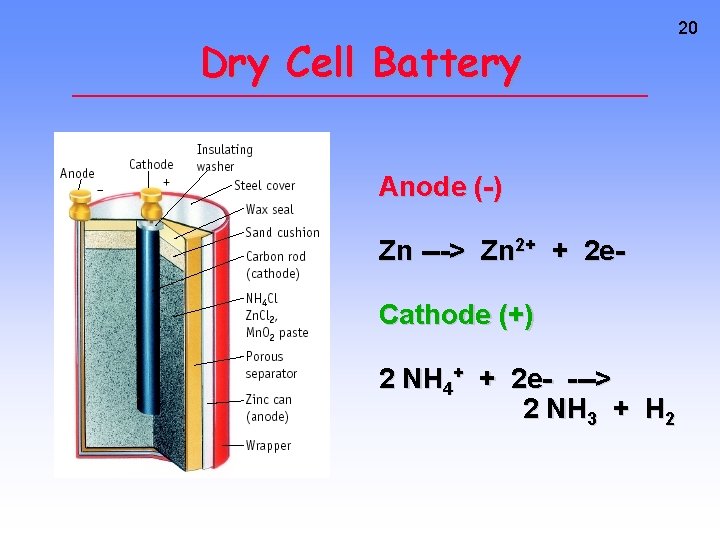
Dry Cell Battery Anode (-) Zn ---> Zn 2+ + 2 e. Cathode (+) 2 NH 4+ + 2 e- ---> 2 NH 3 + H 2 20
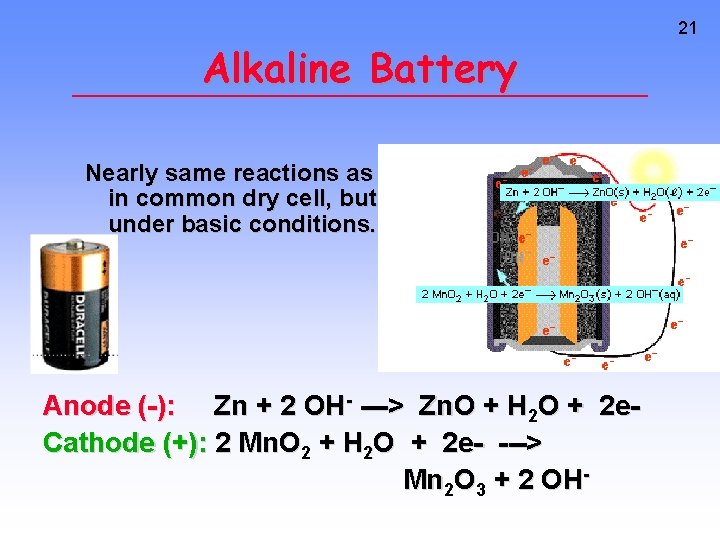
Alkaline Battery Nearly same reactions as in common dry cell, but under basic conditions. Anode (-): Zn + 2 OH- ---> Zn. O + H 2 O + 2 e. Cathode (+): 2 Mn. O 2 + H 2 O + 2 e- ---> Mn 2 O 3 + 2 OH- 21
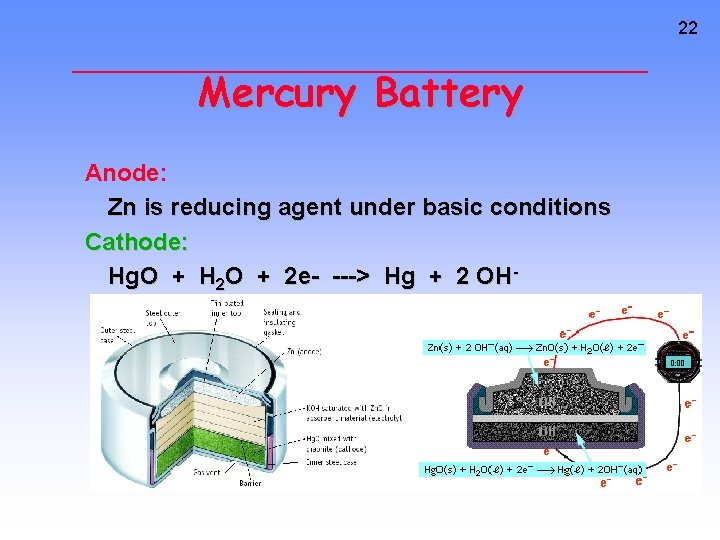
22 Mercury Battery Anode: Zn is reducing agent under basic conditions Cathode: Hg. O + H 2 O + 2 e- ---> Hg + 2 OH-
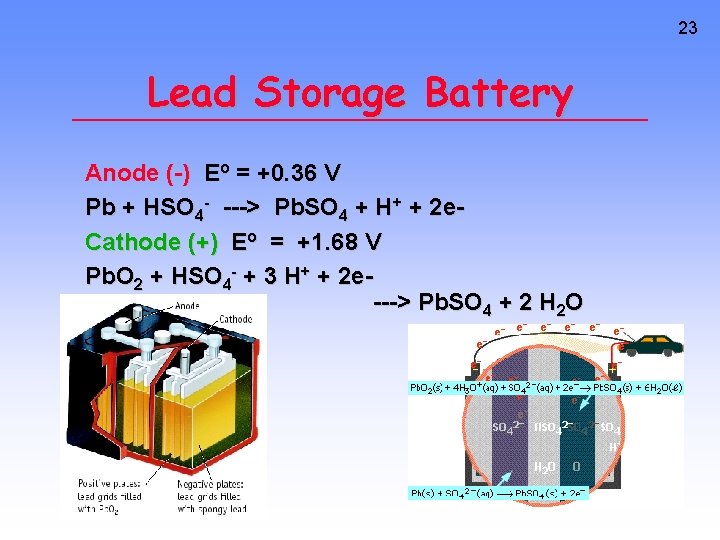
23 Lead Storage Battery Anode (-) Eo = +0. 36 V Pb + HSO 4 - ---> Pb. SO 4 + H+ + 2 e. Cathode (+) Eo = +1. 68 V Pb. O 2 + HSO 4 - + 3 H+ + 2 e---> Pb. SO 4 + 2 H 2 O
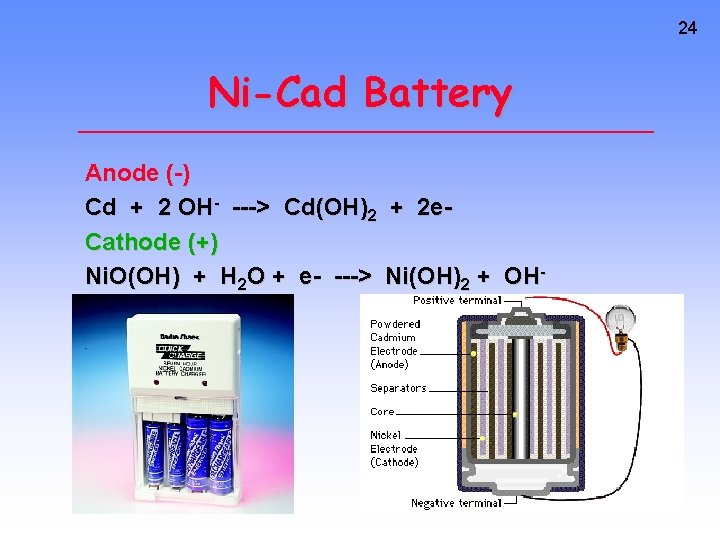
24 Ni-Cad Battery Anode (-) Cd + 2 OH- ---> Cd(OH)2 + 2 e. Cathode (+) Ni. O(OH) + H 2 O + e- ---> Ni(OH)2 + OH-
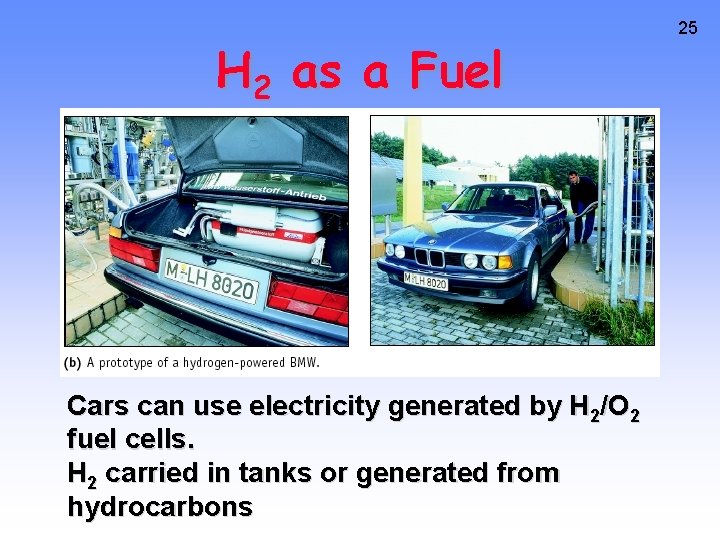
H 2 as a Fuel Cars can use electricity generated by H 2/O 2 fuel cells. H 2 carried in tanks or generated from hydrocarbons 25
- Slides: 25