
Batch Indexing Enviromapper Web Services and GIS Tools
Batch Indexing, Enviromapper, Web Services, and GIS Tools Randy Hill, Kevin Christian US EPA OWOW/AWPD/MB November 28, 2007 1
What is a Web Service? Ø A web service is a computer-to-computer protocol that allows for the direct sharing of information. Ø Web services allow for data from multiple sources to be packaged together in one layout, web presentation, or application. Ø Typically, a web service has input parameters, and pre-defined output format Ø These are the basic principles under which the Exchange Network functions 2
A common web service example Ø Weather bug: l l The weather bug software is something that many are familiar with. It runs on a very basic web service. It has basic input parameters: zip code It has a defined output format (xml file) The actual weather data does not need to be stored on your computer, it just pulls the data via a web service, and then displays that information in a user friendly format. 3
What Web Services are being planned? Ø Four core services are being developed: l l Watershed/Station Catalog service – provides summary information on what data are available Project Catalog service – provides summary information by projects based on an input of min/max latitude/longitude Stations service – provides specific station information Results service – provides results for modeling, analysis, and decision making 4
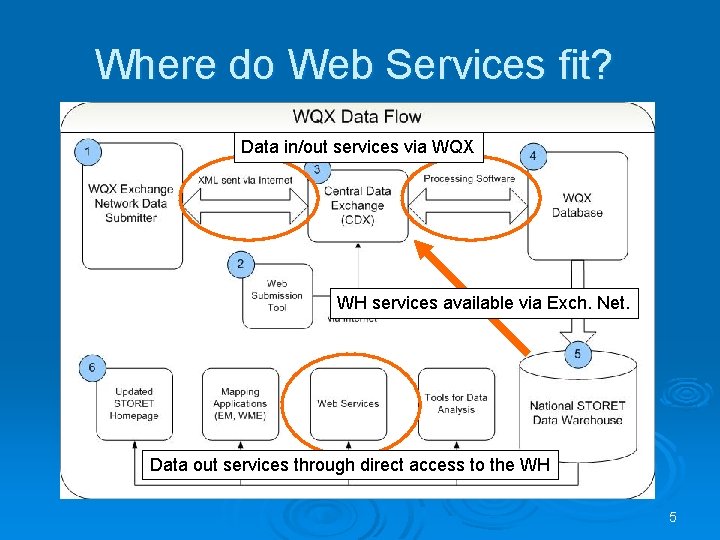
Where do Web Services fit? Data in/out services via WQX WH services available via Exch. Net. Data out services through direct access to the WH 5
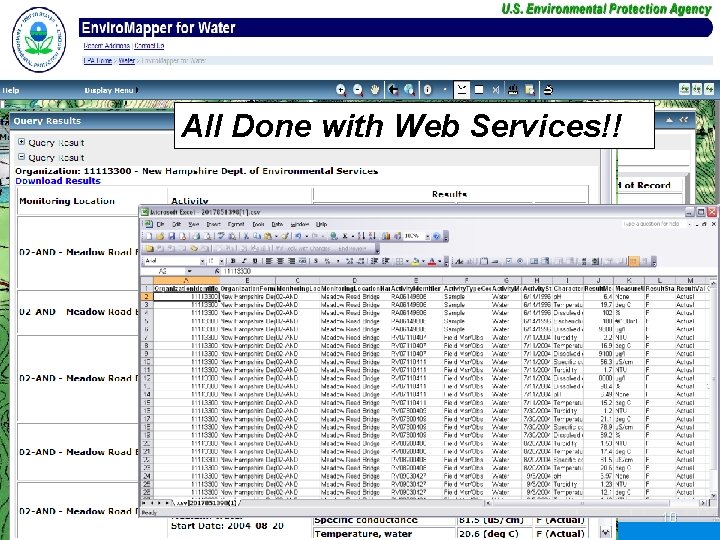
So What? Ø Web Services allow for more accessibility to the data. Ø Allows for any application that can consume a web service to be able to access the data that are available in STORET l Includes: • • Microsoft Excel Mapping Applications Models Or any other custom application 6
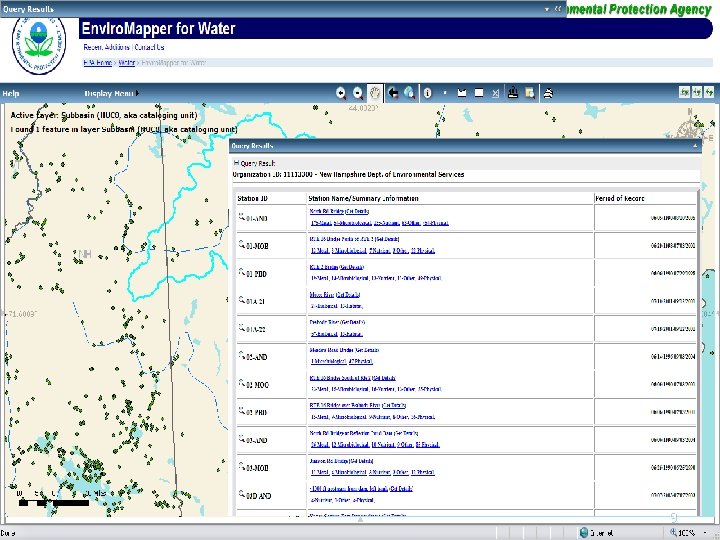
Why Web Services? Ø Allow for you to create one method for accessing data that can be reused in multiple ways Ø Some example applications: l l l EPA’s Watershed Summary reports The next release of Enviromapper for Water An example Virtual Earth application 7
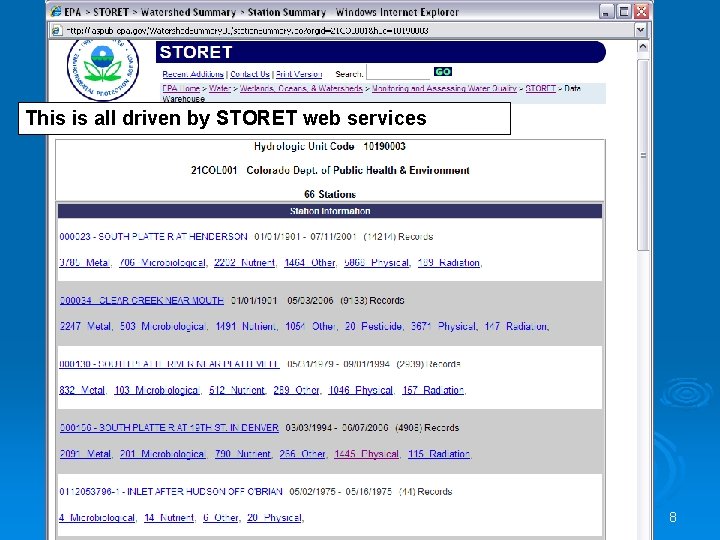
This is all driven by STORET web services 8
9
All Done with Web Services!! 10
Virtual Earth Ø RANDY: Either live demo or slides like Enviromapper 11
Batch Indexing New development that EPA is working on Ø Allow for any new stations submitted via WQX to be automatically georeferenced to the NHD+ Ø The Georeferenced reach codes would be returned to the data provider, as well an opportunity to QA the georeferenced locations Ø This will use a concept called ‘Rain Drop’ to ensure that points are tied to the correct NHD reach Ø 12
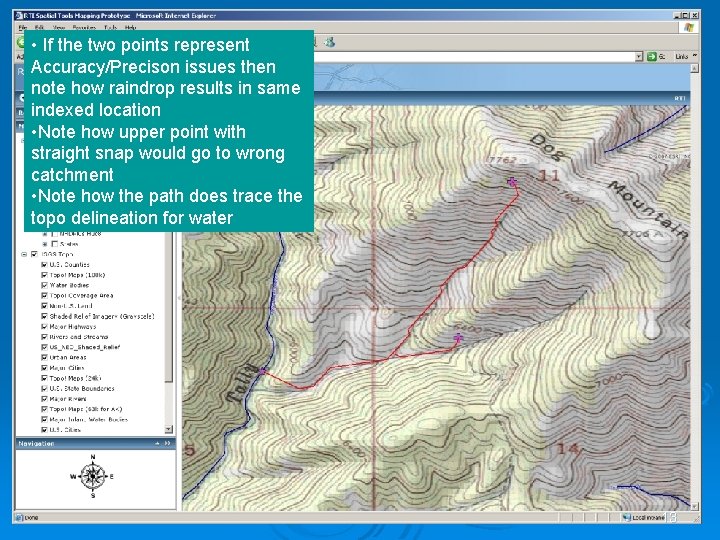
• If the two points represent Accuracy/Precison issues then note how raindrop results in same indexed location • Note how upper point with straight snap would go to wrong catchment • Note how the path does trace the topo delineation for water 13
Why this is Important? Ø Allows for monitoring data to be easily linked to other types of data (i. e. Impaired waters, assessments, permits, etc. ) Ø Allows for upstream/downstream analysis Ø Greatly expands the usability of monitoring data 14
Batch Indexing Timeline Ø This capability should be available Fall of 2008 Ø Deployed as a service that any data flow could use (not just for WQX) Ø Also provide some Geospatial QA services (i. e. is the lat/long in the county/HUC/state that the user specified) 15
Questions? Ø Contacts: l Randy Hill 202 -566 -0644, hill. randye@epa. gov l Kevin Christian 202 -566 -1180, christian. kevin@epa. gov l STORET 1 -800 -424 -9087, storet@epa. gov 16
- Slides: 16