
BAT assessment methodology Monika Pibylov 2442014 1 Content
BAT assessment methodology Monika Přibylová 24/4/2014 1
Content �The aim of BAT assessment methodology �Steps in BAT assessment �Practical example of BAT assessment – Czech sugar plant 2
Purpose of BAT assessment methodology the identification of ways to improve the effectiveness of installation operation that should be applicable to a particular site. The identification of improvements in according to BAT concept is carried out through comparison of existing and potential possibilities, selection and financial appraisal of the suitable options. 3
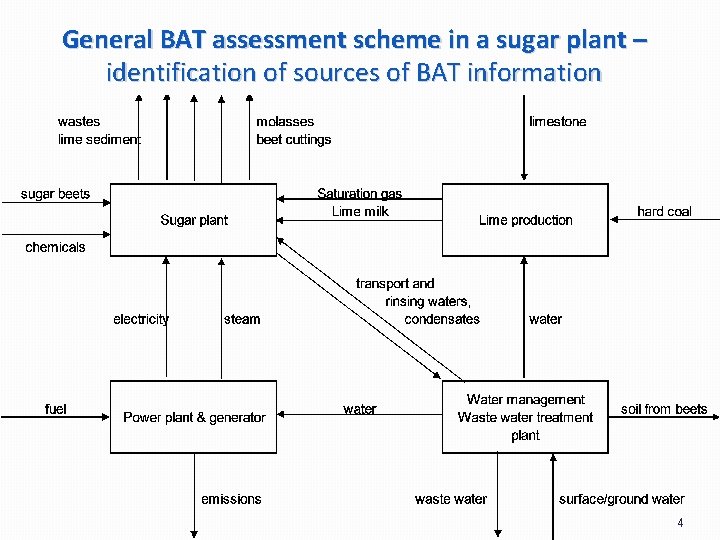
General BAT assessment scheme in a sugar plant – identification of sources of BAT information 4

Information sources for BAT assessment and determination �ВАТ Reference Documents (BREF) as benchmark http: //eippcb. jrc. es/reference/ �Criteria for identifying/evaluating BAT (Annex III of the IED Directive) �Other BAT related guidance (UK guidance notes, IFC sectoral guidelines, …) �Cleaner technology methodology �… 5
Steps for BAT assessment 1. Basic technical description and capacity parameters as a source of BAT´s identification 2. General BAT assessment 3. Define key performance indicators (KPIs) 4. Detailed technological and operational description and BAT assessment 5. Summary of identified BAT 6. Proposal of improvement plan 6
Basic technical description and capacity characteristics �principles of sugar production and power production, �number days per year of operation, �capacity of sugar bulbs per day processing, �fuel consumption and performance of power plant, �capacity of lime production in tones of lime per day, �capacity of WWTP in m 3/day, �Mass and energy balances 7
Description of main technologies For the elementary/general BAT assessment Necessary data: basic process/block scheme drawing and description of main installations/technologies Examples: �water based transport of sugar bulbs, �five stages evaporator with thermo compression, �WWTP with first anaerobic stage and second aerobic stage with closed circle of water through sedimentation basin, �black coal power plant equipped by fabric filters for 8 flue gas cleaning
Key Performance Indicators �Definition of KPIs throughout the plant to be used to report and monitor performance �Main KPI = values related to 1 t of processed raw material or 1 t of product, and efficiency of production, Examples: �consumed beets / 1 t of sugar, �consumed water/ 1 t of sugar, �consumed natural gas 1/t of sugar, �COD in waste water Sources of KPI: e. g. BREFs, IFC EHS Guidelines for Sugar Manufacturing. 9
Detailed technological and operational description and BAT assessment Detailed description of whole plant include: �management system, �way of technology control – number of control places, �way of sugar bulbs and main raw materials supply, �description of supplementary processes – laboratory, waste management, �reporting and monitoring system at different levels. 10
BAT improvement plan 1. summary of identified BAT in all technological/technique levels - description of proposed techniques & related KPI´s 2. improvement proposal Selection of measures, which bring the best effect for the plant – i. e. for each identified measure calculation of: �investment and operational costs, �expected savings and benefits, and �payback period In case the plant breaches the legal requirements the identified improvements which ensure the compliance with legal requirements have to have the preference in the implementation. 3. action plan proposal – allocation of reasonable time for 11
Linkage between EMS and BAT determination �Integrated and preventive approaches form the basis of both systems. �Assessment of enviro. aspects and impacts is necessary for both EMS set up and BAT assessment. �EMS monitoring and reporting requirements can be used for BAT comparison. �EMS Programs may correspond to BAT improvement programs EMS helps in preparing BAT determination and 12
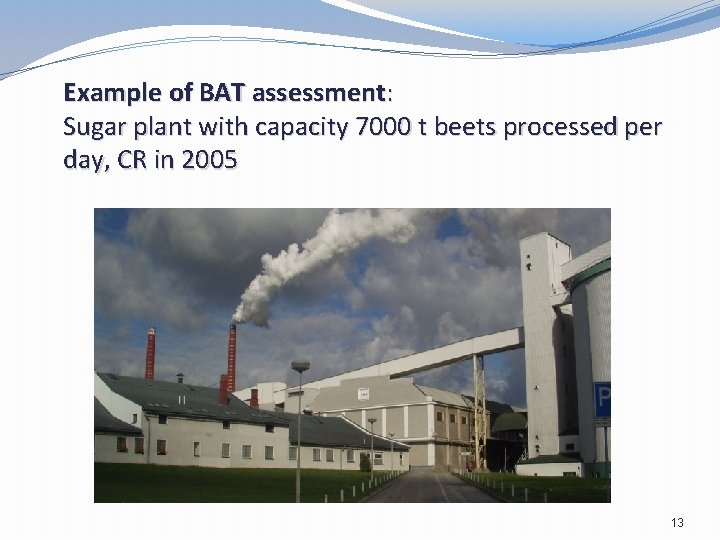
Example of BAT assessment: Sugar plant with capacity 7000 t beets processed per day, CR in 2005 13
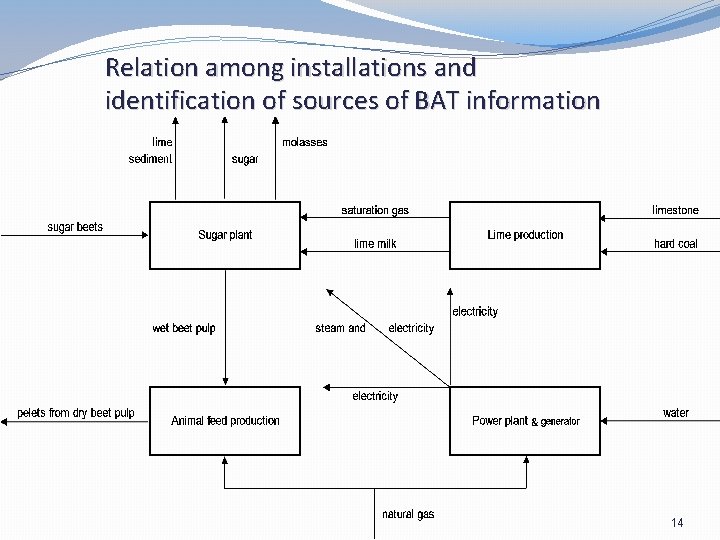
Relation among installations and identification of sources of BAT information 14
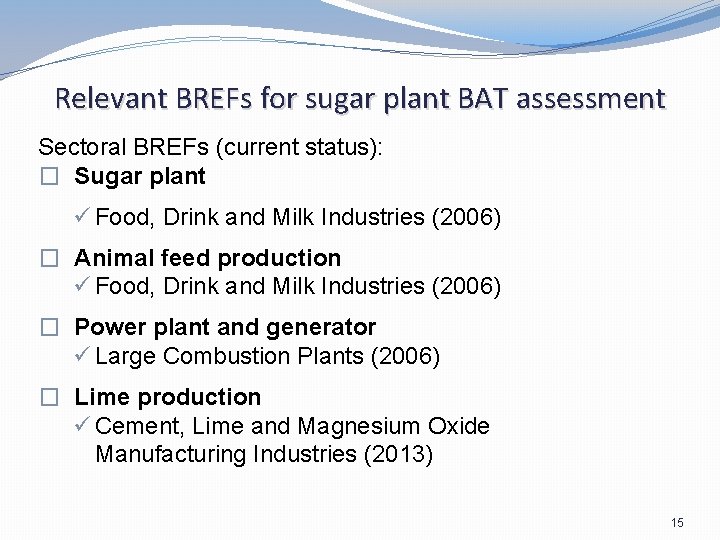
Relevant BREFs for sugar plant BAT assessment Sectoral BREFs (current status): � Sugar plant ü Food, Drink and Milk Industries (2006) � Animal feed production ü Food, Drink and Milk Industries (2006) � Power plant and generator ü Large Combustion Plants (2006) � Lime production ü Cement, Lime and Magnesium Oxide Manufacturing Industries (2013) 15
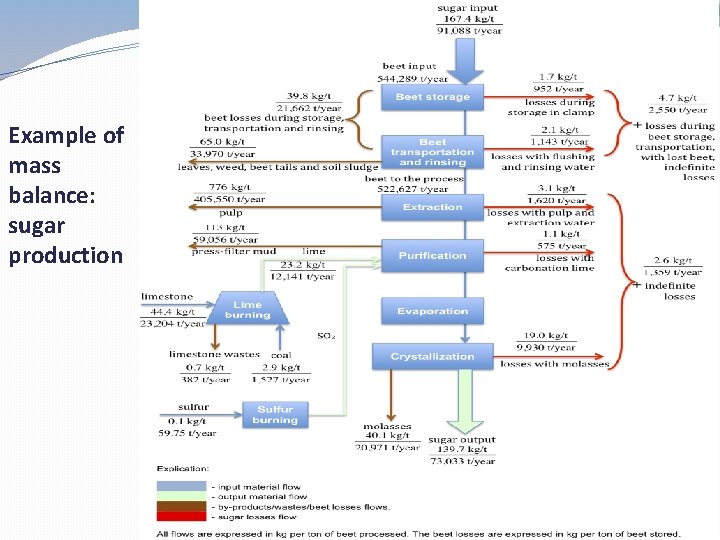
Example of mass balance: sugar production 16

BAT assessment – Sugar production Technical solution Achieved emissions BATs associated emission values Justification of the difference Waste waters quality The waste waters emission levels are slightly higher than the BATs associated emission values Parameter Concentration(mg/l) BOD 5 <25 COD <125 TSS <50 p. H 6– 9 Oil and grease <10 Total N <10 Total P 0. 4 – 5 (BREF FDM Table 5. 1: Typical FDM waste water quality after treatment) Not in line with BAT Fresh water consumption/t bp 0, 3 m 3/t bp Data source: measured value 0, 25 – 0, 4 m 3/t bp (FDM BREF ch. 4. 7. 7. 3) In line with BAT Energy consumption 310, 6 k. Wh/ton beet Data source: energy balance 232 – 367 k. Wh/t bp (FDM BREF ch. 3. 3. 8. 1. 4) In line with BAT 17
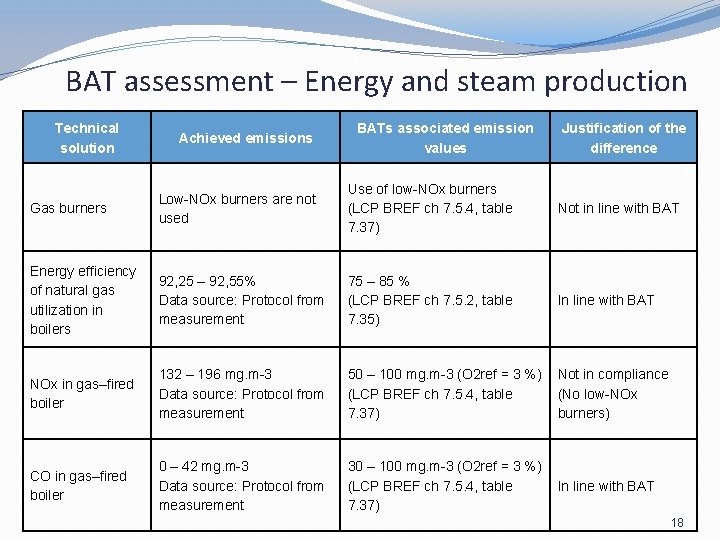
BAT assessment – Energy and steam production Technical solution Achieved emissions BATs associated emission values Justification of the difference Gas burners Low-NOx burners are not used Use of low-NOx burners (LCP BREF ch 7. 5. 4, table 7. 37) Not in line with BAT Energy efficiency of natural gas utilization in boilers 92, 25 – 92, 55% Data source: Protocol from measurement 75 – 85 % (LCP BREF ch 7. 5. 2, table 7. 35) In line with BAT NOx in gas–fired boiler 132 – 196 mg. m-3 Data source: Protocol from measurement 50 – 100 mg. m-3 (O 2 ref = 3 %) (LCP BREF ch 7. 5. 4, table 7. 37) Not in compliance (No low-NOx burners) CO in gas–fired boiler 0 – 42 mg. m-3 Data source: Protocol from measurement 30 – 100 mg. m-3 (O 2 ref = 3 %) (LCP BREF ch 7. 5. 4, table 7. 37) In line with BAT 18
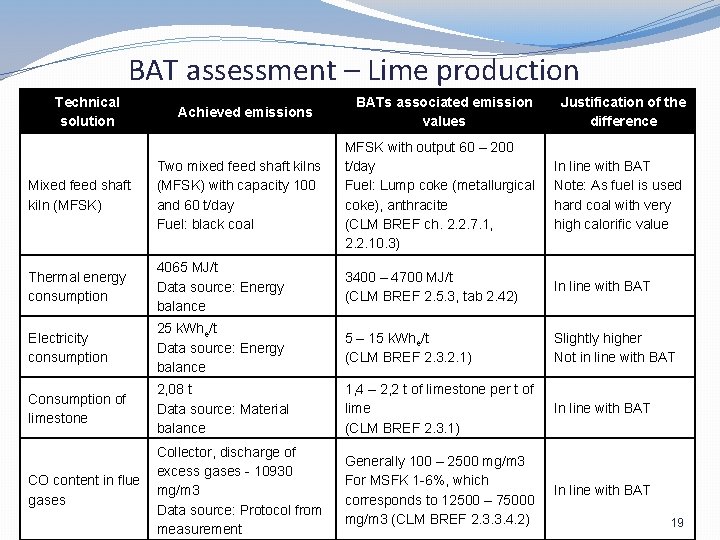
BAT assessment – Lime production Technical solution BATs associated emission values Justification of the difference Mixed feed shaft kiln (MFSK) Two mixed feed shaft kilns (MFSK) with capacity 100 and 60 t/day Fuel: black coal MFSK with output 60 – 200 t/day Fuel: Lump coke (metallurgical coke), anthracite (CLM BREF ch. 2. 2. 7. 1, 2. 2. 10. 3) In line with BAT Note: As fuel is used hard coal with very high calorific value Thermal energy consumption 4065 MJ/t Data source: Energy balance 3400 – 4700 MJ/t (CLM BREF 2. 5. 3, tab 2. 42) In line with BAT Electricity consumption 25 k. Whe/t Data source: Energy balance 5 – 15 k. Whe/t (CLM BREF 2. 3. 2. 1) Slightly higher Not in line with BAT Consumption of limestone 2, 08 t Data source: Material balance 1, 4 – 2, 2 t of limestone per t of lime (CLM BREF 2. 3. 1) In line with BAT CO content in flue gases Collector, discharge of excess gases - 10930 mg/m 3 Data source: Protocol from measurement Generally 100 – 2500 mg/m 3 For MSFK 1 -6%, which corresponds to 12500 – 75000 mg/m 3 (CLM BREF 2. 3. 3. 4. 2) In line with BAT Achieved emissions 19
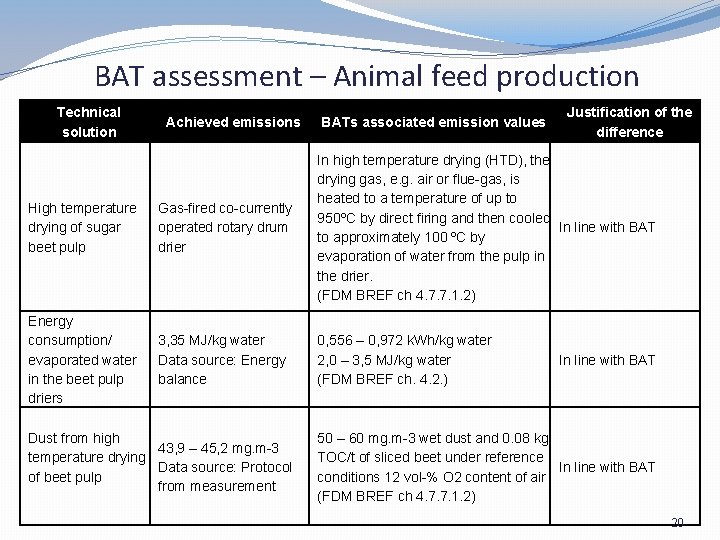
BAT assessment – Animal feed production Technical solution Achieved emissions BATs associated emission values Justification of the difference High temperature drying of sugar beet pulp Gas-fired co-currently operated rotary drum drier In high temperature drying (HTD), the drying gas, e. g. air or flue-gas, is heated to a temperature of up to 950ºC by direct firing and then cooled In line with BAT to approximately 100 ºC by evaporation of water from the pulp in the drier. (FDM BREF ch 4. 7. 7. 1. 2) Energy consumption/ evaporated water in the beet pulp driers 3, 35 MJ/kg water Data source: Energy balance 0, 556 – 0, 972 k. Wh/kg water 2, 0 – 3, 5 MJ/kg water (FDM BREF ch. 4. 2. ) Dust from high 43, 9 – 45, 2 mg. m-3 temperature drying Data source: Protocol of beet pulp from measurement In line with BAT 50 – 60 mg. m-3 wet dust and 0. 08 kg TOC/t of sliced beet under reference In line with BAT conditions 12 vol-% O 2 content of air (FDM BREF ch 4. 7. 7. 1. 2) 20
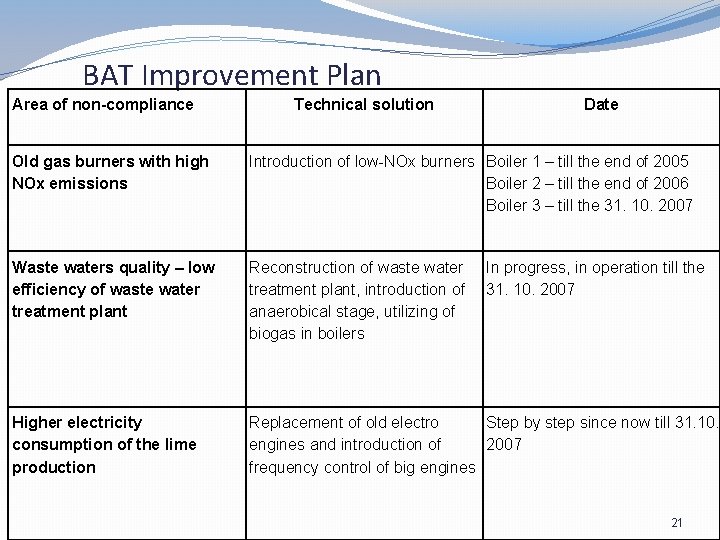
BAT Improvement Plan Area of non-compliance Technical solution Date Old gas burners with high NOx emissions Introduction of low-NOx burners Boiler 1 – till the end of 2005 Boiler 2 – till the end of 2006 Boiler 3 – till the 31. 10. 2007 Waste waters quality – low efficiency of waste water treatment plant Reconstruction of waste water treatment plant, introduction of anaerobical stage, utilizing of biogas in boilers Higher electricity consumption of the lime production Replacement of old electro Step by step since now till 31. 10. engines and introduction of 2007 frequency control of big engines In progress, in operation till the 31. 10. 2007 21
Děkuji za pozornost 22
- Slides: 22