
Basis Risk and Pension Schemes Andrew Hunt Longevity
Basis Risk and Pension Schemes Andrew Hunt Longevity 12 Chicago, USA September 2016
Agenda �Basis risk – Level vs. trend �Reference and sub-population models �Parameter and model risk �Projections and consequences
Basis risk – Level and trend � Basis risk has been the subject to much practical and academic study in recent years �Plat (2009) �Coughlan et al (2011) �Li and Hardy (2011) �Cairns et al (2013) �Haberman et al (2015) � Many of the studies indicate that basis risk is manageable within index-based hedging solutions � However, it is often still given as a reason for the slow development of traded longevity-risk markets � Much of the confusion around basis risk comes from different authors talking about different concepts
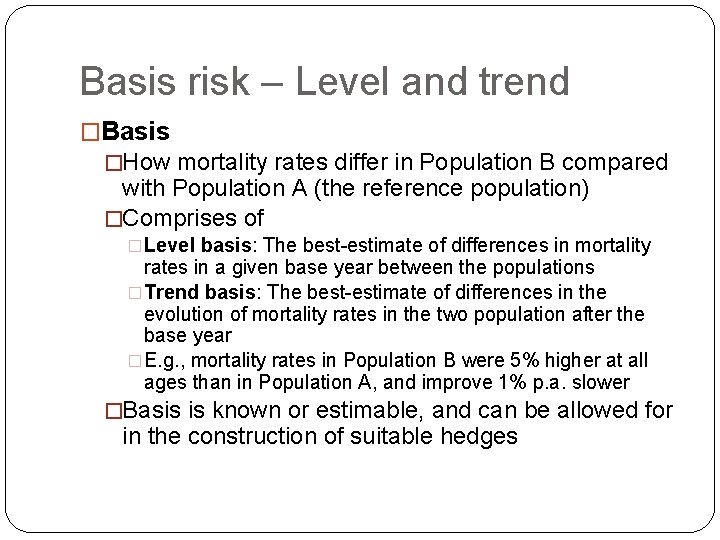
Basis risk – Level and trend �Basis �How mortality rates differ in Population B compared with Population A (the reference population) �Comprises of �Level basis: The best-estimate of differences in mortality rates in a given base year between the populations �Trend basis: The best-estimate of differences in the evolution of mortality rates in the two population after the base year �E. g. , mortality rates in Population B were 5% higher at all ages than in Population A, and improve 1% p. a. slower �Basis is known or estimable, and can be allowed for in the construction of suitable hedges
Basis risk – Level and trend �Basis risk �Risk / uncertainty in the measurement of the basis between Populations A and B �Comprises of �Level basis risk: Measurement uncertainty in the estimation of the level basis �Trend basis risk: Measurement uncertainty in the trend basis plus stochastic risk in the differential evolution of mortality in the two populations �Basis risk is inherently stochastic and cannot be hedged using indices on the reference population
Reference and sub-population models �Context of my research has been pension schemes in the UK �In this case, the reference population is the national population and we are interested in the behaviour of mortality in a sub-population of the reference �Sub-population typically relatively small (less than 5, 000 lives) and have relatively short observation periods (c. 10 years) �Longevity risk transactions to date for these schemes have almost entirely been on an indemnification basis (no basis risk)
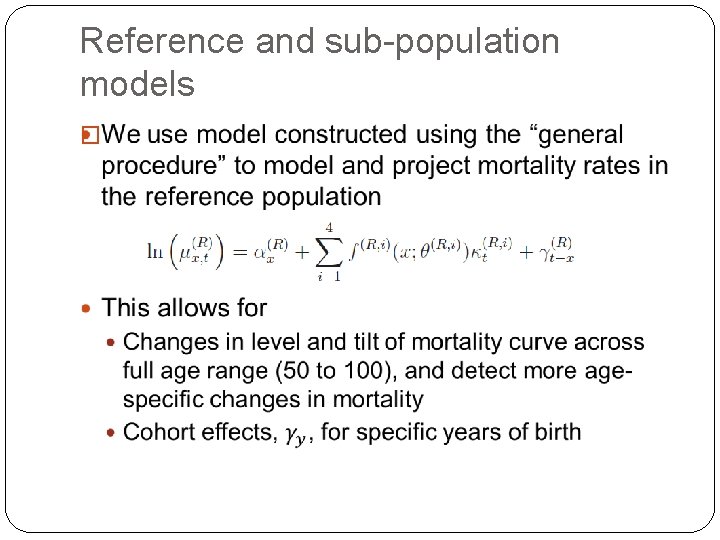
Reference and sub-population models �
Reference and sub-population models �We use data from the CMI Self-Administered Pension Scheme (SAPS) survey as the subpopulation �Survey collects data from large (over 500 member) pension schemes in the UK every three years �Up to 60 k male and 40 k female deaths p. a. �Data available from 2000, ages 60 to 90 �To test our model, we have also rescaled this to size of more typical UK pension scheme

Reference and sub-population models �
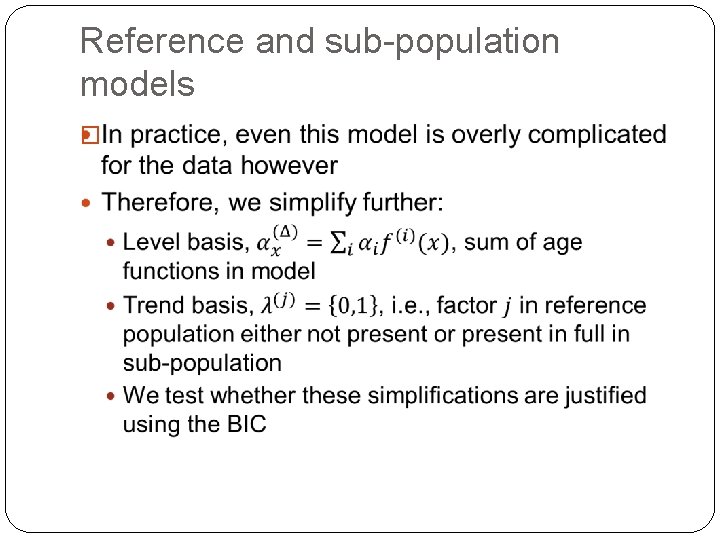
Reference and sub-population models �
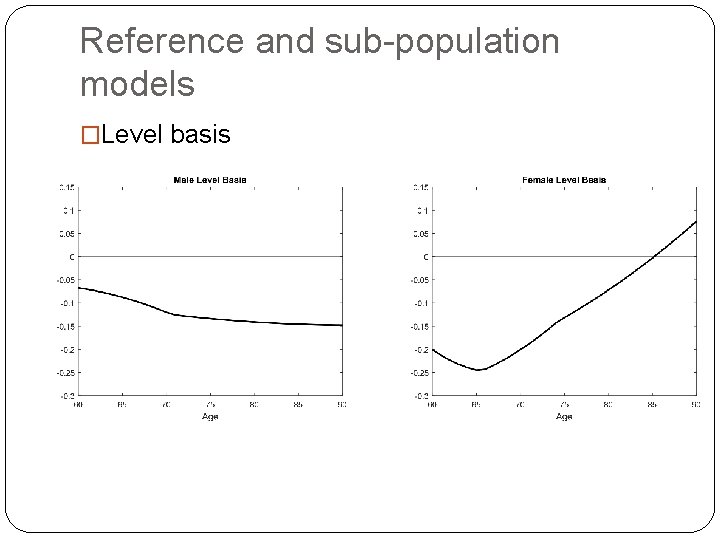
Reference and sub-population models �Level basis
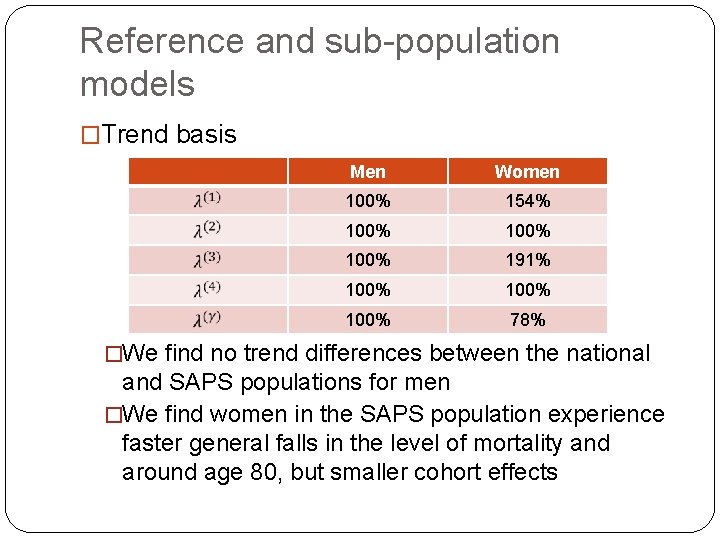
Reference and sub-population models �Trend basis Men Women 100% 154% 100% 191% 100% 78% �We find no trend differences between the national and SAPS populations for men �We find women in the SAPS population experience faster general falls in the level of mortality and around age 80, but smaller cohort effects
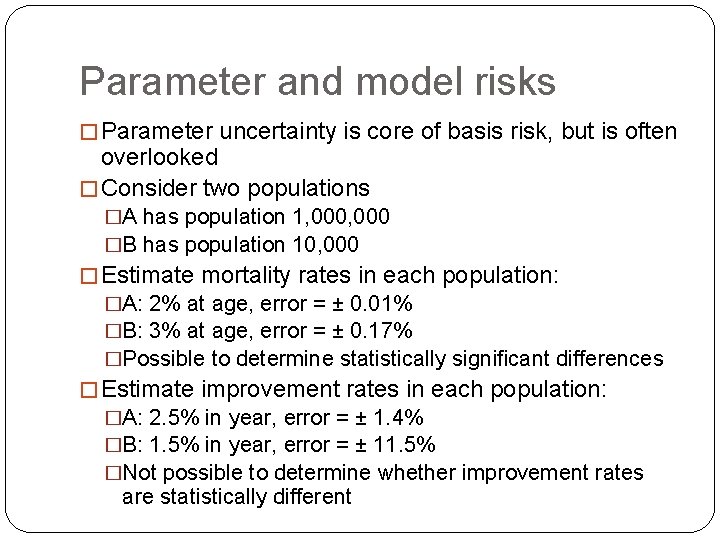
Parameter and model risks � Parameter uncertainty is core of basis risk, but is often overlooked � Consider two populations �A has population 1, 000 �B has population 10, 000 � Estimate mortality rates in each population: �A: 2% at age, error = ± 0. 01% �B: 3% at age, error = ± 0. 17% �Possible to determine statistically significant differences � Estimate improvement rates in each population: �A: 2. 5% in year, error = ± 1. 4% �B: 1. 5% in year, error = ± 11. 5% �Not possible to determine whether improvement rates are statistically different
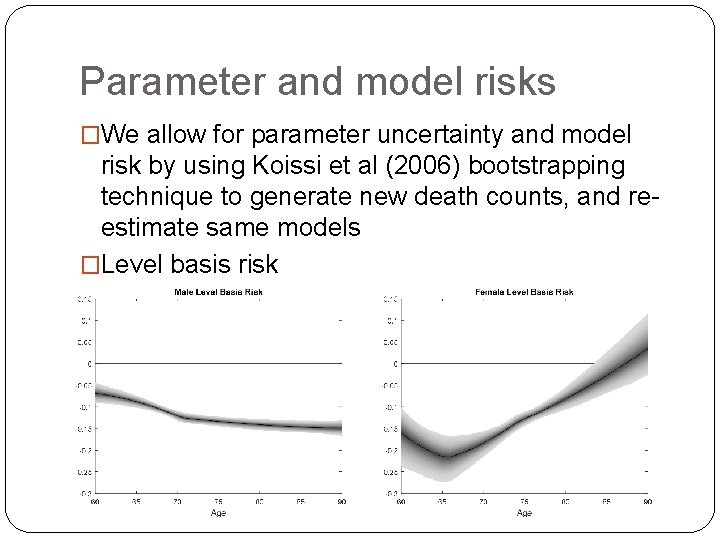
Parameter and model risks �We allow for parameter uncertainty and model risk by using Koissi et al (2006) bootstrapping technique to generate new death counts, and reestimate same models �Level basis risk
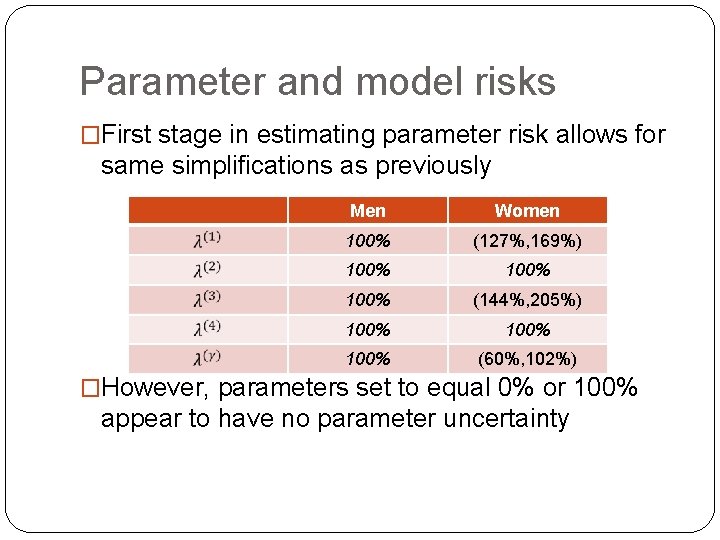
Parameter and model risks �First stage in estimating parameter risk allows for same simplifications as previously Men Women 100% (127%, 169%) 100% (144%, 205%) 100% (60%, 102%) �However, parameters set to equal 0% or 100% appear to have no parameter uncertainty
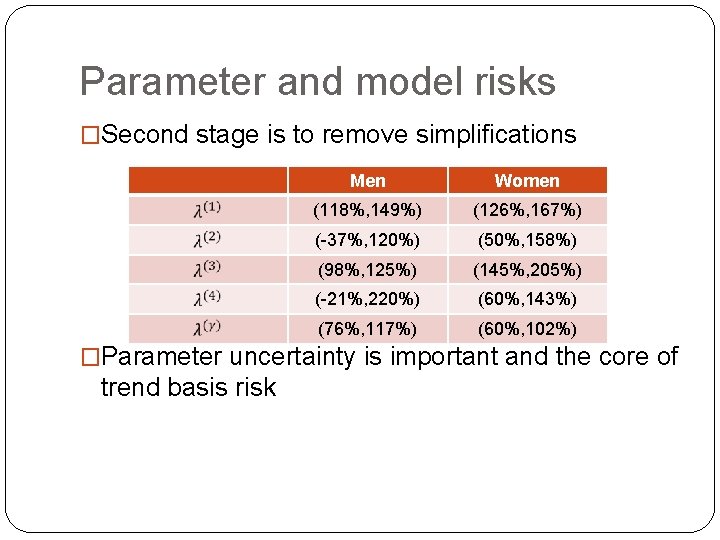
Parameter and model risks �Second stage is to remove simplifications Men Women (118%, 149%) (126%, 167%) (-37%, 120%) (50%, 158%) (98%, 125%) (145%, 205%) (-21%, 220%) (60%, 143%) (76%, 117%) (60%, 102%) �Parameter uncertainty is important and the core of trend basis risk
Parameter and model risks �We then test the bootstrapped samples to see what simplifications are justified �In majority of cases, we arrive at the same set of simplifications (e. g. , no trend basis risk for men) �But not all, however �Whether we allow for basis or not with respect to come factors is not robust to small changes in the data
Parameter and model risk �So far, model estimated using SAPS data �Far greater data volumes than available for any individual pension scheme �If we have trouble estimating basis risk in such large population, what hope is there for individual pension schemes?
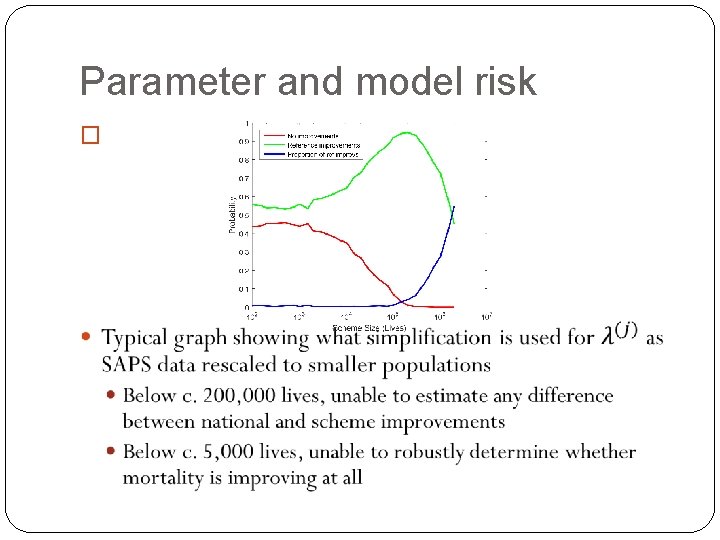
Parameter and model risk �
Projections and consequences �Project mortality in reference population and use model to map this to mortality in the subpopulation �Allows for parameter uncertainty and model risk in the sub-population �Does not allow for any stochastic process risk in sub -population improvements
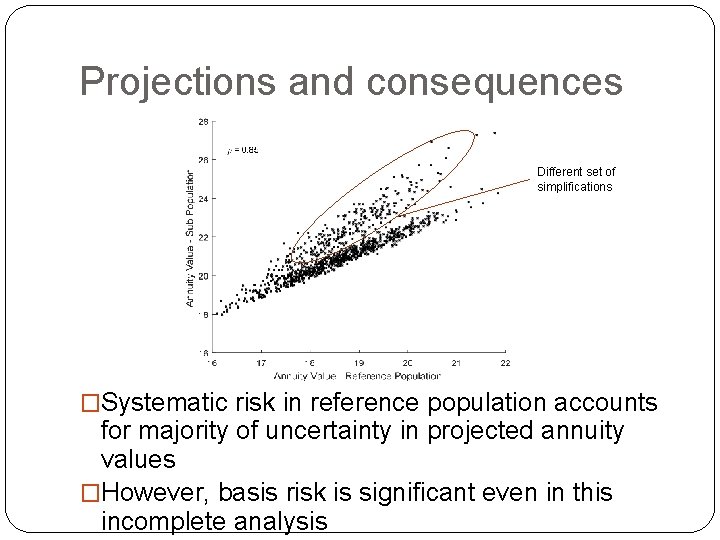
Projections and consequences Different set of simplifications �Systematic risk in reference population accounts for majority of uncertainty in projected annuity values �However, basis risk is significant even in this incomplete analysis
Projections and consequences �Important to differentiate between basis and basis risk �Basis is, in principal measureable �Level basis often measured via experience analysis �However, this often using simple A/E across all ages rather than more sophisticated age-specific approach �Trend basis may be measureable between very large populations, but for most practical circumstances, accept null hypothesis of no trend basis
Projections and consequences �Basis risk is somewhere between a known unknown and an unknown �Level basis risk is measureable but often this is overlooked or overly simplified �Trend basis risk can be approximated using various models (such as this one), but these probably understate true impact
Projections and consequences �Insurers are well placed to measure and hold basis risks: �Level basis can be measured more accurately using tools widely available to actuaries �Level basis risk can be diversified by writing more business �Trend basis may be measureable in large portfolios (though likely to be small as sub-population tend to reference) �Trend basis risk cannot properly me measured or hedged but should be held and capital provided to back it �This provides opportunities for capital markets to
References � Cairns, A. J. G. , Dowd, K. , Blake, D. , Coughlan, G. D. , 2013. Longevity hedge � � � � effectiveness: A decomposition. Quantitative Finance 14 (2), 217– 235. Continuous Mortality Investigation, 2014 c. Working Paper 76 – Analysis of the mortality experience of pensioners of self-administered pension schemes for the period 2006 to 2013. Haberman, S. , Kaishev, V. K. , Millossovich, P. , Villegas, A. M. , Baxter, S. D. , Gaches, A. T. , Gunnlaugsson, S. , Sison, M. , 2014. Longevity basis risk: A methodology for assessing basis risk. Tech. rep. , Cass Business School, City University London and Hymans Robertson LLP. Hunt, A. , Blake, D. , 2014. A general procedure for constructing mortality models. North American Actuarial Journal 18 (1), 116– 138. Koissi, M. , Shapiro, A. , Hognas, G. , 2006. Evaluating and extending the Lee-Carter model for mortality forecasting: Bootstrap confidence interval. Insurance: Mathematics and Economics 38 (1), 1– 20. Li, J. S. -H. , Hardy, M. R. , 2011. Measuring basis risk in longevity hedges. North American Actuarial Journal 15 (2), 177– 200. Plat, R. , 2009. Stochastic portfolio specific mortality and the quantification of mortality basis risk. Insurance: Mathematics and Economics 45 (1), 123– 132. Russolillo, M. , Giordano, G. , Haberman, S. , 2011. Extending the Lee-Carter model: A three-way decomposition. Scandinavian Actuarial Journal 2011 (2), 96– 117. Villegas, A. M. , Haberman, S. , 2014. On the modeling and forecasting of socioeconomic mortality differentials: An application to deprivation and mortality in England. North American Actuarial Journal 18 (1), 168– 193.
- Slides: 25