
Basics We need to review fundamental information about
Basics • We need to review fundamental information about physical properties and their units.
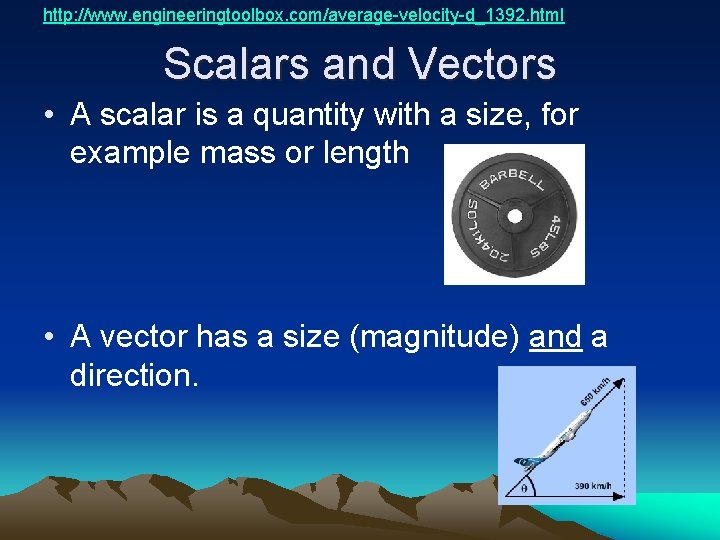
http: //www. engineeringtoolbox. com/average-velocity-d_1392. html Scalars and Vectors • A scalar is a quantity with a size, for example mass or length • A vector has a size (magnitude) and a direction.
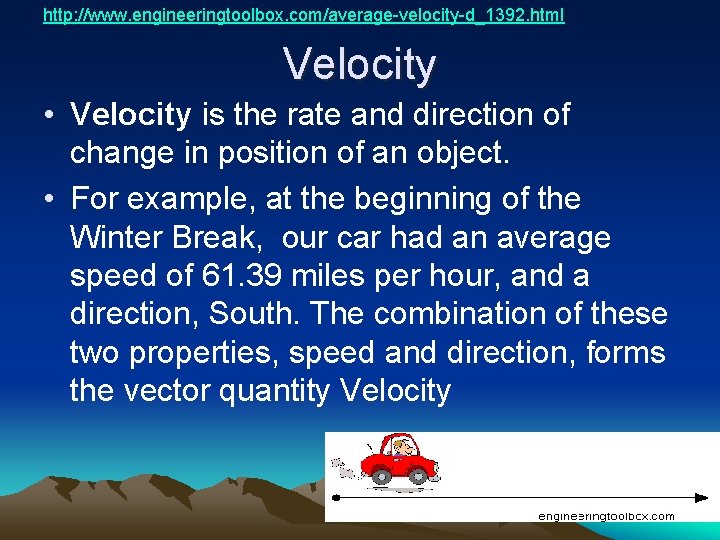
http: //www. engineeringtoolbox. com/average-velocity-d_1392. html Velocity • Velocity is the rate and direction of change in position of an object. • For example, at the beginning of the Winter Break, our car had an average speed of 61. 39 miles per hour, and a direction, South. The combination of these two properties, speed and direction, forms the vector quantity Velocity
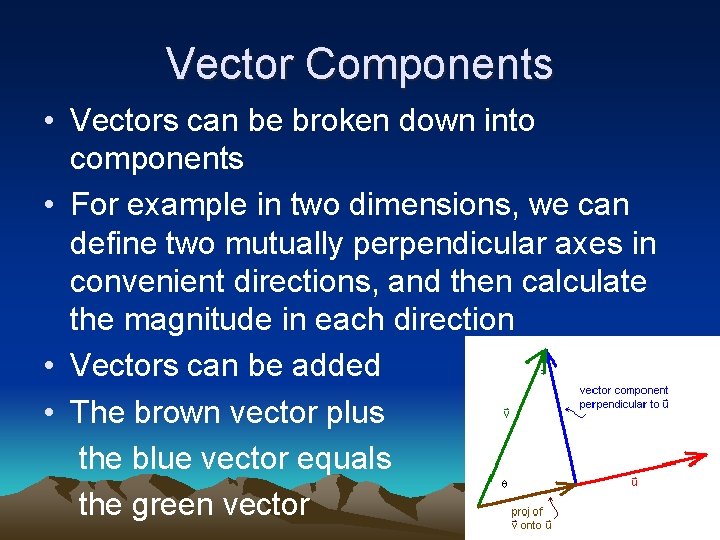
Vector Components • Vectors can be broken down into components • For example in two dimensions, we can define two mutually perpendicular axes in convenient directions, and then calculate the magnitude in each direction • Vectors can be added • The brown vector plus the blue vector equals the green vector

Trig & • Geometry • • cos q = adj / hyp = abs /hyp sine q = opp / hyp = ord / hyp tan q = ord / abs Usually angle known, solve eqn. to find size of an unknown The sum of angles inside a triangle = 180 o
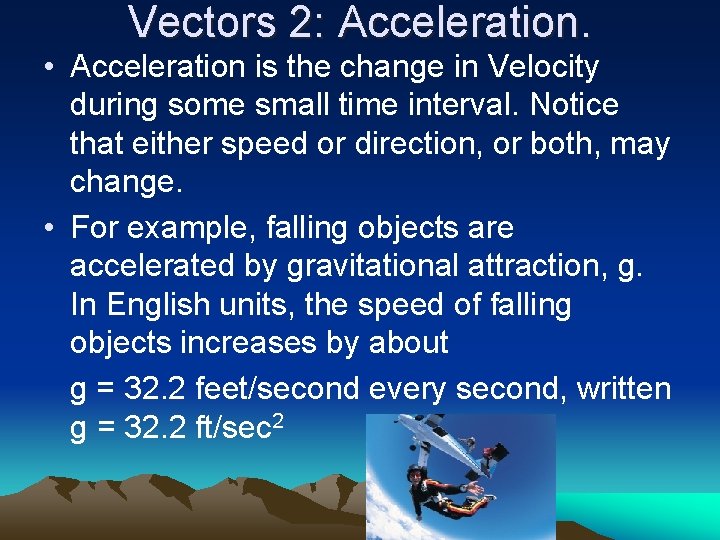
Vectors 2: Acceleration. • Acceleration is the change in Velocity during some small time interval. Notice that either speed or direction, or both, may change. • For example, falling objects are accelerated by gravitational attraction, g. In English units, the speed of falling objects increases by about g = 32. 2 feet/second every second, written g = 32. 2 ft/sec 2
SI Units: Kilogram, meter, second • Most scientists and engineers try to avoid English units, preferring instead SI units. For example, in SI units, the speed of falling objects increases by about 9. 81 meters/second every second, written g = 9. 81 m/sec 2 • Unfortunately, in Hydrology our clients are mostly civilians, who expect answers in English units. We must learn to use both. Système international d'unités pron dooneetay http: //en. wikipedia. org/wiki/International_System_of_Units
Data and Conversion Factors • In your work as a hydrologist, you will be scrounging for data from many sources. It won’t always be in the units you want. We convert from one unit to another by using conversion factors. http: //waterdata. usgs. gov/nj/nwis/current/? type=flow http: //climate. rutgers. edu/njwxnet/dataviewernetpt. php? yr=2010&mo=12&dy=1&qc=&hr=10&element_id%5 B%5 D=24&states=NJ&newdc=1 • Conversion Factors involve multiplication by one, nothing changes • 1 foot = 12 inches so 1 foot = 1 12 “
Example • Water is flowing at a velocity of 30 meters per second through a canyon. What is this speed in feet per second? • Steps: (1) write down the value you have, then (2) select a conversion factor and write it as a fraction so the unit you want to get rid of is on the opposite side, and cancel. Then calculate. • (1) (2) • 30 meters x 3. 281 feet = 98. 61 feet second meter second
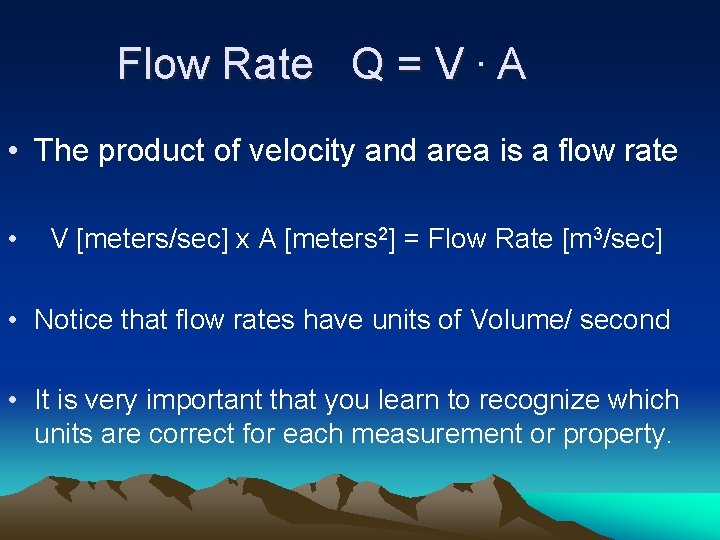
Flow Rate Q = V. A • The product of velocity and area is a flow rate • V [meters/sec] x A [meters 2] = Flow Rate [m 3/sec] • Notice that flow rates have units of Volume/ second • It is very important that you learn to recognize which units are correct for each measurement or property.
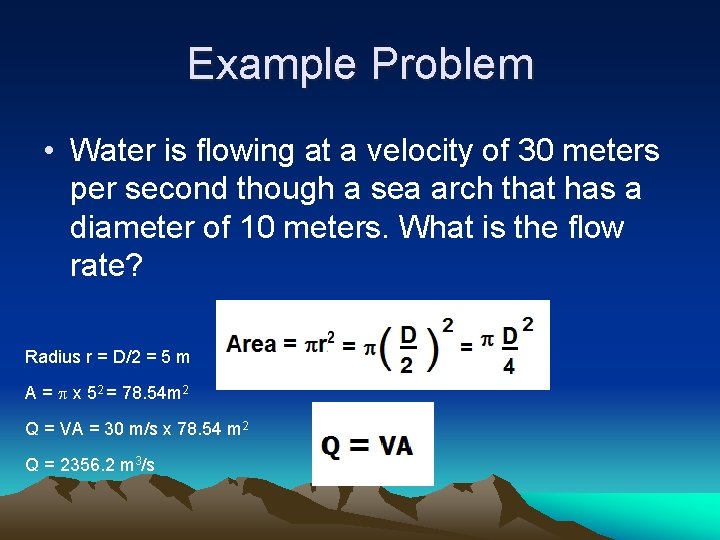
Example Problem • Water is flowing at a velocity of 30 meters per second though a sea arch that has a diameter of 10 meters. What is the flow rate? Radius r = D/2 = 5 m A = p x 52 = 78. 54 m 2 Q = VA = 30 m/s x 78. 54 m 2 Q = 2356. 2 m 3/s
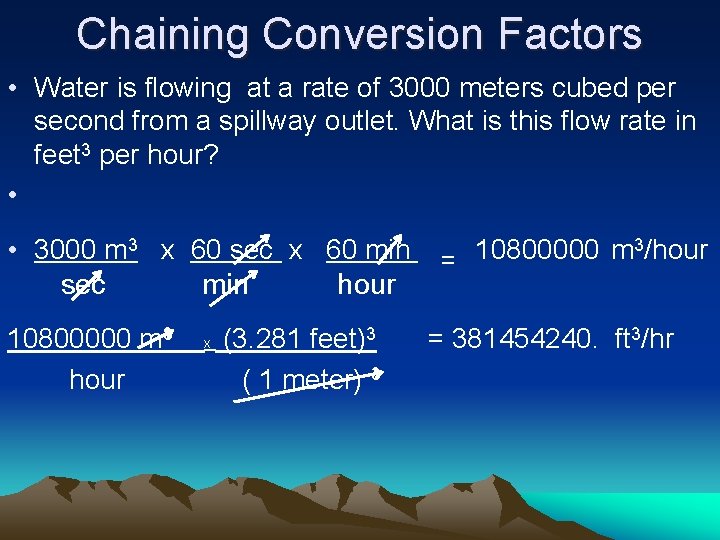
Chaining Conversion Factors • Water is flowing at a rate of 3000 meters cubed per second from a spillway outlet. What is this flow rate in feet 3 per hour? • • 3000 m 3 x 60 sec x 60 min sec min hour 10800000 m 3 hour x (3. 281 feet)3 ( 1 meter) 3 3/hour 10800000 m = = 381454240. ft 3/hr
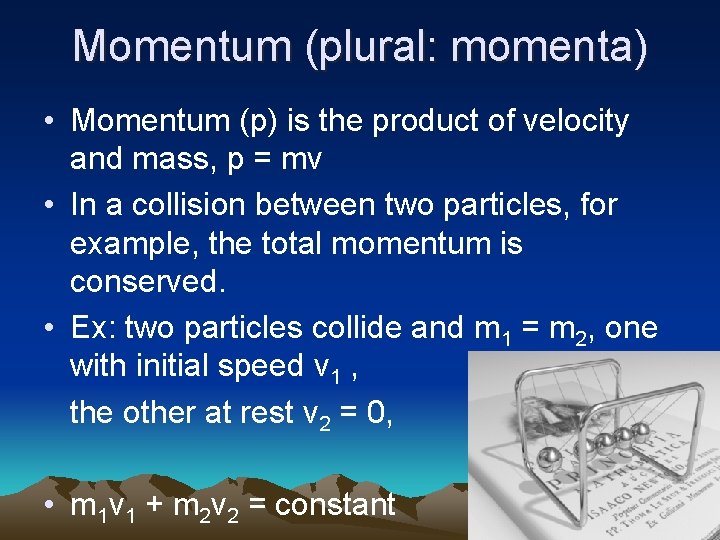
Momentum (plural: momenta) • Momentum (p) is the product of velocity and mass, p = mv • In a collision between two particles, for example, the total momentum is conserved. • Ex: two particles collide and m 1 = m 2, one with initial speed v 1 , the other at rest v 2 = 0, • m 1 v 1 + m 2 v 2 = constant
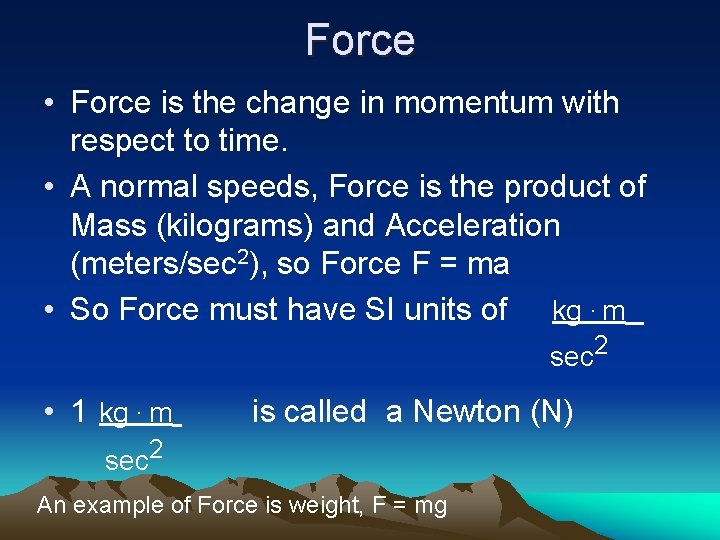
Force • Force is the change in momentum with respect to time. • A normal speeds, Force is the product of Mass (kilograms) and Acceleration (meters/sec 2), so Force F = ma • So Force must have SI units of kg. m sec 2 • 1 kg. m is called a Newton (N) sec 2 An example of Force is weight, F = mg
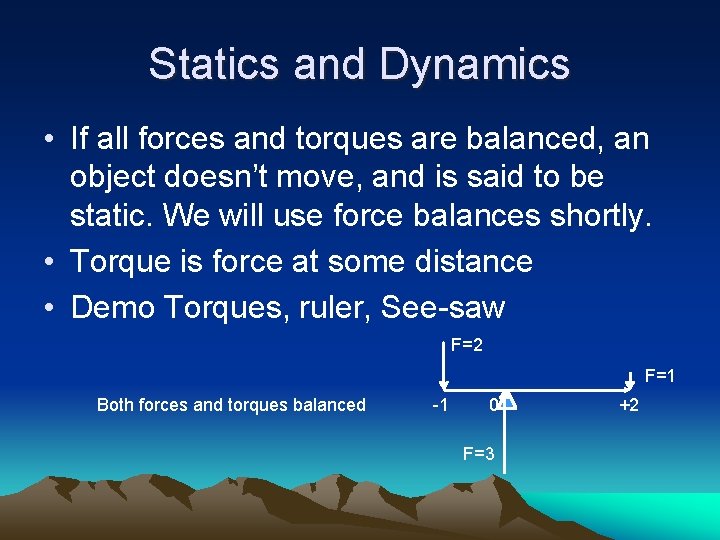
Statics and Dynamics • If all forces and torques are balanced, an object doesn’t move, and is said to be static. We will use force balances shortly. • Torque is force at some distance • Demo Torques, ruler, See-saw F=2 F=1 Both forces and torques balanced -1 0 F=3 +2
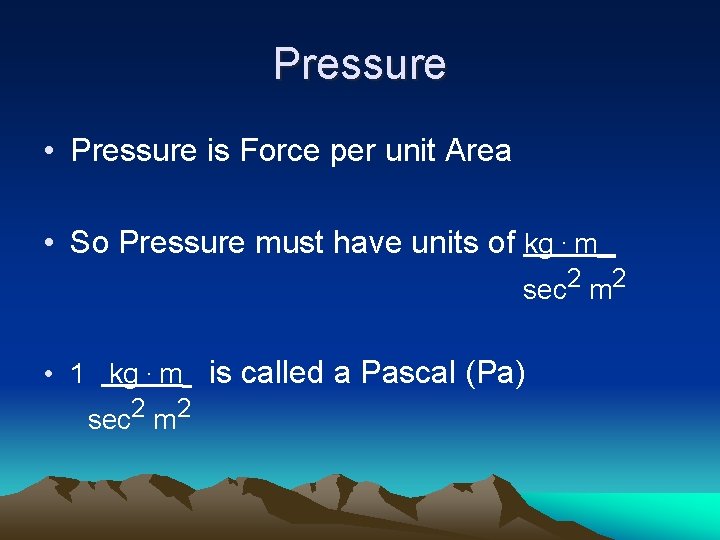
Pressure • Pressure is Force per unit Area • So Pressure must have units of kg. m sec 2 m 2 • 1 kg. m is called a Pascal (Pa) sec 2 m 2
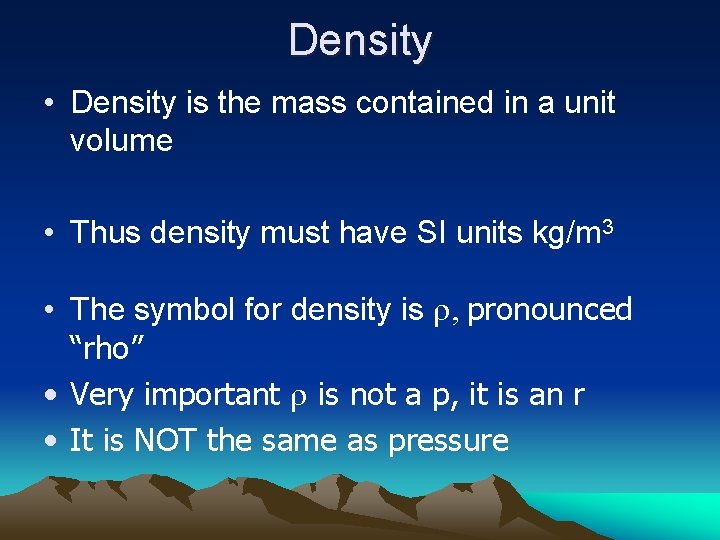
Density • Density is the mass contained in a unit volume • Thus density must have SI units kg/m 3 • The symbol for density is r, pronounced “rho” • Very important r is not a p, it is an r • It is NOT the same as pressure
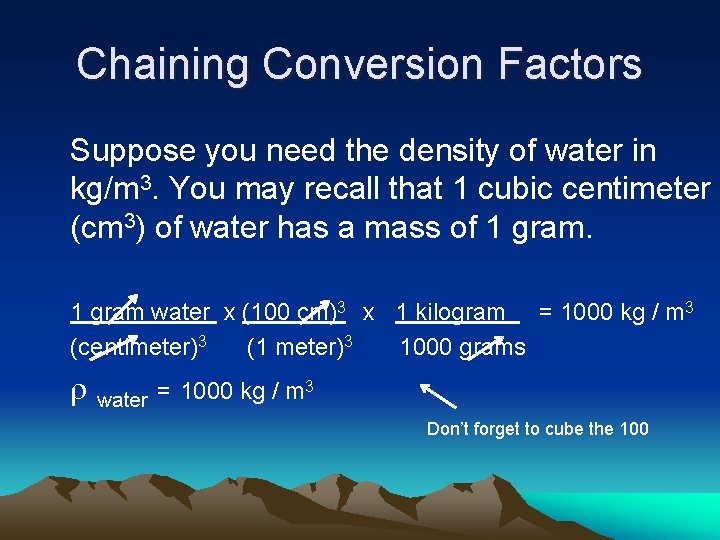
Chaining Conversion Factors Suppose you need the density of water in kg/m 3. You may recall that 1 cubic centimeter (cm 3) of water has a mass of 1 gram water x (100 cm)3 x 1 kilogram = 1000 kg / m 3 (centimeter)3 (1 meter)3 1000 grams r water = 1000 kg / m 3 Don’t forget to cube the 100
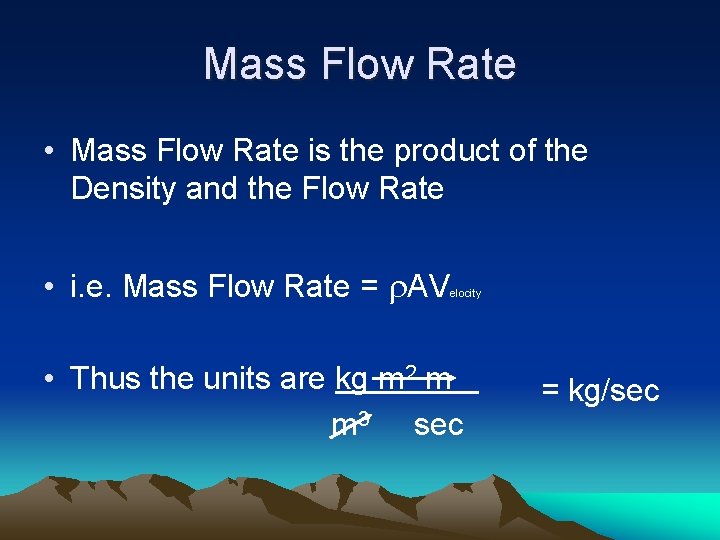
Mass Flow Rate • Mass Flow Rate is the product of the Density and the Flow Rate • i. e. Mass Flow Rate = r. AV elocity • Thus the units are kg m 2 m m 3 sec = kg/sec
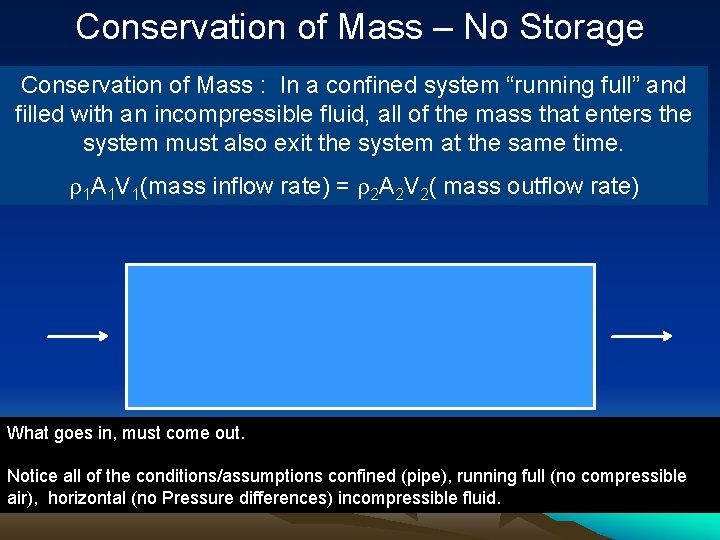
Conservation of Mass – No Storage Conservation of Mass : In a confined system “running full” and filled with an incompressible fluid, all of the mass that enters the system must also exit the system at the same time. r 1 A 1 V 1(mass inflow rate) = r 2 A 2 V 2( mass outflow rate) What goes in, must come out. Notice all of the conditions/assumptions confined (pipe), running full (no compressible air), horizontal (no Pressure differences) incompressible fluid.
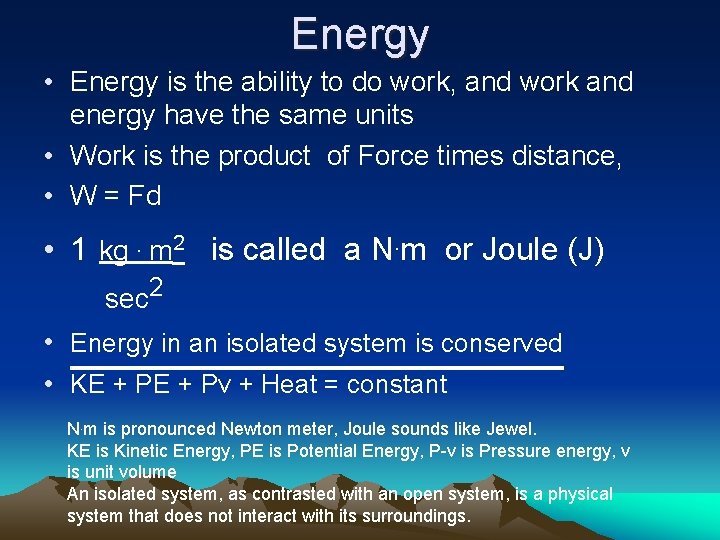
Energy • Energy is the ability to do work, and work and energy have the same units • Work is the product of Force times distance, • W = Fd • 1 kg. m 2 is called a N. m or Joule (J) sec 2 • Energy in an isolated system is conserved • KE + Pv + Heat = constant N. m is pronounced Newton meter, Joule sounds like Jewel. KE is Kinetic Energy, PE is Potential Energy, P-v is Pressure energy, v is unit volume An isolated system, as contrasted with an open system, is a physical system that does not interact with its surroundings.
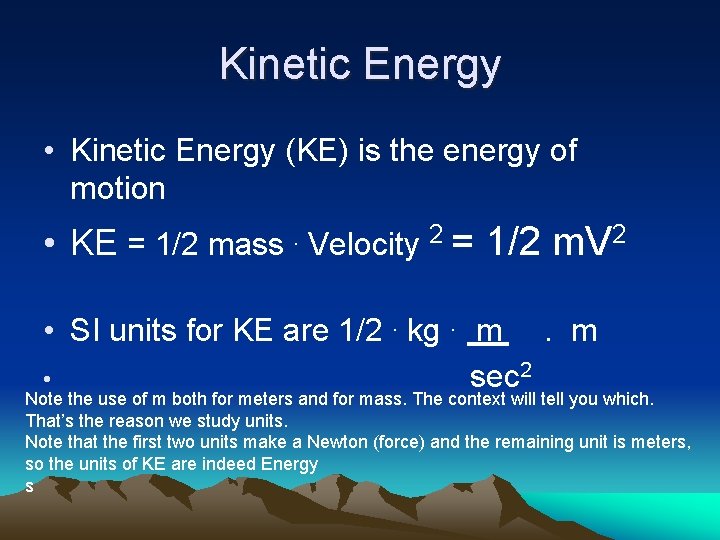
Kinetic Energy • Kinetic Energy (KE) is the energy of motion • KE = 1/2 mass. Velocity 2 = 1/2 m. V 2 • SI units for KE are 1/2. kg. m. m • sec 2 Note the use of m both for meters and for mass. The context will tell you which. That’s the reason we study units. Note that the first two units make a Newton (force) and the remaining unit is meters, so the units of KE are indeed Energy s
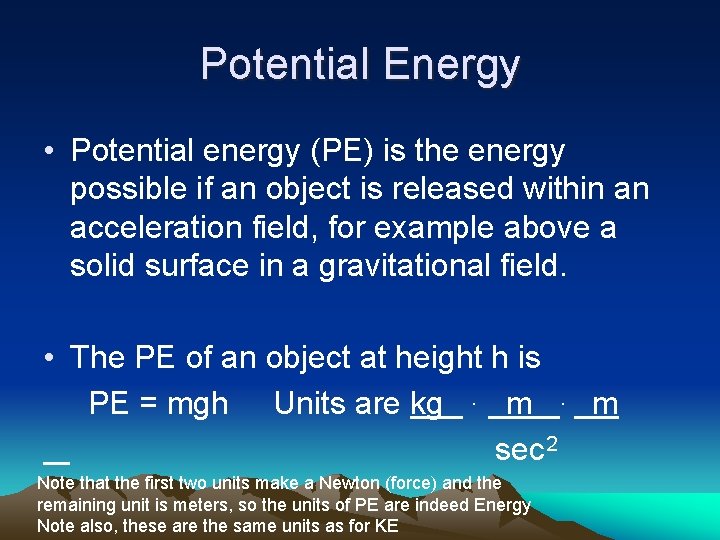
Potential Energy • Potential energy (PE) is the energy possible if an object is released within an acceleration field, for example above a solid surface in a gravitational field. • The PE of an object at height h is PE = mgh Units are kg. m. m sec 2 Note that the first two units make a Newton (force) and the remaining unit is meters, so the units of PE are indeed Energy Note also, these are the same units as for KE
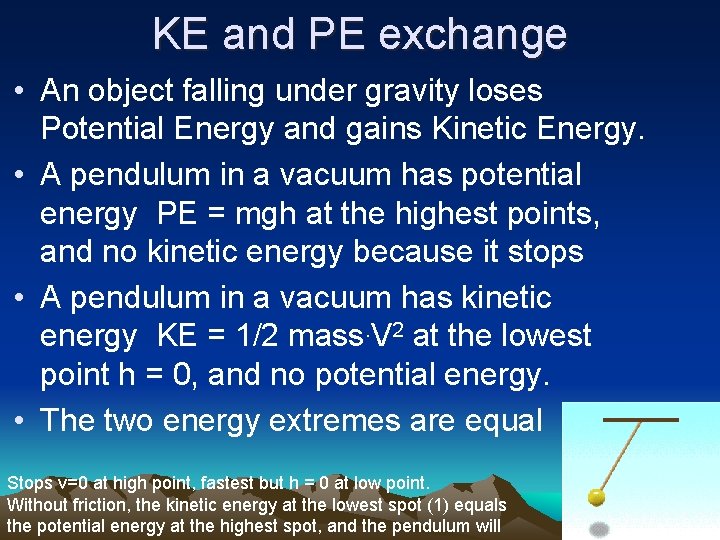
KE and PE exchange • An object falling under gravity loses Potential Energy and gains Kinetic Energy. • A pendulum in a vacuum has potential energy PE = mgh at the highest points, and no kinetic energy because it stops • A pendulum in a vacuum has kinetic energy KE = 1/2 mass. V 2 at the lowest point h = 0, and no potential energy. • The two energy extremes are equal Stops v=0 at high point, fastest but h = 0 at low point. Without friction, the kinetic energy at the lowest spot (1) equals the potential energy at the highest spot, and the pendulum will
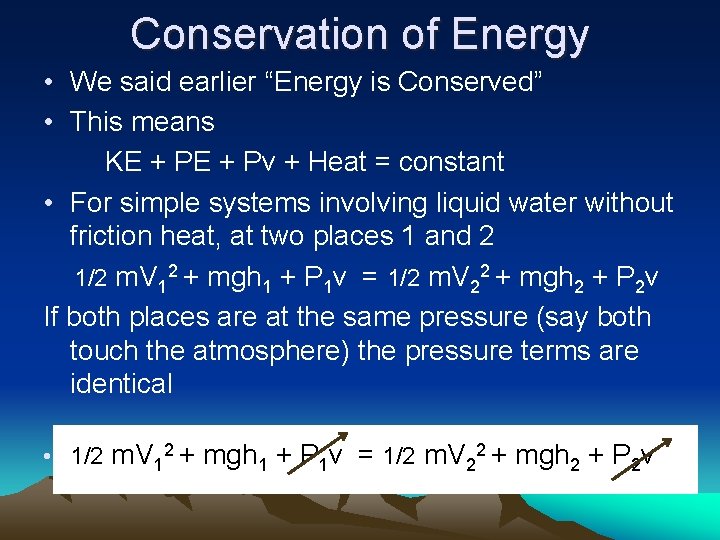
Conservation of Energy • We said earlier “Energy is Conserved” • This means KE + Pv + Heat = constant • For simple systems involving liquid water without friction heat, at two places 1 and 2 1/2 m. V 12 + mgh 1 + P 1 v = 1/2 m. V 22 + mgh 2 + P 2 v If both places are at the same pressure (say both touch the atmosphere) the pressure terms are identical • 1/2 m. V 12 + mgh 1 + P 1 v = 1/2 m. V 22 + mgh 2 + P 2 v
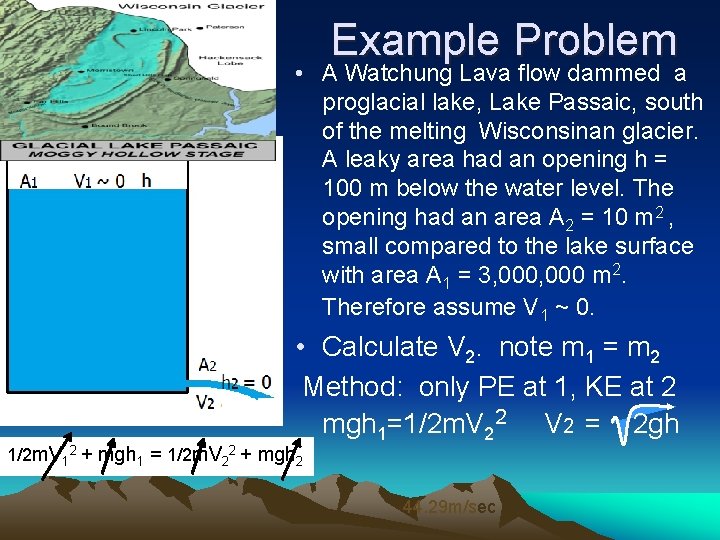
Example Problem • A Watchung Lava flow dammed a proglacial lake, Lake Passaic, south of the melting Wisconsinan glacier. A leaky area had an opening h = 100 m below the water level. The opening had an area A 2 = 10 m 2 , small compared to the lake surface with area A 1 = 3, 000 m 2. Therefore assume V 1 ~ 0. • Calculate V 2. note m 1 = m 2 Method: only PE at 1, KE at 2 mgh 1=1/2 m. V 22 V 2 = 2 gh 1/2 m. V 12 + mgh 1 = 1/2 m. V 22 + mgh 2 44. 29 m/sec
- Slides: 26