
Basics of the Universe Astronomy The study of
Basics of the Universe
Astronomy • The study of the universe Cosmology • The branch of astronomy that deals with the origin, large-scale properties, and the evolution of the observable universe
The Universe • The universe is all space, all the matter, all energy, and all time in it • Big Bang – rapid expansion of matter from a state of extremely high density and temperature that marks the origin of the universe. • major components formed: – galaxies – solar systems – planets – everything
“Big Bang” Theory • Primeval expansion of space, time, matter and energy • Occurred about 13. 7 billion years ago • Expanded within a second from something the size of a spec of dust to the size of our solar system Misconception Alert: Describing this theory as the “Big Bang” is a misnomer because there really was not an explosion, just a release of energy
Early History of the Universe • Matter as we know it did not exist at the time of the Big Bang, only pure energy. • Within the first second, the 4 fundamental forces were created – gravity - the attraction of one body toward another • First explained by Isaac Newton in the Universal Law of Gravity – electromagnetic force - binds atoms into molecules – strong nuclear force - binds protons and neutrons together in the nucleus – weak nuclear force - breaks down an atom’s nucleus, producing radioactive decay
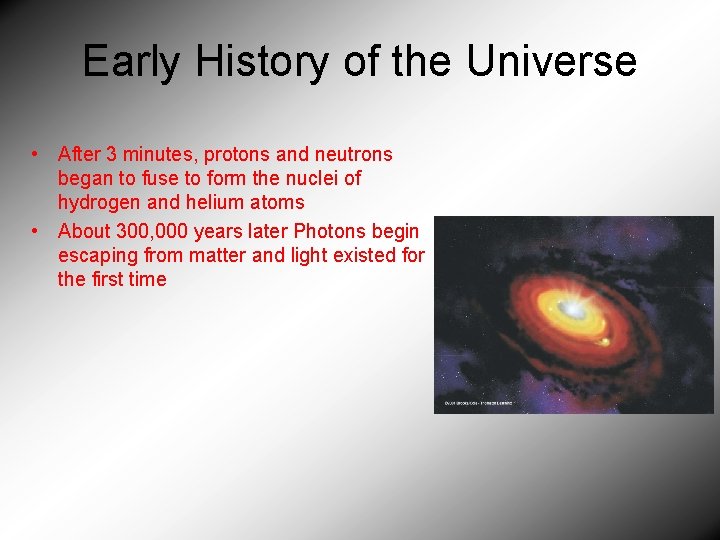
Early History of the Universe • After 3 minutes, protons and neutrons began to fuse to form the nuclei of hydrogen and helium atoms • About 300, 000 years later Photons begin escaping from matter and light existed for the first time
Changing Composition of the Universe • 200 million years later, with expansion still occurring, stars and galaxies began forming from leftover matter - hydrogen and helium – Nuclear fusion in stars reduces Hydrogen to Helium – When a dying star explodes, the heavier elements (less that iron) created by fusion are blown into space to be recycled by newly forming stars – Overall composition of the galaxies is gradually changing to the heavier elements
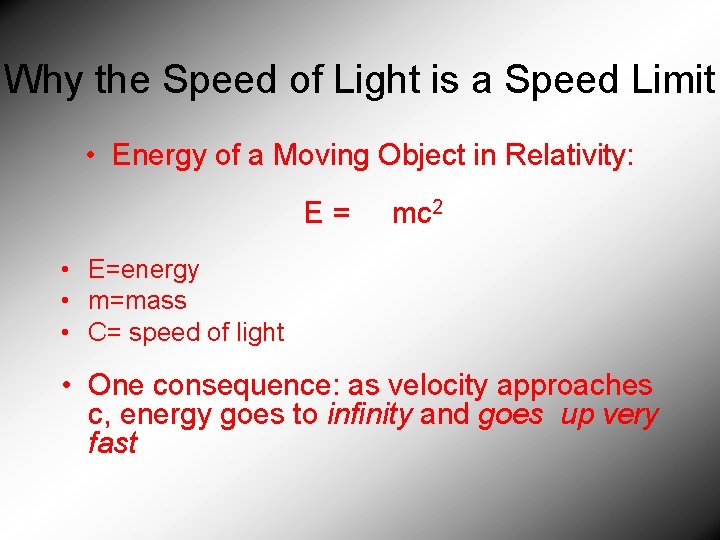
Why the Speed of Light is a Speed Limit • Energy of a Moving Object in Relativity: E= mc 2 • E=energy • m=mass • C= speed of light • One consequence: as velocity approaches c, energy goes to infinity and goes up very fast
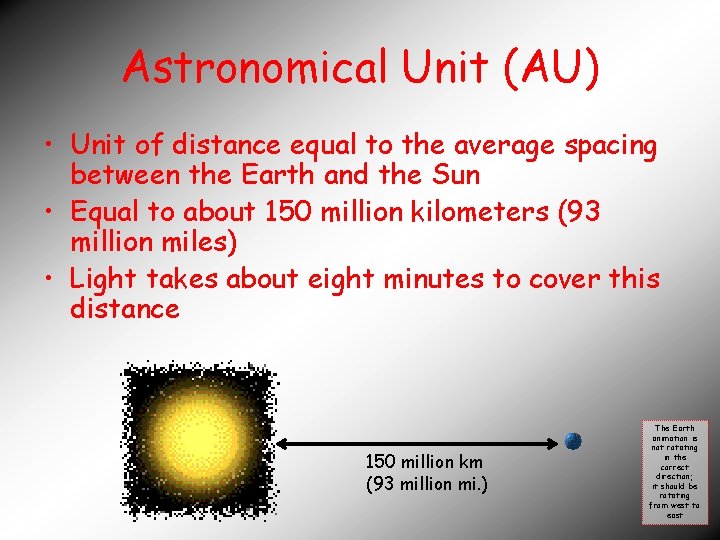
Astronomical Unit (AU) • Unit of distance equal to the average spacing between the Earth and the Sun • Equal to about 150 million kilometers (93 million miles) • Light takes about eight minutes to cover this distance 150 million km (93 million mi. ) The Earth animation is not rotating in the correct direction; it should be rotating from west to east
Light Year • Distance that light travels in one year in a vacuum, which is about 9. 5 trillion kilometers (6 trillion miles) – The Milky Way Galaxy is about 100, 000 light years in diameter • The speed at which light travels this distance is about 300, 000 km/sec (186, 000 mi/sec) The second closest star to the Earth is a little over four light years away. How far away (in miles) is the star?
Parsec • Unit of distance equal to about 3. 26 light years (or 206, 265 AU)
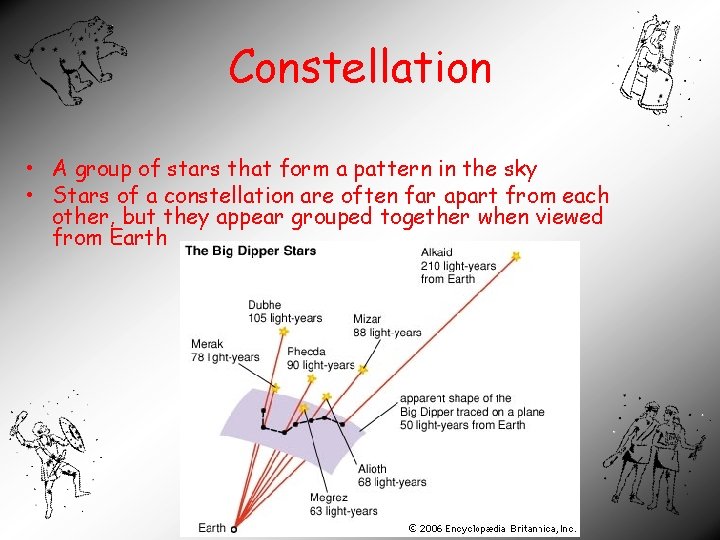
Constellation • A group of stars that form a pattern in the sky • Stars of a constellation are often far apart from each other, but they appear grouped together when viewed from Earth
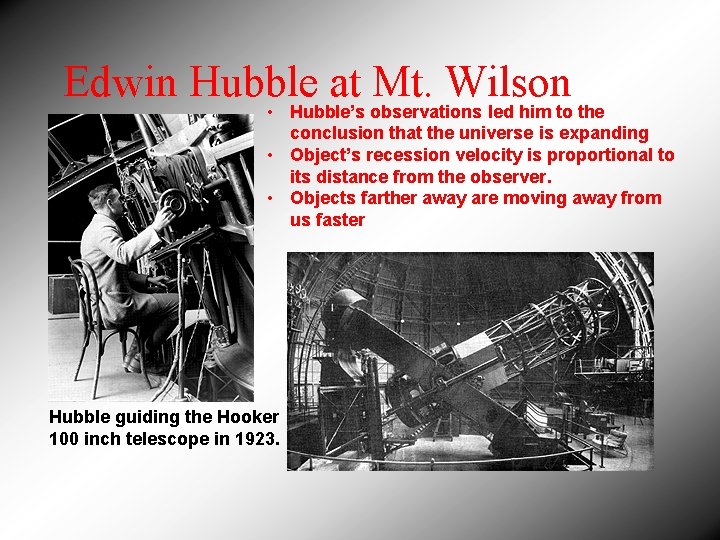
Edwin Hubble at Mt. Wilson • Hubble’s observations led him to the conclusion that the universe is expanding • Object’s recession velocity is proportional to its distance from the observer. • Objects farther away are moving away from us faster Hubble guiding the Hooker 100 inch telescope in 1923.
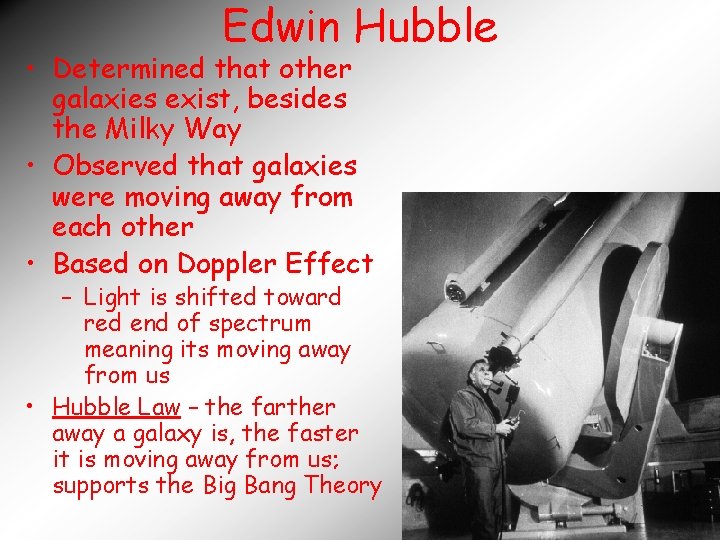
Edwin Hubble • Determined that other galaxies exist, besides the Milky Way • Observed that galaxies were moving away from each other • Based on Doppler Effect – Light is shifted toward red end of spectrum meaning its moving away from us • Hubble Law – the farther away a galaxy is, the faster it is moving away from us; supports the Big Bang Theory
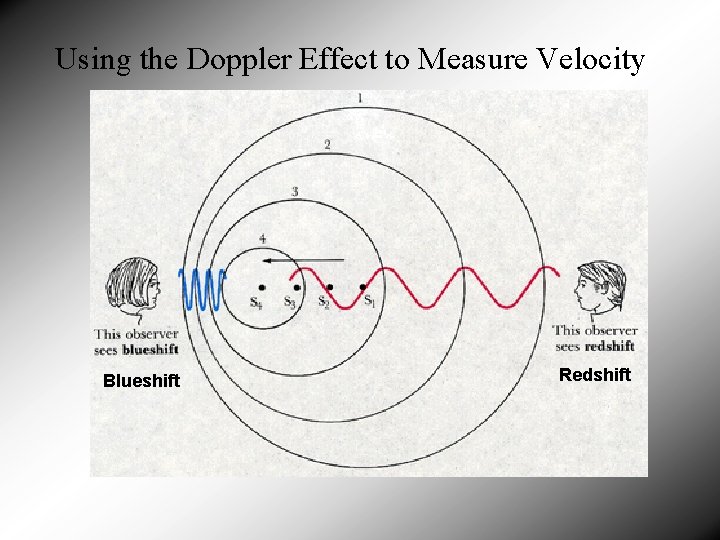
Using the Doppler Effect to Measure Velocity Blueshift Redshift
Telescope • A device that gathers and focuses electromagnetic radiation • Types: – Visible, infrared, ultraviolet • Reflecting - use mirrors that reflect the image being viewed • Refracting – using lenses, gathers light and focuses it near the opposite end of the tube; works like a magnifying glass – Radio - pick up radio waves emitted from space; not effected by variables like weather or clouds
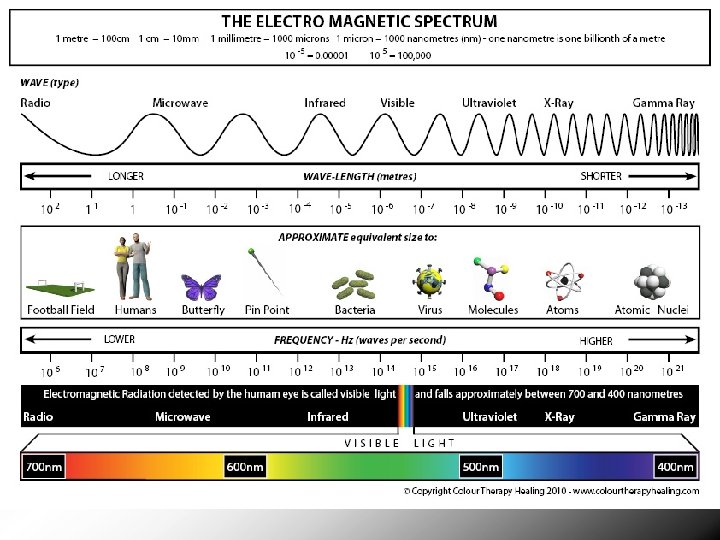
Electromagnetic (EM) Radiation • Majority of astronomy looks at EM Radiation • EM Radiation – includes all radiation (light) from Radio to Gamma Rays • Humans only see small region • Visible light – 400 – 700 nm (violet to red)
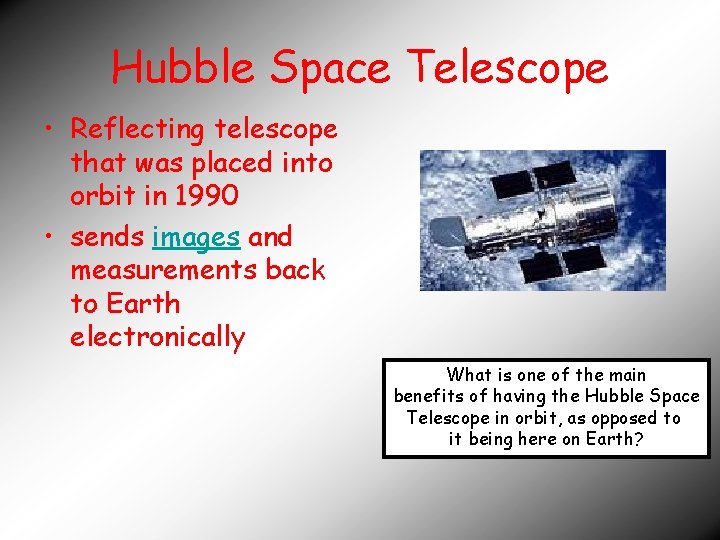
Hubble Space Telescope • Reflecting telescope that was placed into orbit in 1990 • sends images and measurements back to Earth electronically What is one of the main benefits of having the Hubble Space Telescope in orbit, as opposed to it being here on Earth?
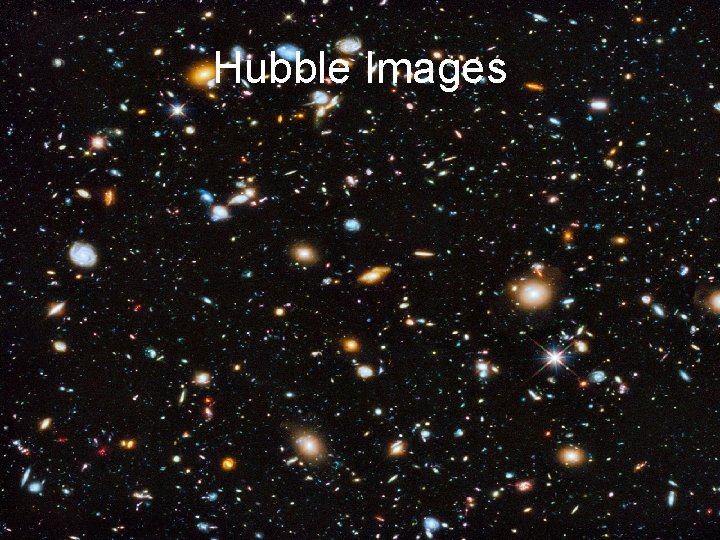
Hubble Images
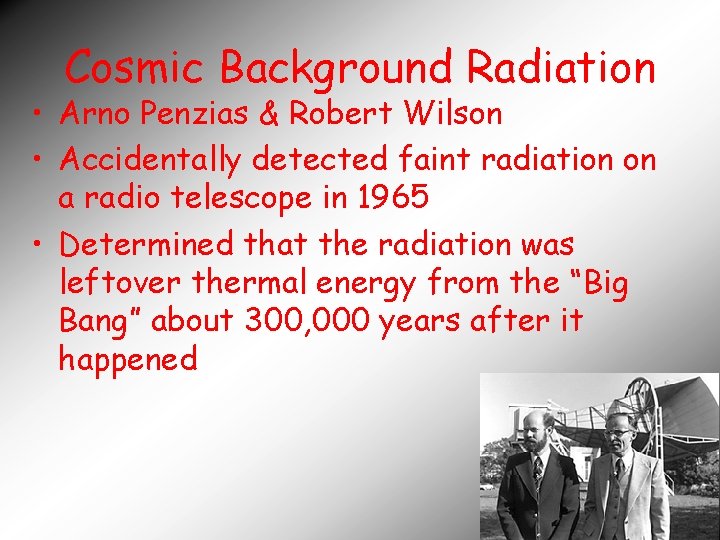
Cosmic Background Radiation • Arno Penzias & Robert Wilson • Accidentally detected faint radiation on a radio telescope in 1965 • Determined that the radiation was leftover thermal energy from the “Big Bang” about 300, 000 years after it happened
Galaxy • A large assemblage of stars (and often gas and dust), typically containing millions to hundreds of billions of member stars – Star - a large hot ball of gas which generates energy in its core by nuclear reactions • Estimated 100 billion galaxies in the universe each with billions of stars • Held together by the gravitational attraction of all its member stars on one another • Formed around 200 million years after the “Big Bang” • Most large galaxies have super-massive black holes at their centers • Sometimes contain very bright centers called quasars • 3 major types: – Spiral – Elliptical – Irregular What is the name of the galaxy we reside in?
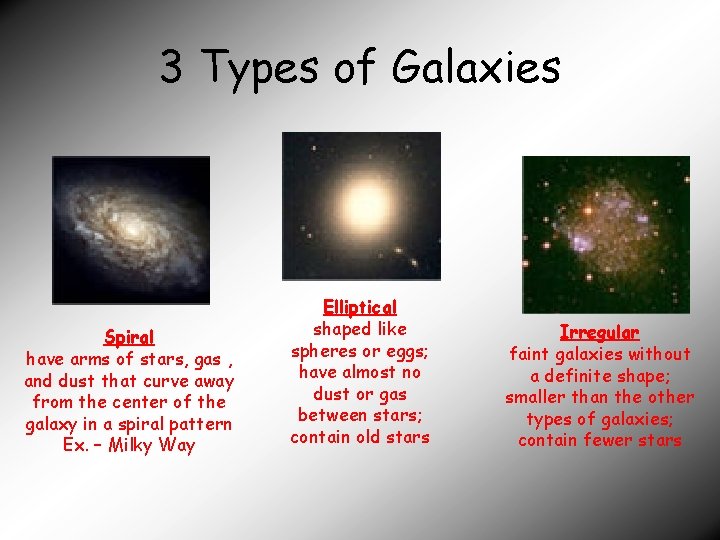
3 Types of Galaxies Spiral have arms of stars, gas , and dust that curve away from the center of the galaxy in a spiral pattern Ex. – Milky Way Elliptical shaped like spheres or eggs; have almost no dust or gas between stars; contain old stars Irregular faint galaxies without a definite shape; smaller than the other types of galaxies; contain fewer stars
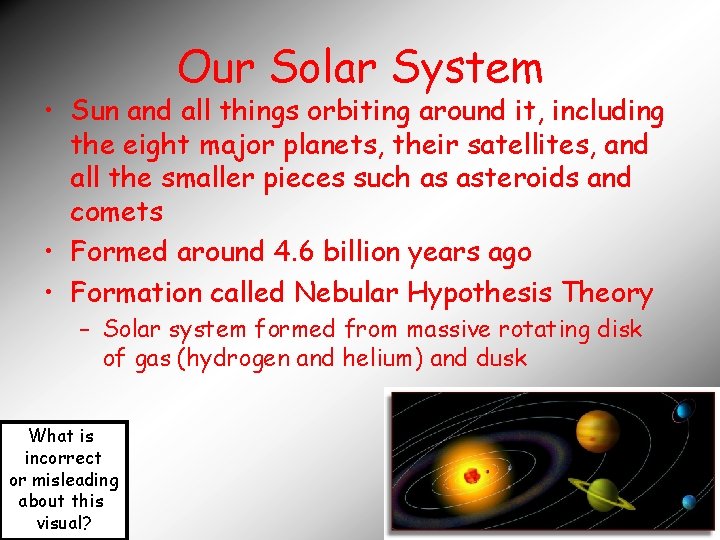
Our Solar System • Sun and all things orbiting around it, including the eight major planets, their satellites, and all the smaller pieces such as asteroids and comets • Formed around 4. 6 billion years ago • Formation called Nebular Hypothesis Theory – Solar system formed from massive rotating disk of gas (hydrogen and helium) and dusk What is incorrect or misleading about this visual?
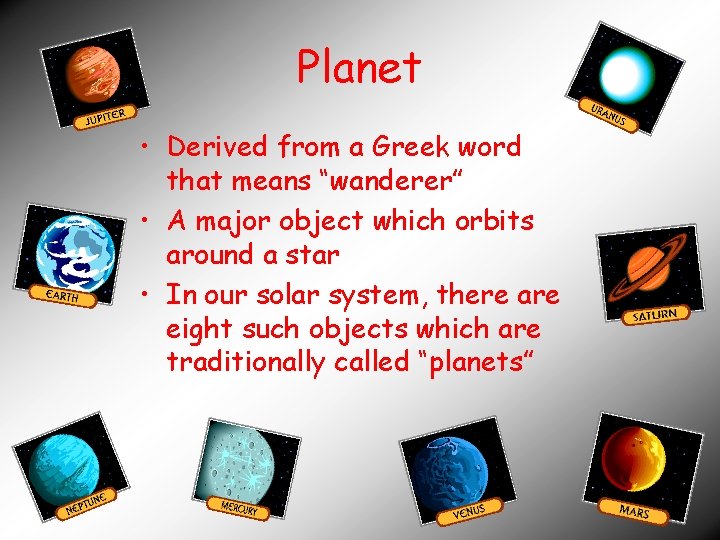
Planet • Derived from a Greek word that means “wanderer” • A major object which orbits around a star • In our solar system, there are eight such objects which are traditionally called “planets”
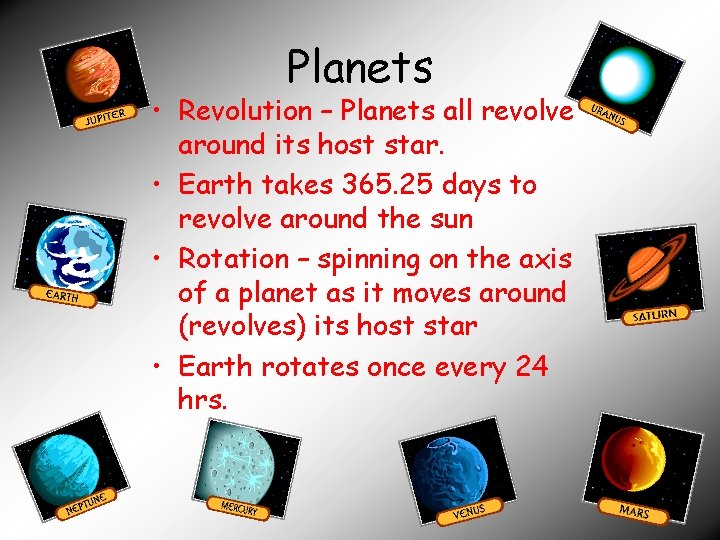
Planets • Revolution – Planets all revolve around its host star. • Earth takes 365. 25 days to revolve around the sun • Rotation – spinning on the axis of a planet as it moves around (revolves) its host star • Earth rotates once every 24 hrs.
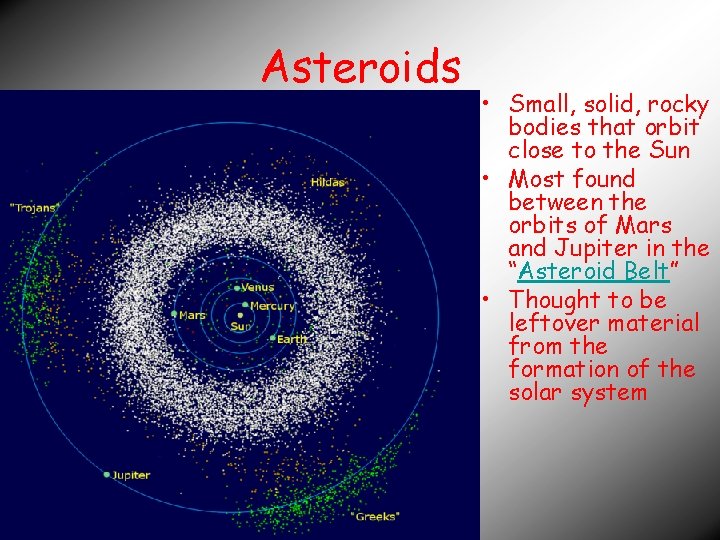
Asteroids • Small, solid, rocky bodies that orbit close to the Sun • Most found between the orbits of Mars and Jupiter in the “Asteroid Belt” • Thought to be leftover material from the formation of the solar system
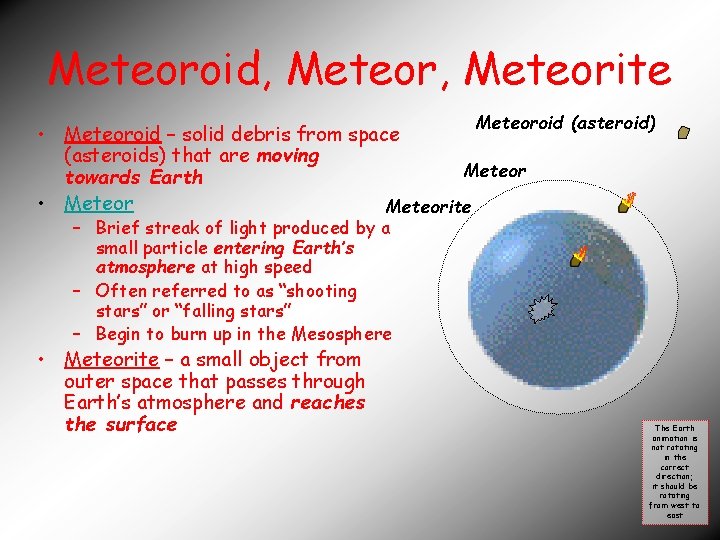
Meteoroid, Meteorite Meteoroid (asteroid) • Meteoroid – solid debris from space (asteroids) that are moving Meteor towards Earth • Meteorite – Brief streak of light produced by a small particle entering Earth’s atmosphere at high speed – Often referred to as “shooting stars” or “falling stars” – Begin to burn up in the Mesosphere • Meteorite – a small object from outer space that passes through Earth’s atmosphere and reaches the surface The Earth animation is not rotating in the correct direction; it should be rotating from west to east
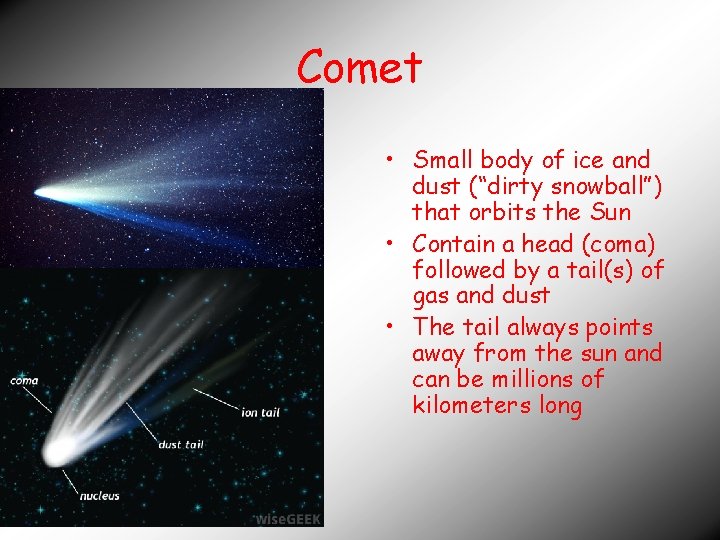
Comet • Small body of ice and dust (“dirty snowball”) that orbits the Sun • Contain a head (coma) followed by a tail(s) of gas and dust • The tail always points away from the sun and can be millions of kilometers long
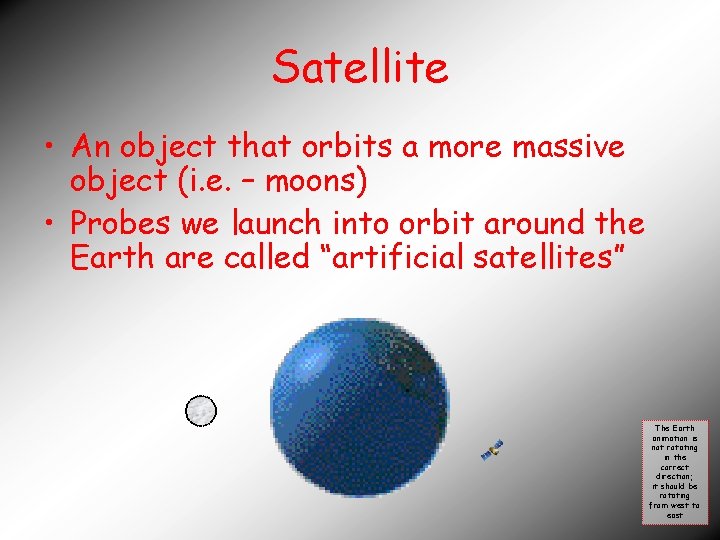
Satellite • An object that orbits a more massive object (i. e. – moons) • Probes we launch into orbit around the Earth are called “artificial satellites” The Earth animation is not rotating in the correct direction; it should be rotating from west to east
- Slides: 29