
BASICS OF SURVEYING A Primer for Land Surveyors
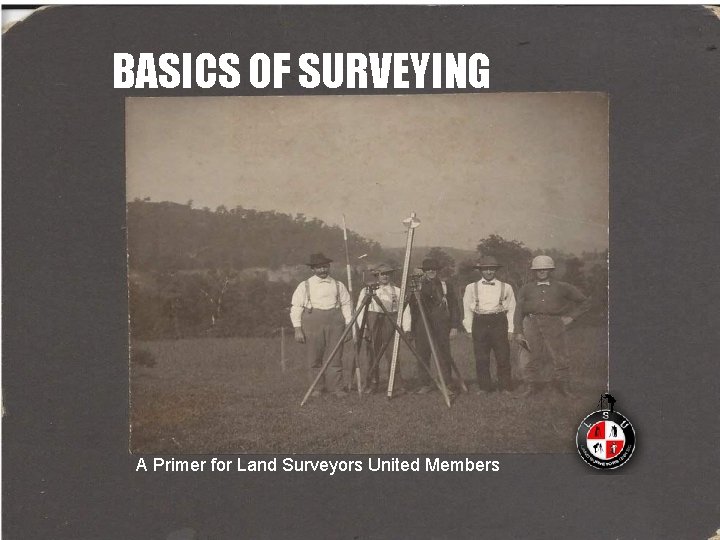
BASICS OF SURVEYING A Primer for Land Surveyors United Members

SURVEYING DEFINITION The art and science of making such measurements as are necessary to determine the relative position of points above, on, or beneath the surface of the earth, or to establish such points in a specified position

MAJOR SURVEYS TYPES Property surveys - Determine boundary lines, location of property corners, acquisition of data to prepare land subdivisions ●Route surveys - Designing and constructing engineering projects associated with transportation and communications ●

MAJOR SURVEYS TYPES Topographic surveys - Collect field data to prepare topographic maps ●Hydrographic surveys - Map shorelines of water bodies, chart bottom areas of streams, lakes, harbors, etc. , measure flow of rivers, assess other issues related to navigation and water resources ●Aerial surveys (photogrammetry) - Use photographs mounted in specially designed planes ●
MAJOR SURVEYS TYPES Mine surveys ●Determine position of underground works and surface mines, fix position and direction of tunnels and shafts, define surface boundaries ● Construction surveys ●Performed during building of structure or project to fix elevation. ●

SURVEY GEOGRAPHIC REFERENCE Latitude (φ) Lines run eastwest parallel to equator Max angle 90° South latitudes are negative ● Longitude (λ) Lines run north south, converge at poles 0° - Greenwich Measured east and west - 80° max angle West longitude negative ●Measured in Deg, Min, Sec ●

DIRECTION Azimuth- clockwise angle from north to Line. Contains an angle between 0 and 360 degrees. (Page 810) ●Bearing – angle measured from north or south. Contains an angle between 0 and 90 degrees. (Page 811) ●

TRAVERSE A traverse is a series of lines that each have a known length and are connected by known angles. Each traverse line is a course, and each point where courses intersect is a traverse station or station point. When traversing you start with a point of beginning (POB) and proceed to utilize a traverse type. ●
CONTOUR Contour lines on a map show elevation. The markings on the contour lines use the same concept at markings on a ruler. ●Heavy contour lines on a map are called INDEX CONTOURS. Index Contours usually have elevations labeled on them. ●Lighter lines between the index contour lines are known as Intermediate Contours and they are usually not labeled with elevations on them. ●You would need to count the number of Intermediate contour lines between the heavy contour lines to determine the elevation scale. ●
CUT AND FILL DRAWING When designing a road, highway or building site, portions of earth must be removed (cut) from hillsides that are too steep and added (filled) to valleys and low spots. The amount of cut and fill can be shown on the profile using contour lines. ●
- Slides: 10