
Basics of Study Design in Foodborne Illness Outbreak
Basics of Study Design in Foodborne Illness Outbreak Investigations Instructor Name Job Title Organization

Types of outbreak activities y r o t a r o b La Epi dem iolo gy Environmental …and lots of talking to people!
Foodborne outbreak definition • A foodborne disease outbreak is defined as an incident in which two or more persons experience a similar illness resulting from the ingestion of a common food CDC definition

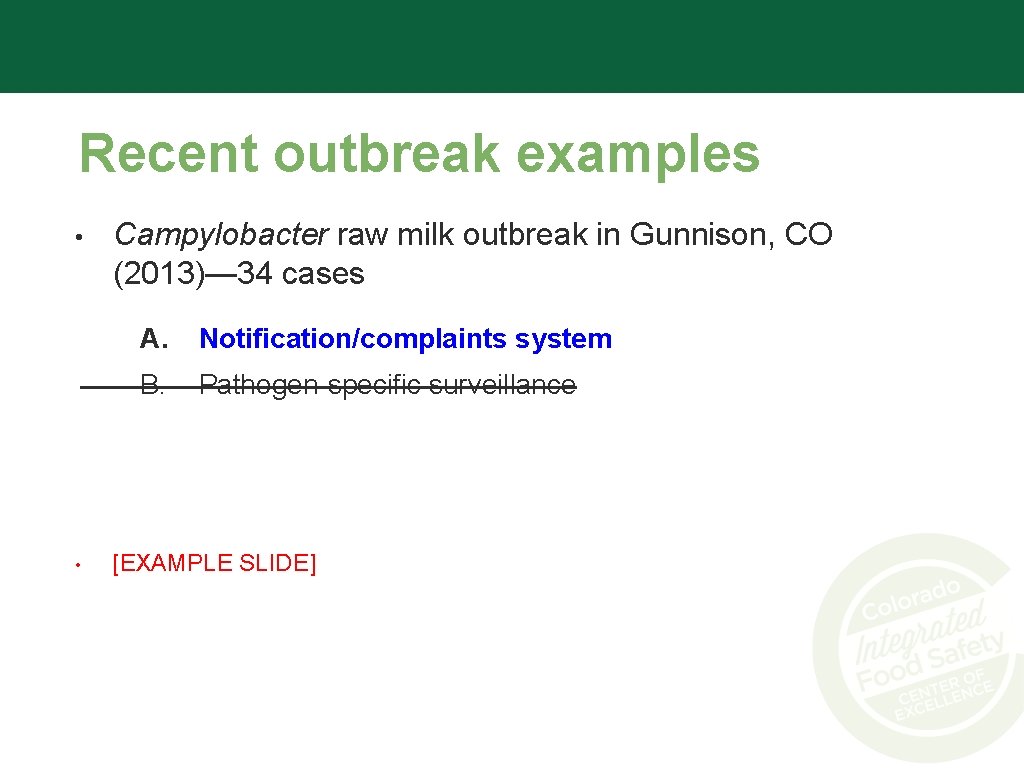
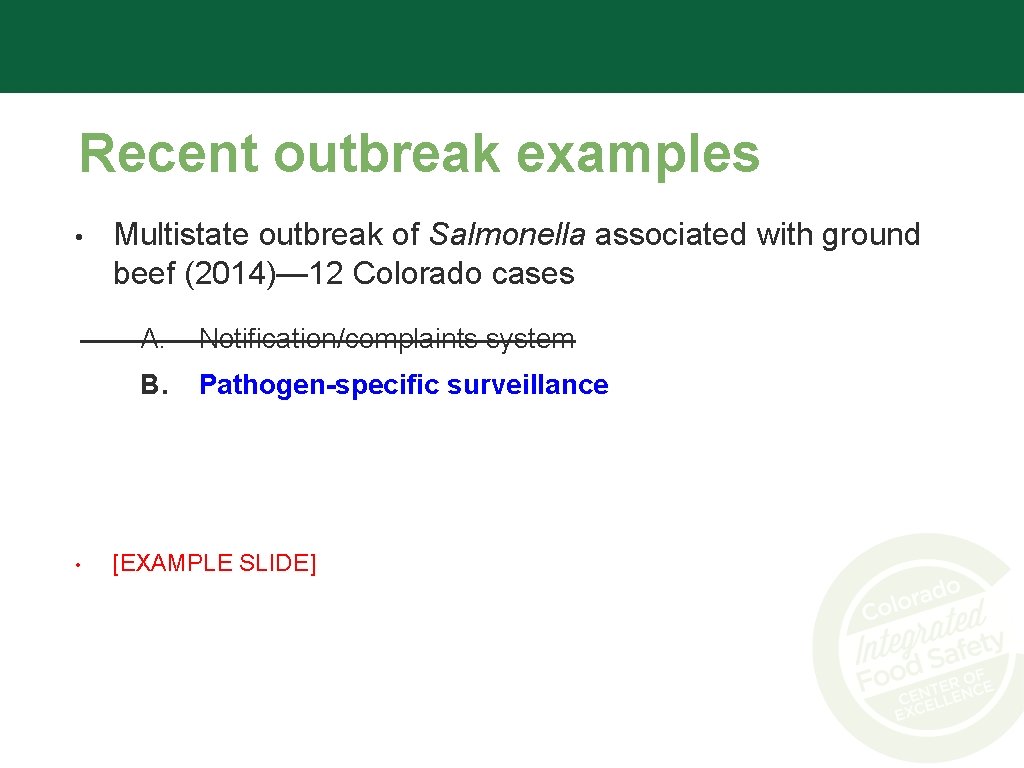
How are outbreaks detected? • Notification/complaints systems - Independent complaints - Reports of a group of ill persons • Pathogen-specific surveillance - Case reporting by laboratories

Recent Outbreak Examples � […. . Instructor, include an example of a recent foodborne illness investigation in your area…] A. Notification/complaints system B. Pathogen-specific surveillance - (see next few slides for examples used for training of participants in Colorado)

Recent Outbreak Examples � […. . Instructor, include an example of a recent foodborne illness investigation in your area…] A. Notification/complaints system B. Pathogen-specific surveillance - (see next few slides for examples used for training of participants in Colorado)
Recent Outbreak Examples � […. . Instructor, include an example of a recent foodborne illness investigation in your area…] A. Notification/complaints system B. Pathogen-specific surveillance - (see next few slides for examples used for training of participants in Colorado)
Recent outbreak examples • • Outbreak of listeriosis linked to cantaloupes (2011)— 146 people ill and 30 deaths from 28 states A. Notification/complaints system B. Pathogen-specific surveillance [EXAMPLE SLIDE]
Recent outbreak examples • • Outbreak of listeriosis linked to cantaloupes (2011)— 146 people ill and 30 deaths from 28 states A. Notification/complaints system B. Pathogen-specific surveillance [EXAMPLE SLIDE]

Recent outbreak examples • • Gastrointestinal outbreak at a prison— 45 cases (2013) A. Notification/complaints system B. Pathogen-specific surveillance [EXAMPLE SLIDE]
Recent outbreak examples • • Gastrointestinal outbreak at a prison— 45 cases (2013) A. Notification/complaints system B. Pathogen-specific surveillance [EXAMPLE SLIDE]
Recent outbreak examples • • E. coli O 157 outbreak linked to cucumbers served at Denver Metro sandwich shop (2013)— 9 people ill A. Notification/complaints system B. Pathogen-specific surveillance [EXAMPLE SLIDE]
Recent outbreak examples • • E. coli O 157 outbreak linked to cucumbers served at Denver Metro sandwich shop (2013)— 9 people ill A. Notification/complaints system B. Pathogen-specific surveillance [EXAMPLE SLIDE]
Recent outbreak examples • • Campylobacter raw milk outbreak in Gunnison, CO (2013)— 34 cases A. Notification/complaints system B. Pathogen-specific surveillance [EXAMPLE SLIDE]
Recent outbreak examples • • Campylobacter raw milk outbreak in Gunnison, CO (2013)— 34 cases A. Notification/complaints system B. Pathogen-specific surveillance [EXAMPLE SLIDE]
Recent outbreak examples • • Multistate outbreak of Salmonella associated with ground beef (2014)— 12 Colorado cases A. Notification/complaints system B. Pathogen-specific surveillance [EXAMPLE SLIDE]
Recent outbreak examples • • Multistate outbreak of Salmonella associated with ground beef (2014)— 12 Colorado cases A. Notification/complaints system B. Pathogen-specific surveillance [EXAMPLE SLIDE]

Recent outbreak examples � • Multistate outbreak of hepatitis A virus infections linked to pomegranate seeds from Turkey (2013)— 162 people ill from 10 states A. Notification/complaints system B. Pathogen-specific surveillance [EXAMPLE SLIDE]
Recent outbreak examples � • Multistate outbreak of hepatitis A virus infections linked to pomegranate seeds from Turkey (2013)— 162 people ill from 10 states A. Notification/complaints system B. Pathogen-specific surveillance [EXAMPLE SLIDE]
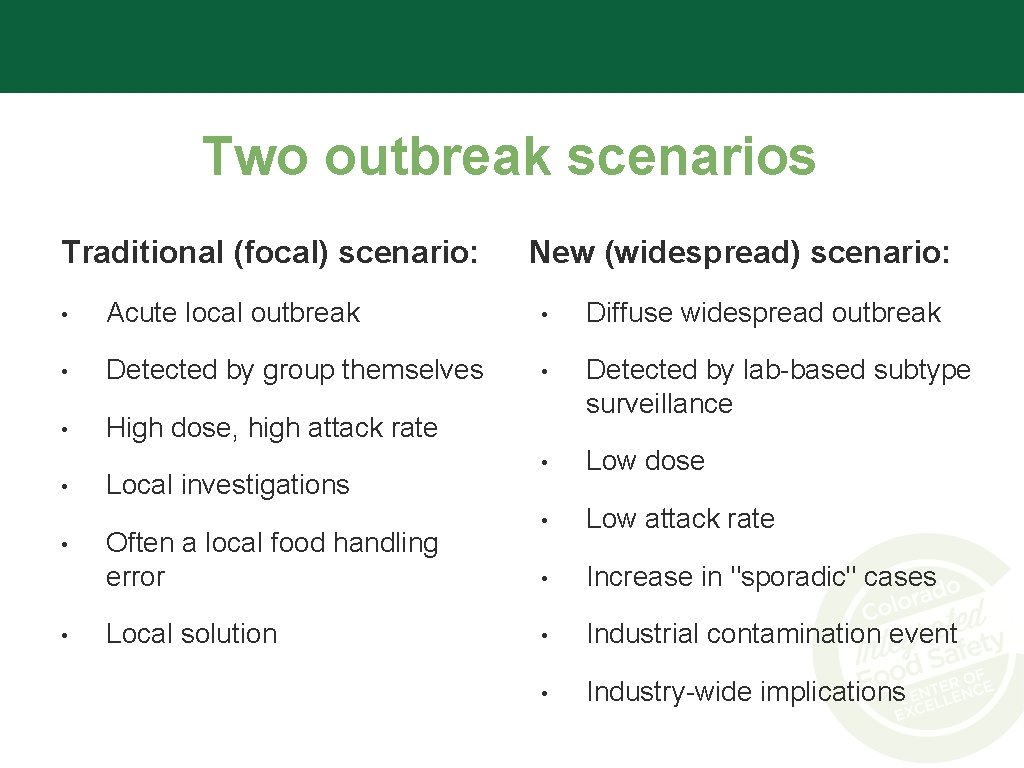
Two outbreak scenarios Traditional (focal) scenario: New (widespread) scenario: • Acute local outbreak • Diffuse widespread outbreak • Detected by group themselves • • High dose, high attack rate Detected by lab-based subtype surveillance • Low dose • Low attack rate • Increase in "sporadic" cases • Industrial contamination event • Industry-wide implications • • • Local investigations Often a local food handling error Local solution
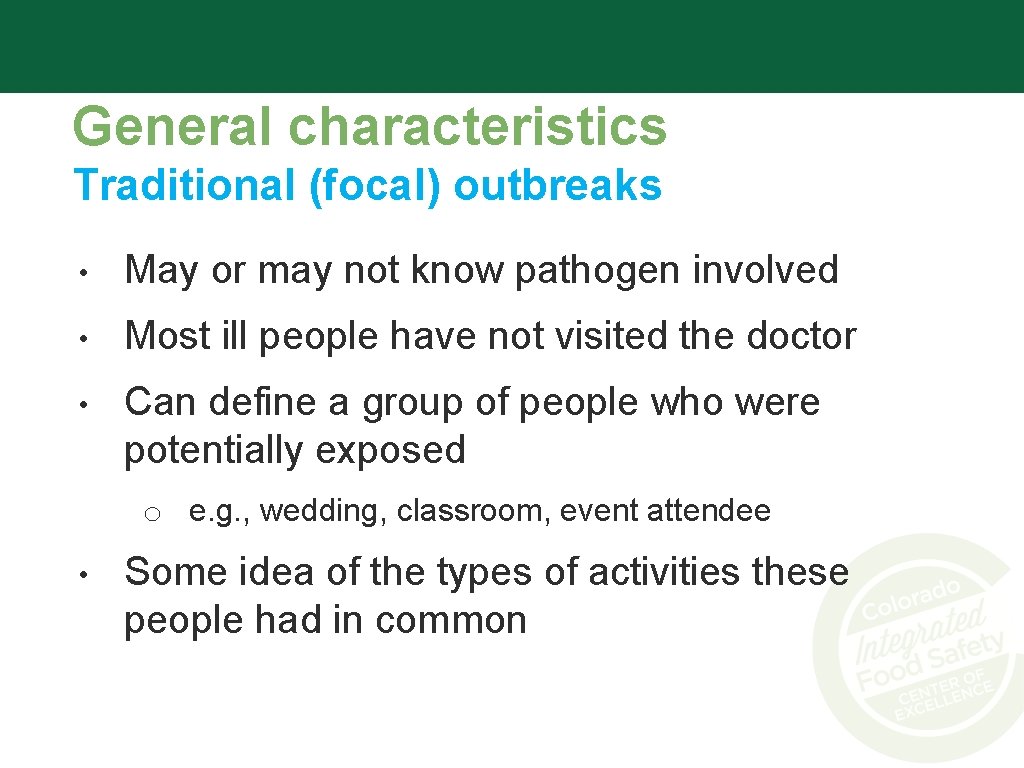
General characteristics Traditional (focal) outbreaks • May or may not know pathogen involved • Most ill people have not visited the doctor • Can define a group of people who were potentially exposed o e. g. , wedding, classroom, event attendee • Some idea of the types of activities these people had in common
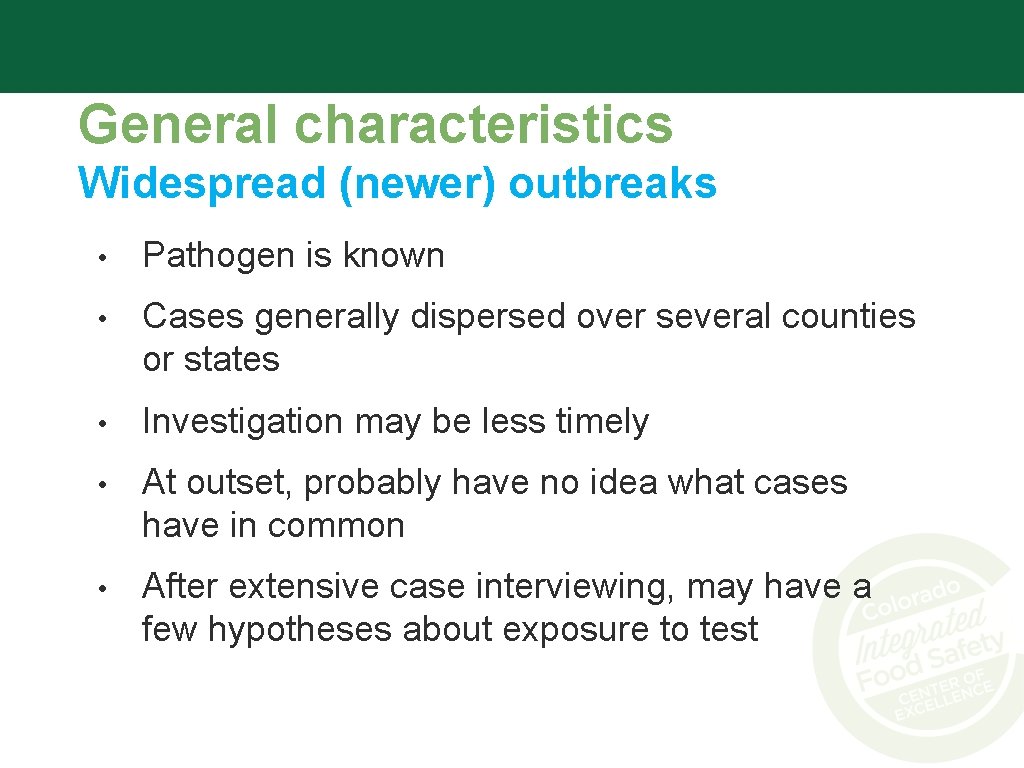
General characteristics Widespread (newer) outbreaks • Pathogen is known • Cases generally dispersed over several counties or states • Investigation may be less timely • At outset, probably have no idea what cases have in common • After extensive case interviewing, may have a few hypotheses about exposure to test
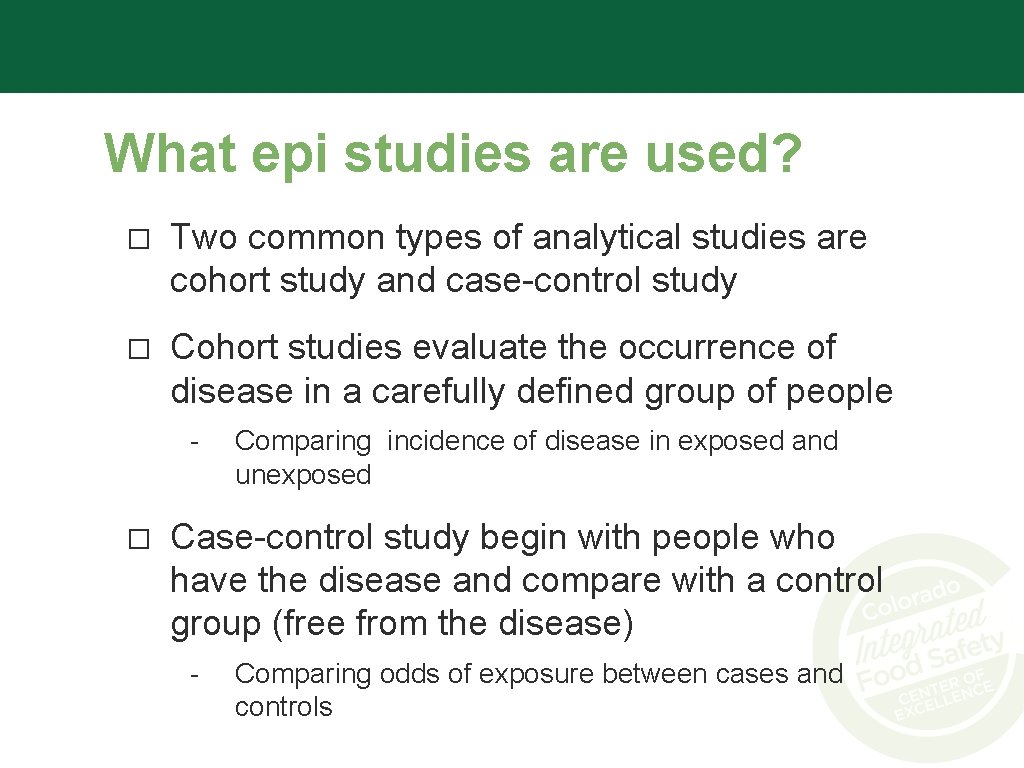
What epi studies are used? � Two common types of analytical studies are cohort study and case-control study � Cohort studies evaluate the occurrence of disease in a carefully defined group of people - � Comparing incidence of disease in exposed and unexposed Case-control study begin with people who have the disease and compare with a control group (free from the disease) - Comparing odds of exposure between cases and controls
Recent Outbreak Examples � […. . Instructor, include an example of a recent foodborne illness investigation in your area…] A. Cohort Study B. Case-control Study - (see next few slides for examples used for training of participants in Colorado)
Recent Outbreak Examples � […. . Instructor, include an example of a recent foodborne illness investigation in your area…] A. Cohort Study B. Case-control Study - (see next few slides for examples used for training of participants in Colorado)
Recent Outbreak Examples � […. . Instructor, include an example of a recent foodborne illness investigation in your area…] A. Cohort Study B. Case-control Study - (see next few slides for examples used for training of participants in Colorado)
Recent outbreak examples • • Outbreak of listeriosis linked to cantaloupes (2011)— 146 people ill and 30 deaths from 28 states A. Cohort Study B. Case-control Study [EXAMPLE SLIDE]
Recent outbreak examples • • Outbreak of listeriosis linked to cantaloupes (2011)— 146 people ill and 30 deaths from 28 states A. Cohort Study B. Case-control Study [EXAMPLE SLIDE]
Recent outbreak examples • • Gastrointestinal outbreak at a prison— 45 cases (2013) A. Cohort Study B. Case-control Study [EXAMPLE SLIDE]
Recent outbreak examples • • Gastrointestinal outbreak at a prison— 45 cases (2013) A. Cohort Study B. Case-control Study [EXAMPLE SLIDE]
Recent outbreak examples • • E. coli O 157 outbreak linked to cucumbers served at Denver Metro sandwich shop (2013)— 9 people ill A. Cohort Study B. Case-control Study [EXAMPLE SLIDE]
Recent outbreak examples • • E. coli O 157 outbreak linked to cucumbers served at Denver Metro sandwich shop (2013)— 9 people ill A. Cohort Study B. Case-control Study [EXAMPLE SLIDE]

Recent outbreak examples • • Campylobacter raw milk outbreak in Gunnison, CO (2013)— 34 cases A. Cohort Study B. Case-control Study [EXAMPLE SLIDE]
Recent outbreak examples • • Campylobacter raw milk outbreak in Gunnison, CO (2013)— 34 cases A. Cohort Study B. Case-control Study [EXAMPLE SLIDE]
Recent outbreak examples • • Multistate outbreak of Salmonella associated with ground beef (2014)— 12 Colorado cases A. Cohort Study B. Case-control Study [EXAMPLE SLIDE]
Recent outbreak examples • • Multistate outbreak of Salmonella associated with ground beef (2014)— 12 Colorado cases A. Cohort Study B. Case-control Study [EXAMPLE SLIDE]

Recent outbreak examples � • Multistate outbreak of hepatitis A virus infections linked to pomegranate seeds from Turkey (2013)— 162 people ill from 10 states A. Cohort Study B. Case-control Study [EXAMPLE SLIDE]
Recent outbreak examples � • Multistate outbreak of hepatitis A virus infections linked to pomegranate seeds from Turkey (2013)— 162 people ill from 10 states A. Cohort Study B. Case-control Study [EXAMPLE SLIDE]
Cohort study—mechanics • Attempt to interview entire group (or random sample), regardless of illness status ‒ e. g. , Wedding attendees, school class, event attendees • Use same questionnaire used for everyone in the group (ill and well) • Questionnaire based on known activities/foods that group members may have done or eaten - • Created from menus, early interviews etc. Includes questions about ‘unknown’ exposures - “Did you do anything else that I forgot to ask about? ”
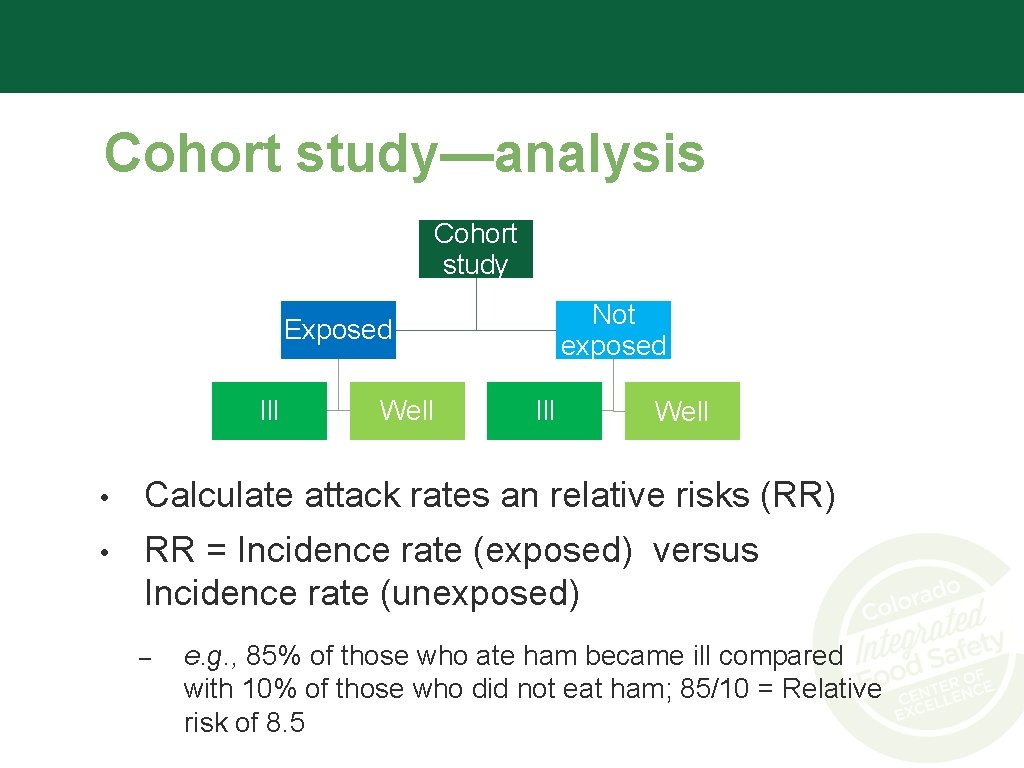
Cohort study—analysis Cohort study Not exposed Exposed Ill Well • Calculate attack rates an relative risks (RR) • RR = Incidence rate (exposed) versus Incidence rate (unexposed) ‒ e. g. , 85% of those who ate ham became ill compared with 10% of those who did not eat ham; 85/10 = Relative risk of 8. 5
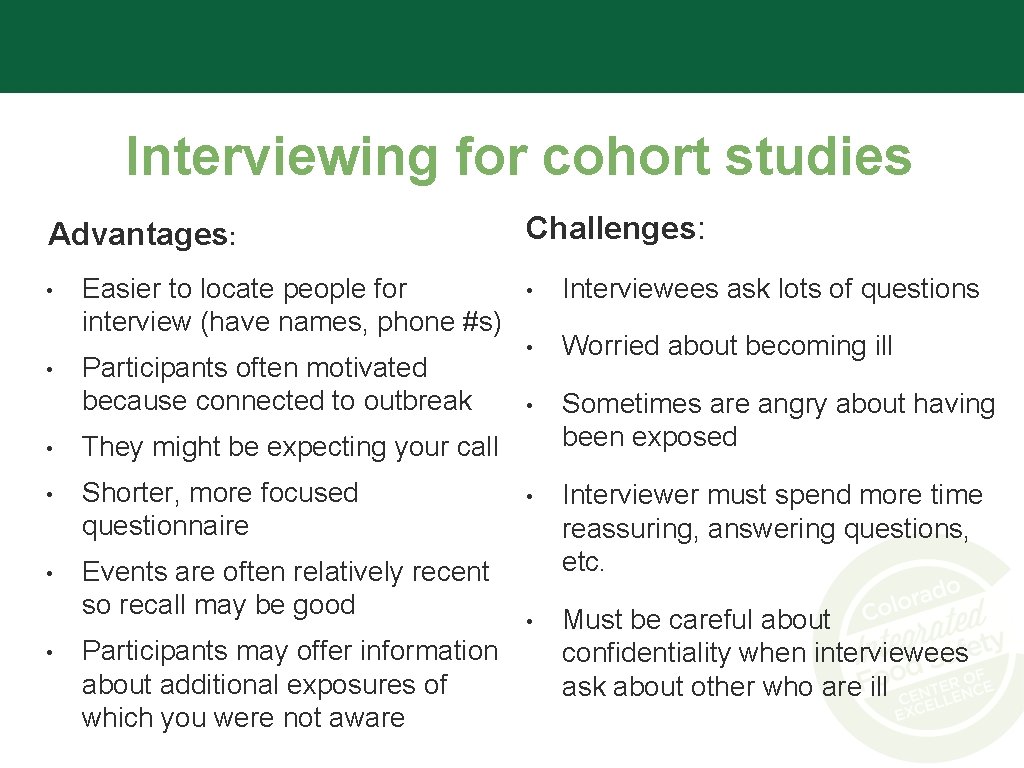
Interviewing for cohort studies Advantages: • • Easier to locate people for interview (have names, phone #s) Participants often motivated because connected to outbreak • They might be expecting your call • Shorter, more focused questionnaire • Events are often relatively recent so recall may be good • Participants may offer information about additional exposures of which you were not aware Challenges: • Interviewees ask lots of questions • Worried about becoming ill • Sometimes are angry about having been exposed • Interviewer must spend more time reassuring, answering questions, etc. • Must be careful about confidentiality when interviewees ask about other who are ill
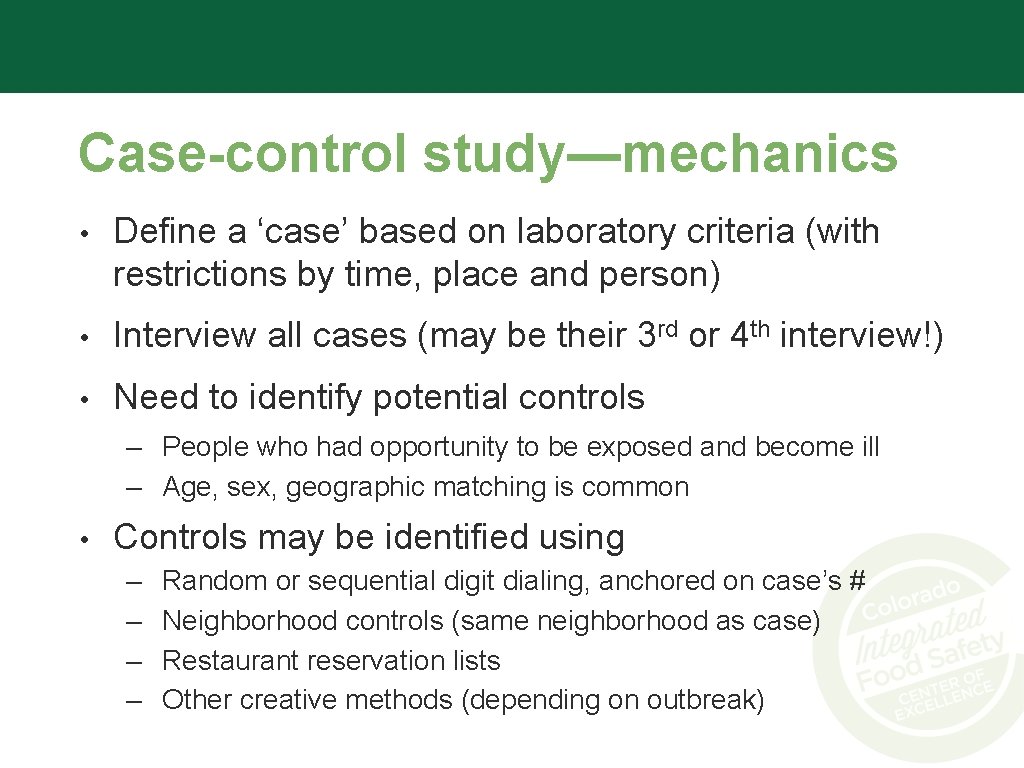
Case-control study—mechanics • Define a ‘case’ based on laboratory criteria (with restrictions by time, place and person) • Interview all cases (may be their 3 rd or 4 th interview!) • Need to identify potential controls ‒ People who had opportunity to be exposed and become ill ‒ Age, sex, geographic matching is common • Controls may be identified using ‒ ‒ Random or sequential digit dialing, anchored on case’s # Neighborhood controls (same neighborhood as case) Restaurant reservation lists Other creative methods (depending on outbreak)
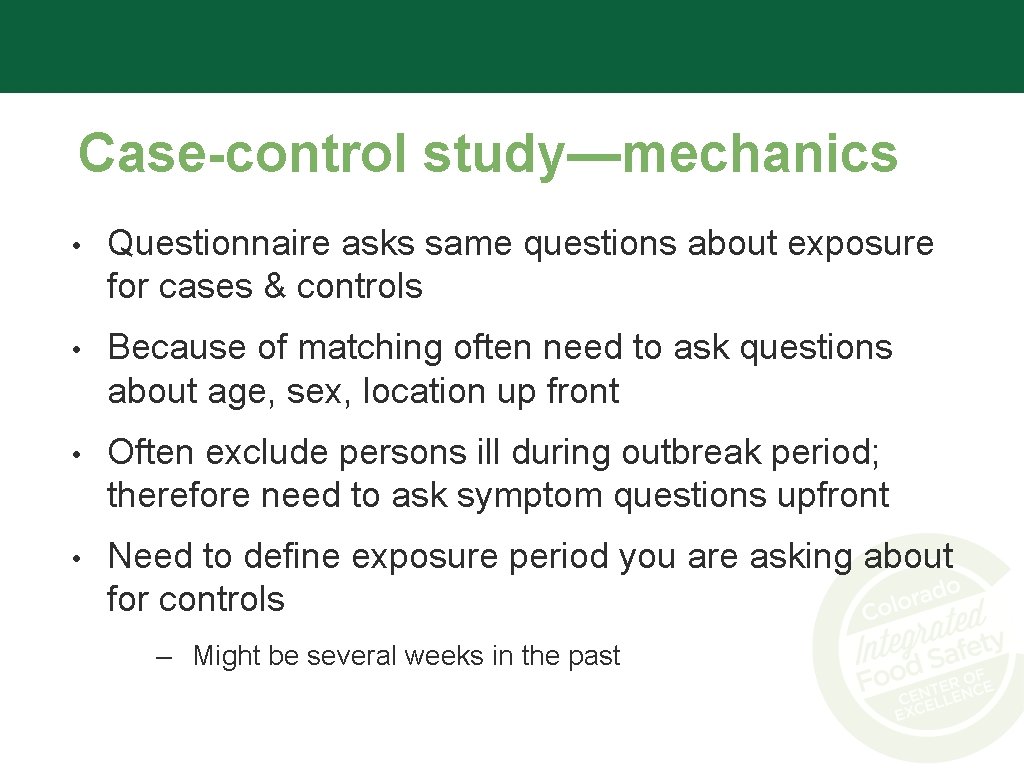
Case-control study—mechanics • Questionnaire asks same questions about exposure for cases & controls • Because of matching often need to ask questions about age, sex, location up front • Often exclude persons ill during outbreak period; therefore need to ask symptom questions upfront • Need to define exposure period you are asking about for controls ‒ Might be several weeks in the past
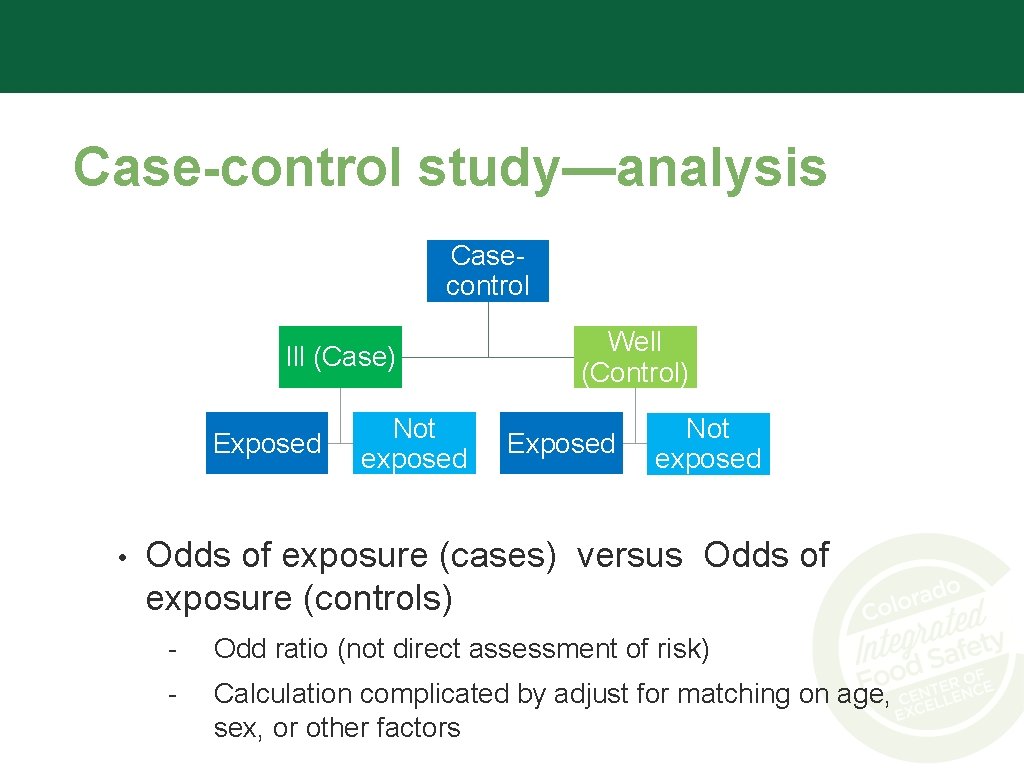
Case-control study—analysis Casecontrol Ill (Case) Exposed • Not exposed Well (Control) Exposed Not exposed Odds of exposure (cases) versus Odds of exposure (controls) - Odd ratio (not direct assessment of risk) - Calculation complicated by adjust for matching on age, sex, or other factors
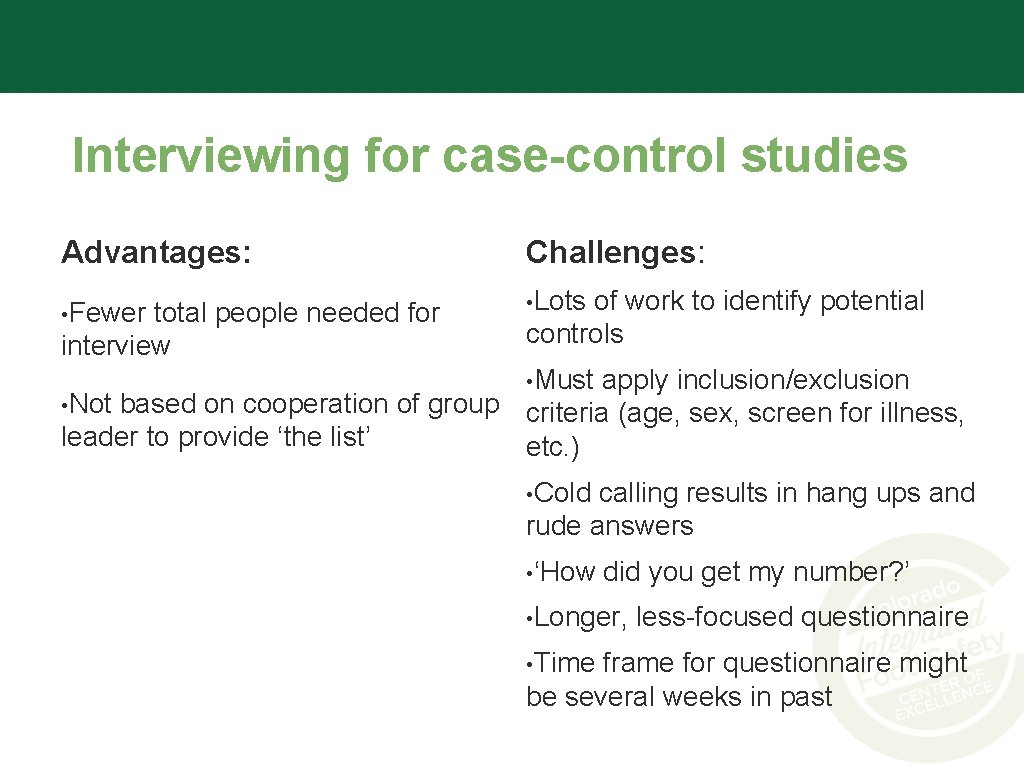
Interviewing for case-control studies Advantages: • Fewer total people needed for interview Challenges: • Lots of work to identify potential controls • Must apply inclusion/exclusion • Not based on cooperation of group criteria (age, sex, screen for illness, leader to provide ‘the list’ etc. ) • Cold calling results in hang ups and rude answers • ‘How did you get my number? ’ • Longer, • Time less-focused questionnaire frame for questionnaire might be several weeks in past
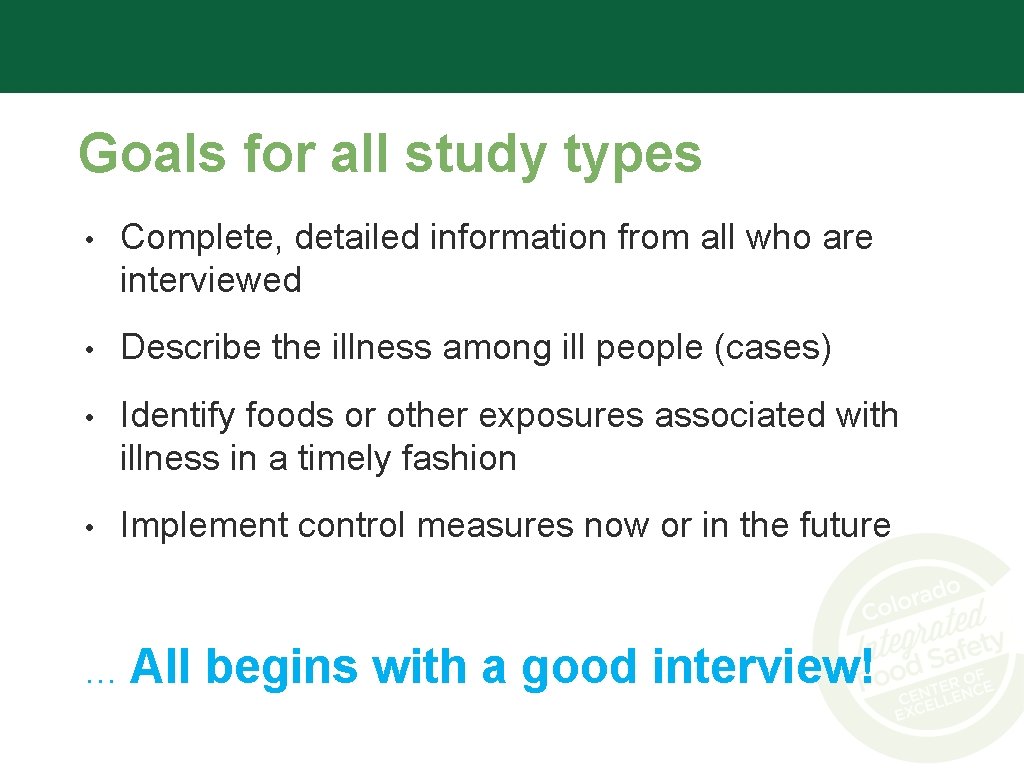
Goals for all study types • Complete, detailed information from all who are interviewed • Describe the illness among ill people (cases) • Identify foods or other exposures associated with illness in a timely fashion • Implement control measures now or in the future … All begins with a good interview!
- Slides: 46