
Basics of Sentence Diagramming English 9 Greenwood High

Basics of Sentence Diagramming English 9 Greenwood High School
You should know: • How to identify a noun. • What a noun phrase is. • How to identify a verb. • Be able to identify these primary phrases: • Preposition • Appositive • Gerund • Infinitive • Participle
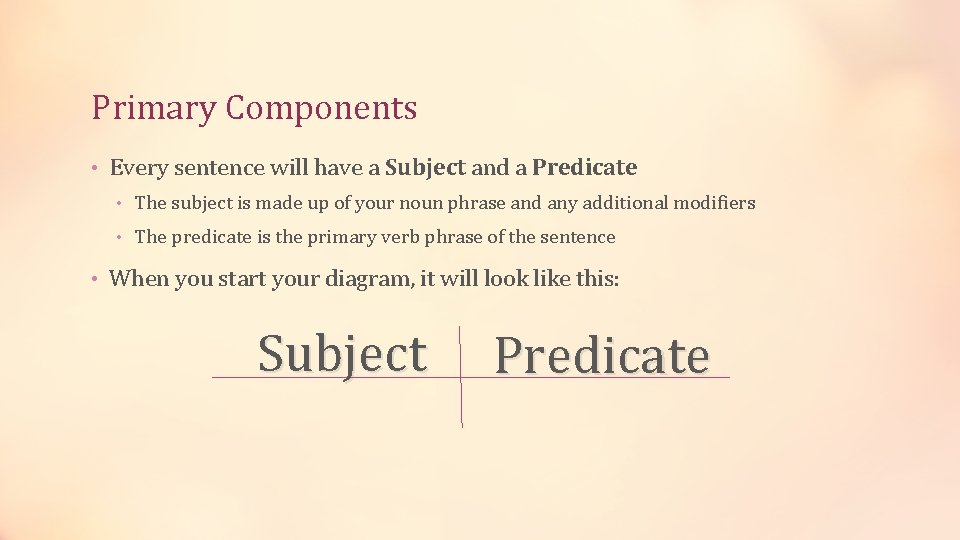
Primary Components • Every sentence will have a Subject and a Predicate • The subject is made up of your noun phrase and any additional modifiers • The predicate is the primary verb phrase of the sentence • When you start your diagram, it will look like this: Subject Predicate
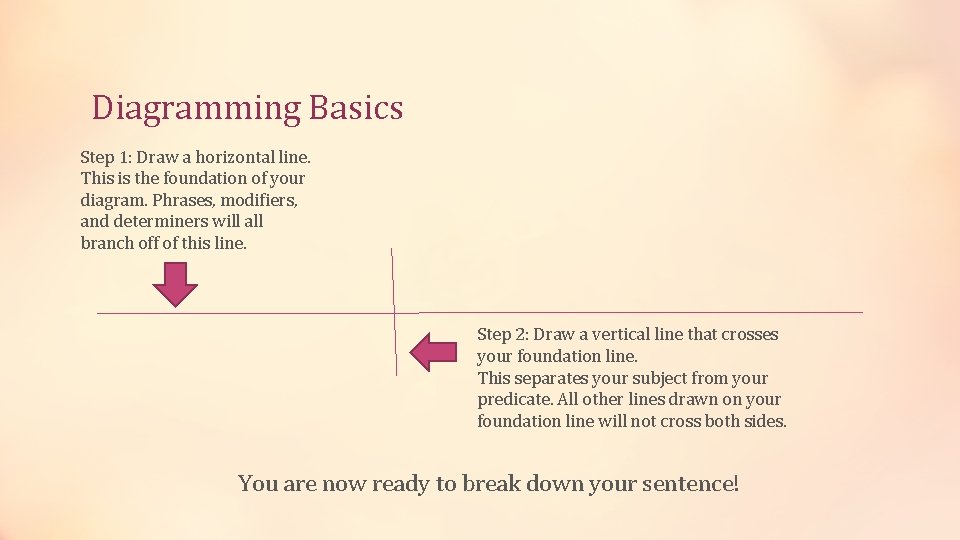
Diagramming Basics Step 1: Draw a horizontal line. This is the foundation of your diagram. Phrases, modifiers, and determiners will all branch off of this line. Step 2: Draw a vertical line that crosses your foundation line. This separates your subject from your predicate. All other lines drawn on your foundation line will not cross both sides. You are now ready to break down your sentence!
Breaking Down a Sentence • Sentences can be broken down into 10 basic patterns • These 10 patterns also fall into 4 groups • “Be” verb patterns • Linking verb patterns • Intransitive verb patterns • Transitive verb patterns • We are starting with “Be” verb patterns
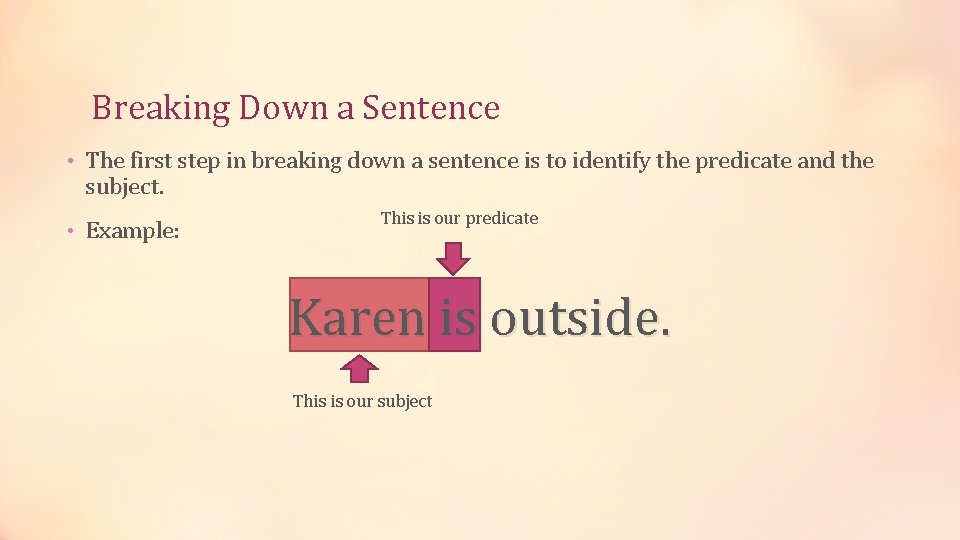
Breaking Down a Sentence • The first step in breaking down a sentence is to identify the predicate and the subject. • Example: This is our predicate Karen is outside. This is our subject

Practice Identifying the Subject & Predicate • Jacob was inside. • Birds are above. • Concerts were yesterday. • I am within. • Now check your answers

Now that we know how to identify our subject and predicate, we can put them into the diagram.
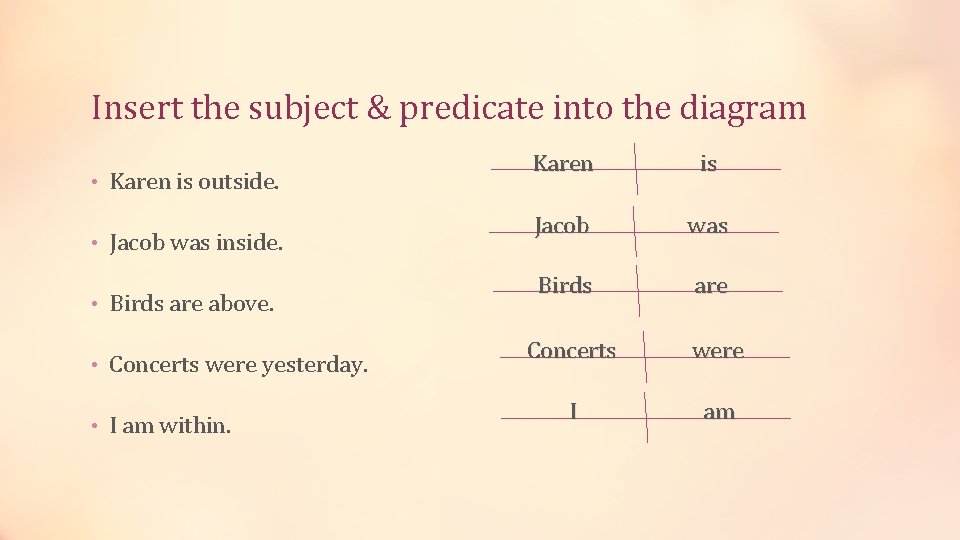
Insert the subject & predicate into the diagram • Karen is outside. • Jacob was inside. • Birds are above. • Concerts were yesterday. • I am within. Karen is Jacob was Birds are Concerts were I am
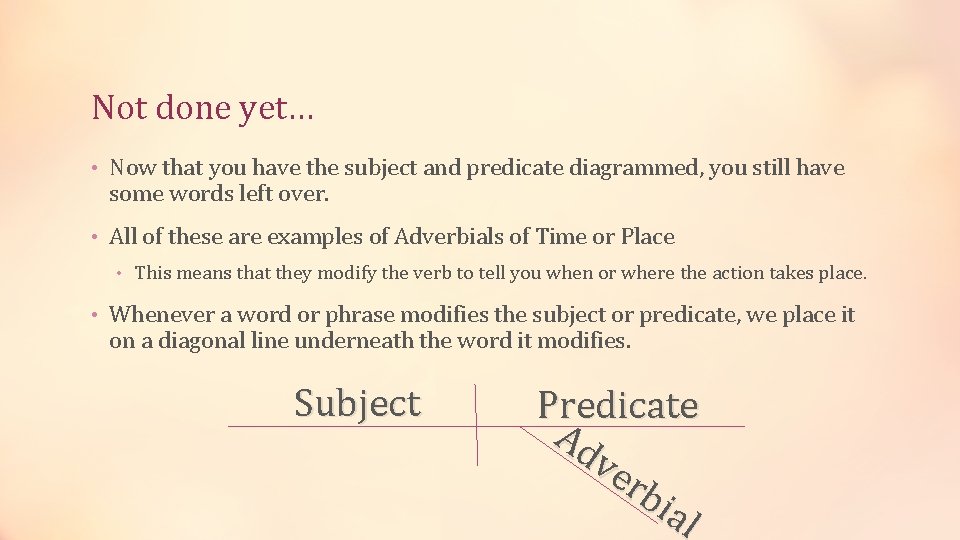
Not done yet… • Now that you have the subject and predicate diagrammed, you still have some words left over. • All of these are examples of Adverbials of Time or Place • This means that they modify the verb to tell you when or where the action takes place. • Whenever a word or phrase modifies the subject or predicate, we place it on a diagonal line underneath the word it modifies. Subject Predicate Ad ve rb ial
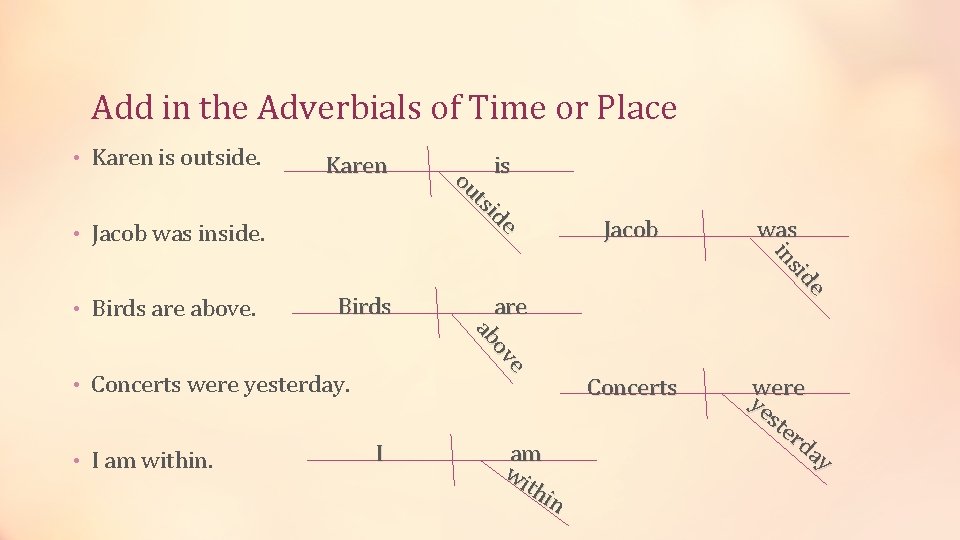
Add in the Adverbials of Time or Place • Karen is outside. Karen • Jacob was inside. Birds • I am within. are e ov ab • Concerts were yesterday. I Jacob am wi thi n was e sid in • Birds are above. ou is ts id e Concerts ywere es te rd ay
Sentence Pattern 1 • All of these sentences are examples of Sentence Pattern 1. • Sentence Pattern one is characterized by having a form of the verb “be” and an Adverbial of Time or Place, or ADV/TP. • Because the subject will not always be one word, we call it the Noun Phrase, or NP, when diagramming. • The only part of the NP that goes on your foundation line is the headword. • All other modifiers and determiners go underneath the foundation line.
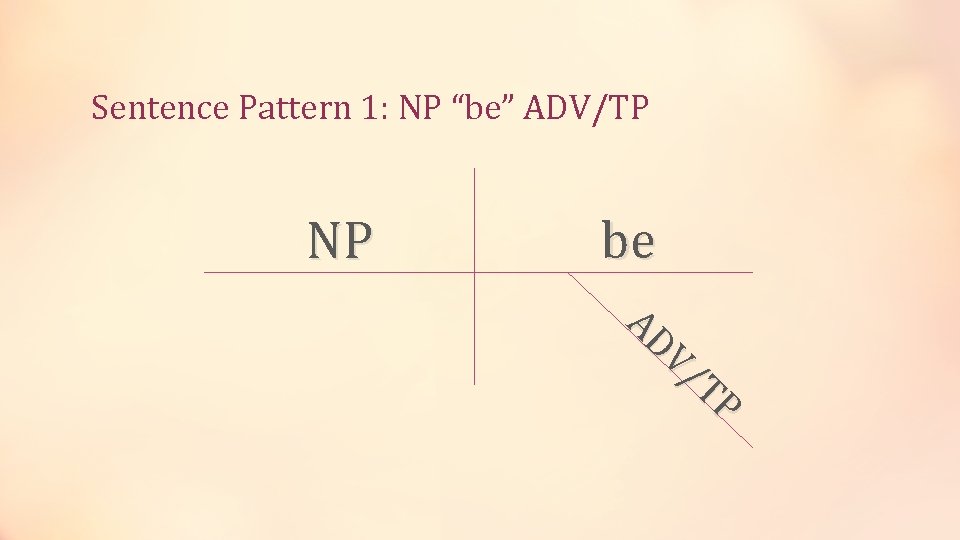
Sentence Pattern 1: NP “be” ADV/TP NP be AD V/ TP
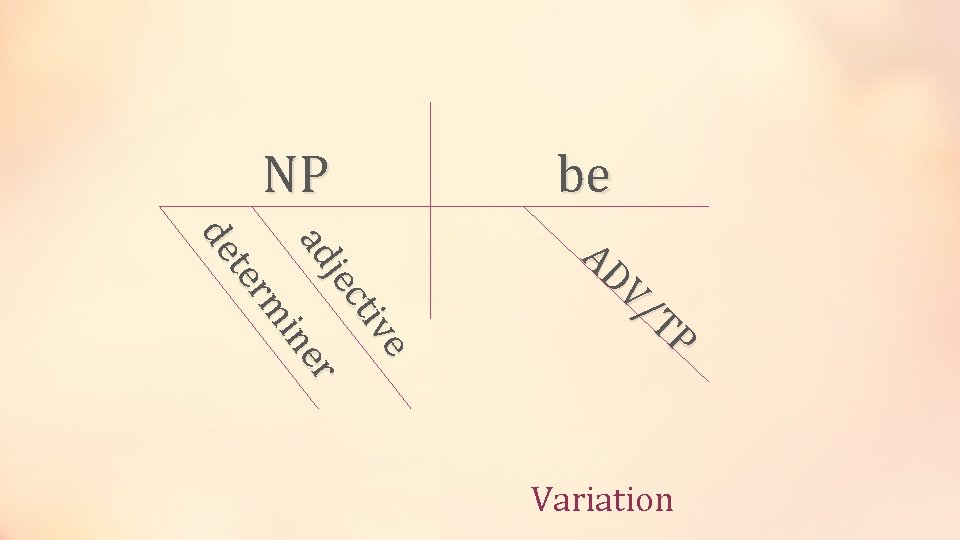
NP be e tiv jec er ad in rm te de AD V/ TP Variation
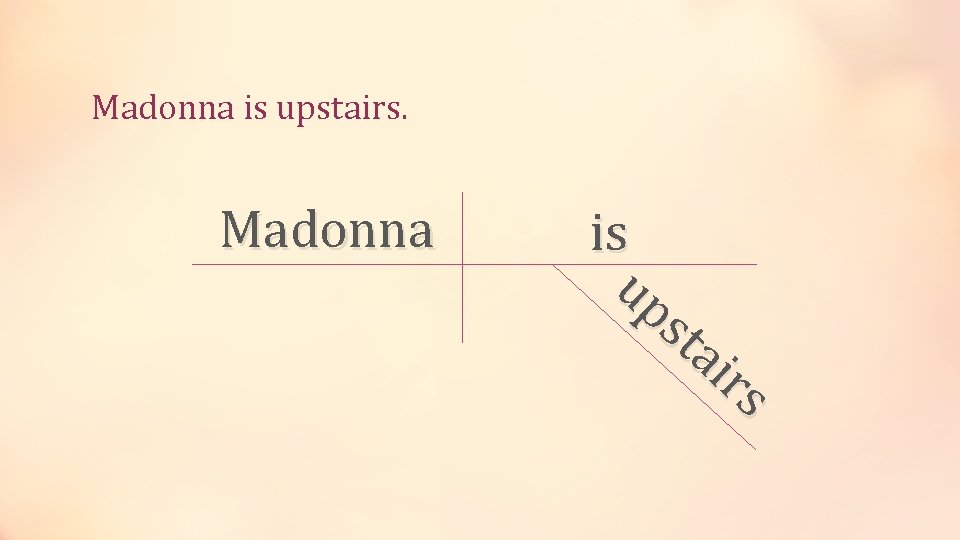
Madonna is upstairs. Madonna is up st ai rs

The massive storm is tomorrow. storm Th ma e ss iv e is to m or ro w

Practice • The boy is outside. • Fall Break is soon. • The music festival was yesterday.
- Slides: 17