
Basics of Rocket Propulsion P M V Subbarao
Basics of Rocket Propulsion P M V Subbarao Professor Mechanical Engineering Department Continuously accelerating Control Volume…. Travel with continuously varying Drag & Gravity…. No Source of Oxygen or working Fluid….

Basics of Rocket : generation of Thrust • Rocket takes mass stored inside combustion chamber and throws it backwards, to use the reaction force to propel the vehicle. • This is known as Rocket Propulsion • Rocket ejects mass at a given momentum rate from the nozzle and receives a thrust in the opposite direction. • Momentum rate of ejects:

Thrust generated by Rocket Ejects
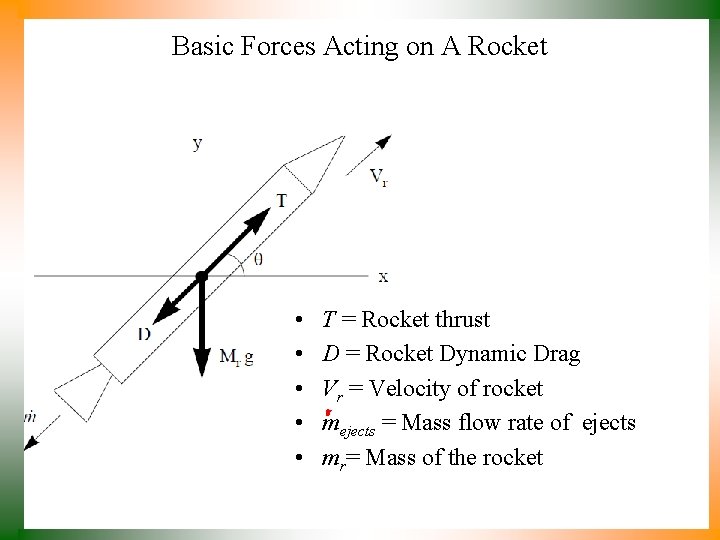
Basic Forces Acting on A Rocket • • • T = Rocket thrust D = Rocket Dynamic Drag Vr = Velocity of rocket mejects = Mass flow rate of ejects mr= Mass of the rocket
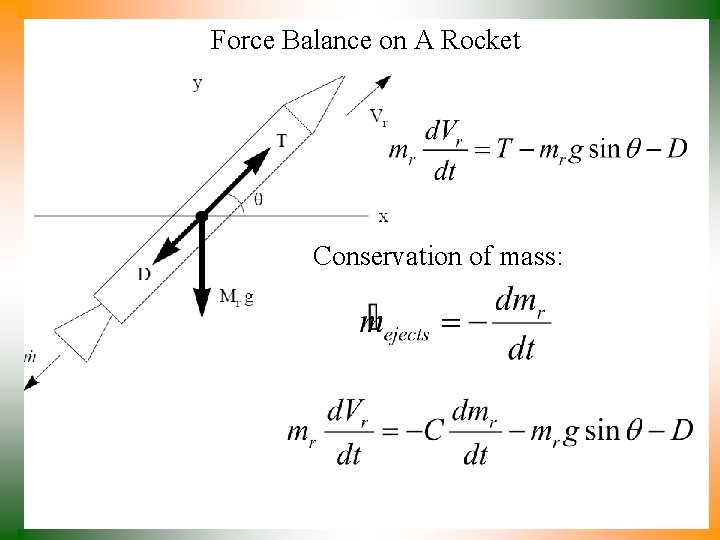
Force Balance on A Rocket Conservation of mass:
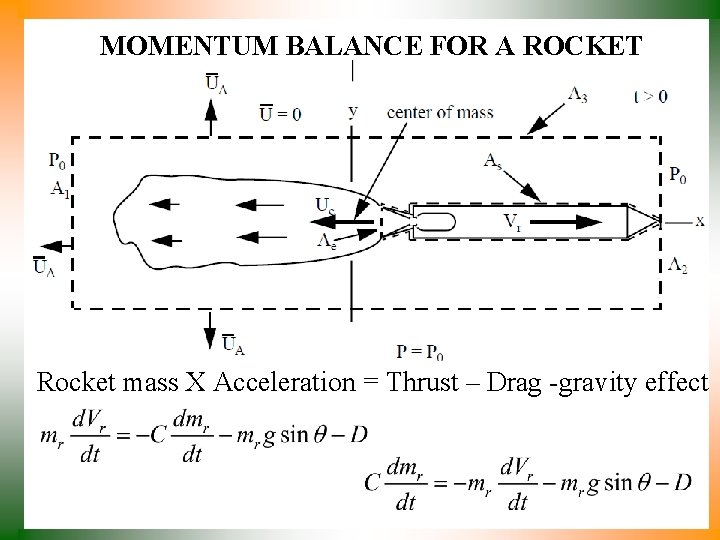
MOMENTUM BALANCE FOR A ROCKET Rocket mass X Acceleration = Thrust – Drag -gravity effect

EFFECTIVE EXHAUST VELOCITY The total mechanical impulse (total change of omentum) generated by an applied force, T, is: The total propellant mass expended is The instantaneous change of momentum per unit expenditure of propellant mass defines the effective exhaust velocity.
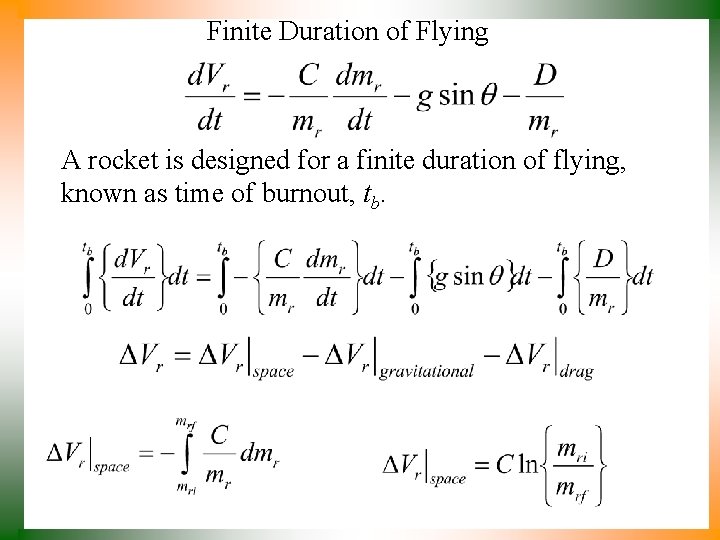
Finite Duration of Flying A rocket is designed for a finite duration of flying, known as time of burnout, tb.
Requirements to REACH An ORBIT • For a typical launch vehicle headed to an orbit, aerodynamic drag losses are in the order of 100 to 500 m/sec. • Gravitational losses are larger, generally ranging from 700 to 1200 m/sec depending on the shape of the trajectory to orbit. • By far the largest term is the equation for the space velocity increment. • The lowest altitude where a stable orbit can be maintained, is at an altitude of 185 km. • This requires an Orbital velocity approximately 7777 m/sec.
Launching Time Requirements to REACH An ORBIT • To reach this velocity from a Space Center, a rocket requires an ideal velocity increment of 9050 m/sec. • The velocity due to the rotation of the Earth is approximately 427 m/sec, assuming gravitational plus drag losses of 1700 m/sec. • A Hydrogen-Oxygen system with an effective average exhaust velocity (from sea-level to vacuum) of 4000 m/sec would require mri/ mrf = 9. 7.
Geostationary orbit • A circular geosynchronous orbit in the plane of the Earth's equator has a radius of approximately 42, 164 km from the center of the Earth. • A satellite in such an orbit is at an altitude of approximately 35, 786 km above mean sea level. • It maintains the same position relative to the Earth's surface. • If one could see a satellite in geostationary orbit, it would appear to hover at the same point in the sky. • Orbital velocity is 11, 066 km/hr= 3. 07 km/sec.
- Slides: 11