
Basics of Quantum Chromodynamics Two lectures Faisal Akram
Basics of Quantum Chromodynamics (Two lectures) Faisal Akram 5 th School on LHC Physics, 15 -26 August 2016 NCP Islamabad 2015
Outlines • A brief introduction of QCD Classical QCD Lagrangian Quantization Green functions of QCD and SDE’s • • Perturbative QCD Perturbative calculation of QCD Green functions Feynman Rules of QCD Renormalization Running of QCD coupling (Asymptotic freedom) Non-Perturbative QCD Confinement QCD phase transition Dynamical breaking of chiral symmetry
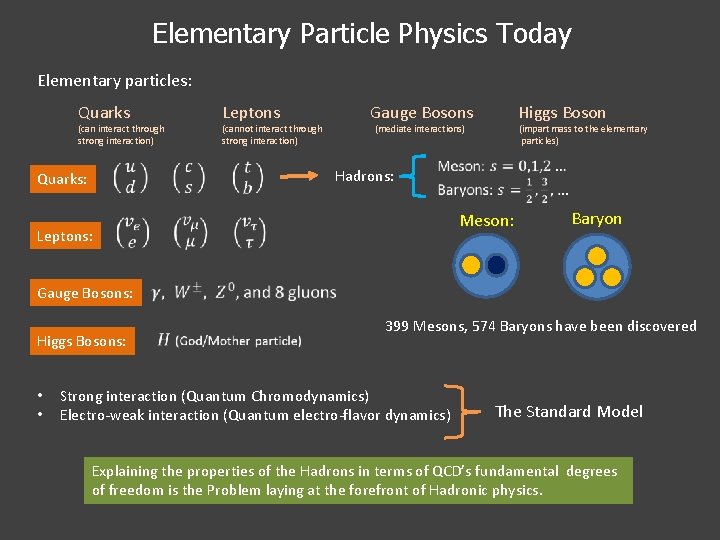
Elementary Particle Physics Today Elementary particles: Quarks (can interact through strong interaction) Quarks: Leptons: (cannot interact through strong interaction) Gauge Bosons (mediate interactions) Hadrons: Higgs Bosons: Higgs Boson (impart mass to the elementary particles) Meson: Gauge Bosons: • • Leptons Baryon 399 Mesons, 574 Baryons have been discovered Strong interaction (Quantum Chromodynamics) Electro-weak interaction (Quantum electro-flavor dynamics) The Standard Model Explaining the properties of the Hadrons in terms of QCD’s fundamental degrees of freedom is the Problem laying at the forefront of Hadronic physics.
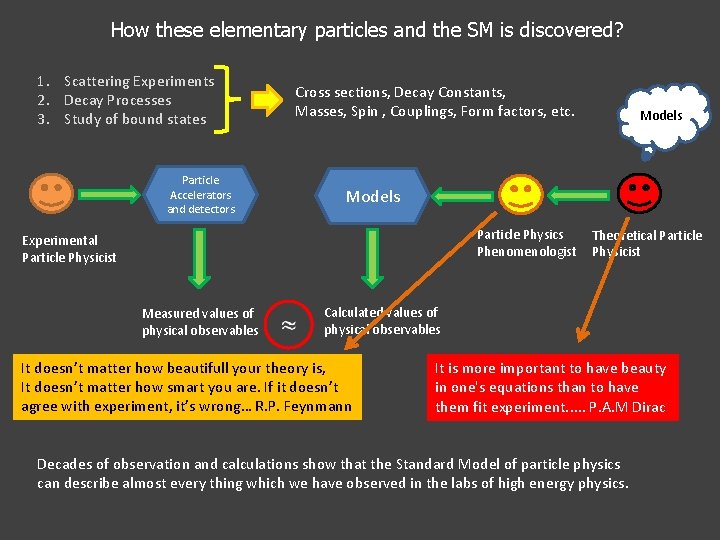
How these elementary particles and the SM is discovered? 1. Scattering Experiments 2. Decay Processes 3. Study of bound states Cross sections, Decay Constants, Masses, Spin , Couplings, Form factors, etc. Particle Accelerators and detectors Models Particle Physics Phenomenologist Experimental Particle Physicist Measured values of physical observables Models Theoretical Particle Physicist Calculated values of physical observables It doesn’t matter how beautifull your theory is, It doesn’t matter how smart you are. If it doesn’t agree with experiment, it’s wrong… R. P. Feynmann It is more important to have beauty in one's equations than to have them fit experiment. . . P. A. M Dirac Decades of observation and calculations show that the Standard Model of particle physics can describe almost every thing which we have observed in the labs of high energy physics.
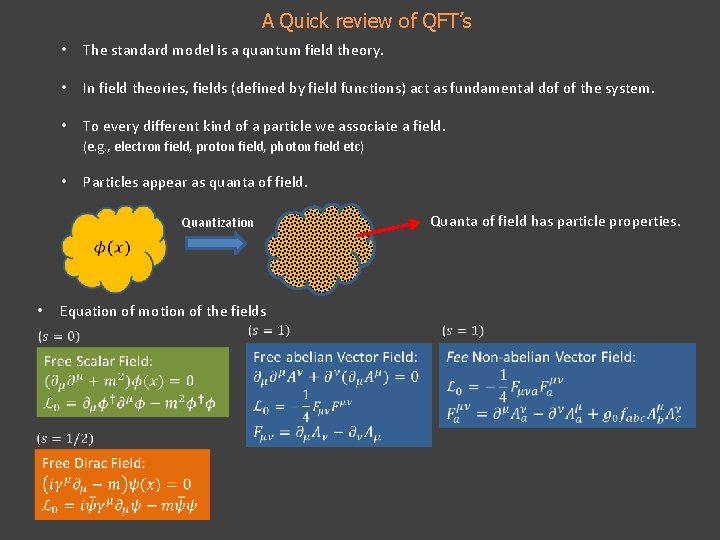
A Quick review of QFT’s • The standard model is a quantum field theory. • In field theories, fields (defined by field functions) act as fundamental dof of the system. • To every different kind of a particle we associate a field. (e. g. , electron field, proton field, photon field etc) • Particles appear as quanta of field. Quantization Quanta of field has particle properties. Equation of motion of the fields •
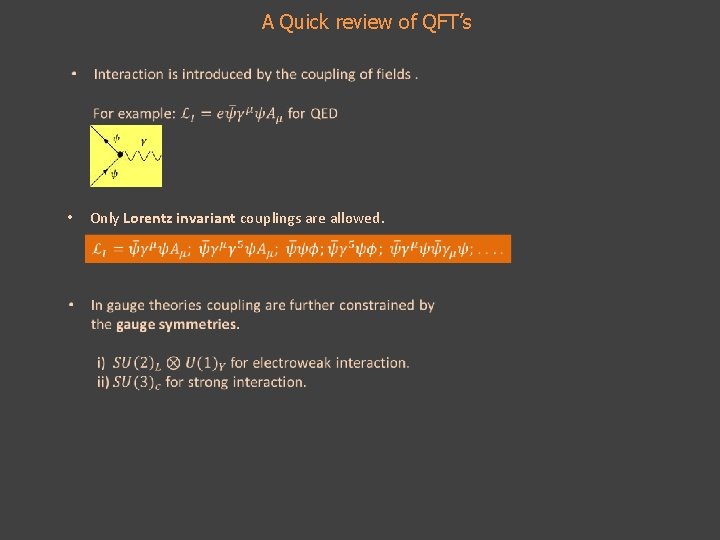
A Quick review of QFT’s • Only Lorentz invariant couplings are allowed.
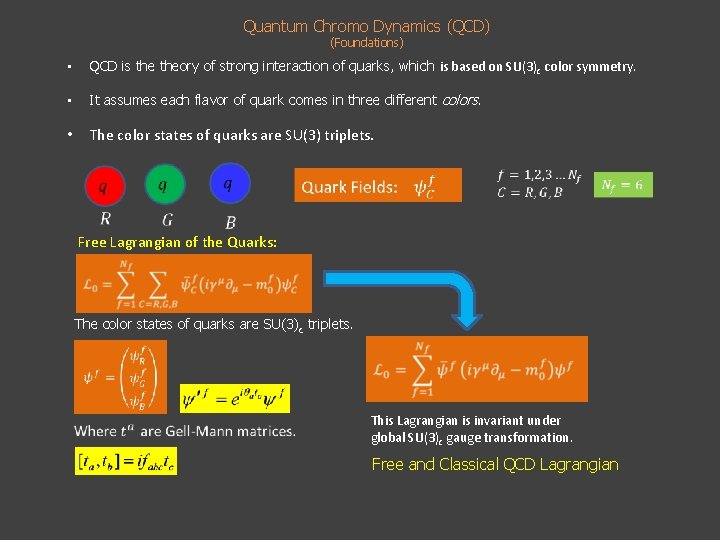
Quantum Chromo Dynamics (QCD) (Foundations) • QCD is theory of strong interaction of quarks, which is based on SU(3)c color symmetry. • It assumes each flavor of quark comes in three different colors. • The color states of quarks are SU(3) triplets. Free Lagrangian of the Quarks: The color states of quarks are SU(3)c triplets. This Lagrangian is invariant under global SU(3)c gauge transformation. Free and Classical QCD Lagrangian
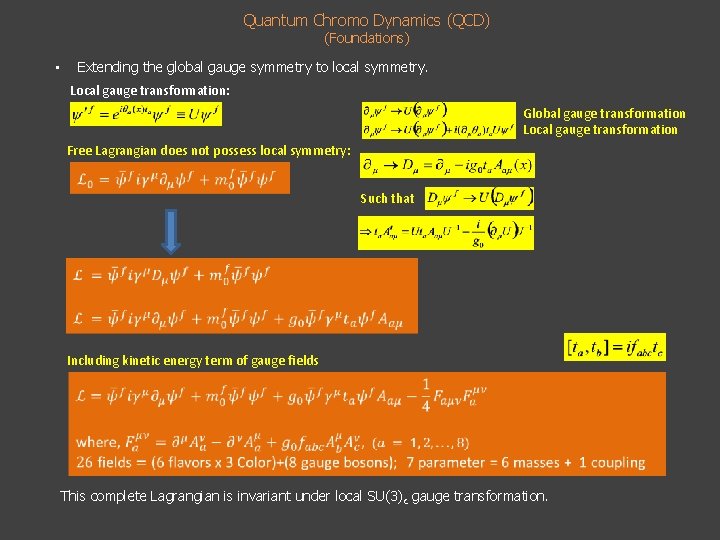
Quantum Chromo Dynamics (QCD) (Foundations) Extending the global gauge symmetry to local symmetry. • Local gauge transformation: Global gauge transformation Local gauge transformation Free Lagrangian does not possess local symmetry: Such that Including kinetic energy term of gauge fields This complete Lagrangian is invariant under local SU(3) c gauge transformation.
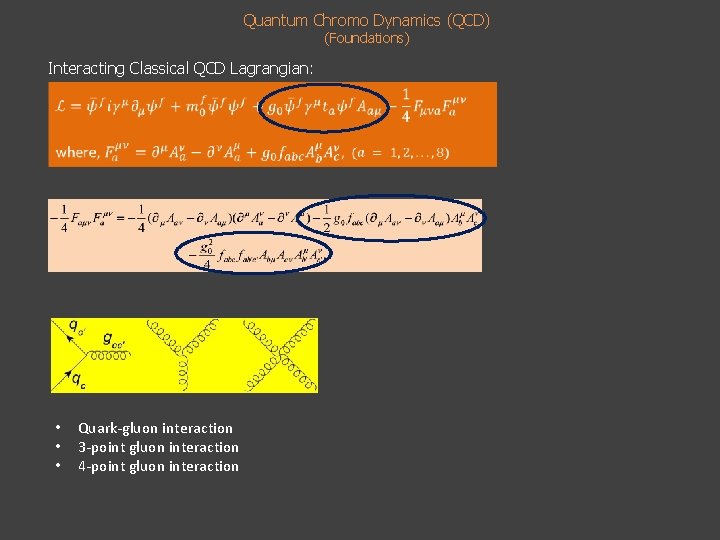
Quantum Chromo Dynamics (QCD) (Foundations) Interacting Classical QCD Lagrangian: • • • Quark-gluon interaction 3 -point gluon interaction 4 -point gluon interaction
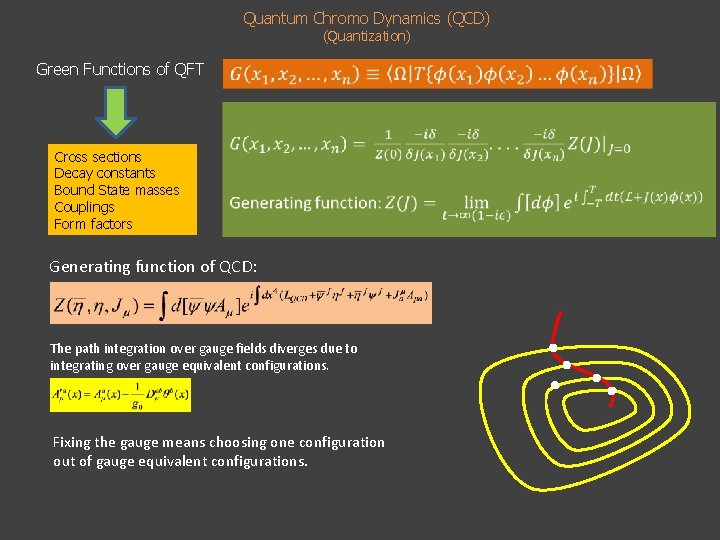
Quantum Chromo Dynamics (QCD) (Quantization) Green Functions of QFT Cross sections Decay constants Bound State masses Couplings Form factors Generating function of QCD: The path integration over gauge fields diverges due to integrating over gauge equivalent configurations. Fixing the gauge means choosing one configuration out of gauge equivalent configurations.
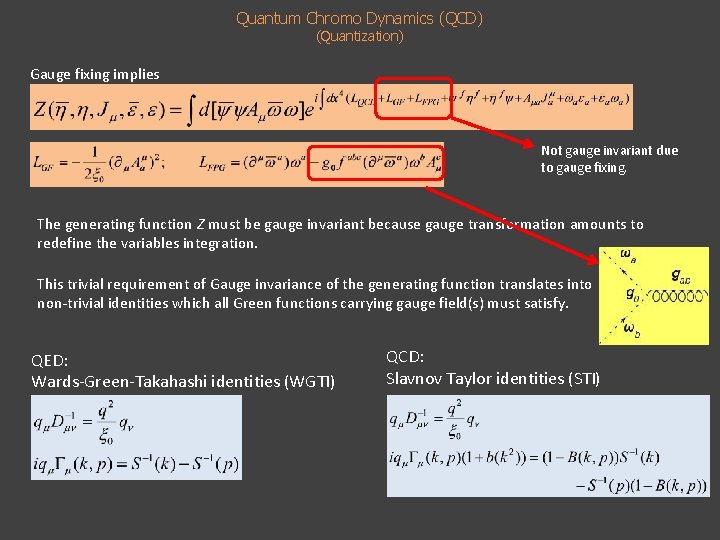
Quantum Chromo Dynamics (QCD) (Quantization) Gauge fixing implies Not gauge invariant due to gauge fixing. The generating function Z must be gauge invariant because gauge transformation amounts to redefine the variables integration. This trivial requirement of Gauge invariance of the generating function translates into non-trivial identities which all Green functions carrying gauge field(s) must satisfy. QED: Wards-Green-Takahashi identities (WGTI) QCD: Slavnov Taylor identities (STI)
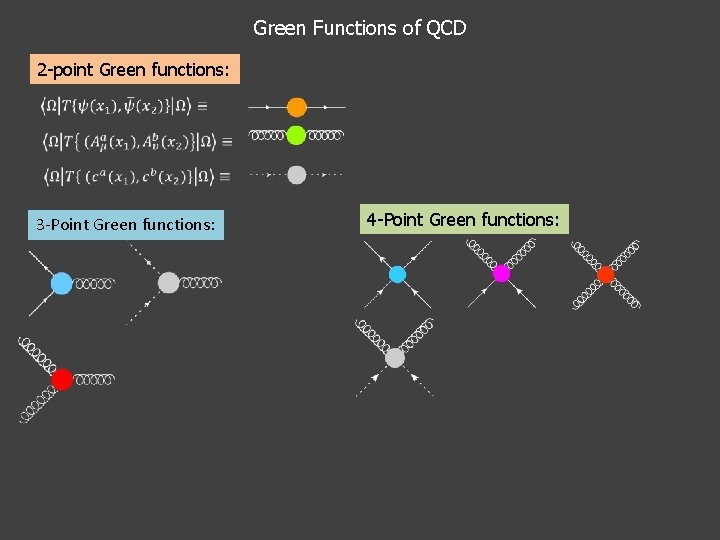
Green Functions of QCD 2 -point Green functions: 3 -Point Green functions: 4 -Point Green functions:
Schwinger-Dyson Equations (SDEs) of QCD • In QFT the Green functions satisfy a set of exact mathematical equations called SDEs. • Corresponding to each green function we have a SDE. • These are exact equations and can be used to find Green functions perturbatively as well as non-perturbatively.
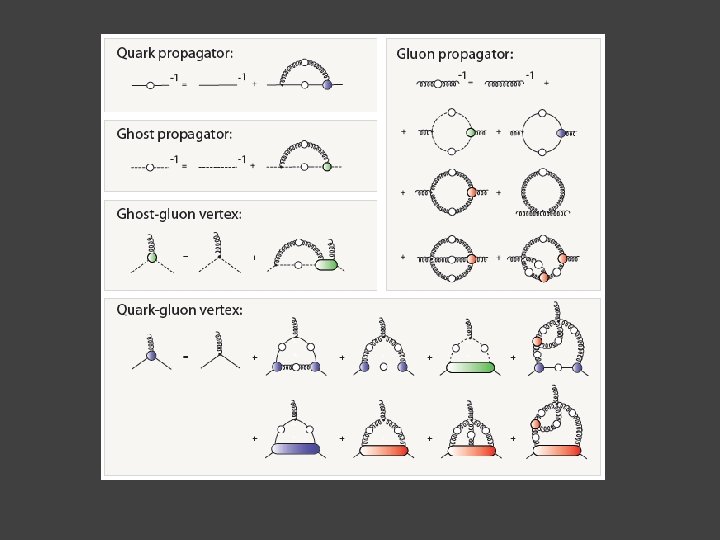
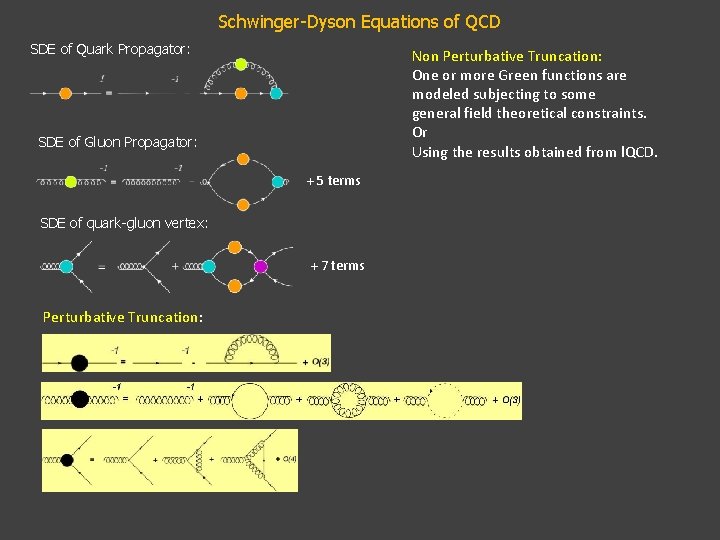
Schwinger-Dyson Equations of QCD SDE of Quark Propagator: Non Perturbative Truncation: One or more Green functions are modeled subjecting to some general field theoretical constraints. Or Using the results obtained from l. QCD. SDE of Gluon Propagator: + 5 terms SDE of quark-gluon vertex: + 7 terms Perturbative Truncation:
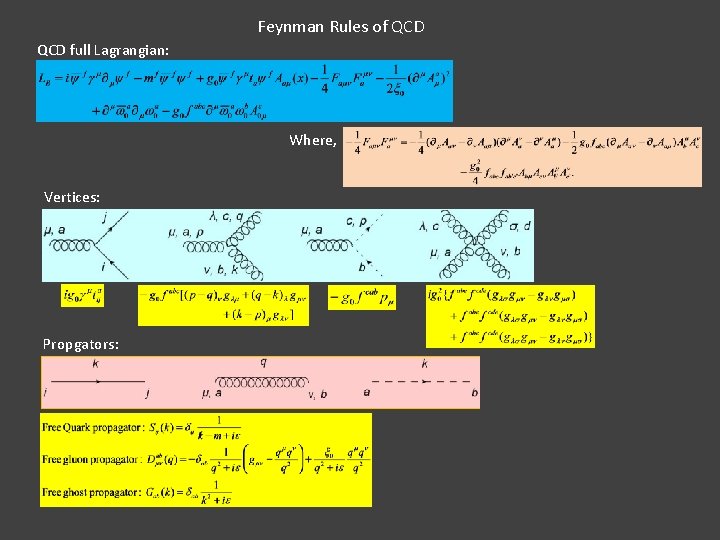
Feynman Rules of QCD full Lagrangian: Where, Vertices: Propgators:
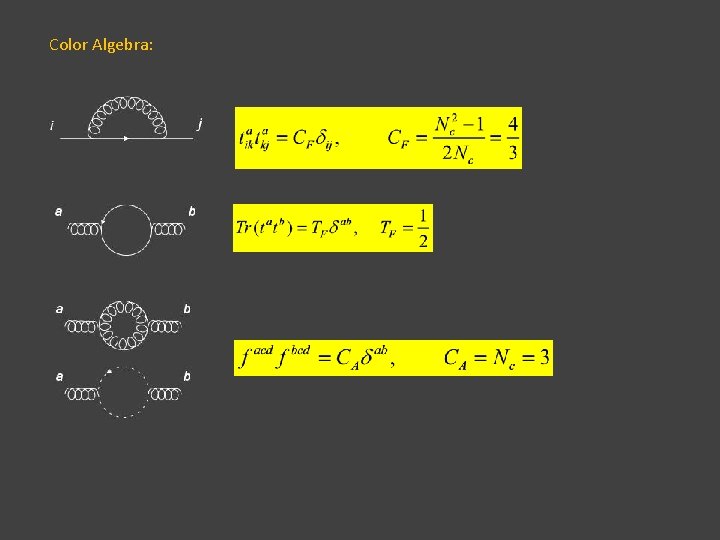
Color Algebra:
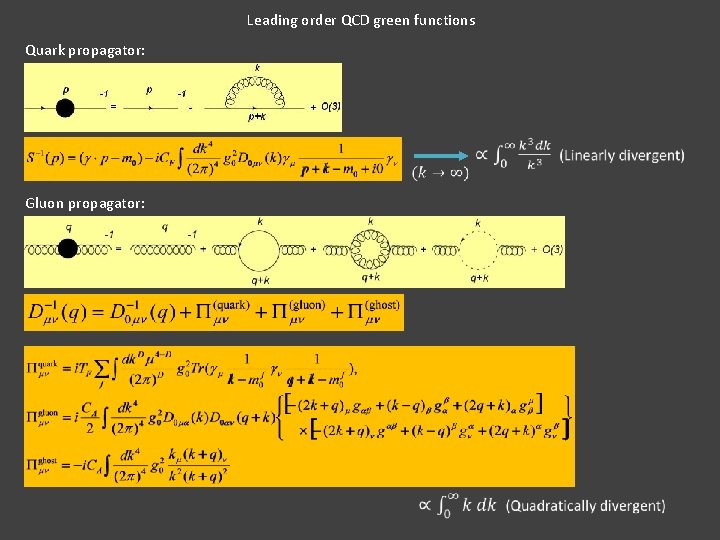
Leading order QCD green functions Quark propagator: Gluon propagator:
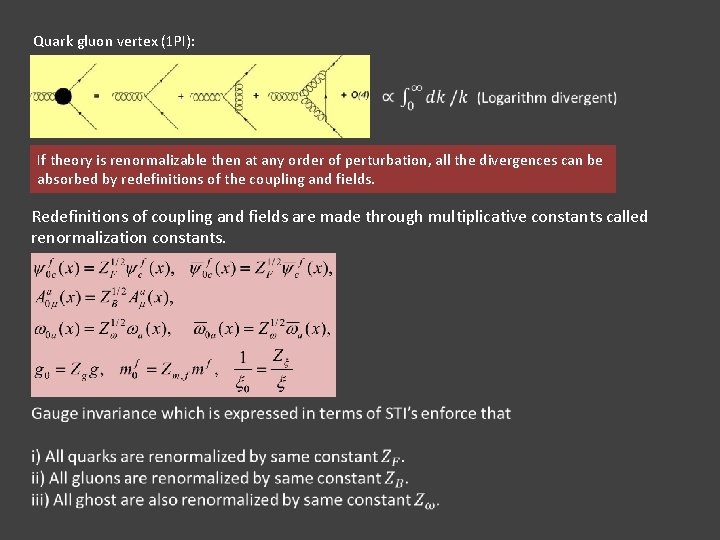
Quark gluon vertex (1 PI): If theory is renormalizable then at any order of perturbation, all the divergences can be absorbed by redefinitions of the coupling and fields. Redefinitions of coupling and fields are made through multiplicative constants called renormalization constants.
End of Lecture 1 Summery: • In QCD we have 5 different interactions i) Quark-Gluon interaction ii) 3 Gluon interaction iii) 4 Gluon interaction iv) Ghost-Gluon interaction • QCD green functions satisfy SDE’s which are exact but unsolvable unless truncated. • In perturbative truncation the amplitude of QCD green functions can be written directly from the Feynman diagram using Feynman rules. • Naïve analysis show that these Green function carry ultraviolet divergences. • Since QCD in renormalizable, therefore, the divergences can be absorbed by redefinition coupling and field of QCD. Next Lecture: • We will continue renormalization program in QCD using dimensional regularization. • Discuss some non-perturbative aspects of QCD.
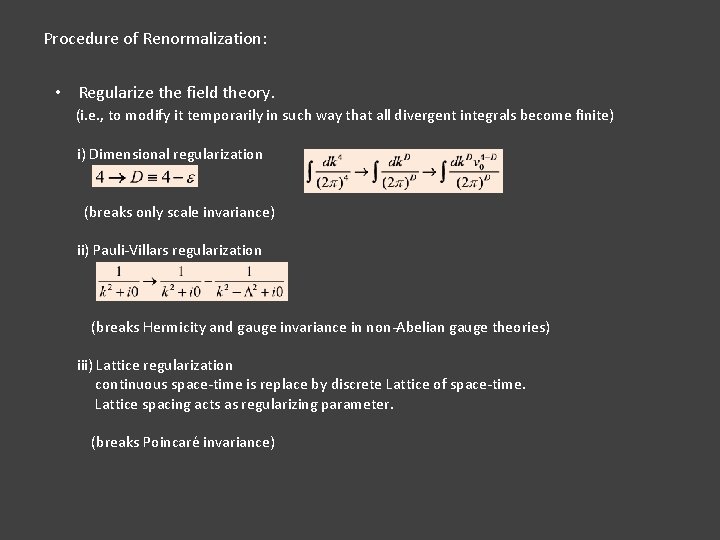
Procedure of Renormalization: • Regularize the field theory. (i. e. , to modify it temporarily in such way that all divergent integrals become finite) i) Dimensional regularization (breaks only scale invariance) ii) Pauli-Villars regularization (breaks Hermicity and gauge invariance in non-Abelian gauge theories) iii) Lattice regularization continuous space-time is replace by discrete Lattice of space-time. Lattice spacing acts as regularizing parameter. (breaks Poincaré invariance)
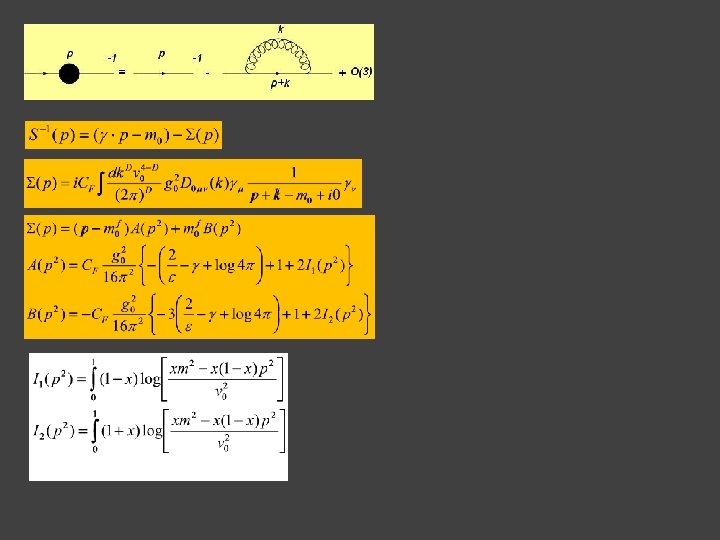
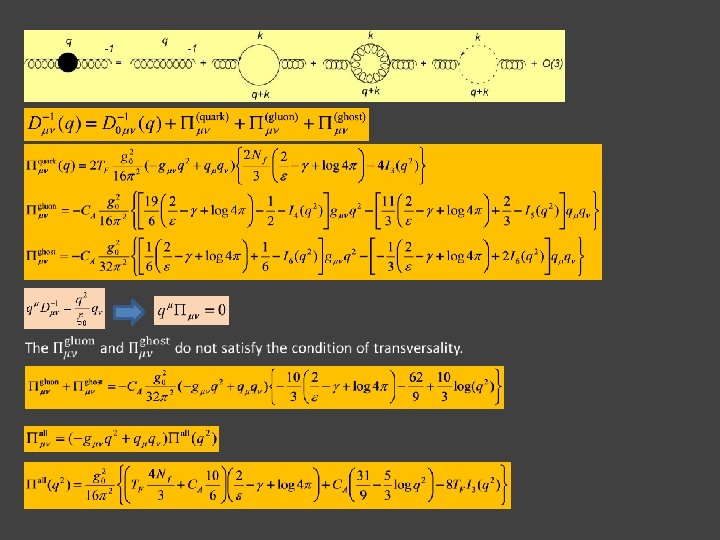
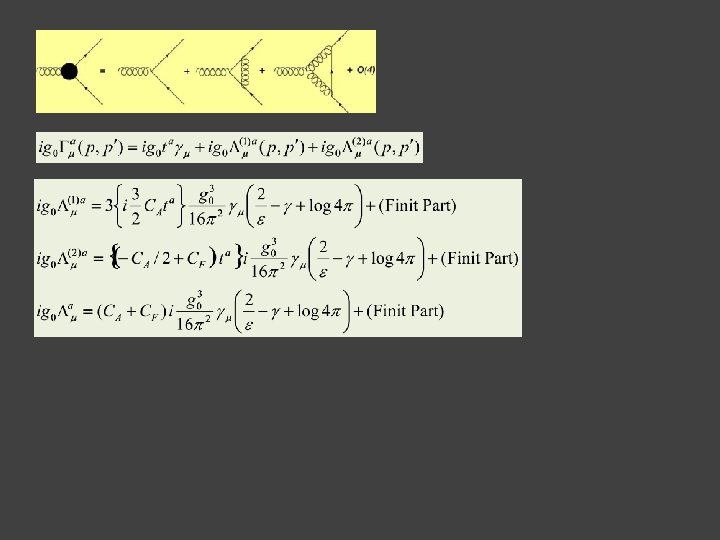
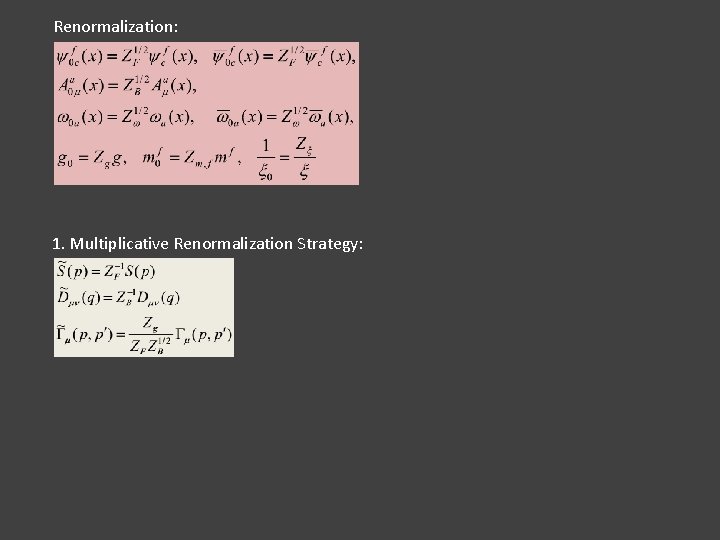
Renormalization: 1. Multiplicative Renormalization Strategy:
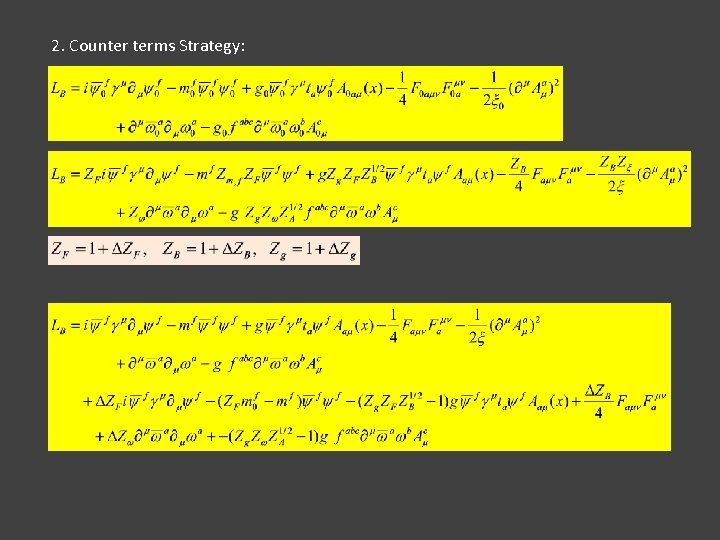
2. Counter terms Strategy:
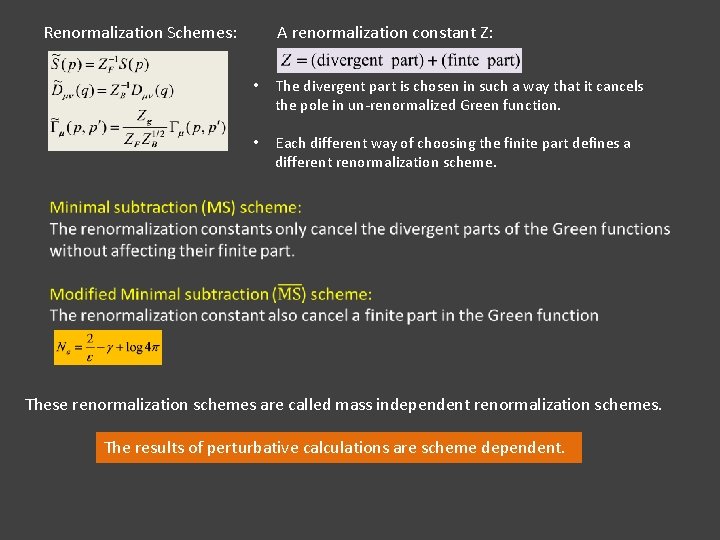
Renormalization Schemes: A renormalization constant Z: • The divergent part is chosen in such a way that it cancels the pole in un-renormalized Green function. • Each different way of choosing the finite part defines a different renormalization scheme. These renormalization schemes are called mass independent renormalization schemes. The results of perturbative calculations are scheme dependent.
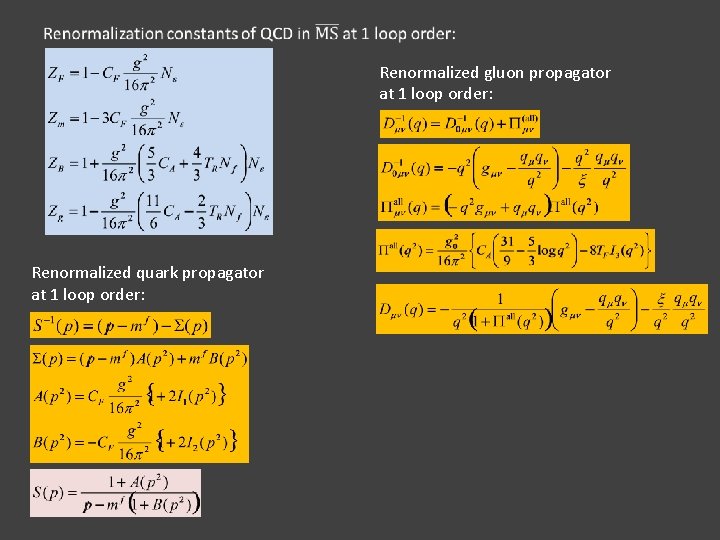
Renormalized gluon propagator at 1 loop order: Renormalized quark propagator at 1 loop order:
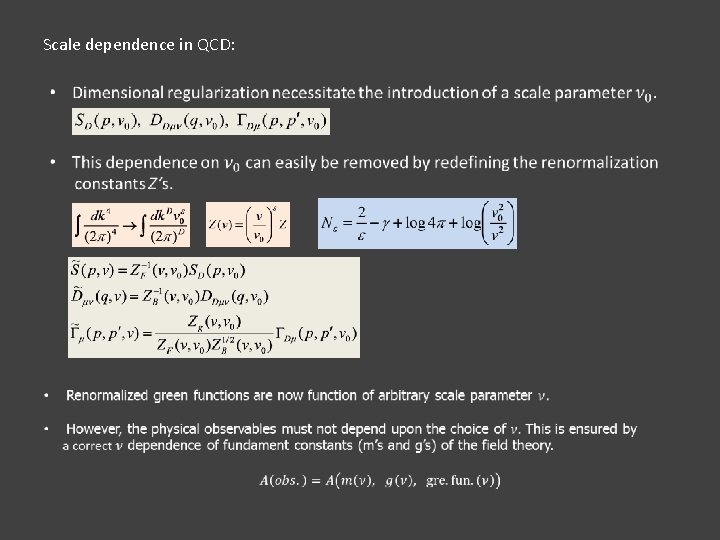
Scale dependence in QCD:
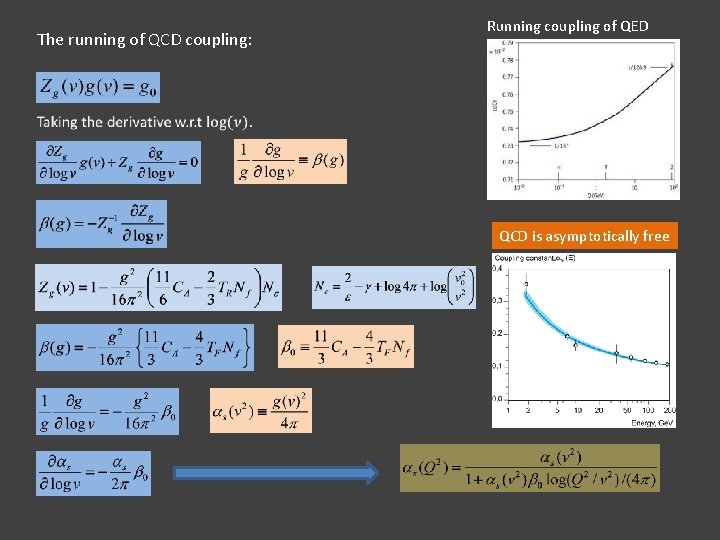
The running of QCD coupling: Running coupling of QED QCD is asymptotically free
END of Lecture 1 Lecture 2 (non-perturbative QCD)
Quantum Chromodynamics (Non-perturbative aspects) Lecture 2 Faisal Akram International Symposium on Physics Beyond the Standard Model NCP Islamabad 2015
Outlines • Characteristics of QCD Asymptotic freedom Confinement QCD phase transition Dynamical breaking of chiral symmetry • Non-Perturbative truncation of Schwinger-Dyson equations • Models of quarks-gluon vertex and gluon propagator • Numerical Solution of SDE of quarks propagator • Results and comparison with the experiments
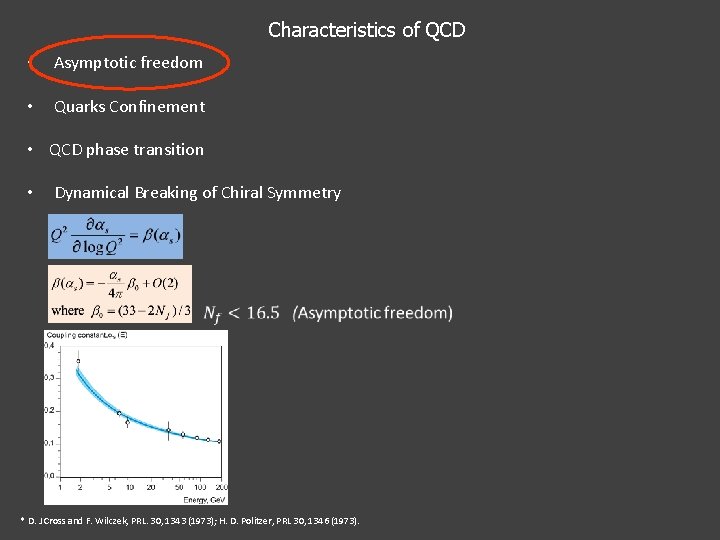
Characteristics of QCD • Asymptotic freedom • Quarks Confinement • QCD phase transition • Dynamical Breaking of Chiral Symmetry * D. J Cross and F. Wilczek, PRL. 30, 1343 (1973); H. D. Politzer, PRL 30, 1346 (1973).
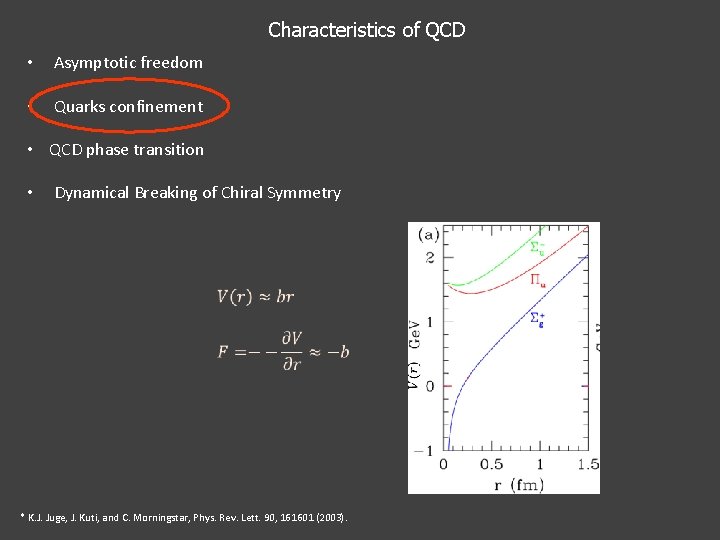
Characteristics of QCD • Asymptotic freedom • Quarks confinement • QCD phase transition • Dynamical Breaking of Chiral Symmetry * K. J. Juge, J. Kuti, and C. Morningstar, Phys. Rev. Lett. 90, 161601 (2003).
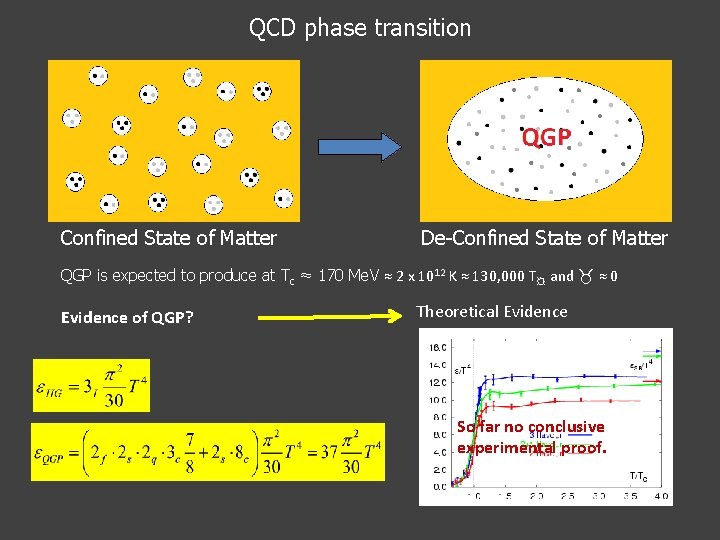
QCD phase transition Confined State of Matter De-Confined State of Matter QGP is expected to produce at Tc ≈ 170 Me. V ≈ 2 x 10¹² K ≈ 130, 000 T☼ and ≈ 0 Evidence of QGP? Theoretical Evidence So far no conclusive experimental proof.
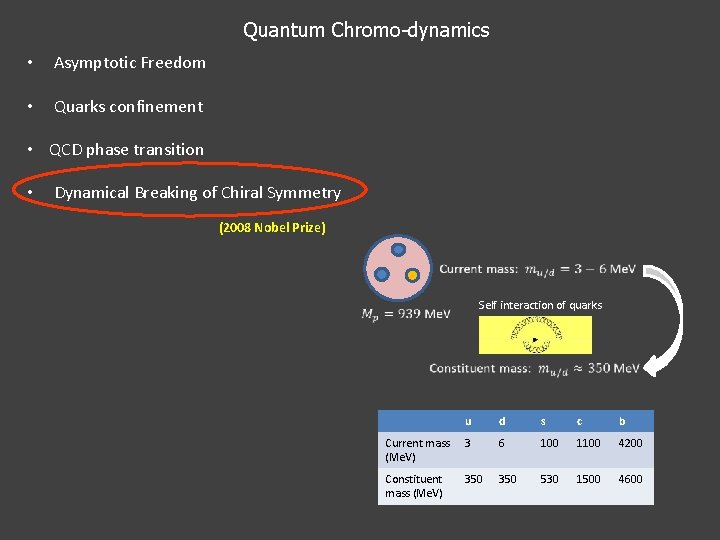
Quantum Chromo-dynamics • Asymptotic Freedom • Quarks confinement • QCD phase transition • Dynamical Breaking of Chiral Symmetry (2008 Nobel Prize) Self interaction of quarks u d s c b Current mass (Me. V) 3 6 100 1100 4200 Constituent mass (Me. V) 350 530 1500 4600
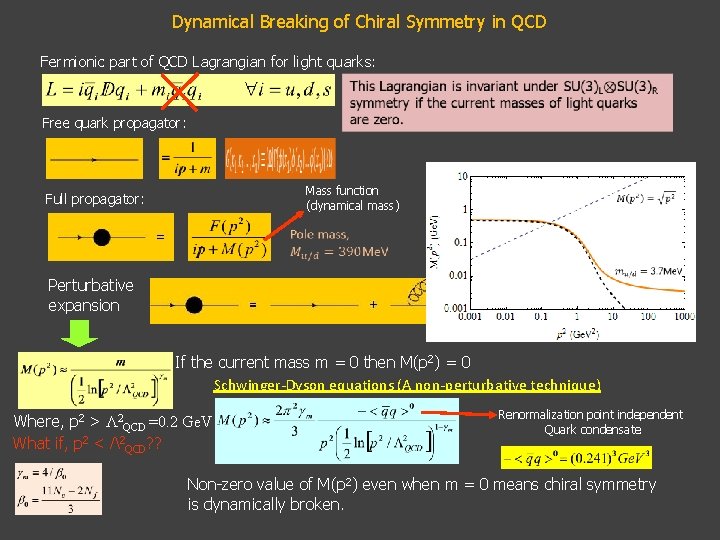
Dynamical Breaking of Chiral Symmetry in QCD Fermionic part of QCD Lagrangian for light quarks: Free quark propagator: Mass function (dynamical mass) Full propagator: Perturbative expansion If the current mass m = 0 then M(p 2) = 0 Schwinger-Dyson equations (A non-perturbative technique) Where, p 2 > Λ 2 QCD =0. 2 Ge. V What if, p 2 < Λ 2 QCD? ? Renormalization point independent Quark condensate Non-zero value of M(p 2) even when m = 0 means chiral symmetry is dynamically broken.
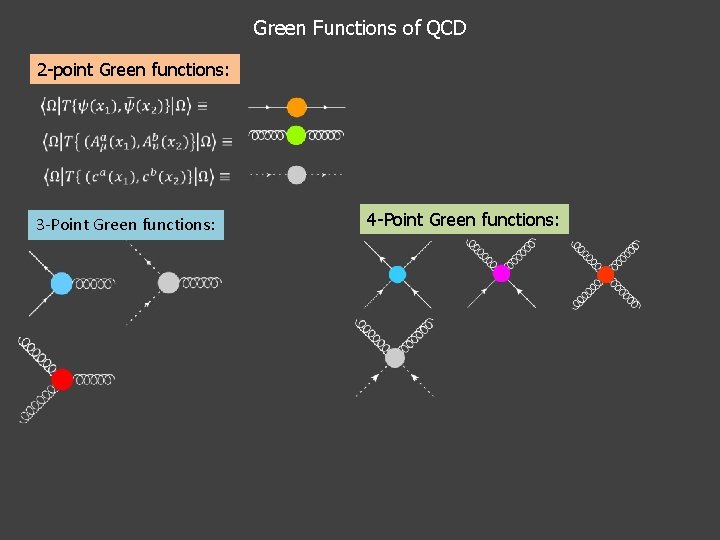
Green Functions of QCD 2 -point Green functions: 3 -Point Green functions: 4 -Point Green functions:
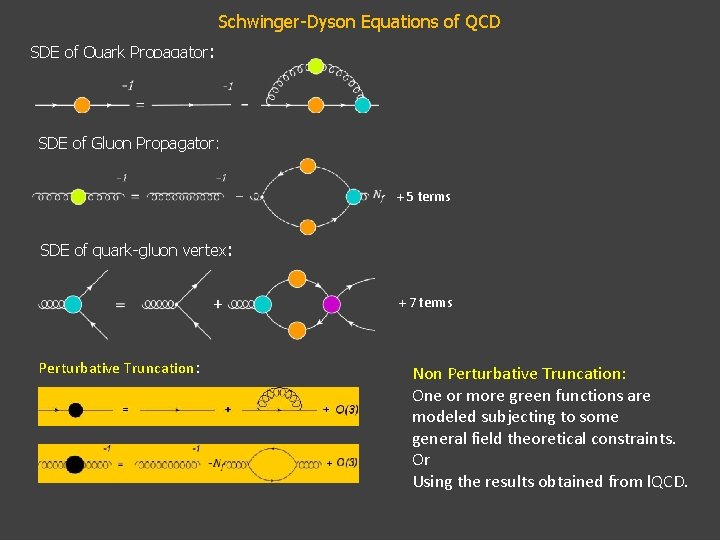
Schwinger-Dyson Equations of QCD SDE of Quark Propagator: SDE of Gluon Propagator: + 5 terms SDE of quark-gluon vertex: + 7 terms Perturbative Truncation: Non Perturbative Truncation: One or more green functions are modeled subjecting to some general field theoretical constraints. Or Using the results obtained from l. QCD.
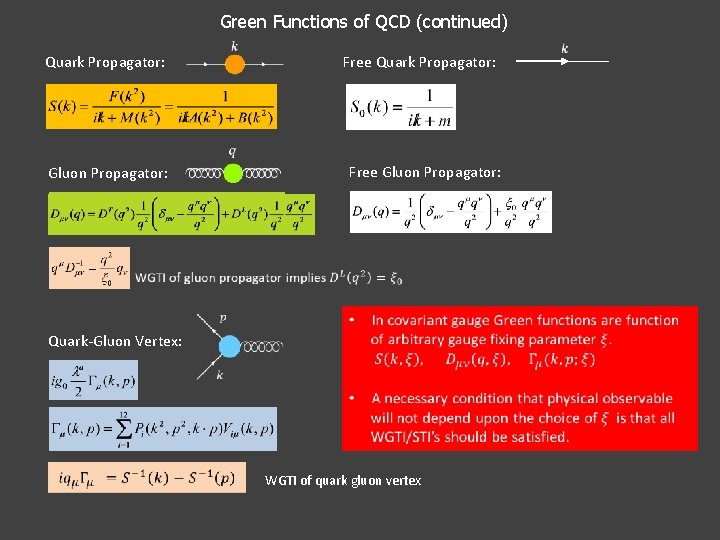
Green Functions of QCD (continued) Quark Propagator: Free Quark Propagator: Gluon Propagator: Free Gluon Propagator: Quark-Gluon Vertex: WGTI of quark gluon vertex
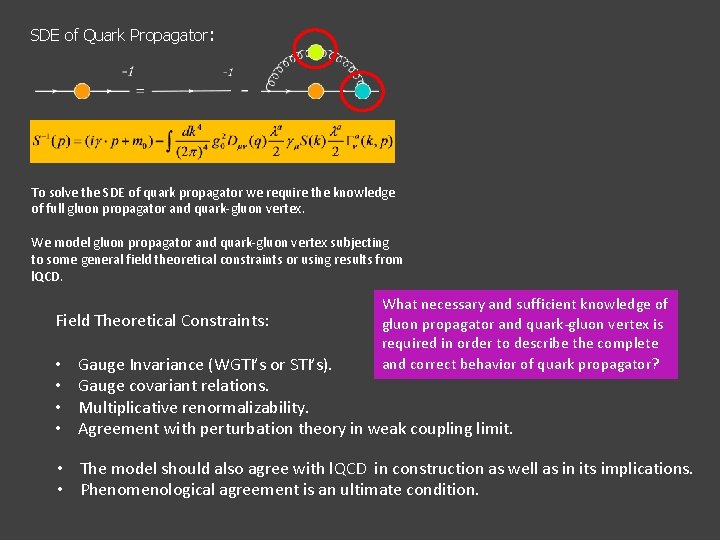
SDE of Quark Propagator: To solve the SDE of quark propagator we require the knowledge of full gluon propagator and quark-gluon vertex. We model gluon propagator and quark-gluon vertex subjecting to some general field theoretical constraints or using results from l. QCD. Field Theoretical Constraints: • • What necessary and sufficient knowledge of gluon propagator and quark-gluon vertex is required in order to describe the complete and correct behavior of quark propagator? Gauge Invariance (WGTI’s or STI’s). Gauge covariant relations. Multiplicative renormalizability. Agreement with perturbation theory in weak coupling limit. • The model should also agree with l. QCD in construction as well as in its implications. • Phenomenological agreement is an ultimate condition.
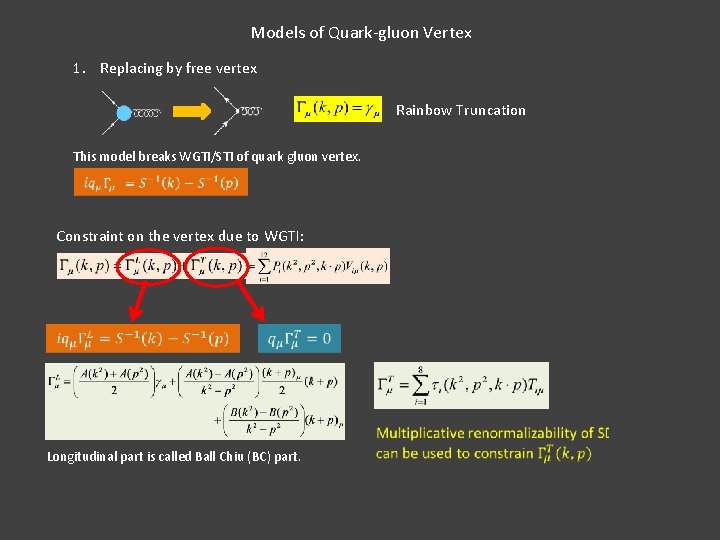
Models of Quark-gluon Vertex 1. Replacing by free vertex Rainbow Truncation This model breaks WGTI/STI of quark gluon vertex. Constraint on the vertex due to WGTI: Longitudinal part is called Ball Chiu (BC) part.
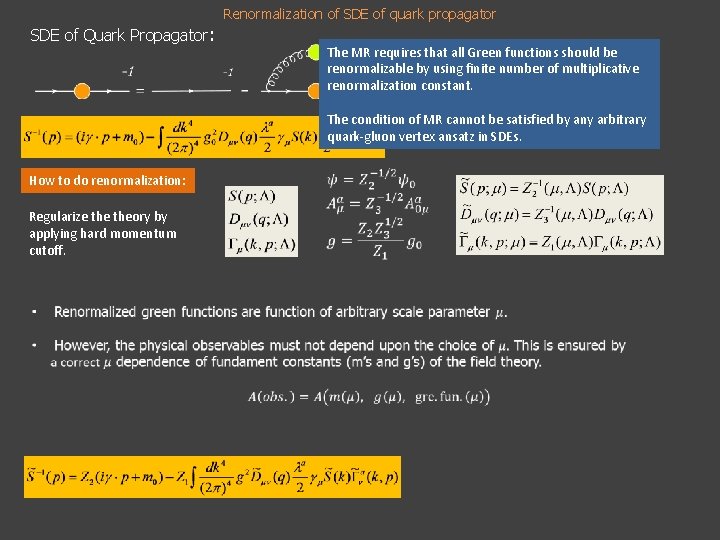
Renormalization of SDE of quark propagator SDE of Quark Propagator: The MR requires that all Green functions should be renormalizable by using finite number of multiplicative renormalization constant. The condition of MR cannot be satisfied by any arbitrary quark-gluon vertex ansatz in SDEs. How to do renormalization: Regularize theory by applying hard momentum cutoff.
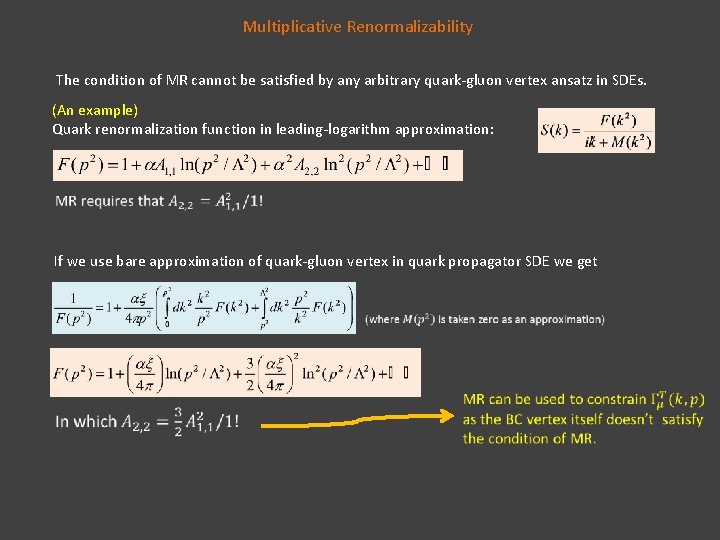
Multiplicative Renormalizability The condition of MR cannot be satisfied by any arbitrary quark-gluon vertex ansatz in SDEs. (An example) Quark renormalization function in leading-logarithm approximation: If we use bare approximation of quark-gluon vertex in quark propagator SDE we get
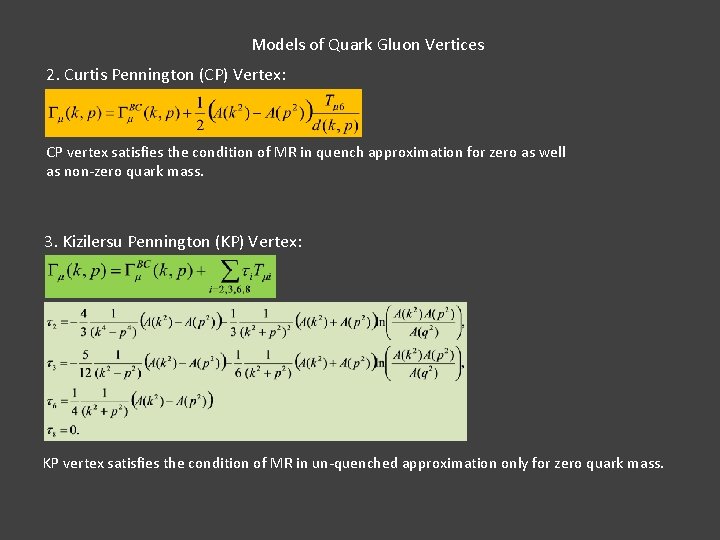
Models of Quark Gluon Vertices 2. Curtis Pennington (CP) Vertex: CP vertex satisfies the condition of MR in quench approximation for zero as well as non-zero quark mass. 3. Kizilersu Pennington (KP) Vertex: KP vertex satisfies the condition of MR in un-quenched approximation only for zero quark mass.
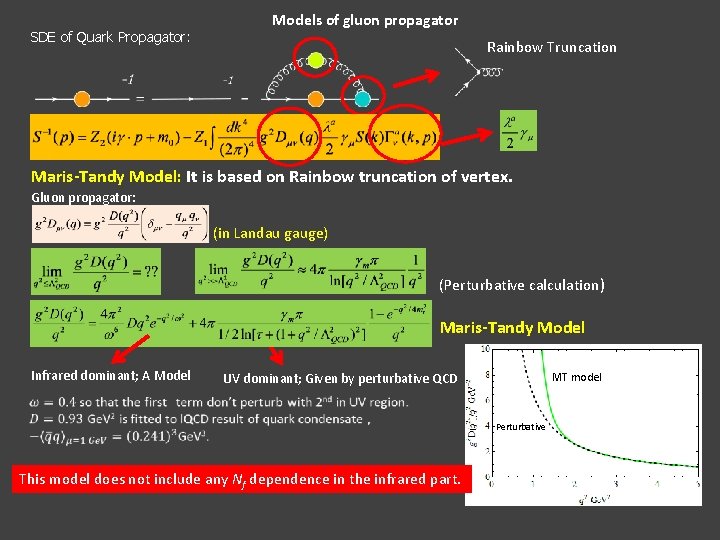
SDE of Quark Propagator: Models of gluon propagator Rainbow Truncation Maris-Tandy Model: It is based on Rainbow truncation of vertex. Gluon propagator: (in Landau gauge) (Perturbative calculation) Maris-Tandy Model Infrared dominant; A Model UV dominant; Given by perturbative QCD MT model Perturbative This model does not include any Nf dependence in the infrared part.
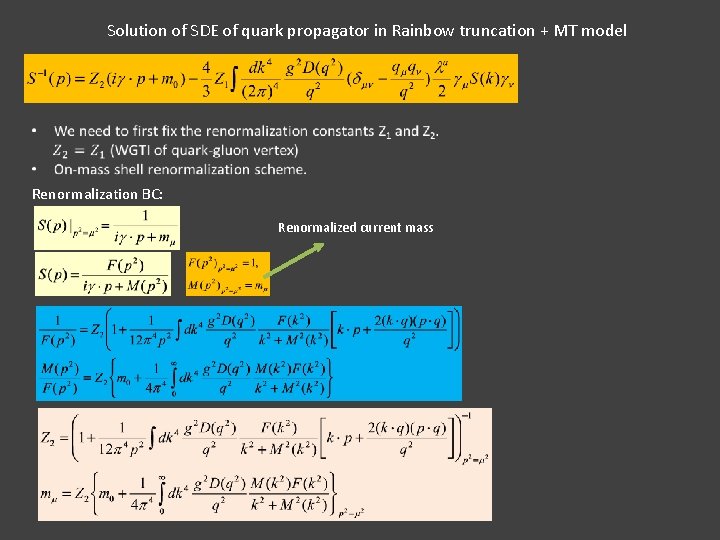
Solution of SDE of quark propagator in Rainbow truncation + MT model Renormalization BC: Renormalized current mass
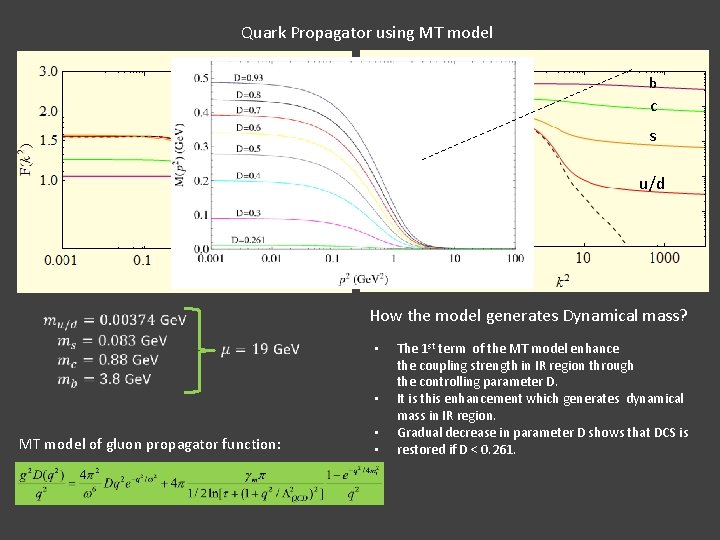
Quark Propagator using MT model b c s u/d How the model generates Dynamical mass? MT model of gluon propagator function: • The 1 st term of the MT model enhance the coupling strength in IR region through the controlling parameter D. • It is this enhancement which generates dynamical mass in IR region. • Gradual decrease in parameter D shows that DCS is • restored if D < 0. 261.
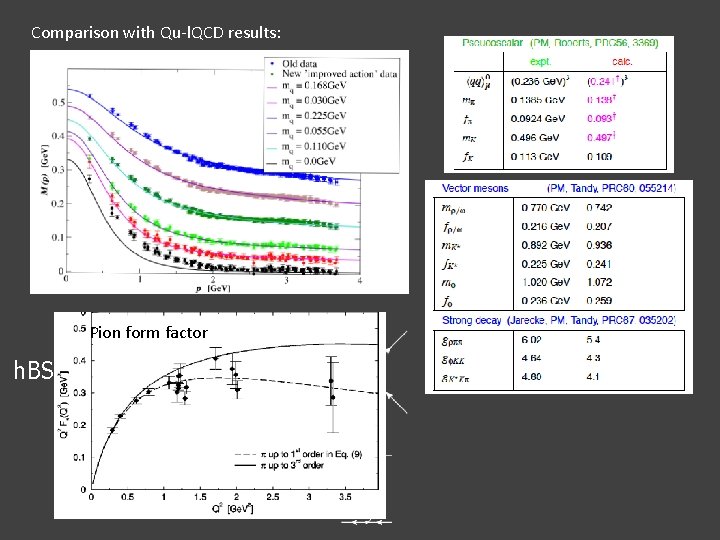
Comparison with Qu-l. QCD results: Pion form factor h. BSE: Ladder Truncation MT model
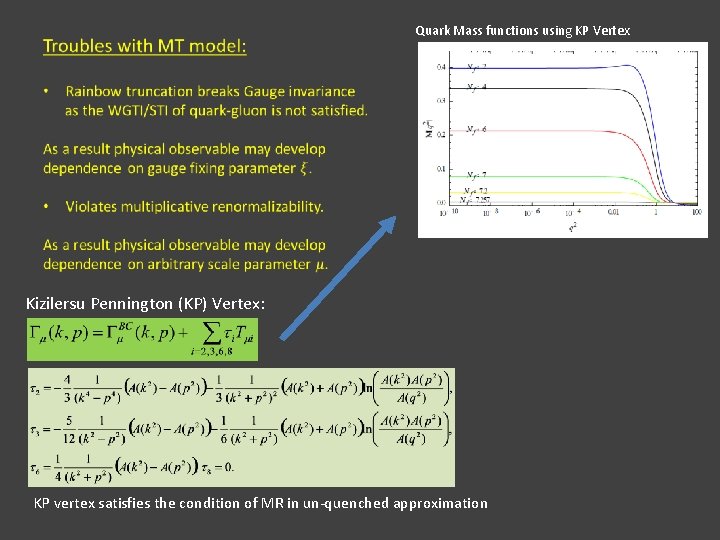
Quark Mass functions using KP Vertex Kizilersu Pennington (KP) Vertex: KP vertex satisfies the condition of MR in un-quenched approximation
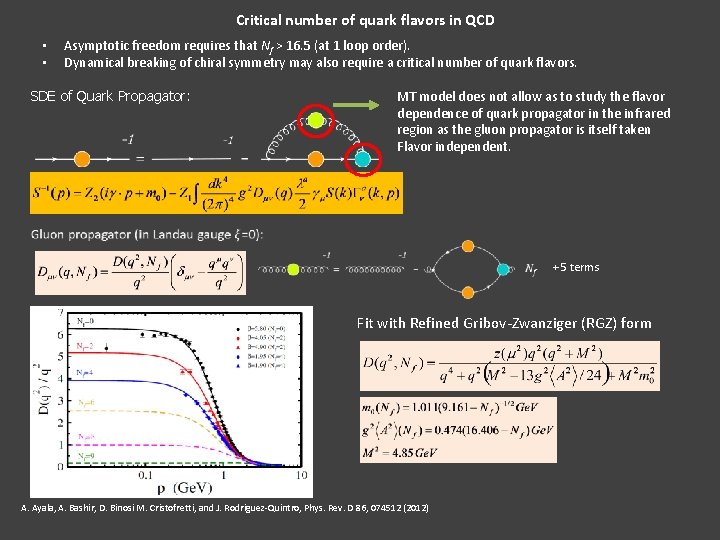
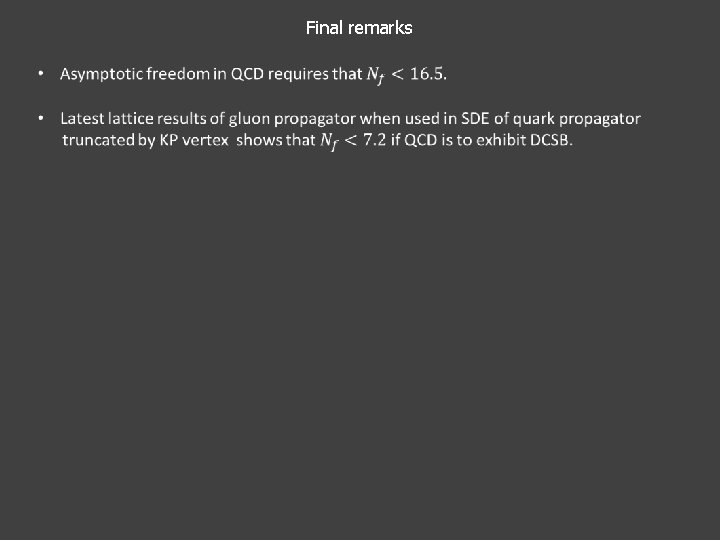
Critical number of quark flavors in QCD • • Asymptotic freedom requires that Nf > 16. 5 (at 1 loop order). Dynamical breaking of chiral symmetry may also require a critical number of quark flavors. SDE of Quark Propagator: MT model does not allow as to study the flavor dependence of quark propagator in the infrared region as the gluon propagator is itself taken Flavor independent. + 5 terms Fit with Refined Gribov-Zwanziger (RGZ) form A. Ayala, A. Bashir, D. Binosi M. Cristofretti, and J. Rodriguez-Quintro, Phys. Rev. D 86, 074512 (2012)
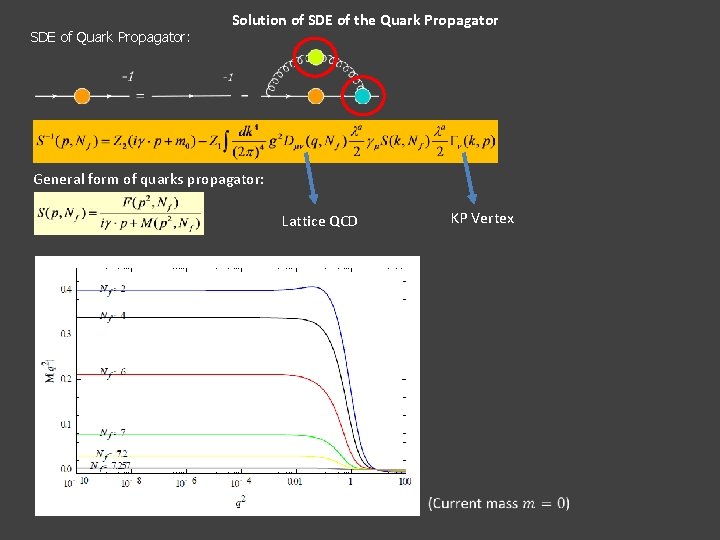
SDE of Quark Propagator: Solution of SDE of the Quark Propagator General form of quarks propagator: KP Vertex Lattice QCD
Final remarks

Extra slides
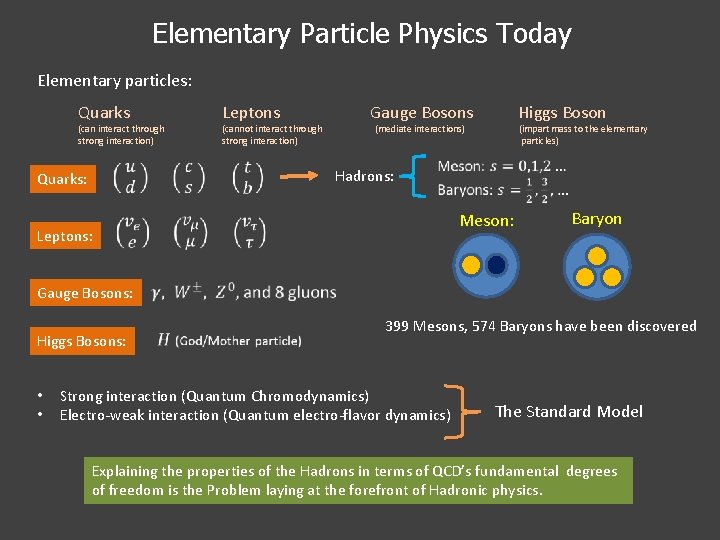
Elementary Particle Physics Today Elementary particles: Quarks (can interact through strong interaction) Quarks: Leptons: (cannot interact through strong interaction) Gauge Bosons (mediate interactions) Hadrons: Higgs Bosons: Higgs Boson (impart mass to the elementary particles) Meson: Gauge Bosons: • • Leptons Baryon 399 Mesons, 574 Baryons have been discovered Strong interaction (Quantum Chromodynamics) Electro-weak interaction (Quantum electro-flavor dynamics) The Standard Model Explaining the properties of the Hadrons in terms of QCD’s fundamental degrees of freedom is the Problem laying at the forefront of Hadronic physics.
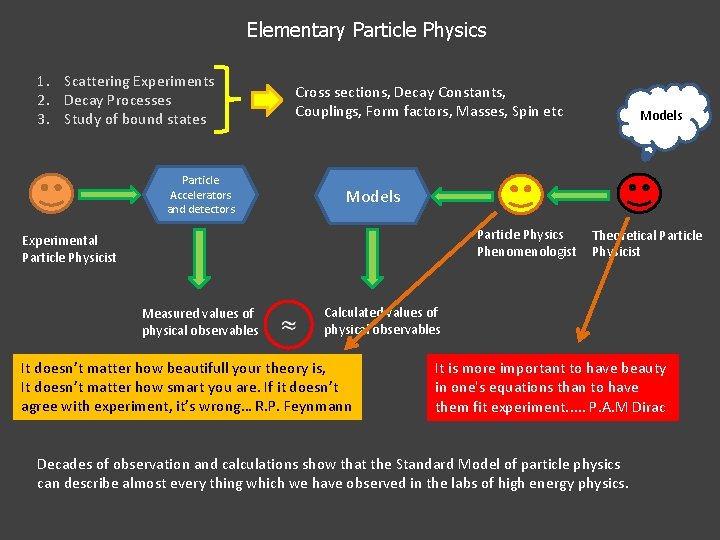
Elementary Particle Physics 1. Scattering Experiments 2. Decay Processes 3. Study of bound states Cross sections, Decay Constants, Couplings, Form factors, Masses, Spin etc Particle Accelerators and detectors Models Particle Physics Phenomenologist Experimental Particle Physicist Measured values of physical observables Models Theoretical Particle Physicist Calculated values of physical observables It doesn’t matter how beautifull your theory is, It doesn’t matter how smart you are. If it doesn’t agree with experiment, it’s wrong… R. P. Feynmann It is more important to have beauty in one's equations than to have them fit experiment. . . P. A. M Dirac Decades of observation and calculations show that the Standard Model of particle physics can describe almost every thing which we have observed in the labs of high energy physics.
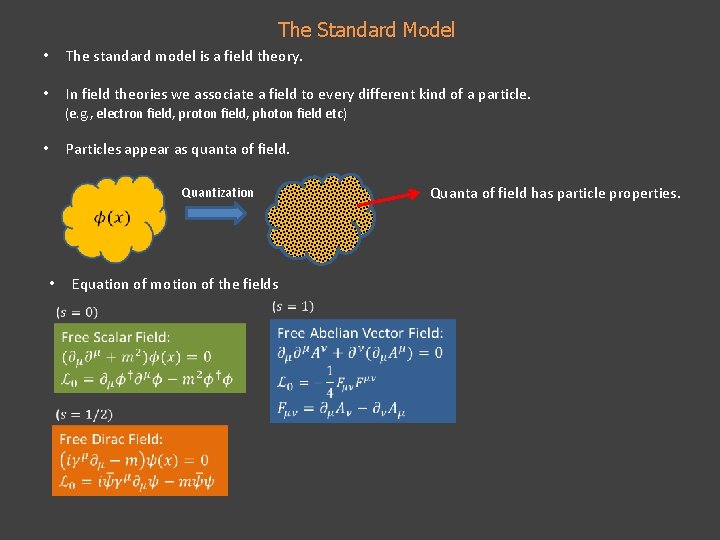
The Standard Model The standard model is a field theory. • • In field theories we associate a field to every different kind of a particle. (e. g. , electron field, proton field, photon field etc) Particles appear as quanta of field. • Quanta of field has particle properties. Quantization Equation of motion of the fields •
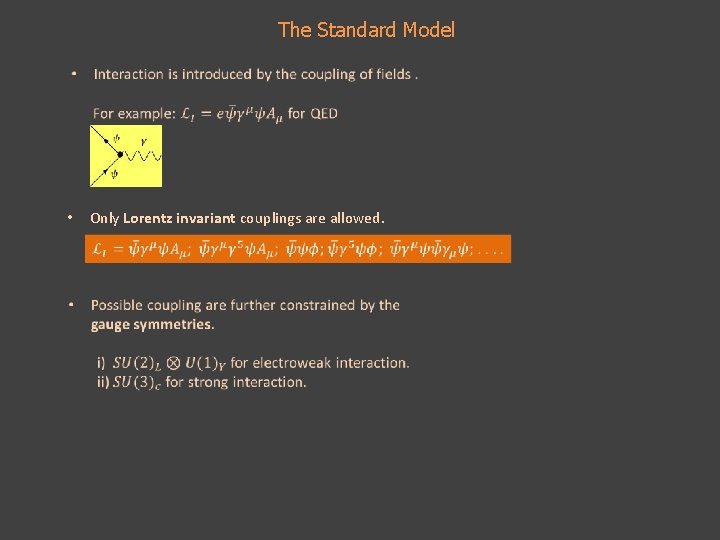
The Standard Model • Only Lorentz invariant couplings are allowed.
- Slides: 59