
Basics of Qualitative Research Design Soc 3307 f

Basics of Qualitative Research Design Soc 3307 f
Caelli (2003, ‘Clear as Mud’) says: n “Qualitative approaches do not encompass a single universally understood position. Arising as they do from multiple and evolving philosophic understandings of the world and the nature of humanity, there are many different standpoints from which to evaluate qualitative research (Sandelowski, 2002). Sandelowski and Barroso’s (2002) argument correctly posits that qualitative research can be judged only on its individual merits based on the research report. ”
Credibility of qualitative research… n Is established through assessing ¨ “ 1. theoretical positioning of the researcher; ¨ 2. the congruence between methodology and methods; ¨ 3. the strategies to establish rigor; and ¨ 4. the analytic lens through which the data are examined. ” (Caelli, 2003) n All are critical aspects of the research design
Characteristics of Qualitative Research Context is critical n In depth, detailed n Researcher immerses self in data (nonobjective) n Researcher integrity n Bias recognized n Use of grounded theory n Can detect process and sequence n Data are interpreted rather than analyzed n
Janesick (1994) in Berg (2009)…. “design is the choreography that establishes the research dance” n What are the implications of this statement?
The Research Design n The plan for conducting a study ¨ Foresee possible glitches ¨ Consider appropriate pacing ¨ Appraise ethical proprieties n Feasibility is contingent on many factors: ¨ Length of time to do the study ¨ Ethical constraints ¨ Cooperation of others ¨ Cost of conducting the research ¨ Researcher’s own skills
Qualitative Research Designs n Field studies or ethnographies ¨ Long n term involvement in the field Grounded theory studies ¨ Development n Action research ¨ Collaboration n n of new theory grounded in the data with stakeholders for social change Case study designs Observational designs: ¨ phenomenological n or ethnomethodological Historiography ¨ Examination of the past
Qualitative Research Methods n Observation ¨ Participant n Interviewing ¨ Structured, n semi-structured, unstructured Focus groups ¨ Group n and non-participant interviews and observation Unobtrusive methods ¨ Examining the artifacts of social communication
Data Analysis in Qualitative Research Content analysis n Coding n Building grounded theory n
Your You. Tube Research Will be a grounded theory study n Use unobtrusive methods n Content analysis and coding to analyze the data n End product will be a research report that outlines creates concepts and linkages between them and carefully grounds your ideas in actual observations n The concepts and linkages are theory n
What is Theory? “a statement of relationships between concepts” or “a roadmap for organizing ideas and knowledge about the social world” n Berg (2009) says “inter-related ideas about various patterns, concepts, processes, relationships, or events” n
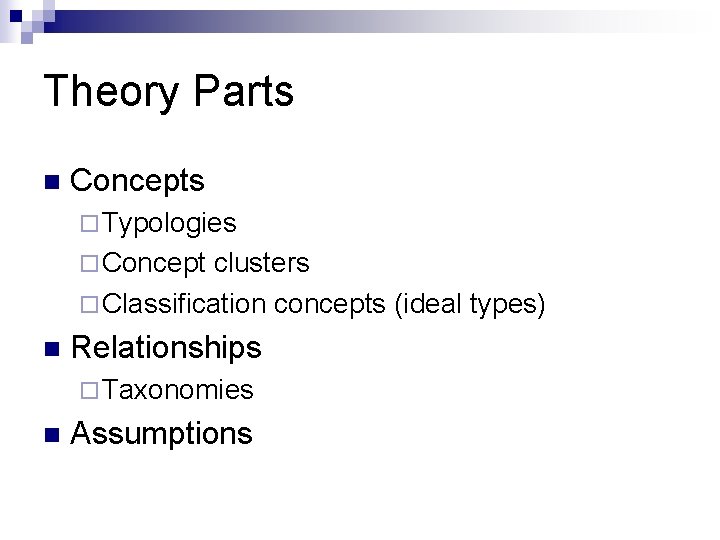
Theory Parts n Concepts ¨ Typologies ¨ Concept clusters ¨ Classification concepts (ideal types) n Relationships ¨ Taxonomies n Assumptions
Concepts n Are the abstract symbolic elements of thought and communication that we use to represent objects, processes, phenomena, etc. n Meanings vary from person to person n Must be clearly defined in research n Two distinct parts ¨Symbolic elements (word, symbol, term) ¨Definitional element Copyright © Allyn & Bacon 2010
Operationalization of a Concept n Conceptualize ¨ Providing a working definition of a concept ¨ Use theory and research n Operationalize ¨ providing the criteria for measuring a concept ¨ What, specifically, will you be observing? ¨ Often continues throughout the research process Copyright © Allyn & Bacon 2010
The Research Process n “Spiraling Research Approach” (Berg, 2009) n Begin with a rough idea n Gather theoretical information n Reconsider/redefine ideas grounded in what you see Process: Your idea(s) about an aspect of You. Tube videos Your review of relevant literature and theories Your research design and sample Your observations (data collection/organization) Your analysis/findings and generalizations (new theory? ) Dissemination of ideas – your presentation and paper Copyright © Allyn & Bacon 2010
Starting your Research: Choosing a Research Problem n n Where do problems come from? ¨ Practical problems in the field ¨ The literature in the field ¨ Personal interest Start by thinking about what you know and have seen on You. Tube Look at some of the literature in the area Refine your idea to create an actual problem statement of what you will observe
Creating a concept map (see Berg (reserve) Ch. 2 Fig. 2. 4) Try this! n Will help you to focus your research question or problem n Helps to plan your research design n Start a rough map while developing your problem statement and modify it as you go: while you conduct your literature search and while you gather and analyze data n
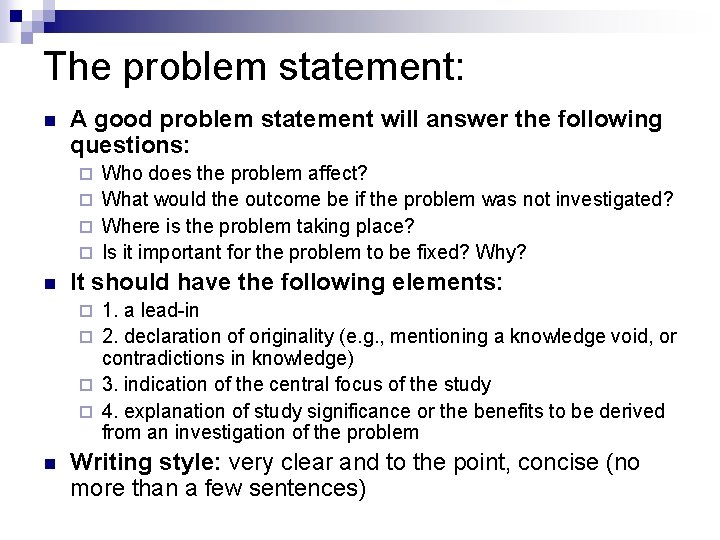
The problem statement: n A good problem statement will answer the following questions: Who does the problem affect? ¨ What would the outcome be if the problem was not investigated? ¨ Where is the problem taking place? ¨ Is it important for the problem to be fixed? Why? ¨ n It should have the following elements: 1. a lead-in ¨ 2. declaration of originality (e. g. , mentioning a knowledge void, or contradictions in knowledge) ¨ 3. indication of the central focus of the study ¨ 4. explanation of study significance or the benefits to be derived from an investigation of the problem ¨ n Writing style: very clear and to the point, concise (no more than a few sentences)
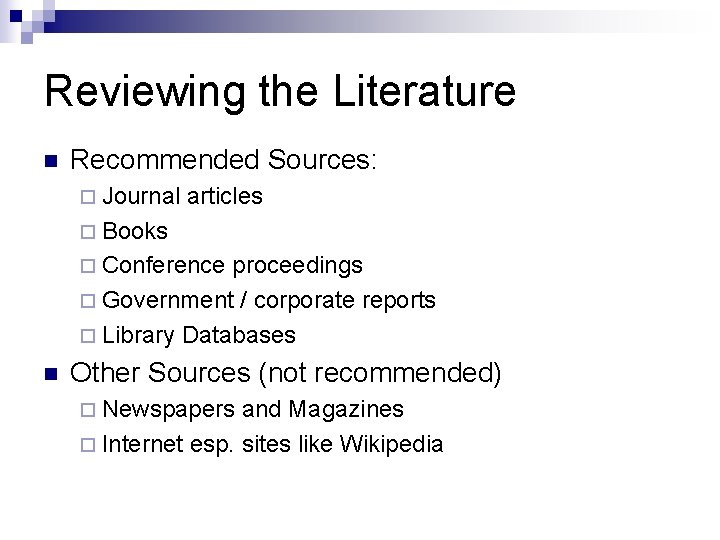
Reviewing the Literature n Recommended Sources: ¨ Journal articles ¨ Books ¨ Conference proceedings ¨ Government / corporate reports ¨ Library Databases n Other Sources (not recommended) ¨ Newspapers and Magazines ¨ Internet esp. sites like Wikipedia
The Annotated Bibliography n A very useful first step… n Consists of a bibliographic citation and a descriptive and evaluative annotation of a selection of your most useful sources
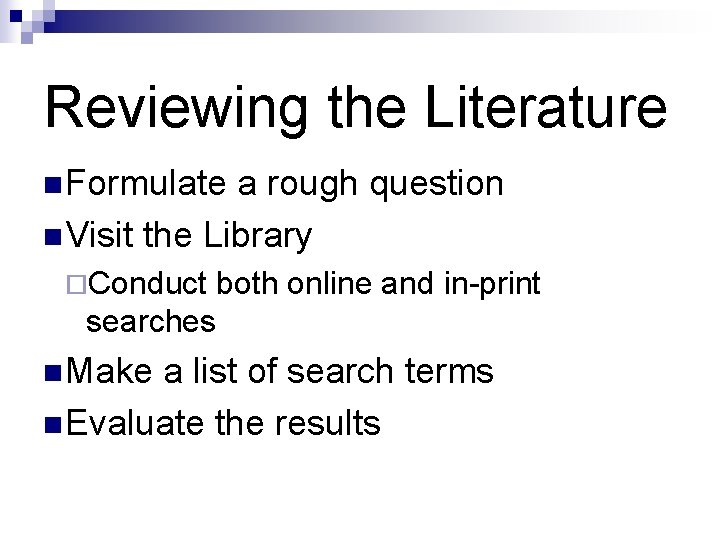
Reviewing the Literature n Formulate a rough question n Visit the Library ¨Conduct both online and in-print searches n Make a list of search terms n Evaluate the results Copyright © Allyn & Bacon 2010
Evaluating Web Sites n Information to check on every website ¨ URL ¨ Domain ¨ Date of last update ¨ Corroborating information Copyright © Allyn & Bacon 2010
Writing The Literature Review n Concentrates on the scientific research n Provides the context for your research n Justifies and grounds the study n Summarizes and evaluates the literature in the field
Questions to consider when doing a literature review: n n n n n 1. What do we already know in the immediate area concerned? 2. What are the characteristics of the key concepts? 3. What are the relationships between these key concepts? 4. What are the existing generalizations or theories? 5. Where are the inconsistencies/shortcomings in our knowledge and understanding? 6. What views need to be (further) explored? 7. What information or evidence is lacking, inconclusive, contradictory or too limited? 8. Why study (further) the research problem? 9. What contribution can the present study be expected to make? 10. What research designs or methods seem unsatisfactory?
Tips: Remember the purpose n Read with a purpose n Write with a purpose n Always put citations into your writing immediately n Keep a bibliographic file n
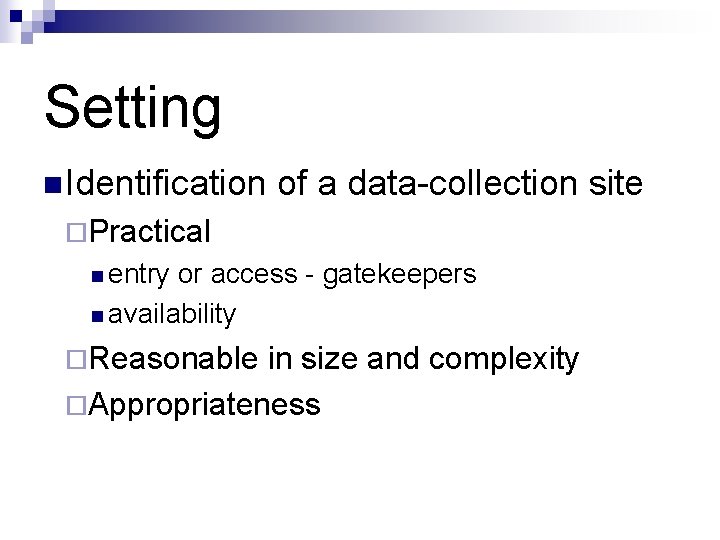
Setting n Identification of a data-collection site ¨Practical n entry or access - gatekeepers n availability ¨Reasonable in size and complexity ¨Appropriateness Copyright © Allyn & Bacon 2010
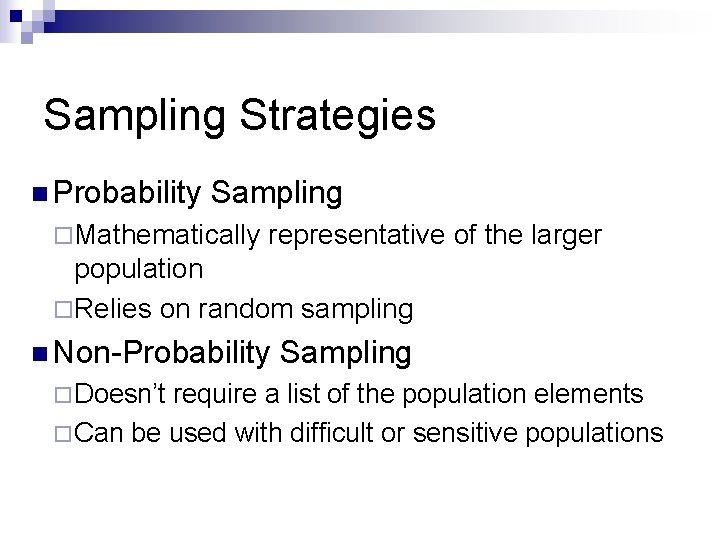
Sampling Strategies n Probability Sampling ¨ Mathematically representative of the larger population ¨ Relies on random sampling n Non-Probability Sampling ¨ Doesn’t require a list of the population elements ¨ Can be used with difficult or sensitive populations Copyright © Allyn & Bacon 2010

Probability Sampling (used for quantitative research) n Simple Random Sampling ¨ Every unit has the same chance of inclusion n Systematic Random Sampling ¨ Every nth unit is selected from the list n Stratified Random Sampling ¨ Independent samples from subgroups of the sample n Cluster Sampling ¨ Clusters are randomly and elements within are randomly selected Copyright © Allyn & Bacon 2010
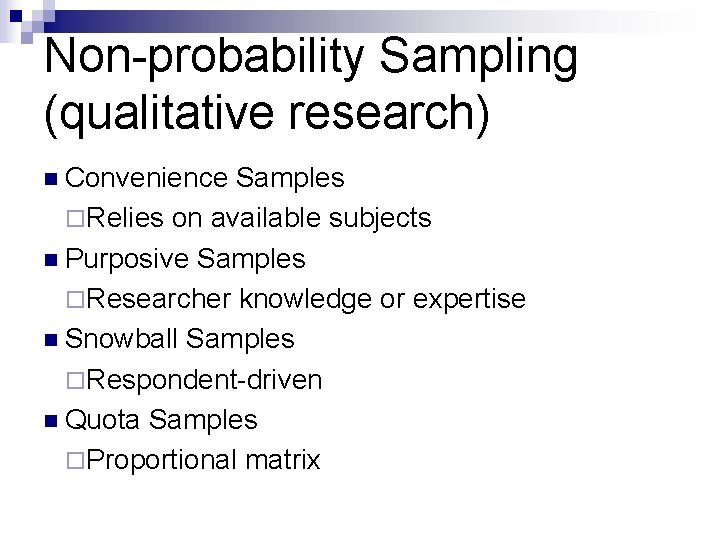
Non-probability Sampling (qualitative research) n Convenience Samples ¨ Relies on available subjects n Purposive Samples ¨ Researcher knowledge or expertise n Snowball Samples ¨ Respondent-driven n Quota Samples ¨ Proportional matrix
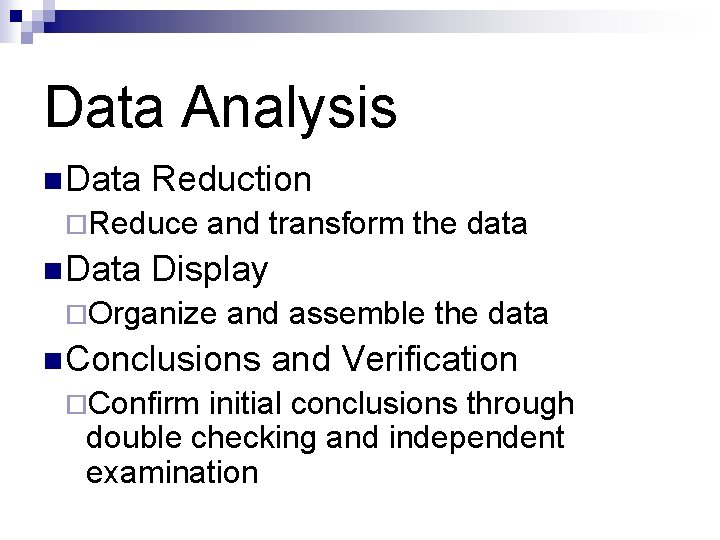
Data Analysis n Data Reduction ¨Reduce n Data and transform the data Display ¨Organize and assemble the data n Conclusions and Verification ¨Confirm initial conclusions through double checking and independent examination Copyright © Allyn & Bacon 2010
Dissemination Writing the final report on your research for presentation, submission or publication n Integral part of the research process n
- Slides: 31