
Basics of Qualitative Research Design Berg Ch 2

Basics of Qualitative Research Design Berg Ch. 2 Leedy and Ormrod Ch. 3 - 5

Three General Approaches to Research APPROACH POSITIVISM CRITICAL INTERPRETIVE USUAL TYPE OF RESEARCH experiment, survey, cont. anal. historicalcomparative field research, interviews PERSPECTIVE technocratic transcendent TYPE OF LOGIC reconstructed logic-in-practice PATH linear non-linear /cyclical
Qualitative methodology n n n Data in words rather than numbers Non-positivistic orientation Includes: ¨ Field research and ethnography ¨ Observation, case studies ¨ Qualitative interviewing ¨ Action research ¨ Historical comparative analysis

Characteristics of Qualitative Research Context is critical n In depth, detailed n Researcher immerses self in data (nonobjective) n Researcher integrity n Bias recognized n Use of grounded theory n Can detect process and sequence n Data are interpreted rather than analyzed n

Ideas and Theory The Deductive (Quantitative) Process ¨ Ideas and theory come before empirical research ¨ Ideas lead to refutation through research Copyright © Allyn & Bacon 2010 The Inductive (Qualitative) Process o Research leads to theory development o Research initiates, reformulates, deflects and clarifies theory

What is Theory? n “a statement of relationships between concepts” n “a roadmap for organizing ideas and knowledge about the social world”

Theory Parts n Concepts ¨ Concept clusters ¨ Classification concepts (ideal types) n Assumptions n Typology or Taxonomy n Relationships
The Measurement Process n Quantitative = deductive n Qualitative = inductive n Both involve conceptualization and operationalization
Concepts n Symbolic elements n Foundation of communication and thought n Two distinct parts ¨Symbolic elements (word, symbol, term) ¨Definitional element Copyright © Allyn & Bacon 2010
Operationalization of a Concept n Conceptualize ¨ Providing a working definition of a concept ¨ Use theory and research n Operationalize ¨ providing the criteria for measuring a concept ¨ What, specifically, will you be observing? ¨ Often continues throughout the research process Copyright © Allyn & Bacon 2010
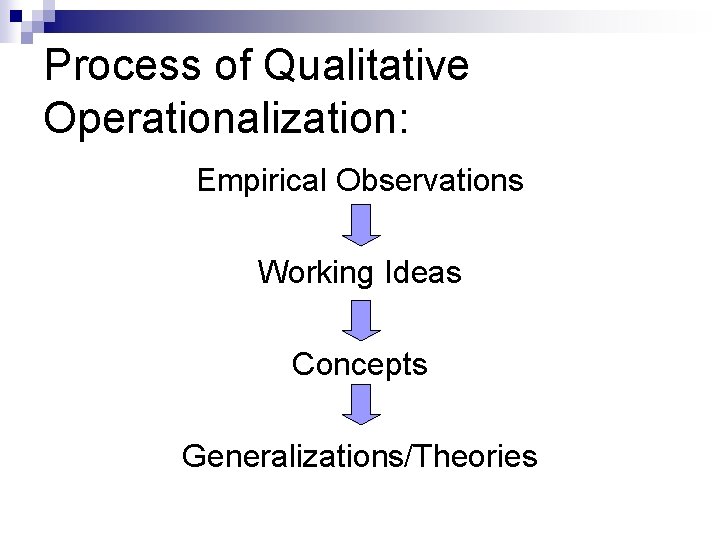
Process of Qualitative Operationalization: Empirical Observations Working Ideas Concepts Generalizations/Theories
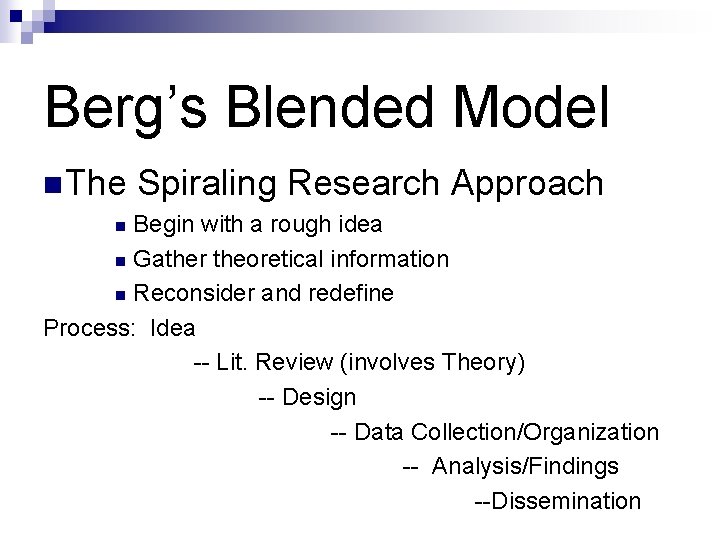
Berg’s Blended Model n The Spiraling Research Approach Begin with a rough idea n Gather theoretical information n Reconsider and redefine Process: Idea -- Lit. Review (involves Theory) -- Design -- Data Collection/Organization -- Analysis/Findings --Dissemination Copyright © Allyn & Bacon 2010 n
Choosing a Research Problem n Where do problems come from? ¨Practical problems in the field ¨The literature in the field ¨Personal interest
Examples of Problems: The purpose of this study is to examine the effect of body image and PPF (perceived physical fitness) for different exercise settings n The purpose of this study is to examine the type of talk during a writing activity to determine if there is a difference between off topic and on topic talk on the quality of students’ writing samples n
Reviewing the Literature n Recommended Sources: ¨ Journal articles ¨ Books ¨ Conference proceedings ¨ Government / corporate reports ¨ Library Databases n Other Sources (not recommended) ¨ Newspapers and Magazines ¨ Internet esp. sites like Wikipedia

The Annotated Bibliography n A very useful first step… n Consists of a bibliographic citation and a descriptive and evaluative annotation of a selection of your most useful sources
Reviewing the Literature n Formulate a rough question n Visit the Library ¨Conduct both online and in-print searches n Make a list of search terms n Evaluate the results Copyright © Allyn & Bacon 2010
Evaluating Web Sites n Information to check on every website ¨ URL ¨ Domain ¨ Date of last update ¨ Corroborating information Copyright © Allyn & Bacon 2010
Writing The Literature Review n Concentrates on the scientific research n Provides the context for your research n Justifies the proposed study n Summarizes and evaluates the literature in the field
Questions to be answered in a literature review: n n n n n 1. What do we already know in the immediate area concerned? 2. What are the characteristics of the key concepts (or the main factors or variables)? 3. What are the relationships between these key concepts, factors or variables? 4. What are the existing generalizations or theories? 5. Where are the inconsistencies/shortcomings in our knowledge and understanding? 6. What views need to be (further) explored? 7. What information or evidence is lacking, inconclusive, contradictory or too limited? 8. Why study (further) the research problem? 9. What contribution can the present study be expected to make? 10. What research designs or methods seem unsatisfactory?

Tips: Remember the purpose n Read with a purpose n Write with a purpose n Always put citations into your writing immediately n Keep a bibliographic file n
Berg’s Two-Card Method ¨Author n Full Card citation n Library call number o Topic Card o Author’s name o Date of publication o Brief topical label o Verbatim excerpt Copyright © Allyn & Bacon 2010
Janesick (1994) in Berg…. “design is the choreography that establishes the research dance” n What are the implications of this statement?
The Research Design n The plan for conducting a study ¨ Foresee possible glitches ¨ Consider appropriate pacing ¨ Appraise ethical proprieties n Feasibility is contingent on many factors: ¨ Length of time to do the study ¨ Ethical constraints ¨ Cooperation of others ¨ Cost of conducting the research ¨ Researcher’s own skills
Setting n Identification of a data-collection site ¨Practical n entry or access - gatekeepers n availability ¨Reasonable in size and complexity ¨Appropriateness Copyright © Allyn & Bacon 2010
Sampling Strategies n Probability Sampling ¨ Mathematically representative of the larger population ¨ Relies on random sampling n Non-Probability Sampling ¨ Doesn’t require a list of the population elements ¨ Can be used with difficult or sensitive populations Copyright © Allyn & Bacon 2010
Probability Sampling n Simple Random Sampling ¨ Every unit has the same chance of inclusion n Systematic Random Sampling ¨ Every nth unit is selected from the list n Stratified Random Sampling ¨ Independent samples from subgroups of the sample n Cluster Sampling ¨ Clusters are randomly and elements within are randomly selected Copyright © Allyn & Bacon 2010
Non-probability Sampling n Convenience Samples ¨ Relies on available subjects n Purposive Samples ¨ Researcher knowledge or expertise n Snowball Samples ¨ Respondent-driven n Quota Samples ¨ Proportional matrix
Data Analysis n Data Reduction ¨Reduce n Data and transform the data Display ¨Organize and assemble the data n Conclusions and Verification ¨Confirm initial conclusions through double checking and independent examination Copyright © Allyn & Bacon 2010
Dissemination Writing the final report on your research for publication or presentation to a funding agency n Integral part of the research process n
- Slides: 30