
Basics of Protocols Choosing the right protocol in
Basics of Protocols Choosing the right protocol in a Cisco Unified Call. Manager environment
Introduction • Who am I? – Louis R. Marascio, former CTO of Metreos Corporation – Metreos was acquired by Cisco Systems in June 2006 • For the past 6 years I have been building a development platform, tools, and applications for large Cisco IP Communications customers • In this session I hope to share with you knowledge learned through painful trial and error in the real world www. voipdeveloper. com August 8 -10, 2006 Santa Clara, California Hyatt Regency Santa Clara
Who Cares About the Protocol? • Pragmatism wins in the dynamic world of IP communications • End-users DO NOT care if the call was handled with SIP, H. 323, JTAPI, or SCCP • End-users DO care if the protocol chosen to handle the call does not provide the feature set they want • Choosing a protocol is like choosing a programming language: determine which protocols can solve the problem and then pick the one you are most comfortable with www. voipdeveloper. com August 8 -10, 2006 Santa Clara, California Hyatt Regency Santa Clara
Line Side vs. Trunk Side vs. CTI • Legacy terminology carried over to the IP communications world • Capabilities differ depending on how you present your application to the telephony system • Traditionally only CTI was available, but IP communications enables us to leverage the line and trunk side as well www. voipdeveloper. com August 8 -10, 2006 Santa Clara, California Hyatt Regency Santa Clara

Line vs. Trunk vs. CTI (cont) PROS • Dialed number modification • Very easy to setup • Straightforward routing PROS • Call routing • Built in failover & redundancy CONS 1. Limited access to features CONS • Complexity PROS • Access to features • Scalability CONS • Increased administration • Line side device limits • Licensing www. voipdeveloper. com August 8 -10, 2006 Santa Clara, California Hyatt Regency Santa Clara
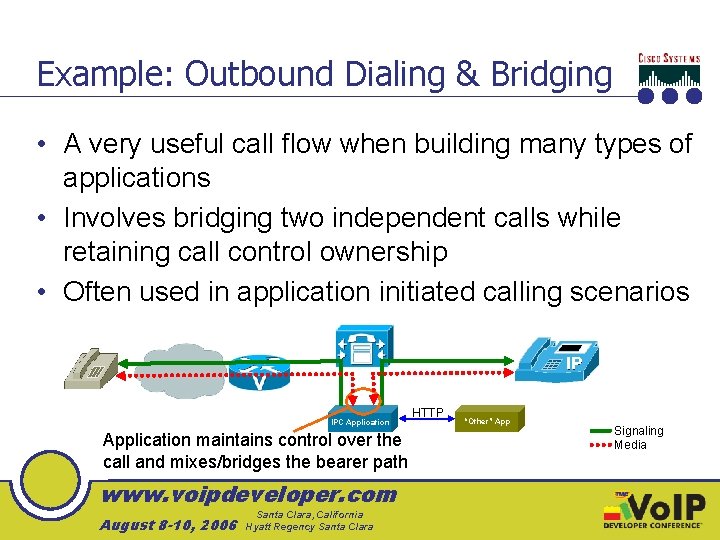
Example: Outbound Dialing & Bridging • A very useful call flow when building many types of applications • Involves bridging two independent calls while retaining call control ownership • Often used in application initiated calling scenarios IPC Application maintains control over the call and mixes/bridges the bearer path www. voipdeveloper. com August 8 -10, 2006 Santa Clara, California Hyatt Regency Santa Clara HTTP “Other” App Signaling Media
Example: Outbound Dialing (cont) • Trunk interfaces are typically best suited for this type of application • Modification of calling number is an important aspect, make the call look like it is coming from another entity • H. 323 or SIP trunk side is the best choice • If you need supplementary services and don’t have CCM 5. 0 then use JTAPI, but you won’t be able to do calling number modification www. voipdeveloper. com August 8 -10, 2006 Santa Clara, California Hyatt Regency Santa Clara
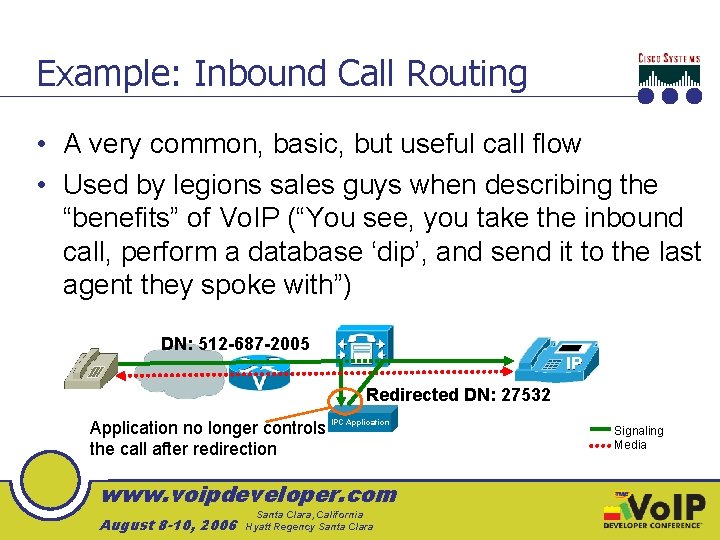
Example: Inbound Call Routing • A very common, basic, but useful call flow • Used by legions sales guys when describing the “benefits” of Vo. IP (“You see, you take the inbound call, perform a database ‘dip’, and send it to the last agent they spoke with”) DN: 512 -687 -2005 Redirected DN: 27532 Application no longer controls IPC Application the call after redirection www. voipdeveloper. com August 8 -10, 2006 Santa Clara, California Hyatt Regency Santa Clara Signaling Media

Example: Inbound Call Routing (cont) • Traditionally the realm of JTAPI route points • In Call. Manager versions prior to 5. 0, JTAPI is the best and preferred way to accomplish this • In Call. Manager 5. 0 you can leverage SIP trunks and a redirect (302) response to achieve a similar result • Depending on the features you need, SIP may not be enough in 5. 0 (Calling Search Space modification per call, calling name or number modification, etc) www. voipdeveloper. com August 8 -10, 2006 Santa Clara, California Hyatt Regency Santa Clara
Basic (mostly true) Rules of Thumb • Choose trunk side protocols for easy manipulation of calling party number • In general, avoid CTI if you can • Line side protocols are useful when you need access to phone oriented features, but they tend to be harder to setup and manage • Abstract yourself away from the protocol, it will make your life much easier as the underlying system evolves www. voipdeveloper. com August 8 -10, 2006 Santa Clara, California Hyatt Regency Santa Clara
Contact Information • If you have any questions please feel free to contact me: Louis R. Marascio Cisco Systems, Inc. louis@cisco. com www. voipdeveloper. com August 8 -10, 2006 Santa Clara, California Hyatt Regency Santa Clara
- Slides: 12