
Basics of Pacemaker Functioning T K Govindarajan Medtronic
Basics of Pacemaker Functioning T K Govindarajan Medtronic

Topics • Components of a Pacemaker System • Types of Pacemakers & their Operation • Functions of a Pacemaker System – Stimulation of cardiac tissue – Sensing of intrinsic heartbeats – Single chamber timing cycle
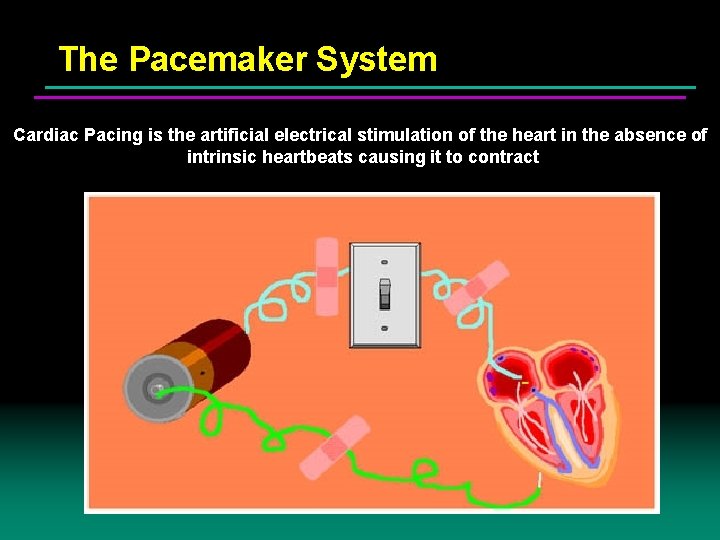
The Pacemaker System Cardiac Pacing is the artificial electrical stimulation of the heart in the absence of intrinsic heartbeats causing it to contract
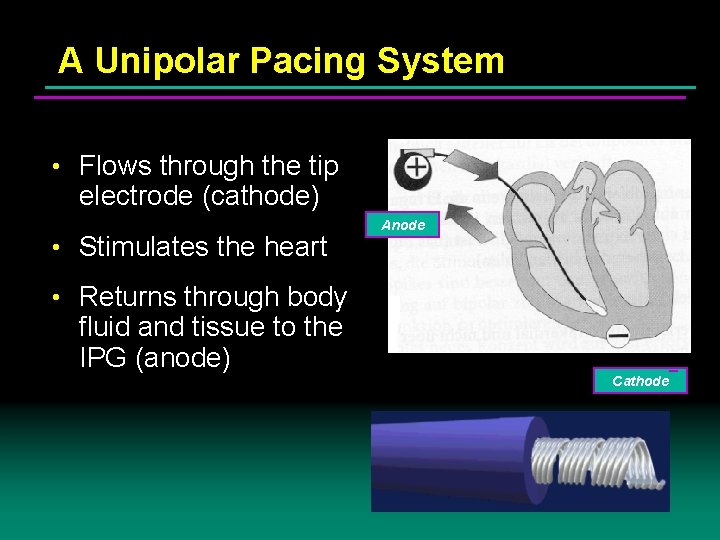
A Unipolar Pacing System • Flows through the tip electrode (cathode) • Stimulates the heart Anode • Returns through body fluid and tissue to the IPG (anode) - Cathode
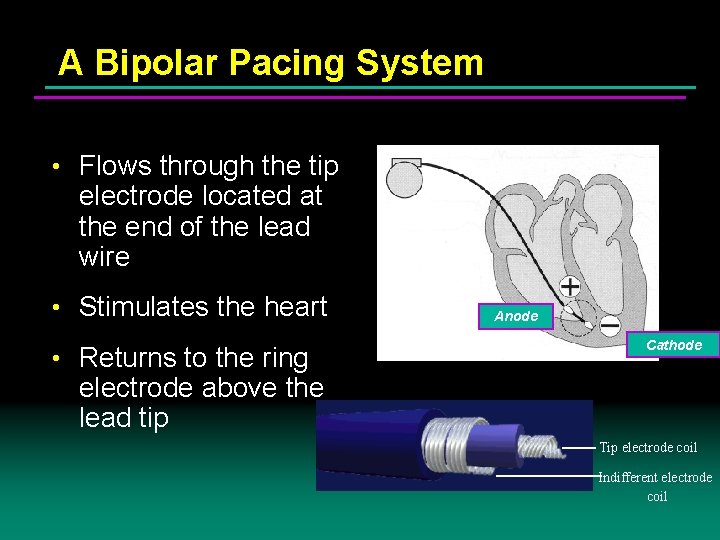
A Bipolar Pacing System • Flows through the tip electrode located at the end of the lead wire • Stimulates the heart • Returns to the ring Anode Cathode electrode above the lead tip Tip electrode coil Indifferent electrode coil
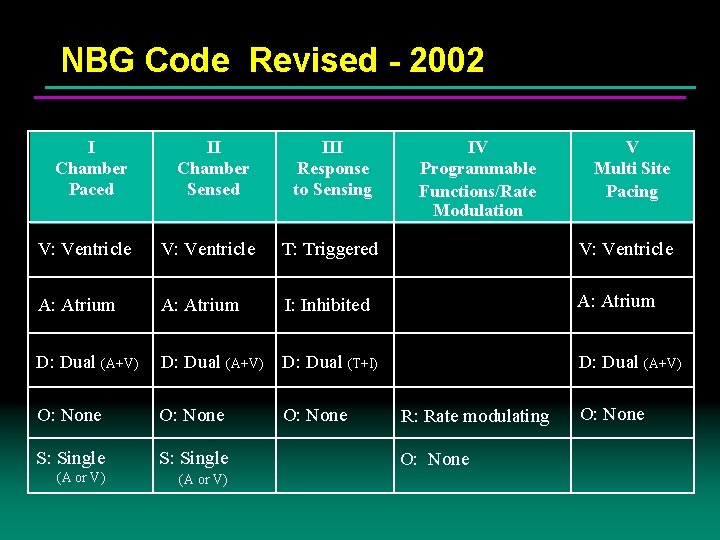
NBG Code Revised - 2002 I Chamber Paced II Chamber Sensed III Response to Sensing V: Ventricle T: Triggered V: Ventricle A: Atrium I: Inhibited A: Atrium D: Dual (A+V) D: Dual (T+I) O: None S: Single (A or V) O: None IV Programmable Functions/Rate Modulation V Multi Site Pacing D: Dual (A+V) R: Rate modulating O: None
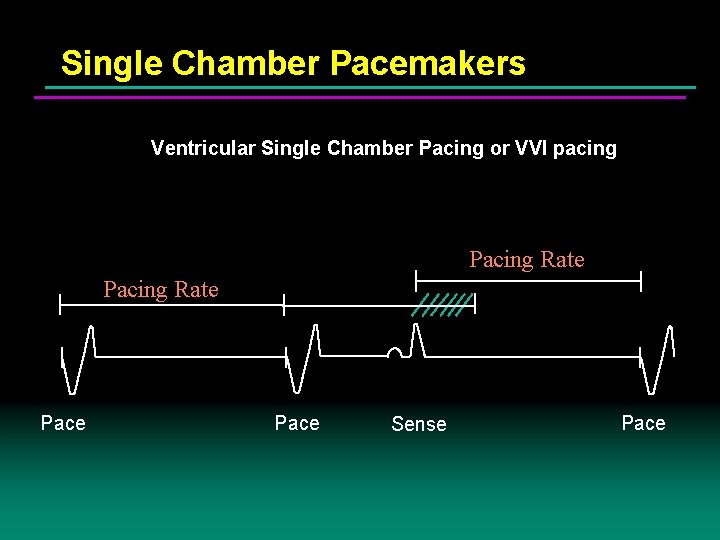
Single Chamber Pacemakers Ventricular Single Chamber Pacing or VVI pacing Pacing Rate Pace Sense Pace
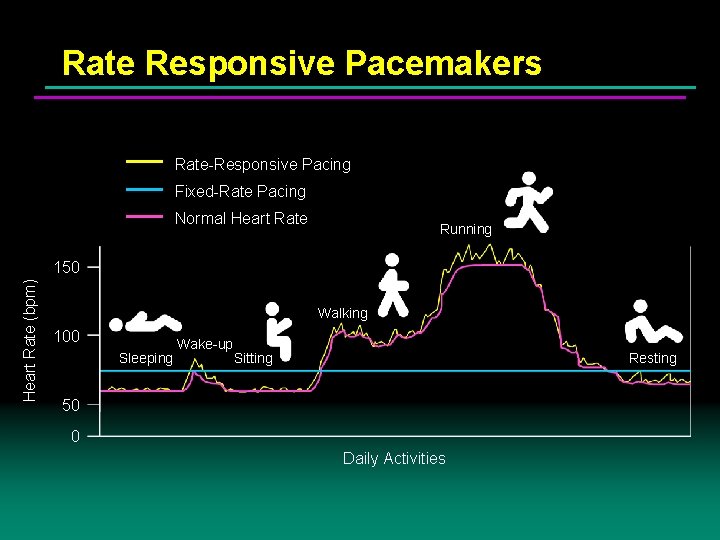
Rate Responsive Pacemakers Rate-Responsive Pacing Fixed-Rate Pacing Normal Heart Rate Running Heart Rate (bpm) 150 Walking 100 Sleeping Wake-up Resting Sitting 50 0 Daily Activities
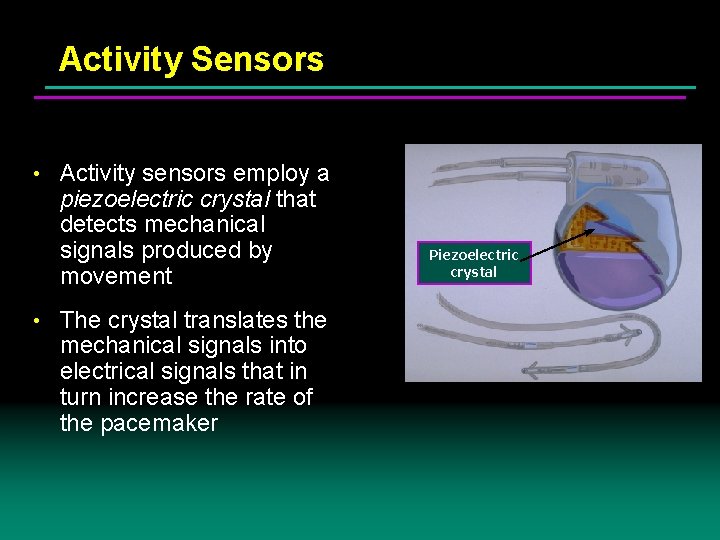
Activity Sensors • Activity sensors employ a piezoelectric crystal that detects mechanical signals produced by movement • The crystal translates the mechanical signals into electrical signals that in turn increase the rate of the pacemaker Piezoelectric crystal
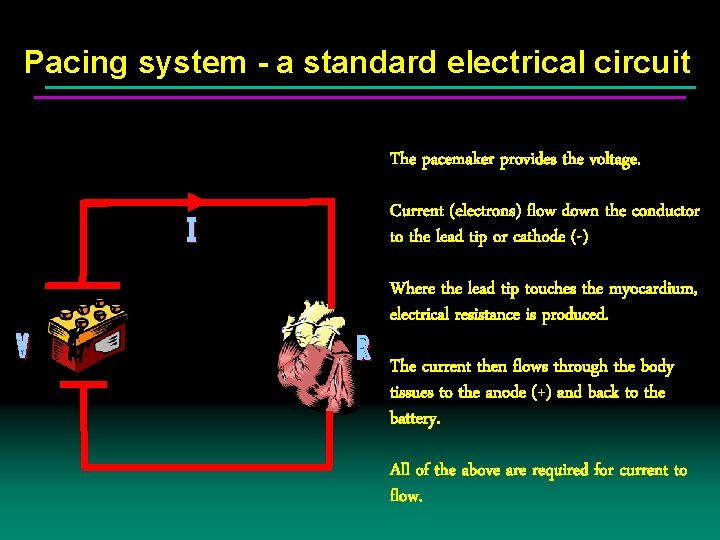
Pacing system - a standard electrical circuit The pacemaker provides the voltage. Current (electrons) flow down the conductor to the lead tip or cathode (-) Where the lead tip touches the myocardium, electrical resistance is produced. The current then flows through the body tissues to the anode (+) and back to the battery. All of the above are required for current to flow.
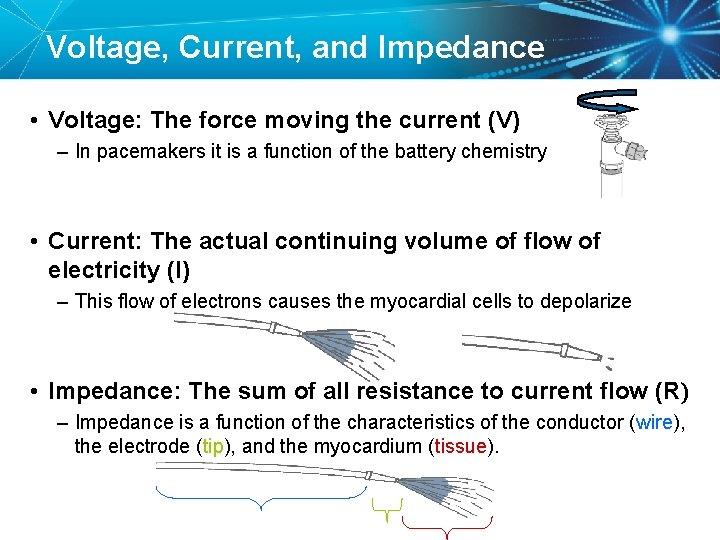
Voltage, Current, and Impedance • Voltage: The force moving the current (V) – In pacemakers it is a function of the battery chemistry • Current: The actual continuing volume of flow of electricity (I) – This flow of electrons causes the myocardial cells to depolarize • Impedance: The sum of all resistance to current flow (R) – Impedance is a function of the characteristics of the conductor (wire), the electrode (tip), and the myocardium (tissue).
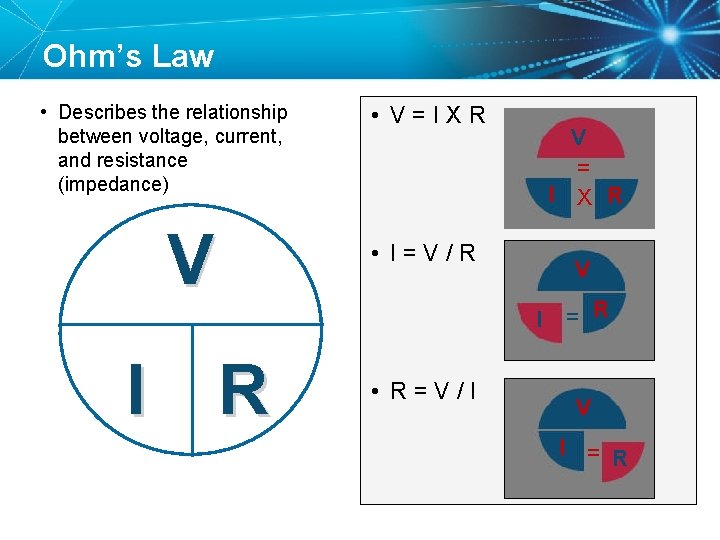
Ohm’s Law • Describes the relationship between voltage, current, and resistance (impedance) V • V=IXR V = I X R • I=V/R V I I R • R=V/I = R V I = R
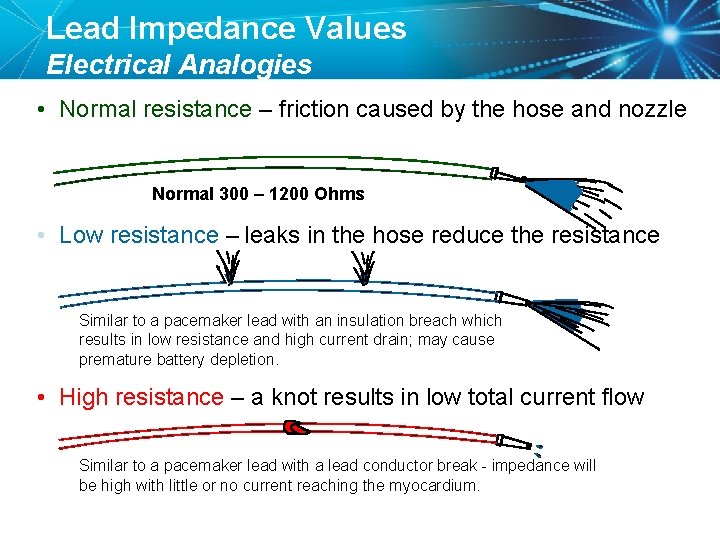
Lead Impedance Values Electrical Analogies • Normal resistance – friction caused by the hose and nozzle Normal 300 – 1200 Ohms • Low resistance – leaks in the hose reduce the resistance Similar to a pacemaker lead with an insulation breach which results in low resistance and high current drain; may cause premature battery depletion. • High resistance – a knot results in low total current flow Similar to a pacemaker lead with a lead conductor break - impedance will be high with little or no current reaching the myocardium.
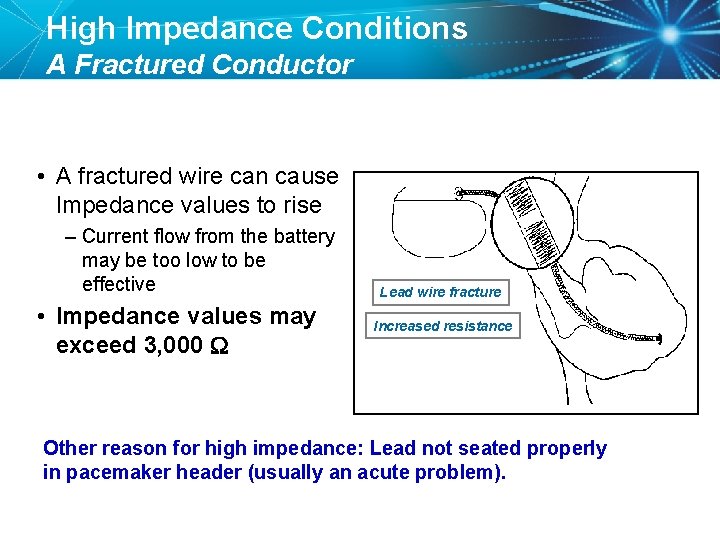
High Impedance Conditions A Fractured Conductor • A fractured wire can cause Impedance values to rise – Current flow from the battery may be too low to be effective • Impedance values may exceed 3, 000 W Lead wire fracture Increased resistance Other reason for high impedance: Lead not seated properly in pacemaker header (usually an acute problem).
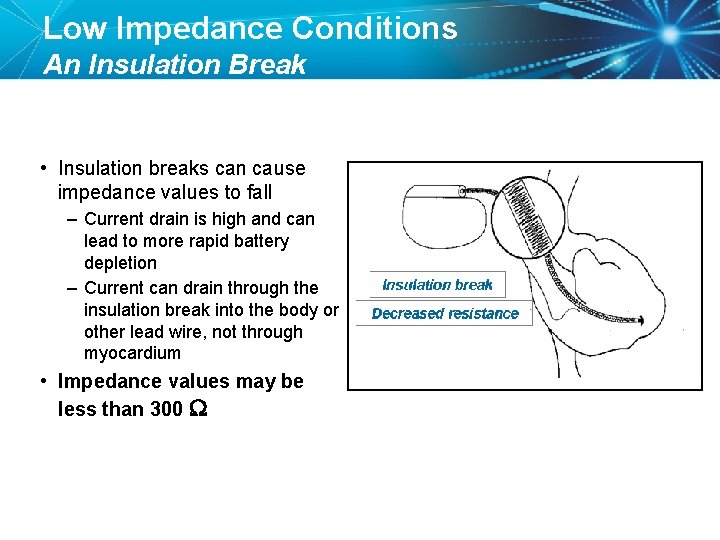
Low Impedance Conditions An Insulation Break • Insulation breaks can cause impedance values to fall – Current drain is high and can lead to more rapid battery depletion – Current can drain through the insulation break into the body or other lead wire, not through myocardium • Impedance values may be less than 300 W
Stimulation Threshold • Pacing Voltage Threshold – The minimum pacing voltage – at any given pulse width – required to consistently stimulate the heart – outside the myocardial refractory period causing it to contract
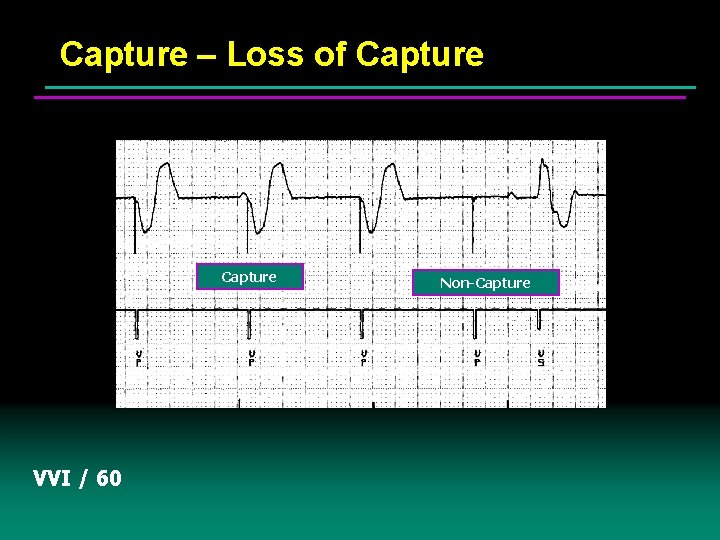
Capture – Loss of Capture VVI / 60 Non-Capture
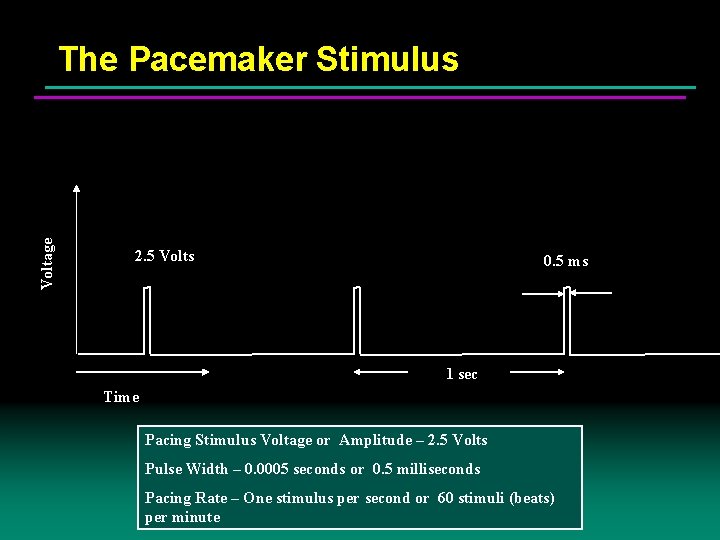
Voltage The Pacemaker Stimulus 2. 5 Volts 0. 5 ms 1 sec Time Pacing Stimulus Voltage or Amplitude – 2. 5 Volts Pulse Width – 0. 0005 seconds or 0. 5 milliseconds Pacing Rate – One stimulus per second or 60 stimuli (beats) per minute
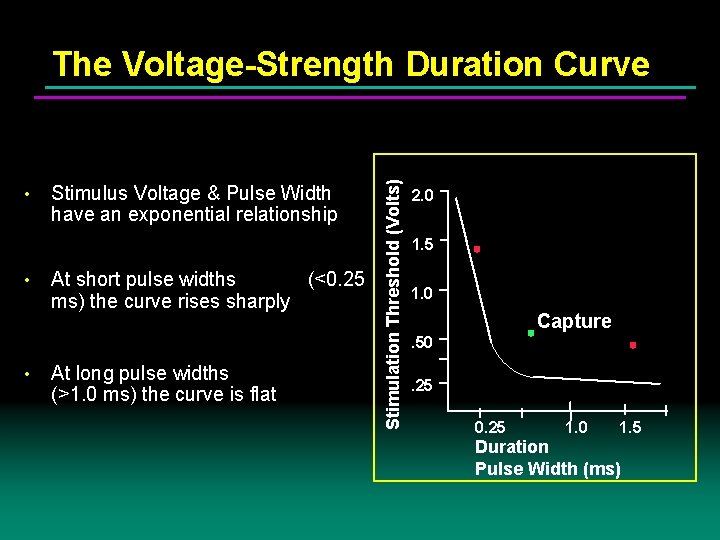
• • • Stimulus Voltage & Pulse Width have an exponential relationship At short pulse widths (<0. 25 ms) the curve rises sharply At long pulse widths (>1. 0 ms) the curve is flat Stimulation Threshold (Volts) The Voltage-Strength Duration Curve 2. 0 1. 5 1. 0 Capture. 50. 25 1. 0 1. 5 Duration Pulse Width (ms)
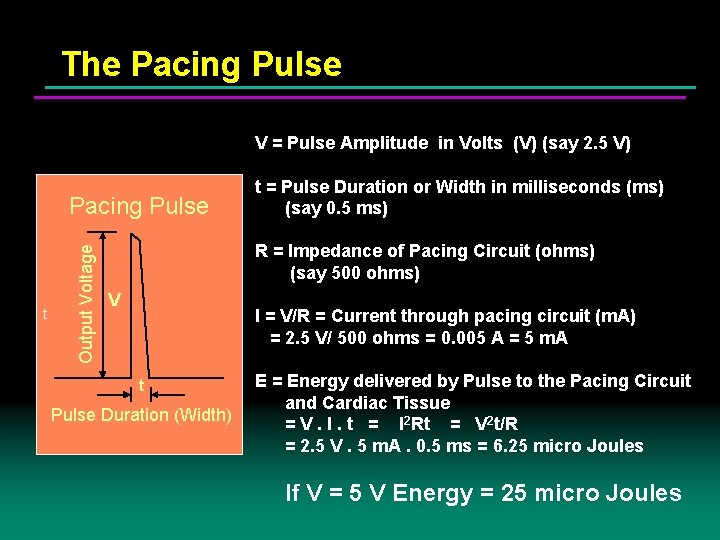
The Pacing Pulse V = Pulse Amplitude in Volts (V) (say 2. 5 V) t Output Voltage Pacing Pulse t = Pulse Duration or Width in milliseconds (ms) (say 0. 5 ms) R = Impedance of Pacing Circuit (ohms) (say 500 ohms) V I = V/R = Current through pacing circuit (m. A) = 2. 5 V/ 500 ohms = 0. 005 A = 5 m. A t Pulse Duration (Width) E = Energy delivered by Pulse to the Pacing Circuit and Cardiac Tissue = V. I. t = I 2 Rt = V 2 t/R = 2. 5 V. 5 m. A. 0. 5 ms = 6. 25 micro Joules If V = 5 V Energy = 25 micro Joules
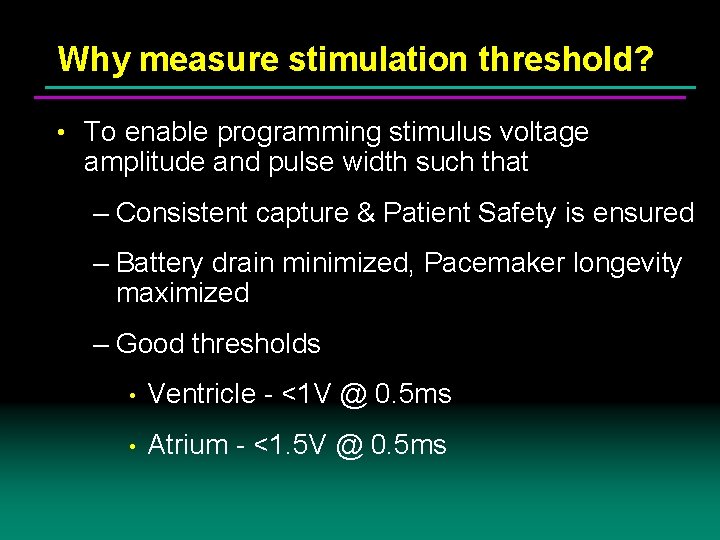
Why measure stimulation threshold? • To enable programming stimulus voltage amplitude and pulse width such that – Consistent capture & Patient Safety is ensured – Battery drain minimized, Pacemaker longevity maximized – Good thresholds • Ventricle - <1 V @ 0. 5 ms • Atrium - <1. 5 V @ 0. 5 ms
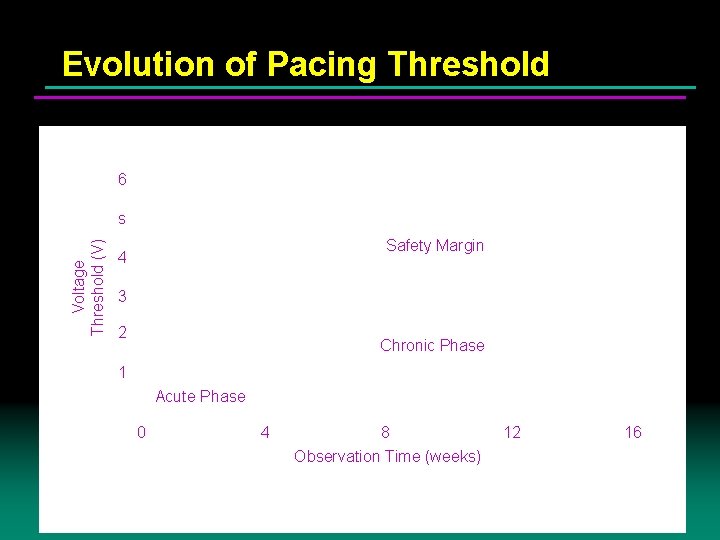
Evolution of Pacing Threshold 6 Voltage Threshold (V) s Safety Margin 4 3 2 Chronic Phase 1 Acute Phase 0 4 8 Observation Time (weeks) 12 16
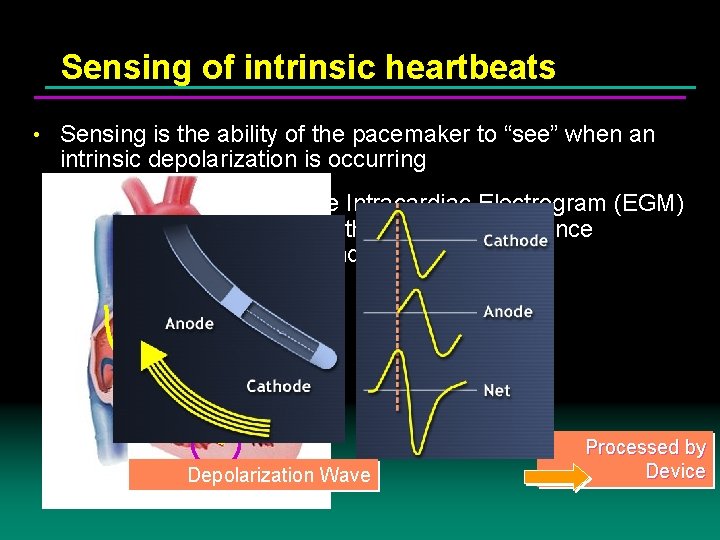
Sensing of intrinsic heartbeats • Sensing is the ability of the pacemaker to “see” when an intrinsic depolarization is occurring – Pacemakers record the Intracardiac Electrogram (EGM) by constantly recording the potential difference between the cathode and anode Depolarization Wave Processed by Device
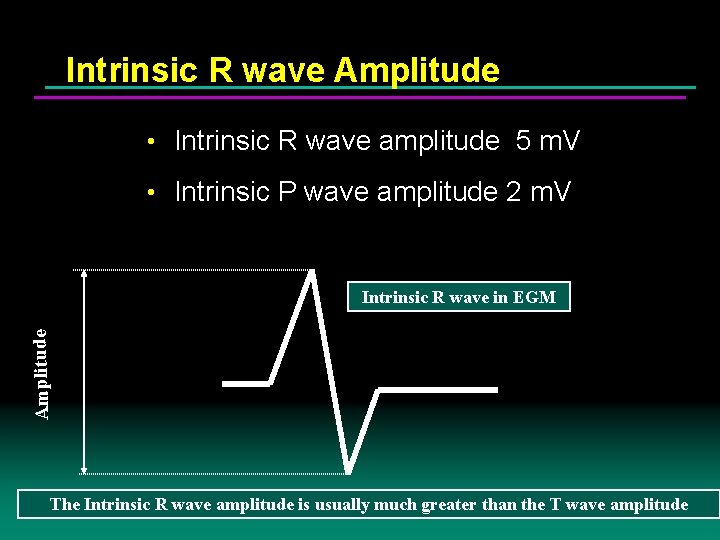
Intrinsic R wave Amplitude • Intrinsic R wave amplitude 5 m. V • Intrinsic P wave amplitude 2 m. V Amplitude Intrinsic R wave in EGM The Intrinsic R wave amplitude is usually much greater than the T wave amplitude
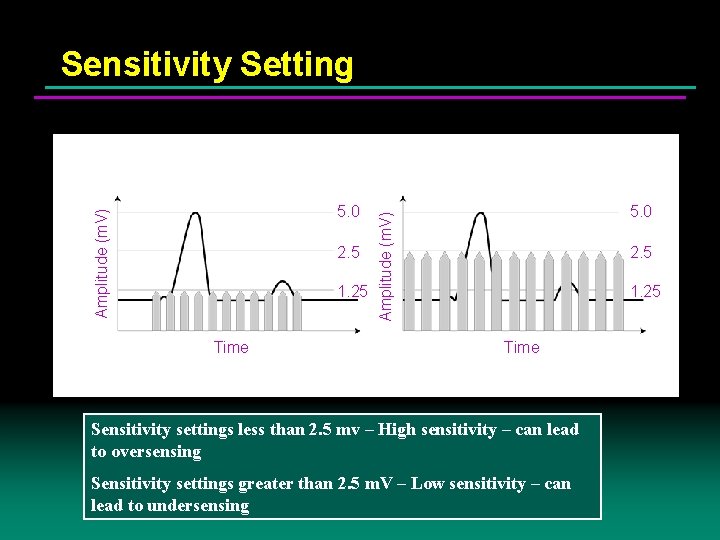
Sensitivity Setting 2. 5 1. 25 Time 5. 0 Amplitude (m. V) 5. 0 2. 5 1. 25 Time Sensitivity settings less than 2. 5 mv – High sensitivity – can lead to oversensing Sensitivity settings greater than 2. 5 m. V – Low sensitivity – can lead to undersensing
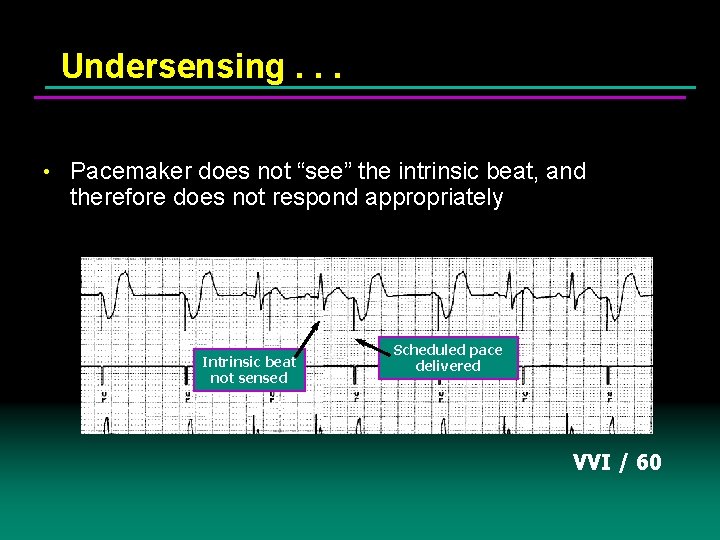
Undersensing. . . • Pacemaker does not “see” the intrinsic beat, and therefore does not respond appropriately Intrinsic beat not sensed Scheduled pace delivered VVI / 60
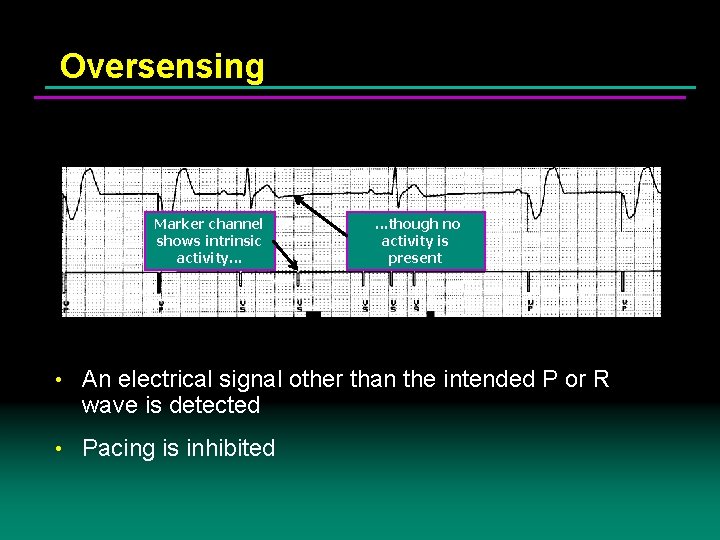
Oversensing Marker channel shows intrinsic activity. . . though no activity is present • An electrical signal other than the intended P or R wave is detected • Pacing is inhibited
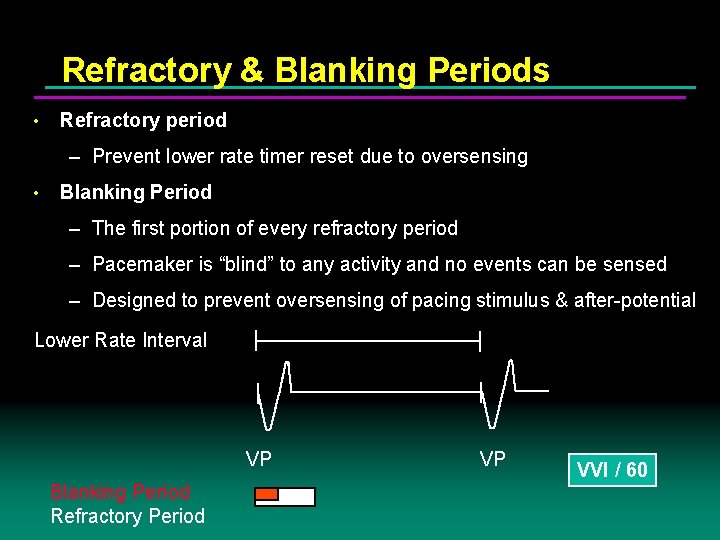
Refractory & Blanking Periods • Refractory period – Prevent lower rate timer reset due to oversensing • Blanking Period – The first portion of every refractory period – Pacemaker is “blind” to any activity and no events can be sensed – Designed to prevent oversensing of pacing stimulus & after-potential Lower Rate Interval VP Blanking Period Refractory Period VP VVI / 60
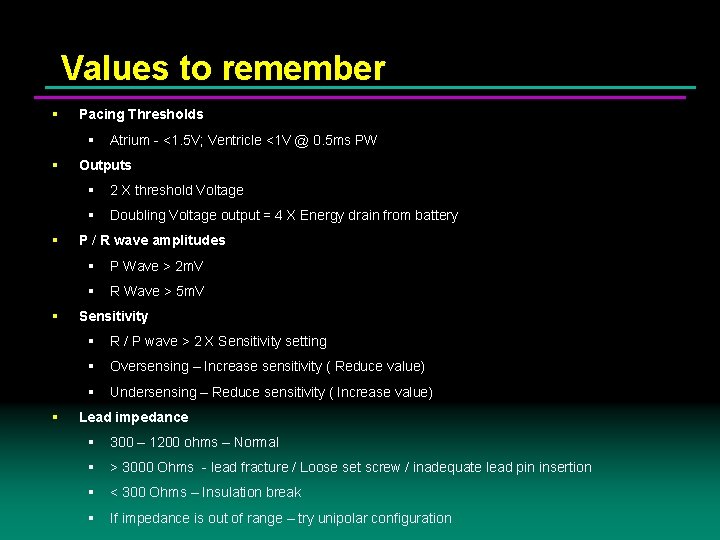
Values to remember § Pacing Thresholds § § § Atrium - <1. 5 V; Ventricle <1 V @ 0. 5 ms PW Outputs § 2 X threshold Voltage § Doubling Voltage output = 4 X Energy drain from battery P / R wave amplitudes § P Wave > 2 m. V § R Wave > 5 m. V Sensitivity § R / P wave > 2 X Sensitivity setting § Oversensing – Increase sensitivity ( Reduce value) § Undersensing – Reduce sensitivity ( Increase value) Lead impedance § 300 – 1200 ohms – Normal § > 3000 Ohms - lead fracture / Loose set screw / inadequate lead pin insertion § < 300 Ohms – Insulation break § If impedance is out of range – try unipolar configuration
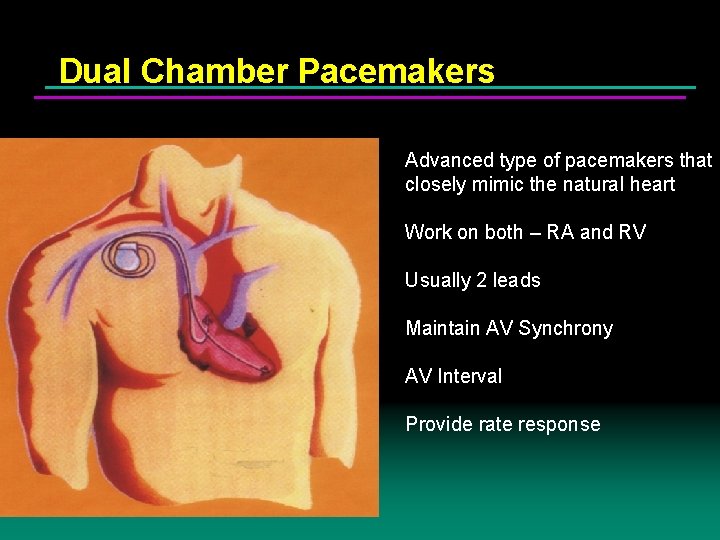
Dual Chamber Pacemakers Advanced type of pacemakers that closely mimic the natural heart Work on both – RA and RV Usually 2 leads Maintain AV Synchrony AV Interval Provide rate response
Dual Chamber Pacemakers • DDD, DDDR – sense & pace both atrium and ventricle • VDD – Sense atrium, pace ventricle

The four faces of dual chamber pacing AV SEQUENTIAL PACING Atrial Pacing Rate – 60, AV Interval – 200 ms AV Synchronous Pacing : NATURAL ATRIAL CONTRACTION & VENTRICULAR PACING : VDD AV Interval = 150 ms Spontaneous Atrial Rate – 55 Spontaneous Atrial Rate – 110
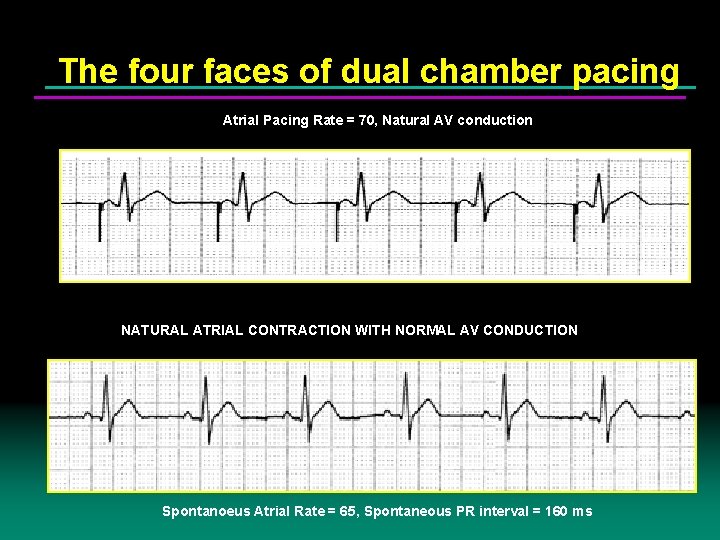
The four faces of dual chamber pacing Atrial Pacing Rate = 70, Natural AV conduction NATURAL ATRIAL CONTRACTION WITH NORMAL AV CONDUCTION Spontanoeus Atrial Rate = 65, Spontaneous PR interval = 160 ms

Thank You
- Slides: 34