
Basics of Optical Imaging in Microlithography A Handson
Basics of Optical Imaging in Microlithography: A "Hands-on" Approach Tom D. Milster (University of Arizona) Robert Socha (ASML) Peter Brooker (SYNOPSYS) Thanks to: • Del Hansen • Phat Lu • Warren Bletscher Milster, Socha, Brooker SPIE- SC 707 1
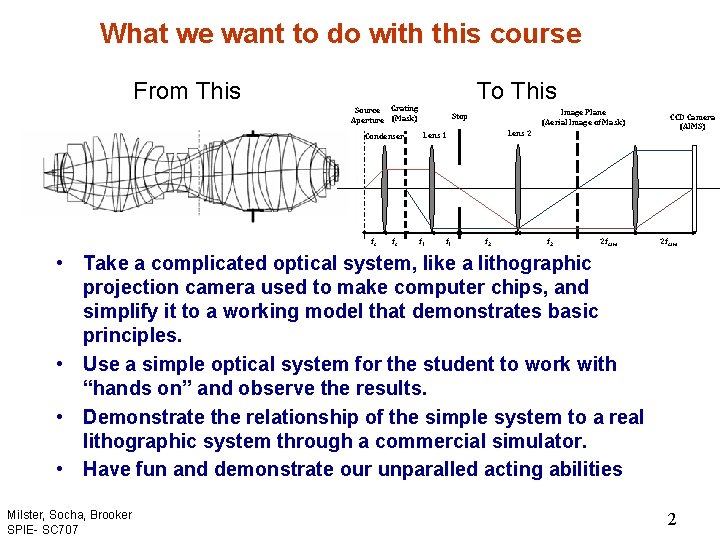
What we want to do with this course From This To This Source Grating Aperture (Mask) Condenser fc fc Image Plane (Aerial Image of Mask) Stop Lens 2 Lens 1 f 1 f 2 2 fcam CCD Camera (AIMS) 2 fcam • Take a complicated optical system, like a lithographic projection camera used to make computer chips, and simplify it to a working model that demonstrates basic principles. • Use a simple optical system for the student to work with “hands on” and observe the results. • Demonstrate the relationship of the simple system to a real lithographic system through a commercial simulator. • Have fun and demonstrate our unparalled acting abilities Milster, Socha, Brooker SPIE- SC 707 2

OUTLINE • Intro – Basic Imaging – What we do in lithography – The goal of making a small image – What limits the size of the image? • Basic Illumination and Imaging – Koehler Illumination – Definition of coherence factor “sigma” • Binary Mask – – • Contrast versus pitch for sigma ~ 0 Contrast versus pitch for sigma > 0 2 -Beam and 3 -Beam Imaging Focus behavior Phase Mask – Contrast versus pitch – Focus behavior • Off-Axis Illumination – Contrast versus pitch – Focus behavior • Summary Milster, Socha, Brooker SPIE- SC 707 3
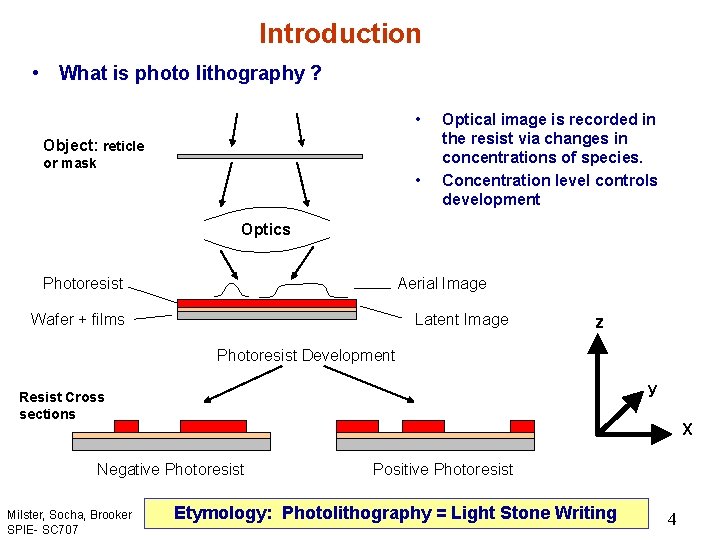
Introduction • What is photo lithography ? • Object: reticle or mask • Optical image is recorded in the resist via changes in concentrations of species. Concentration level controls development Optics Photoresist Aerial Image Wafer + films Latent Image z Photoresist Development y Resist Cross sections X Negative Photoresist Milster, Socha, Brooker SPIE- SC 707 Positive Photoresist Etymology: Photolithography = Light Stone Writing 4
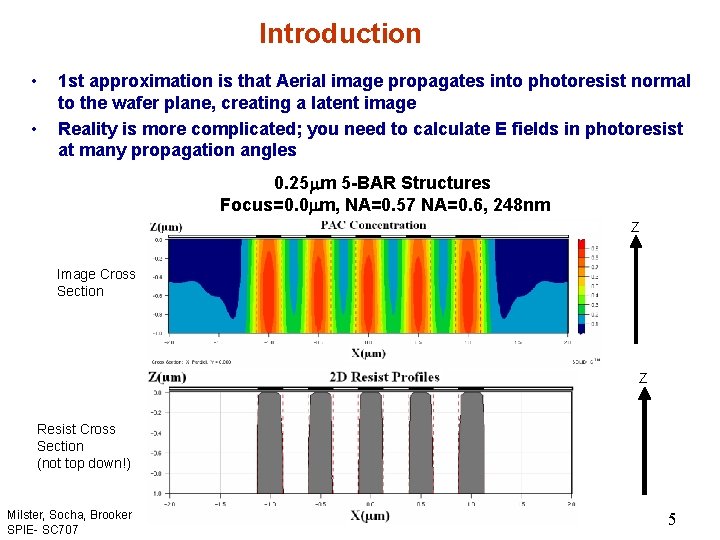
Introduction • • 1 st approximation is that Aerial image propagates into photoresist normal to the wafer plane, creating a latent image Reality is more complicated; you need to calculate E fields in photoresist at many propagation angles 0. 25 mm 5 -BAR Structures Focus=0. 0 mm, NA=0. 57 NA=0. 6, 248 nm Z Image Cross Section Z Resist Cross Section (not top down!) Milster, Socha, Brooker SPIE- SC 707 5
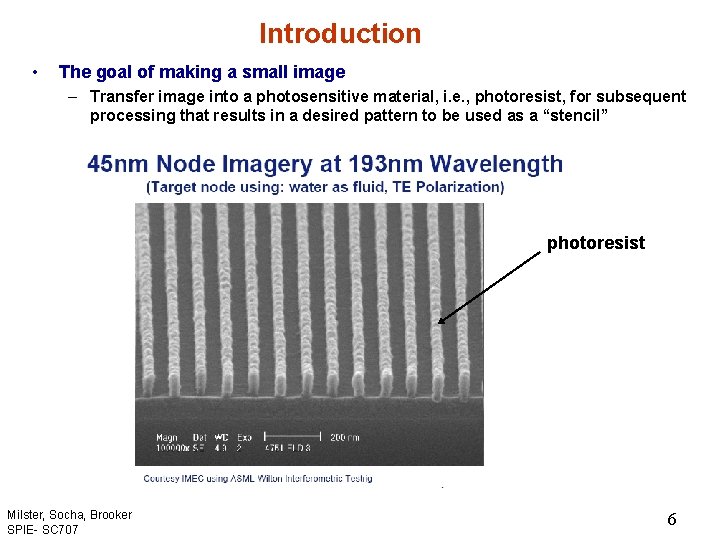
Introduction • The goal of making a small image – Transfer image into a photosensitive material, i. e. , photoresist, for subsequent processing that results in a desired pattern to be used as a “stencil” photoresist Milster, Socha, Brooker SPIE- SC 707 6
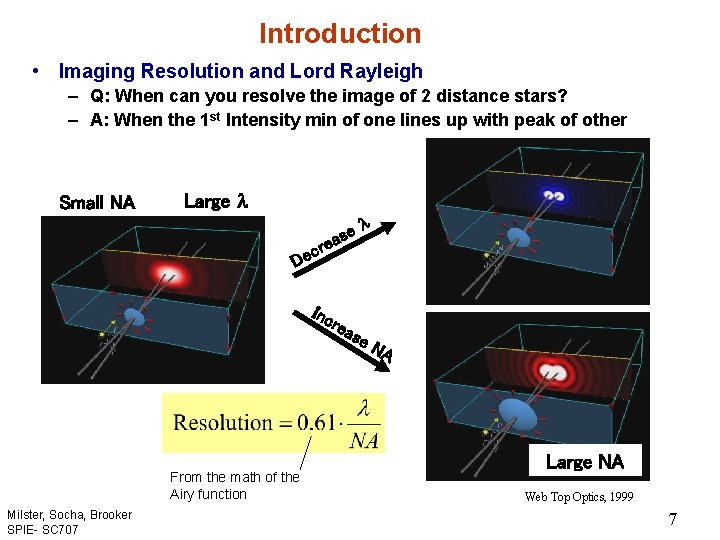
Introduction • Imaging Resolution and Lord Rayleigh – Q: When can you resolve the image of 2 distance stars? – A: When the 1 st Intensity min of one lines up with peak of other Small NA Large l c De se a e r Inc rea l se From the math of the Airy function Milster, Socha, Brooker SPIE- SC 707 NA Large NA Web Top Optics, 1999 7
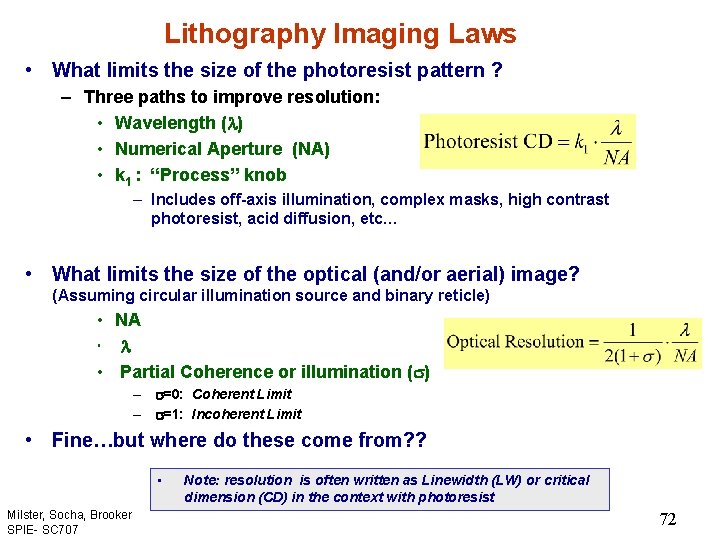
• Oh Master-Litho… • . . what limits the size of the photoresist pattern? • Grasshopper, there are three paths to improve resolution: • Reduce Wavelength (Lambda) • Increase numerical aperture (NA) • Decrease k 1 : “Process” knob – Includes off-axis illumination, complex masks, high contrast photoresist, acid diffusion, etc… • …. now go away Grasshopper I am busy. Milster, Socha, Brooker SPIE- SC 707 8
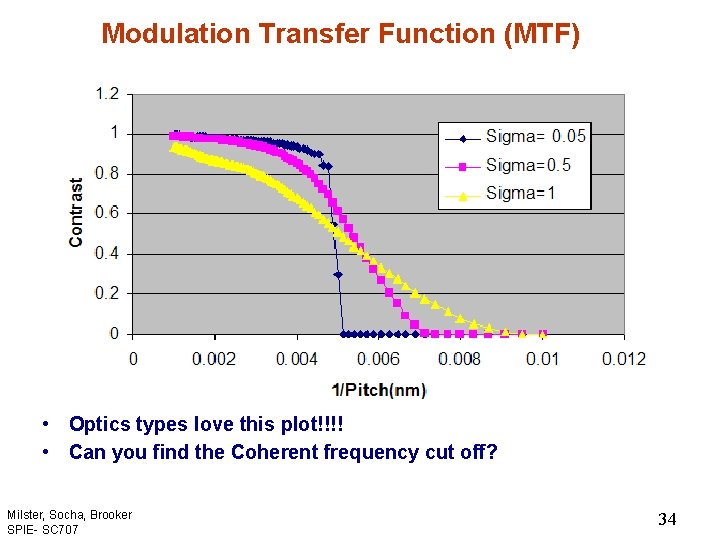
• What is it now Grasshopper… • Master, what affects the contrast of the image? • The answer is found in the values of • NA • CD and Pitch • Partial Coherence or illumination (s) – s=0: Coherent Limit – s=1: Incoherent Limit Milster, Socha, Brooker SPIE- SC 707 9
• You again grasshopper… • Master… • …look at the following data Milster, Socha, Brooker SPIE- SC 707 10
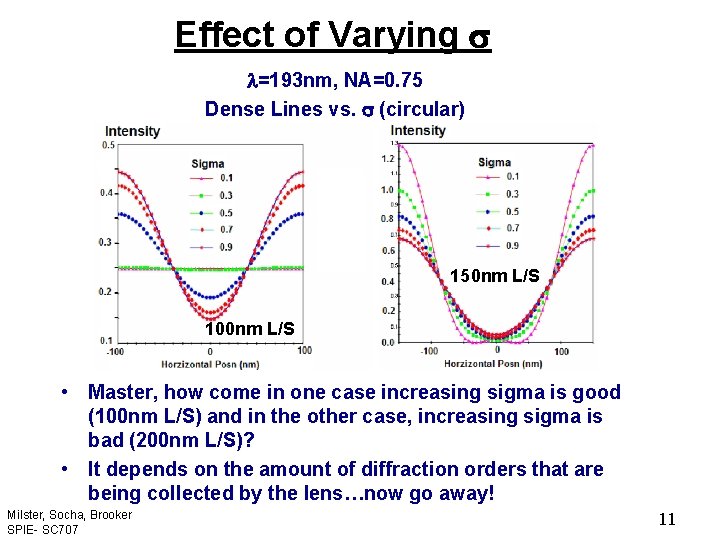
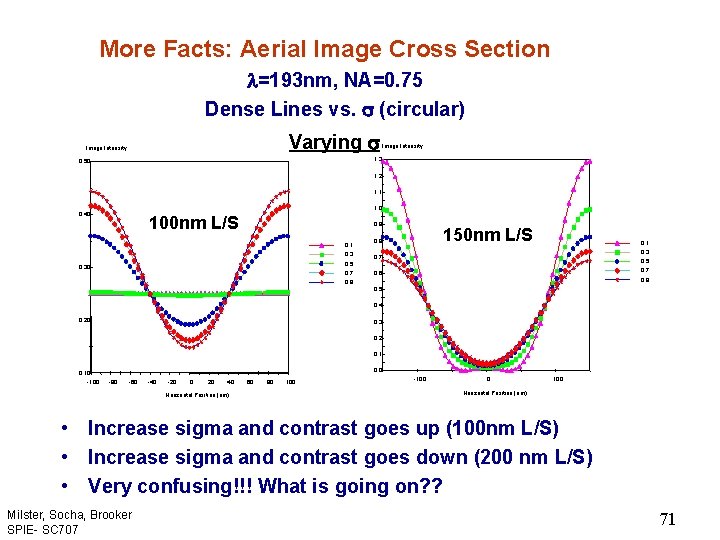
Effect of Varying l=193 nm, NA=0. 75 Dense Lines vs. (circular) 150 nm L/S 100 nm L/S • Master, how come in one case increasing sigma is good (100 nm L/S) and in the other case, increasing sigma is bad (200 nm L/S)? • It depends on the amount of diffraction orders that are being collected by the lens…now go away! Milster, Socha, Brooker SPIE- SC 707 11
• • Master, I am sure that your answers are correct but… …yes Grasshopper… But I find these facts confusing. What is sigma? How can in some cases a larger sigma be good and in other cases a larger sigma be bad? And what the heck is k 1? Master…I do not want only the answers…I want to understand…please help me understand master… Grasshopper… you are finally asking the right question Go to the optical bench now… It holds the answer to your questions!! Milster, Socha, Brooker SPIE- SC 707 12
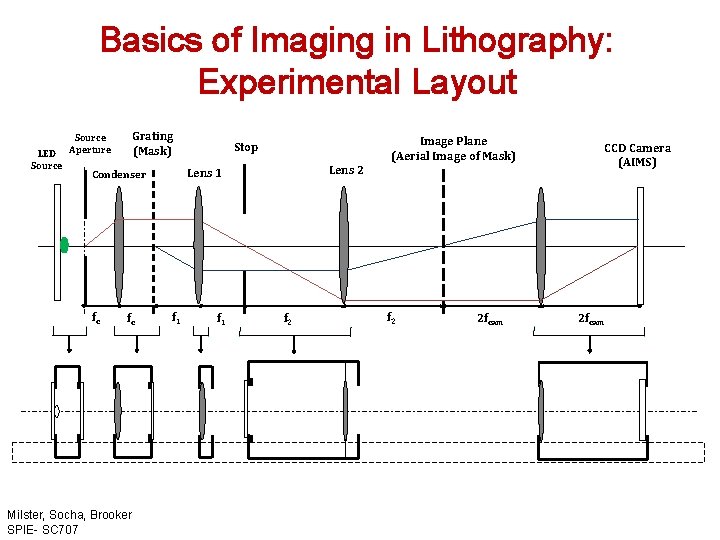
Basics of Imaging in Lithography: Experimental Layout LED Source Aperture Grating (Mask) fc Milster, Socha, Brooker SPIE- SC 707 Lens 2 Lens 1 Condenser fc Stop f 1 f 2 Image Plane (Aerial Image of Mask) f 2 2 fcam CCD Camera (AIMS) 2 fcam
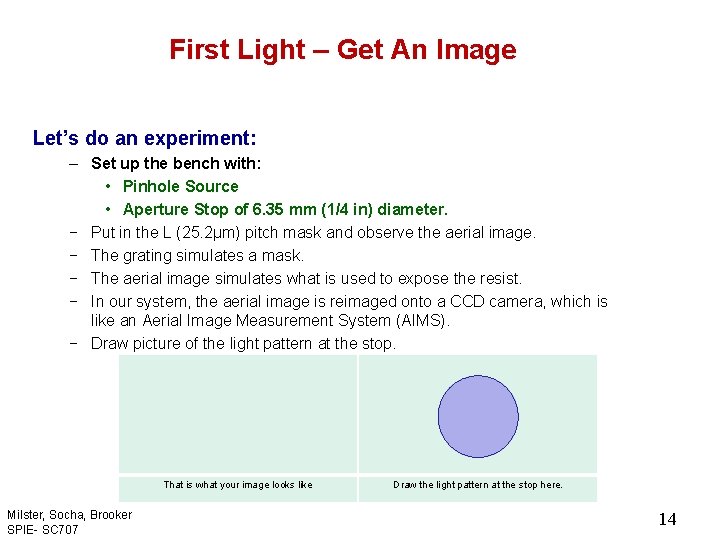
First Light – Get An Image Let’s do an experiment: – Set up the bench with: • Pinhole Source • Aperture Stop of 6. 35 mm (1/4 in) diameter. − Put in the L (25. 2µm) pitch mask and observe the aerial image. − The grating simulates a mask. − The aerial image simulates what is used to expose the resist. − In our system, the aerial image is reimaged onto a CCD camera, which is like an Aerial Image Measurement System (AIMS). − Draw picture of the light pattern at the stop. That is what your image looks like Milster, Socha, Brooker SPIE- SC 707 Draw the light pattern at the stop here. 14
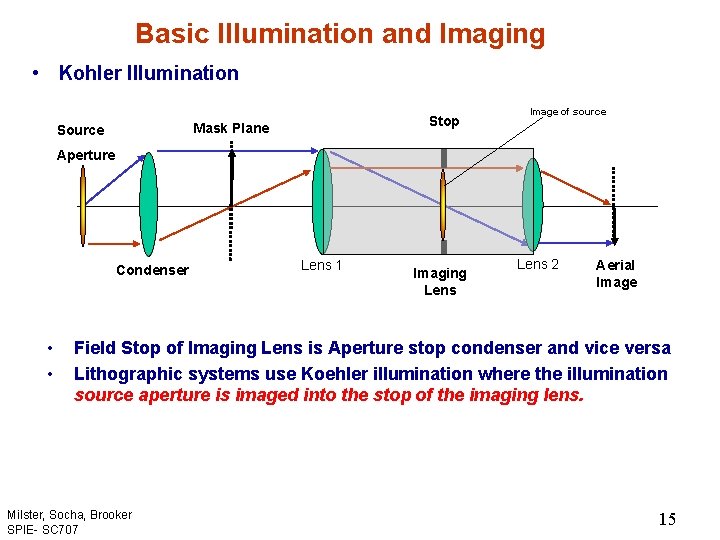
Basic Illumination and Imaging • Kohler Illumination Stop Mask Plane Source Image of source Aperture Condenser • • Lens 1 Imaging Lens 2 Aerial Image Field Stop of Imaging Lens is Aperture stop condenser and vice versa Lithographic systems use Koehler illumination where the illumination source aperture is imaged into the stop of the imaging lens. Milster, Socha, Brooker SPIE- SC 707 15
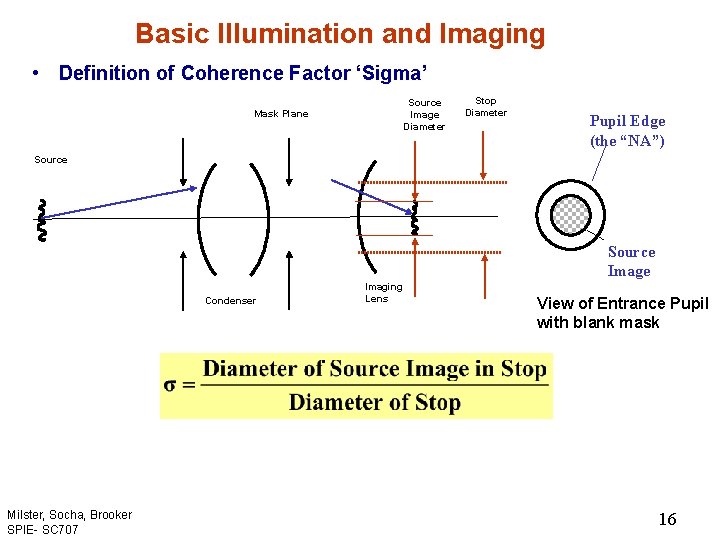
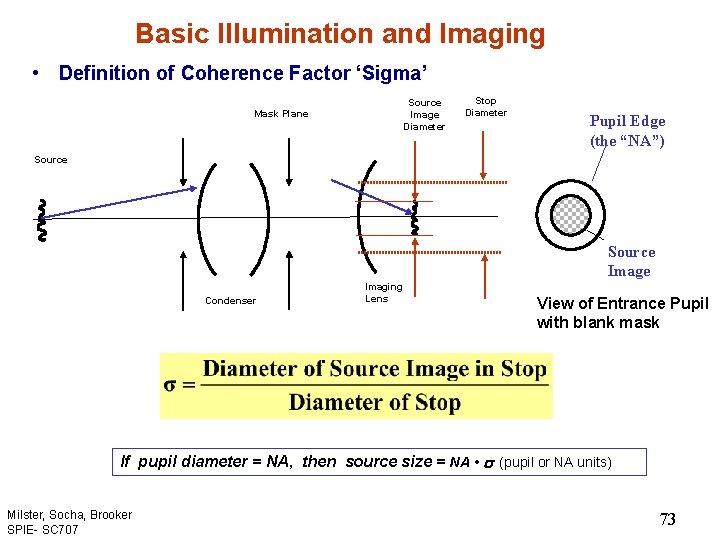
Basic Illumination and Imaging • Definition of Coherence Factor ‘Sigma’ Source Image Diameter Mask Plane Stop Diameter Pupil Edge (the “NA”) Source Image Condenser Milster, Socha, Brooker SPIE- SC 707 Imaging Lens View of Entrance Pupil with blank mask 16
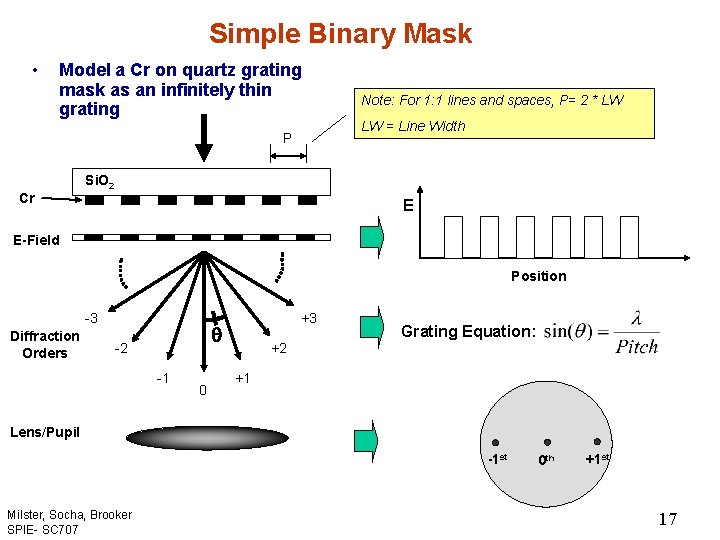
Simple Binary Mask • Model a Cr on quartz grating mask as an infinitely thin grating P Cr Note: For 1: 1 lines and spaces, P= 2 * LW LW = Line Width Si. O 2 E E-Field Position -3 Diffraction Orders +3 q -2 -1 0 Grating Equation: +2 +1 Lens/Pupil -1 st Milster, Socha, Brooker SPIE- SC 707 0 th +1 st 17
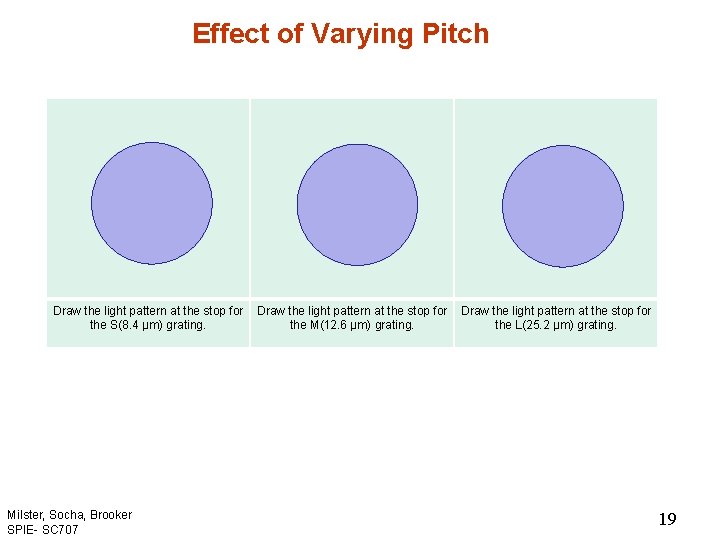
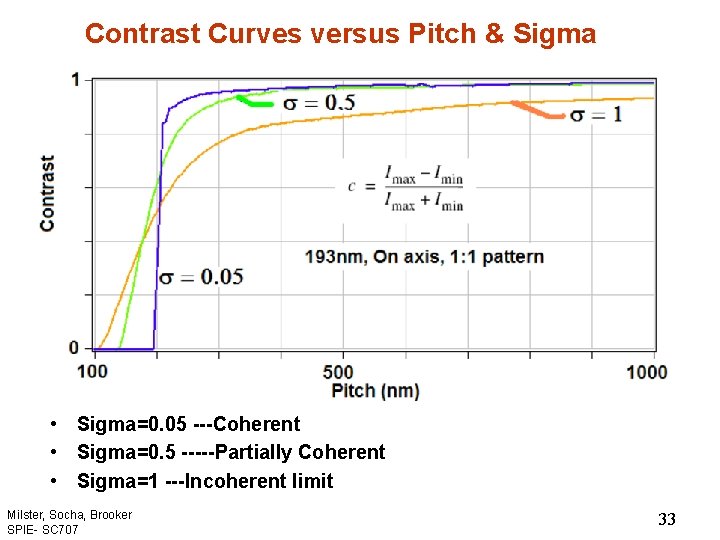
Effect of Varying Pitch • Let’s do an experiment – Set up the bench with: • Pinhole Source • Aperture Stop of 6. 35 mm (1/4 in) diameter. – Use the S(8. 4µm), M(12. 6µm) and L(25. 2µm) pitches of the mask and observe the effects in the image plane and at the stop. – Draw the light pattern at the stop on the next page. – What is the relationship between the light pattern at the stop and the image? – What is the smallest pitch for which we can obtain an image? – This system is very similar to what would be observed if an on-axis laser beam was used to illuminate the mask. Therefore, we call this case coherent imaging. – Notice that the lines in the image are either completely resolved, or they are not. There is no ‘partially resolved’ case. Milster, Socha, Brooker SPIE- SC 707 18
Effect of Varying Pitch Draw the light pattern at the stop for the S(8. 4 µm) grating. Milster, Socha, Brooker SPIE- SC 707 Draw the light pattern at the stop for the M(12. 6 µm) grating. Draw the light pattern at the stop for the L(25. 2 µm) grating. 19
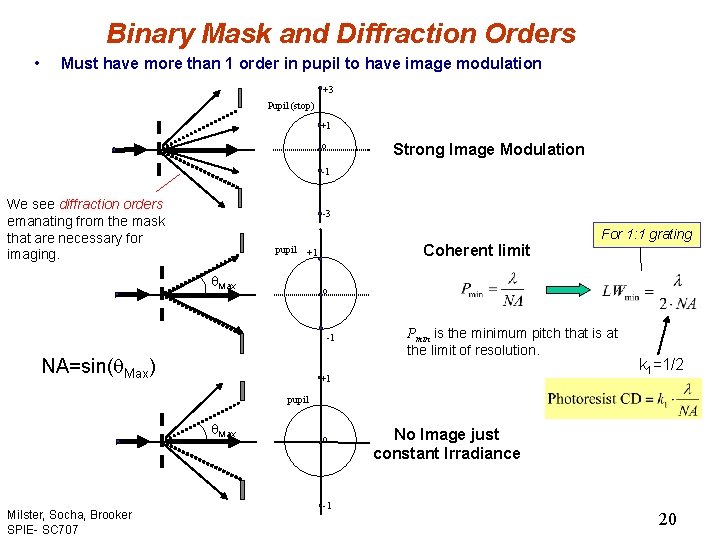
Binary Mask and Diffraction Orders • Must have more than 1 order in pupil to have image modulation +3 Pupil (stop) +1 o Strong Image Modulation -1 We see diffraction orders emanating from the mask that are necessary for imaging. -3 pupil Coherent limit +1 q. Max For 1: 1 grating o -1 NA=sin(q. Max) Pmin is the minimum pitch that is at the limit of resolution. +1 k 1=1/2 pupil q. Max Milster, Socha, Brooker SPIE- SC 707 o -1 No Image just constant Irradiance 20

Coffee Break Milster, Socha, Brooker SPIE- SC 707 21
• Time for the Late Shows new and exciting quiz game sensation. • Do you want to play: – Know your “Current events”? – Know your “Cuts of Beef’? – Know your “Optics Bench Basics”? • Know your Bench Basics! Excellent choice!!! Milster, Socha, Brooker SPIE- SC 707 22
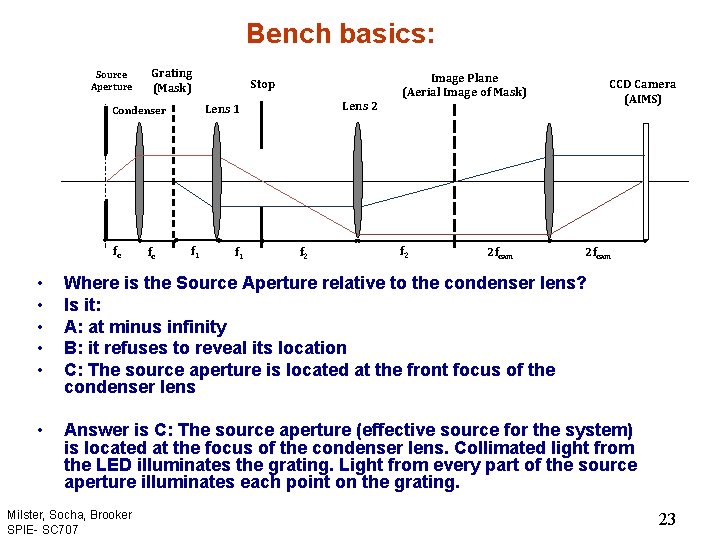
Bench basics: Source Aperture Grating (Mask) fc Lens 2 Lens 1 Condenser fc Stop f 1 f 2 Image Plane (Aerial Image of Mask) f 2 2 fcam CCD Camera (AIMS) 2 fcam • • • Where is the Source Aperture relative to the condenser lens? Is it: A: at minus infinity B: it refuses to reveal its location C: The source aperture is located at the front focus of the condenser lens • Answer is C: The source aperture (effective source for the system) is located at the focus of the condenser lens. Collimated light from the LED illuminates the grating. Light from every part of the source aperture illuminates each point on the grating. Milster, Socha, Brooker SPIE- SC 707 23
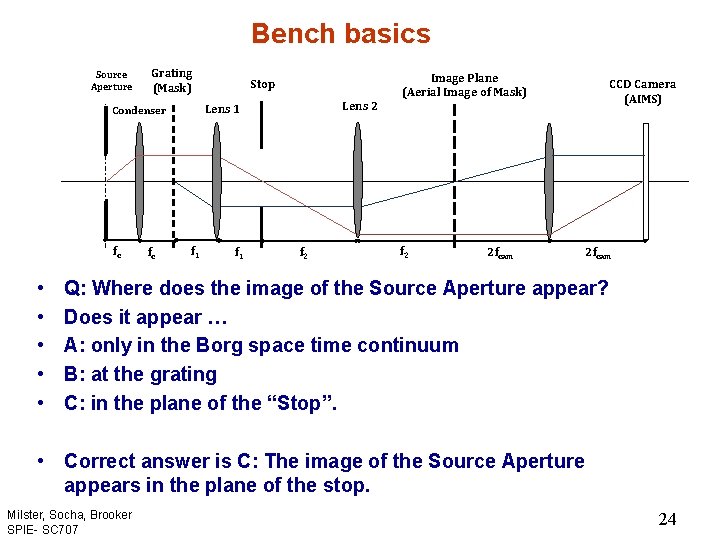
Bench basics Source Aperture Grating (Mask) • • • fc Lens 2 Lens 1 Condenser fc Stop f 1 f 2 Image Plane (Aerial Image of Mask) f 2 2 fcam CCD Camera (AIMS) 2 fcam Q: Where does the image of the Source Aperture appear? Does it appear … A: only in the Borg space time continuum B: at the grating C: in the plane of the “Stop”. • Correct answer is C: The image of the Source Aperture appears in the plane of the stop. Milster, Socha, Brooker SPIE- SC 707 24
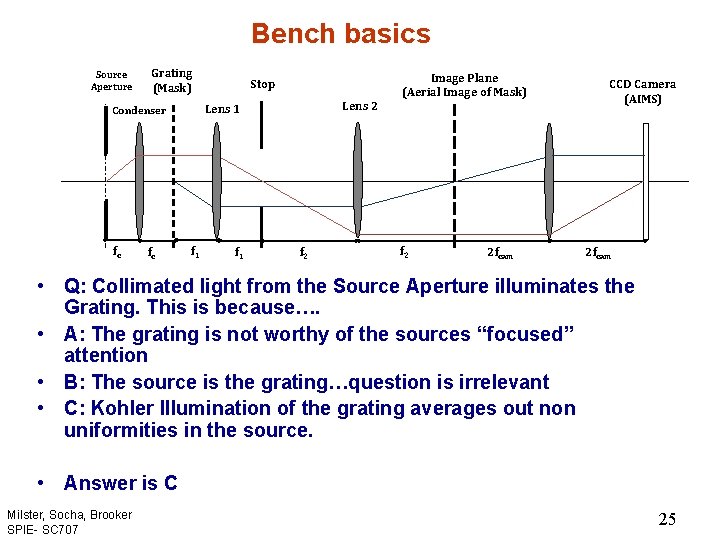
Bench basics Source Aperture Grating (Mask) fc Lens 2 Lens 1 Condenser fc Stop f 1 f 2 Image Plane (Aerial Image of Mask) f 2 2 fcam CCD Camera (AIMS) 2 fcam • Q: Collimated light from the Source Aperture illuminates the Grating. This is because…. • A: The grating is not worthy of the sources “focused” attention • B: The source is the grating…question is irrelevant • C: Kohler Illumination of the grating averages out non uniformities in the source. • Answer is C Milster, Socha, Brooker SPIE- SC 707 25

• Comedy writer’s strike… • No more multiple choice answers • Let’s continue to cement the concepts associated with the bench Milster, Socha, Brooker SPIE- SC 707 26
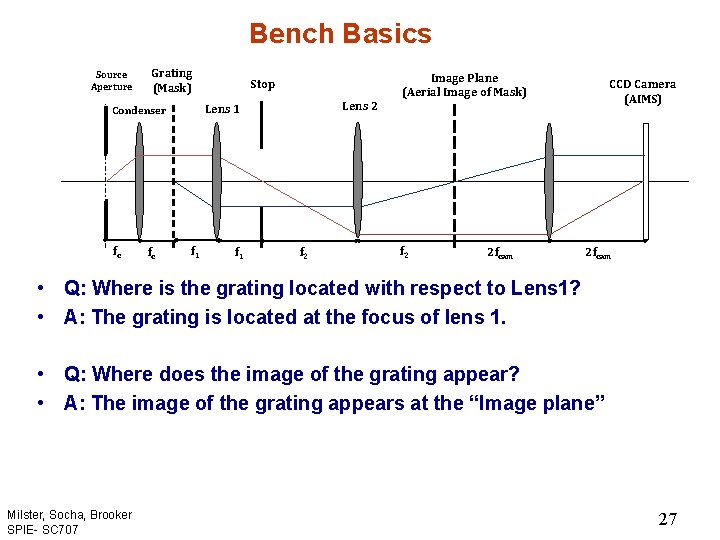
Bench Basics Source Aperture Grating (Mask) fc Lens 2 Lens 1 Condenser fc Stop f 1 f 2 Image Plane (Aerial Image of Mask) f 2 2 fcam CCD Camera (AIMS) 2 fcam • Q: Where is the grating located with respect to Lens 1? • A: The grating is located at the focus of lens 1. • Q: Where does the image of the grating appear? • A: The image of the grating appears at the “Image plane” Milster, Socha, Brooker SPIE- SC 707 27
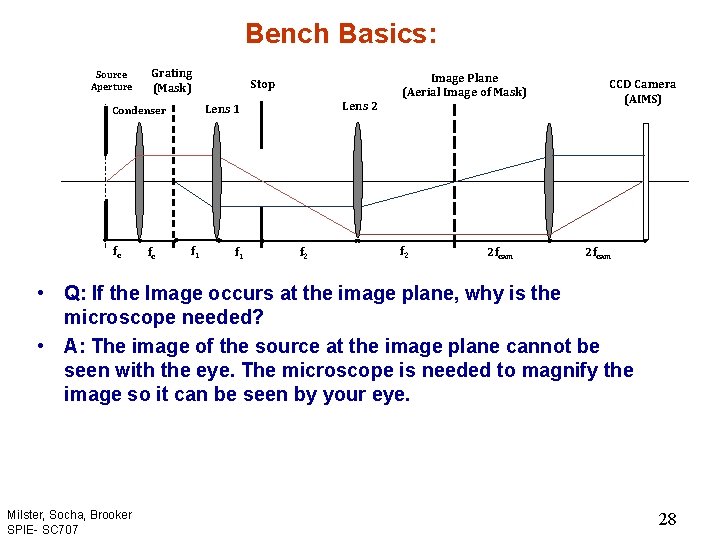
Bench Basics: Source Aperture Grating (Mask) fc Lens 2 Lens 1 Condenser fc Stop f 1 f 2 Image Plane (Aerial Image of Mask) f 2 2 fcam CCD Camera (AIMS) 2 fcam • Q: If the Image occurs at the image plane, why is the microscope needed? • A: The image of the source at the image plane cannot be seen with the eye. The microscope is needed to magnify the image so it can be seen by your eye. Milster, Socha, Brooker SPIE- SC 707 28
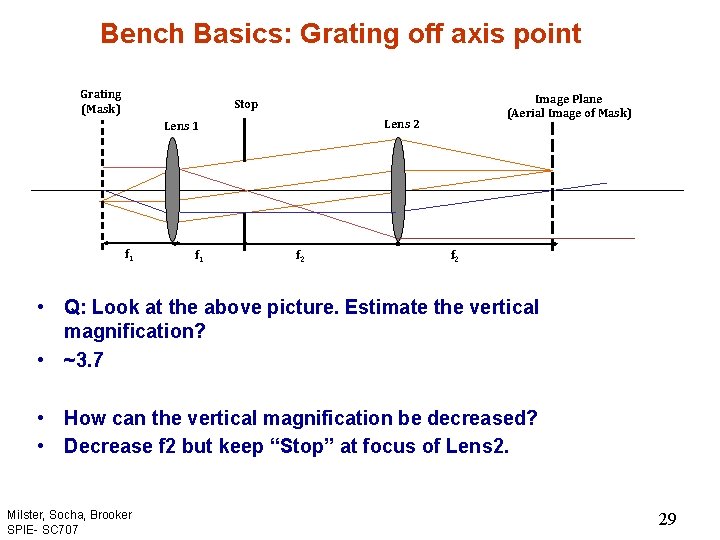
Bench Basics: Grating off axis point Grating (Mask) Image Plane (Aerial Image of Mask) Stop Lens 2 Lens 1 f 1 f 2 • Q: Look at the above picture. Estimate the vertical magnification? • ~3. 7 • How can the vertical magnification be decreased? • Decrease f 2 but keep “Stop” at focus of Lens 2. Milster, Socha, Brooker SPIE- SC 707 29
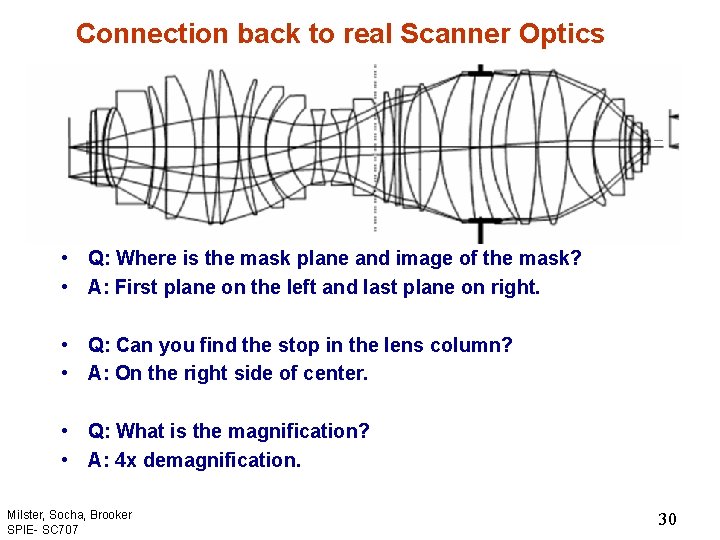
Connection back to real Scanner Optics • Q: Where is the mask plane and image of the mask? • A: First plane on the left and last plane on right. • Q: Can you find the stop in the lens column? • A: On the right side of center. • Q: What is the magnification? • A: 4 x demagnification. Milster, Socha, Brooker SPIE- SC 707 30
Effect of Varying Sigma • Let’s do an experiment – Set up the bench with: • Pinhole Source • Aperture Stop of 6. 35 mm diameter. • S(8. 4µm) grating – Use the PH, 3. 18 mm (1/8 in) and 6. 35 mm (1/4 in) diameter sources and observe the effect at the stop and at the image plane. Estimate for each source. – Draw the light pattern at the stop on the next page. – Is there a point where we can resolve the lines in the image? – By changing , we are allowing more light through the stop that can interfere to form an image. – Not all of the light that is passed through the stop can interfere, thus giving us background light that reduces our contrast. The amount of background light is a function of the pitch, therefore the contrast is a function of the pitch. – This case is called partially coherent imaging, because of the dependence of the contrast on pitch. Milster, Socha, Brooker SPIE- SC 707 31
Effect of Varying Sigma Draw the light pattern at the stop for the PH light source. Milster, Socha, Brooker SPIE- SC 707 Draw the light pattern at the stop for the 3. 18 mm diameter light source. Draw the light pattern at the stop for the 6. 45 mm diameter light source. 32
Contrast Curves versus Pitch & Sigma • Sigma=0. 05 ---Coherent • Sigma=0. 5 -----Partially Coherent • Sigma=1 ---Incoherent limit Milster, Socha, Brooker SPIE- SC 707 33
Modulation Transfer Function (MTF) • Optics types love this plot!!!! • Can you find the Coherent frequency cut off? Milster, Socha, Brooker SPIE- SC 707 34
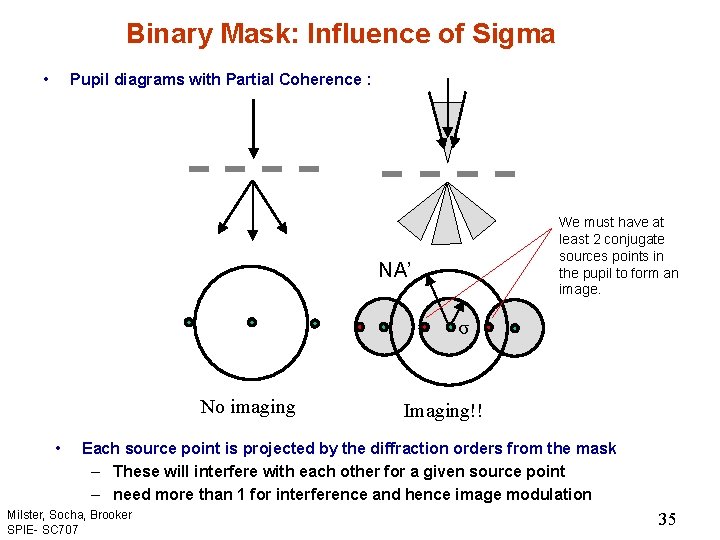
Binary Mask: Influence of Sigma • Pupil diagrams with Partial Coherence : We must have at least 2 conjugate sources points in the pupil to form an image. NA’ σ No imaging • Imaging!! Each source point is projected by the diffraction orders from the mask – These will interfere with each other for a given source point – need more than 1 for interference and hence image modulation Milster, Socha, Brooker SPIE- SC 707 35
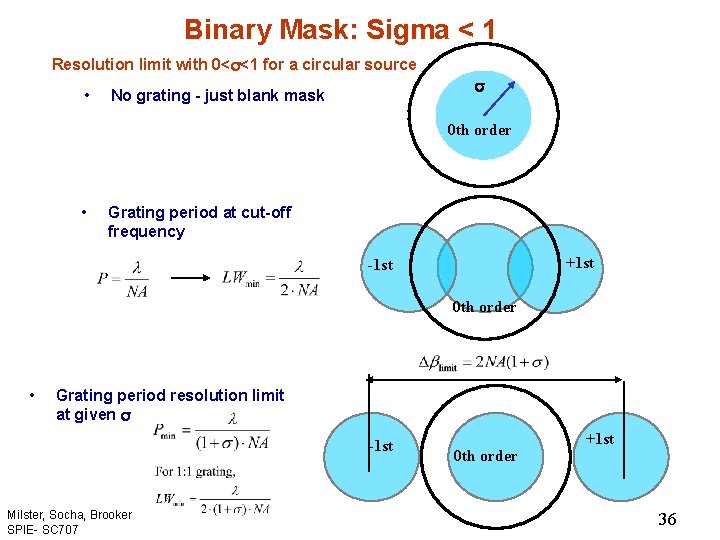
Binary Mask: Sigma < 1 Resolution limit with 0< <1 for a circular source • No grating - just blank mask 0 th order • Grating period at cut-off frequency +1 st -1 st 0 th order • Grating period resolution limit at given -1 st Milster, Socha, Brooker SPIE- SC 707 0 th order +1 st 36
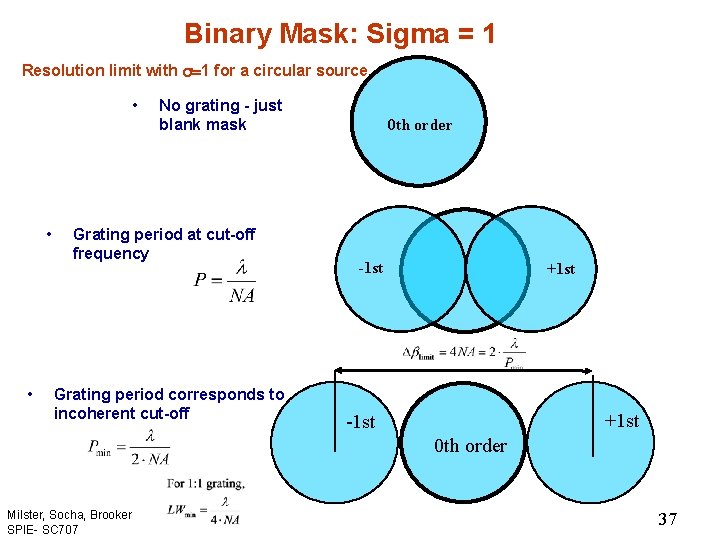
Binary Mask: Sigma = 1 Resolution limit with =1 for a circular source • • • No grating - just blank mask Grating period at cut-off frequency Grating period corresponds to incoherent cut-off 0 th order -1 st +1 st -1 st 0 th order Milster, Socha, Brooker SPIE- SC 707 37
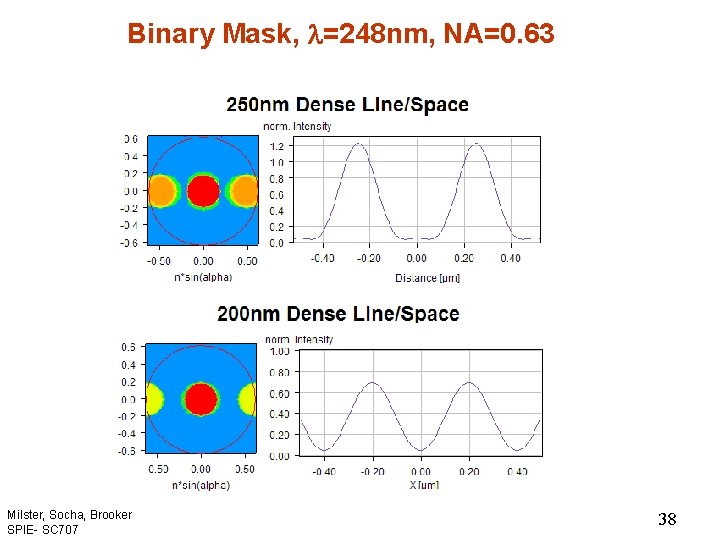
Binary Mask, l=248 nm, NA=0. 63 Milster, Socha, Brooker SPIE- SC 707 38
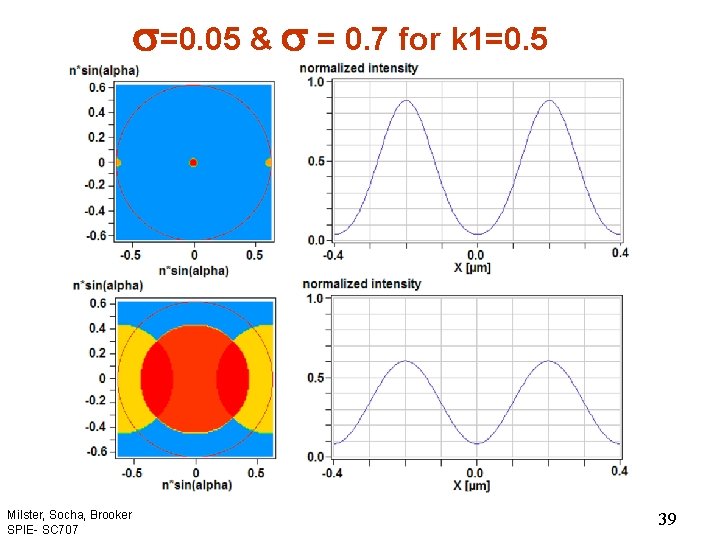
=0. 05 & = 0. 7 for k 1=0. 5 Milster, Socha, Brooker SPIE- SC 707 39
Different cases for on axis, k 1=0. 5 • Assume circular, on axis illumination • Assume dense L/S • k 1=0. 5 – Center of n=1 diffraction orders are at edge of lens – CD = LW = 0. 5*Lambda/NA • For 248 nm illumination, NA=0. 63 – CD = 0. 5*248 nm/0. 63 = 197 nm 200 nm L/S give k 1=0. 5 • For 193 nm illumination, NA=0. 93 – CD = 0. 5*193 nm/0. 93 = 104 nm L/S give k 1=0. 5 • For 193 nm illumination, NA = 1. 2 – CD = 0. 5*193/1. 2 = 80. 4 nm 80 nm L/S gives k 1 = 0. 5 • Results above are only good for on axis illumination. • The usual off-axis case is different. Milster, Socha, Brooker SPIE- SC 707 40
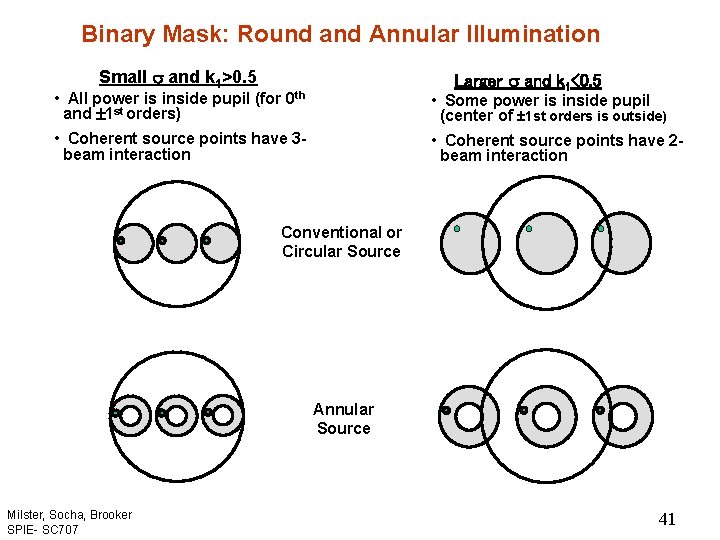
Binary Mask: Round and Annular Illumination Small and k 1>0. 5 • All power is inside pupil (for and 1 st orders) Larger and k 1<0. 5 0 th • Some power is inside pupil (center of 1 st orders is outside) • Coherent source points have 3 beam interaction • Coherent source points have 2 beam interaction Conventional or Circular Source Annular Source Milster, Socha, Brooker SPIE- SC 707 41
Binary Mask: 3 -Beam Imaging • Let’s do an experiment – Set up the bench with: • L(25µm) Pitch grating • PH Source – Observe the behavior (position and contrast) of the image as the observation plane is moved from the perfect focus. Write down your observations. – What happens as the observation plane is moved beyond the point of zero contrast? Milster, Socha, Brooker SPIE- SC 707 42
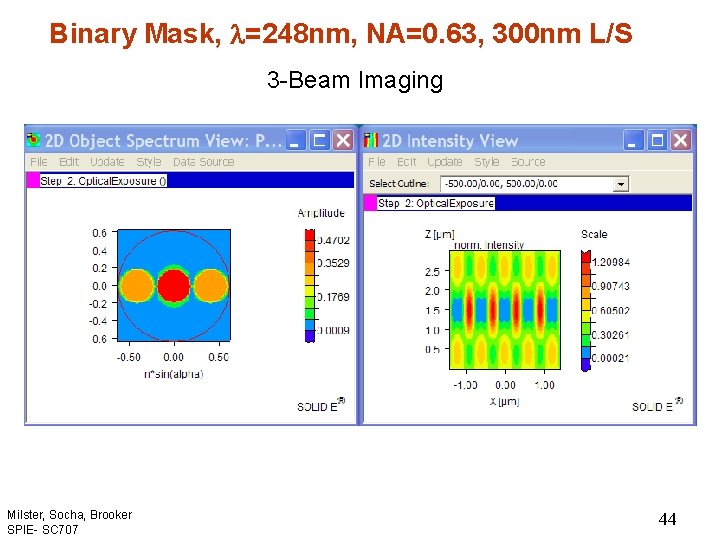
Binary Mask: 3 -Beam Imaging – Do you see reversed-contrast lines? – This type of focus behavior is indicative of three-beam imaging, where all of the power from the 0 and +/- 1 st diffraction orders passes the stop. – Every point in the image is derived from three conjugate source points in the pupil. – Three-beam imaging has the characteristic that reversed-contrast planes can occur if the focus is too far or the resist is too thick. Milster, Socha, Brooker SPIE- SC 707 43
Binary Mask, l=248 nm, NA=0. 63, 300 nm L/S 3 -Beam Imaging Milster, Socha, Brooker SPIE- SC 707 44
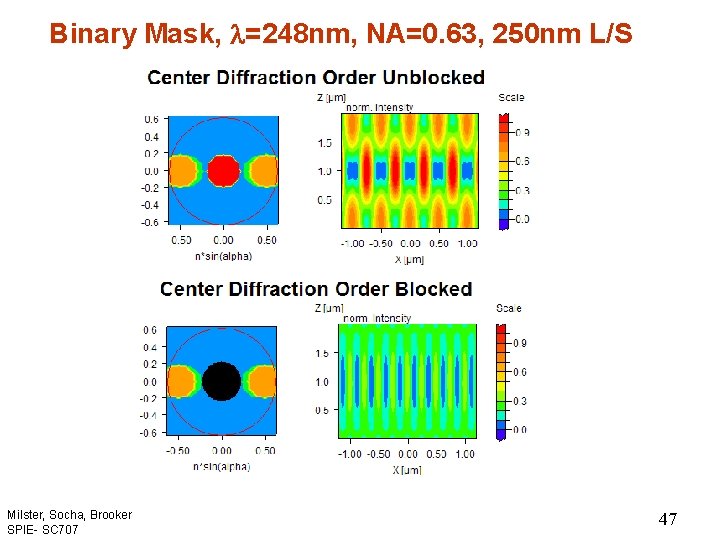
Missing Orders • Let’s do an experiment – Set the bench with • L(25 µm) pitch • PH source – Draw a sketch of the image on the next page. – Block the zero diffraction order at the stop. – Draw a sketch of the image on the next page. – Does the pitch of the image change? – This type of focus behavior is indicative of two-beam imaging. – Every point in the image is derived from two conjugate source points in the pupil, which are widely separated and lead to a double-frequency image. – Now change the system to block either the +1 or -1 order, but let the zero order pass the stop. – Draw a sketch of the image on the next page. – Observe the image pitch and defocus behavior. Write down your observations. Milster, Socha, Brooker SPIE- SC 707 45
Missing Orders L pitch and PH source Milster, Socha, Brooker SPIE- SC 707 Block zero order Block ± 1 order 46
Binary Mask, l=248 nm, NA=0. 63, 250 nm L/S Milster, Socha, Brooker SPIE- SC 707 47
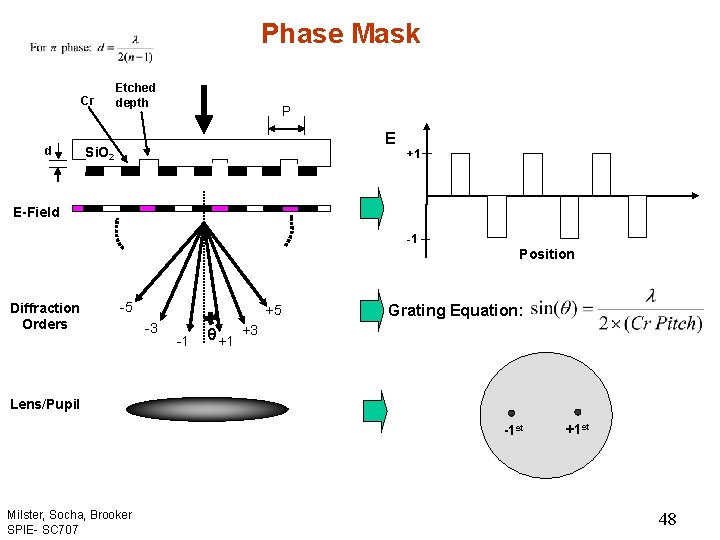
Phase Mask Cr d Etched depth P E Si. O 2 +1 E-Field -1 Position Diffraction Orders -5 +5 -3 -1 Grating Equation: q +1 +3 Lens/Pupil -1 st Milster, Socha, Brooker SPIE- SC 707 +1 st 48
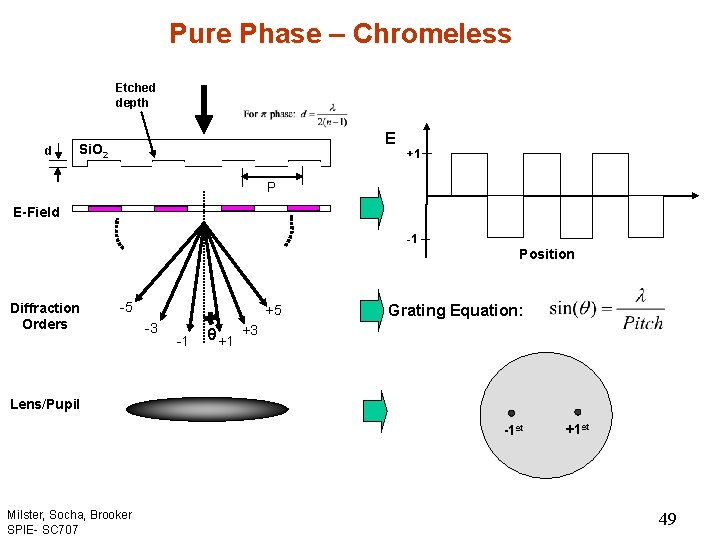
Pure Phase – Chromeless Etched depth d E Si. O 2 +1 P E-Field -1 Position Diffraction Orders -5 +5 -3 -1 Grating Equation: q +1 +3 Lens/Pupil -1 st Milster, Socha, Brooker SPIE- SC 707 +1 st 49
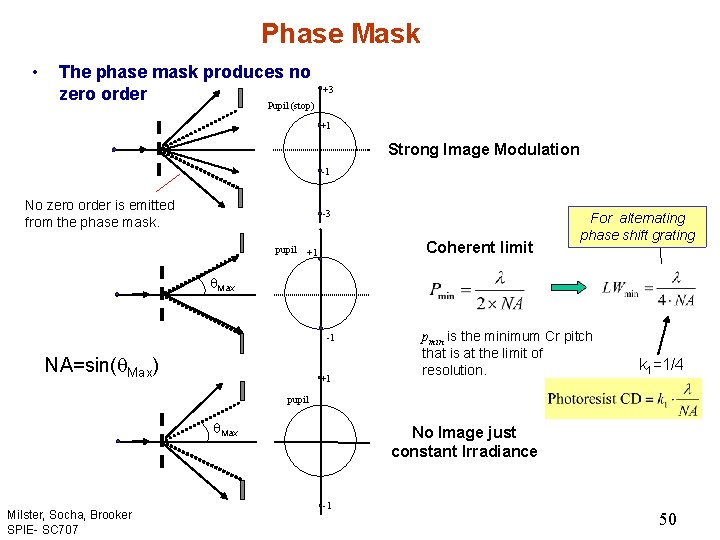
Phase Mask • The phase mask produces no zero order +3 Pupil (stop) +1 Strong Image Modulation -1 No zero order is emitted from the phase mask. -3 pupil Coherent limit +1 For alternating phase shift grating q. Max -1 NA=sin(q. Max) +1 pmin is the minimum Cr pitch that is at the limit of resolution. k 1=1/4 pupil q. Max Milster, Socha, Brooker SPIE- SC 707 No Image just constant Irradiance -1 50
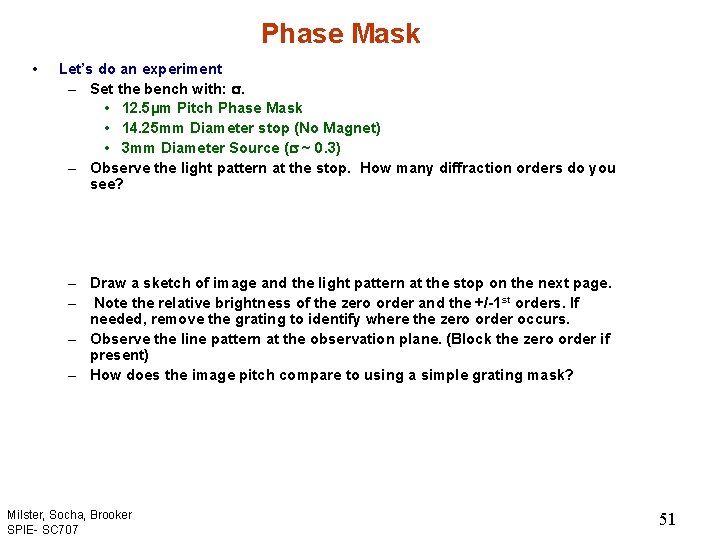
Phase Mask • Let’s do an experiment – Set the bench with: . • 12. 5µm Pitch Phase Mask • 14. 25 mm Diameter stop (No Magnet) • 3 mm Diameter Source ( ~ 0. 3) – Observe the light pattern at the stop. How many diffraction orders do you see? – Draw a sketch of image and the light pattern at the stop on the next page. – Note the relative brightness of the zero order and the +/-1 st orders. If needed, remove the grating to identify where the zero order occurs. – Observe the line pattern at the observation plane. (Block the zero order if present) – How does the image pitch compare to using a simple grating mask? Milster, Socha, Brooker SPIE- SC 707 51
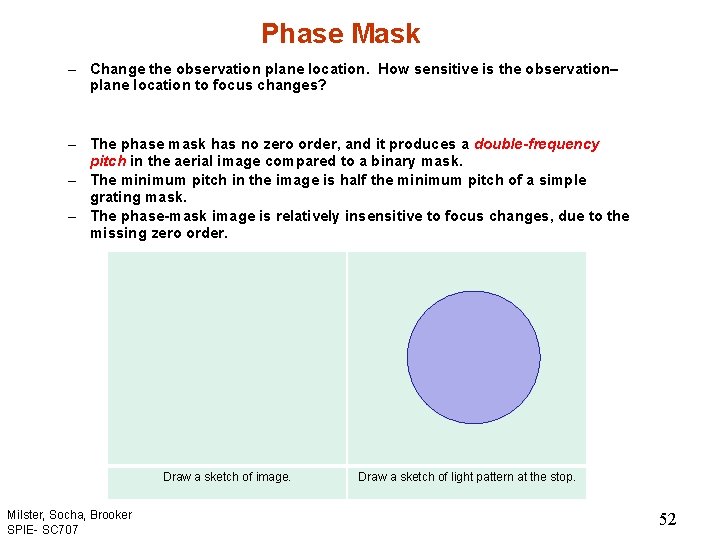
Phase Mask – Change the observation plane location. How sensitive is the observation– plane location to focus changes? – The phase mask has no zero order, and it produces a double-frequency pitch in the aerial image compared to a binary mask. – The minimum pitch in the image is half the minimum pitch of a simple grating mask. – The phase-mask image is relatively insensitive to focus changes, due to the missing zero order. Draw a sketch of image. Milster, Socha, Brooker SPIE- SC 707 Draw a sketch of light pattern at the stop. 52
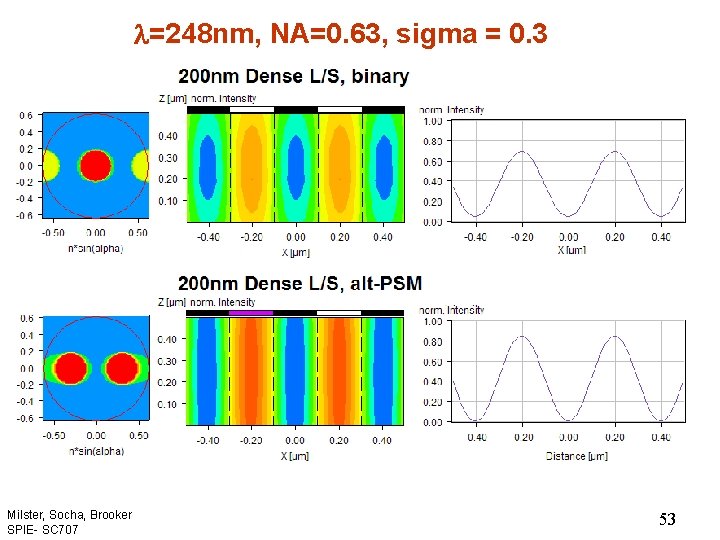
l=248 nm, NA=0. 63, sigma = 0. 3 Milster, Socha, Brooker SPIE- SC 707 53
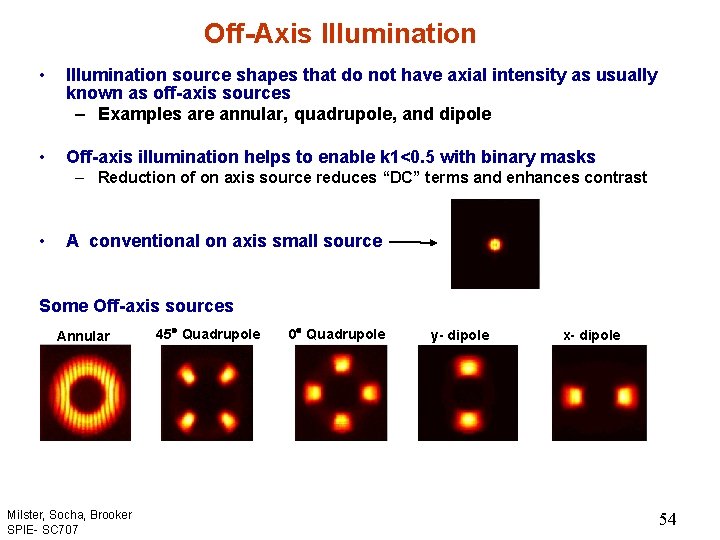
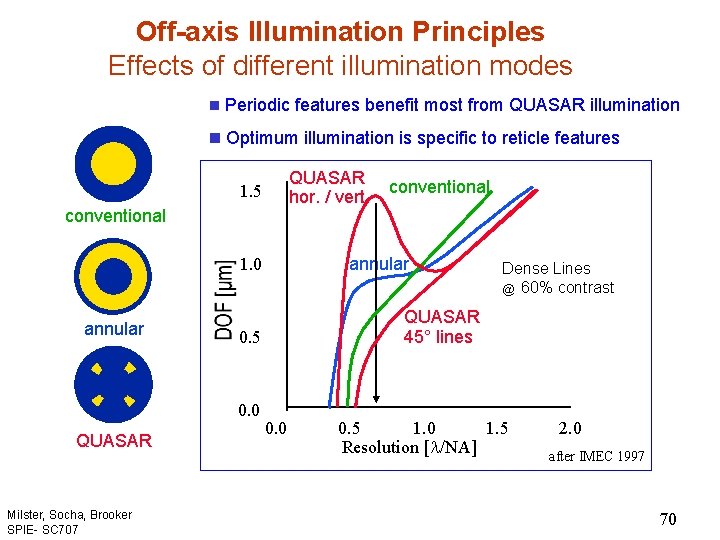
Off-Axis Illumination • Illumination source shapes that do not have axial intensity as usually known as off-axis sources – Examples are annular, quadrupole, and dipole • Off-axis illumination helps to enable k 1<0. 5 with binary masks – Reduction of on axis source reduces “DC” terms and enhances contrast • A conventional on axis small source Some Off-axis sources Annular Milster, Socha, Brooker SPIE- SC 707 45 Quadrupole 0 Quadrupole y- dipole x- dipole 54
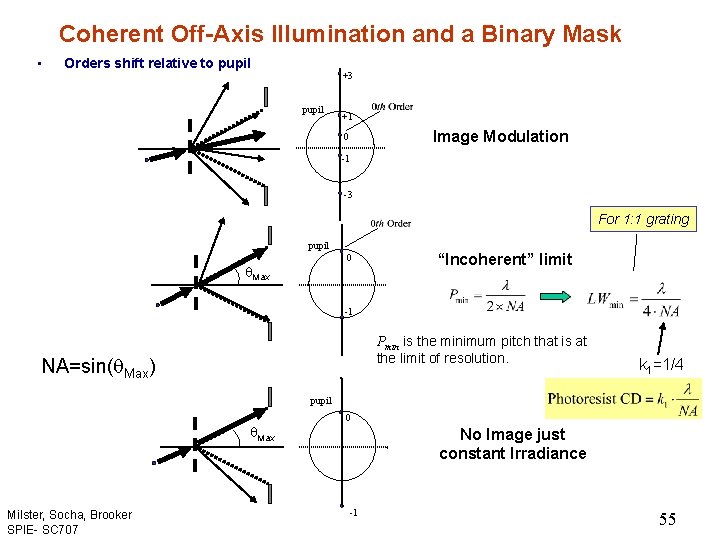
Coherent Off-Axis Illumination and a Binary Mask • Orders shift relative to pupil +3 pupil +1 Image Modulation 0 -1 -3 For 1: 1 grating pupil 0 q. Max “Incoherent” limit -1 Pmin is the minimum pitch that is at the limit of resolution. NA=sin(q. Max) k 1=1/4 pupil 0 q. Max Milster, Socha, Brooker SPIE- SC 707 No Image just constant Irradiance -1 55
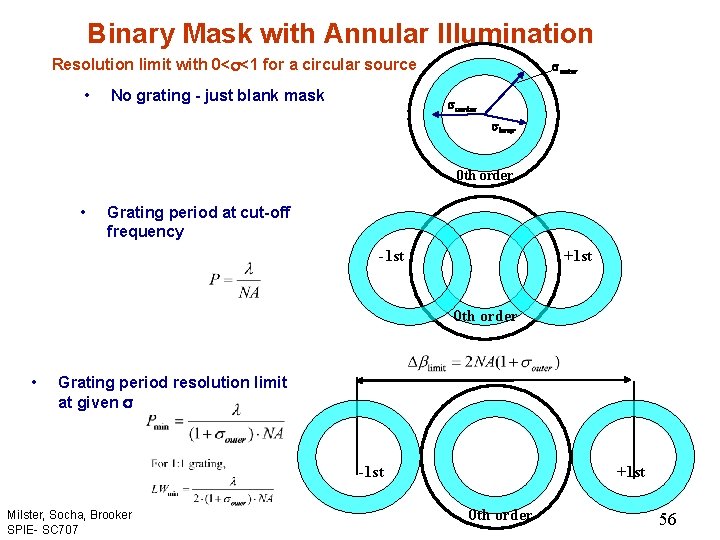
Binary Mask with Annular Illumination Resolution limit with 0< <1 for a circular source • No grating - just blank mask outer center inner 0 th order • Grating period at cut-off frequency -1 st +1 st 0 th order • Grating period resolution limit at given -1 st Milster, Socha, Brooker SPIE- SC 707 +1 st 0 th order 56
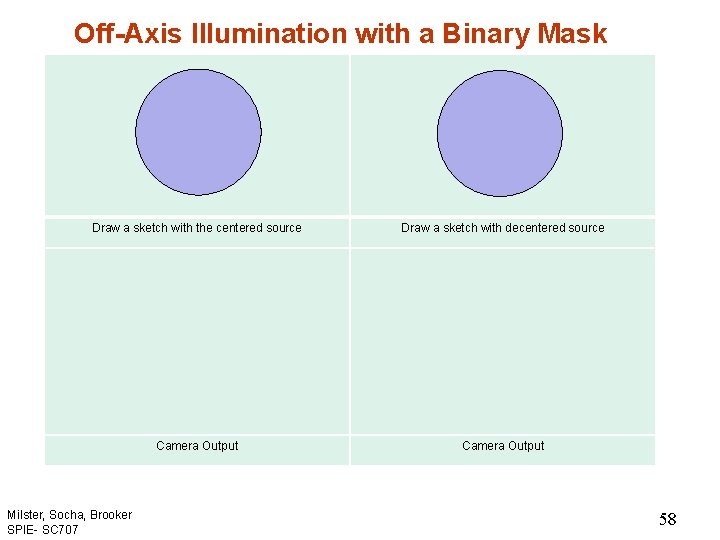
Off-Axis Illumination with a Binary Mask • Let’s do an experiment – Set up the bench with: system for minimum . • S(8. 2µm) pitch mask • PH Source centered on axis – Observe the pattern at the stop. Draw the light pattern at the stop on the next page. – Do you see an image? Sketch the camera output on the next page. – Move the source until at least two orders pass through the stop. Draw the pattern at the stop and the image on the next page. Milster, Socha, Brooker SPIE- SC 707 57
Off-Axis Illumination with a Binary Mask Draw a sketch with the centered source Draw a sketch with decentered source Camera Output Milster, Socha, Brooker SPIE- SC 707 58
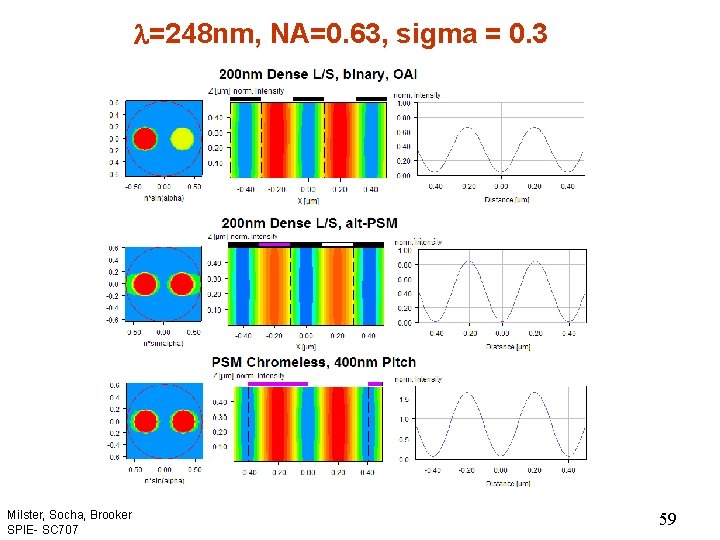
l=248 nm, NA=0. 63, sigma = 0. 3 Milster, Socha, Brooker SPIE- SC 707 59
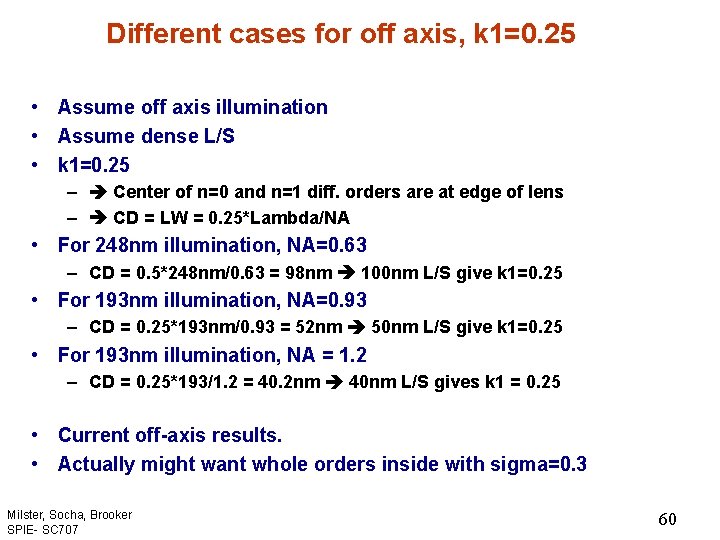
Different cases for off axis, k 1=0. 25 • Assume off axis illumination • Assume dense L/S • k 1=0. 25 – Center of n=0 and n=1 diff. orders are at edge of lens – CD = LW = 0. 25*Lambda/NA • For 248 nm illumination, NA=0. 63 – CD = 0. 5*248 nm/0. 63 = 98 nm 100 nm L/S give k 1=0. 25 • For 193 nm illumination, NA=0. 93 – CD = 0. 25*193 nm/0. 93 = 52 nm 50 nm L/S give k 1=0. 25 • For 193 nm illumination, NA = 1. 2 – CD = 0. 25*193/1. 2 = 40. 2 nm 40 nm L/S gives k 1 = 0. 25 • Current off-axis results. • Actually might want whole orders inside with sigma=0. 3 Milster, Socha, Brooker SPIE- SC 707 60
Summary • What have we learned? – The basic optical components of a lithography system are the source, condenser and imaging lens. – The size and shape of the source influence properties of the aerial image. – The stop of the system determines the maximum angle of diffraction orders that can pass to the image. – It takes at least two diffraction orders passing the stop to form a line-space image. – By increasing , we can change from coherent-like illumination to partially-coherent illumination. – Partially coherent illumination can allow higher pitch in the image at the expense of reduced contrast. – 2 -Beam and 3 -Beam geometries have different focus characteristics. – By using a phase-shift mask, the zero order is eliminated and the first diffraction orders move closer to the center. – Off-axis illumination can produce a half-pitch image, but the contrast is lower than with a phase-shift mask. Milster, Socha, Brooker SPIE- SC 707 61
References Introductory Articles SPIE Proceedings for Microlithography Journal of Microlithography, Microfabrication, and Microsystems (JM 3) – SPIE Press Industry Magazines Microlithography World www. pennwell. com Books Intro to Fourier Optics and Statistical Optics by J. Goodman Resolution Enhancement Techniques and Optical Imaging in Projection Microlithography Alfred Wong, SPIE Press Microlithography: Science and Technology Ed: James Sheats and Bruce Smith Pub: Marcel Dekker Linear Systems by J. Gaskill Milster, Socha, Brooker SPIE- SC 707 62
References Intro Papers “Using location of diffraction orders to predict performance of future scanners”, Peter Brooker Publication: Proc. SPIE Vol. 5256, p. 973 -984, 23 rd BACUS (2003) “Roles of NA, sigma, and lambda in low-k 1 aerial image formation”, Peter D. Brooker Publication: Proc. SPIE Vol. 4346, p. 1575 -1586, (2001) Advanced Papers U of A Dissertation by Doug Goodman (1979), Stationary Optical Projectors Papers by H. H. Hopkins for partial coherent imaging, Richards and Wolf for high NA Milster, Socha, Brooker SPIE- SC 707 63

Thank You for Taking This Course! Milster, Socha, Brooker SPIE- SC 707 64

Backup Slides Milster, Socha, Brooker SPIE- SC 707 65
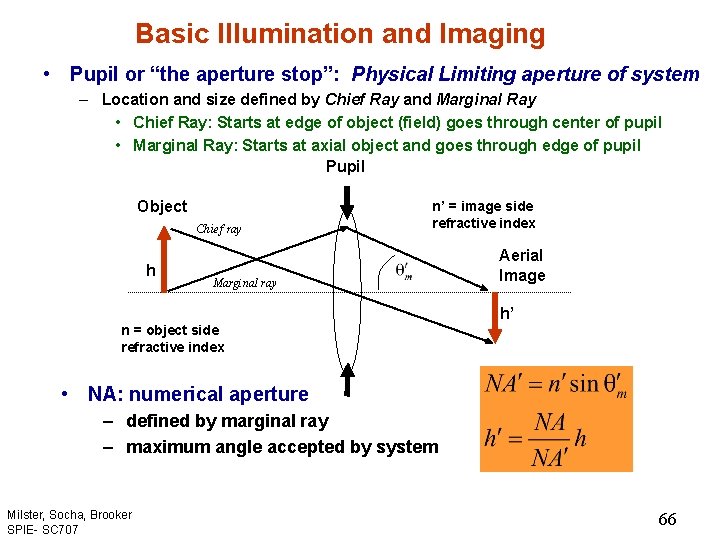
Basic Illumination and Imaging • Pupil or “the aperture stop”: Physical Limiting aperture of system – Location and size defined by Chief Ray and Marginal Ray • Chief Ray: Starts at edge of object (field) goes through center of pupil • Marginal Ray: Starts at axial object and goes through edge of pupil Pupil Object Chief ray h n’ = image side refractive index Marginal ray Aerial Image h’ n = object side refractive index • NA: numerical aperture – defined by marginal ray – maximum angle accepted by system Milster, Socha, Brooker SPIE- SC 707 66
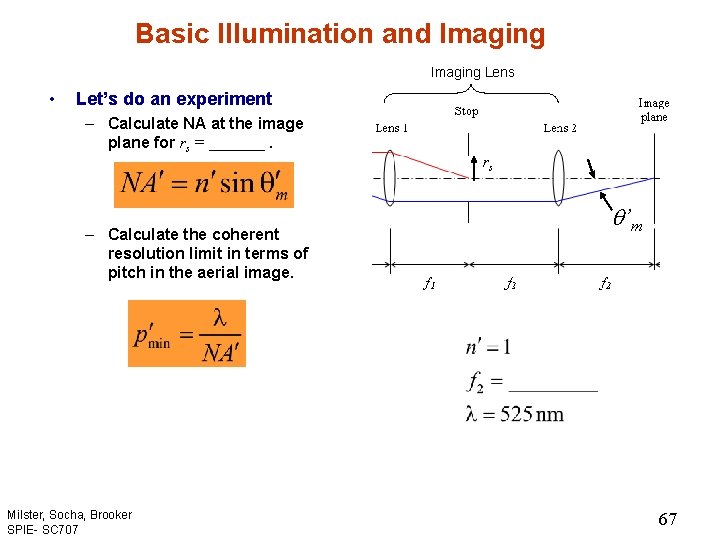
Basic Illumination and Imaging Lens • Let’s do an experiment – Calculate NA at the image plane for rs = _______. – Calculate the coherent resolution limit in terms of pitch in the aerial image. Milster, Socha, Brooker SPIE- SC 707 rs ’m 67
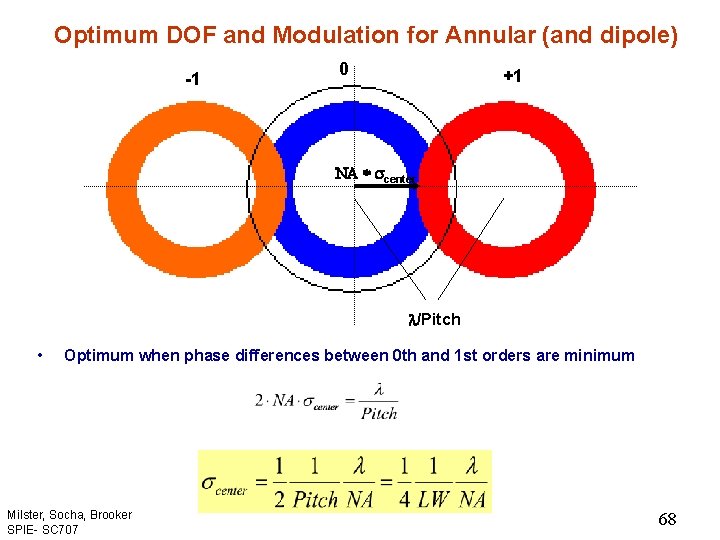
Optimum DOF and Modulation for Annular (and dipole) -1 0 +1 NA * center l/Pitch • Optimum when phase differences between 0 th and 1 st orders are minimum Milster, Socha, Brooker SPIE- SC 707 68
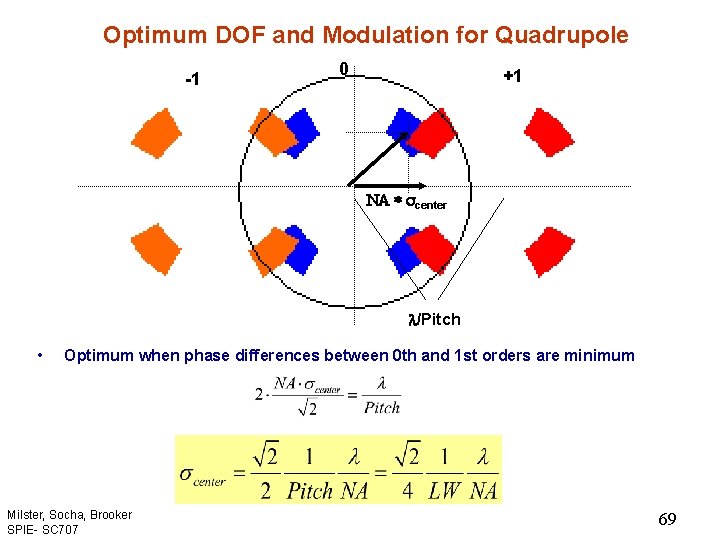
Optimum DOF and Modulation for Quadrupole -1 0 +1 NA * center l/Pitch • Optimum when phase differences between 0 th and 1 st orders are minimum Milster, Socha, Brooker SPIE- SC 707 69
Off-axis Illumination Principles Effects of different illumination modes n Periodic features benefit most from QUASAR illumination n Optimum illumination is specific to reticle features QUASAR hor. / vert. 1. 5 conventional annular 1. 0 annular QUASAR Milster, Socha, Brooker SPIE- SC 707 Dense Lines @ 60% contrast QUASAR 45° lines 0. 5 0. 0 conventional 0. 0 0. 5 1. 0 1. 5 Resolution [ /NA] 2. 0 after IMEC 1997 70
More Facts: Aerial Image Cross Section l=193 nm, NA=0. 75 Dense Lines vs. (circular) Varying Image Intensity 1. 3 0. 50 1. 2 1. 1 1. 0 0. 40 100 nm L/S 0. 9 0. 1 0. 3 150 nm L/S 0. 8 0. 1 0. 3 0. 7 0. 5 0. 30 0. 7 0. 6 0. 9 0. 5 0. 4 0. 20 0. 3 0. 2 0. 1 0. 0 0. 10 -100 -80 -60 -40 -20 0 20 40 Horizontal Position (nm) 60 80 100 -100 0 100 Horizontal Position (nm) • Increase sigma and contrast goes up (100 nm L/S) • Increase sigma and contrast goes down (200 nm L/S) • Very confusing!!! What is going on? ? Milster, Socha, Brooker SPIE- SC 707 71
Lithography Imaging Laws • What limits the size of the photoresist pattern ? – Three paths to improve resolution: • Wavelength (l) • Numerical Aperture (NA) • k 1 : “Process” knob – Includes off-axis illumination, complex masks, high contrast photoresist, acid diffusion, etc… • What limits the size of the optical (and/or aerial) image? (Assuming circular illumination source and binary reticle) • NA • l • Partial Coherence or illumination ( ) – =0: Coherent Limit – =1: Incoherent Limit • Fine…but where do these come from? ? • Milster, Socha, Brooker SPIE- SC 707 Note: resolution is often written as Linewidth (LW) or critical dimension (CD) in the context with photoresist 72
Basic Illumination and Imaging • Definition of Coherence Factor ‘Sigma’ Source Image Diameter Mask Plane Stop Diameter Pupil Edge (the “NA”) Source Image Condenser Imaging Lens View of Entrance Pupil with blank mask If pupil diameter = NA, then source size = NA • s (pupil or NA units) Milster, Socha, Brooker SPIE- SC 707 73
- Slides: 73